Slashdot Mirror
Domain: nasa.gov
Stories and comments across the archive that link to nasa.gov.
Stories · 2,550
-
Flare Sends A Gigaton Of Solar Detritus Toward Earth
Dr. Zowie writes: "This morning at about 10:00 UT, a major explosion occured on the Sun. The solar X-ray output went up by over 1,000 times. About a billion tons of material are speeding toward Earth at over a million miles per hour, and should hit sometime in the next couple of days. Low latitude aurorae and anomalies in radio communications and power service are likely consequences. You can see the event from the SOHO spacecraft's home page -- images and movies are here. In the movies, watch for the burst of radiation hitting SOHO about 13:00 UT -- that's a high energy proton storm caused by the flare itself. You can also see the earthly effects of a similar event from last year." -
Flare Sends A Gigaton Of Solar Detritus Toward Earth
Dr. Zowie writes: "This morning at about 10:00 UT, a major explosion occured on the Sun. The solar X-ray output went up by over 1,000 times. About a billion tons of material are speeding toward Earth at over a million miles per hour, and should hit sometime in the next couple of days. Low latitude aurorae and anomalies in radio communications and power service are likely consequences. You can see the event from the SOHO spacecraft's home page -- images and movies are here. In the movies, watch for the burst of radiation hitting SOHO about 13:00 UT -- that's a high energy proton storm caused by the flare itself. You can also see the earthly effects of a similar event from last year." -
Flare Sends A Gigaton Of Solar Detritus Toward Earth
Dr. Zowie writes: "This morning at about 10:00 UT, a major explosion occured on the Sun. The solar X-ray output went up by over 1,000 times. About a billion tons of material are speeding toward Earth at over a million miles per hour, and should hit sometime in the next couple of days. Low latitude aurorae and anomalies in radio communications and power service are likely consequences. You can see the event from the SOHO spacecraft's home page -- images and movies are here. In the movies, watch for the burst of radiation hitting SOHO about 13:00 UT -- that's a high energy proton storm caused by the flare itself. You can also see the earthly effects of a similar event from last year." -
Deep Space 1 Completes Comet Fly-by
Saint Aardvark writes: "All right...Space.com is reporting here that NASA's Deep Space 1 probe successfully made it through Comet Borrelly -- pretty good for a spacecraft using up the last of its fuel, 'way past its expected lifetime, doing something it wasn't designed to do'. About 30 pix are being downloaded right now, and there's a press conference planned for Tuesday. In the meantime, read NASA's press release here. Way to go, DS-1 and NASA!" -
Deep Space 1 Completes Comet Fly-by
Saint Aardvark writes: "All right...Space.com is reporting here that NASA's Deep Space 1 probe successfully made it through Comet Borrelly -- pretty good for a spacecraft using up the last of its fuel, 'way past its expected lifetime, doing something it wasn't designed to do'. About 30 pix are being downloaded right now, and there's a press conference planned for Tuesday. In the meantime, read NASA's press release here. Way to go, DS-1 and NASA!" -
Beer In Space
Saint Aardvark writes: "Check it out...NASA recently sent up an experiment to see how well beer could be brewed in space. The result? One millilitre of space brew. Can orbital microbrew be far behind?" They've been making great strides since our first Beer in Space article. -
Slashback: Licensure, Restriction, Cometry
Slashback tonight with more on the continuing role of Mitchell Baker with the Mozilla project, flying through comet trails, gaming particulars, and the interesting Microsoft FrontPage EULA forbidding certain types of web pages be made with it.Because not everything is as simple as who signs your paycheck ... cetan writes: "As a follow up to being laid off by AOL from Netscape, Mitchell Baker posted an article on Mozillazine discussing her role within Mozilla.org."
Can you think of a title to help her replace "Chief Lizard Wrangler"? All that wrangling has been a good thing, though, as recent builds make clear. I'd like to suggest "Reptilian Ambassador."
Sometimes, you just have to play. t0qer writes: "This is an update to this story. Originally I said kaillera was a net enabled version of mame, it's actually a free SDK to enable any emulator to have netplay. It was written by Christophe Thibault, of winamp fame. Contrary to some comments that the code was ripped from netmame, it was actually borged from jnetlib which was written by his boss and buddy Justin Frankel. So far kaillera has been adopted by 10 different emulators.
Speaking of games, iphayd writes: "Graeme Devine updated his plan , and released a version of Return to Castle Wolfenstein. While this isn't interesting in itself, he's claiming that he is getting 3x the frame rate on a dual 800 G4 system than his dual P3 800 system."
You shall not convert the news headlines in the MSNBC component into an audio format. MarkedMan writes: "There has been some confusion over Microsoft's Frontpage EULA, with some claiming it prohibited using the software to produce works disparaging Microsoft and some saying it simply prohibited the use of the Frontpage logo on such sites. (The logo restriction actually seemed reasonable to me.) After some searching I found that some versions of the EULA do indeed limit use of the program itself. This from Northwestern University's Microsoft User License: Check out page 2, section 2. http://www.tss.northwestern.edu/select/mspur.pdf"
We have come to terms. bkuhn writes: "The FSF and FSMLabs have an agreement on a GPL-compliant version of the RTLinux Open Patent License. You can read our statement and related press release on the matter."
It's cool to see this sort of conflict work be met and resolved.
Not quite a date with a star. Troodon writes "A brief reminder, JPL and BBCnews report that this Saturday (22/SEP/2001) at 2230 Universal time (3:30 p.m. PDT) Deep Space 1 has a date with the Comet Borrelly"
-
Slashback: Licensure, Restriction, Cometry
Slashback tonight with more on the continuing role of Mitchell Baker with the Mozilla project, flying through comet trails, gaming particulars, and the interesting Microsoft FrontPage EULA forbidding certain types of web pages be made with it.Because not everything is as simple as who signs your paycheck ... cetan writes: "As a follow up to being laid off by AOL from Netscape, Mitchell Baker posted an article on Mozillazine discussing her role within Mozilla.org."
Can you think of a title to help her replace "Chief Lizard Wrangler"? All that wrangling has been a good thing, though, as recent builds make clear. I'd like to suggest "Reptilian Ambassador."
Sometimes, you just have to play. t0qer writes: "This is an update to this story. Originally I said kaillera was a net enabled version of mame, it's actually a free SDK to enable any emulator to have netplay. It was written by Christophe Thibault, of winamp fame. Contrary to some comments that the code was ripped from netmame, it was actually borged from jnetlib which was written by his boss and buddy Justin Frankel. So far kaillera has been adopted by 10 different emulators.
Speaking of games, iphayd writes: "Graeme Devine updated his plan , and released a version of Return to Castle Wolfenstein. While this isn't interesting in itself, he's claiming that he is getting 3x the frame rate on a dual 800 G4 system than his dual P3 800 system."
You shall not convert the news headlines in the MSNBC component into an audio format. MarkedMan writes: "There has been some confusion over Microsoft's Frontpage EULA, with some claiming it prohibited using the software to produce works disparaging Microsoft and some saying it simply prohibited the use of the Frontpage logo on such sites. (The logo restriction actually seemed reasonable to me.) After some searching I found that some versions of the EULA do indeed limit use of the program itself. This from Northwestern University's Microsoft User License: Check out page 2, section 2. http://www.tss.northwestern.edu/select/mspur.pdf"
We have come to terms. bkuhn writes: "The FSF and FSMLabs have an agreement on a GPL-compliant version of the RTLinux Open Patent License. You can read our statement and related press release on the matter."
It's cool to see this sort of conflict work be met and resolved.
Not quite a date with a star. Troodon writes "A brief reminder, JPL and BBCnews report that this Saturday (22/SEP/2001) at 2230 Universal time (3:30 p.m. PDT) Deep Space 1 has a date with the Comet Borrelly"
-
Slashback: Licensure, Restriction, Cometry
Slashback tonight with more on the continuing role of Mitchell Baker with the Mozilla project, flying through comet trails, gaming particulars, and the interesting Microsoft FrontPage EULA forbidding certain types of web pages be made with it.Because not everything is as simple as who signs your paycheck ... cetan writes: "As a follow up to being laid off by AOL from Netscape, Mitchell Baker posted an article on Mozillazine discussing her role within Mozilla.org."
Can you think of a title to help her replace "Chief Lizard Wrangler"? All that wrangling has been a good thing, though, as recent builds make clear. I'd like to suggest "Reptilian Ambassador."
Sometimes, you just have to play. t0qer writes: "This is an update to this story. Originally I said kaillera was a net enabled version of mame, it's actually a free SDK to enable any emulator to have netplay. It was written by Christophe Thibault, of winamp fame. Contrary to some comments that the code was ripped from netmame, it was actually borged from jnetlib which was written by his boss and buddy Justin Frankel. So far kaillera has been adopted by 10 different emulators.
Speaking of games, iphayd writes: "Graeme Devine updated his plan , and released a version of Return to Castle Wolfenstein. While this isn't interesting in itself, he's claiming that he is getting 3x the frame rate on a dual 800 G4 system than his dual P3 800 system."
You shall not convert the news headlines in the MSNBC component into an audio format. MarkedMan writes: "There has been some confusion over Microsoft's Frontpage EULA, with some claiming it prohibited using the software to produce works disparaging Microsoft and some saying it simply prohibited the use of the Frontpage logo on such sites. (The logo restriction actually seemed reasonable to me.) After some searching I found that some versions of the EULA do indeed limit use of the program itself. This from Northwestern University's Microsoft User License: Check out page 2, section 2. http://www.tss.northwestern.edu/select/mspur.pdf"
We have come to terms. bkuhn writes: "The FSF and FSMLabs have an agreement on a GPL-compliant version of the RTLinux Open Patent License. You can read our statement and related press release on the matter."
It's cool to see this sort of conflict work be met and resolved.
Not quite a date with a star. Troodon writes "A brief reminder, JPL and BBCnews report that this Saturday (22/SEP/2001) at 2230 Universal time (3:30 p.m. PDT) Deep Space 1 has a date with the Comet Borrelly"
-
More WTC News
Current WTC happenings: The FBI is searching ISPs with FISA warrants. Architects and civil engineers are starting to speculate on why the towers collapsed. Pictures: NASA, a powerful photoessay, newspaper headlines. Current investigation news: LA Times, NY Times, CNN. They're finally starting to mention casualty figures. Finally, bjb writes: "It isn't the hollywood blockbuster of a story, but I'm a daily reader of Slashdot, and I was on the 38th floor of the WTC 1 building when the first plane hit. Oh, and I was reading Slashdot at the time. You can read about my experience here. It was originally an email that I sent out to friends and family, but I was asked by NPR's Talk of the Nation to make it a web page." -
First Factory Use Of 'Replicator' For Spare Parts
maddogsparky writes: "Over at Spacedaily, there is an article about how a 3D printer was used to fabricate a replacement part in a production environment--the first known case. They've also done some tests in NASA's vomit comet and are planning on a shuttle test for applications on the ISS or Mars trip." -
Boiling Water In Zero G
Dr. Manhattan writes: "NASA has released some movies showing how water boils in microgravity... and it's very different from how it behaves at one G. This has implications for the design of cooling systems in space and perhaps power plants on Earth." -
Lisp as an Alternative to Java
Joseph Dale writes "Lisp as an Alternative to Java is a detailed and well-reasoned study comparing Lisp to Java and C++ in terms of execution time, memory consumption, and developer effort. The author, Erann Gat, was the principal software architect for the Mars Science Microrover, the prototype for the Mars Pathfinder rover." -
Moon and Stars
Water Paradox writes: "The astronomy picture of the day is unusually beautiful today. I check it every day, and today is one of the best I've ever seen, and the large version of the image is detailed enough to make your own poster out of. I know, I know, there's lots of cool images on the 'net. But I thought I'd share this one." -
Moon and Stars
Water Paradox writes: "The astronomy picture of the day is unusually beautiful today. I check it every day, and today is one of the best I've ever seen, and the large version of the image is detailed enough to make your own poster out of. I know, I know, there's lots of cool images on the 'net. But I thought I'd share this one." -
NASA Overcomes 802.11b Wireless Security Flaws
4mn0t1337 writes: "Looks like the people at NASA came up with a "solution" to the weak secrutity in 802.11: Bypass it. From the article: "The team also assumed that all information on the network would be subject to eavesdropping, and that no identification information built into 802.11b could be trusted." So they chose to disable it, and set up an 'off-the-shelf PC running the OpenBSD operating system, an Apache web server, the Internet Software Consortium DHCP server, the IPF firewall software' and just depend on the security in protocols the services use. Moral of the story: Ignore the 802.11 security and just tunnel into our access points ..." -
NASA Overcomes 802.11b Wireless Security Flaws
4mn0t1337 writes: "Looks like the people at NASA came up with a "solution" to the weak secrutity in 802.11: Bypass it. From the article: "The team also assumed that all information on the network would be subject to eavesdropping, and that no identification information built into 802.11b could be trusted." So they chose to disable it, and set up an 'off-the-shelf PC running the OpenBSD operating system, an Apache web server, the Internet Software Consortium DHCP server, the IPF firewall software' and just depend on the security in protocols the services use. Moral of the story: Ignore the 802.11 security and just tunnel into our access points ..." -
Virtual Telescope from Data Mining
Atomic Snarl writes: "The ASTROVIRTEL project is mining a 7 Terabyte archive from NASA, ESA, and others for all things astronomical. One recent discovery is a new Kupier Belt object larger than asteroid Ceres. APOD story here, ESO press release here. They're looking for more research projects, too. Just the thing for all those spare cycles on your G4 Cube... ;-)" -
Scramjet Test Successful
An Anonymous Coward writes: "The Sacramento Bee is running this story about the first powered device to achieve "hypersonic" speeds in the Earth's atmosphere. In a series of DARPA-sponsored tests, at Arnold Air Force Base in Tennessee, a scramjet engine, encased in a titanium projectile, was fired from a 130-foot cannon, at an initial velocity of Mach 7.1. The scramjet's engines then ignited, and the object moved another 260 feet, in just 30 milliseconds, before it came to rest in a series of steel plates designed to halt the flight. Peak acceleration: about 10,000 G's. Elapsed time, including cigarettes & pillowtalk: less than a second. PS: According to this nifty page at NASA, Mach 7.1 is about 5406 MPH, whereas 260 ft, per 0.03 seconds, is about 5909 MPH." -
Spaceballs Could Invade Mars
Byteme writes: "CNN reports giant tethered inflatable balls that are being developed by NASA as a potential alternative to the unsuccessful roving robots. The balls apparently will inflate and deflate to catch favorable wind directs and to stop on location. Not quite the fast, cheap and out-of-control solution... but it could be fun to watch!" I wonder if there are any MPEGs of the test this article talks about -- it sounds pretty fun to watch. -
Politics Kills Spacecraft Launch
Electrawn writes: "Partisan politics became involved in an effort to kill the Triana spacecraft. Triana's mission is to sit in Lagrange 1, a spot between the Sun and Earth and take pictures of Earth as a whole and monitor climate changes. Yahoo has this AP Story on what happened, and also, here is a MSNBC version via the Washington Post. It seems former Presidential candidate Al Gore had something to do with inspiring the space craft, which made it a target for the Republican Congress." -
Geographic Update From Io
We recently learned more about how Earth looks from Space Now, Galileo buzzes a volcano. Gogo Dodo writes: "The Galileo spacecraft will be flying past Jupiter's moon Io (Images here) at an altitude of 124 miles. NASA is hoping that a recently discovered volcanic plume from the volcano Tvashtar will still be there during the flyby as Galileo is set to fly through the top quarter of the volcanic plume. Additional photo of Tvashtar here." -
Geographic Update From Io
We recently learned more about how Earth looks from Space Now, Galileo buzzes a volcano. Gogo Dodo writes: "The Galileo spacecraft will be flying past Jupiter's moon Io (Images here) at an altitude of 124 miles. NASA is hoping that a recently discovered volcanic plume from the volcano Tvashtar will still be there during the flyby as Galileo is set to fly through the top quarter of the volcanic plume. Additional photo of Tvashtar here." -
Geographic Update From Io
We recently learned more about how Earth looks from Space Now, Galileo buzzes a volcano. Gogo Dodo writes: "The Galileo spacecraft will be flying past Jupiter's moon Io (Images here) at an altitude of 124 miles. NASA is hoping that a recently discovered volcanic plume from the volcano Tvashtar will still be there during the flyby as Galileo is set to fly through the top quarter of the volcanic plume. Additional photo of Tvashtar here." -
Geographic Update From Io
We recently learned more about how Earth looks from Space Now, Galileo buzzes a volcano. Gogo Dodo writes: "The Galileo spacecraft will be flying past Jupiter's moon Io (Images here) at an altitude of 124 miles. NASA is hoping that a recently discovered volcanic plume from the volcano Tvashtar will still be there during the flyby as Galileo is set to fly through the top quarter of the volcanic plume. Additional photo of Tvashtar here." -
Geographic Update From Io
We recently learned more about how Earth looks from Space Now, Galileo buzzes a volcano. Gogo Dodo writes: "The Galileo spacecraft will be flying past Jupiter's moon Io (Images here) at an altitude of 124 miles. NASA is hoping that a recently discovered volcanic plume from the volcano Tvashtar will still be there during the flyby as Galileo is set to fly through the top quarter of the volcanic plume. Additional photo of Tvashtar here." -
Geographic Update From Io
We recently learned more about how Earth looks from Space Now, Galileo buzzes a volcano. Gogo Dodo writes: "The Galileo spacecraft will be flying past Jupiter's moon Io (Images here) at an altitude of 124 miles. NASA is hoping that a recently discovered volcanic plume from the volcano Tvashtar will still be there during the flyby as Galileo is set to fly through the top quarter of the volcanic plume. Additional photo of Tvashtar here." -
Shuttle Radar Topography Mission Data
SubtleNuance writes: "This story on Canada.com describes the mission and results of NASA's recent flight to map Earth. The Shuttle trip has provided the most detailed 3D photos of Earth ever released." Some of the images are just astounding. Too bad most of the data isn't available yet. -
Shuttle Radar Topography Mission Data
SubtleNuance writes: "This story on Canada.com describes the mission and results of NASA's recent flight to map Earth. The Shuttle trip has provided the most detailed 3D photos of Earth ever released." Some of the images are just astounding. Too bad most of the data isn't available yet. -
Shuttle Radar Topography Mission Data
SubtleNuance writes: "This story on Canada.com describes the mission and results of NASA's recent flight to map Earth. The Shuttle trip has provided the most detailed 3D photos of Earth ever released." Some of the images are just astounding. Too bad most of the data isn't available yet. -
Shuttle Radar Topography Mission Data
SubtleNuance writes: "This story on Canada.com describes the mission and results of NASA's recent flight to map Earth. The Shuttle trip has provided the most detailed 3D photos of Earth ever released." Some of the images are just astounding. Too bad most of the data isn't available yet. -
Shuttle Radar Topography Mission Data
SubtleNuance writes: "This story on Canada.com describes the mission and results of NASA's recent flight to map Earth. The Shuttle trip has provided the most detailed 3D photos of Earth ever released." Some of the images are just astounding. Too bad most of the data isn't available yet. -
Genesis Mission - Search For Origins
kurros writes "For those who haven't been following the project, the Genesis will finally lift off Monday at 12:36pm EDT. The launch will of course be aired on NASA TV. The Genesis mission is a step towards understanding exactly what the Sun and planets in our system are made up of, and hopefully provide data to help explain its origins." -
X-33 Venture Star Reborn as Space Bomber
Julius Su writes: "The LA Times reports that the Pentagon is interested in developing a "space bomber" that could be used to drop bombs on any Earthly target within 90 minutes of takeoff -- from an altitude of 300,000 feet. At this height, bombs don't need explosives to function. Critics worry about the start of a new arms race in space. Not to worry, Pentagon officials say -- the plane would fly in a suborbital path and would only attack Earth targets. The plane itself would be adapted from the X-33 Venture Star, originally developed at the Skunk Works as a vertical-take-off glider-landing reusable space vehicle." NASA needs to simply glue machine guns to every launch vehicle they have to assure permanent funding. -
Pennsylvania Meteor Report
squiggy writes: "Turns out the scorched corn field in Pennsylvania, and the reports of car sized space rocks hitting the earth were a bit overthe top. Likely, the object was very small, disintegrated before impact, and anything that might have reached the ground intact would have been cold to the touch. The full story is here" -
NASA Developing Space Droids
krez writes: "NASA is developing neat little space-droids to help astronauts in space with their chores. According to the article, these things fly, talk, and 'think.' I dunno about you, but if I could get one to vacuum my apartment I'd be a happy dude." If NASA would sell these as toys (modified for earth gravity, with lots of LEDs), maybe their funding problems would disappear. -
Russian SLBM Launches Solar Sail
Barbarian writes: "CNN reports that a Russian Submarine has launched a rocket containing a solar sail payload sucessfully. The mission is a 30 minute sub-orbital test. space.com has more details on the craft." Our earlier story. Another submitter noted that today is the 25th anniversary of the landing of the Viking 1 Mars probe. JPL has a Mars site, which is not responding as I write this. Maybe the Martians got to it. :) -
Russian SLBM Launches Solar Sail
Barbarian writes: "CNN reports that a Russian Submarine has launched a rocket containing a solar sail payload sucessfully. The mission is a 30 minute sub-orbital test. space.com has more details on the craft." Our earlier story. Another submitter noted that today is the 25th anniversary of the landing of the Viking 1 Mars probe. JPL has a Mars site, which is not responding as I write this. Maybe the Martians got to it. :) -
Mars The Dusty
Buzboy writes: "This could be the largest and longest-lasting dust storm on Mars in the past 25 years. The storm now covers the entire globe and has caused the temperatures to rise by 30 degrees C." -
NASA Sends One Up; DoD Shoots One Down
drbrain writes: "They seem to have succeeded again, their Helios is their first success of a remotely, solar self powered aircraft. Looks kinda weird. They plan to use it for research and the military." Meanwhile, Guppy06 and many others sent in stories about a successful test of the Star Wars missile defense system, which will protect us from all those ballistic missiles that foreign nations don't have and would be silly to use, when you can just drive down from Canada with a suitcase nuke. -
Hotel on the Moon
pythorlh writes: "This site has plans submitted for a hotel on the moon. Interesting solution to the various engineering challenges. Also, Astronomy Picture of the Day has an artists concept." It's an insane cantilevered design that couldn't be built in full-gravity. I look forward to the day when "Low-Gravity Architectonics" is a required course for your B.Arch. -
Japan Tests Reusable Rocket
HobbySpacer writes: "Japan's ISAS (Institute for Space and Aeronautical Science) is testing a sub-orbital rocketship called the Reusable Rocket Vehicle Test (RVT). A video of a recent test flight is available. (Alternate source.) According to Space News, the vertical-takeoff-vertical-landing vehicle was built on an annual budget of $400k and assisted by volunteers from the Japan Rocket Society. The highest flight so far is 25m but the priority is technology development and low-cost operations, i.e. learning to run a rocket vehicle like a jet. Gradually, the flight envelope will be expanded and later more powerful engines and lighter components will be tested." Low budgets, encouraging volunteer participants -- now that's the way to run a space program!"Like the DC-X project, the approach is a throwback to the successful X projects of the 1950s when great progress was made by progressing in small steps with small dedicated teams and modest budgets. (As with the X-15, at least 2 or 3 vehicles should be built because if you don't lose at least one during testing, you aren't pushing hard enough.) Perhaps the U.S. will return to this approach, as well, since the mega, 10 bleeding edge technologies at once, all or nothing approach of the X-33 failed miserably."
-
Japan Tests Reusable Rocket
HobbySpacer writes: "Japan's ISAS (Institute for Space and Aeronautical Science) is testing a sub-orbital rocketship called the Reusable Rocket Vehicle Test (RVT). A video of a recent test flight is available. (Alternate source.) According to Space News, the vertical-takeoff-vertical-landing vehicle was built on an annual budget of $400k and assisted by volunteers from the Japan Rocket Society. The highest flight so far is 25m but the priority is technology development and low-cost operations, i.e. learning to run a rocket vehicle like a jet. Gradually, the flight envelope will be expanded and later more powerful engines and lighter components will be tested." Low budgets, encouraging volunteer participants -- now that's the way to run a space program!"Like the DC-X project, the approach is a throwback to the successful X projects of the 1950s when great progress was made by progressing in small steps with small dedicated teams and modest budgets. (As with the X-15, at least 2 or 3 vehicles should be built because if you don't lose at least one during testing, you aren't pushing hard enough.) Perhaps the U.S. will return to this approach, as well, since the mega, 10 bleeding edge technologies at once, all or nothing approach of the X-33 failed miserably."
-
Japan Tests Reusable Rocket
HobbySpacer writes: "Japan's ISAS (Institute for Space and Aeronautical Science) is testing a sub-orbital rocketship called the Reusable Rocket Vehicle Test (RVT). A video of a recent test flight is available. (Alternate source.) According to Space News, the vertical-takeoff-vertical-landing vehicle was built on an annual budget of $400k and assisted by volunteers from the Japan Rocket Society. The highest flight so far is 25m but the priority is technology development and low-cost operations, i.e. learning to run a rocket vehicle like a jet. Gradually, the flight envelope will be expanded and later more powerful engines and lighter components will be tested." Low budgets, encouraging volunteer participants -- now that's the way to run a space program!"Like the DC-X project, the approach is a throwback to the successful X projects of the 1950s when great progress was made by progressing in small steps with small dedicated teams and modest budgets. (As with the X-15, at least 2 or 3 vehicles should be built because if you don't lose at least one during testing, you aren't pushing hard enough.) Perhaps the U.S. will return to this approach, as well, since the mega, 10 bleeding edge technologies at once, all or nothing approach of the X-33 failed miserably."
-
A Close Encounter Of The Stellar Kind
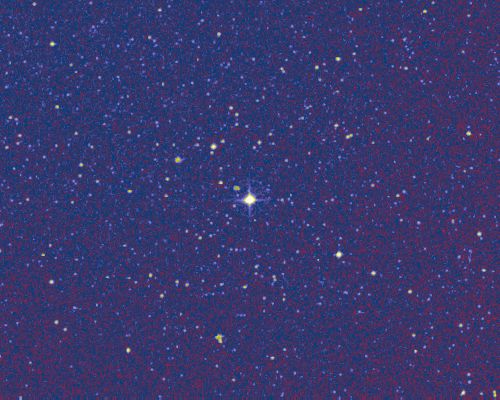
Beowulf_Boy writes "Acording to the APOD on July 7th, The star in this image known as Gliese (Gl) 710 (currently 63 lightyears away), will be only 1 Lightyear from Sol in 1.5 million years. Currently, it is much to faint to be seen by the naked eye, but, in 1,502,000 A.D. it will be at .6 magnitude, rivaling the current bright star of Antares. Although Gliese 710 will not apparently present any major dangers, it could possibly scatter debris out of the Oort cloud, cause many more comets and meteors than usual. This future stellar encounter was discovered by researchers Joan Garcia-Sanchez and Robert Preston (JPL), and collaborators while studying stars in the solar neighborhood using data from the Hipparcos Astrometry Satellite." -
A Close Encounter Of The Stellar Kind
Beowulf_Boy writes "Acording to the APOD on July 7th, The star in this image known as Gliese (Gl) 710 (currently 63 lightyears away), will be only 1 Lightyear from Sol in 1.5 million years. Currently, it is much to faint to be seen by the naked eye, but, in 1,502,000 A.D. it will be at .6 magnitude, rivaling the current bright star of Antares. Although Gliese 710 will not apparently present any major dangers, it could possibly scatter debris out of the Oort cloud, cause many more comets and meteors than usual. This future stellar encounter was discovered by researchers Joan Garcia-Sanchez and Robert Preston (JPL), and collaborators while studying stars in the solar neighborhood using data from the Hipparcos Astrometry Satellite." -
MAP Satellite Launch
PineGreen writes: "Tomorrow, MAP Satellite is to be launched. MAP is the first space mission to measure Cosmic Microwave Background (CMB) fluctuations after the famous COBE who was first to detect fluctuations in the CMB. It is supposed to do the job with an unprecedented accuracy. There were several successful balloon experiments (Boomerang, Maxima) and interferometer experiments (VSA, DASI, CBI), some of which still haven't published their data. But of course, we are all waiting for the big European Planck mission in 2007. Measuring CMB fluctuations can tell us a lot about the universe in which we live, its constituents and its geometrical properties." -
MAP Satellite Launch
PineGreen writes: "Tomorrow, MAP Satellite is to be launched. MAP is the first space mission to measure Cosmic Microwave Background (CMB) fluctuations after the famous COBE who was first to detect fluctuations in the CMB. It is supposed to do the job with an unprecedented accuracy. There were several successful balloon experiments (Boomerang, Maxima) and interferometer experiments (VSA, DASI, CBI), some of which still haven't published their data. But of course, we are all waiting for the big European Planck mission in 2007. Measuring CMB fluctuations can tell us a lot about the universe in which we live, its constituents and its geometrical properties." -
MAP Satellite Launch
PineGreen writes: "Tomorrow, MAP Satellite is to be launched. MAP is the first space mission to measure Cosmic Microwave Background (CMB) fluctuations after the famous COBE who was first to detect fluctuations in the CMB. It is supposed to do the job with an unprecedented accuracy. There were several successful balloon experiments (Boomerang, Maxima) and interferometer experiments (VSA, DASI, CBI), some of which still haven't published their data. But of course, we are all waiting for the big European Planck mission in 2007. Measuring CMB fluctuations can tell us a lot about the universe in which we live, its constituents and its geometrical properties." -
Slashback: Reconciliation, Passportation, Inflation
Tonight, Slashback brings you good news on the Gnome Front, news that's either sobering or annoying on the Passport patrol, and a very useful checklist for those caught outside, simulating space travel, and pretty much alone.Reconciliation among comics and gnomes. CaptainCarrot writes: "In today's Penny Arcade newspost, Tycho continues the discussion on Scott McCloud's piece on micropayments. He has moderated his tone considerably from his original rant on the subject, and offered his apologies for, as he puts it, having misjudged McCloud. During their phone conversations, the two apparently came to some meeting of the minds. Here's yesterdays Slashback on the topic, and the two prior relevant discussions."
On a similar note, in response to the recent story on Gnome losing its 2.0 package maintainer, an Anonymous Coward wrote:"Here's the first chapter in the rest of the story. In short, the guy who quit, returned."
Perhaps they'll be offering student visas. Mike Schiraldi writes: "MSDN users aren't the only ones who have to use Passport. When i bought a Dell computer this January, it came with a "free" (i.e. included in the price of the machine) year of MSN. I went to set up POP, and found out that MSN no longer supports POP for new subscribers. We have to use a secret Passport protocol that only the new Outlook Express can speak. I fought with customer service, and spoke with many levels of tech support, and believe me, they're not budging."
Is this because a Real Doll would be too heavy? Hanford writes: "Looks like this checklist for a simulated Mars mission includes a few comforts from Earth. Check out the last two items. Remember this is from nasa.gov :)"
And since you won't be on camera nearly as much as the astronauts in the various earth-orbiting devices are, this might be more practical than aloft. Remember those vinyl patches, too.