Slashdot Mirror
Domain: nasa.gov
Stories and comments across the archive that link to nasa.gov.
Comments · 16,365
-
Re:Question having RTFA
The nice thing about cut and paste journalism is that it makes it easier to find the original source.
The nice thing about cut and paste journalism is that it makes it easier to find the original source, according to Pyrus.mg
-
Nasa original article
Nasa original article, with better text, 3 Mpixel images and no ads business going on...
-
Lake Victoria
The largest hydroelectric power plant reservoir in the world is actually a natural lake, lake Victoria in Uganda. This lake serves the reservoir for the Nalubaale (formerly Owens Falls) dam.
The large total volume of water and the fact that it's located at the equator makes it the reservoir with most influence on the earth's rotation rate.
-
Re:Death star?
Even better is the thermal map...
-
ARCs Java Pathfinder open source dev since 2005
see http://science.slashdot.org/story/05/04/27/1510204/NASA-Goes-SourceForge
And this was not just a toss-over-the-fence. Most of the projects on http://babelfish.arc.nasa.gov/trac/jpf are actually maintained by external collaborators, and JPF just applied for its 3rd Google Summer of Code participation. With all the domestic and international research collaborations this has been a good success story for NASA. -
Worldwind and Worldwind Java: NASA Open Source
A link to the Java SDK page:
http://worldwind.arc.nasa.gov/java/
Based on at least this project, I think they already get it...
-
Re:Courtesy of the Sun
I was waiting for something to happen after hearing about the massive solar flare yesterday, but nothing this big.
And how is that supposed to work?
Well, I thought this was a more accepted concept than it is, but I guess not.
For your reading pleasure:
Change in magnetic field: an early warning system to understand seismotectonics
Universality in solar flare and earthquake occurrence
Earthquakes, Solar Flares, and Solar Wind Anaylsis
Whether solar flares can trigger earthquakes
Hopefully, that'll shed a bit more light on this growing theory for you. I don't think anyone is saying that every earthquake is caused by CME's, but when you have massive ejections like yesterdays they can certainly contribute to instability in the Earth's magnetic field, which leads to tectonic shifting.
Cheers! -
Re:Develop spacefaring technology first
Mars may not be the best place for humans to go. Mercury for example looks positively inviting in comparison to Mars.
My apologies to throw in some facts on to your dreams, but I wouldn't call Mercury "more inviting".
Atmosphere - 1 nanoPascal (blown away by solar wind), a magnetic field at 1% the terrestrial one => very little protection against hard radiation With an eccetric orbit, the Sun's radiation intensity is between 4.59 and 10.61 times the level on the Earth orbit (on the surface of Mercury, the Sun looks on average almost three times as big as it does from Earth).Not having a significant atmosphere, there are no chances for aero-breaking. The delta-v between the orbital-speed is 18 km/s that need to be lost for reaching a transfer orbit. Even more, a space vehicle will fall into the Sun's gravitational well, requiring another huge delta-v to compensate if you want to avoid a crash-landing - a trip alone (not even landing) to Mercury requires more rocket fuel than to escape the solar system. Solar-sails you say? Heck, how long can one afford to keep a maned space vehicle in a radiation 5-10 times more virulent than on Earth orbit. Bigger shields you say? Errr.... more rocket fuel to escape the Earth gravitation, I ask?
Heck, even if I would be to accept the idea of Mercury being more inviting, I wonder if we currently afford to give course to the invitation. Cost per kilogram of dead matter transported to:
1. the surface of Mars - US$309,000
2. a fly-by followed by orbiting Mercury (but not landing on it) - US$878,000 (Messenger mission cost/spacecraft mass).BTW - the orbital insertion of the Messenger spacecraft around Mercury is expected in about 8 days from now (on March 17, 2011 after 6.5 years from its launch) - fingers crossed.
-
Re:We Need Audio!
-
Re:He also asked the crew of the Discovery...
Have you ever kissed a girl?
...and all of
-
Re:Another drive by hit piece
As in, there is no room for debate, it has been decided, any contrary view is automatically wrong.
But from a scientific point of view it has been decided:
* There is compelling evidence for rapid climate change.
* With 90% probability we caused most of it.I don't know what it will take to convince you, but if an approval by NASA isn't good enough, I don't know what will be.
-
Re:Another drive by hit piece
As in, there is no room for debate, it has been decided, any contrary view is automatically wrong.
But from a scientific point of view it has been decided:
* There is compelling evidence for rapid climate change.
* With 90% probability we caused most of it.I don't know what it will take to convince you, but if an approval by NASA isn't good enough, I don't know what will be.
-
Re:Climate change
What wasn't been definitively established is to what extent this change is due to the activities of man versus to what extent it is due to the Earth's natural cycles and was going to happen anyway.
Nonsense. See section "The role of human activity" here:
"90 percent probability that human-produced greenhouse gases such as carbon dioxide, methane and nitrous oxide have caused much of the observed increase in Earth's temperatures over the past 50 years."
-
Re:to echo a commenter on TFA....
http://science.nasa.gov/science-news/science-at-nasa/2005/07dec_moonstorms/
Nope, there are moonstorms. From the link:
"All this matters to NASA because, by 2018 or so, astronauts are returning to the Moon. Unlike Apollo astronauts, who never experienced lunar sunrise, the next explorers are going to establish a permanent outpost. They'll be there in the morning when the storm sweeps by.
The wall of dust, if it exists, might be diaphanous, invisible, harmless. Or it could be a real problem, clogging spacesuits, coating surfaces and causing hardware to overheat.
Which will it be? Says Stubbs, "we've still got a lot to learn about the Moon."
-
Re:Animatronic vs. Robot
The interesting thing about regular robots is that they're supposed to control themselves
I'm not sure what you mean by regular robot. But there are precedents for remotely controlled robots, both in science fiction and real life. E.g. the battle droids of the Trade Federation in the Star Wars prequels appear to be remote controlled:
"These droids would blindly obey orders spoken to them by their commanders or transmitted to them from an orbital Droid Control ship. The efforts of Bravo Squadron, and Anakin Skywalker in particular, destroyed the Droid Control Ship, thereby rendering the army useless."
The droids may have had some sensory autonomy but were largely "mindless", pretty much like a phone "app" whose data processing back end is in the cloud.
The robonaut that was sent up to the ISS is basically a telepresence device, a telerobot if you will. And of course there are the unglamorous industrial robots that are all tools and arms.
-
NASA is correct.http://www.nasa.gov/pdf/168019main_MESSENGER_71504_PressKit.pdf "page 6" (8/33)
Rotates on its axis once every 59 Earth days, but because of its slow rotation and fast speed around the Sun, one solar day (from noon to noon at the same place) lasts 176 Earth days, or two Mercury years
Although I'd say the article is clearer, both the article and Wikipedia are technically correct because Wikipedia talks about three rotations, not days. Calculating the length of a solar day on Mercury requires accounting for the orientation of a point on Mercury to the Sun; as Mercury rotates once, it also travels through 59/88 of an orbit, so one rotation != one solar day on Mercury and the article and Wikipedia are not in contradiction, they just tell different parts of the story. Hope this helps.
-
Re:Where Is the More Interesting Article...
...on the "dreaded microgravity wet burp"?
This is the closest I could find. The article is from 2001 and your particular query is only covered in the last paragraph, but the whole article is kind of interesting.
-
Re:Someone educate me
Info on soda and beer in space from the horse's mouth here: http://science.nasa.gov/science-news/science-at-nasa/2001/ast21sep_1/
-
Re:Similar Earth image
Any super resolution image for the Earth around?
Here's one:
http://www.nasa.gov/images/content/136214main_BlueMarble_2005_west.jpgAnd here's another (seriously, download it!):
http://www.google.com/earth/index.htmlEnjoy!
-
Re:Anyone know the location of the moon landings?
All of the Moon landing sites have high res images from LRO.
Heck, they even found the long missing Lunakhod 1, enabling it to be recovered by LLR.
-
Re:Anyone know the location of the moon landings?
All of the Moon landing sites have high res images from LRO.
Heck, they even found the long missing Lunakhod 1, enabling it to be recovered by LLR.
-
Re:Anyone know the location of the moon landings?
All of the Moon landing sites have high res images from LRO.
Heck, they even found the long missing Lunakhod 1, enabling it to be recovered by LLR.
-
Solar Syatem Simulator
This will let you see how things look from any spacecraft: http://space.jpl.nasa.gov/
-
shoutout to NASA!
-
I would recommend the thing you already linked.
The derivation of Lagrange's result linked from the NASA page you just linked is probably about as good as any explanation you'll find outside a $100+ textbook, and better than some of those as well.
-
Re:Time for another IAU meeting
Ok, I was wrong.
Anyway, I still find it counterintuitive... Are there somewhere the equations explaining gravitatory pull (potential) near L4? Also, can someone tell how big would be the "stable" area of L4 in, for example, the Earth-Moon system?
-
Re:Time for another IAU meeting
Ok, I was wrong..
Anyway, I still find it counterintuitive for it to be stable; IANA (I am not an astronomer) but could someone point to some pages with the equations with the graviatory pull (potential) at L4/L5? Also, how big would be the "stable" area around L4 (in the Earth-Moon system).
-
Re:And bolster my theory
That there's a duplicate Earth on the exact opposite side of the Sun!
OK, just for the fun of it: what would be the most efficient method to check this hypothesis?
That would be STEREO.
-
Re:Oh, right
First, If there's anything "going on" that shows any promise of significantly reducing costs to get to Mars, I'm not aware of it.
Ok, so your argument is that ROBOTS need this really elaborate landing system, but for humans, any old thing will do.
Well, humans don't need $1 million per kg water, air, or food.
The point being that, yeah, landing squishy bags of water and bone on another planet is going to require pretty ridiculous optimization too.
Heat shield and retrorockets. It's a simpler system. And we're already developing the tools for that as well (landers from Armadillo Aerospace and Masten Space Systems).
but by the time anyone gets around to doing this, they'll have the costs under control and a means to get most of the mass they need from the Martian environment rather than being dragged from Earth.
Well, I can agree with this much. It's just that I think that it's going to be a long, long time (maybe never) before we get to that point.
It's not all that unlikely that you are right. We could wipe ourselves out in the next few decades or develop a stagnant global society that precludes progress. But with continued technology development over decades, I don't see any outcome other than eventual success.
-
Re:Wasn't tetter source than Fox?
-
Re:Help me out here
Sulfur dioxide in the stratosphere reflects sunlight. This is a known fact.
Volcanoes spew sulfur dioxide. Large eruptions cause it to reach the stratosphere. This is also a known fact.
The effect of global cooling caused by sulfur dioxide in the stratosphere has been measured and reported in numerous science journals.
http://terra.nasa.gov/FactSheets/Aerosols/ http://vulcan.wr.usgs.gov/Glossary/VolcWeather/description_volcanoes_and_weather.html http://www.nytimes.com/2007/10/24/opinion/24caldiera.html?_r=1 -
Re:Help me out here
As an engineering physicist who has studied geophysics, I can assure you I real in the realm of real science on a daily basis. Here is a very simple web page for you on the subject of infrared radiation, courtesy of NASA. http://airs.jpl.nasa.gov/overview/quintessential_ghg/
-
Re:so
Apparently NASA has to fly Atlantis, so it's definitely going ahead: http://www.nasa.gov/mission_pages/shuttle/launch/orbiters.html
The way people were talking, I thought STS-133 was the final shuttle mission but now I realise there are two more chances to see a launch. Back in the 90s we had a family holiday to Florida during which there was a Shuttle launch window. Unfortunately the launch was delayed, so we didn't get to see blast off.
I'm now really thinking about taking a week to fly over there, it's not like it'll happen again....
-
Re:Help me out here
Hmm I like this better.
Nasa says Florida didn't get hotter, it got colder. Also Russia got hotter, but not as much as indicated. The effect is much more subdued on the 10 year map Nasa gives.
Amusingly, while everything in the world is trapped in a furnace, the global mean has moved about half a degree. I usually hear 3-4 degrees in the past decade quoted.
-
Carbon Credits
I won't believe anyone until Gore is put in prison along with the rest of the financial elite that have created the carbon credit scam.
The whole climate debate on man made issues is just a scam for making money.
Meanwhile, breakthroughs in sun energy measurements are showing 99.9999% of earths climate is controlled by the sun.
http://science.nasa.gov/science-news/science-at-nasa/2007/25may_costep/
With a huge portion of that energy not even within range of our current instrumentation used in climate modeling.
To condemn the third world to destruction so a bunch of financial elites can rob vast areas of these countries in the name of climate change is BS.
We have all the technology and money to solve just about any problem mother nature throws at us if we can just get rid of the 1% that want to rob, control, own and enslave the rest of the 99% of us.
-Hack
-
Re:Help me out here
I disagree. They ignore that there is an extremely strong and longstanding correlation between the state of the sun and the earth's temperature. When the sun is magnetically active, the solar wind and solar magnetic field significantly alter the Earth's magnetosphere, modulating a number of quantities, e.g. the incident flux rate of galactic cosmic rays. The correlations here are statistically supported at an extremely high level, and of course the physical mechanism is well understood. The interesting thing is that -- if you throw out Mann, Bradley and Hughes (as nearly everybody has by now, even though the AGW folks never talk about it) it turns out that the temperature fluctuations over the last thousand years from the Medieval Warm Period through the present are very strongly correlated with solar state. Periods of high solar activity tend to be warm; periods of low solar activity tend to be cool. Periods with no solar activity, such as the stretch from roughly 1640 to 1720 (the Maunder Minimum) are cold -- this is the "little ice age" erased in the MBH hockety stick fit.
Correlation is not causality, of course, but the fact of the matter is that while CO_2 has more or less monotonically increased for as long as the Mauna Loa record exists, temperature has not, and the fluctuations in temperature nearly perfectly correspond to solar activity variations.
A recent paper by Svensmark (2007) has studied historical correlations between cloud formation and GCRs. There is apparently a strong correlation between low solar activity, high GCR levels, and higher than normal rates of low altitude, low latitude cloud formation over the last three solar cycles (for which satellites give us good measures of global cloud levels). This is further correlated with relative local cooling, as the high albedo of clouds is well known to be an important modulator of insolation. Svensmark has at least limited direct laboratory evidence that GCR cascades can create nucleation points for cloud formation, effectly "seeding" saturated air to where feedback accelerates overall cloud formation rates, although the hypothesis that this is what is happening is far from proven.
However, this all by itself is clear evidence that scientists have not been successful in ruling out solar variability as being the primary driver of climate change with CO_2 variation being a relatively unimportant secondary modulator. They absolutely haven't ruled out the causal chain -- experiments are just now underway to test the GCR-nucleation mechanism further.
It is worth noting in conclusion that we are just now coming off of a century of some of the highest levels of solar activity in the last thousand years, as either directly observed or extrapolated by means of proxies such as C14 or Be10. Those proxies, in turn, are strongly correlated with arctic sea ice levels across the entire Holocene (See Bond et. al, in Science (2001)). Again, mere correlation, but the correlation is compelling. To quote: "Our correlations are evidence, therefore, that over the last 12,000 years virtually every centennial time scale increase in drift ice documented in our North Atlantic records was tied to a distinct interval of variable and, overall, reduced solar output."
Similar correlations are clearly visible in the direct temperature records since the invention of thermometers (see e.g. Lassen and Friis-Christensen: http:www.tmgnow.com/repository/solar/lassen1.html and more recent work as well).
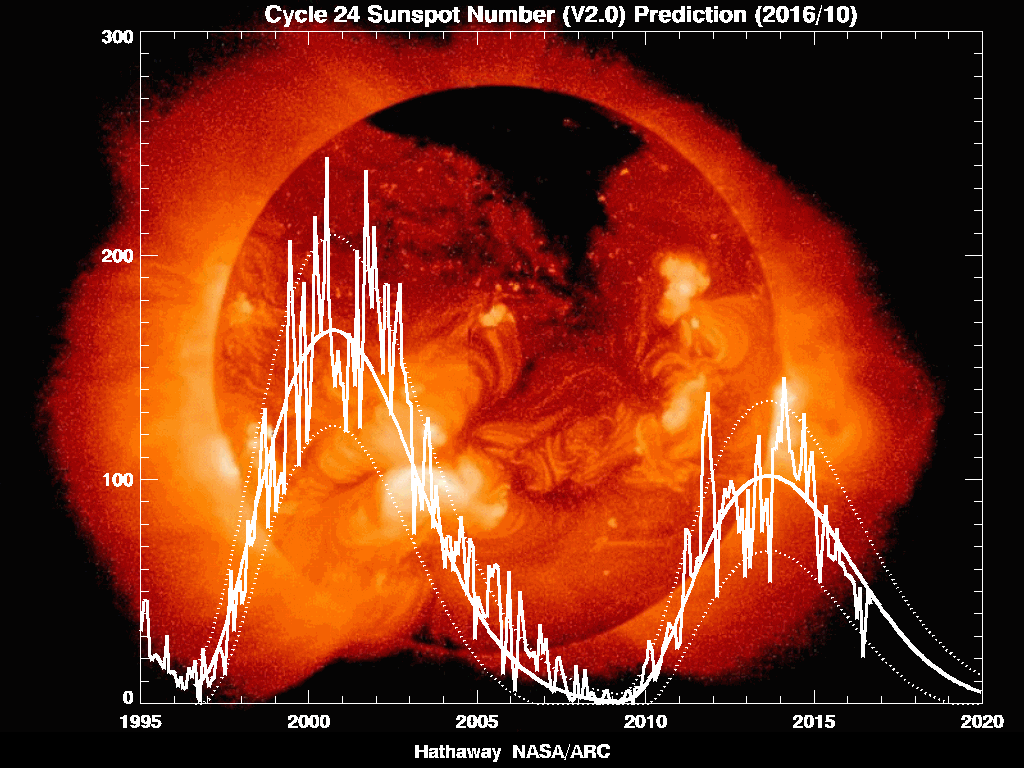
The current solar cycle (as some of you may know as I think it was linked here quite recently) has been delayed almost two years and the level of solar activity has been so low that current estimates for the solar peak expected this time are perhaps half of what they have been for the last three cycles, if that. The trend is worth a peek: http://s -
Re:Who says the ice is melting?
Look at the link I provided. NASA is saying the Antarctic ice is melting. Watts is looking at the area of ice, not the volume or mass. NASA is measuing the mass of ice.
If you put a compacted snowball in a tub of water, and as it starts melting and covers the surface of the tub, do you conclude that the ice is increasing because the area of ice is increasing? Or do you need to measure the volume or mass of the ice to determine if it's melting? If you ask me, the area has increased because it's melting and breaking up.
-
Re:Misrepresenting Anthony Watts...
-
Re:Can I have it now you are finished with it?
My bad, you're right. It's indeed 1.7bn, and I can't find a solid source for the cost without the spare components. Even if it were double that, though... the R&D has already been done so it still seems cheap relative to the Orion program cost.
Per-flight cost: the Wikipedia space shuttle article states the incremental per-flight costs are $60m.
NASA, however, states the total launch costs are $450m: http://www.nasa.gov/centers/kennedy/about/information/shuttle_faq.html#10
I don't know what the true costs of a Soyuz launch are-- the $45m figure is just what the Russians charge us, btw. -
Re:Lagrangian Points
20? Try 40! The shuttle was designed during the NIXON Presidency and was approved of on 5 January 1972!
http://history.nasa.gov/stsnixon.htm -
Re:goddammitsomuch
The rate of orbital decay is highly dependent on the surface area to mass ratio of the object. Typical debris has little mass and a lot of surface area, so it decays very rapidly when compared to a satellite or other massive object. This PDF explains it well, and you can look at TLE files to get a feel for actual decay terms.
The EGRS-3 Sat launched in 1965 is still orbiting in an 894 x 927 km orbit. TIROS-1 was launched into a 693 km x 750 km orbit in 1960, and is still merrily orbiting away 51 years later at 638 x 672 km.
The oldest sat still in orbit is Vanguard-1. It was launched into a rather elliptical orbit with the perigee near 650 km, but only massed 1kg!
-
Re:goddammitsomuch
You're right.. you'd have to put them at their highest orbit, robotically. It would be about 600km altitude and last centuries.. or until it collided with something else
NASA disagrees:
12). How long will orbital debris remain in Earth orbit?
The higher the altitude, the longer the orbital debris will typically remain in Earth orbit. Debris left in orbits below 600 km normally fall back to Earth within several years. At altitudes of 800 km, the time for orbital decay is often measured in decades. Above 1,000 km, orbital debris will normally continue circling the Earth for a century or more. -
Re:What is the human race?
the mainstream estimates I've seen are another 300-500 million or so years due to sun expanding slowly http://image.gsfc.nasa.gov/poetry/ask/a10474.html
-
Re:Only 50 billion?
Bullshit. Kepler looks at every star in its field of view. Why wouldn't it? And indeed from Kepler Mission Scientific Objective:
1. Determine the abundance of terrestrial and larger planets in or near the habitable zone of a wide variety of stars;
3. Estimate how many planets there are in multiple-star systems; -
Re:IndianaWhen I look at this map, what I see is population distribution. For example, Indiana and Arizona has about the same population. In Arizona, about a quarter of the people are in the about 400 aquare miles of Pheonix. The rest are spread over the state in a density of less than 40 people per square mile. Compare this to indiana where only about 10% live in Indianapolis and the rest are spead with a density of about 150 people per square mile. In the case of Arizona the state will have to take huge sums of tax payer money to provide service to the state, while in Indianapolis more areas are able to pay a fair price for service without government regulations and waste. The same is true for Texas. There are simply not that many people that live south and east of Abilene. Sure we could pay huge taxes to pull fiber and provide broadband to the one farm located in the middle of a square mile of noting, but why would we?
Take a look at this image of the earth at nigh It shows the same trend as the bradband map.
Frankly when one goes east, the population density decreases, and we must assume the level of service to do so as well. I don't see broadband like I do land telephone. I hope over time we will see some cost saving, and decrease in taxes on communications, by encouraging individuals to cover more of the costs. For instance in some countries no physical lines are run to places with low population density. They are expected to use mobile phones. Furthermore, the coverage is not that good, and many people are required to buy home booster units if they want cell service. It is simply not fair to charge other customers high rates or taxes so that one person can use a phone. This type of thing can also deliver broadband to low density areas. New cell technology seems to able to cover 5 square miles, which in the case of Arizona would be 150 people, maybe enough to justify a station.
-
If you want a comparaison with hubble
If you want a comparaison with hubble go there : http://www.jwst.nasa.gov/comparison.html
-
Re:Shame about flash
What is it with people having some sort of fetish for putting EVERYTHING into the frigging browser?
This problem starts, believe it or not, with certain Web designers. Some people out there will not be able to sleep at night if you and me actually control the way their pages are displayed or their Web-sites used. The Flash obsession, for example, starts with the desire to prevent you from saving videos, and it continues with an absolute necessity of making you watch ads. Me and you understand that it would be elementary to have a browser plugin that detects Web-links to video files/streams and starts an external player. The truth is, clicking on a link to a video is so easy, no one needs a plugin for that. A program like VLC is far superior to any browser gizmo with respect to controlling the video playback. On a phone form-factor, playing back inside the browser window is simply INSANE. Indeed, linking is the simplest solution, and the one with the least overhead, and also the one that was working as far back as there were video players and Web browsers, and, of course, the one still implemented on every frigging Web-site not done by dicks.
I am afraid that HTML5 is not going to change the landscape. People who have a monopoly on serving bits (or just desire it) will persist in using proprietary software and secret protocols. HTML5 will be worse than useless to them for the reason stated above. IMHO, Mozilla and W3C are mostly wasting everyone's time with the video tag. Other tags, such as the ones for Web-forms, seem far more useful. And all of this superfluous BS distracts people from converting over to XHTML, which would actually improve Web documents' quality and compatibility.
-
Wrong Solar System?
Scanning through some of the releases on http://www.jpl.nasa.gov/news/stardust/ "NASA's Stardust-NExT mission took this image of comet Tempel 1 at 8:40 p.m. PST (11:40 p.m. EST) on Feb 14, 2011, from a distance of approximately 946.05 trillion kilometers (587.85 trillion miles). The comet was first visited by NASA's Deep Impact mission in 2005." 587.85 trillion miles? ( See http://en.wikipedia.org/wiki/Trillion for both defintions ) This would put it 6,314,828 A.U., or about 23 times the 4.365 Light years ( 276,041 A.U.) distance to Alpha Centauri.
-
Re:NASA website
Even better: JPL's Comet images gallery and NASA's crater image gallery of pictures captured by this mission.
-
Re:NASA website
Even better: JPL's Comet images gallery and NASA's crater image gallery of pictures captured by this mission.