Slashdot Mirror
Domain: nasa.gov
Stories and comments across the archive that link to nasa.gov.
Stories · 2,550
-
Spectacular New Martian Impact Crater Spotted From Orbit
New submitter kc123 writes: "The team that runs the HiRISE camera on the Mars Reconnaissance Orbiter has released a photo showning a new impact crater on Mars, formed sometime early this decade. The crater at the center is about 30 meters in diameter, and the material ejected during its formation extends out as far as 15 kilometers. The impact was originally spotted by the MRO's Context Camera, a wide-field imaging system that provides the context—an image of the surrounding terrain—for the high-resolution images taken by HiRISE. The time window on the impact, between July 2010 and May 2012, simply represents the time between two different Context Camera photos of the same location. Once the crater was spotted, it took until November of 2013 for another pass of the region, at which point HiRISE was able to image it." Reader astroengine adds some more Mars news: "On Thursday at 3:41 p.m. EST (20:41 UTC), Mars rover Curiosity beamed back a photo from its rear hazard avoidance camera (Hazcam). In the shot we see wheel tracks in the downward slope of the dune bridging "Dingo Gap" with the peak of Curiosity's eventual goal, Mount Sharp, on the horizon. This can mean only one thing; the one-ton robot has successfully conquered its first Mars dune! Curiosity has also taken a picture of Earth." -
Not Just Healthcare.gov: NASA Has 'Significant Problems' With $2.5B IT Contract
schwit1 writes "According to the Inspector General, NASA and HP Enterprise Services have encountered significant problems implementing the $2.5 billion Agency Consolidated End-User Services (ACES) contract, which provides desktops, laptops, computer equipment and end-user services such as help desk and data backup. Those problems include 'a failed effort to replace most NASA employees' computers within the first six months and low customer satisfaction,' the report states (PDF). It adds that NASA lacked the technical and cultural readiness for an agencywide IT delivery model and did not offer clear contract requirements, while HP failed to deliver on multiple promises." -
Senator Makes NASA Complete $350 Million Testing Tower That It Will Never Use
Hugh Pickens DOT Com writes "Phillip Swarts reports in the Washington Times that NASA is completing a $350 million rocket-engine testing tower at Stennis Space Center in Mississippi that it doesn't want and will never use. 'Because the Constellation Program was canceled in 2010, the A-3's unique testing capabilities will not be needed and the stand will be mothballed upon completion (PDF),, said NASA's inspector general. The A-3 testing tower will stand 300 feet and be able to withstand 1 million pounds of thrust (PDF). The massive steel structure is designed to test how rocket engines operate at altitudes of up to 100,000 feet by creating a vacuum within the testing chamber to simulate the upper reaches of the atmosphere. Although NASA does not expect to use the tower after construction, it's compelled by legislation from Sen. Roger F. Wicker (R-MS), who says the testing tower will help maintain the research center's place at the forefront of U.S. space exploration. 'Stennis Space Center is the nation's premier rocket engine testing facility,' says Wicker. 'It is a magnet for public and private research investment because of infrastructure projects like the A-3 test stand. In 2010, I authored an amendment to require the completion of that particular project, ensuring the Stennis facility is prepared for ever-changing technologies and demands.' Others disagree, calling the project the 'Tower of Pork' and noting that the unused structure will cost taxpayers $840,000 a year to maintain. 'Current federal spending trends are not sustainable, and if NASA can make a relatively painless contribution to deficit reduction by shutting down an unwanted program, why not let it happen?' says Pete Sepp, executive vice president of the National Taxpayers Union. 'It's not rocket science, at least fiscally.'" -
Senator Makes NASA Complete $350 Million Testing Tower That It Will Never Use
Hugh Pickens DOT Com writes "Phillip Swarts reports in the Washington Times that NASA is completing a $350 million rocket-engine testing tower at Stennis Space Center in Mississippi that it doesn't want and will never use. 'Because the Constellation Program was canceled in 2010, the A-3's unique testing capabilities will not be needed and the stand will be mothballed upon completion (PDF),, said NASA's inspector general. The A-3 testing tower will stand 300 feet and be able to withstand 1 million pounds of thrust (PDF). The massive steel structure is designed to test how rocket engines operate at altitudes of up to 100,000 feet by creating a vacuum within the testing chamber to simulate the upper reaches of the atmosphere. Although NASA does not expect to use the tower after construction, it's compelled by legislation from Sen. Roger F. Wicker (R-MS), who says the testing tower will help maintain the research center's place at the forefront of U.S. space exploration. 'Stennis Space Center is the nation's premier rocket engine testing facility,' says Wicker. 'It is a magnet for public and private research investment because of infrastructure projects like the A-3 test stand. In 2010, I authored an amendment to require the completion of that particular project, ensuring the Stennis facility is prepared for ever-changing technologies and demands.' Others disagree, calling the project the 'Tower of Pork' and noting that the unused structure will cost taxpayers $840,000 a year to maintain. 'Current federal spending trends are not sustainable, and if NASA can make a relatively painless contribution to deficit reduction by shutting down an unwanted program, why not let it happen?' says Pete Sepp, executive vice president of the National Taxpayers Union. 'It's not rocket science, at least fiscally.'" -
GPM Satellite To Usher In a New Era of Weather Observation
Zothecula writes: "A new satellite designed to take detailed, near real-time measurements of rain and snowfall on a global scale whilst mapping the interior of storm systems is set to launch. The Global Precipitation Measurement Core Observatory has been in development since 2005 and is a collaboration project between NASA and the Japanese Space Agency (JAXA). The satellite is due to be launched on the Japanese manufactured H-IIA delivery vehicle from the Tanegashima Space Centre, Tanegashima Island, Japan, on February 27." -
Mystery Rock 'Appears' In Front of Mars Rover
astroengine writes "After a decade of exploring the Martian surface, the scientists overseeing veteran rover Opportunity thought they'd seen it all. That was until a rock mysteriously 'appeared' a few feet in front of the six wheeled rover a few days ago. News of the errant rock was announced by NASA Mars Exploration Rover lead scientist Steve Squyres of Cornell University at a special NASA Jet Propulsion Laboratory '10 years of roving Mars' event at the California Institute of Technology (Caltech), Pasadena, Calif., on Thursday night. The rock, about 'the size of a jelly doughnut' according to Squyres, is thought to have either come from a freak "flipping" event or a very recent meteorite impact. However, the latter isn't thought to be very likely. Although they are still working on the rock's origin, the rover team believe it was 'tiddlywinked' by Opportunity's broken wheel; as the rover was turning on the spot, the rock was kicked from place under the wheel and flipped a few feet away from the rover. Never missing a science opportunity, Squyres told Discovery News, 'It obligingly turned upside down, so we're seeing a side that hasn't seen the Martian atmosphere in billions of years and there it is for us to investigate. It's just a stroke of luck.'" -
International Space Station Mission Extended To 2024
An anonymous reader writes with news that funding has been secured for the ISS through at least 2024. From NASA: "'...We are pleased to announce that the Obama Administration has approved an extension of the International Space Station until at least 2024. We are hopeful and optimistic that our ISS partners will join this extension effort and thus enable continuation of the groundbreaking research being conducted in this unique orbiting laboratory for at least another decade. ... A further benefit of ISS extension is it will give NASA and its private-sector partners time to more fully transition to the commercial space industry the transportation of cargo and crew to low-Earth-orbit, allowing NASA to continue to increase its focus on developing the next-generation heavy-lift rocket and crew capsule necessary for deep-space exploration." -
Cygnus ISS Launch Delayed Due To Sun's Coronal Mass Ejection
ClockEndGooner writes "A giant coronal mass ejection from the Sun yesterday has resulted in a higher than normal level of radioactivity, and in turn, forced Orbital Sciences to postpone their first mission launch of the Cygnus space truck to the International Space Station. Citing concerns of the effect increased levels of space radiation may have on the Antares launcher and Cygnus avionics, the NASA and Orbital launch team is now evaluating if conditions will improve for a launch on Thursday, which would have Cygnus arriving at the ISS on Sunday morning." In other ISS news, the Orlando Sentinel is reporting that NASA has gotten approval from the White House to extend the ISS's mission for another four years, pushing the end date back to 2024. An official announcement is expected later this week. -
Cygnus ISS Launch Delayed Due To Sun's Coronal Mass Ejection
ClockEndGooner writes "A giant coronal mass ejection from the Sun yesterday has resulted in a higher than normal level of radioactivity, and in turn, forced Orbital Sciences to postpone their first mission launch of the Cygnus space truck to the International Space Station. Citing concerns of the effect increased levels of space radiation may have on the Antares launcher and Cygnus avionics, the NASA and Orbital launch team is now evaluating if conditions will improve for a launch on Thursday, which would have Cygnus arriving at the ISS on Sunday morning." In other ISS news, the Orlando Sentinel is reporting that NASA has gotten approval from the White House to extend the ISS's mission for another four years, pushing the end date back to 2024. An official announcement is expected later this week. -
NASA Could Explore Titan With Squishable 'Super Ball Bot'
An anonymous reader writes "IEEE Spectrum reports on a rover design being developed at NASA Ames Research Center: Super Ball Bot. The premise is that the rover's brain and scientific equipment would be suspended in the center of a structure made of rigid rods and elastic cables. The rods and cables would be deformable, allowing the rover to roll over complex terrain without damage. This design would be ideal for exploring a place like Saturn's moon Titan. Its atmosphere is thick enough that a probe could drop the rover from 100km above the surface, and it would survive the fall without a parachute. 'In a scenario studied by the team (PDF), the robot could be collapsed to a very compact configuration for launch. Once it reaches the moon, it would pop open and drop to the surface, flexing and absorbing the force of impact. By shortening and lengthening the cables that connect its rigid components, the ball bot could then roll about the surface. These same cables could be used to pull back parts of the robot, so that science instruments at the center could be exposed and used.'" -
NASA Could Explore Titan With Squishable 'Super Ball Bot'
An anonymous reader writes "IEEE Spectrum reports on a rover design being developed at NASA Ames Research Center: Super Ball Bot. The premise is that the rover's brain and scientific equipment would be suspended in the center of a structure made of rigid rods and elastic cables. The rods and cables would be deformable, allowing the rover to roll over complex terrain without damage. This design would be ideal for exploring a place like Saturn's moon Titan. Its atmosphere is thick enough that a probe could drop the rover from 100km above the surface, and it would survive the fall without a parachute. 'In a scenario studied by the team (PDF), the robot could be collapsed to a very compact configuration for launch. Once it reaches the moon, it would pop open and drop to the surface, flexing and absorbing the force of impact. By shortening and lengthening the cables that connect its rigid components, the ball bot could then roll about the surface. These same cables could be used to pull back parts of the robot, so that science instruments at the center could be exposed and used.'" -
ISS Coolant Pump Restarted After Successful Spacewalks
Yesterday, two astronauts completed a seven hour spacewalk to finish installation of a spare coolant pump after a failed coolant pump forced a partial shut down of the ISS. As of late yesterday afternoon, that pump is online and operating normally: "The new pump now is considered fully functional, but it will take some time to fully reintegrate the pump and Loop A of the two-loop external cooling system. Teams at mission control are following a schedule that should allow the restored cooling loop to be fully activated and integrated into the station’s cooling system on Christmas Day, Dec. 25. ... Electrical systems that depend on cooling from Loop A will be repowered or moved back from temporary support on Loop B gradually on Thursday, Friday, and throughout the weekend." -
ISS Coolant Pump Restarted After Successful Spacewalks
Yesterday, two astronauts completed a seven hour spacewalk to finish installation of a spare coolant pump after a failed coolant pump forced a partial shut down of the ISS. As of late yesterday afternoon, that pump is online and operating normally: "The new pump now is considered fully functional, but it will take some time to fully reintegrate the pump and Loop A of the two-loop external cooling system. Teams at mission control are following a schedule that should allow the restored cooling loop to be fully activated and integrated into the station’s cooling system on Christmas Day, Dec. 25. ... Electrical systems that depend on cooling from Loop A will be repowered or moved back from temporary support on Loop B gradually on Thursday, Friday, and throughout the weekend." -
Rough Roving: Curiosity's Wheel Damage 'Accelerated'
astroengine writes "Despite the assurances that the holes seen in Mars rover Curiosity's wheels were just a part of the mission, there seems to be increasing concern for the wheels' worsening condition after the one-ton robot rolled over some craggy terrain. In an upcoming drive, rover drivers will monitor the six wheels over some smooth terrain to assess their condition. "We want to take a full inventory of the condition of the wheels," said Jim Erickson, project manager for the NASA Mars Science Laboratory at NASA's Jet Propulsion Laboratory, Pasadena, Calif. 'Dents and holes were anticipated, but the amount of wear appears to have accelerated in the past month or so.' Although the wheels are designed to sustain significant damage without impairing driving activities, the monitoring of the situation is essential for future planning." -
How Astronauts Took the Most Important Photo In Space History
The Bad Astronomer writes "On December 24, 1968, the Apollo 8 astronauts saw the Earth rising over the limb of the Moon. The photo they took of this moment — dubbed Earthrise — has become an icon of our need to explore, and to protect our home world. NASA has just released a video explaining how the astronauts were able to capture this unique moment, which included a dash of both coincidence and fast teamwork." -
NASA Schedules Space Walks to Fix ISS Pumps; Orbital Sciences Launch Delayed
The ISS has been operating at partial capacity after a coolant pump malfunctioned last week. NASA has now announced the repair mission: "NASA currently plans for two Expedition 38 astronauts to venture outside the space station Dec. 21, 23, and 25. NASA astronauts Rick Mastracchio and Mike Hopkins will remove a pump module that has a failed valve. They will replace it with an existing spare that is stored on an external stowage platform. The pump is associated with one of the station's two external cooling loops, which circulate ammonia outside the station to keep both internal and external equipment cool. Each of the three spacewalks will begin at 7:10 a.m. and is scheduled to last six and a half hours. NASA TV coverage will begin at 6:15 a.m." NASA TV will be airing a preview of the space walks at 3 p.m. EST. As a result of the coolant pump malfunction and the repairs, NASA has also delayed the launch of Orbital Sciences' cargo resupply mission until at least mid-January. -
Coldest Spot On Planet Earth Identified
Thorfinn.au sends this news from NASA: "What is the coldest place on Earth? It is a high ridge in Antarctica on the East Antarctic Plateau where temperatures in several hollows can dip below minus 133.6 degrees Fahrenheit (minus 92 degrees Celsius) on a clear winter night. Scientists made the discovery while analyzing the most detailed global surface temperature maps to date, developed with data from remote sensing satellites including the new Landsat 8, a joint project of NASA and the U.S. Geological Survey (USGS). Ted Scambos, lead scientist at the National Snow and Ice Data Center in Boulder, Colo., joined a team of researchers reporting the findings Monday at the American Geophysical Union meeting in San Francisco. Researchers analyzed 32 years' worth of data from several satellite instruments. They found temperatures plummeted to record lows dozens of times in clusters of pockets near a high ridge between Dome Argus and Dome Fuji, two summits on the ice sheet known as the East Antarctic Plateau. The new record of minus 93.2 C was set Aug. 10, 2010." -
Cassini Gets Amazing Views of Saturn's Hexagon
SternisheFan sends this excerpt from a JPL news release: "NASA's Cassini spacecraft has obtained the highest-resolution movie yet of a unique six-sided jet stream, known as the hexagon, around Saturn's north pole. This is the first hexagon movie of its kind (GIF), using color filters, and the first to show a complete view of the top of Saturn down to about 70 degrees latitude. Spanning about 20,000 miles (30,000 kilometers) across, the hexagon is a wavy jet stream of 200-mile-per-hour winds (about 322 kilometers per hour) with a massive, rotating storm at the center. There is no weather feature exactly, consistently like this anywhere else in the solar system. 'The hexagon is just a current of air, and weather features out there that share similarities to this are notoriously turbulent and unstable,' said Andrew Ingersoll, a Cassini imaging team member at the California Institute of Technology in Pasadena. 'A hurricane on Earth typically lasts a week, but this has been here for decades — and who knows — maybe centuries.'" -
Cassini Gets Amazing Views of Saturn's Hexagon
SternisheFan sends this excerpt from a JPL news release: "NASA's Cassini spacecraft has obtained the highest-resolution movie yet of a unique six-sided jet stream, known as the hexagon, around Saturn's north pole. This is the first hexagon movie of its kind (GIF), using color filters, and the first to show a complete view of the top of Saturn down to about 70 degrees latitude. Spanning about 20,000 miles (30,000 kilometers) across, the hexagon is a wavy jet stream of 200-mile-per-hour winds (about 322 kilometers per hour) with a massive, rotating storm at the center. There is no weather feature exactly, consistently like this anywhere else in the solar system. 'The hexagon is just a current of air, and weather features out there that share similarities to this are notoriously turbulent and unstable,' said Andrew Ingersoll, a Cassini imaging team member at the California Institute of Technology in Pasadena. 'A hurricane on Earth typically lasts a week, but this has been here for decades — and who knows — maybe centuries.'" -
Two Supermassive Black Holes About To Embrace
Taco Cowboy writes "NASA's WISE (Wide-field Infrared Survey Explorer) satellite was looking at a distant galaxy, some 3.8 billion light-years away, and saw something rather unusual. At first they thought that they saw a galaxy was forming new stars at a furious rate, but upon closer checking, they found that they were seeing two supermassive black holes spiraling closer and closer to each other. The dance of this black hole duo started out slowly, with the objects circling each other at a distance of about a few thousand light-years. As the black holes continued to spiral in toward each other, they were separated by just a few light-years. Supermassive black holes at the cores of galaxies typically shoot out pencil-straight jets, but in this case, the jet showed a zig-zag pattern. According to the scientists, a second massive black hole could, in essence, be pushing its weight around to change the shape of the other black hole's jet. Visible-light spectral data from the Gemini South telescope in Chile showed similar signs of abnormalities, thought to be the result of one black hole causing disk material surrounding the other black hole to clump. Together, these and other signs point to what is probably a fairly close-knit set of circling black holes, though the scientists can't say for sure how much distance separates them." -
NASA Will Send Seeds to the Moon In 2015
Hugh Pickens DOT Com writes "The Telegraph reports that NASA plans to send turnip, cress, and basil seeds to the Moon inside a specially constructed canister, known as the Lunar Plant Growth Chamber. The chamber will carry enough air for 10 days and NASA says the air in the chamber would be adequate to allow the seeds to sprout and grow for five days. It is hoped that the latest experiment will help to pave the way for astronauts to grow their own food while living on a lunar base. NASA says it will use natural sunlight to germinate the plants inside the chamber and the seeds will grow on pieces of filter paper laden with nutrients. 'If we send plants and they thrive, then we probably can. Thriving plants are needed for life support — food, air, water — for colonists. And plants provide psychological comfort, as the popularity of the greenhouses in Antarctica and on the Space Station show.' The Lunar Plant Growth Chamber is expected to weigh around 2.2lbs and will also carry 10 seeds each of basil and turnips. Upon landing on the Moon a trigger would release a small reservoir of water to wet the filter paper and initiate the germination of the seeds. Photographs of the seedlings would be taken at regular intervals to monitor their progress and compare them to seedlings being growing in similar conditions on Earth." -
Comet ISON Survives Perihelion (Barely)
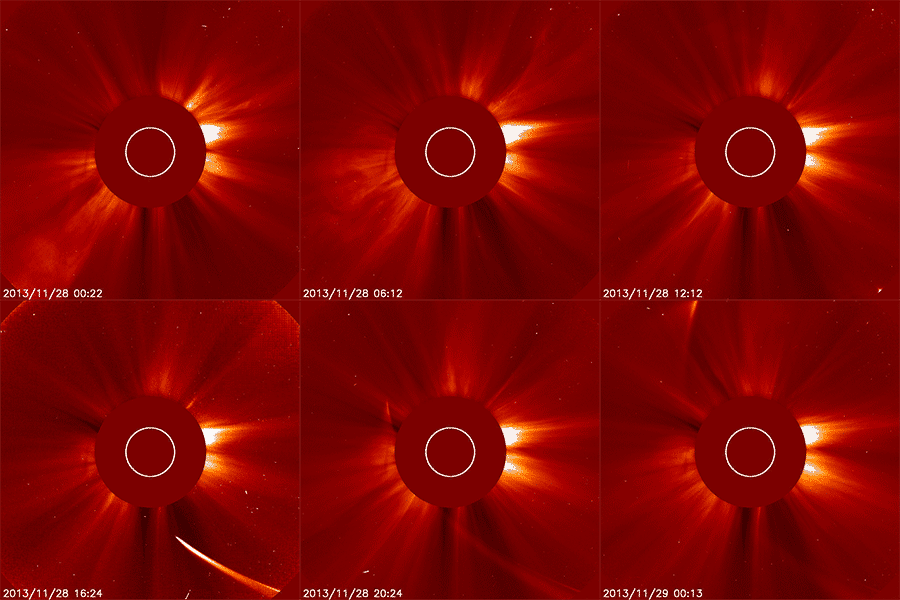
An anonymous reader sends this update from NightSkyInfo: "Yesterday, when Comet ISON plunged through the solar atmosphere and behind SOHO's coronagraph (the black disk designed to block out the direct light from the Sun), its nucleus dwindled away to nothing and most of the tail simply evaporated. Everyone assumed that the comet completely disintegrated and died a fiery death. However, several hours after perihelion, ISON began to brighten up again. It is now distinctly evident on live images from SOHO, looks like a comet, and continues to brighten as it moves farther away from the Sun." Experts are unwilling to say precisely how intact the comet is — we'll need more data to make a conclusion about that — but astrophysicist Karl Battams says this is their best guess: 'As comet ISON plunged towards to the Sun, it began to fall apart, losing not giant fragments but at least a lot of reasonably sized chunks. There's evidence of very large dust in the form of that long thin tail we saw in the LASCO C2 images. Then, as ISON plunged through the corona, it continued to fall apart and vaporize, and lost its coma and tail completely just like Lovejoy did in 2011. (We have our theories as to why it didn't show up in the SDO images but that's not our story to tell - the SDO team will do that.) Then, what emerged from the Sun was a small but perhaps somewhat coherent nucleus, that has resumed emitting dust and gas for at least the time being. In essence, the tail is growing back, as Lovejoy's did.' Here's a GIF of the comet rounding the Sun (put together by Emily Lakdawalla). -
Comet ISON Survives Perihelion (Barely)
An anonymous reader sends this update from NightSkyInfo: "Yesterday, when Comet ISON plunged through the solar atmosphere and behind SOHO's coronagraph (the black disk designed to block out the direct light from the Sun), its nucleus dwindled away to nothing and most of the tail simply evaporated. Everyone assumed that the comet completely disintegrated and died a fiery death. However, several hours after perihelion, ISON began to brighten up again. It is now distinctly evident on live images from SOHO, looks like a comet, and continues to brighten as it moves farther away from the Sun." Experts are unwilling to say precisely how intact the comet is — we'll need more data to make a conclusion about that — but astrophysicist Karl Battams says this is their best guess: 'As comet ISON plunged towards to the Sun, it began to fall apart, losing not giant fragments but at least a lot of reasonably sized chunks. There's evidence of very large dust in the form of that long thin tail we saw in the LASCO C2 images. Then, as ISON plunged through the corona, it continued to fall apart and vaporize, and lost its coma and tail completely just like Lovejoy did in 2011. (We have our theories as to why it didn't show up in the SDO images but that's not our story to tell - the SDO team will do that.) Then, what emerged from the Sun was a small but perhaps somewhat coherent nucleus, that has resumed emitting dust and gas for at least the time being. In essence, the tail is growing back, as Lovejoy's did.' Here's a GIF of the comet rounding the Sun (put together by Emily Lakdawalla). -
Scientists Forced To Reexamine Theories In Light of Massive Gamma-Ray Burst
cold fjord writes "Earlier this year we discussed news of a shockingly powerful gamma-ray burst. Scientists have had time to study the phenomenon, but it's not offering up any easy answers. The Christian Science Monitor reports, 'An exploded star some 3.8 billion light-years away is forcing scientists to overhaul much of what they thought they knew about gamma-ray bursts – intense blasts of radiation triggered, in this case, by a star tens of times more massive than the sun that exhausted its nuclear fuel, exploded, then collapsed to form a black hole. Last April, gamma rays from the blast struck detectors in gamma-ray observatories orbiting Earth, triggering a frenzy of space- and ground-based observations. Many of them fly in the face of explanations researchers have developed during the past 30 years ... "Some of our theories are just going down the drain," said Charles Dermer, an astrophysicist at the Los Alamos National Laboratory in New Mexico ... while typical long-duration bursts last from a few seconds to a few minutes, GRB 130427A put on its display for 20 hours. ... [W]ith GRB 130427A, some of the highest energy photons, including the new record-holder, appeared hours after the blast. "This is hard to explain with our current models," Dermer said. In addition, gamma rays and emissions at visible wavelengths brightened and dimmed in tandem, quite unexpected because theory suggested they come from different regions of the expanding shells of material and thus should have peaked and dimmed at different times. Finally, theorists had posited different mechanisms for generating gamma rays and X-rays that are part of the light show a long-duration gamma-ray burst puts on. The result should have been a fadeout for the two forms of light punctuated by periods where emissions were interrupted. Instead, the two dimmed smoothly. The theoretical edifice GRB 130427A is eroding has been 46 years in the making.' — The 21 November 2013 Science Express has abstracts for four related papers (first, second, third, fourth). More at Sky & Telescope and NASA." -
CubeSat Launch Visible Around U.S. East Coast Tonight
Hugh Pickens DOT Com writes "Brad Lendon reports at CNN that 29 satellites, the most ever launched at one time, will be aboard a single Minotaur I rocket scheduled to lift off from NASA's Wallops Flight Facility in Virginia Tuesday night at 7:30 pm. The main payload will be the Air Force's Space Test Program Satellite-3, plus 28 tiny satellites called CubeSats about 4 inches on each side, weighing about 3 pounds and with a volume of about a quart. The cubesats will include Ho`oponopono-2 from the University of Hawaii to continue a long-existing radar calibration service for the 80 plus C-band radar tracking stations distributed around the world. It will also have CAPE-2 from the Cajun Advanced Picosatellite Experiment, to give students at the University of Louisiana at Lafayette the opportunity to research, design, develop, and maintain a low earth orbiting satellite, and SwampSat from the University of Florida to advance the TRL (Technology Readiness Level) of CMGs (Control Moment Gyroscopes) appropriate for smallsats. Among the CubeSats is the TJ3Sat, the first satellite made by high-schoolers to go into space, built by the students of Thomas Jefferson High School for Science and Technology in Alexandria, Virginia. It will give students and other amateur radio users the opportunity to send and receive data from the satellite. Approved text strings will be transmitted to the satellite, and the resulting voice interpretation will be relayed back to Earth over an amateur radio frequency using the onboard Stensat radio. Orbital says the 29 satellites should achieve orbit in a little less than 12½ minutes after the rocket ignites. NASA says the launch may be visible from northern Florida to southern Canada and as far west as Indiana. Live coverage of the launch is available via UStream beginning at 6:30 p.m. EST on launch day." -
MAVEN Ready To Launch Today
An anonymous reader writes "Mars seems to have gone from being a warm, wet planet with a liquid core (with magnetic fields strong enough to maintain an atmosphere) to a cooled frozen desert-like surface. By gathering information about the Mars upper atmosphere and its magnetic field scientists hope MAVEN can help explain what happened and where the water went." -
Comet ISON Nears Date With Sun
riverat1 writes "Now visible in the morning sky, comet ISON will swing around the Sun on November 28. ISON will pass 730,000 km above the surface of the Sun at closest approach (Mercury's perihelion distance is 46 million km). If it survives its near brush with the Sun it could provide a spectacular sky show from December into January. This NASA timeline shows that ISON will be the most observed comet ever as instruments ranging from a balloon carried telescope to the Hubble Space Telescope to the STEREO satellites will be brought into play. Lowell Observatory astronomer Matthew Knight lays out three possibilities for ISON: spontaneous disintegration before it gets to the Sun (less than 1% chance); disintegration as it rounds the Sun; or survival. If it survives, its closest approach to Earth will be on December 26 at about 1/3 of an AU." -
Comet ISON Nears Date With Sun
riverat1 writes "Now visible in the morning sky, comet ISON will swing around the Sun on November 28. ISON will pass 730,000 km above the surface of the Sun at closest approach (Mercury's perihelion distance is 46 million km). If it survives its near brush with the Sun it could provide a spectacular sky show from December into January. This NASA timeline shows that ISON will be the most observed comet ever as instruments ranging from a balloon carried telescope to the Hubble Space Telescope to the STEREO satellites will be brought into play. Lowell Observatory astronomer Matthew Knight lays out three possibilities for ISON: spontaneous disintegration before it gets to the Sun (less than 1% chance); disintegration as it rounds the Sun; or survival. If it survives, its closest approach to Earth will be on December 26 at about 1/3 of an AU." -
Global Warming Since 1997 Underestimated By Half
Layzej writes "A new paper shows that global temperature rise of the past 15 years has been greatly underestimated. The reason is that the weather station network covers only about 85% of the planet. Satellite data shows that the parts of the Earth that are not covered by the surface station network, especially the Arctic, have warmed exceptionally fast over the last 15 years. Most temperature reconstructions simply omit any region not covered. A temperature reconstruction developed by NASA somewhat addresses the gaps by filling in missing data using temperatures from the nearest available observations. Now Kevin Cowtan (University of York) and Robert Way (University of Ottawa) have developed a new method to fill the data gaps using satellite data. The researchers describe their methods and findings in this YouTube video. 'The most important part of our work was testing the skill of each of these approaches in reconstructing unobserved temperatures. To do this we took the observed data and further reduced the coverage by setting aside some of the observations. We then reconstructed the global temperatures using each method in turn. Finally, we compared the reconstructed temperatures to the observed temperatures where they are available... While infilling works well over the oceans, the hybrid model works particularly well at restoring temperatures in the vicinity of the unobserved regions.' The authors note that 'While short term trends are generally treated with a suitable level of caution by specialists in the field, they feature significantly in the public discourse on climate change.'" -
NASA's Mars Orbiter Reaches Data Milestone
Nerval's Lobster writes "NASA's Mars Reconnaissance Orbiter has sent 200 terabits of scientific data all the way back to Earth over the past seven years. That data largely comes from six instruments aboard the craft, and doesn't include the information used to manage the equipment's health. That 200-terabit milestone also surpasses the ten years' worth of data returned via NASA's Deep Space Network from all other missions managed by NASA's Jet Propulsion Laboratory in Pasadena, California. 'The sheer volume is impressive, but of course what's most important is what we are learning about our neighboring planet,' JPL's Rich Zurek, the project scientist for the Mars Reconnaissance Orbiter, wrote in a statement. It takes roughly two hours for the craft to orbit Mars, recording voluminous amounts of data on everything from the atmosphere to the subsurface. Thanks to its instruments, we know that Mars is a dynamic environment, once home to water. 'Mars Reconnaissance Orbiter has shown that Mars is still an active planet, with changes such as new craters, avalanches and dust storms,' Zurek added. 'Mars is a partially frozen world, but not frozen in time.' While the Orbiter's two-year 'primary science phase' ended in 2008, NASA has granted the hardware three additional extensions, each of which has resulted in additional insight into the Red Planet's secrets." -
NASA's Robonaut Gets Its Legs; Could a Moonwalk Be In Its Future?
MarkWhittington writes "Project M was a proposal at NASA's Johnson Spaceflight Center that would have put together a mission to deliver a bipedal robot to the lunar surface within a thousand days. The idea never got out of the conception stage, but two major components, a new type of lunar lander, now called Morpheus, and a robonaut continued on as separate projects. Morpheus is getting ready to conduct a second attempt at free flight tests at the Kennedy Space Center. The first attempt resulted in the destruction of the prototype vehicle. If the second round of tests is successful, NASA will have a spacecraft that could deliver 1,100 pounds of payload to the lunar surface. While a copy of Robonaut 2 is still undergoing tests on board the International Space Station, ABC News reports that a cousin of the mechanical person has been built with legs. It stands eight feet tall and weighs 500 pounds. With two major components of Project M nearing completion, could a robonaut become the next moon walker?" -
NASA's Robonaut Gets Its Legs; Could a Moonwalk Be In Its Future?
MarkWhittington writes "Project M was a proposal at NASA's Johnson Spaceflight Center that would have put together a mission to deliver a bipedal robot to the lunar surface within a thousand days. The idea never got out of the conception stage, but two major components, a new type of lunar lander, now called Morpheus, and a robonaut continued on as separate projects. Morpheus is getting ready to conduct a second attempt at free flight tests at the Kennedy Space Center. The first attempt resulted in the destruction of the prototype vehicle. If the second round of tests is successful, NASA will have a spacecraft that could deliver 1,100 pounds of payload to the lunar surface. While a copy of Robonaut 2 is still undergoing tests on board the International Space Station, ABC News reports that a cousin of the mechanical person has been built with legs. It stands eight feet tall and weighs 500 pounds. With two major components of Project M nearing completion, could a robonaut become the next moon walker?" -
Dream Chaser Damaged In Landing Accident At Edwards AFB
RocketAcademy writes "The test article for Sierra Nevada's Dream Chaser spacecraft suffered a landing accident on Saturday when the left main landing gear failed to deploy, causing the vehicle to flip over. NBC News quotes a Sierra Nevada engineer saying that the pilot would have walked away. Sierra Nevada Corporation is developing the Dream Chaser to support the International Space Station as part of NASA's Commercial Crew and Cargo program. It is not yet known what effect the mishap will have on Dream Chaser development. A number of rocket vehicles have suffered landing-gear mishaps in the recent past. Several years ago, concerns over spacecraft gear design led to a call for NASA to fund a technology prize for robust, light-weight landing gear concepts." -
Laser Communication System Sets Record With Data Transmissions From Moon
sighted writes "NASA reports that it has used a pulsed laser beam to transmit data over the 384,633 kilometers (239,000 miles) between the Moon and the Earth at a transfer rate of 622 megabits per second. The transmissions took place between a ground station in New Mexico and the LADEE robotic spacecraft now orbiting the moon. 'LLCD is NASA's first system for two-way communication using a laser instead of radio waves. It also has demonstrated an error-free data upload rate of 20 Mbps transmitted from the primary ground station in New Mexico to the spacecraft currently orbiting the moon. ... LLCD is a short-duration experiment and the precursor to NASA's long-duration demonstration, the Laser Communications Relay Demonstration (LCRD). LCRD is a part of the agency's Technology Demonstration Missions Program, which is working to develop crosscutting technology capable of operating in the rigors of space. It is scheduled to launch in 2017.'" -
How Many Tiny Chelyabinsk-Class Asteroids Buzz Earth?
astroengine writes "The meteor that exploded over the Urals region of Russia in February was a violent reminder that our planet exists in a cosmic shooting gallery. Now, astronomers are focusing on these mysterious small and possibly dangerous objects in the hope of understanding what they are made of and what kind of threat they pose in the future. However, a recent paper accepted for publication in the Astrophysical Journal has identified a possible 'Achilles Heel' of visible light surveys. Using data from NEOWISE (the near-Earth object-hunting component of NASA's Wide-field Infrared Survey Explorer mission), there appears to be a bias in visible light asteroid surveys against finding small (100 meters) dark space rocks. 'With our previous NEOWISE studies, we found that about a third of NEOs larger than 100 meters are dark. It's possible that a population of smaller dark asteroids exists, but we don't have the right sample to test that theory with what we've done so far (in this research),' NASA JPL scientist and NEOWISE principal investigator Amy Mainzer told Discovery News. 'In my opinion it is probable that a similar fraction of small NEOs are dark, but the visible surveys are biased against finding them. They do find some but not many.' On considering the impact of the small Chelyabinsk object earlier this year, it is perhaps sobering to realize that while around 90 percent of NEOs with diameters larger than 1 kilometer are thought to have been discovered, less than one percent of asteroids the size of the Chelyabinsk meteor (17-20 meters in diameter) have been detected." -
Mercury Astronaut Scott Carpenter Dies At 88
schwit1 writes "M. Scott Carpenter, whose flight into space in 1962 as the second American to orbit the Earth was marred by technical glitches and ended with the nation waiting anxiously to see if he had survived a landing far from the target site, died on Thursday in Denver. He was 88 and one of the last two surviving astronauts of America's original space program, Project Mercury." NASA has a nice biography of Carpenter, too, and scottcarpenter.com has much more besides. -
Juno Needs Radio Amateurs!
An anonymous reader writes "NASA's Juno mission to Jupiter will perform a close 'fly-by' of the Earth in a few hours. To assist with its radio and plasma wave experiment, the mission is asking amateur radio operators to send a 'Morse Code' message to the probe as it passes." The page has all the info you need: "The activity will begin at 18:00 UTC on October 9, 2013 and continue until 20:40 UTC. This page will clearly indicate when you should key up or key down to transmit 'HI' to Juno in Morse Code (see examples below). The Morse code pattern below can also act as a guide. The 'HI' message will be repeated every 10 minutes, beginning at 18:00, 18:10, 18:20, etc. " -
MAVEN Mission To Mars Will Proceed, Despite Shutdown
necro81 writes "Due to the ongoing shutdown of the U.S. Government, NASA is largely grounded. This is bad for all kinds of reasons, but one particularly bad outcome would have been missing the launch window for the MAVEN spacecraft, due to launch 18 November. The next launch window would not have been until 2016. MAVEN, thankfully, has been given the go-ahead, in large part because this orbiter will serve as a vital communications link for the Opportunity and Curiosity rovers currently on the surface. Currently, these rovers are served by two aging orbiters: Mars Odyssey (launched 2001) and Mars Reconnaissance Orbiter (launched 2005). Maintaining communications with the rovers is considered essential, hence the preparations and launch will proceed. (NASA's official mission website is currently offline.)" -
"Synthetic Tracking" Makes It Possible to Find Millions of Near Earth Asteroids
KentuckyFC writes "Astronomers think that near-Earth Asteroids the size of apartment blocks number in the millions. And yet they spot new ones at the rate of only about 30 a year because these objects are so faint and fast moving. Now astronomers at the Jet Propulsion Laboratory have developed a technique called synthetic tracking for dramatically speeding up asteroid discovery. Insteads of long exposures in which near-Earth asteroids show up as faint streaks, the new technique involves taking lots of short exposures and adding them together in a special automated way. The trick is to shift each image so that the pixels that record the asteroid are superimposed on top of each other. The result is an image in which the asteroid is sharp point of light against a background of star streaks. They say synthetic tracking has the capability to spot 80 new near Earth asteroids each night using a standard 5 metre telescope. That'll be handy for spotting rocks heading our way before they get too close and for identifying targets for NASA's future asteroid missions." -
Orbital Sciences Cargo Test Mission To ISS Launches Successfully
Months after a successful test launch of the Antares rocket with a dummy payload, today Orbital Sciences Corp successfully launched their demo cargo mission to the ISS. Their Cygnus resupply craft detached from the second stage and at 11:33 a.m. deployed its solar array. From NASA: "Solar array deployment is complete for Orbital Sciences Corp.'s Cygnus spacecraft, now traveling 17,500 mph in Earth's orbit to rendezvous with the International Space Station on Sunday, Sept. 22, for a demonstration resupply mission. The spacecraft will deliver about 1,300 pounds (589 kilograms) of cargo, including food and clothing, to the space station's Expedition 37 crew, who will grapple and attach the capsule using the orbiting laboratory's robotic arm." There's an updates weblog, and some pictures. -
Orbital Sciences Cargo Test Mission To ISS Launches Successfully
Months after a successful test launch of the Antares rocket with a dummy payload, today Orbital Sciences Corp successfully launched their demo cargo mission to the ISS. Their Cygnus resupply craft detached from the second stage and at 11:33 a.m. deployed its solar array. From NASA: "Solar array deployment is complete for Orbital Sciences Corp.'s Cygnus spacecraft, now traveling 17,500 mph in Earth's orbit to rendezvous with the International Space Station on Sunday, Sept. 22, for a demonstration resupply mission. The spacecraft will deliver about 1,300 pounds (589 kilograms) of cargo, including food and clothing, to the space station's Expedition 37 crew, who will grapple and attach the capsule using the orbiting laboratory's robotic arm." There's an updates weblog, and some pictures. -
Orbital Sciences Cargo Test Mission To ISS Launches Successfully
Months after a successful test launch of the Antares rocket with a dummy payload, today Orbital Sciences Corp successfully launched their demo cargo mission to the ISS. Their Cygnus resupply craft detached from the second stage and at 11:33 a.m. deployed its solar array. From NASA: "Solar array deployment is complete for Orbital Sciences Corp.'s Cygnus spacecraft, now traveling 17,500 mph in Earth's orbit to rendezvous with the International Space Station on Sunday, Sept. 22, for a demonstration resupply mission. The spacecraft will deliver about 1,300 pounds (589 kilograms) of cargo, including food and clothing, to the space station's Expedition 37 crew, who will grapple and attach the capsule using the orbiting laboratory's robotic arm." There's an updates weblog, and some pictures. -
It's Official: Voyager 1 Is an Interstellar Probe
astroengine writes "After a 35-year, 11-billion mile journey, NASA's Voyager 1 spacecraft left the solar system to become the first human-made object to reach interstellar space, new evidence from a team of scientists shows. 'It's kind of like landing on the moon. It's a milestone in history. Like all science, it's exploration. It's new knowledge,' long-time Voyager scientist Donald Gurnett, with the University of Iowa, told Discovery News. The first signs that the spacecraft had left the solar system's heliopause was a sudden drop in solar particles and a corresponding increase in cosmic rays in 2012, but this evidence alone wasn't conclusive. Through indirect means, scientist analyzing oscillations along the probe's 10-meter (33-foot) antennas were able to deduce that Voyager was traveling through a less dense medium — i.e. interstellar space." You can watch NASA's briefing on the probe's progress here. -
Space Food From Space Farms
Modern Farmer magazine has an article about NASA's efforts into growing food in space, a slow, difficult process that's nonetheless necessary if humanity is to have any significant presence away from Earth's surface. Quoting: "This December, NASA plans to launch a set of Kevlar pillow-packs, filled with a material akin to kitty litter, functioning as planters for six romaine lettuce plants. The burgundy-hued lettuce (NASA favors the 'Outredgeous' strain) will be grown under bright-pink LED lights, ready to harvest after just 28 days. NASA has a long history of testing plant growth in space, but the goals have been largely academic. Experiments have included figuring out the effects of zero-gravity on plant growth, testing quick-grow sprouts on shuttle missions and assessing the viability of different kinds of artificial light. But [the Vegetable Production System] is NASA's first attempt to grow produce that could actually sustain space travelers. Naturally, the dream is to create a regenerative growth system, so food could be continually grown on the space station — or, potentially, on moon colonies or Mars. ... Plant size is a vital calculation in determining what to grow on the space station, where every square foot is carefully allotted. Harvest time is also of extreme importance; the program wants to maximize growth cycles within each crew’s (on average) six-month stay." -
Open Source Photometry Code Allows Amateur Astronomers To Detect Exoplanets
An anonymous reader writes "Have access to a telescope with a CCD? Now you can make your very own exoplanet transit curves. Brett Morris, a student from the University of Maryland, has written an open source photometry application known as Oscaar. In a recent NASA Press Release, Morris writes: "The purpose of a differential photometry code – the differential part – is to compare the changes in brightness of one star to another nearby. That way you can remove changes in stellar brightness due to the Earth's atmosphere. Our program measures the brightness change of all the stars in the telescope's field of view simultaneously, so you can pull out the change in brightness that you see from the planet-hosting star due to the transit event." The program opens up exoplanet-observing to amateur astronomers and undergraduate students across the globe." -
Monster Storm Reveals Water On Saturn
cold fjord sends this news from NASA: "A monster storm that erupted on Saturn in late 2010 – as large as any storm ever observed on the ringed planet -- has already impressed researchers with its intensity and long-lived turbulence. A new paper in the journal Icarus reveals another facet of the storm's explosive power: its ability to churn up water ice from great depths. This finding, derived from near-infrared measurements by NASA's Cassini spacecraft, is the first detection at Saturn of water ice. The water originates from deep in Saturn's atmosphere. 'The new finding from Cassini shows that Saturn can dredge up material from more than 100 miles [160 kilometers],' said Kevin Baines, a co-author of the paper who works at the University of Wisconsin-Madison and NASA's Jet Propulsion Laboratory, Pasadena, Calif. 'It demonstrates in a very real sense that typically demure-looking Saturn can be just as explosive or even more so than typically stormy Jupiter.'" -
Curiosity Goes Autonomous For the First Time
Zothecula writes "NASA took the metaphorical training wheels off the Mars rover Curiosity on Tuesday, as the unmanned explorer took its first drive using autonomous navigation. It used its onboard cameras and software to select and drive over an area of ground that mission control at the Jet Propulsion Laboratory in Pasadena, California couldn't see and vet beforehand. This capability allows the nuclear-powered rover to negotiate the most direct route to Mount Sharp rather than having to detour to find routes that can be seen directly by Curiosity before entering, so they can be analyzed by mission control." -
NASA Scientists Jubilant After Successful Helicopter Crash
Hugh Pickens DOT Com writes "Elizabeth Barber reports in the Christian Science Monitor that when a CH-46E Sea Knight helicopter plummeted into the ground at more than 30 miles per hour, there was jubilation from the scientists on the ground at the culmination of some two years of preparation to test a helicopter's crashworthiness. 'We designed this test to simulate a severe but survivable crash under both civilian and military requirements,' says NASA lead test engineer Martin Annett. 'It was amazingly complicated with all the planning, dummies, cameras, instrumentation and collaborators, but it went off without any major hitches.' During the crash, high-speed cameras filming at 500 images per second tracked the black dots painted on the helicopter, allowing scientists to assess the exact deformation of each part of the craft, in a photographic technique called full field photogrammetry. Thirteen instrumented crash test dummies and two un-instrumented manikins stood, sat or reclined for a potentially rough ride. The goal of the drop was to test improved seat belts and seats, to collect crashworthiness data and to check out some new test methods but it was also to serve as a baseline for another scheduled test in 2014. 'It's extraordinarily useful information. I will use this information for the next 20 years,' says Lindley Bark, a crash safety engineer at Naval Air Systems Command on hand for the test. 'Even the passenger airplane seats in there were important to us because we fly large aircraft that have the same type of seating."' -
This Satellite Could Be Beaming Solar Power Down From Space By 2025
Daniel_Stuckey writes "A NASA veteran, aerospace entrepreneur, and space-based solar power (SBSP) expert, [John] Mankins designed the world's first practical orbital solar plant. It's called the Solar Power Satellite via Arbitrarily Large PHased Array, or SPS-ALPHA for short. If all goes to plan, it could be launched as early as 2025, which is sooner than it sounds when it comes to space-based solar power timelines. Scientists have been aware of the edge the "space-down" approach holds over terrestrial panels for decades. An orbiting plant would be unaffected by weather, atmospheric filtering of light, and the sun's inconvenient habit of setting every evening. SBSP also has the potential to dramatically increase the availability of renewable energy." -
Will the Headless Ape Robot Win the DARPA Challenge?
New submitter pausz42 writes "The NASA Jet Propulsion Laboratory and Stanford University are promoting RoboSimian, a simian-inspired robot able to face environments which are hostile for men. In the DARPA Robotics Challenge the selected teams have to develop an autonomous robot able to get into a car, drive it to a disaster site and perform hazardous activities. While this prototype is the only one that that doesn't have a humanoid shape (and it's quite creepy, since it does not have a head), it seems that its three fingered limbs are better fitted for some of the difficult tasks required by the DARPA challenge."