Slashdot Mirror
Domain: nasa.gov
Stories and comments across the archive that link to nasa.gov.
Comments · 16,365
-
Re:bogus rationalizations
This is terribly sad.
This is the end of Manned Space Flight for the United States.
If you, or your children, want to see the launch of a manned American bird, you'd better do it immediately, in the remainder of 2009 or 2010. You have nine Shuttle launches left.
NASA has been promised funding sufficient for nine more Shuttle missions to finish the ISS, and that is all. (2009 & 2010). This is essentially funding for the coffin and headstone.
One year from now, we will be back to 1957. The Russians will still have their heavy-lift rockets and Soyuz capsules, and we won't have anything. We'll have to beg/buy rides from Russia to get to the ISS. Should the Russians decide they're not in the mood, they can easily say: "And what are you going to do about it?".
The Russians do not have a good "Partners in Space" history. Remember when the ISS was very nearly lost to [Russian] computer problems, the Russians were swift to blame the Americans for "bad power". When the Soyuz's explosive bolts failed, the Russians blamed the ISS for mysterious "plasma discharges" that, somehow (don't ask me how) damaged explosive bolts.
Now NASA is trying to build its "Ares-1" rocket. Two stages. Its lower stage is a Shuttle SRB (Solid Rocket Booster) with an extra solid segment, which means higher pressures, more joints, and this time the vibration is directly transmitted to the backs of the crew.
(I wish someone would tell me why we're not just using the Saturn V main booster technology for the first stage. It has the advantage of being repeatedly tested and it works. Is it just too easy or something?)
It's revealing to see what former NASA officials say when they are not muzzled anymore:
Former NASA Administrator Mike Griffin said in a recent speech the projected funding shortfalls threaten America's leadership in manned space flight.
"In a democracy, the proper purpose of the OMB (Office of Management and Budget) is not to find a way to create a Potemkin Village at NASA. It is not to create the appearance of having a real space program without having to pay for it. It is not to specify to NASA how much money shall be allocated for human lunar return by 2020. The proper purpose of the OMB is to work with NASA, as a partner in good government, to craft carefully vetted estimates of what is required to achieve national policy goals. The judgment as to whether the stated goals are too costly, or not, is one to be made by the nation's elected leadership, not career civil service staff.
No one can wrest leadership in space from the United States. We're that good. But we can certainly cede it, and that is the path we are on."
Something like the Ares-1 design has happened before; see the history of the Space Shuttle:
http://history.nasa.gov/SP-4221/contents.htm
You will find that what Congress/OMB and Obama are doing ia just about precisely what Congress/BoB and Nixon did.
Funding was cut right through the fat, muscle, and into the bone, and the only way NASA could figure out to launch anything was using solid rocket boosters (SRB's), which add significant vibration and which cannot be throttled, or switched off and reignited. Many engineers left NASA when the decision to use SRB's came down.
A stunning quote from one Douglas Cookie, 'Associate Administrator for the Exploration Systems Mission Directorate at NASA HQ', is:
[Cooke] said the biggest single reason he has favored Ares 1 over competing designs is _crew safety_.
"That's in part due to the Ares 1 first stage, an extended five-segment shuttle booster. Two four-segment boosters are used for every shuttle flight and in 125 missions to date - 250 booster flights - only one booster has ever failed, the one that doomed Challenger.
"I personally believe the risk is l
-
Re:Mod parent up! Excellent points.
What is absolutely necessary is both technical proficiency and managerial ability. If NASA cannot find a leader with both, it would be better to minimize NASA projects until one could be found.
I'm not sure I agree. Both are preferable, but only managerial ability is absolutely necessary. A good manager can make up for gaps in their technical knowledge by appointing a good technical staff and setting up an environment in which they can give quality advice. If you have a bad manager, there's really nothing you can do to make up for their management shortcomings. In fact, I think if you have a scenario where you have an organization as vast as NASA and you have the head administrator trying to micromanage technical decisions, something's gone horribly wrong.
Also, if anything the main jobs of NASA administrator are making sure the various NASA centers and programs are running smoothly, and dealing with Congress and the President. If anything, the political role is the most important part of being administrator.
-
Re:Jim Wetherbee
You're right, we aren't in the space race with Russia anymore. Astronauts aren't rockstars.
And one other thing: NASA doesn't just do space.
http://www.nasa.gov/topics/earth/features/tideenergy.html
This is just a single example, but there are many others. NASA is about a lot more than space these days, and our funding of NASA is a lot more important than you apparently realize.
You said you want to see the next generation clean up the financial and environmental mess our generation and previous generations created. Well, assuming that's even true, then I think this tidal power project represents precisely the kind of project that you think we should pursue.
Still think we should stop funding NASA?
-
Re:Why burn them up?
Here is a better graph. At 800km up your orbit only lasts 200-300 years. You'd need another couple hundred kilometers before you get to the thousands of years realm.
-
Re:Voyager
I completely agree - and it's worth noting that we're talking about a spacecraft launched in 1977 - so it's flying tech is even older.
Not only that - our ground tech is truly incredible.
The power received at an earth antenna is 1e-16 watts - imagine finding and holding that signal in the cosmic background noise!
-
Re:"every _________ knows" ~Al GoreThank you very much for the detailed response. As I am sure you noticed, I love to rant, but it comes from the heart, so taking the time to cover each detail is appreciated.
What if instead of buying foreign oil we started letting Americans across the country tap into the huge reserves of oil we have right here? I think the only argument I have heard is that "we need to protect our reserves", but when it comes to many of the problems of oil, a lot of the arguments are over the fact that it is foreign (we are not at war over the environment).
This may sound harsh, but rather than this expensive, preemptive attack on oil and energy and trying to force alternative energy upon a very stubborned market, instead we can stop subsidizing, and stop regulating, let it run free and when the oil runs out or gets outrageously expensive, I truly believe some brilliant, greedy team of scientists from Berkley, Stanford, MIT, Harvard, or wherever are going to respond to that situation and use their brains to come up with a competitive solution determined by the real, natural economy. The problem with the present situation of bail outs and subsidies is that it is artificial, and even if you could get into the circle to earn a grant or whatever, you are expected to give it over to the government. Even if someone could come up with a solution now to solve the energy crisis and develop alternative energy in 20 years time, who is to say that the up to 5 different administrations won't change those laws making all of your work worthless.
I really believe that the more changes and fixes created by the government made right now in an attempt to make things right is intimidating people with real skills, real money, and real ideas to keep them all to themselves and wait for this whole situation blows over to a point where there is something stable enough for people to count on.I thought that Keynes was all about macro stuff
I actually just started reading Human Action today, and really enjoying it. In the scholar edition (that is the edition linked), the introduction covers a lot of the personal relationship and rivalry. I always had that impression, and had been told, that Microeconomics was about small local economies, while macroeconomics looks at the economy from the big picture / national level. But the impression I was getting from the intro of that book was that to a certain extent the interpretation of what "micro" and "macro" meant was intentional by proponents of Keynes. I think a more appropriate (though maybe just as bias) meaning of "micro" (which Mesis agreed with) was that he advocated for a bottom-up approach, and that Keynes "Macro" philosophy was a top-down approach. I could only hope to ever explain the fundamental differences between bottom-up and top-down as well as this guy. It is a great read, and MUCH shorter than the link above that covers a mans life work; Feynman on the Challenger disaster. Looking at the big picture is useful, but trying to control it directly will not cause the changes intended because too many things can be tied to that element that were not realized. Looking at a problem from the bottom-up, not to advocate for micro-management so much as delicate management, you get a much better perspective on all variables, and any policies taken from such an approach will be more precise, and better learned from to build upon appropriately. Anyway, I'll not just keep going on with that, but see how that definition of "microeconomics" is really different than to mean small and only appropriate when involving a few number of people?
Oh, and as long as were on the topic, I am actually a big fan of The Fair Tax. I think it is much more than "a national sales tax" and is worth looking at in fine detail. I think our tax code has -
Re:Insightful? Mods on crack?
In case you haven't noticed warming's stopped the last dozen or so years and we've actually started to get colder the last two.
Where did you "notice" this? Sorry dude, you've been fooled again! Stop and think!
"Cooler" relative to what? To some pre-industrial base-line? To some conventional baseline (eg 1951)? Or to
Look at the actual data expressed here for meteorological stations and here for the land-ocean index. Note that compared to a 1951 baseline there has not even been a monthly fall in temperature since 1992 and 1994 respectively, let alone a yearly one.
How many IPCC models predicted that? Zero?
It was widely predicted and reported that 2008-09 were expected to be somewhat cooler than the previous few years. This would not have been as the result of climate models which do not study changes in temperature over so short a time period, but from long-range weather forecasting.
A little humility might be in order on the part of the AGW crew.
What is the AGW crew? A little more knowledge and thought might be in order from you and yes some humility would be good too.
But it's not science but scientism to ignore new evidence. Trying to freeze consensus to the state of knowledge of a few years ago and ignoring the end of warming for the time being is politics masquerading as science and is doing real damage to science in general.
When I look at the mirror today, I can notice no more wrinkles than yesterday. Ergo I have stopped ageing. Cool I'm immortal! Well if I looked at a picture from 10 years ago I would instantly loose my immortality, so I shan't.
The warming trend over that last 160 years of the instrumental record, is so significant that it would take closer to 20 years of cooling to negate it. Not 2! That's not scientism, it's statistics.
You need to be far more sceptical about the sources of information you accept as valid. You've swallowed some rather obvious denialist propaganda hook line and sinker. Don't be fooled again.
-
Re:Insightful? Mods on crack?
In case you haven't noticed warming's stopped the last dozen or so years and we've actually started to get colder the last two.
Where did you "notice" this? Sorry dude, you've been fooled again! Stop and think!
"Cooler" relative to what? To some pre-industrial base-line? To some conventional baseline (eg 1951)? Or to
Look at the actual data expressed here for meteorological stations and here for the land-ocean index. Note that compared to a 1951 baseline there has not even been a monthly fall in temperature since 1992 and 1994 respectively, let alone a yearly one.
How many IPCC models predicted that? Zero?
It was widely predicted and reported that 2008-09 were expected to be somewhat cooler than the previous few years. This would not have been as the result of climate models which do not study changes in temperature over so short a time period, but from long-range weather forecasting.
A little humility might be in order on the part of the AGW crew.
What is the AGW crew? A little more knowledge and thought might be in order from you and yes some humility would be good too.
But it's not science but scientism to ignore new evidence. Trying to freeze consensus to the state of knowledge of a few years ago and ignoring the end of warming for the time being is politics masquerading as science and is doing real damage to science in general.
When I look at the mirror today, I can notice no more wrinkles than yesterday. Ergo I have stopped ageing. Cool I'm immortal! Well if I looked at a picture from 10 years ago I would instantly loose my immortality, so I shan't.
The warming trend over that last 160 years of the instrumental record, is so significant that it would take closer to 20 years of cooling to negate it. Not 2! That's not scientism, it's statistics.
You need to be far more sceptical about the sources of information you accept as valid. You've swallowed some rather obvious denialist propaganda hook line and sinker. Don't be fooled again.
-
Why not go the source??
Why would the OP link is story to some obscure third party blurb site when a direct link to WWW.NASA.GOV would make far more sense.
You could even watch live at the Nasa site:
http://www.nasa.gov/multimedia/nasatv/index.html?param=public -
Re:I love NASA TV
How do I watch NASA TV????
Using firfox on winxp here at work and it keeps redirecting me to a help page.
http://www.nasa.gov/help/multimedia/odplayer.htmlApparently it thinks I need to install more plug ins... but I never even get a chance to see the webpage with the video.
Have a stream address I can plug into VLC?
-
Re:Watch it live (on Linux too)
If it redirects you to the "no player found" page (as it did for me), try:
mplayer -playlist 'http://playlist.yahoo.com/makeplaylist.dll?id=1369080&segment=149773'
(The original link is http://www.nasa.gov/55644main_NASATV_Windows.asx , but MPlayer doesn't seem to be able to handle multiple levels of playlists.)
As one who (perhaps from Kubrick's 2001) had a sense of EVA actions being slow, deliberate things, it's neat to see that the work's going practically as smoothly as if it was being done in a lab.
-
Watch it live
Check it out on NASA TV if you haven't had the chance yet. Viewing Hubble the way the astronauts see it is a neat experience.
-
Re:Crappy quality
There's another photo showing the Shuttle and the ISS transiting the Sun and the two are very similar. In that photo, the ISS is the more prominent object.
-
Re:fake?
You don't really need full ephemeris data, you'd just need to know when the transit happened. I'll grant you determining when the transit happens is a more difficult problem, although you can pull the data off of the JPL HORIZONS http://ssd.jpl.nasa.gov/?horizons data.
Get two text files with a list of RA/DEC for the sun and Hubble for the next week, and set up a script to read through them and find the closest approach. If its less than the radius of the sun you have a winner. Given that this guy does this a lot (he's credited for earlier ISS images) he probably has a script set up to download and check the ephemeris for any satellites or other objects of interest a week or two in advance..
At least thats what I'd do... in fact maybe I should buy a solar filter and do just that... -
Re:Astronomy Picture of the Day [ISS]
Here's one with the space-station taken a few years ago:
-
Re:fake?has anyone actually verified this as legit
-
Re:Astronomy Picture of the Day
"Today" is relative. I saw a different one. Use a fixed date: http://antwrp.gsfc.nasa.gov/apod/ap090516.html
-
Re:"The entire North Polar ice cap....
I guess that there really is no point in pointing out that "may well be" part of the sentence, but some actual data MAY BE useful.
-
Re:listen to Dr. Hammel's short speech about Hubbl
A slight correction: Ed Weiler is the _Associate_ Administrator for NASA's Science Mission Directorate, not the agency's overall Administrator. That post has been vacant since Michael Griffin resigned in January. You can see the organization structure here.
Personally, I'm expecting Mike Griffin to be replaced with Peter Griffin.
-
Re:Misleading Article TitleWhile I agree with your first two sentences, I think you go wrong from there. The article explicitly states that the process they used could not have happened as they did it. But all the ingredients were likely to be around before life began on Earth.
Since when do organisms add material and cleanse and add and cleanse?
Hey, I bathe atleast once a year!
Assuming you mean naturally occurring process, rather than organism. How about a tidal pool where the chemistry is likely to change every day. Or near a periodic geyser, or a volcanic plume under the sea.Who threw the sugar in the first primordial soup?
The sugar was already there.
Where would RNA get it's instructions?
Why would the RNA need "instructions"? We are simply trying to make some.
There are too many holes... this isn't a breakthrough in science, It's an episode of "The Frugal Gourmet"
How so? They are proving that from simple precursors which would have been on early Earth that RNA can be made. True they are not showing the exact way life started, just that it is plausible with relatively simple natural like chemistry. I think it is a worthy scientific piece of knowledge.
-
Watch it NOW live on Nasa TV...
Don't forget, they're broadcasting the whole operation live on Nasa TV.
http://www.nasa.gov/ntv -
Re:Obsolete Already?
Except if you actually follow the links and read the comments - you find that at best the Keck merely equals the performance of Hubble, it doesn't even remotely outclass it.
Equaling Hubble but not costing 1.3 billion for a Shuttle launch to fix it is a big deal to me. It's not only that newer ground based telescopes are catching up with it. It's also about the insane cost to keep it running. That we can almost build two of those 30 meter telescopes for the cost of this one Shuttle launch makes me wonder why we bother.
It's not like we're rolling in money, either. Hubble was great when it was launched, but it's just to expensive to run any more. And God help us if we need to launch a rescue mission due to the damage that the Shuttle has sustained. 2.6 Billion, then.
That's a lot of money. I bet JPL would love to have even the cost of one Shuttle launch added to its funding for next year.(note - that would nearly double their budget for 2010!)
P.S. the 30 meter telescope will have technology in it to filter out virtually all of the distortion caused by the atmosphere. It's a very well thought out and high-tech design. For Infrared, though - the JWST is going to replace Hubble anyways in 2014.
I'd have rather saved the billion+ dollars and just had no IR space telescope for 4 years. I honestly don't think most of the people would have noticed.
-
Re:I have the fail-safe solution to these problems
-
Re:Call a tow truck
My back-of-the-napkin estimate says you claim it is only ~300 miles to the far side of the planet.
You seem to be using elapsed distance over elapsed time as a measure of the rover's speed. However, the rovers are often sitting still doing science and taking pictures for a good deal of the time, so that's not a realistic speed.
So, Let's see... [/me finds napkin, turns over]... 148 years at MER top speed of 5 cm/s (as per NASA site) comes to about 234,000 km, or 47,000km if you use the 1cm/s average speed the rover gets when you take obstacle avoidance into effect. Opportunity could drive itself around Mars twice in that time. Of course this assumes travel 24h/day (or 24.6597h/sol). If we only have usable sunlight for a third of that time, then Opportunity can only travel 16,000km.
So how far apart are the rovers? Plugging some latitude and longitude figures into a great circle calculator and compensating for the different Mars parameters... 9700km apart, as the Martian crow-equivalent flies. So, assuming a travel day of 1/3 of a sol at the 0.036 km/h rover self drive speed, and allowing for an increase in distance to avoid obstacles of 50-60% - 15,000km.
Wow! My my pull-a-number-out-of-thin-air wild guess came remarkably close. -
Re:Call a tow truck
My back-of-the-napkin estimate says you claim it is only ~300 miles to the far side of the planet.
You seem to be using elapsed distance over elapsed time as a measure of the rover's speed. However, the rovers are often sitting still doing science and taking pictures for a good deal of the time, so that's not a realistic speed.
So, Let's see... [/me finds napkin, turns over]... 148 years at MER top speed of 5 cm/s (as per NASA site) comes to about 234,000 km, or 47,000km if you use the 1cm/s average speed the rover gets when you take obstacle avoidance into effect. Opportunity could drive itself around Mars twice in that time. Of course this assumes travel 24h/day (or 24.6597h/sol). If we only have usable sunlight for a third of that time, then Opportunity can only travel 16,000km.
So how far apart are the rovers? Plugging some latitude and longitude figures into a great circle calculator and compensating for the different Mars parameters... 9700km apart, as the Martian crow-equivalent flies. So, assuming a travel day of 1/3 of a sol at the 0.036 km/h rover self drive speed, and allowing for an increase in distance to avoid obstacles of 50-60% - 15,000km.
Wow! My my pull-a-number-out-of-thin-air wild guess came remarkably close. -
Re:doh.
Roger that.
FWIW, you can get a lot of mission info while it happens, even if you don't have satellite TV - http://www.nasa.gov/multimedia/nasatv/index.html
-
Re:It's also good for practical jokes
Interesting idea. I found this terminal velocity calculator.
A 1 cm^3 cube of UDD has a surface area of 0.00107639104 sq feet. (Actually, it would be a little more as it rotates in the air.) Unfortunately, the above calculator rounds values off too much to handle this. In fact, it can't really handle it because it isn't able to compensate for compressibility effects and shock waves as we exceed the speed of sound. (Using the Eiffel Tower's height of 1063 ft., it is returning a value of a little over a mile per second!)
So let's try dropping a big piece, say a sphere with a cross sectional area of 1 sq. ft. This will have a radius of sqrt(1 / pi), and hence a volume of (4/3) * pi * (sqrt( 1 / pi))^3, or about 0.75225 cubic feet. This yields an impressive weight of 6,113,486 pounds.
The terminal velocity calculator is cutting us off at 10,000 pounds, but we can punch this out ourselves to get an answer. We just need a reasonable value for the atmospheric density. Through a little trial and error, I found that a value of
This is surely a ridiculous result, since we're still disregarding compressibility effects, and using dodgy math. Still, it was interesting, and this sort of speed is not impossible. The fastest man made space probe, Helios, traveled at over twice this speed, albeit in a vacuum.
Let's accept the result for now, and compare this to the Chicxulub impact, which is "one of the largest confirmed impact structures in the world; the impacting bolide that formed the crater was at least 10 km (6 mi) in diameter." I don't see any estimates of the bolide's mass or impact velocity. However, we know the impact released 400 zettajoules of energy, or 4x10^23 joules.
Our object would have a kinetic energy of merely 1.3x10^15 joules, so it probably won't be destroying the earth. Still, with the force all directed at such a tiny area, something dramatic is bound to happen. I imagine it would burrow quite deeply, and then release energy upward and outward somehow.
I have no idea how to estimate the hole's depth. If anyone thinks this ludicrous math is enjoyable, feel free to add your own calculations!
-
5 out of 6 wheels?!?
SOURCE: Wikipedia
On sol 779, the right front wheel ceased working after having covered 4.2 mi (7 km) on Mars. Engineers began driving the rover backwards, dragging the dead wheel. Ironically, although this has resulted in changes to driving techniques the dragging effect has also had a positive effect in the fact that the wheel dragging has partially cleared soil away on the surface as the rover travels and allows for imaging areas that would normally be covered in soil.http://marsrovers.nasa.gov/mission/images/rover1_detail_500.jpg
NASA got awesome mileage out of this vehicle... considerably more than was initially expected- over 7700 meters! Hopefully they get it unstuck. According the the NASA website, they've gotten it backed up by a few CM over the last few Sols... -
Re:Why not build another one ...
Not as much as you might think. First of all you will have modify the design. Old suppliers are gone. The standardized parts may have changed so you will have to do some redesign for that. And the big problem is that odds are pretty good that they Hubble design isn't available in SolidWorks, AutoCad, ProE or even IGES format. So it will probably have to be redrawn on a modern CAD system. You will want to completely update all the electronics so those will be different as well.
About the one only thing you would want to keep unchanged would be the basic structure and maybe the optics. Everything else you would want to update just because it would be cheaper than than trying to rebuild 20 to 30 year old parts.
The replacement for the Hubble has a much larger collecting mirror and will really out preform the Hubble. http://www.jwst.nasa.gov/ -
T minus 140 minutes
If you aren't already, follow the mission on the nasa website http://www.nasa.gov/
-
Re:So which is it
Schematic picture of inflating space.
-
Re:Star Trek vs. Futurama
He's the *former* head because there's no *current* head - the project was officially closed down last year.
From http://www.grc.nasa.gov/WWW/bpp/
"Status of the NASA Breakthrough Propulsion Physics (BPP) Project
All NASA support to sustain cognizance on these possibilities has been withdrawn as of October 1, 2008. The final NASA contribution was to assist in the compilation of a graduate-level technical book, Frontiers of Propulsion Science, which is due out in early 2009." -
Wall not sufficient
Droughts far worse than the infamous Sahel drought of the 1970s and 1980s are within normal climate variation for sub-Saharan West Africa, according to new research.
For the first time, scientists have developed an almost year-by-year record of the last 3,000 years of West African climate. In that period, droughts lasting 30 to 60 years were common. Surprisingly, however, these decades-long droughts were dwarfed by much more severe droughts lasting three to four times as long, scientists report in the 17 April issue of the journal Science.
I don't think a wall will help if the land turns to dust and the lakes dry up.
http://earthobservatory.nasa.gov/Newsroom/view.php?id=38348&src=eorss-manews -
Re:11 billion? is nothing. was Re:Hype, nothing
Actually I believe a mission to mars could boost US research quite a bit.
This is a list off technology from the Apollo program: http://www.sti.nasa.gov/tto/apollo.htm -
Re:First swine flu, now loose-roaming black holes?
A couple of years ago, there was an astronomy news story about the discovery that our nearest spiral-galaxy neighbor, the Andromeda Galaxy, has two large black holes (with masses of several million sols) in its core. This explained some of the anomalies in that galaxy's shape, which isn't quite as flat or symmetrical as you'd expect a big spiral to be. The suggested explanation is a merger with another galaxy that probably happened several billion years ago, long enough that the resulting mess has settled down into what at first glance looks like a single normal spiral galaxy.
This isn't at all unusual, though. There are lots of galactic collisions visible in space. There was a fun one a few days ago on the Astronomy Picture of the Day site. Stories on them generally explain that few if any of the stars collide, because they're too far apart. The dust and gas clouds do collide, and the result is a period of star formation. In many cases, simulations show that the galaxies merge, typically producing an elliptical galaxy if both were large and had different orientations. In the Andromeda case, they were probably roughly coplanar, so the merger just produced a slightly bigger spiral.
Another recent story is about calculations showing that the Andromeda and Milky Way galaxies are on a collision course, and will collide in several billion years. The result may look a lot like the above picture to astronomers in other nearby galaxies.
Astronomers have also found the remnants of several smaller galaxies that our Milky Way has gobbled up. They were generally disrupted, but most of the stars from a single such galaxy now have similar orbits, so each appears as a loose "stream" of stars with a thickening that corresponds to the core of the original small galaxy. It's likely that each such smaller galaxy contributed one or more "medium" black holes (with a few thousand solar masses) to our galaxy.
Anyway, this story isn't especially surprising to anyone who follows atronomy news.
-
Re:Nah, I call BS
It's also worth pointing out galaxies orbit each other and when the galaxies are of similar size you get repeated collisions before a merger. Black holes were a mathematical conjecture when I was a kid and we still tend to think of galaxies as islands that occasionally bump into each other but advances in astronomy and computing are telling us it's a much more dynamic and structured universe than we thought existed 30-40yrs ago.
-
2174.749 f/sBased on this NASA app: http://www.grc.nasa.gov/WWW/K-12/airplane/termv.html
- The Apollo Command Module weighed 12773lbf/5806 kg, but the app only takes 10000 lbf.
- Diameter of 3.9m, 12' 10" yields frontal area of 128.5 square feet.
- WILD A55 guessing the Drag Coefficient at 1.0 (based on the page: http://www.grc.nasa.gov/WWW/K-12/airplane/shaped.html)
- Dropping from an altitude of 100000ft (ha!)
2174.749 f/s SOMEONE has the wrong terminal velocity. Are we sure this isn't a way to eliminate political dissidents?
-
2174.749 f/sBased on this NASA app: http://www.grc.nasa.gov/WWW/K-12/airplane/termv.html
- The Apollo Command Module weighed 12773lbf/5806 kg, but the app only takes 10000 lbf.
- Diameter of 3.9m, 12' 10" yields frontal area of 128.5 square feet.
- WILD A55 guessing the Drag Coefficient at 1.0 (based on the page: http://www.grc.nasa.gov/WWW/K-12/airplane/shaped.html)
- Dropping from an altitude of 100000ft (ha!)
2174.749 f/s SOMEONE has the wrong terminal velocity. Are we sure this isn't a way to eliminate political dissidents?
-
Re:Old news?
The original DC-X was a half-scale (IIRC) version just designed to demo the tech of "Landing on your own tailfire", and all the initial flights were tethered. Flew several times in '93 and '94, but the final flight in '96 experienced a hydraulic line failure in one of the struts, and tipped over. In a "full-up" system, a backup manual extender would have mitigated the problem.
Good info on the flights are found on NASA's Website http://www.hq.nasa.gov/office/pao/History/x-33/dc-xa.htm -
NASA Cosmos Software
What ever happened to the Cosmos software catalog? http://colab.arc.nasa.gov/cosmoscode NASA used to place many interesting pieces of software in there.
I worked on a set of programs in 1993-1996 that was placed there.
-
Re:Fairly small resistors
Hmm, well according to NASA, a new solar cycle began at the start of last year, that was when the current solar minimum "bottomed out" so to speak.
So we've been coming out of solar minimum for more than a year now, with the expected increased activity to start showing up around 2012.
Its an 11 year cycle, so if NASA is right and the new one started in Jan. 2008, then the midpoint of the cycle, when solar maximum occurs, will be sometime in 2013.
-
Re:Fairly small resistors
...I'd hate to know what they call "huge resistors".
Now those damn stripes on Jupiter makes sense, it's color coded!
-
Re:Act now! Avoid Doomsday!
I wouldn't exactly call it a doomsday scenario. These flares happen fairly often. The last one to disrupt power was in March 1989 but there was a bigger one in April 2001 that missed us.
Can't wait for discovery channels "doco" on the star in the east being solar flares hitting Jupiter though. -
Re:Not really the oldest event ever seen - CMB
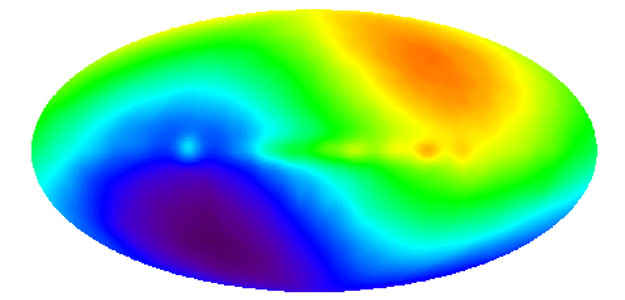
Yes, it is a picture of the entire universe when it was 400,000 years old taken today from the earth. But in the same way we take pictures with photo cameras, the object which the picture was taken of is 3D but the resulting picture itself is 2D. In the case of the CMB, we can think of the picture as follows: for each latitude and longitude on the earth, you point a camera straight up and record the CMB photons coming from that direction. Then, for each point on the surface of the earth (2D) you have a number - and that's the picture. These photons are coming from a very distant place in the universe and started traveling to us a very long time ago; and the energy of those photons is proportional to the amount of energy there was at that point in the universe when the photon started its trip towards the earth. Then that picture is telling us what the distribution of matter-energy was 400,000 years after the big bang.
You are perfectly right that the picture is like the internal surface of a sphere, and I've seen balloons with the CMB painted on it, which is probably the best representation of the picture. However, we like to have things on flat paper, and for that we need a projection from the surface of the sphere to a flat space. This is equivalent to the projections used to represent world maps on flat surfaces. I'm not sure what the particular projection used for CMB is.
Another interesting fact is that that picture is not the "actual" picture taken: it has been through two processes. In fact, originally it looks like this. This is due to the well-known doppler effect. We are moving with respect to the CMB photons, so the photons coming from the direction we're moving into seem to be more energetic than the photons coming from the opposite direction. This fact allows us to measure the speed we're moving through the CMB which happens to be about 600km/s.
After correcting for the doppler effect, what's left is this. In fact, the universe was extremely homogeneous 400,000 year after the big bang. However if one looks carefully it is possible to detect inhomogeneities in that picture, as small as 1 in 10^5. Those inhomogeneities is what actually is represented in the pictures as the one I showed in the previous post. -
Re:Why so long?
Um, sorry, but do you seriously think the Apollo program wasn't managed like a project, with quality assurance and heaps of subcontractor management hazzles? If so, perhaps you'd better not read any histories. The sound of illusions shattering can be so disheartening...
Aerospace engineering had damned well better be managed and QA'd to within an inch of its life, if the metal is to get off the ground at all without killing everybody in a five hundred meter radius, simply because Bert thought Ernie knew which tank to fill with LOX (or Ken thought Bill always used the metric system of measurements). And even so...
-
Re:Why does NASA suck so much?
It's the public's imagination that's at fault if that really is the case. NASA continues to do spectacular, amazing things.
The NASA current missions page:
http://www.nasa.gov/missions/current/Does the Cassini-Huygens mission do nothing for you?
That Hubble Telescope doodad not honking your horn?
Spirit and Opportunity are things that make you go "meh"?If you (or rather some notional "member of the public") would rather be watching tonight's new episode of "The Apprentice" than reading about one of these missions, then where does the lack of vision lie?
-
Re:I beg to differ
In fact if you were in your space ship at the same pressure as space outside is, you could technically hold your breath and go outside and be OK, at least until the extreme cold causes other bodily functions to fail. The holding your breath part would suck too of course.
Yeah, the holding your breath part might be problematic. If you find a pressure gauge, though, and blow into it, if you can hit ~14psi, you could definitely hold your breath in space.
As for the extreme cold, it's misleading. You're in a vacuum, which is nominally very cold but has incredibly low thermal mass. It's not going to instantly freeze you, and in fact I'm not sure if it could even drain enough heat to stop a human from overheating. Your main concern (assuming that you get oxygen soon enough) will be sunburn.
More info - apparently it takes ~14 seconds to lose consciousness, although I'd be interested to see if, with proper preparation, that couldn't be extended significantly. Arthur C. Clarke made this interesting suggestion in one of his stories (I believe it was 'Earthlight'), although that story overestimated the viable time (to the tune of 2 minutes before becoming impaired) because Clarke didn't take into account the fact that in a vacuum, lungs deplete the blood of oxygen. -
Re:World's *First* X-Ray Laser? I don't think so.
It actually says Hard X-ray's
http://hesperia.gsfc.nasa.gov/sftheory/xray.htm
This announcement believe it or not has actually made my day. It will 100% spur innovation like the original Red Lasers did.
-
Re:I beg to differ
Lunar surface dust in a pressurized environment does. I don't remember that anyone has adequately explained it or not, but it's probably due to rapid oxidation of soil particles in an oxygenated environment. (makes sense)
Looking around, I found an interesting link here
http://www.nasa.gov/exploration/home/30jan_smellofmoondust.html
Another possibility is that moondust "burns" in the lunar lander's oxygen atmosphere. "Oxygen is very reactive," notes Lofgren, "and would readily combine with the dangling chemical bonds of the moondust." The process, called oxidation, is akin to burning. Although it happens too slowly for smoke or flames, the oxidation of moondust might produce an aroma like burnt gunpowder. (Note: Burnt and unburnt gunpowder do not smell the same. Apollo astronauts were specific. Moondust smells like burnt gunpowder.)
SB
-
Re:I beg to differ
And the moon smells like burnt gunpowder.