Slashdot Mirror
Domain: nature.com
Stories and comments across the archive that link to nature.com.
Comments · 2,953
-
Re:0.43 mm per year, eh?
Actually, this recent study claims that in the years 2005-2011, contribution from melting ice was 3 times as high as thermal expansion of the oceans: http://www.nature.com/ngeo/jou...
-
Re:Ithaco background
This looks pretty bad for Ithaco:
http://www.nature.com/news/the...:"ball bearings, which had already shown signs of pitting" BEFORE THE LAUNCH!!!!
Well, it WAS the lowest bid after all.
-
Ithaco background
This looks pretty bad for Ithaco: http://www.nature.com/news/the...: "ball bearings, which had already shown signs of pitting" BEFORE THE LAUNCH!!!!
-
on old whales
impressive, since the first thing we do is compare to ourselves as some sort of We're #1! thing.
I always found this story of a 100 year old harpoon being found in the back of a modern whale to be a pretty wild reality check:
-
Re:How do they know man's actions cause this?
Unpublished? It's published right here: http://www.nature.com/nature/j...
So what data are they using to compare to the current data to determine this is caused by man's actions?
They looked at seasonal variations. If seasonal variations are causing a change in elevation, why wouldn't the volume of groundwater lost over the past century and a half also cause a change in elevation? In fact, when they compared the expected changes in elevation with the observed changes they got a pretty good match.
-
Re:Translation...
... So, using your own logic here: why is it that when we see comparisons of "warming" and ice starting from 1937, rather than 1979, we see no warming pattern or ice loss? [Jane Q. Public]
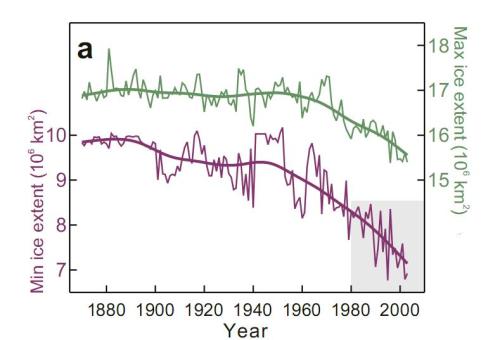
Fig. 2(a) from Polyak et al. 2010 shows that the reconstructed Arctic sea ice extent in the 1930s was comparable to that in 1979, and the modern decline is quite clear.
Seriously? You haven't noticed that nearly all the warming "evidence" seems to start around 1979? Have you looked at the actual historical temperature and climate records before then? I have. Be careful when you lecture about "long term trends", lest you end up not looking so smart.
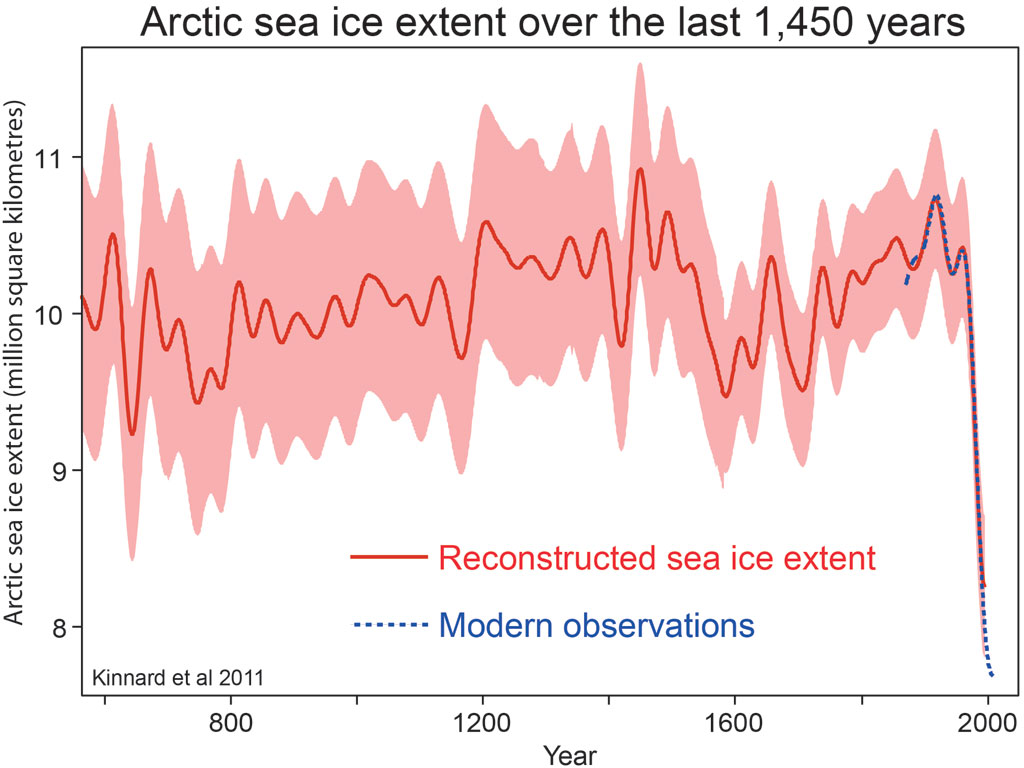
Kinnard et al. 2011 reconstructed Arctic sea ice over the past 1,450 years. Again, the modern decline is quite clear.
-
Re:Thats a good name
Yeah, that article contains good arguments in the sense that they're worth talking about, unlike the stupid denial of basic physics you have been professing. The scientists recognize the greenhouse effect and recognize the basic validity of climate models. They are trying to find an explanation for an observed inaccuracy in past predictions (the famous temporary slowdown in warming - please do note that the trend is still warming). Their explanation consists of slight inaccuracies in the data that have been fed to the model. Other explanations have subsequently been proposed , and while the topic is still subject to debate, heat getting trapped in the depths of the pacific ocean currently seems to be gaining traction as the most prevalent hypothesis, which is worrisome because once this finite heat reservoir is saturated, the heating will pick up with a vengeance (see links at the end of this post for mainstream media reports that quote the authors on making this same point).
To corroborate what I said, the article you're linking to was published in the "opinion & comment section". "Commentary articles are opinionated pieces that focus on a topical issue in climate research that is relevant to policy, the economy or society". In other words, this part of the journal is to stir up discussions. And discussions there are. Here are two articles in the same journal that cite yours:
This one says that even though the heating is slower, it's still getting hotter (yeah, it's also a commentary).
This is the famous paper that proposes a mechanism behind the observation that heat is being stored in the Pacific at an increasing rate (full peer-reviewed article).And to close, for those who don't like to dig through highly technical papers or simply don't have access, here are three mainstream media reports on that last article. This is science at work, people. It advances through hypothesis and counter-hypothesis, and you cannot just go cherry-picking one report that seems to confirm your political bias without following the further developments of the story...
-
Re:Thats a good name
Yeah, that article contains good arguments in the sense that they're worth talking about, unlike the stupid denial of basic physics you have been professing. The scientists recognize the greenhouse effect and recognize the basic validity of climate models. They are trying to find an explanation for an observed inaccuracy in past predictions (the famous temporary slowdown in warming - please do note that the trend is still warming). Their explanation consists of slight inaccuracies in the data that have been fed to the model. Other explanations have subsequently been proposed , and while the topic is still subject to debate, heat getting trapped in the depths of the pacific ocean currently seems to be gaining traction as the most prevalent hypothesis, which is worrisome because once this finite heat reservoir is saturated, the heating will pick up with a vengeance (see links at the end of this post for mainstream media reports that quote the authors on making this same point).
To corroborate what I said, the article you're linking to was published in the "opinion & comment section". "Commentary articles are opinionated pieces that focus on a topical issue in climate research that is relevant to policy, the economy or society". In other words, this part of the journal is to stir up discussions. And discussions there are. Here are two articles in the same journal that cite yours:
This one says that even though the heating is slower, it's still getting hotter (yeah, it's also a commentary).
This is the famous paper that proposes a mechanism behind the observation that heat is being stored in the Pacific at an increasing rate (full peer-reviewed article).And to close, for those who don't like to dig through highly technical papers or simply don't have access, here are three mainstream media reports on that last article. This is science at work, people. It advances through hypothesis and counter-hypothesis, and you cannot just go cherry-picking one report that seems to confirm your political bias without following the further developments of the story...
-
Re:Thats a good name
Yeah, that article contains good arguments in the sense that they're worth talking about, unlike the stupid denial of basic physics you have been professing. The scientists recognize the greenhouse effect and recognize the basic validity of climate models. They are trying to find an explanation for an observed inaccuracy in past predictions (the famous temporary slowdown in warming - please do note that the trend is still warming). Their explanation consists of slight inaccuracies in the data that have been fed to the model. Other explanations have subsequently been proposed , and while the topic is still subject to debate, heat getting trapped in the depths of the pacific ocean currently seems to be gaining traction as the most prevalent hypothesis, which is worrisome because once this finite heat reservoir is saturated, the heating will pick up with a vengeance (see links at the end of this post for mainstream media reports that quote the authors on making this same point).
To corroborate what I said, the article you're linking to was published in the "opinion & comment section". "Commentary articles are opinionated pieces that focus on a topical issue in climate research that is relevant to policy, the economy or society". In other words, this part of the journal is to stir up discussions. And discussions there are. Here are two articles in the same journal that cite yours:
This one says that even though the heating is slower, it's still getting hotter (yeah, it's also a commentary).
This is the famous paper that proposes a mechanism behind the observation that heat is being stored in the Pacific at an increasing rate (full peer-reviewed article).And to close, for those who don't like to dig through highly technical papers or simply don't have access, here are three mainstream media reports on that last article. This is science at work, people. It advances through hypothesis and counter-hypothesis, and you cannot just go cherry-picking one report that seems to confirm your political bias without following the further developments of the story...
-
Re:Deniers are too stupid to read -- prove me wron
He likes to point out how virtually every climate model has fallen down, badly, during the current warming pause.
But that happens to not be the case. The cause of the current "pause" seems to be ENSO. Climate models can't predict ENSO, because ENSO is weather not climate. If one constrains a climate model with the current ENSO conditions it turns out that the pause is modeled very well.
Kosaka and Xie (2013, Nature, doi:10.1038/nature12534)
He believes #2 for the same reason he admits that CO2 likely has a warming effect. Scientists can both explain theoretically and demonstrate the mechanisms by which they occur.
Which scientists believe that feedback mechanisms will "mute the severity of CO2-induced warming." will outweigh the feedback mechanisms that enhance global warming.
He's only seeing the things that reinforce what he wants to be true. Motivated reasoning at it's finest.
-
Paywalled...
I hope I am missing something, but it seems like:
Thanks for your help J.Q. Public!
If you are interested in the results, buy access here:
http://www.nature.com/nature/journal/vaop/ncurrent/full/nature13240.html#figuresAC CAPTCHA = "despise"
-
Re:Link
Thanks for the link to TFA. (I included a hyperlinked version for the benefit of the copy-paste impaired).
Reading that WSJ article allowed me to find the actual scientific paper in Nature Medicine , for those so inclined. Unfortunately it's paywalled except for the abstract and figures but those in the target audience of the paper probably have access through their institutions.
-
Re:Load of toss
According to the actual paper's abstract:
Here we describe the Geographic Population Structure (GPS) algorithm and demonstrate its accuracy with three data sets using 40,000–130,000 SNPs. GPS placed 83% of worldwide individuals in their country of origin. Applied to over 200 Sardinians villagers, GPS placed a quarter of them in their villages and most of the rest within 50km of their villages. GPS’s accuracy and power to infer the biogeography of worldwide individuals down to their country or, in some cases, village, of origin, underscores the promise of admixture-based methods for biogeography and has ramifications for genetic ancestry testing.[Emphasis added]
So the claims aren't as specific as some make it out to be. I guess it's sometimes good to read the ARRBTFA (Acutal Resources Referenced By The Fine Article). Just sayin'.
-
It's way cool, but read the actual study.
Don't read the moronic gizmag article. (yeah I know,
See this:
http://www.nature.com/ncomms/2...
It's pretty cool stuff. -
Re:Yucca Mountain IS the permanent storage reposit
Your friend must be lying to you then. http://www.nature.com/nature/j...
-
Statistical significance
Can't find the article available for online reading, beyond http://www.nature.com/nmeth/jo...
But one wonders about the sample size and the statistical significance of the experiments.
-
Re:Actually it's both.
Nope. Strange how many people get this wrong, it's really not that complicated.
The water doesn't work like a chain, the cohesion of water is only just enough to hold a drop of water together, certainly not enough to pull a whole column of water along through a siphon. The motion is caused by gravity BUT atmospheric pressure is needed as well (as shown in the actual experiment that was referenced in the Slashdot summary and described in more detail in Nature). Here's how a siphon acually works:
Suppose you have a source reservoir and a destination water reservoir, with the water level of the destination lower than that of the source. The reservoirs are connected by a tube that goes from the source reservoir up to an apex above both water levels and then down into the destination reservoir. The tube is filled with water (you have to start the siphon somehow by filling it with water before it can work).
Now, if you would calculate the pressure at the apex starting from the inlet, it should be equal to atmospheric pressure MINUS the water pressure from the difference in height between the apex and the source reservoir level. On the other hand, if you calculate the pressure at the apex starting from the outlet, it should be equal to atmospheric pressure MINUS the water pressure from the difference in height between the apex and the destination water level. If the destination water level is lower, the latter value for the pressure at the apex is lower than the former. Of course there can only be one pressure at the apex, which will be in between these two pressures. It is lower than what you would expect when calculating from the inlet, and higher than what you would expect when calculating from the outlet, so the pressure gradient will suck water in from the inlet and push it out of the outlet.
But note the two times I wrote "MINUS" in bold capital letters. You can't go below zero pressure. When the atmospheric pressure is too low to push the water from the source reservoir up to the apex, the siphon breaks up.
That's exactly what happened in the experiment described in Nature. They tested it with a 1.5 meter siphon in a pressure chamber. The water in the siphon broke up when they reduced pressure to below 0.18 atmosphere, which makes perfect sense because at that point the pressure at the apex would start to approach zero. The siphon actually turned into a double barometer with vacuum (or a bit of water vapour, actually) in between.
So yes, the motion is caused by gravity but you DO need atmospheric pressure or it simply won't work. In fact, if you look at it a certain way, it's not even wrong to say that atmospheric pressure is pushing the water up to the apex and therefore making the siphon work.
-
Re:Open source shovels and hoes
Weeds can become resistant to roundup but this is not a serious issue. I can be easily solved by the application of alternative herbicides when a roundup resistant strain appears. The alternative herbicide will kill the roundup resistant weeds before they spread. Without weeds leaching nutrients the crops grow healthier and fuller so the world receives more food.
Insects are somewhat trickier because of their greater mobility and faster life cycles, but there are also procedures in place to handle this. These GMO crops are very different from roundup resistant crops in that they actually attack insects by producing pesticides. Every farmer who uses GMO crops that produce insecticides is required by contract and EPA regulations to also plant non GMO refuges within every field. These refuges allow non resistant insects a place to live so that in the highly unlikely event that an insect develops a resistance it has plenty of non resistant mates available and the resistance is lost in cross breeding. There are absolutely no documented incidences of insects developing Bt resistance when the refuge system is utilized. However, just in case there are new strains being developed which use up to two of the three effective pesticides. This means that in the really truly extreme unlikelihood that an insect becomes resistant to both insecticides they simply plant another strain that uses the third type and it kills the insects.
Peer reviewed citation: http://www.nature.com/nbt/jour...
Simple diagram: http://www.bt.ucsd.edu/learn/r...
There are mountains of evidence showing that GM crops produce more food per acre and have a very positive effect on feeding the world. They are also better on the environment because they reduce the usage of harsh herbicides and insecticides. There is no credible evidence that GMO crops have any negative effect on consumers. The few studies which claimed cancer links were proven false and have since been retracted. Continuing to make this work does require ongoing research and the development of new GMO plants. This research is expensive and that's why the seeds cost more. In the end the farmers still win because the increased output of the fields more than offsets the extra cost of the seed. In the process the entire world wins because we produce more food.
That is, until fear mongering groups who have no scientific proof fight to have laws put in place to prevent anyone from growing GMO crops. In their fight to "save" the world from GMO billions of people starve due to famines that could have been prevented. -
Re:here's the data
This paper is probably relevant (suggesting scientists often need to improve their statistics).
Interesting paper. Something else peaked for me at age 24, but it definitely had a high P value. (wink wink)
-
here's the data
They calculated the mean time between switching to a new screen and then clicking on something on that screen.
Here is the data they collected. Look at it and see if you can figure out where it peaks. What are the things that strike you most about that data? The primary correlation is between skill-level and mean time, if age matters at all it is a far weaker variable.
Looking at the actual data, I would say they've found the age when people stop playing Starcraft; it's a fairly sharp drop-off. And the change in mean-switching-time is not a real effect, merely an artifact of the suddenly smaller data they have around that age. This paper is probably relevant (suggesting scientists often need to improve their statistics).
Furthermore, if you read the actual paper, you have this quote: "A second analysis of dual-task performance finds no evidence of a corresponding age-related decline." So I'm going to say there's not a story here. -
Re:What if we overcorrect?
You forget fertilizer production.. BY FAR the biggest offender from an CO2 perspective.
Fertilizer manufacture is only responsible for about 4.5% of the emssions from the food system according to this nature news article.
You will condemn to starvation a large part of the world by stopping that.
Phosphate is a limited resource. We're going to have to find a way to do without at some point. In the meantime, where there is current starvation in the Sahel and South East Asia, fertilizer is often not used each year, or not used at all, so the hit to production will occur first where it doesn't matter as much. Food prices will increase in the first world.
Carrying the nutrients off the soil each year with the crop is a bad idea. The way to put them back is to shit them back on to the agricultural land. This will eventually happen, I think. There's some social (and health) issues to overcome, but there's really no sustainable way forward that includes washing the nitrates and phosphates out to sea. -
Re:Why do people listen to her?
Peer review isn't meant to assure accuracy. It's a filter to stem the tide of obvious crap.
That's not correct. Take the referee guide from Nature.
The primary purpose of the review is to provide members of the Editorial Board with the information needed to reach a decision. It could also instruct the authors on how they can strengthen their paper to the point where it may be acceptable.
When writing the review, referees should be mindful that they are assessing the manuscript on technical soundness. Judgements on the importance of a paper will be made after publication.
To enable rapid and easy decisions we have developed a template approach. The review process will answer the following questions:
Is the paper technically sound?
Are the claims convincing? If not, what further evidence is needed?
Are the claims fully supported by the experimental data?
Are the claims appropriately discussed in the context of previous literature?
If the manuscript is unacceptable in its present form, does the study seem sufficiently promising that the authors should be encouraged to consider a resubmission in the future?
In addition to answering the previous questions, referees can provide further information, including comments that may answer the following:Is the manuscript clearly written? If not, how could it be made more accessible?
Have the authors done themselves justice without overselling their claims?
Have they been fair in their treatment of previous literature?
Have they provided sufficient methodological detail that the experiments could be reproduced?
Is the statistical analysis of the data sound?
Are there any special ethical concerns arising from the use of animals or human subjects? -
Re:Ahh, statistics
It's been pointed out that climate scientists () are often not very good at getting the statistics right.
-
Weren't they already dying?
Weren't they already in serious decline before being visited?
That first graph shows a lot larger average population before year 0 (the year of contact), which slowly grows in the 20 years after contact.
http://www.nature.com/srep/201...
The original article seems to confirm this:
http://www.nature.com/srep/201...
Estimates of population sizes before sustained peaceful contact (n = 22, recorded an average of 45 years before contact, range 1–106) were on average 5.5 times larger than populations at contact
So if populations were 5 times higher before any contact at all, why do they blame the contact for population declines?
-
Weren't they already dying?
Weren't they already in serious decline before being visited?
That first graph shows a lot larger average population before year 0 (the year of contact), which slowly grows in the 20 years after contact.
http://www.nature.com/srep/201...
The original article seems to confirm this:
http://www.nature.com/srep/201...
Estimates of population sizes before sustained peaceful contact (n = 22, recorded an average of 45 years before contact, range 1–106) were on average 5.5 times larger than populations at contact
So if populations were 5 times higher before any contact at all, why do they blame the contact for population declines?
-
Re:Huh? Why was Monsanto even on the list?
It is pretty terrifying the scale at which Monsanto has been carless with its experimentation. Their projects seem to be escaping into the wild and replicating at an alarming rate. http://www.nature.com/news/201... and http://www.kgw.com/news/USDA-N...
-
Re:Life? I doubt it.
Already pre-existing life adapting to living there is one thing - evolving there from base chemicals is another entirely.
Except that hydrothermal vents are suspected to be a good contender for where life on Earth first evolved.
-
Reply from the Nature Group
Kevin, I’m posting this as a comment here to provide clarity for all, given the interest this has generated. I’ve also written to you to suggest a conversation. I am sorry that we didn’t talk with you before we started requesting waivers from authors at Duke University, that would have been better all round. You raise two concerns: about our requesting that authors provide formal waivers of Duke University open access policy; and the ‘moral rights’ statement in our license to publish. I’ll start with the second. We take seriously our responsibility for the integrity of the scientific record. The “moral rights” language included in the license to publish is there to ensure that the journal and its publisher are free to publish formal corrections or retractions of articles where the integrity of the scientific record may be compromised by the disagreement of authors. This is not our preferred approach to dealing with corrections and retractions, and we work with authors and institutions to seek consensus first. We always attribute articles to authors, we have clear contribution policies. See: http://www.nature.com/nature/j... and http://www.nature.com/authors/... We believe researchers should be credited for their work, and as a founding member of ORCID, we have implemented ORCID integration on nature.com to foster disambiguated accreditation. We are requesting waivers from Duke University authors, because of the wide grant of rights as per your open access policy. If we do not request a waiver, Duke University has the rights not only to archive in Dukespace, but to publish and distribute the final version of a subscription article freely to the world at large, in any medium, immediately on publication. We started requesting waivers recently, following an enquiry from a Duke University author. NPG is supportive of open access. We have no problem with you archiving accepted manuscripts in DukeSpace, for public access six months after publication. We encourage self-archiving, and have done so since we implemented our policy in 2005: http://www.nature.com/authors/... This is in addition to open access publication options available on many journals we publish. We are happy to try to answer further questions, and would welcome a discussion with you. We have worked constructively with PubMed Central and institutional repositories for many years, and do not want our intentions and commitment to academic integrity and open access to be misunderstood. Grace Baynes Head of Communications, Nature Publishing Group
-
Reply from the Nature Group
Kevin, I’m posting this as a comment here to provide clarity for all, given the interest this has generated. I’ve also written to you to suggest a conversation. I am sorry that we didn’t talk with you before we started requesting waivers from authors at Duke University, that would have been better all round. You raise two concerns: about our requesting that authors provide formal waivers of Duke University open access policy; and the ‘moral rights’ statement in our license to publish. I’ll start with the second. We take seriously our responsibility for the integrity of the scientific record. The “moral rights” language included in the license to publish is there to ensure that the journal and its publisher are free to publish formal corrections or retractions of articles where the integrity of the scientific record may be compromised by the disagreement of authors. This is not our preferred approach to dealing with corrections and retractions, and we work with authors and institutions to seek consensus first. We always attribute articles to authors, we have clear contribution policies. See: http://www.nature.com/nature/j... and http://www.nature.com/authors/... We believe researchers should be credited for their work, and as a founding member of ORCID, we have implemented ORCID integration on nature.com to foster disambiguated accreditation. We are requesting waivers from Duke University authors, because of the wide grant of rights as per your open access policy. If we do not request a waiver, Duke University has the rights not only to archive in Dukespace, but to publish and distribute the final version of a subscription article freely to the world at large, in any medium, immediately on publication. We started requesting waivers recently, following an enquiry from a Duke University author. NPG is supportive of open access. We have no problem with you archiving accepted manuscripts in DukeSpace, for public access six months after publication. We encourage self-archiving, and have done so since we implemented our policy in 2005: http://www.nature.com/authors/... This is in addition to open access publication options available on many journals we publish. We are happy to try to answer further questions, and would welcome a discussion with you. We have worked constructively with PubMed Central and institutional repositories for many years, and do not want our intentions and commitment to academic integrity and open access to be misunderstood. Grace Baynes Head of Communications, Nature Publishing Group
-
Reply from the Nature Group
Kevin, I’m posting this as a comment here to provide clarity for all, given the interest this has generated. I’ve also written to you to suggest a conversation. I am sorry that we didn’t talk with you before we started requesting waivers from authors at Duke University, that would have been better all round. You raise two concerns: about our requesting that authors provide formal waivers of Duke University open access policy; and the ‘moral rights’ statement in our license to publish. I’ll start with the second. We take seriously our responsibility for the integrity of the scientific record. The “moral rights” language included in the license to publish is there to ensure that the journal and its publisher are free to publish formal corrections or retractions of articles where the integrity of the scientific record may be compromised by the disagreement of authors. This is not our preferred approach to dealing with corrections and retractions, and we work with authors and institutions to seek consensus first. We always attribute articles to authors, we have clear contribution policies. See: http://www.nature.com/nature/j... and http://www.nature.com/authors/... We believe researchers should be credited for their work, and as a founding member of ORCID, we have implemented ORCID integration on nature.com to foster disambiguated accreditation. We are requesting waivers from Duke University authors, because of the wide grant of rights as per your open access policy. If we do not request a waiver, Duke University has the rights not only to archive in Dukespace, but to publish and distribute the final version of a subscription article freely to the world at large, in any medium, immediately on publication. We started requesting waivers recently, following an enquiry from a Duke University author. NPG is supportive of open access. We have no problem with you archiving accepted manuscripts in DukeSpace, for public access six months after publication. We encourage self-archiving, and have done so since we implemented our policy in 2005: http://www.nature.com/authors/... This is in addition to open access publication options available on many journals we publish. We are happy to try to answer further questions, and would welcome a discussion with you. We have worked constructively with PubMed Central and institutional repositories for many years, and do not want our intentions and commitment to academic integrity and open access to be misunderstood. Grace Baynes Head of Communications, Nature Publishing Group
-
The publisher's response
From http://blogs.nature.com/ofsche...
"...NPG’s commitment to open access has been questioned, following our request that authors provide a formal waiver of Duke University’s open access policy. NPG is supportive of open access. We encourage self-archiving, and have done so since we implemented our policy in 2005:
'When a manuscript is accepted for publication in an NPG journal, authors are encouraged to submit the author’s version of the accepted paper (the unedited manuscript) to PubMedCentral or other appropriate funding body’s archive, for public release six months after publication. In addition, authors are encouraged to archive this version of the manuscript in their institution’s repositories and, if they wish, on their personal websites, also six months after the original publication. '
We are requesting waivers from Duke University authors, because of the grant of rights asserted in its open access policy: 'In legal terms, each Faculty member grants to Duke University a non-exclusive, irrevocable, royalty-free, worldwide license to exercise any and all rights under copyright relating to each of his or her scholarly articles, in any medium, and to authorize others to do so, provided that the articles are not sold. The Duke faculty author remains the copyright owner unless that author chooses to transfer the copyright to a publisher.'If we do not request a waiver, the general language of this policy means that Duke University has the rights not only to archive the manuscript in Dukespace, but also to distribute and publish to the world at large the final version of a subscription article freely, in any medium, immediately on publication. We started requesting waivers recently, following an enquiry from a Duke University author." [emphasis added]
Since the issue seems to be about publishing in the open immediately vs. waiting 6 months, asking for a waiver of all moral rights seems like using a cannon to swat a fly.
-
Re:Projections
Yeah! The motto of the UN and any world leaders should be "Hope for the best and prepare only for the best!" Because planning for the worst-case scenario is just ASKING for trouble. Who are these people with their negative thinking about the worlds food supply? Why, that's downright irresponsible to be pessimistic like that, according to "The Secret."
Sarcasm aside, I do sorta agree with you. They know it's going to be a problem. They don't really seem to be pointing fingers which would be the next step. I realize the top carbon emitting nations run the show at the UN, so even a toothless resolution telling the US and China to fucking stop tinkering with the atmosphere is never going to get anywhere, but it doesn't seem like anyone is trying. Furthermore, the UN is against the next logical step of cleaning it up. They seem resistant to finding out if iron fertilization in the oceans could solve it.
So they won't make moves to prevent it and they won't make moves to allow it to be reduced. They come up with suggestions, but they're all basically "deal with the problems." For instance it encourages economic diversification in response to problems with the economy. Oh, great. Cause that's not something anyone thought to do before hand. MUCH easier than causing algal blooms in the ocean to soak up the carbon. -
Why?
There is just one link to put in TFA : http://www.nature.com/nnano/journal/vaop/ncurrent/full/nnano.2014.31.html. Note that this paper never mentioned the word "contact lenses".
So why? Why do we have instead a link to some stupid news site where they clearly don't have any clue on what they are talking about? -
Re:Schwartz was a hero
> Vandalism, arson, speeding, blasphemy, slander, theft, fraud, and copying are all different.
Yes, and the laws that govern copyright violation are linked to those of theft, in theft. Please, don't pretend "copying is not theft" and that that somehow covers this case when the law is pretty clear that it _was_ theft, due to its scale.
> No. Journals are no longer expensive to run. Neither the authors nor the reviewers receive any compensation from the publishers.
Again, nonsense. They're reasonably cheap to _print_, although electronic publication has helped that a lot. They're expensive to pay the experts and reviewers that provide the analysis and editing that make these journals useful, and there are real costs with the layout and getting the often badly formatted original documents into a printable format. And some reviewers _do_ get paid, it has become part of the "fast track" to publication to get an article reviewed and published early.
There are fascinating articles about this, such as http://www.nature.com/news/ope..., and we're seeing open access journals springing. But stealing complete copies of all journals, and the indexes and cross references from JSTOR just exacerbates the problem and discredits the "information should be free" community. And yes, the charges included "theft".
>> public access which would be _impossible_ with so many journals and no organization of their contents and references, and no infrastructure to keep websites running and backups made
> Those are jobs for our public libraries.
The job is too big for libraries smaller than the Library of Congress or perhaps the British Library, or some other international institution. The Library of Congress _might_ be able to do it, if they were funded for it. But it would be taking on a job that JSTOR is already doing, as a _private_ library service and quite reasonable charges. Why should a federal agency take on a job that is being done reasonably well by private industry? And which federal program are you going to give up to fund it with?
-
Re:"Victims"
You failed as soon as you chose Wikipedia as your source.
Would you prefer Nature? (Note: linked from the Wikipedia article).
-
Re:Solar cell that emits light....
-
Re:No confirmationIt sounds like this is actually sort of the confirmation.
Last year, another telescope in Antarctica — the South Pole Telescope (SPT) — became the first observatory to detect a B-mode polarization in the CMB (see Nature http://doi.org/rwt; 2013). That signal, however, was over angular scales of less than one degree (about twice the apparent size of the Moon in the sky), and was attributed to how galaxies in the foreground curve the space through which the CMB travels (D. Hanson et al. Phys. Rev. Lett. 111, 141301; 2013). But the signal from primordial gravitational waves is expected to peak at angular scales between one and five degrees...
Furthermore, data taken with a newer, more sensitive polarization experiment, the Keck array, which the team finished installing at the South Pole in 2012 and will continue operating for two more years, showed the same characteristics. “To see this same signal emerge from two other, different telescopes was for us very convincing,” says Kovac.Nature
So it's not just one experiment, there are multiple other readings that support it, though I guess a complete experiment duplication is not yet complete. That nature article mentions that the SPT is a competitor to BICEP2, which published the findings, and they were literally a few meters away at the south pole. So I'd assume that SPT and maybe some other competitor is most of the way to confirming the findings, enough that they were confident in publishing.
That said, I'm totally not a physicist. It just sounds like this isn't a single experiment. -
Re:Science, I think not
Large parts of science are actually a cult/religion built up by the community, and discrediting one's findings by looking for plagiarism in a thesis is a symptom of that. If this were science for science's sake, your past would be completely irrelevant. Your pedigree would neither help nor harm you. Only your science would matter, and it would only matter when someone was able to reproduce your findings.
Instead we have a world where you can publish an article containing only gibberish. And not just once but over 120 times:
http://www.nature.com/news/pub...
Like any other community made up of humans, there are Emperor's Clothes, and the degree to which the importance of what scientists publish matters is just the tip of the iceberg.
-
Re:Science, I think not
Because "chicanery" is not an absolute for one. I had to look up the definition "the use of trickery to achieve a political, financial, or legal purpose." You could argue that plagarizing text is trickery to get a thesis out and finished, sure. However, if Waseda is anything like my graduate school, background text on things like stem cells were of nearly zero importance. It doesn't sound like she faked any results in her thesis, which is the only part anyone cares about.
Here was my recipie for my thesis, approved by my thesis adviser and committee: Take two papers you've already published, staple them together. Write up a third part in case I hire someone to finish the stuff you didn't. Get signatures, the end.
Theses are treated with great esteem in other graduate programs. In science, or at least biology, no one gives a shit about them. My thesis adviser heavily scrutinized the two papers making up the main part of my thesis, they got peer reviewed, but the third part probably got skimmed only by my thesis adviser. Everyone else likely didn't even open the document aside from signing it.
This is not to say "plagiarism doesn't matter," or that it shouldn't be punished, just that labeling the STAP cells as bogus because of that is an overreaction. It should and IS factoring into skepticism about the results, and it should be and is a black mark on Obokata.
As far as reproducible, it's still early. It's only a few months old. The Knopfler blog is keeping track of some efforts that have failed, but if I recall, it took a year for induced pluripotent stem cells to be reproduced. The detailed protocol was released only two weeks ago.
At this point, you can conclude that Obokata should face consequences for plagiarism in her thesis, and that the "easy pluripotent stem cells" headlines were misleading. You can also conclude that more skepticism and scrutiny is merited, though skepticism should be and already was high given how important it is. It's far too early to conclude that it's outright fraud or not science. I've been somewhat following the controversy, there's no smoking gun on the actual science yet.
Lastly, remember that these are scientists, not PR experts, politicians, or celebrities. Obokata went into hiding after this blew up, I think people smelled blood in the water from that and assumed something fishy was up and not, say, that she was overwhelmed. -
Re:Next up: a direct detection
NOTHING escapes a black hole...
Perhaps so, unless of course you believe Stephen Hawkings...
-
bullshit
Federal science funding is near an all time high (disregarding the one-time stimulus nonsense):
http://www.nature.com/news/201...
Whether billionaires also spend money on additional research makes no iota of difference to the publicly funded research.
Furthermore, large-scale government funding of research is historically a relatively recent phenomenon and closely tied to the rise of socialism and communism: socialist and communist regimes in large part tried to direct research for what their central planners considered "the public good", and the US responded in turn with nuclear weapons research, research into industrial agriculture, etc. Let's not even get into publicly funded research into social science, politics, and race. So, it isn't even clear that publicly funded research is a good thing. But whether it is or not, we have plenty of it.
-
Re:No general consensus
"There is a general consensus that ultimately photons will replace electrons running through wires in most of our microelectronic devices."
No there isn't.
We know that for silicon CMOS, Moore's law is starting to slow down and further miniaturisation is becoming much more expensive. We know that if the complexity and efficiency of microelectronics is to continue improving at its current or past pace, we'll probably have to move to something other than silicon. There are multiple possibilities, including carbon (graphene or nanotubes), semiconductors other than silicon, titanium dioxide memristors and other more exotic things. Maybe one of these technologies will enable us to push computing closer to its physical limits. Maybe more than one. Maybe none of them will, and eventually we'll just have to be satisfied with gradually refining and optimising silicon CMOS techniques even further. Optical computing has attracted some criticism about its prospects: http://www.nature.com/nphoton/... (sorry for the paywall).
There is no consensus at this point that any particular technology, optical or otherwise, is one of the next major steps in microelectronics.
I think the point that was being made is that optical will eventually replace all electrical connections. It was not saying the only jump to be from Silicon -> Optical, but rather will ultimately be replaced by Optical as a faster medium just like the advances we saw by deploying Fiber Optic cables (and the more recent push for optical-based network switches to replace existing electrical). Realistically the full Optical transition is still years away and you are likely correct that we will move to on of the other transitional architectures that are still electrical-based in the mean time.
-
Re:Tried it already. It kind of flopped.
So, would you rather have a tasty diet and live till 88, or eat the same tasty diet, just more of it, and die at 68?
This is not the answer you would like, but I'll take 68 over 88 any day of the week
Calorie restriction does a good job of extending lifespan in worms, mice and rats maintained on high-growth feed, but studies in any larger animals (including humans) don't seem to bear that out. You definitely shouldn't expect to get 30% increase in lifespan from 40% calorie restriction. Most of the strictly calorie-dependent health improvement you'll see comes from cutting back from 2600 to 1900.
In fact, while high BMI is a risk factor for developing certain diseases, once you get sick, high BMI actually decreases mortality (see, eg: http://www.nature.com/ki/journ... ).
-
Re:Why?I never said I posted a study, I said I posted an article with a study, however you can also see it at http://www.bris.ac.uk/news/201..., or crap even here http://science.slashdot.org/st....
Of course it took 30 seconds to google and find the actual study http://www.nature.com/npp/jour...
-
Re:Really?
That is what I was thinking of when I made the comment, cf http://www.nature.com/hdy/jour...
http://ncse.com/files/pub/evol...I thought the science was reasonably settled on this, apparently
-
Re:HIPAAUnfortunately, it has been shown already that the few details relevant to medical studies can often be used to uniquely identify individuals even after name and address are removed. "Yaniv Erlich shows how research participants can be identified from 'anonymous' DNA" http://www.nature.com/news/pri...
Same will be true for various kinds of employment data and census data.
-
This is not new at all
Standard policy. Nature have been doing this for some time. They state: authors are required to make materials, data and associated protocols promptly available to readers without undue qualifications. So have Cell Press and Science. I stopped searching at this point, but I'm sure other major journals do the same thing.
-
Re:Predictive Power
The Pacific Decadal Oscillation causes oscillations in the warming pattern as well. It doesn't change the overall picture for global warming: The oceans were assumed to heat up somehow, and now we have details about that process and how it affects surface temps.
-
Re:DOI not found.
-
Re:DOI not found.