Slashdot Mirror
Domain: nhk.or.jp
Stories and comments across the archive that link to nhk.or.jp.
Comments · 75
-
Evacuation radius expanded again, now to 20km.
Just announced on the NHK channel.
-
Explosion
According to this Japanese article, TEPCO (the power company that runs the reactor) reports that at about 3:30 pm local time (1 hour 40 minutes ago) an explosion was heard and white smoke could be seen coming from the number 1 reactor. A few workers have been reported to be injured.
-
Re:discrepancy
Maybe you wanna check this: http://www3.nhk.or.jp/daily/english/12_45.html or this http://slashdot.org/submission/1496534/JapanCaesium-measured-melt-down-may-have-started
-
NHK
Since most foreign media just use NHK news, here is the link to their english website:
http://www3.nhk.or.jp/daily/english/index.html
I am in japan and following this very closely
-
Re:Its really
There are alternative sources if one looks. Some material may be objectionable, viewer discretion is advised.
Besides the U.S. commercial and cable broadcasters, there is news service on PBS stations with some streaming and podcasts available from http://www.pbs.org./ Many PBS and other public stations also carry the BBC which has much available on the web too.
http://www.bbc.co.uk/news/A great many international newscasts are carried by the non-profit public satellite broadcaster MHz on their WorldView channel. (They have a number of other international channels also)
This guide is easier to browse than the one on their website:
http://proweb.myersinfosys.com/day.php?timezone=0&station=world&channel=MHz+Worldview&airdate=They have free news and paid programs on-demand streamed through ROKU
mhznetworks.org/rokuMany of the news sources they carry have websites with some content available, here are some:
http://www.dw-world.de/ (Deutsche Welle from Germany)
http://www.euronews.net/
http://www.france24.com/en/
http://www.rt.com/ (Russia Today)
http://www.aljazeera.net/english
http://www.youtube.com/profile?user=AlJazeeraEnglish#g/u
http://www.nhk.or.jp/nhkworld/ (NHK Newsline)
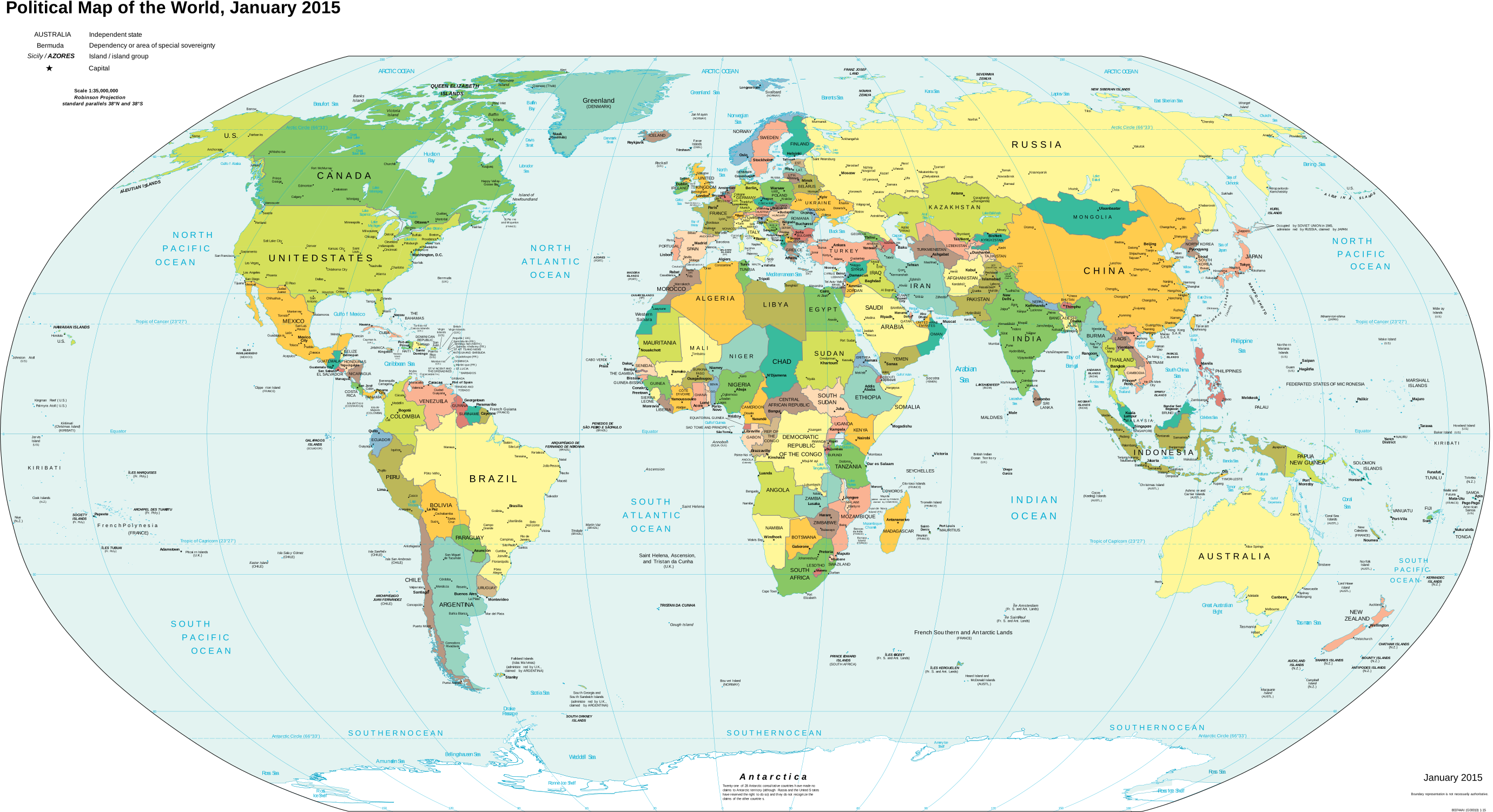
http://www.youtube.com/taiwanmactvNot sure where a country is? Here's a good but simple map.
http://upload.wikimedia.org/wikipedia/commons/3/3f/CIA_WorldFactBook-Political_world.svgMore info and a list of stations carrying WorldView:
http://www.mhznetworks.org/mhzworldview/Sometimes a station has them on a secondary digital channel (Like KCET 28.4 Los Angeles) that isn't on cable. Ask your cable operator to add it if they're not carrying the feed.
-
Kids these days don't get appsYou'll be surprised that they can spend many hours running Flash or Java straight off websites. I would however load TuxPaint and shortcuts on the desktop to some safe and attractive starting points like Club Penguin as well as your choice of national broadcasters "kids" site (e.g. Australia - ABC for Kids, US - PBS Kids, Japan - Kids World).
The main thing though is to control logon time using NET USER. I'd only allow a one or two hour slot each day and one or two rest days with no access permitted. Be brutal and blame the computer when it says "logon has time limits".
-
Re:3D
I don't really see it that way.
Rather, this is the typical theater vs. home wars, bumping up to the next level. It's clear that Hollywood, Inc. has discovered that "3D" in films, when used to actually enhance the film (rather as the gimmick it's been in the past) is fairly compelling. More people saw "Avatar" in 3D than normal, and this film is now the highest grossing in history, and the first to pass the $2 billion mark. And that's just box office.
The 3D thing is really overblown, anyway. It's largely a change in software on the Blu-Ray player, as the upgrades from Sony illustrate. It will work with some of today's TVs as-is, but a 3D aware television may offer better results, as would higher speed interfaces.
Most people are completely happy with Blu-Ray, and really do appreciate the difference between HD and SD (the difference between Blu-Ray and DVD is greater than the difference between DVD and VHS... and Blu-Ray is growing faster than DVD did at the same point in its evolution). What they're not ready for yet is $250+ for a player. So player sales only grew 67% in 2009 over 2008. Most industry watchers predict the crossover in media sales in 2012 or 2013. Today, Blu-Ray accounts for 10%-30% of media sales, depending on the release. In the last quarter of 2009, Blu-Ray media sales grew by 35% in the USA. DVD sales in the same quarter fell by 17%.
This is hardly an usual thing, but in fact, exactly what you sign up for when you make things based around computers. It was difficult to grow media formats in a compatible way back in the analog days, but for this, the 3D is just an optional add-on. Older players will just play the 2D version, and 3D-aware players will offer you a choice, or perhaps even only offer that choice in the presence of proper 3D viewing gear.
Hollywood, Inc. is already moving on. Most of the digital projectors in theaters these days have been 2K format projectors (nominally 2000x1000 pixels), which is essentially just the same as HDTV. They're moving rapidly to shooting in 4K (nominally 4000x2000), and beyond. Some folks in Japan have already shown off a prototype 8K television (nominally 8000x4000... http://www.nhk.or.jp/digital/en/super_hi/index.html). It just never ends.
Of course, it really does end. You can see 1080p just dandy on a computer monitor... I'm about 2ft away from my dual 1200p monitors here, and I see it fine. But at a normal television viewing distance, you can't tell the difference between 1200p/1080p and 720p. Unless you're Superman, or at least Harvey Birdman. I have a 71" 1080p television in my media room. Most people will see an advantage to 1080p at 10-12 feet from the screen, which is an absolutely reasonable viewing distance, within the THX optimal viewing range, and just a bit short of the SMPTE optimal viewing range (both THX and SMPTE are based on your angle of view).
To get much out of a 4K screen, I'm going to have to sit closer than ft, or get a very gigantic screen. Of course, when I grew up, my parent's "big screen" TV was a 25" Sears console... that was the largest they ever owned, at least while I was at home. Could be some go larger in the future. But how many people really have room for 100" + screens. Ok, if you're offering, sure, I'll make it fit...
-
We're still seeing the same thing today
Just as we say today "wow, they had 737i prototypes in 1958!" one day in the future we will marvel "wow, they had 4096p prototypes all the way back in 2002!"
-
Re:Opportunity
The Japanese self-defense forces (military) took a photo of a whitish 50m by 3km spot in the Pacific (Japanese only, but if you click on the image you can see a video) that they think might be where the missile went down.
-
Make it a game show
Have celebrities on who need to guess why something is the way it is or what something is given multiple choices and make sure the guest celebrities are witty as are the hosts. Wild, colourful sets also required. Imagine the old Hollywood Squares focussing on just one or two topics ranging from heart disease to tofu cooking. Include short segments interviewing experts in the field and carry out experiments and trials with outside people as well as the guests.
Japanese TV has perfected this means of science (and other) general knowledge education through two shows my family watches all the time:
Tameshite Gatten! (Try it and Discover)
Sekai Ichiban Uketai Jugyou. (World's best/most useful/want to learn classes)
We learn a ton of practical, interesting things whilst laughing our asses off. -
Re:Graphics processing power
Just found myself another link of this http://www.nhk.or.jp/digital/en/superhivision/ind
e x.html -
Re:Camera Phones Suck
Actually, camera phones do have uses beyond taking fuzzy pictures of your drunk friends. Unfortunately they don't seem to be coming over to the states for some reason.
If you've seen any Japanese magazines or websites lately, you'll notice square barcode-type things on some ads or sites. See the bottom left of this site. They allow you to use your phone camera to take a pic, then your camera web browser goes to an address encoded in the pic without having to type in the address. Basically the same thing Cue:Cat did, but on commodity hardware.
Okay, now you're thinking, "So what? I can get ads easier?", but there are other uses for the technology, too. I've heard some European countries have methods of paying for stuff using a cell phone, where you take a pic of a barcode like that, and the price is charged to your cell account.
Basically, don't just think of it as "A crappy camera glued to a cell phone", but as "An optical sensor attached to a pervasivly-networked device". There is a world of possibility in using it as an input device for ubiquitous computing. Where other attempts to make computer interaction seamless in the real world have failed, the camerphone might succeed because it uses technology that is useful for other things (camera + phone, regular printer + ink), and widely adopted by the public already. It's all a matter of software to make it useful, no new harware needed. -
Re:How to feed it ?
NHK Super Hi-Vision, of course.
-
Re:Why i?
They state on the NHK site that the 16:9 super-duper-neato camera captures progressive images.
Matthew Jeppsen
www.FresHDV.com -
A bit more info and obvious first applicationThere's a little more info on the Open House 2005 site (where it was demo'd) that includes a graphic and mentions that it "employs a 22.2 channel 3D loudspeaker arrangement to realize excellent sound field reproduction and a wide listening range"
As with many new technologies, the p0rn industry will probably be the first to deploy this 33,177,600 pixel technology. Boy, I feel a bit inadaquate as my halloween webcam (goes offline Saturday night) only has 337,920 pixels (704x480) - I guess size matters, eh?
-
NHK tried this for a while in Japan
NHK (Japanese public TV) tried using a 3D weather map something like this--not spherical, but an angled view of the archipelago--on their nightly news program for about a year, then it disappeared. They didn't give any explanation, at least as far as I know, but from personal experience I assume it was because (1) it was harder to read/interpret than the regular 2D map and (2) the camera shook like crazy whenever they panned across it (it looked like they were panning across some sort of bluefield and putting the 3D images in through CGI).
-
Re:Not exactly the first...
Many of these appear to be typos from Japanese domains:
marketing.jp/
tk2nd.dip.jp/
www.adtek.co.jp/
www.kirin.co.jp/
www.kt.rim.or.jp/
www.nhk.or.jp/
www.portopialand.co.jp/
www.sagawa-exp.co.jp/
www.smt.city.sendai.jp/
www.taiyogo.co.jp/ -
Re:Forget IBOC - The rest of the world has DAB
Indeed, Europe, Canada, Australia,... all are adapting DAB. The only other exception is Japan, which introduced its own standard, ISDB-T (Terrestrial Integrated Services Digital Broadcasting) in 1998. This standard covers both digital radio and television.
Another article on ISDB-T. -
A picture tells a thousand words
ASCII art is great for porn but for technical stuff I prefer real images. This image cleared things up for me.
-
Re:Just dont buy one..quite a bit.
Wi-Lan isn't Wi-Fi (802.11b)- wi-lan is W-OFDM, wireless t1/e1- and they have a great technology for the reception of HDTV so that you don't get the silly black blocks that disrupt signal,-- but instead, the FCC chose to back 8-VSB, an inferior technology.
The greater question is, why is the FCC deciding this? They didn't decide which cell phone technology was going to reign, only which frequencies we'd use.
Sources? http://www.wi-lan.com
commentary: If we were to follow the 'lead' from the ATSC then this is what the future would look like. The Americans are still in denial about the Brazilian (and other) DTT test results (denying the basic facts that a single carrier system can never work for wireless DTT) and have carried out their own tests arriving at their own conclusions using incorrectly configured DVB-T equipment. The sooner the US drops its single carrier 8-VSB based standard in favour of an OFDM solution the better for all concerned. A report summarising why DTV is not happening in the US (example of flawed thinking: DTV does not necessarily mean HDTV). Unfortunately, DVB and ISDB have (so far) been unable to agree on a common OFDM way forward even though both standards are nearly exactly the same (ISDB improved the DVB-T standard with the addition of extra time interleaving, band segmentation and the option for 4k carriers). However, due to the wide acceptance of DVB-T and its myriad other supporting standards it is unlikely that ISDB compliant equipment will ever be deployed outside of Japan.
Take-up of Digital TV in the UK has been the most successful in the world in percentage terms (the US is not far behind); but can it continue to grow at the same pace? ITVdigital, the DTT service provider in the UK, launched with an early (2k carrier) release of DVB-T and had been reasonably successful (although I am sure some would disagree?) with over 1.2 million subscribers up to the end of 2001. Unfortunately, due to a combination of factors ITVdigital are in danger of closing down and are currently in administration. The BBC in their annual R&D review for 2000-2001 (Digital Television Distribution section) list some of the issues associated with DTT in the UK and give an interesting insight into how improvements can be achieved. Thanks to the wealth of experience gained in the UK other European DTT service providers will be able to provide a more advanced and improved service to their customers. Get the insider views on the UK DTT experience from the following newsgroup: uk.tech.digital-tv;
-
Integral photographyIntegral photography dates from the 19th century. Here's an explaination. It trades resolution for depth inefficiently, although there's been some work in the UK on compressing integral TV images.
This group is using the technique to extract depth using a single HDTV camera. That makes sense, although the approach is somewhat low-res. Depth extraction from stereo images is commercially available, and is an alternative to this approach.
-
Re:Ummm... No.
As well as converting to digital, they are also putting all the data on smaller cassetes. As http://www.strl.nhk.or.jp/open99/co-4/shosai-e.ht
m l explains, the data/cassete volume ratio increases by 20 times(the small cassetes hold the same amount of data as D-3 cassetes but have a much smaller volume) -
Official site for NHK digital broadcast
The official site with more information is available at:
NHK Digital
or NHK Digital(English translation) -
Official site for NHK digital broadcast
The official site with more information is available at:
NHK Digital
or NHK Digital(English translation) -
Maybe not! (Was:Alas.....)Copied from BBC's Tommorow's World
Unlike traditional three dimensional (3D) television, which uses two cameras simultaneously to give a sense of perspective, this new system uses just one camera, but with a special lens, made up from 2500 tiny micro-lenses. These micro-lenses split the picture into thousands of tiny images, each with a slightly different view of the object. This means the camera is filming from hundreds and hundreds of different angles, all at the same time.
I have a dominant eye, so I don't use stereoscopic vision. But I saw this on the program and the picture on the 3D TV showed a few geometric shapes at different depths. They moved the camera dolly sideways and it looked like it was completely 3D.
Another interesting link is: NHK Research labs
Captain SpankMunki
--
When in danger, or in doubt,
Run in circles, scream and shout