Slashdot Mirror
Domain: noaa.gov
Stories and comments across the archive that link to noaa.gov.
Comments · 2,602
-
Re:Method of living for the socially challenged: W
> the President is not someone who would
> jeopardize the livelihood of hundreds of
> millions of americans for a little profit
What did you smoke, buddy?
The Bush administration has systematically cut the spending on all types of essential infrastructure in the U.S. Not only did they ignore the flawed flood protection systems that New Orleans had but they've done it everywhere else in the nation.
Not only that, Bush was informed by NOAA (The National Oceanic and Atmospheric Administration) on August 2nd that there was a 95% to 100% likelihood of a major hurricane in the August-September time frame in the Gulf. Bush and Cheney did absolutely nothing to prepare for a possible Katrina. It had been know for several years that the levees in New Orleans would not be able to sustain a level 3 hurricane.
32 hours before Katrina hit, state and city authorities in Louisiana asked Bush for federal assistance. All they got was a click on the phone.
Only 5 days after the catastrophe was a fact the U.S. military finally was ordered to moved in.
As the Senate Minority Leader Harry Reid asked: "Where were you, Mr. Bush? Were you the President?"
What now is known is that Bush and his ventriloquist, Dick "dick" Cheney, rejected all offers to get refined petroleum from around the world. Many countries offered gasoline to the U.S. but Bush and Cheney wanted the gasoline price to go up in order to loot the American people even more. (In fact, there is no shortage of petroleum in the U.S. or the world and about $40 of the price per barrel is pure speculation.) This was the only executive action they took.
Fortunately, there is a paradigm shift taking place in Washington, D.C. and around the country. People are now calling for great infrastructure projects like a new New Deal, a TVA-style (Tennessee Valley Authority) project for the Gulf Coast, an American Marshall plan to rebuild the nation. This goes for not only Democrats but certainly also for most of all the sane Republicans. Only a small, and now increasingly isolated, group inside the Republican Party are crazy neo-cons. Remember, the Republican Party is the party of Lincoln and many Republicans want to go back to Lincoln's tradition of infrastructure building and real production. Bush is not a Republican, he's an idiot. Hopefully he (and Cheney too) will be impeached soon.
-
Re:Preemptive strike against biological weapons.
-
Re:Easy way to control hurricanes:
"[...] is in a fairly standard path for hurricanes [...] the strongest [hurricane] to hit New Orleans was in 1915."
So this "fairly standard path" will send a strong hurricane once every 90 years?
I'm not sure how many "strong storms" there were in between the two events that struck New Orleans, but keep in mind that it's a rare storm that reaches the strength required to break those levees. Florida is pummeled all the time, but Andrew was a stunning blow. To a lesser extent, the same is true of Cape Cod. They get hit by a major storm very rarely, but every 10 years or so even they get a cat 2 or 3.
My point was that we can't run around saying "look how much worse man has made things" (paraphrase of parent of my original post) when this wasn't the largest storm they've been hit by.
To give you a sense, 2001-2004 there were 9 hurricanes that struck the U.S., of which 3 were "major" (cat 3+). That's well above the norm compared to the 90s, where the whole decade saw 14 storms (5 major) and even moreso for the 80s. However, compare that to the 1941-1950 decade! 24 storms (10 major). See U.S. Hurricane Strikes by Decade on the NOAA site for details.
Let me quote the NOAA:"Beginning with 1995 all of the Atlantic hurricane seasons have been above normal, with the exception of two El Niño years (1997 and 2002). This contrasts sharply with the generally below-normal activity observed during the previous 25-year period 1970-1994 (Goldenberg et al. 2001, Science)." -
Now, had the last 10 years been a high-activity period compared to the last 200 years, then I would be inclined to think of this as a "change" in behavior, but it's not, it's simply a return to a periodic swell in activity.
As for the rest of your article, you are misinformed if you think the storm didn't hit New Orleans. See the track on the NOAA site. Buras-Triumph, Louisiana took the first hit, but the storm walked right over the delta and smacked N.O. good and hard!
Also, the predictions that a major storm would hit New Orleans were not of the "perhaps sometime in the next 100 years" sort. Expectations were set every season that a major storm might well hit SOON, and indeed, it did. -
Re:Easy way to control hurricanes:
"[...] is in a fairly standard path for hurricanes [...] the strongest [hurricane] to hit New Orleans was in 1915."
So this "fairly standard path" will send a strong hurricane once every 90 years?
I'm not sure how many "strong storms" there were in between the two events that struck New Orleans, but keep in mind that it's a rare storm that reaches the strength required to break those levees. Florida is pummeled all the time, but Andrew was a stunning blow. To a lesser extent, the same is true of Cape Cod. They get hit by a major storm very rarely, but every 10 years or so even they get a cat 2 or 3.
My point was that we can't run around saying "look how much worse man has made things" (paraphrase of parent of my original post) when this wasn't the largest storm they've been hit by.
To give you a sense, 2001-2004 there were 9 hurricanes that struck the U.S., of which 3 were "major" (cat 3+). That's well above the norm compared to the 90s, where the whole decade saw 14 storms (5 major) and even moreso for the 80s. However, compare that to the 1941-1950 decade! 24 storms (10 major). See U.S. Hurricane Strikes by Decade on the NOAA site for details.
Let me quote the NOAA:"Beginning with 1995 all of the Atlantic hurricane seasons have been above normal, with the exception of two El Niño years (1997 and 2002). This contrasts sharply with the generally below-normal activity observed during the previous 25-year period 1970-1994 (Goldenberg et al. 2001, Science)." -
Now, had the last 10 years been a high-activity period compared to the last 200 years, then I would be inclined to think of this as a "change" in behavior, but it's not, it's simply a return to a periodic swell in activity.
As for the rest of your article, you are misinformed if you think the storm didn't hit New Orleans. See the track on the NOAA site. Buras-Triumph, Louisiana took the first hit, but the storm walked right over the delta and smacked N.O. good and hard!
Also, the predictions that a major storm would hit New Orleans were not of the "perhaps sometime in the next 100 years" sort. Expectations were set every season that a major storm might well hit SOON, and indeed, it did. -
Could always Nuke em
http://www.aoml.noaa.gov/hrd/tcfaq/C5c.html/
NOAA does NOT suggest the detonation of nuclear ordenances to slow or stop hurricanes.
Thing is, the link above is NOT a joke -
Re:N'awlins doesn't NEED to be RIGHT THEREI've just about lost my patience with people saying stuff like this. No one who has ever spent any time in New Orleans, or even looked at the area on a map at sufficient detail, would suggest that we "just build it somewhere else".
Here are some satellite photos of New Orleans taken after 8/28. The building I worked in was in the central business district, near the top of the big U of the river. The first floor of that building, and most others in the CBD, was flooded. As you may be able to guess from the name, the central business district is not heavily residential.
The city is squeezed between the lake and the river, and is flush up against them both. There ain't a lot of room below the river, and that would be moving you closer to the ever-eroding wetlands, anyways. All pragmatics aside, there is something special about the city as it has developed. There is a unique culture there, which someone from the cornfields of Iowa can be excused for not being able to comprehend, that this country would be poorer without.
Without dirt and darkness and struggle, all art would be appropriate for a hallmark card. Do you want to live in a world like that?
As far as Habitat for Humanity goes, we don't need you. Go spend your money on Bourbon Street.
By the way, it's either New Orleans or NOLA. The N'awlins spelling is only found on tourist brochures. Did you know you can actually tell what part of the city someone is from by the way the pronounce New Orleans? It's true. Also, because our house was near Tchoupitoulas, we were safe, from the flood, anyways.
-
Re:Foolish arroganceI refer you to NOAA's own FAQ on the subject of hurricane alteration/modification. Specifically, I refer you to section C5: http://www.aoml.noaa.gov/hrd/tcfaq/tcfaqHED.html
As when Man messes with Nature, unforeseen or expected consequence are often the result. Keeping Nature at bay is not the same as bringing it under our direct and managable control.
As to controlling hurricanes with regards to chaotic system, the fundamental problem is one of initial conditions. As it is well-known, small differences produce large effects. Lorenz proved this in his attempts to predict weather in the 60's. The same problem still remains. And the inputs you talk about controlling are vast.
And we need to understand the process by which a tropical wave makes the transition to tropical depression and evolve into a full-blown hurricane. We currently do not understand how this happens. And even when we do learn and are able to predict with a decent amount of accuracy which storms will become hurricanes and better able to predict their tracks, what then? The expenditure of tens of billions of dollars to prevent one possible landfall of a major hurricane just to save some man-altered coastline?
I don't see it as a possibility that we can stop a hurricane. You could drop every nuclear weapon on earth into it and it would just keep on coming. Nature can churn up a million cubic feet of atmosphere and sustain the forces involved for two weeks at a time (the life of an average hurricane). There isn't enough energy on the planet for us to harness that can match that.
If we are able to precisely measure the initial conditions that lead to hurricane genesis, small changes might yield useful effects. But then we would need to predict the effects of those changes with like accuracy. People in the future would be none-too-pleased to have a prediction go wrong and a hurricane that was supposed to stay out to sea turn in and hit their homes intead. As Katrina is showing, politicians are real quick to point fingers. However, the precision required for this would probably require sensors operating at cubic inch resolution and that is simply not doable (and it is probably a conservative estimate). Not to mention the mere presence of sufficient numbers of sensors could alter the initial conditions themselves and thus invoke Heisenberg's Uncertainty Principle. Isn't chaos grand?
-
Re:Global Impact
" Despite your depressing analysis, things are not getting worse"
Whether the other poster was correct or not your anaylsis that things are not getting worse is incorrect. I think if nothing else the size of the Yearly Ozone hole over tha Antarctic is one of the solid pieces of evidence that that is true.
Some links to back up the connection of Hurricane and global warming (not making judgement of who is politically responible for the situation but if we don't act soon politialy/globally
http://www.aoml.noaa.gov/hrd/hrd_sub/dynamics.html
http://www.realclimate.org/index.php?p=181#more-18 1 -
New Orleans explanation
This is long, and you may not read it all, but it offers a lot of insight into the New Orleans situation
SPEAKING TRUTH TO HYSTERIA
The rains from Katrina's aftermath had barely begun to taper off before the utterly predictable, knee-jerk, blame-Bush for everything hysteria began to rage. The attacks are loud, strident and given top billing by the media, who have shamelessly and blatantly added their own negative, anti-Bush spin without investigating the facts or questioning the political motives of the critics.. It seems, those of us who look to the actual facts before we draw our own conclusions are forced to endure a hurricane of rhetoric, speculation, and just plain nonsense. So don your waders, as there are some actual facts amidst all the debris. Let's start with the tin-foil hat stuff.
THE THEORIES OF THE LUNATIC FRINGE: THE DEMOCRATS AND THE MEDIA.
CLAIM: Global warming is Bush's fault and global warming caused Katrina.
First, of course, hurricanes in the US have not in fact been increasing in number or intensity since the supposed onslaught of global warming. As this schedule from the national weather service ( http://www.nhc.noaa.gov/pastdec.shtml) shows, both the number and intensity have actually decreased in recent decades, and were generally much more severe in the first half of the century.
More to this point, however, let's accept the global warming alarmists on their own terms, and assume global warming caused Katrina without inquiring too closely into what caused all those other hurricanes. Had Al Gore been elected President in 2000, and the day after his inauguration managed to get the US Senate (who had rejected the Kyoto Protocol
95-0 during the Clinton administration) to ratify and then fully implement its provisions in the US immediately, and had every other major country in the world also done so, the projected decrease in global warming after 20 years was projected, by its own proponents, to be only 0.7 degrees centigrade. In the first few years, that is, by now, even if it had been implemented in 2000, the supposed decrease would be essentially zero. So there is simply no conceivable scenario in which Bush's policies could possibly have had an impact on hurricanes. These claims, retailed widely in major US newspapers and by German and other European politicians, are nothing but despicable political posturing.
CLAIM: The Iraq war has dangerously depleted our National Guard Resources,and that's why help took so long to arrive.
Facts can be your friend. There are roughly
1,000,000 army personnel in the US, including active duty, National Guard and reserves. A bit over 100,000 or 10% are in Iraq (the rest of the forces over there are from the other branches of service). The Pentagon has agreed with the states that it will not mobilize more than 50% of the National Guard from any state, and only about a third of Louisiana's National Guard is on active duty. The National Guard units that have been mobilized for active duty in Iraq are for the most part heavily armored combat units, not the more lightly armed military police and search and rescue units that are the primary source for domestic disaster support.
You might never know this if you watched network news, but the Commander-in-Chief of each state's National Guard is the governor of the state, not the President, unless and until the National Guard units are called by the Department of Defense to active duty. It is also worth noting that it is against federal law, the long-standing Posse Comitatus law, for active duty troops to be used for law enforcement-the only National Guard troops that can be used this way are those commanded by state governors. There has been some talk since 9/11 of repealing or amending the Posse Comitatus law, but the changes were strongly opposed by groups from both the left and right.
Would it also be crass to point out the undeniable fact that by Sunday, September -
Re:Easy way to control hurricanes:This is 'insightful?'
Take a look at the actual NOAA data, and you find that for the past several decades we have been in a *lull* of hurricane activity, and that's just recently started to swing back the other way.
The NYT has this to say:Because hurricanes form over warm ocean water, it is easy to assume that the recent rise in their number and ferocity is because of global warming.
But that is not the case, scientists say. Instead, the severity of hurricane seasons changes with cycles of temperatures of several decades in the Atlantic Ocean. The recent onslaught "is very much natural," said William M. Gray, a professor of atmospheric science at Colorado State University who issues forecasts for the hurricane season.
From 1970 to 1994, the Atlantic was relatively quiet, with no more than three major hurricanes in any year and none at all in three of those years. Cooler water in the North Atlantic strengthened wind shear, which tends to tear storms apart before they turn into hurricanes.
In 1995, hurricane patterns reverted to the active mode of the 1950's and 60's.
Only on -
Ask the experts...NOAA
The Hurricane Research Division of the Atlantic Oceanographic and Meteorological Laboratory has a section of their FAQ dedicated to "Tropical cyclone modification and myths".
As for the submitter's ideas, well, I don't think NOAA will be sending him the Segway he asks for on his home page. Take his "plowing" idea. Please. (Thanks, I'll be here all week) I haven't done the math but I'd think that towing a device a half mile wide that extends several feet below the surface of the water would slow a submarine more than 10 mph. But let's say you had an army, er, navy of submarines to plow up a square 465 miles on a side over a month. The mixing wouldn't last that long, and such an area is miniscule compared to the area of tropical cyclone formation.
The sprinkler idea has problems on many fronts. Even if you could deploy hundreds of such sprinklers the amount of water brought up would not effectively cool the surface. The cooler water would be rapidly warmed by the sun.
The iceberg idea is dealt with in the FAQ linked above. He sure seems to have a thing for submarines though. Submarines are probably the worst choice craft to accomplish his scheme. They're not designed for surface travel. Better to use surface craft for all the towing (plows, sprinklers, icebergs) required.
And yes, I am a meteorologist, though not a tropical meteorologist, and none of these answers required meteorological answers. Kudos to the submitter on getting his home page posted on Slashdot! -
Re:energy
According to the 1993 World Almanac, the entire human race used energy at a rate of 10^13 watts in 1990, a rate less than 20% of the power of a hurricane. http://www.aoml.noaa.gov/hrd/tcfaq/C5c.html
-
From the NOAA FAQ...
Found this interesting reply to the parent, from our good friends at NOAA...
Why don't we try to destroy tropical cyclones by (fill in the blank)?
http://www.aoml.noaa.gov/hrd/tcfaq/C5f.html
There have been numerous techniques that we have considered over the years to modify hurricanes: seeding clouds with dry ice or Silver Iodide, cooling the ocean with cryogenic material or icebergs, changing the radiational balance in the hurricane environment by absorption of sunlight with carbon black, exploding the hurricane apart with hydrogen bombs, and blowing the storm away from land with giant fans, etc. (Some of these have been addressed in detail in this section of FAQ's.) As carefully reasoned as some of these suggestions are, they all share the same shortcoming: They fail to appreciate the size and power of tropical cyclones. For example, when Hurricane Andrew struck South Florida in 1992, the eye and eyewall devastated a swath 20 miles wide. The heat energy released around the eye was 5,000 times the combined heat and electrical power generation of the Turkey Point nuclear power plant over which the eye passed. The kinetic energy of the wind at any instant was equivalent to that released by a nuclear warhead. Perhaps if the time comes when men and women can travel at nearly the speed of light to the stars, we will then have enough energy for brute-force intervention in hurricane dynamics.
Human beings are used to dealing with chemically complex biological systems or artificial mechanical systems that embody a small amount (by geophysical standards) of high-grade energy. Because hurricanes are chemically simple --air and water vapor -- introduction of catalysts is unpromising. The energy involved in atmospheric dynamics is primarily low-grade heat energy, but the amount of it is immense in terms of human experience.
Attacking weak tropical waves or depressions before they have a chance to grow into hurricanes isn't promising either. About 80 of these disturbances form every year in the Atlantic basin, but only about 5 become hurricanes in a typical year. There is no way to tell in advance which ones will develop. If the energy released in a tropical disturbance were only 10% of that released in a hurricane, it's still a lot of power, so that the hurricane police would need to dim the whole world's lights many times a year.
Perhaps some day, somebody will come up with a way to weaken hurricanes artificially. It is a beguiling notion. Wouldn't it be wonderful if we could do it ?
Perhaps the best solution is not to try to alter or destroy the tropical cyclones, but just learn to co-exist better with them. Since we know that coastal regions are vulnerable to the storms, building codes that can have houses stand up to the force of the tropical cyclones need to be enforced. The people that choose to live in these locations should be willing to shoulder a fair portion of the costs in terms of property insurance - not exorbitant rates, but ones which truly reflect the risk of living in a vulnerable region. In addition, efforts to educate the public on effective preparedness needs to continue. Helping poorer nations in their mitigation efforts can also result in saving countless lives. Finally, we need to continue in our efforts to better understand and observe hurricanes in order to more accurately predict their development, intensification and track. -
Good answer to this at NOAA
This is a common question and there were indeed some experiments at hurricane modification. Most of the common ideas, including some of the ones that the original author proposes, are explained it the NOAA FAQ on tropical storms in the section TROPICAL CYCLONE MODIFICATION AND MYTHS.
-
Re:Six Flags Under Water
I am a season pass holder for Six Flags New orleans. I am looking for pictures of Six Flags New Orleans after Katrina hit. I went to this websitehttp://ngs.woc.noaa.gov/katrina/KATRINA000
0 .HTM, but I never could find it. I went to New Orleans & Lake Ponchatrain. Could someone please give me a clue to which block to click & where to click like New Orleans & Lake Ponchatrain. I would appreciate it. -
Does something weird on Firefox 1.0.3 on Linux
I entered the html in hex editor as from:
http://it.slashdot.org/comments.pl?sid=161697&cid= 13519728
and clicked on the link. The link pointed to:
https://xn--m1aaaaaaaaaaaaaaaaaaaaaaaaaaaaaaaaaaaa aaaaaaa/
and firefox downloaded this:
http://www.srh.noaa.gov/abrfc/archive/1996/aug/rvm files/96083106_1_rvmshv -
New X5 Flare
The current space weatherwith x-ray data and forecast. I haven't looked at SOHO images yet, so I can't say whether the CME is Earth-directed or not, or even if there is one.
-
Re:Caused by ...
But the frequency of large hurricanes is increasing, if the data is correct.
Wrong. Here is the data from the National Hurricane Center on number of major hurricane strikes to the U.S. mainland each decade. Please show me where in this data the number of large hurricanes is increasing?
Don't blindly buy into the "frequency of large hurricanes is increasing" myth being pushed by many so-called environmentalist. They have a political agenda, pure and simple. -
Being alert for a Solar Flare HOWTO
- Download & install gkrellm
- Download & install Gkrellkam plugin (it's for getting images from webcams).
-
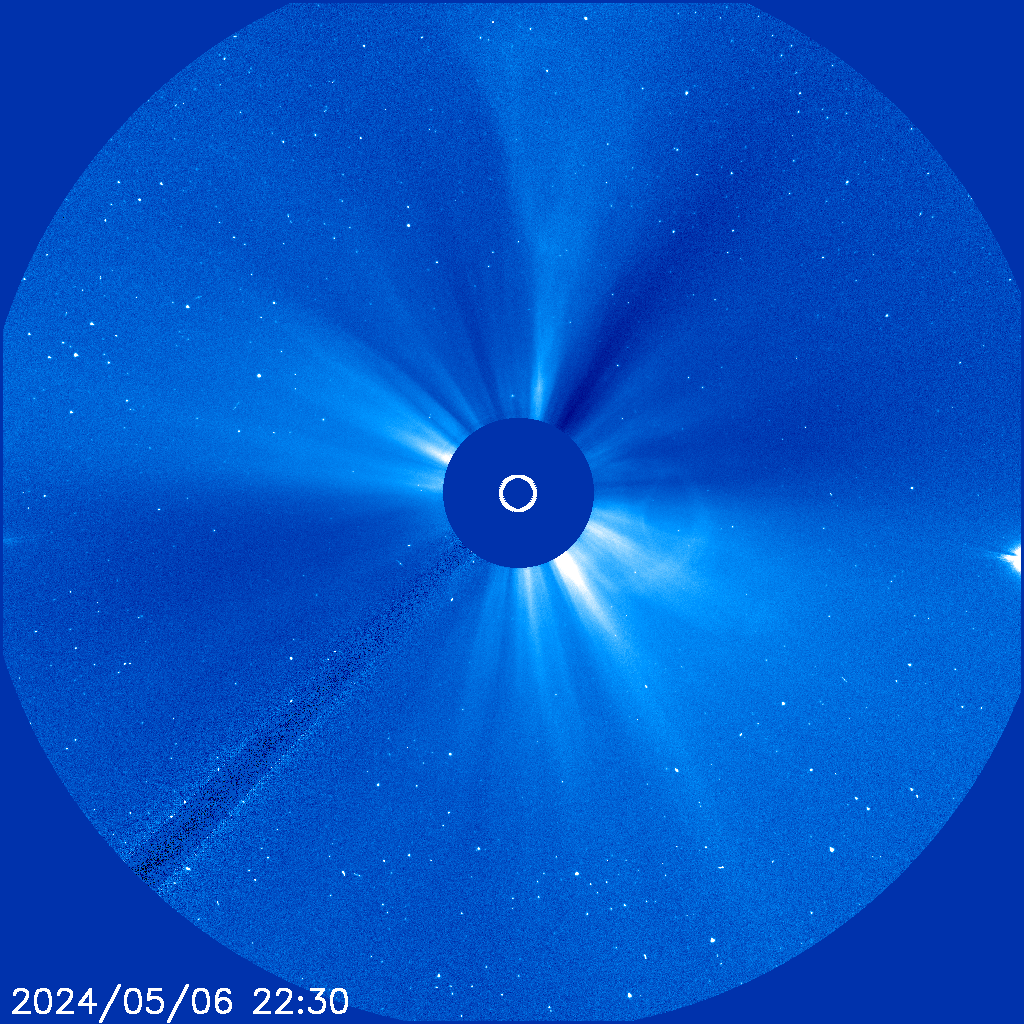
Set up the gkrellkam plugin to get the image from http://sohowww.nascom.nasa.gov/data/realtime/c3/1
0 24/latest.gif, which is a LASCO instrument at SOHO (which we are turning into the world's most expensive webcam IMHO). - Also, set the number of second per update at 3600, so your image will update every hour (I don't know exactly the update times at soho website, I think 1 hour is ok)
- Stay alert for some twisted structure like this
I have four gkrellkam panels, one for watching sunspots, another for coronal holes (currently in "bake-out"), another for the auroral oval and the above one. The links for those images are:
Auroral oval (replace "pmapS.gif" to "pmapN.gif" for the northern hemisphere)
Take a look to the SOHO website (lastest images->near realtime images) for more images... sadly the SOHO now is in a kind of blind point, so many of them are marked as "CCD Bakeout". Maybe it will be back online in a few weeks.
Of course you can use gkrellkam for a lot of other purposes, like getting weather satellite images... oh, and getting images from a ordinary webcam
-
All hail!
We should all bow to the mightiest slashdotter of them all!
- Jonathan -
NOAA Article
-
NOAA Article
-
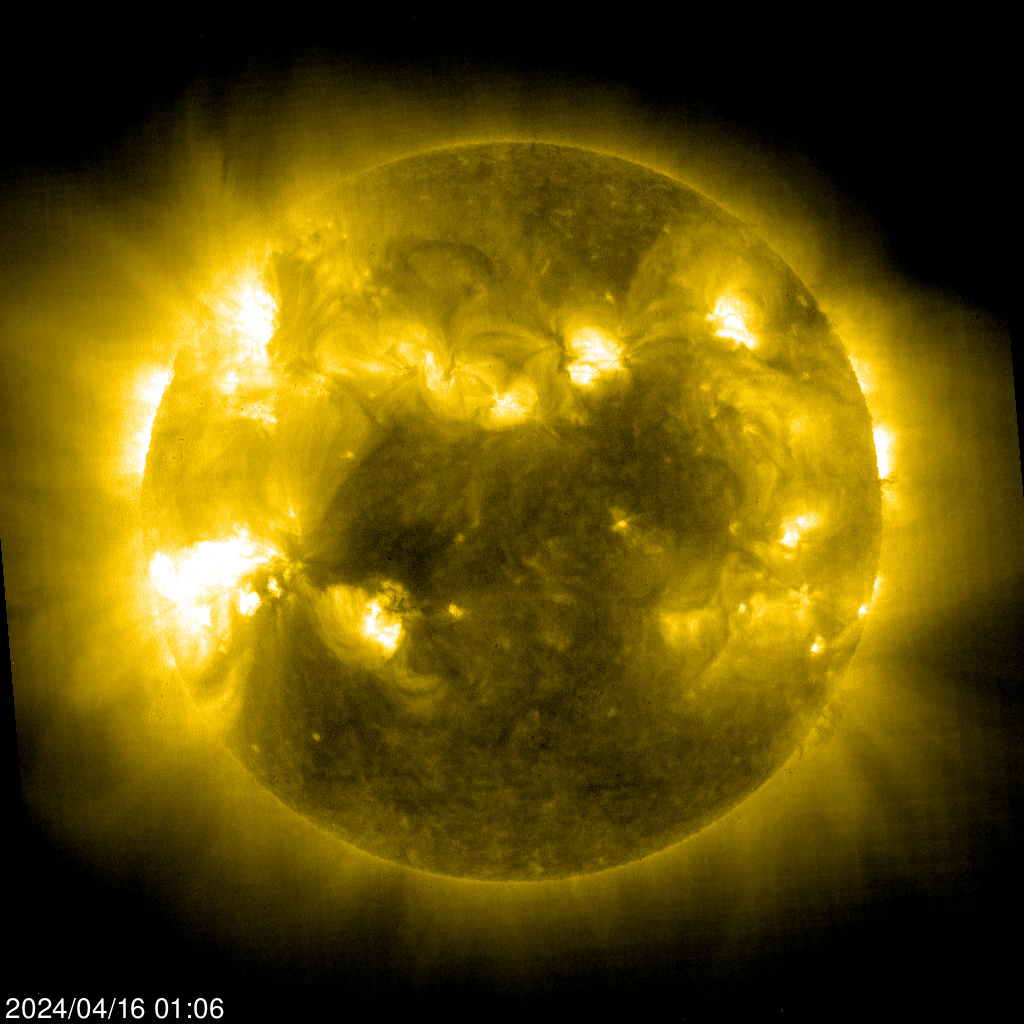
Take a look at the LASCO or SXI images --
MDI just showed a spot
EIT's in the middle of a bakeout, so you'll want to take a look at the SOHO/LASCO images, or GOES/SXI
See the NASA press release for more info. -
Re:guns illegal in Australia
You think Mississippi did not get suffer as much damage as New Orleans? http://www.noaanews.noaa.gov/stories2005/s2495.ht
m I suggest you take a look. The state an local governments of Mississippi just did a much better job of evacuating and managing the disaster than New Orleans did.
One of the cultural problems that happened in New Orleans is an almost mystical belief that it couldn't happen to them. Think about it, why was there ever a voluntary evacuation notice? Why wasn't it mandatory on Saturday? The risk was so high but people still stayed. I am not talking about the poor and infirm but people that could leave but didn't! Also In Mississippi no hospital that was in a flood zone was left occupied.
These are images and facts you can see for yourself not Dogma.
Way too many people are forgetting Mississippi because of New Orleans. Also remember that flooding happened the day after the storm passed. No one should have died in New Orleans. No hospital should have had patients in it. Over 1000 school buses where left in a parking compound in New Orleans by the city that was below sea level instead of being used to get the poor and sick out of town. The state of Louisiana did not have enough shelters in the area around New Orleans for the people to go to. Yes a large amount of the looting was caused by the desperation of the people but that dire situation was caused by the culture of the City and the corruption of the local and state government. This culture isn't due to race or even class. Frankly I have no idea why city of New Orleans seems to have a culture that inspires the same long term planning goals of the average 15 year old.
I mean look at this from the New York Times!
The first responders are stressed in New Orleans. So what is the City of New Orleans going to do for them? Counseling? How about a drunked weekend partying in Las Vegas... Yea that will do it.
http://www.nytimes.com/2005/09/05/national/nationa lspecial/05vegas.html?adxnnl=1&adxnnlx=1126205635- yZeiYgyytHSmkJqZcQOc0A
Good grief some things you can just not make up. -
The images are in the public domain
2. The new imagery doesn't have any obvious copyright notices. Did they skip this step or is there a new invisible watermark?
Because the images were taken by NOAA and are freely available on the National Weather Service Website, I think the images are in the public domain. In fact, from the same website where the original (and higher resolution) images can be found, I dug up this disclaimer:
The information on government servers are in the public domain, unless specifically annotated otherwise, and may be used freely by the public... -
The images are in the public domain
2. The new imagery doesn't have any obvious copyright notices. Did they skip this step or is there a new invisible watermark?
Because the images were taken by NOAA and are freely available on the National Weather Service Website, I think the images are in the public domain. In fact, from the same website where the original (and higher resolution) images can be found, I dug up this disclaimer:
The information on government servers are in the public domain, unless specifically annotated otherwise, and may be used freely by the public... -
Re:Any Images of the School Bus Fiasco??
From the NOAA:
http://ngs.woc.noaa.gov/storms/katrina/24426958.jp g (top-right)
http://ngs.woc.noaa.gov/storms/katrina/24426578.jp g (bottom left-centre) -
Re:Any Images of the School Bus Fiasco??
From the NOAA:
http://ngs.woc.noaa.gov/storms/katrina/24426958.jp g (top-right)
http://ngs.woc.noaa.gov/storms/katrina/24426578.jp g (bottom left-centre) -
Re:Much better pictures
Yes, the NOAA pictures are much better. Take a look at this one, which shows the main breach of the levee on 17th St. Canal:
http://ngs.woc.noaa.gov/storms/katrina/24425580.jp g
(Warning: the photos are almost 4k x 4k pixels, and the ground resolution is about 37 cm / pixel.) -
Re:Much better pictures of levee breaches
Correction: a better picture of Breach 1.
-
Much better pictures of levee breaches
Thanks for the link. I found higher-res shots of the levee breaches:
Breach 1
Breach 2
Breach 3
Someone else linked to the Superdome, I believe; I also found the convention center (I think).
(Warning: images are very large.) -
Much better pictures of levee breaches
Thanks for the link. I found higher-res shots of the levee breaches:
Breach 1
Breach 2
Breach 3
Someone else linked to the Superdome, I believe; I also found the convention center (I think).
(Warning: images are very large.) -
Much better pictures of levee breaches
Thanks for the link. I found higher-res shots of the levee breaches:
Breach 1
Breach 2
Breach 3
Someone else linked to the Superdome, I believe; I also found the convention center (I think).
(Warning: images are very large.) -
Much better pictures of levee breaches
Thanks for the link. I found higher-res shots of the levee breaches:
Breach 1
Breach 2
Breach 3
Someone else linked to the Superdome, I believe; I also found the convention center (I think).
(Warning: images are very large.) -
Much better pictures of levee breaches
Thanks for the link. I found higher-res shots of the levee breaches:
Breach 1
Breach 2
Breach 3
Someone else linked to the Superdome, I believe; I also found the convention center (I think).
(Warning: images are very large.) -
Hi-res superdome
-
Re:Much better picturesSee http://ngs.woc.noaa.gov/katrina// for an explanation: The date of the photography can be derived from the first 3 characters of the image name. Image names beginning with 243 were acquired Aug 30, 2005, those beginning with 244 were acquired Aug 31, and so on.
So an image like http://ngs.woc.noaa.gov/storms/katrina/24427024.jp g/, which makes NO look like Venice, was taken on August 31. -
Re:Much better picturesSee http://ngs.woc.noaa.gov/katrina// for an explanation: The date of the photography can be derived from the first 3 characters of the image name. Image names beginning with 243 were acquired Aug 30, 2005, those beginning with 244 were acquired Aug 31, and so on.
So an image like http://ngs.woc.noaa.gov/storms/katrina/24427024.jp g/, which makes NO look like Venice, was taken on August 31. -
Re:Much better pictures
http://ngs.woc.noaa.gov/katrina/089I30C_KATRINA.H
T M Try this one. The eye came ashore here. Several small artsy communities here pretty much don't exist any more. My aunt lived about a quarter of a mile from the water and all she found once it was over was a few pieces of Waterford crystal she'd wrapped in bubble wrap and stuffed under the couch cushions. No sign of the couch though. I think she found that like half a mile away. Turns out a 22 ft storm surge does quite a bit of damage. -
Re:Bottoming Out
Your plan would flood my neighborhood next to City Park.
The broken canal walls were built in the last 10-15 years--not in the 30s. They failed because they are concrete walls built on top of a shorter dirt levee. The storm surge topped the concrete walls and ate out the dirt below causing the walls to collapse. Had there been more funding to create category 5 height walls perhaps they would have never failed.
Bayou St. John (along bottom in satellite picture) is capped off from the lake by a huge lock and is thus never a threat from flooding. The areas surrounding Bayou St. John flooded because of other levee breaches in the area.
Compartmentalizing the city with internal flood walls would be a better idea that might prevent one or two breaches from inundating the city. There was also a plan proposed to build a giant sea wall along I-10 near Slidell that would prevent storm surges from entering the lake. This might have prevented the storm surge from topping the levees along the canals. -
Much better pictures
can be found at NOAA's site, at http://ngs.woc.noaa.gov/katrina/KATRINA0000.HTM
The pics were just taken off the plane and thrown on a server. North isn't always up, and the pictures aren't very well labeled. You pretty much have to know what you're looking for before you can make sense of the pictures. But they are much better quality than that of maps.google.com. -
Six Flags Under Water
They're gonna kill me for the bandwidth this uses, but I managed to find a picture of Six Flags (a series of large theme parks for you non-USians, second only to Disney's stuff) after it was hit. It looks pretty disturbing to see rides halfway submerged.
Six Flags:
http://www.ecsis.net/~gregday/park.jpg
Park Map:
http://www.ecsis.net/~gregday/map.pdf
The rest of the NOAA aerial images taken from a Cessna:
http://ngs.woc.noaa.gov/katrina/KATRINA0000.HTM
But I warn you, it's very creepy. -
Re:Bottoming Out
A hurricane generates 1.5E12W in 144KPH winds over 60Km. Katrina was 260KPH over 170KM. We're talking many times the global electrical generating capacity. Maybe New Orleans windmills aren't such a stoned idea...
The power of a single spacecake, though, can bend the fabric of spacetime. So we're really talking about relativistic energy. The Dutch are lightyears ahead of us in America, even with out Shell Oil.
- posted from Nieuw Amsterdam -
Re:Doing what is right
It amazes me how people will quickly jump on a bandwagon when it 'feels good'. Quick, let's ban all SUV's because that's what's causing it and we all know that it's good to hate big things that use petroleum.
It's a fricking hurricane during hurricane season. That's it. It ain't because the US didn't sign onto the Kyoto Protocol. This crap happens EVERY YEAR, June through October. EVERY DAMN YEAR.
Also, huricanes were worse prior to 1960, not recently. http://www.nhc.noaa.gov/pastdec.shtml
If this happened in December - February, then maybe it's the humans fault but I don't think so. If anything, blame the tsumani in the Indian Ocean.
Cripes, that shifted land masses, changed our rotation speed, and we still don't have an idea what global impact that did. -
Re:Population
Whether that's global warmings fault is debatable, but certainly plausible.
If its global warming's fault, global warming is really selective. Globally, we haven't seen more, powerful storms. Regionally, the North Atlantic has increased the number of yearly hurricanes, but that seems to be due to a multi-year cycle in hurricane intensity. Even this isn't an extremely strong trend -- the years 1991 - 1994 had an extremely low number of Atlantic hurricanes, but few people want to attribute a decrease in hurricanes to global warming.
More detailed information, for the curious.
-
Re:Runaway
If you belief that 'global warming' has effect on hurricanes hitting the US in the last 20 years please review the chart at U.S. Hurricane Strikes by Decade -- http://www.nhc.noaa.gov/pastdec.shtml I see a random distribution on this chart... now show me a global table with hundreds of intense storms with landfall counts conclusion can start being statically significant. Category 3,4,5 don't happen that often and its even more rare they make landfall.
-
Re:Global warming, Global dimming?And I refuse to hear it's "normal as climates change" as it's natural. Climates don't drasticly change over a course of a century as far as I know.
Oh really? This table suggests there were more hurricaines in the mid 20th century than at the end.
The source article ends with a soberingly prescient conclusion though:
"The message to coastal residents is: Become familiar with what hurricanes can do, and when a hurricane threatens your area, increase your chances of survival by moving away from the water until the hurricane has passed! Unless this message is clearly understood by coastal residents through a thorough and continuing preparedness effort, disastrous loss of life is inevitable in the future."
-
Re:Global warming, Global dimming?And I refuse to hear it's "normal as climates change" as it's natural. Climates don't drasticly change over a course of a century as far as I know.
Oh really? This table suggests there were more hurricaines in the mid 20th century than at the end.
The source article ends with a soberingly prescient conclusion though:
"The message to coastal residents is: Become familiar with what hurricanes can do, and when a hurricane threatens your area, increase your chances of survival by moving away from the water until the hurricane has passed! Unless this message is clearly understood by coastal residents through a thorough and continuing preparedness effort, disastrous loss of life is inevitable in the future."
-
Re:Population
Which, if you look back to the 1850's, was one of the lightest decades for hurricane strikes on the United States (NOAA)
-
Re:Bus Report
Just another image of the buses left behind.