Slashdot Mirror
Domain: nsidc.org
Stories and comments across the archive that link to nsidc.org.
Comments · 236
-
Re:Increased geological activity?
Earthquakes look pretty typical to me, notoriety isn't the same thing as frequency or intensity. Also the glaciers have been melting for the entire Holocene, so that's really not unusual and to top it all off the polar ice caps have rebounded to normal levels. Some scientists have made a similar assertion to icecap melting leading to increased vulcanism;
They said there was no sign that the current eruption from below the Eyjafjallajokull glacier that has paralysed flights over northern Europe was linked to global warming. The glacier is too small and light to affect local geology. Ice cap thaw may awaken Icelandic volcanoes
that isn't the case here.
-
Re:Texas was once...
The hypothesis of AGW does not say that only human activity can cause warming. In the past, the cooling and warming were natural, caused by changes in the Earth's orbit. Right now, most warming seems to be due to increasing concentrations of greenhouse gasses in the atmosphere.
You are correct that there is no "right" temperature for the Earth, but if the Earth warms up by several more degrees and the sea level rises by several meters, trillions of dollars of wealth will be lost as coastal urban areas are inundated by the ocean. The fact is that it is economically advantageous for us to reduce carbon dioxide emissions.
Asphalt parking lots would not make the Arctic ice and Antarctic ice melt.
-
Re:Science or Religion?
One question for the warmers reading. Can the theory of AGW be falsified?
Of course it can. It wouldn't be a valid scientific hypothesis if it couldn't be falsified. If the global average temperature decreases or stabilizes over the timescale of decades, even as the concentration of carbon dioxide in the atmosphere continues to increase, that would invalidate the notion that increased carbon dioxide causes significant warming. If the Arctic ice and Antarctic ice stop melting, that would show that the warming has stopped. It should be trivial to falsify, if it is false. If it cannot be falsified, that that means the hypothesis has been confirmed.
-
Re:Green... EPIC FAILURE
What matters in science is not what someone with a fancy degree says. What matters is what evidence is provided. I have seen a few climatologists say that the Earth is not warming, but I do not accept that statement because the evidence is that the oceans are warming, and the Arctic ice and Antarctic ice are melting. I have seen some people say that human activities are not increasing the amount of carbon dioxide in the atmosphere, but the Keeling curve and the ratio of carbon isotopes show that the increase is due to burning fossil fuels.
Science is not a matter of he said, she said. It is about evidence. If you have some evidence to back up your claims, providing it would be far more convincing than an appeal to authority.
-
Re:It's shitty science, Rei.
There's no need to cherry-pick 1850 as a starting point. Pick any year from several decades ago and you can show warming over the past several decades. There's also no need to cherry-pick 1998 as an ending point. Pick any year in the past decade, and you can show warming over the previous several decades. The past decade was hotter than the 90s, which was hotter than the 80s, which was hotter than the 70s. It truly is warming as shown by the instrumental temperature record, Arctic ice melting, and Antarctic ice melting.
-
Re:Not a new warning
I imagine that a big problem is the melting of the ice caps, and resultant rise in sea levels
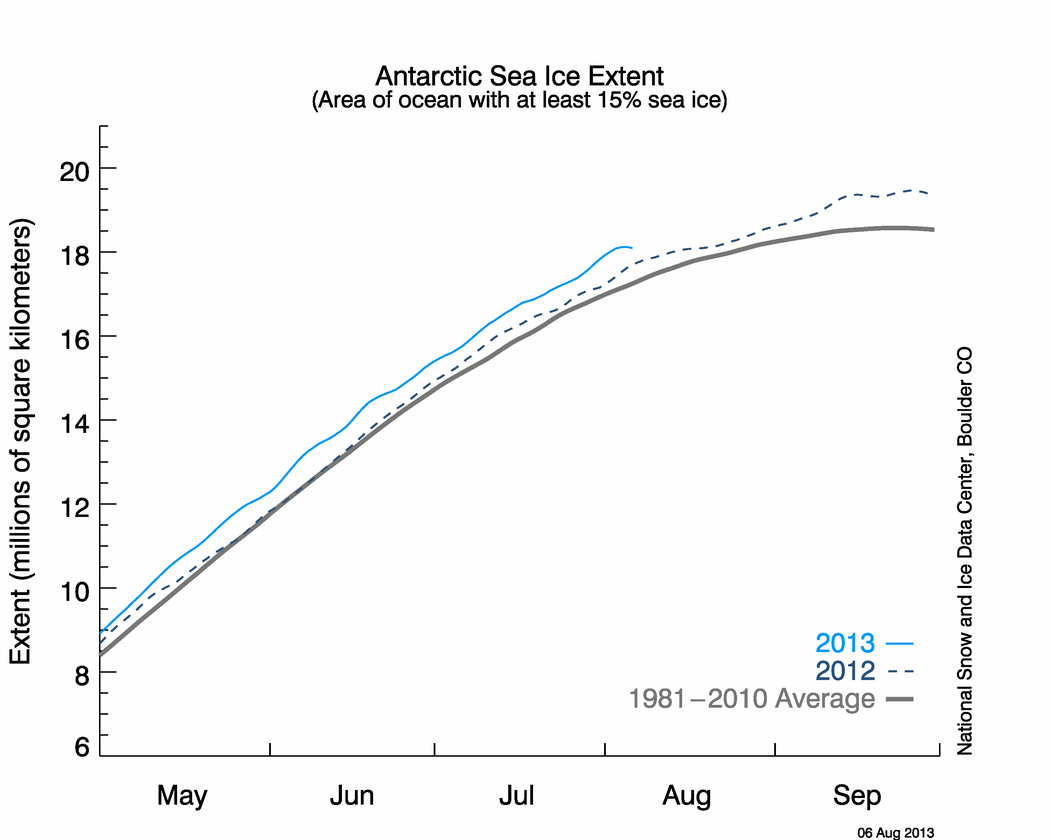
The ice caps melting will have little impact, because they are largely already floating on the water. As an example, look at this graph to see that the antarctic ice coverage changes as much as 15 million square kilometers every year, without particularly changing sea levels.
The IPCC predicts that sea levels will continue rising at around 3 millimeters a year, which can sound a little worrysome when you add it up, but this speed is slower than geological processes happening: ie, continental drift moves faster than that, so either way it is something we will have to worry about, as we do now.A 10% improvement in crop productivity or whatever isn't going to be much of a payback for a couple billion people having to pick up and move somewhere. Besides, even if the crops grow better, a warmer earth probably will mean more insects to eat those crops before the people can harvest them
This is all speculation. Maybe a warmer earth will cause more rainfall in the Owens Valley, opening up millions of acres to be farmed. Also, I don't think anyone is estimating that billions of people will be displaced.
The fundamental problem with this whole "humans will have to adapt" idea is that there's simply far too many humans now.
If so, then we are in trouble because we will have to adapt regardless of what the effects of CO2 on the environment are.
-
Re:Politics
Well... melting? receeeding? even that is doubtful, remember there's ice caps in the artic but also in the antarctic, those have been pretty big this year.
There's a lot of misinformation (most of it, probably caused by this CRU guys) on this subject , one of the problems that leads to confusion is that it's being treated as a single issue, first you have to separate the topics (or the queastions for that matter):
- Is there a real global warming
- Is it abnormal / unnatural
- Is it caused by human activity
- Is it caused by CO2?
- Should this be a top environmental priority for humanity?
The problem with all this misinformation is that the focus on the real environmental problems and it's causes is being shifted to things that can be economically exploited and really bad stuff that is real, confirmed, and its causes known to be of human origin, is being overlooked
-
Re:Great...
The mountains of research done on this is pretty clear about why
it's happening. But I don't expect facts to get in the way of beliefs
anytime soon. Be that as it may, why is not the important. The
important questions, and the ones the climate scientists spend a lot of
time working out, are how it's going to affect us and what we can do to
prepare for it.There are no mountains of research that show why any climate change is
happening or even IF climate change is happening. Arctic ice cover has increased
every year since 2007, for example, while the AGW models pushed by the NSIDC and IPCC
don't allow for any such increase. Carbon dioxide is
routinely pushed by politicians as the cause of global warming and yet
it is a simple calculation to show that there is already more
than sufficient carbon dioxide in the atmosphere to absorb ALL of the
IR radiation radiating from Earth that is in the wavelength where it
can be absorbed by carbon dioxide... within the first few hundred
meters of the atmosphere. It is even easier to show
that gas-phase H2O in the atmosphere (commonly referred to as humidity)
is present in much higher concentrations in the atmosphere than CO2 and
is a far more potent 'greenhouse' gas than CO2...and yet the planet is
obviously still able to radiate sufficient heat to space in the
non-absorbable IR wavelengths to cool itself. Finally,
supposing for argument's sake that atmospheric carbon dioxide
concentration really was: 1) a problem and 2) correctable, why
would it be the 'climate scientist's' job (read IPCC and NSIDC) to tell
us how to prepare for it's impact? They seem even less qualified
for that job than they are for the investigation of global
warming. -
Re:What is the net effect?
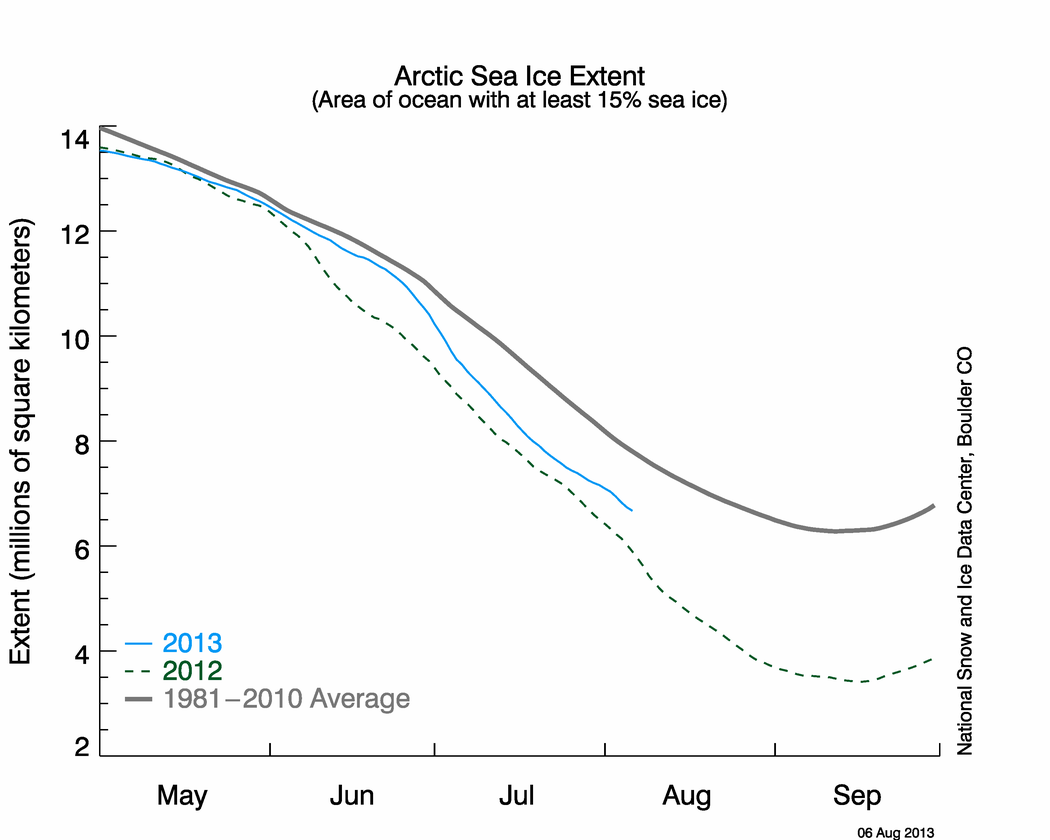
Why would it surprise you? Ice extent has been growing in Antarctica for quite some time, and the same goes for the Arctic since 2007.
This is not disputed, it's simple fact.
http://nsidc.org/seaice/characteristics/difference.html
http://www.ijis.iarc.uaf.edu/en/home/seaice_extent.htm
Watch out for the hyperbole in popular media that's simply not based on actual observations but "models".
-
Re:No...
Yeah and you can just ignore the FACT that the North Atlantic is melting because it is some NASA plot!
http://www.nasa.gov/vision/earth/environment/arcticice_decline.html
And you ignore the fact that the ice is at a greater level today than it was a year ago.
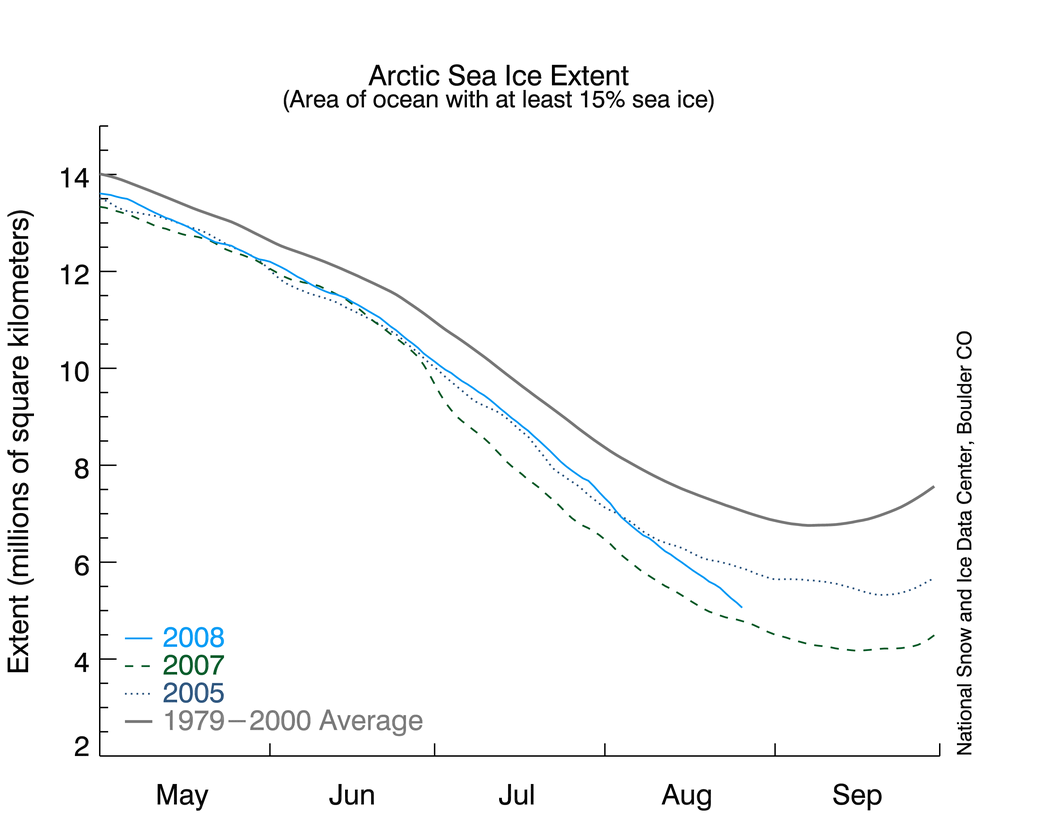
From August 1 to 17, Arctic sea ice extent declined at an average rate of 54,000 square kilometers (21,000 square miles) per day. This decline was slower than the same period in 2008, when it was 91,000 square kilometers (35,000 square miles) per day, and for the same period in 2007, when ice extent declined at a rate of 84,000 square kilometers (32,000 square miles) per day. The recent rate of ice loss has slowed considerably compared to most of July. Arctic sea ice extent is now greater than the same day in 2008.
-
Re:Ice melting or technological advance ?
We've known that the Arctic ice has been melting for quite some time. Not only is the surface area of the ice decreasing, but the total volume of Arctic ice is also decreasing. In a few decades, the Arctic might be completely ice free during the summer.
-
Re:Did we not already know this?
Um, the National Snow and Ice Data Center disagrees.
-
Re:55% say they are Democrats
The ice has stopped melting. You need to keep up with current events.
No, it hasn't. But if in the coming decade it will stop melting, I'm sure that will be spun by some media as "there is no global warming, the north pole is'nt even melting anymore!"
-
but it's not just one thingHas the global sea ice decline stopped?
The planet has not shown substantial warming for a decade now. The Gore Effect seems to be holding. Some glaciers are advancing . And the Arctic Sea ice appears to have halted its decline, if only temporarily.
-
It's gotta go somewhere.
I'm pretty positive that the reason this ice shelf broke off is that there is an over-abundance of ice and with all that new ice forming, some of it has to go somewhere. Here, do the numbers yourself : http://nsidc.org/cgi-bin/bist/bist.pl?no_panel=1&annot=1&legend=1&scale=75&tab_cols=2&tab_rows=2&config=seaice_index&submit=Refresh&mo0=01&hemis0=S&img0=extn&mo1=01&hemis1=S&img1=conc&year0=2009&year1=1980&.cgifields=no_panel
-
Re:PS:
Was there some specific point on the page you want me to refute because quite frankly there is so much wrong with it I don't know where to start?
Thing is I've never heard of that link before but it's full of the standard red-herrings and half-truths, when I'd read enough of them I looked at the names of their so called scientists. Some stand out like dogs balls, the names also pop up in connection with the heartland institute. You would probably recognise such luminaries as Fred Singer, Dr Ball, George Will, senator Inhofe?
You can rant about FACTS all you like but that site doesn't tell you where it gets it's so called facts from and even when it does give you some clues their primary source does not agree with them on at least one major point. -
Re:More Climate Change-balls....
Wow. That's a serious why to twist around the facts. If you look at the plot from your link, you'll see that the minimum sea ice extent is small. This is where the news has been. Anyway, ice volume matters more. Notice my article is also from NSIDC and directly contracts the bent in your article on a site dedicated to spreading misinformation about the science behind climate change.
I strongly doubt you can find an article from NSIDC that agrees with what Watts Up With That? claimed they said, but I don't expect you to want to find anything that might change your views. -
pffft.
So they got the ice extent wrong for a whole month. What's all the excitement for? http://nsidc.org/arcticseaicenews/ And they never said the Arctic would be ice free in 2008. That's just media hyperbole.
-
Re:Rocket science?
The Earth is getting warmer and our ice is melting, and that's not in dispute. If the warming trend continues, all of the ice will melt eventually, this is dictated by physics.
Wrong about the physics: Whether all the ice melts is not dictated by the derivative of temperature. Wrong about the facts: polar ice-extent is neutral despite the warming. Southern Extent is increasing.
Your implication of overwhelming political bias in climate science is simply contrary to the facts. The fact that these researchers seem to have been biased is not relevant to the science as a whole.
GP did not mention political bias. He said "bias". This "bias" has been well documented by MIT Climate Scientist Richard Lindzen and Roger Pielke, Jr. of the University of Colorado.
The "think tanks" who criticize climate science don't do any actual science. They cherry pick data from scientific papers, and attempt to refute CO2 vs warming trends with typical logical fallacies, but they do no research, make no predictions, and advance no falsifiable claims.
Huh? Lindzen and his students have put forward the IR-Iris theory that suggests negative-feedbacks dominate. Roy Spencer of the University of Alabama wrote a paper explaining the systemic error in the climate models used to predict the IPCC's 2C/century.
There are many more.
-
Re:Rocket science?
Hold on, I was actually looking at the article just before I wrote that...
Ah, found it. This was linked from the slashdot summary and discusses it briefly, and links to this press release.
"The forecast by researchers at CU-Boulder's Colorado Center for Astrodynamics Research is based on satellite data and temperature records and indicates there is a 59 percent chance the annual minimum sea ice record will be broken this fall for the third time in five years."
-
Re:The story is far over-hyped
Um, didn't they say that there would be NO ICE on the north pole in 2008? It's 2009 and there is still ice on the North Pole.
Actually, no. They didn't. It was people like you who said that they said that.
And congratulations on completely misrepresenting the current conclusion by the scientists, as well as the actual facts behind the conclusion. It's stupidity, ignorance and lies like this that demonstrate to me that a) global climate change is happening (otherwise there'd be better counter arguments floating around) and b) we're all doomed (you. duh.)Actually, what they said was that an ice-free north pole was "quite possible".
Here's a quote from the National Snow and Ice Data Center:Taken together, an assessment of the available evidence, detailed below, points to another extreme September sea ice minimum. Could the North Pole be ice free this melt season? Given that this region is currently covered with first-year ice, that seems quite possible.
The source sited by NSIDC:
"Based on the current sea ice conditions, aerospace engineering Research Professor Jim Maslanik said the Northern Sea Route -- the shipping lane from the Atlantic Ocean to the Pacific Ocean along the Russian coastline -- might also open up this summer. "It also is quite possible that extensive ice-free conditions could develop at or near the North Pole," said Maslanik.
I wonder why they would make such dire predictions?
CU-Boulder's Arctic Regional Ice Forecasting System group -- the only research group in the world currently making seasonal Arctic sea ice forecasts based on probability -- receives funding from the National Science Foundation, the National Oceanic and Atmospheric Administration and NASA.
Oh, I see. They are after funding!
-
Re:Rocket science?
Flamebait? For blockquoting a bit of TFA?!? Go to TFA, scroll down a bit, and read the goddamn article, willya??
-
Re:Non-solution to non-problem
Re: Ice. Yeah, so the melting isn't a perfectly smooth downward trend. In 2008, the minimum ice coverage for the melting season was 4.67M square kilometers, and the year before, it was 4.28M. That doesn't negate the overall trend. In actuality, the next lowest year wasn't 2006, but 2005. In 2006, there was a slight recovery as well.
It's pretty dishonest for sites like NewsBusters and FreeRepublic to be trumpeting a half-million km^2 gain, without pointing out the previous year saw a loss of about 1.2M km^2. They also forgot to mention that the ice-shrinking trend has been statistically significant over the past fifty years of fluctuating year-over-year levels. They also won't tell you that the people who produced the data think that ice volume (as opposed to ice area) is down from last year.
One. Year. Means. Jack.
That goes double for "global warming peaked in 1998." Look at the graph, and notice a couple of things. First, notice that 1998 was a really, really, really weird year. I defy you to find another year on the graph as far above the five year average (though a couple from the 1880s are in the running). 1998 was an El Nino-injected monster of a year, and it's utterly dishonest for anyone to use it as a baseline.
The next thing to note: the sheer amount of noise in the graph. Even the five year averages are full of dips and surges. The progression is anything but steady, yet the overall trend is clear. Individual years? They're all over the map. The record is littered with unusually low years that, in the end, didn't amount to anything significant.
The last thing to note: Even accounting for the fact that 1998 is pulling up the five year average towards the end of the blue line, every single year from 2001 on matched or exceeded that five year average. 2008 isn't on the chart yet, and when it is, it will be somewhat below the average for this decade. But climate scientists aren't sweating.*
Re: computer models. I don't know what you're talking about, and I'm starting to suspect that you don't either.
Watching climate contrarians spin is like watching a compulsive gambler. Sure, you made $1800 that last hand, but if you were thinking clearly you'd notice that you were still down twenty grand for the night. Don't let one offbeat year fool you. The averages are what matter.
* They mention that this year did include a La Nina event, which tends to drop temperatures.
-
Re:Non-solution to non-problem
You need to seriously learn to tell the difference between weather and climate. One or two years doesn't tell you squat about what the climate trend is doing. Clue: this does not mean that the Arctic sea ice has stopped melting.
-
Re:Less is more
It's called "winter". You may have heard of it.
Yes, I have. It's up 20%.
http://nsidc.org/data/seaice_index/images/daily_images/S_timeseries.pngYou didn't cite any references which contradict the theory of CO2-based global warming
There's no need. All I need do is show a graph of the global temperature anomaly.
http://www.nationalpost.com/893554.binP.S. If you're so worried about forestalling the next ice age, you should be arguing that we save our excess fossil carbon for later when we really need it for climate control, instead of using it all up now when we don't.
The argument is that man changes the Climate and has done since he started deforestation and agriculture. It's hard to argue with this as it's obvious. What's also obvious (and should be obvious to any intelligent person), is that when you are "against" warming or cooling, you're against it given the value you associate with the status-quo. That is, you assign a value judgement to current climate as your starting point for "best". It's clear that no run-away warming can take place, given the paleoclimate record:
http://www.clearlight.com/~mhieb/WVFossils/PageMill_Images/image277.gif
, you can see that CO2 has been far, far higher in history than today, as have global temperatures. If these very simple facts aren't enough to convince you to at least question the hypothesis, then I'd say you are the one looking for evidence to support your position, not I. -
In other news
The President of the Squirrels has announced his government's plan to buyout all the toxic Oak companies in order to stabilize the squirrel economy. When asked how the government would pay for this he responded "We have a national plan to look more cute and cuddly for the tourists to our great nation in order to increase our revenue for the year. This will allow us to buyout all these bad Oaks and ensure that our Acorn supply is not affected."
As far as the global warming thing, it can never hurt to be more enviromentally conscious, however we can't go completely nuts and shaft ourselves. There's a lot of things happening that not even global warming can just explain off in one shot. We're seeing record ice growth in the arctic right now ( http://nsidc.org/arcticseaicenews/ ) but that's not exactly something you're ever going to see in the news. The fact of the matter is no one knows what the hell is going on. Should humans do their best to curtail enviromental damage, absolutely, and I don't think anyone would argue the point, but everything in moderation. If we went with some of the plans some of the global warming hacks (who are about as braindead as the PETA morons) want, we'd cripple our entire civilization and tank what was left of our economy (not that that would take a whole lot of effort at this point). -
Re:Statistics?
Given the interannual variability in the long term data, differences between 2005 and 2008 levels are almost certainly not statistically significant. The change between the 1950s and today is a different matter.
-
Re:Wait...
No, and they're being *deliberately* misleading. Arctic sea ice this year hit the second lowest level in recorded history. Last year was the lowest.
Arctic sea ice extent during the 2008 melt season dropped to the second-lowest level since satellite measurements began in 1979, reaching the lowest point in its annual cycle of melt and growth on September 14, 2008. Average sea ice extent over the month of September, a standard measure in the scientific study of Arctic sea ice, was 4.67 million square kilometers (1.80 million square miles) (Figure 1). The record monthly low, set in 2007, was 4.28 million square kilometers (1.65 million square miles); the now-third-lowest monthly value, set in 2005, was 5.57 million square kilometers (2.15 million square miles)./I.
To report values now, from *October*, during the refreeze is just bloody ridiculous. Yes, different years melt and refreeze at different times; there's a lot of spring and fall fluctuation. What matters are the maximum and minimum extents.
FYI, arctic sea ice normally low in years after El Nino winters and high in years after La Nina winters. Winter of 2006-2007 was in El Nino conditions, leading to the record 2007 melt. But winter of 2007-2008 was in a strong La Nina. The fact that we got the second lowest ice extends on record despite this is incredibly disturbing.
-
Re:Oil
Oil may have turned the corner, but there are more fossil fuels than that. There are literally hundreds of years' worth of workable coal deposits. What worries me is that atmospheric pollution is a classic tragedy-of-the-commons. So long as there's a sufficiently industrialised civilisation to dig it up and burn it, we're going to be emitting fossil CO2 at, at best, mid-20th century levels for the foreseeable future. Look out Jurassic, here we come. (Oh yeah, and the water-vapour-cloud-seeding-ships idea fails at the first hurdle, namely that (even if it worked, which I seriously doubt as the clouds would be too low in the atmosphere) the whole thing stops working the day the ships do. Dirty coal does at least produce relatively long-lived and high sulphate aerosols. (Now if only there were a cheap simple way to capture the CO2 at the generator site, but still emit the sulphates...) Over the past 20 years, my level of optimism for the future (vis a vis climate change) has followed a curve very similar to the NSIDC sea-ice extent for 2008 (except that my optimism only flat-lined at the point where I couldn't think things could get much worse.)
-
Wrong
Umm. There's more ice in the arctic this year than last year.
No, there is less. As the graph from the article you site shows, the present sea-ice coverage area is very slightly larger than it was this time last year (which was a record low), but the thickness of the ice is steadily decreasing, and as a consequence, so is the total amount of ice.
In fact, as the ice melts and breaks up it tends to spread out, temporarily increasing the "sea area with > 15% ice" which is what the graph shows.
--MarkusQ
-
Re:What percentage is that?
So arctic ice extent varies (seasonally) between about 4 and 13 MILLION square kilometers. I'm guessing it's at the minimum for the year (it is the end of summer after all) so lets say 4,000,000 km^2. Hmmm 100km^2.... what is that about 0.003%. Why is this news?
Because it is not an isloated event.
-
Re:Maybe that's why...
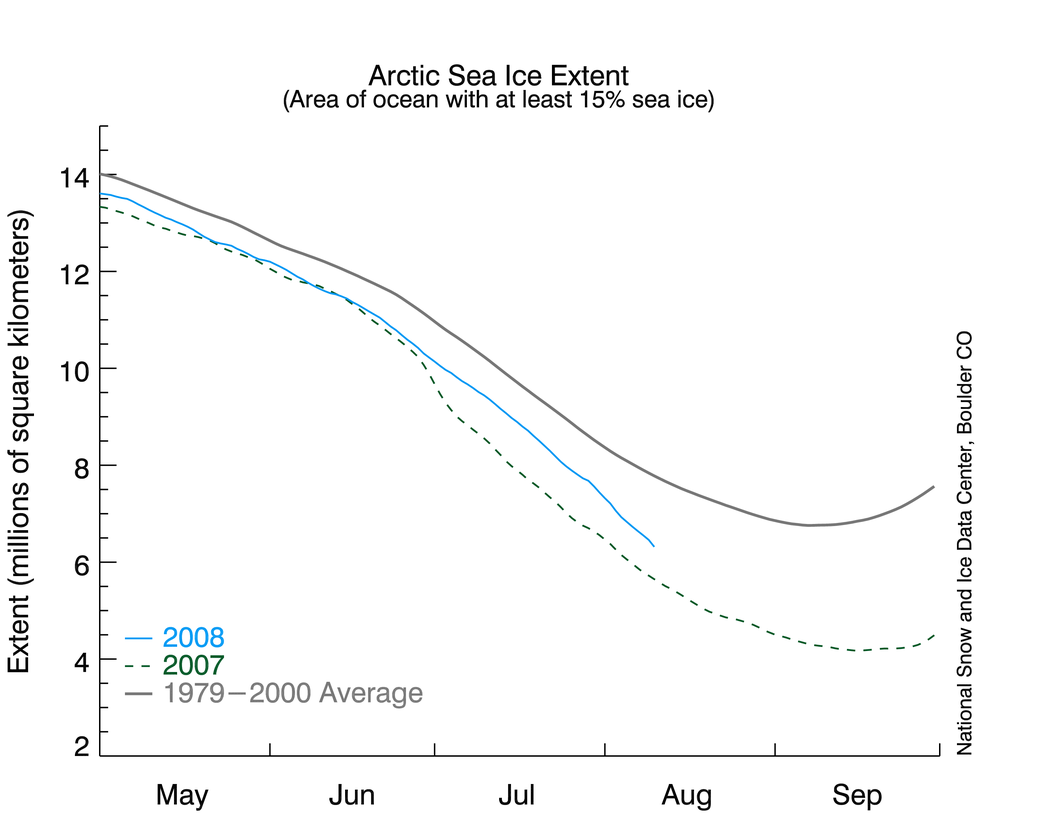
Hey look - an updated graph: http://nsidc.org/images/arcticseaicenews/20080827_Figure2.png I'd say the difference is now about 2-5% from last year's record minimum. Extrapolating from the current curves, I'd say that a new minimum record will be set by mid-September.
It looks like the predictions I heard were pretty spot on. And that crack you've been smoking must be pretty rocking.
-
Re:Maybe that's why...
What the hell are you smoking? There was a warning that it *could* be ice free. Not to mention that North Pole being ice free is not the same as no ice anywhere. And so far, they're on track to have the smallest summer covering ever. By a few million square kilometers.
Really. If climate change wouldn't be such a huge issue, I'd take comfort in the fact that the only people disputing it can't even read the articles they're quoting. Instead, it's just depressing
You ask what I am smoking when every statement you make is completely wrong. If you bothered to look at the Graph it clearly shows that there is 10% more Arctic ice this year than last and is on pace to stay the same. Notice how the average varies between 7 and 14 million sq. km every year and the lowest (2007) was at 4 million sq. km. If this year would be lower by as much as you say, there'd be about 0 ice left in the Arctic.
If you care to look at this graph You'll notice that the ice area in the southern hemisphere has been slightly above average.
Yes, the article originally claimed 30% more ice than last year and was wrong because the pictures and the graph were a little misleading. It doesn't change the fact that in June every news outlet in the country said that there'd be almost no ice at the North Pole (it wasn't just national geographic) and they were very wrong.
Not only was August sun spot free, but there have been over 400 spotless days in the current solar cycle.
-
Re:Storing heat?
Now you say the ice sheets are receeding. Graph of Artic Sea Ice Extent from National Snow and Ice Data Center in Boulder, CO actually shows about a 10% increase from last year. Granted its lower than the average from 1979 to 2000, but it is growing compared to last year.
-
Re:There's still some ice at the North Pole
Actually, there's more polar ice than there was last year.
http://nsidc.org/data/seaice_index/images/daily_images/N_timeseries.png
(Daily chart showing icepack compared to last year and to previous 20 average.)
So yes, there's less ice than there used to be, but the somewhat under-reported increase this year over last year casts some question over the long-term trend, it could simply be long term climate oscillation.
-
Re:Cryosphere ChartMy "must watch" site-o-the-summer[tm] is The National Snow and Ice Data Centre with their horribly compelling weekly-updated map and chart of the total sea-ice extent. I've been printing the chart off every week and sticking it up on the wall; the idea being that looking at the chart as it'll be in late September is a different experience from looking at lots of individual charts showing the progress over the whole season. As you say, pure climate porn. (I also like reading journal articles where there are large chunks I'm completely unable to follow, but where the abstract uses terms like "unprecedented", "catastrophic", "tipping elements" and the like, yeah I'm weird that way.)
One particular season's worth of data in isolation tells us fuck-all about the future state of the climate, of course. In context with the gigantically irrefutable body of work around it, though, it's pretty damn depressing to be honest. If humanity dropped through a time warp tomorrow and popped out again in a couple of centuries time, ie there are no emissions whatsoever for that time and then we all pop back into existence exactly where we are today, the climate would still kill a significant fraction of the population with a few years.
-
Re:Cyclic?
...but I heard one report that ice levels right now are higher than at the same time last year.
According to http://nsidc.org/data/seaice_index/images/daily_images/N_timeseries.png that is true, but not by a significant amount. Last year was an unusual anomaly, but the question is whether the feedbacks from that will be enough to tip us into a new regime where that level of ice loss is normal. I think it's too early to know, but so far this year isn't a strong argument against that happening.
-
Re:Cryosphere Chart
This is the money shot:
http://nsidc.org/data/seaice_index/images/daily_images/N_timeseries.png.
It shows this year's progress, updated daily, plotted against what happened last year, and the multi-year average. Bottom line is we're about where we were last year at this time, after starting the season with more ice than last year. However, last year there was a pretty steep drop over the period corresponding to the next two weeks. It will be interesting to see if we see a similar drop this year. Bookmark this link for daily updates and pop open a cold one.
-
Re:Cryosphere Chart
Forgot...
this is another great place to look for monthly summations:
http://www.nsidc.org/arcticseaicenews/
-
"Almost certain"???
It's now almost certain that the world's ice shelves are melting
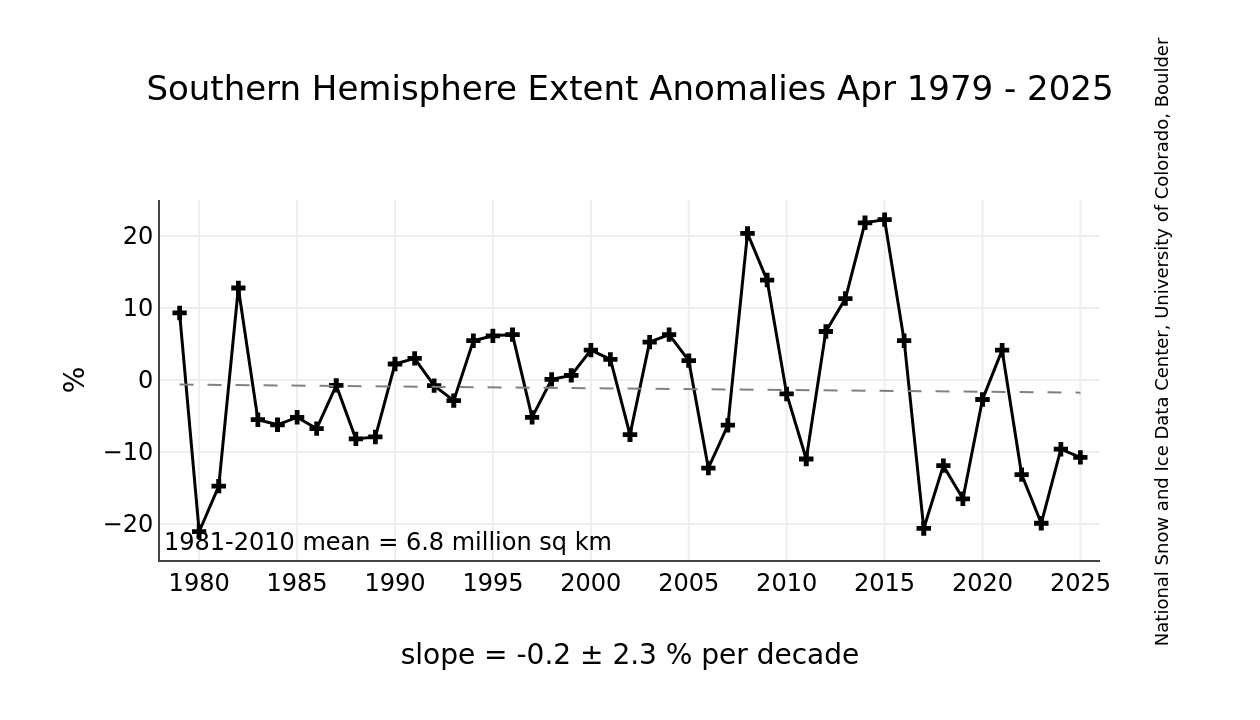
Funny, that's not what the actual facts show. We're at the highest ever recorded ice cover in the Southern Hemisphere right now:
http://nsidc.org/data/seaice_index/s_plot.html
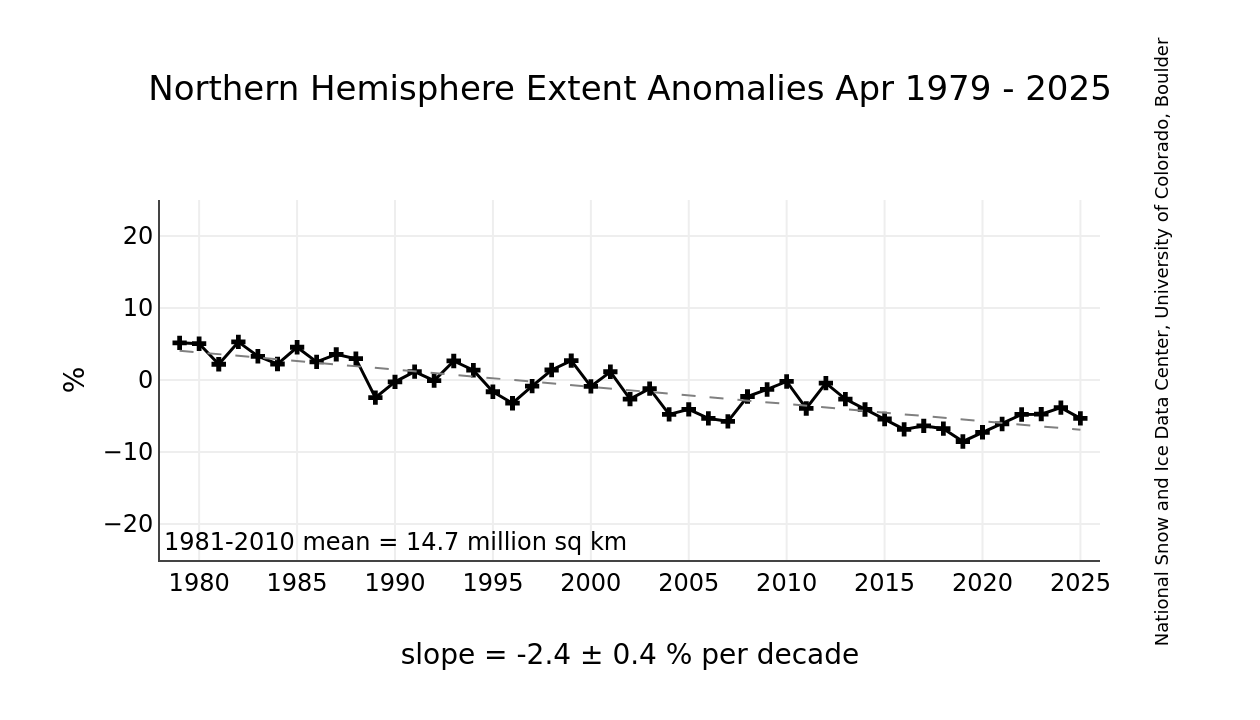
which already more than balances out the Northern Hemisphere's recent decline,
http://nsidc.org/data/seaice_index/n_plot.html
and now that the PDO has entered a cool phase,
http://jisao.washington.edu/pdo/
it's as certain as anything to do with climate is that you're going to see that trend smartly reverse itself as well.
Soooooo -
"Almost certain"???
It's now almost certain that the world's ice shelves are melting
Funny, that's not what the actual facts show. We're at the highest ever recorded ice cover in the Southern Hemisphere right now:
http://nsidc.org/data/seaice_index/s_plot.html
which already more than balances out the Northern Hemisphere's recent decline,
http://nsidc.org/data/seaice_index/n_plot.html
and now that the PDO has entered a cool phase,
http://jisao.washington.edu/pdo/
it's as certain as anything to do with climate is that you're going to see that trend smartly reverse itself as well.
Soooooo -
And again, what's the cost of all of that?
The costs are overstated, and, really all you have is some anecdotal evidence and you aren't considering the benefits side of the equation at all.
Life is one cost, are you saying life isn't worth it? If so then why won't people lower their living standards, after all it's not worth it. As for the benefits it wasn't my aim to consider them, my aim was to show that even those who don't use coal are made to pay for it's usage.
1. Artic ice is actually thicker and wider this year, so the inuit are fine for now.
Oh really, that would surprise those scientists who have said the ice covering the Arctic Sea ice coverage has shrunken for the fifth year. Do you know more than they do? Scientist now say the Arctic will be ice free by 2030, decades before the models forecast. "Global Warming Is Rapidly Raising Sea Levels, Studies Warn". "Sea Level Rise During Past 40 Years Determined from Satellite and in Situ Observations". And Inuit's would either laugh or cry if you were to tell them they were fine. Oh and if it's not so bad then why is the government considering putting the polar bears on the endangered species list? But I guess you know more than the scientists, Inuits, and polar bears do, or more likely you're a troll.
I can't go on anymore with such nonsense.
Falcon -
Re:Global Warming is bullshit
Interesting... When looking at images at http://nsidc.org/ - There is distinctly less ice now in 2008 than there was in 2006...
-
Re:Google Maps
Most likely a dark spot is a steep slope (remember the sun angle is low) or a mountain sticking up through the ice. I wasn't sure which spot you looked at and images used in Google maps really suck. Someone needs to import the Actarctic MODIS Mosaic into Google Maps and Google Earth. It's a very pretty dataset. Or, here's a link to import Lansat images into Google Earth. Nothing much near your location. It was probably just a cloud shadow. There's are lots of clouds in the Google Maps images of Antarctica.
-
Appropriately skeptical
You seem appropriately skeptical. I'd agree that (depending on what you mean by "analysis") the RealClimate site also demonstrates a fair degree of bias beyond just what the facts dictate. Most recently, their analysis of the judge's ruling of An Inconvenient Truth bear that out. I trust their facts completely, but not always their interpretation of those facts. Or rather, I see the spin that resides in their interpretation. ClimateAudit, on the other hand, I don't always trust with even the facts.
You're right that we can't compare apples with apples on the Northwest Passage beyond 1979. However, if this trend continues (as most climatologists believe it will), it will be very hard to deny the unique nature of the modern climate in another 10-20 years. What I mean by that is that, from 1979 to 2006, the Arctic sea-ice extent has dropped by an average of 100,000 sq km per year. That's averaged over the entire 27 year period. In 2007, it dropped by 1,200,000 sq km, or 12 times the average rate. (If you include this new melt into the total melt since 1979, by my calculations the new average melt is 140,000 sq km per year. Of course, this also highlights the newness of satellite data.) Now, everyone is saying that's an anomaly, but it still seems logical (to me, at least) to expect that the rate of melt has sped up. If we split the difference between 2005 and 2007's record minima (to get 4,730,000 sq km) and assume that the melting now is 200,000 sq km (all of these assumptions made up by me), then in 24 years (2031) the Arctic will be completely* free of sea ice in the summer. Of course, the longer we wait to act, the more expensive it will be to act.
*I need to qualify "completely". A location is considered to be ice-free if there is less than 15% ice in that location. Per NSIDC: "In the calculation of ice extent, we simply sum up the area of grid cells that have an ice concentration of at least 15%." Note, this is the same measure being used from 1979 up to the present. Also, in looking further at the data, my assumption about 200,000 sq km per year is arguably unjustified, although at least one climatologist has stated he would no longer be surprised if the Arctic ocean were completely ice free by 2030. (Naturally, saying "not surprised if" and "expecting it" are two different things.)
-
SighYour user ID suggests that you're not new to Slashdot, so surely you've seen all of this refuted before. Perhaps you haven't followed this issue very carefully?
- Your memory is flawed. A few magazines (Time and Newsweek) made a big deal about it, the same way they do about the "Summer of the Shark". That does not make it accepted science. Look to the journals themselves if you doubt me. (I hope you appreciate that it's difficult for me to "prove the negative" here—i.e., the absence of journal articles dealing with the topic.)
- Here is one site that says 2005 tied with 1998. Here is one that says 2005 is the hottest. Here is NASA's site. The fact that you think it was "during the early 1900's, around the depression era" suggests you've either been (a) reading sites that spread disinformation, or (b) didn't understand that they were talking about US temperatures and not global temperatures. (The US record year happened during the dust bowl—not a coincidence, I'd guess. We've currently come within a couple hundredths of a degree of passing that record.)
- The land bridge has to do with sea levels, not sea ice. As for the 20% figure, since you seem to doubt it, here's a site for that, as well. As for why the sea levels wouldn't have risen due to significant sea-ice melt, maybe it's because the ice was in the sea already? When an ice cube melts in a glass of water, it does not (significantly) raise the level of water in that glass. You're thinking of the ice melting off of land—e.g., Greenland or Antarctica.
-
Fair enough
An interesting web-site that has weekly updates on the Arctic sea-ice is http://nsidc.org/news/press/2007_seaiceminimum/20070810_index.html
I found this graph quite interesting: http://nsidc.org/news/press/2007_seaiceminimum/images/20070910_timeseries.png
-
Fair enough
An interesting web-site that has weekly updates on the Arctic sea-ice is http://nsidc.org/news/press/2007_seaiceminimum/20070810_index.html
I found this graph quite interesting: http://nsidc.org/news/press/2007_seaiceminimum/images/20070910_timeseries.png
-
Re:Huh.Hey, why not ask a climatologist (or six)? That's an excellent paper. If you've heard the "skeptic" canard along the lines of "but the temperature in teh historical proxy records starts rising before the CO2 starts to increase" -- which is completely correct - please take the trouble to read and understand the description of the albedo-flip feedback cycle. That's right, this means that things are much worse than the IPCC thinks.
No, wait, he's a crank. He works for that hotbed of liberal tree-huggers, NASA!
Here's the National Snow and Ice Data Center's latest map of Arctic sea-ice extent (w/e 10th September 2007), showing the average extent from 1980-2000 at this time of year. (context and the latest data will be here tomorrow..) This will be updating tomorrow (Monday) afternoon with the latest week's data. Normally sea-ice reaches it's minimum extent at the end of September, so we're not at the bottom of the 2007 season yet.
Final one for the depressingly high number of skeptic loonies and ignoramuses who always come out of the wordwork on these stories: are you really saying that George Bush and Arnold Schwartzenegger are both suckers who have fallen for bad silence peddled by some sort of environmentalist illuminati? really? Cos even Dubya has now officially accepted the basic, uncontroversial amongst actual scientists, IPCC-version models are accurate (and this is anthropogenic warming caused by greenhouse gas emissions). You did know that didn't you?
What do you know, that Dubya doesn't?
-
Re:Huh.Hey, why not ask a climatologist (or six)? That's an excellent paper. If you've heard the "skeptic" canard along the lines of "but the temperature in teh historical proxy records starts rising before the CO2 starts to increase" -- which is completely correct - please take the trouble to read and understand the description of the albedo-flip feedback cycle. That's right, this means that things are much worse than the IPCC thinks.
No, wait, he's a crank. He works for that hotbed of liberal tree-huggers, NASA!
Here's the National Snow and Ice Data Center's latest map of Arctic sea-ice extent (w/e 10th September 2007), showing the average extent from 1980-2000 at this time of year. (context and the latest data will be here tomorrow..) This will be updating tomorrow (Monday) afternoon with the latest week's data. Normally sea-ice reaches it's minimum extent at the end of September, so we're not at the bottom of the 2007 season yet.
Final one for the depressingly high number of skeptic loonies and ignoramuses who always come out of the wordwork on these stories: are you really saying that George Bush and Arnold Schwartzenegger are both suckers who have fallen for bad silence peddled by some sort of environmentalist illuminati? really? Cos even Dubya has now officially accepted the basic, uncontroversial amongst actual scientists, IPCC-version models are accurate (and this is anthropogenic warming caused by greenhouse gas emissions). You did know that didn't you?
What do you know, that Dubya doesn't?