Slashdot Mirror
Domain: nytimes.com
Stories and comments across the archive that link to nytimes.com.
Comments · 17,660
-
Re:good
The hockey stick has stood the test of time. The facts hold. The data continue to support it. Here's Mann recently, and discussion.
Here are myths about the hockey stick debunked.
-
Re:As usual, the rich win.
True. We know federal judges are above anything like bribery.
http://www.nytimes.com/1985/09...
-
Re:Realization Dawns
Now it's 2014 and the President is using the IRS, EPA, and ATF to harass and attack his political opponents.
Yeah, using the IRS, the Secret Service, the FBI, and perhaps the CIA against political opponents isn't a good thing.
-
Realization Dawns
Back in 2002 or so, when people were really starting to rally against the PATRIOT act, the usual faces were all over the media, calling detractors "terrorist sympathizers" and worse. More than a few openly called for such people to be labeled traitors.
Manifestly, there is no civil-liberties crisis in this country. Consequently, people who claim there is must have a different goal in mind. What else can you say of such people but that they are traitors? (source)
And here's Paul Krugman with regards to Rush Limbaugh back in 2002...
As far back as 2002, Rush Limbaugh, in words very close to those used by The Wall Street Journal last week, accused Tom Daschle, then the Senate majority leader, of a partisan "attempt to sabotage the war on terrorism." (source.)
I can't remember where it happened, or who exactly said it, but someone confronted Rush Limbaugh about his words and said, "Imagine if Hillary Clinton were to become president, and she has the power that you want to give President Bush."
Well.
It would appear that has a very good chance of happening. And what was laughed off back in 2002, is now staining underwear in 2014.
-
Re:Radioactive paranoia
According to this, they were arrested and taken to a hospital with one individual showing signs of possible rad. poisoning.
-
Re:Not new
Can anyone with more info on this tell me how this earlier paper is different - arxiv.org/abs/0907.0042
I certainly don't pretend to understand the content of the England/Michaelian papers.
But after a quick scan of Michaelian's paper, I think the difference might be that England's paper rigorously quantifies the theory mathematically, while Michaelian's paper does not.
One should check with xarchive.org (and elsewhere) which ip-addresses have visited Michaelians' article.
A few years back some Spanish researchers were caught tapping original data
http://www.nytimes.com/2005/09...
"But now evidence has been offered that Dr. Ortiz and his group did access the observing logs. Prompted by questions by Dr. Rabinowitz of Yale, one of Dr. Brown's team members, Dr. Pogge, who maintains the Smarts telescope Web site, decided to investigate the traffic on the site. He found that computers from an unfamiliar address had visited the Web site eight times from July 26 to 28, when the Spanish group was making its announcement. Each time the computers went straight to pages deep within the site that described the Brown group's observations of K40506A. The first three visits happened a few minutes apart early on July 26, a day and a half before the Ortiz group made its announcement. Another cluster of hits came on the morning of the July 28 before the object was observed in Mallorca and Dr. Ortiz made his more complete report to the astronomical union. Dr. Pogge was able to trace the computers through the so-called IPP numbers, which the Internet assigns to each computer on it. Those numbers eventually led him to the Web site of the Andalusian Institute. Dr. Pogge said he gasped out loud when it popped up."
These things happen.
Nonetheless, Jeremy L England's article is plain sloppy research for not finding Michaelian's paper.
-
Re:U.S. Willing to Talk if Snowden Pleads Guilty
http://www.nytimes.com/2014/01...
Is this a new thing now, where
unmolested: http://www.nytimes.com/2014/01...
a href: http://www.nytimes.com/2014/01/24/us/politics/us-willing-to-hold-talks-if-snowden-pleads-guilty.html?_r=0This is dumb and whoever implemented it is dumb.
-
Re:U.S. Willing to Talk if Snowden Pleads Guilty
http://www.nytimes.com/2014/01...
Is this a new thing now, where
unmolested: http://www.nytimes.com/2014/01...
a href: http://www.nytimes.com/2014/01/24/us/politics/us-willing-to-hold-talks-if-snowden-pleads-guilty.html?_r=0This is dumb and whoever implemented it is dumb.
-
U.S. Willing to Talk if Snowden Pleads Guilty
http://www.nytimes.com/2014/01...
His response should be "you first".
-
Re:More regulation nation
That's not Regulation Nation. That's a general story and all they did was pull from the AP.
As to Benghazi, what cover up? The incident took place over 9 hours. The Republicans had just cut the State Department's budget as far as security was concerned. The incident was spontaneous and happened because of the tape. Or didn't you read the New York Times article which laid out the facts?
So point me to the Fox story showing the incompetence of the Bush administration which had 6 months of daily warnings of an Al Qaeda attack on the U.S. and did nothing. An administration which didn't even read the report personally handed to George on his first day by Richard Clarke telling him an attack was being planned.
Why did the administration refuse to give any testimony or provide any documents to the 9/11 Commission on what it did or did not do to stop the attacks?
What about the two days of refusal to provide more troops at Tora Bora as repeatedly requested by troops on the ground to block Bin Laden's escape?
What about the coverup of Pat Tillman's death?
When you can point me to any Fox articles on these issues, issues which took place over days and months, we can talk about an incident which happened over 9 hours. -
Re:Oh the naiivete!
Where do people think the electricity to charge their electric cars come from? The electric fairy? Most electricity today is provided by coal, oil, and natural gas. All fossil fuels. Keep buying those electric cars and telling yourself you're doing your part. You're just putting your part off on someone else (the utility company)
I think, in places like Oklahoma, it's mostly coal and NG, and you'd only need a car that got 40mpg to have comparable fossil fuel usage and emissions.
I think, where I live, in Arizona, it's a blind of coal, NG, hydro, solar and nuclear, and I'd need a car that got 50mpg to have comparable fossil fuel usage and emissions.
I think, in California and the Pacific Northwest, it's a good blend of solar, wind, hydro, nuclear, plus some coal and gas, and I'd need a 65+mpg car to compare.This NYT article doesn't take into account battery production overhead, and a few other factors that hit a few places (like Arizona, where new solar has gone online), but does provide a simple map that easily illustrates the difference location makes.
http://www.nytimes.com/interac...
So, take the numbers on the map with a grain of salt, but the point stands: Some grid electricity is WAY, WAY better for you than burning gasoline.
-
Re:hello real world
its laughable for people to think anyone who challenges deep political and financial power structures are going to 1. somehow be rewarded or applauded for their efforts or 2. get some sort of "fair trial"
You might have missed these:
Former U.S. Officials Give NSA Whistleblower Snowden Award in Russia
In first meeting with Americans since finding asylum in Russia, NSA leaker Edward Snowden gets Sam Adams Award for Integrity in Intelligence.Snowden Among Nominees for a European Human Rights Prize
The Sakharov Prize for Freedom of Thought, considered Europe’s top human rights award, has been bestowed on luminaries like Daw Aung San Suu Kyi and Nelson Mandela. This year, in a slap against Washington, the award could go to Edward J. Snowden, known as either the N.S.A. whistle-blower or a traitor, depending on one’s perspective.No Contest: Edward Snowden is Person of the Year
In an effort to gin up a bit of publicity for its annual choice for “Person of the Year,” Time has released its list of ten finalists. They include Pope Francis, President Obama, Jeff Bezos, Miley Cyrus, Ted Cruz, and two Middle Eastern leaders: Bashar al-Assad, the embattled President of Syria, and Hassan Rouhani, the new President of Iran. Of these, Pope Francis is by far the strongest candidate, but even the radical new Pontiff can’t compete with another troublemaker on the list: Edward Snowden, the former N.S.A. contractor who is currently residing somewhere in Russia as the guest of Vladimir Putin, Time’s 2007 honoree. -
Re:Thankfully it's NYC
In contrast to some humans I can think of.
-
Re:I don't think so, Marc...
1. The assertions about no charge or low charges for transactions. Glenn's seems correct when he says this can't continue. Right now, people justify their computing expenses "keeping the books" by mining, but that will end as we approach the end of bitcoins in the mine. For them to continue providing their service, they have to get some value, and that will come from fees. (Did you see what people are paying to set up powerful enough computers these days? http://dealbook.nytimes.com/20... ) So the nirvana of incredibly low transactions fees vanishes (sale ends soon so act fast -- supplies are limited!)
I find bitcoins interesting but this is one of the things I don't quite understand. If the miners are the ones doing the transactions or whatnot, and if you need some huge expensive custom HW these days to do any of this.. Why would people continue to do it once it gets that expensive? Then what happens to all the transaction?
-
I don't think so, Marc...
So Marc's article is basically cheerleading Bitcoin. I understand that; he's decided it is the future and has tens of millions invested in making it so. Glenn's critique takes issue with Marc's analogies of Bitcoin to the PC and Internet -- whether those analogies are correct or not seems irrelevant to the main issue: is Bitcoin "the answer".
After reading these, two things make me think Bitcoin won't ever be huge:
1. The assertions about no charge or low charges for transactions. Glenn's seems correct when he says this can't continue. Right now, people justify their computing expenses "keeping the books" by mining, but that will end as we approach the end of bitcoins in the mine. For them to continue providing their service, they have to get some value, and that will come from fees. (Did you see what people are paying to set up powerful enough computers these days? http://dealbook.nytimes.com/20... ) So the nirvana of incredibly low transactions fees vanishes (sale ends soon so act fast -- supplies are limited!)2. The assertion that the network is safe from attack or manipulation. Right now, bitcoin is too small so no one cares. But when governments start caring, does anyone really believe that the NSA will not throw its resources at this problem if needed? Most stories (including these) quote how it's virtually impossible to have enough computing power to destabilize the network. I've heard these claims before -- in the 1980s, the US government would allow us to export software with a 40 bit salt on our pathetic 32 bit encryption because it was "too secure and endangered national security". Yeah, right. Every single claim has been true for a while -- until it wasn't. Everything is eventually cracked. I'm not sure I'm willing to turn over all my assets to the cloud, and I don't think most people will, either. So bitcoin may be a bit player, but I don't expect it to rise to the levels Marc projects.
-
Also Wyoming
Looks like a screwup, not intentional.
http://mobile.nytimes.com/blog... -
Re:healthcare.gov or Nieman Marcus
somehow I don't think that a group of people looking for government subsidies for their healthcare represent the best targets for identity fraud.
The wealthy often benefit from subsidies.
For example:
http://www.nytimes.com/2013/11...
http://www.nytimes.com/2013/07...
etc... -
Re:healthcare.gov or Nieman Marcus
somehow I don't think that a group of people looking for government subsidies for their healthcare represent the best targets for identity fraud.
The wealthy often benefit from subsidies.
For example:
http://www.nytimes.com/2013/11...
http://www.nytimes.com/2013/07...
etc... -
Re:What about the CAPUCHIN MONKEY?
Monkey see, monkey do. It's a type of intelligence, but there are others that are tested too, some more important - such as puzzles that have to be solved without being shown the correct solution. For example, squirrels working out how to overcome anti-squirrel bird feeders are showing more intelligence than the monkeys in the examples you mention.
Check also these links please, and tell us your opinion, if you wish. http://www.nytimes.com/2005/06... http://www.ncbi.nlm.nih.gov/pm...
-
Re:How do I get clients like this?
-
Re:This stuff is so stupid (and so is Forbes)
Probably Hasbro is surprised as well and didn't think the system had become so ridiculous that they could have done that. After all there was some fuss over Windows in the past, the initial trademark application was rejected in 1993, but somehow they succeeded in 1995: http://www.nytimes.com/2002/12...
I personally believe that trademarks should not be allowed on common single words[1]. If they want to trademark single words they should make up their own words. Trademarking rare/unique word combinations or phrases should be allowed.
[1] I'm not sure if Amazon qualifies as common, I think it's not such a common word in daily usage (other than specifically referring to Amazon corp's stuff). Whereas Candy is certainly not uncommon for games and clothes.
-
Re:An ode to wankery
Read the works of Prof. Richard Lindzen of MIT. He has proved
-snipped bunch of poppycock-Of all of the findings you attribute to Dr. Linzen, I couldn't find a single one in his recent work, making it painfully obvious you have no clue what you're talking about.
'Dr. Lindzen accepts the elementary tenets of climate science. He agrees that carbon dioxide is a greenhouse gas, calling people who dispute that point “nutty.” He agrees that the level of it is rising because of human activity and that this should warm the climate.'
Source.So there you go, I have it from a source you seem to respect a lot that you are a nut.
Dr. Lindzen's differences with the mainstream view of climate science have been decreasing together with the uncertainties of the climate models. If I'm following the story correctly, he currently thinks the climate models overestimate the warming by about 25%. The basis for his argument is not totally outlandish, but is considered somewhat outdated and inaccurate. At any rate, even 25% less warming is predicted to cause us trouble. It is this prediction Dr. Lindzen disagrees with most. He basically states that it won't do a great bit of harm to adapt a "wait and see" attitude for a few more decades. To me, this goes against the precautionary principle. Not to mention that the measures that need to be taken will give us a head start adapting to the inevitable depletion of fossil fuels. Getting our homework done early won't hurt anything but the pockets of some prominent special-interest groups. Having to do it all at the last minute (or when it's too late), OTOH, may have an impact on society and the economy at large.
For experimental confirmation that the earth is not warming a great amount, stick your thumb out the window. This past December the USA recorded a long listing or record low temperatures.
Really? Using that argument alone puts you out of the discussion.
-
Re:Education, not laws
In the most narrow sense, that is largely, but not completely, correct. Some of the anti-Klan or civil rights laws related laws do in fact touch questions of free speech or expression. Some examples:
Georgia Supreme Court Reinstates Ban on Wearing of Klan Masks
DOJ Attorney Cracks Down on Anti-Muslim Hate Speech
The Law and Your Job - Sexual Harassment -
Re:What could possibly go wrong???
The organ theft urban legend has been around for a long time, but organ transplant isn't just something any unethical surgeon can do in the back of a fan.
Unethical surgeons aided by criminal enterprises (which is sometimes the state) seem to be available.
GURGAON, India — As the anesthetic wore off, Naseem Mohammed said, he felt an acute pain in the lower left side of his abdomen. Fighting drowsiness, he fumbled beneath the unfamiliar folds of a green medical gown and traced his fingers over a bandage attached with surgical tape. An armed guard by the door told him that his kidney had been removed.
Mr. Mohammed was the last of about 500 Indians whose kidneys were removed by a team of doctors running an illegal transplant operation, supplying kidneys to rich Indians and foreigners, police officials said. A few hours after his operation last Thursday, the police raided the clinic and moved him to a government hospital.
Many of the donors were day laborers, like Mr. Mohammed, picked up from the streets with the offer of work, driven to a well-equipped private clinic, and duped or forced at gunpoint to undergo operations.
Illegal kidney trade booms as new organ is 'sold every hour'
China Admits Selling Prisoners’ OrgansStolen baby is found alive - Woman arrested in grisly case
The baby who had been ripped from her slain mother’s womb was found alive and well in New Hampshire last night, and a woman was arrested in the grisly killing and kidnapping
Social workers 'seize unborn baby from the WOMB' after mother has panic attack
-
N.S.A. Devises Radio Pathway Into Computers
By david e. sanger and thom shanker = jan. 14, 2014
= URL: http://www.nytimes.com/2014/01/15/us/nsa-effort-pries-open-computers-not-connected-to-internet.html
=Image: http://cryptome.org/2014/01/nsa-quantum-radio.jpg
== Coverage #1: http://news.slashdot.org/story/14/01/15/1324216/nyt-nsa-put-100000-radio-pathway-backdoors-in-pcs
== Coverage #2: http://cryptome.org/2014/01/nsa-quantum-radio.htm
== Coverage #3: http://rt.com/usa/nsa-radio-wave-cyberattack-607/
=== Archive: http://web.archive.org/web/20140116010210/http://www.nytimes.com/2014/01/15/us/nsa-effort-pries-open-computers-not-connected-to-internet.html"WASHINGTON - The National Security Agency has implanted software in nearly 100,000 computers around the world that allows the United States to conduct surveillance on those machines and can also create a digital highway for launching cyberattacks.
While most of the software is inserted by gaining access to computer networks, the N.S.A. has increasingly made use of a secret technology that enables it to enter and alter data in computers even if they are not connected to the Internet, according to N.S.A. documents, computer experts and American officials.
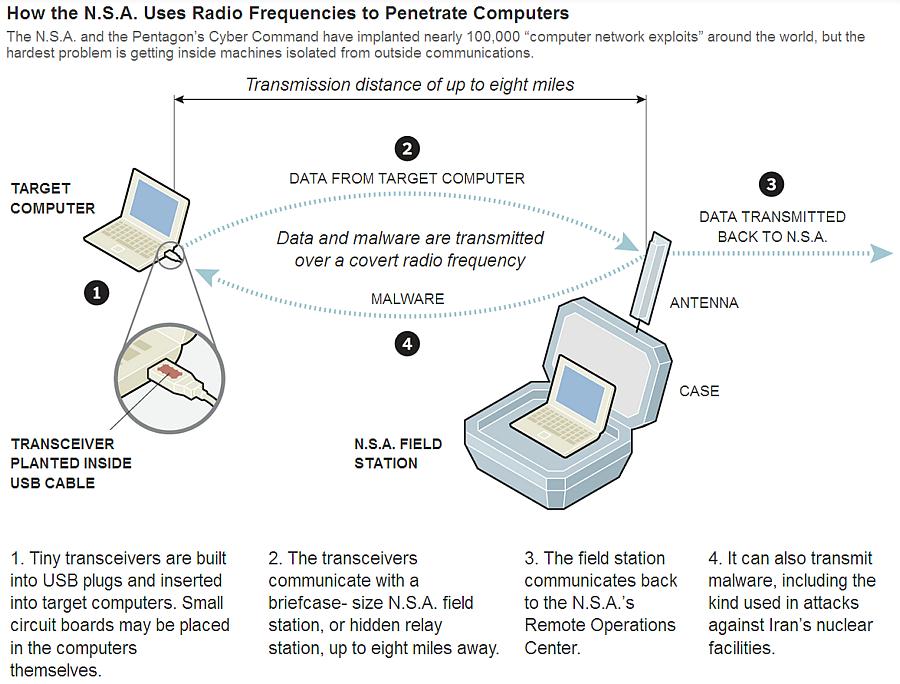
The technology, which the agency has used since at least 2008, relies on a covert channel of radio waves that can be transmitted from tiny circuit boards and USB cards inserted surreptitiously into the computers. In some cases, they are sent to a briefcase-size relay station that intelligence agencies can set up miles away from the target.
The radio frequency technology has helped solve one of the biggest problems facing American intelligence agencies for years: getting into computers that adversaries, and some American partners, have tried to make impervious to spying or cyberattack. In most cases, the radio frequency hardware must be physically inserted by a spy, a manufacturer or an unwitting user.
The N.S.A. calls its efforts more an act of "active defense" against foreign cyberattacks than a tool to go on the offensive. But when Chinese attackers place similar software on the computer systems of American companies or government agencies, American officials have protested, often at the presidential level.
Among the most frequent targets of the N.S.A. and its Pentagon partner, United States Cyber Command, have been units of the Chinese Army, which the United States has accused of launching regular digital probes and attacks on American industrial and military targets, usually to steal secrets or intellectual property. But the program, code-named Quantum, has also been successful in inserting software into Russian military networks and systems used by the Mexican police and drug cartels, trade institutions inside the European Union, and sometime partners against terrorism like Saudi Arabia, India and Pakistan, according to officials and an N.S.A. map that indicates sites of what the agency calls "computer network exploitation."
"Whatâ(TM)s new here is the scale and the sophistication of the intelligence agencyâ(TM)s ability to get into computers and networks to which no one has ever had access before," said James Andrew Lewis, the cybersecurity expert at the Center for Strategic and International Studies in Washington. "Some of these capabilities have been around for a while, but the combination of learning how to penetrate systems to insert software and learning how to do that using radio frequencies has given the U.S. a win
-
Re:yes!
Obsidian would now have to show that Cox had actual knowledge that her post was false when she published it
Something about this just seems wrong. How may times have people had their lives ruined by false accusations in the Press only to have the accusations shown to be false. Richard Jewel is a good example. Seems to me that just being a notable person should not be a free pass for folks in the Press to ruin them, accidentally or otherwise.
True, Obsidian would normally under these circumstances, have to show negligence, either that the information
was false or that she had no information at all, and was merely slandering Obsidian.However, Cox (apparently) tried to hide behind journalism privilege, without providing evidence in court,
perhaps trying to protect her sources, or perhaps because she really never had any verifiable
information. Its not clear from TFA.But had she substantiated her claims, that's when journalistic protections should kick in.
And had that she provided proof, it would have worked for a private citizen as well, although
the private citizen might not get to protect sources.The problem here is that Cox did not have entirely clean hands. From TFA:
Cox has a history of making allegations of fraud and other illegal activities "and seeking payoffs in exchange for retraction.
So once again, we are in a situation where this might be the Law of the 9Th, but it may well not fly elsewhere.
-
Re:Easy Distinction to Make
These are the very reasons that the non-traditional press needs as much or more protection than the mundane, risk-averse mainstream media.
I absolutely agree with you. However, I'm not sure that this particular blogger is the best representative of the "non-traditional press." From TFA:
Cox's blogging activities have attracted their share of controversy. According to the court's opinion, Cox has a history of making allegations of fraud and other illegal activities "and seeking payoffs in exchange for retraction."
Further, if you start doing any basic internet searches, you'll find all sorts of sordid claims about this blogger. If stuff on this link is true, for example -- this blogger is the kind of person who registers the domain names of not only enemies, but the children of her enemies, and then posts horrible stuff about them (apparently sometimes made up), and then sends letters asking for money if they want it taken down.
I have no idea if all of this is true, but it's clear from a number of stories -- both on blogs and in the "institutional press" that you accuse of not asking the hard questions, like the NY Times -- that the blogger at the center of this case is not just a "non-traditional press" representative or journalist. This appears to be someone who deliberately posts offensive material about people in order to extort money.
So, is this really a victory for the "non-traditional press," or an invitation for a new kind of "shake-down" scheme where the mob comes after your business and acts for "protection" money? (I haven't been following this story, so I don't know the answer to this, but this is the kind of stuff I've found with a few quick searches, so it appears more complex than a simple "freedom of the press" victory.)
-
Re:yes!
Obsidian would now have to show that Cox had actual knowledge that her post was false when she published it
Something about this just seems wrong. How may times have people had their lives ruined by false accusations in the Press only to have the accusations shown to be false. Richard Jewel is a good example. Seems to me that just being a notable person should not be a free pass for folks in the Press to ruin them, accidentally or otherwise.
-
"No evidence of abuse has been found"
Obviously LOVEINT is one example. But more details are coming out about how David Patraues was caught having an affair because of "metadata" collected by the NSA.
http://www.charlotteobserver.com/2013/06/17/4111871/metadata-helped-reveal-gen-petraeus.html#.Utlud2nfqCgWhen Jill Kelley first reported getting threatening emails about Patraues, the FBI read all her emails as part of "a routine step".
http://www.nytimes.com/2014/01/06/us/from-petraeus-scandal-an-apostle-for-privacy.htmlThey didn't have a warrant to read her email, they just hacked into google and made a copy of everyone's email. If you report a crime to the FBI they read your email. Simple as that.
-
Re:So the hell what?
what annoys me about this is obama is focusing on the phone data collection stuff. but what about PRISM, and the L3 infrastructure stuff, the new text message stuff (which is notable because it's content, not metadata), and all that jazz. he says the NSA's stuff is legal and he'll make a few adjustments, but he's ignoring all the ILLEGAL things they do. BTDubs the full text of the speech is at NYTimes.
-
Re:Seems reasonable
There are over 11 million reasons that say you're wrong:
http://www.nytimes.com/2013/09/24/us/immigrant-population-shows-signs-of-growth-estimates-show.html?_r=0 -
Re:Obviously!
-
Fat people like all-you-can-eat buffets, too
Sure, the major labels may love all the money they're getting, but they've squeezed all the profit out of the streaming companies. Free/cheap streaming music may not be long for this world once the venture capital runs out.
http://www.nytimes.com/2013/12/13/business/media/a-stream-of-music-not-revenue.html
-
Re:Malaysia
Most Universities likely charge higher for international students, so it should actually drive tuition down.
The amount of brief cases expands to contain all of the available money.
If I can fill my university seats with high-paying foreigners, why would I not do that more often?
And why would I not jack up resident tuition so as to have more seats available for non-resident foreign students?
An admission is a limited resource. It will tend to get sold to the highest bidder.This is already happening in some states, even in State funded schools.
Of course independent universities, including many of the most prestigious, aren't subject to state laws requiring a certain percentage of admissions being reserved for in-state students. -
N.S.A. Devises Radio Pathway Into Computers
By david e. sanger and thom shanker = jan. 14, 2014
= URL: http://www.nytimes.com/2014/01/15/us/nsa-effort-pries-open-computers-not-connected-to-internet.html
= Image: http://cryptome.org/2014/01/nsa-quantum-radio.jpg
== Coverage #1: http://news.slashdot.org/story/14/01/15/1324216/nyt-nsa-put-100000-radio-pathway-backdoors-in-pcs
== Coverage #2: http://cryptome.org/2014/01/nsa-quantum-radio.htm
== Coverage #3: http://rt.com/usa/nsa-radio-wave-cyberattack-607/
== Coverage #4: http://arstechnica.com/security/2014/01/nsa-uses-covert-radio-transmissions-to-monitor-100000-bugged-computers/
=== Archive: http://web.archive.org/web/20140116010210/http://www.nytimes.com/2014/01/15/us/nsa-effort-pries-open-computers-not-connected-to-internet.html"WASHINGTON - The National Security Agency has implanted software in nearly 100,000 computers around the world that allows the United States to conduct surveillance on those machines and can also create a digital highway for launching cyberattacks.
While most of the software is inserted by gaining access to computer networks, the N.S.A. has increasingly made use of a secret technology that enables it to enter and alter data in computers even if they are not connected to the Internet, according to N.S.A. documents, computer experts and American officials.
The technology, which the agency has used since at least 2008, relies on a covert channel of radio waves that can be transmitted from tiny circuit boards and USB cards inserted surreptitiously into the computers. In some cases, they are sent to a briefcase-size relay station that intelligence agencies can set up miles away from the target.
The radio frequency technology has helped solve one of the biggest problems facing American intelligence agencies for years: getting into computers that adversaries, and some American partners, have tried to make impervious to spying or cyberattack. In most cases, the radio frequency hardware must be physically inserted by a spy, a manufacturer or an unwitting user.
The N.S.A. calls its efforts more an act of "active defense" against foreign cyberattacks than a tool to go on the offensive. But when Chinese attackers place similar software on the computer systems of American companies or government agencies, American officials have protested, often at the presidential level.
Among the most frequent targets of the N.S.A. and its Pentagon partner, United States Cyber Command, have been units of the Chinese Army, which the United States has accused of launching regular digital probes and attacks on American industrial and military targets, usually to steal secrets or intellectual property. But the program, code-named Quantum, has also been successful in inserting software into Russian military networks and systems used by the Mexican police and drug cartels, trade institutions inside the European Union, and sometime partners against terrorism like Saudi Arabia, India and Pakistan, according to officials and an N.S.A. map that indicates sites of what the agency calls "computer network exploitation."
"What's new here is the scale and the sophistication of the intelligence agency's ability to get into computers and networks to which no one has ever had access before," said James Andrew Lewis, the cybersecurity expert at the Center for Strategic and Interna
-
N.S.A. Devises Radio Pathway Into Computers
N.S.A. Devises Radio Pathway Into Computers
By david e. sanger and thom shanker = jan. 14, 2014
= URL: http://www.nytimes.com/2014/01/15/us/nsa-effort-pries-open-computers-not-connected-to-internet.html
= Image: http://cryptome.org/2014/01/nsa-quantum-radio.jpg
== Coverage #1: http://news.slashdot.org/story/14/01/15/1324216/nyt-nsa-put-100000-radio-pathway-backdoors-in-pcs
== Coverage #2: http://cryptome.org/2014/01/nsa-quantum-radio.htm
== Coverage #3: http://rt.com/usa/nsa-radio-wave-cyberattack-607/
== Coverage #4: http://arstechnica.com/security/2014/01/nsa-uses-covert-radio-transmissions-to-monitor-100000-bugged-computers/
=== Archive: http://web.archive.org/web/20140116010210/http://www.nytimes.com/2014/01/15/us/nsa-effort-pries-open-computers-not-connected-to-internet.html"WASHINGTON - The National Security Agency has implanted software in nearly 100,000 computers around the world that allows the United States to conduct surveillance on those machines and can also create a digital highway for launching cyberattacks.
While most of the software is inserted by gaining access to computer networks, the N.S.A. has increasingly made use of a secret technology that enables it to enter and alter data in computers even if they are not connected to the Internet, according to N.S.A. documents, computer experts and American officials.
The technology, which the agency has used since at least 2008, relies on a covert channel of radio waves that can be transmitted from tiny circuit boards and USB cards inserted surreptitiously into the computers. In some cases, they are sent to a briefcase-size relay station that intelligence agencies can set up miles away from the target.
The radio frequency technology has helped solve one of the biggest problems facing American intelligence agencies for years: getting into computers that adversaries, and some American partners, have tried to make impervious to spying or cyberattack. In most cases, the radio frequency hardware must be physically inserted by a spy, a manufacturer or an unwitting user.
The N.S.A. calls its efforts more an act of "active defense" against foreign cyberattacks than a tool to go on the offensive. But when Chinese attackers place similar software on the computer systems of American companies or government agencies, American officials have protested, often at the presidential level.
Among the most frequent targets of the N.S.A. and its Pentagon partner, United States Cyber Command, have been units of the Chinese Army, which the United States has accused of launching regular digital probes and attacks on American industrial and military targets, usually to steal secrets or intellectual property. But the program, code-named Quantum, has also been successful in inserting software into Russian military networks and systems used by the Mexican police and drug cartels, trade institutions inside the European Union, and sometime partners against terrorism like Saudi Arabia, India and Pakistan, according to officials and an N.S.A. map that indicates sites of what the agency calls "computer network exploitation."
"What's new here is the scale and the sophistication of the intelligence agency's ability to get into computers and networks to which no one has ever had access before," said James Andrew Lewis, the cybersecur
-
Re:Unwise
Ok, so what good is the NSA without an enforcement mechanism? The armed services are only there to thwart a revolution by "Real Americans", so should be disarmed and dismissed. Oh, and we should dismantle our spy satellites because they might look into your backyard for the AR-15s you stockpiled under the rose garden. Obviously the national guard should be disbanded since they are only there to keep us in, not keep others out.
You seem to believe all of the most extreme rhetoric one finds in a Tea Party/Libertarian pamphlet. Do you have any actual proof that the NSA's mission is to control US citizens? Paranoia is defined thusly: "A mental condition characterized by delusions of persecution, unwarranted jealousy, or exaggerated self-importance, typically elaborated into an organized system."
In the world I live in, Elizabeth Warren is now a Senator, NYC elected a borderline socialist as mayor, President Obama just raised taxes on the "1%", and the problem of inequality is being discussed more and more. It does not sound like the NSA is doing a very good job of squelching debate. But perhaps we're just not as good as the Chinese seem to be.
I understand your concern about the scale and power of the intelligence community. It is in fact the duty of all citizens to be vigilant in the defense of freedom. But I suppose if you believe the whole "drown the govt in a bathtub" thing, there's not much more you'll have to offer in this discussion. But we'll see. Unless of course the NSA gets a look at this and we both hear the black helicopters coming...
-
#BADBIOS IS FUCKING YOU AND STILL YOU DISBELIEVE
N.S.A. Devises Radio Pathway Into Computers
By david e. sanger and thom shanker = jan. 14, 2014
= URL: http://www.nytimes.com/2014/01/15/us/nsa-effort-pries-open-computers-not-connected-to-internet.html
= Image: http://cryptome.org/2014/01/nsa-quantum-radio.jpg
== Coverage #1: http://news.slashdot.org/story/14/01/15/1324216/nyt-nsa-put-100000-radio-pathway-backdoors-in-pcs
== Coverage #2: http://cryptome.org/2014/01/nsa-quantum-radio.htm
== Coverage #3: http://rt.com/usa/nsa-radio-wave-cyberattack-607/
== Coverage #4: http://arstechnica.com/security/2014/01/nsa-uses-covert-radio-transmissions-to-monitor-100000-bugged-computers/
=== Archive: http://web.archive.org/web/20140116010210/http://www.nytimes.com/2014/01/15/us/nsa-effort-pries-open-computers-not-connected-to-internet.html"WASHINGTON - The National Security Agency has implanted software in nearly 100,000 computers around the world that allows the United States to conduct surveillance on those machines and can also create a digital highway for launching cyberattacks.
While most of the software is inserted by gaining access to computer networks, the N.S.A. has increasingly made use of a secret technology that enables it to enter and alter data in computers even if they are not connected to the Internet, according to N.S.A. documents, computer experts and American officials.
The technology, which the agency has used since at least 2008, relies on a covert channel of radio waves that can be transmitted from tiny circuit boards and USB cards inserted surreptitiously into the computers. In some cases, they are sent to a briefcase-size relay station that intelligence agencies can set up miles away from the target.
The radio frequency technology has helped solve one of the biggest problems facing American intelligence agencies for years: getting into computers that adversaries, and some American partners, have tried to make impervious to spying or cyberattack. In most cases, the radio frequency hardware must be physically inserted by a spy, a manufacturer or an unwitting user.
The N.S.A. calls its efforts more an act of "active defense" against foreign cyberattacks than a tool to go on the offensive. But when Chinese attackers place similar software on the computer systems of American companies or government agencies, American officials have protested, often at the presidential level.
Among the most frequent targets of the N.S.A. and its Pentagon partner, United States Cyber Command, have been units of the Chinese Army, which the United States has accused of launching regular digital probes and attacks on American industrial and military targets, usually to steal secrets or intellectual property. But the program, code-named Quantum, has also been successful in inserting software into Russian military networks and systems used by the Mexican police and drug cartels, trade institutions inside the European Union, and sometime partners against terrorism like Saudi Arabia, India and Pakistan, according to officials and an N.S.A. map that indicates sites of what the agency calls "computer network exploitation."
"What's new here is the scale and the sophistication of the intelligence agency's ability to get into computers and networks to which no one has ever had access before," said James Andrew Lewis, the cybersecur
-
Re:This is new?
If there wasn't an advantage in having an appendix, humans wouldn't have them.
The appendix may provide an advantage as a reservoir for helpful bacteria.
-
N.S.A. Devises Radio Pathway Into Computers
N.S.A. Devises Radio Pathway Into Computers
By david e. sanger and thom shanker = jan. 14, 2014
= URL: http://www.nytimes.com/2014/01/15/us/nsa-effort-pries-open-computers-not-connected-to-internet.html
= Image: http://cryptome.org/2014/01/nsa-quantum-radio.jpg
== Coverage #1: http://news.slashdot.org/story/14/01/15/1324216/nyt-nsa-put-100000-radio-pathway-backdoors-in-pcs
== Coverage #2: http://cryptome.org/2014/01/nsa-quantum-radio.htm
== Coverage #3: http://rt.com/usa/nsa-radio-wave-cyberattack-607/
=== Archive: http://web.archive.org/web/20140116010210/http://www.nytimes.com/2014/01/15/us/nsa-effort-pries-open-computers-not-connected-to-internet.html"WASHINGTON - The National Security Agency has implanted software in nearly 100,000 computers around the world that allows the United States to conduct surveillance on those machines and can also create a digital highway for launching cyberattacks.
While most of the software is inserted by gaining access to computer networks, the N.S.A. has increasingly made use of a secret technology that enables it to enter and alter data in computers even if they are not connected to the Internet, according to N.S.A. documents, computer experts and American officials.
The technology, which the agency has used since at least 2008, relies on a covert channel of radio waves that can be transmitted from tiny circuit boards and USB cards inserted surreptitiously into the computers. In some cases, they are sent to a briefcase-size relay station that intelligence agencies can set up miles away from the target.
The radio frequency technology has helped solve one of the biggest problems facing American intelligence agencies for years: getting into computers that adversaries, and some American partners, have tried to make impervious to spying or cyberattack. In most cases, the radio frequency hardware must be physically inserted by a spy, a manufacturer or an unwitting user.
The N.S.A. calls its efforts more an act of "active defense" against foreign cyberattacks than a tool to go on the offensive. But when Chinese attackers place similar software on the computer systems of American companies or government agencies, American officials have protested, often at the presidential level.
Among the most frequent targets of the N.S.A. and its Pentagon partner, United States Cyber Command, have been units of the Chinese Army, which the United States has accused of launching regular digital probes and attacks on American industrial and military targets, usually to steal secrets or intellectual property. But the program, code-named Quantum, has also been successful in inserting software into Russian military networks and systems used by the Mexican police and drug cartels, trade institutions inside the European Union, and sometime partners against terrorism like Saudi Arabia, India and Pakistan, according to officials and an N.S.A. map that indicates sites of what the agency calls "computer network exploitation."
"What's new here is the scale and the sophistication of the intelligence agency's ability to get into computers and networks to which no one has ever had access before," said James Andrew Lewis, the cybersecurity expert at the Center for Strategic and International Studies in Washington. "Some of these capabilities have been around for a while, but the combination of learning how to penetrate systems to insert software and learning how to do that using radio fre
-
N.S.A. Devises Radio Pathway Into Computers
N.S.A. Devises Radio Pathway Into Computers
By david e. sanger and thom shanker = jan. 14, 2014
= URL: http://www.nytimes.com/2014/01/15/us/nsa-effort-pries-open-computers-not-connected-to-internet.html
=Image: http://cryptome.org/2014/01/nsa-quantum-radio.jpg
== Coverage #1: http://news.slashdot.org/story/14/01/15/1324216/nyt-nsa-put-100000-radio-pathway-backdoors-in-pcs
== Coverage #2: http://cryptome.org/2014/01/nsa-quantum-radio.htm
== Coverage #3: http://rt.com/usa/nsa-radio-wave-cyberattack-607/
=== Archive: http://web.archive.org/web/20140116010210/http://www.nytimes.com/2014/01/15/us/nsa-effort-pries-open-computers-not-connected-to-internet.html"WASHINGTON - The National Security Agency has implanted software in nearly 100,000 computers around the world that allows the United States to conduct surveillance on those machines and can also create a digital highway for launching cyberattacks.
While most of the software is inserted by gaining access to computer networks, the N.S.A. has increasingly made use of a secret technology that enables it to enter and alter data in computers even if they are not connected to the Internet, according to N.S.A. documents, computer experts and American officials.
The technology, which the agency has used since at least 2008, relies on a covert channel of radio waves that can be transmitted from tiny circuit boards and USB cards inserted surreptitiously into the computers. In some cases, they are sent to a briefcase-size relay station that intelligence agencies can set up miles away from the target.
The radio frequency technology has helped solve one of the biggest problems facing American intelligence agencies for years: getting into computers that adversaries, and some American partners, have tried to make impervious to spying or cyberattack. In most cases, the radio frequency hardware must be physically inserted by a spy, a manufacturer or an unwitting user.
The N.S.A. calls its efforts more an act of "active defense" against foreign cyberattacks than a tool to go on the offensive. But when Chinese attackers place similar software on the computer systems of American companies or government agencies, American officials have protested, often at the presidential level.
Among the most frequent targets of the N.S.A. and its Pentagon partner, United States Cyber Command, have been units of the Chinese Army, which the United States has accused of launching regular digital probes and attacks on American industrial and military targets, usually to steal secrets or intellectual property. But the program, code-named Quantum, has also been successful in inserting software into Russian military networks and systems used by the Mexican police and drug cartels, trade institutions inside the European Union, and sometime partners against terrorism like Saudi Arabia, India and Pakistan, according to officials and an N.S.A. map that indicates sites of what the agency calls "computer network exploitation."
"Whatâ(TM)s new here is the scale and the sophistication of the intelligence agencyâ(TM)s ability to get into computers and networks to which no one has ever had access before," said James Andrew Lewis, the cybersecurity expert at the Center for Strategic and International Studies in Washington. "Some of these capabilities have been around for a while, but the combination of learning how to penetrate systems to insert software and learning how to do tha
-
Re:So you want to retire a statistical term...
How did you like this bit from Sean Carroll suggesting that "falsifiability" is the scientific concept overdue for retirement?
Modern physics stretches into realms far removed from everyday experience, and sometimes the connection to experiment becomes tenuous at best.
The truth is the opposite. Whether or not we can observe them directly, the entities involved in these theories are either real or they are not. Refusing to contemplate their possible existence on the grounds of some a priori principle, even though they might play a crucial role in how the world works, is as non-scientific as it gets.
If you think the rift between economics and social science is deep, take a look at your roots.
To the degree that the educated public knows and respects the scientific tradition, it's because of the adherence to falsifiability. That's the economic foundation of getting what we pay for. I wouldn't go so far as to argue that the multiverse (and the statistical landscape--bleh) is not actually physics, but it sure as hell isn't physics resting on the foundation that has conferred upon physics its esteem and respect as a hard science over the last four centuries.
Let's reopen the question about why we're funding this kind of work on the public purse. He's smoking a crack pipe if he thinks he can flush falsifiability and still keep his cozy budget. Personally I celebrate renegade artists and crackpots like Garrett Lisi—Kepler was equally nutty and he punched through. I think Carroll should sleep in a van on a Hawaiian beach and get back to us when his awe-inspiring kaleidoscopic symmetries collapse to a waveform we can actually test (yes, I know Dyson took a pot shot at collapsing waveforms on that same forum). Perhaps Carroll will cough up on the beach a core idea for the next consolidation of physics beyond the standard model. I'll cheer for him every step of the way. Meanwhile, no falsifiability means no public funds. He can grovel at the knees of the Templetons who find this new kind of science somehow majestic.
I'm not a physicist. I did study physics. I'm not an economist. I have listened to nearly every EconTalk dating back to 2005. I think his crush on Hayek is misguided. This doesn't stop me from tuning in, because most of his guests are smart.
Even with economics, there's an enormous rift between mathematical economics, the study of models that barely reflect reality, and narrative economics, where people try to convince each other that a stimulus actually works or it doesn't work, and no reference back to the raw data ever settles the matter.
Economic policy advisors are no better than sociologists.
Taleb's primary point—and he's totally right—is that analytic models that are always right except during rare events are complete dogshit, though it you can get traction on it, you might make off with a lode for a short while. The mere presence of a nearly infallible player in an economic market precipitates rare events of the nastiest kind. If I were teleported back to Edge 2005 to write a little essay for What do you believe true even though you cannot prove it? that could be my starting point.
You should read Assumptions Economists Make, which describes economics from the perspective of Jonathan Schlefer, a political scientist who got his hands dirty.
In Economics, You Are What You Model
I don't know why you think you need to look outside your own disciplines of physics and economics to find people playing fast and loose with the scientific method.
-
Who Are The FISA Judges?
They are all picked by one man - Supreme Court Chief Justice Roberts.
http://www.nationaljournal.com/nationalsecurity/chief-justice-john-roberts-appointed-every-judge-on-the-fisa-court-20130812This was meant to be a body of jurists to check the validity of search warrants, but it developed its own body of case law. With no check on its power. None.
The NY Times notes "In making assignments to the court, Chief Justice Roberts, more than his predecessors, has chosen judges with conservative and executive branch backgrounds that critics say make the court more likely to defer to government arguments that domestic spying programs are necessary."
http://www.nytimes.com/2013/07/26/us/politics/robertss-picks-reshaping-secret-surveillance-court.html?ref=charliesavage&_r=0So, yeah, I'd say the FISA judges don't want anyone looking over their shoulders.
-
Re:subsidy misnomer
> The last I checked, no cash was being given away to oil companies.
I am guessing you don't check often or you check in the wrong places (like Faux News).
Energy subsidies
https://en.wikipedia.org/wiki/Energy_subsidies#Allocation_of_subsidies_in_the_United_StatesAs Oil Industry Fights a Tax, It Reaps Subsidies
http://www.nytimes.com/2010/07/04/business/04bptax.html?pagewanted=allThese subsidies have been the subject of frequent battles in the lame US Congress.
Either way please read up on this crap and go crawl back under your rock.
-
Re:Shocking
Perhaps we should just remove the defense attorney from criminal proceedings as well. That should clear out the case backlog,
Something like 80%~97% of ALL criminal cases are settled by plea agreement.
(Depending on the jurisdiction and specific court)Traffic and misdemeanor courts have similarly high rates of plea bargains or guilty pleas.
If there's a backlog in the court system, it's entirely because of underfunding.
-
Re:wait wait wait....
So this didn't happen? Obama was beating that war drum right until Congress (including the Senate, led by his own party) told him to sit down and shut up. That's when they tried to go the diplomatic route, and then spin history saying that the whole Congressional authorization for military force was just a "bargaining chip" to get Syria to the table, and not another complete disaster when it comes to the relations between Congress and this White House.
Yeah right. Syria saw a way to get rid of this shit without having to pay to do it, and blame someone else if (when) something goes wrong. And, it was a bargaining chip for Assad to stay in power - he gets to say "Ohh, we're giving up all our bad shit that has left my country in the world's doghouse for decades! Clearly we want to work with the world unlike the jihadist rebel fucks shooting up the place!" Never mind him using his air force to bomb cities and civilians that told him to go eat a bag of shit. And never mind the so-called Free Syrian Army who are blockading cities and not allowing food in because the city is siding with the government.
Hey, didn't we send a bunch of Marines to Somalia when some fuckface of a warlord and his thugs used hunger as a weapon? I guess black people in Mogadishu count, but arabs in Aleppo don't. Killing with hunger over weeks of time is completely okay, just like using helicopters and tanks on civilians. Just as long as they don't use chemicals that kill in minutes - that provokes international outrage!
-
Re:Based on what?
The second reason is that the deviation from rationality may often be viewed as a stochastic variable with zero mean. Ignoring it affects individual cases, but not the overall conclusions.
What is interesting about current research is that this assumption appears to not be true a lot of the time.
-
Retribution
During his news conference, Mr. Christie said he had been “blindsided” by emails made public on Wednesday that showed that staff members — also his close friends — had punished the Democratic mayor of Fort Lee in September by closing entrance lanes to the bridge because he did not endorse the governor for re-election.
All that for not endorsing him? What kind of goomba is this guy? So, he's have the State Police beat the shit out of you if you criticize him and call it a "Police training exercise"?
So much for the Great White Republican Hope for President in '16.
Maybe they'd get Christine Todd Whitman?
Nah! Too sane! The right wing social conservative Evangelical nut jobs would never go for her!
-
Research, Lifestyle changes, and Specialists
There are a plethora of studies out there tying memory and cognitive function to various things, including diet, sleep, type of learning, etc... Being in my 30's I can empathise with the problem, I just don't seem to pick things up as quickly as I did in my teens and 20's. It's not drastic, but it is noticable.
Some foods have been tied to cognitive function. Read up a little bit here and here. Or do some googling for some more stuff. It's interesting that the traditional american diet of burger and fries is actually a hindrance to memory and brain function. Healthy eating is very important to every component of your life, I just wish I new that when I was in my early 20's.
Exercise is another thing that fuels the brain. I find that when I stop biking/running, my mood goes to crap and I have a harder time sleeping. As my exercise level goes up, everything else gets better. Plenty of research here to back it up.
Different people also learn things in different ways. Looking at learning styles may help you figure out what works best for you. One thing I learned in undergrad is you don't really understand something until you can:
- Define what it is
- Defend it's strengths
- Attack its flaws
In that same class, the professor told us that if we knew our stuff, there was no way he could trick us. I've applied that same test to those things I really want to remember, and I've found it works great. Repetition in Math never really stuck with me, but when I was finally able to reason about what the equation was actually doing, and understand the strengths and weaknesses (getting into applied math here), I found it was much easier to comprehend and work with.
You could spin your wheels for days trying to figure what works best for you, or to discover that there may be something else going on that needs treatment (i.e. ADD or something) before you're able to progress. It may be worth talking to your primary care and getting a referral to the appropriate specialist.
-
Research, Lifestyle changes, and Specialists
There are a plethora of studies out there tying memory and cognitive function to various things, including diet, sleep, type of learning, etc... Being in my 30's I can empathise with the problem, I just don't seem to pick things up as quickly as I did in my teens and 20's. It's not drastic, but it is noticable.
Some foods have been tied to cognitive function. Read up a little bit here and here. Or do some googling for some more stuff. It's interesting that the traditional american diet of burger and fries is actually a hindrance to memory and brain function. Healthy eating is very important to every component of your life, I just wish I new that when I was in my early 20's.
Exercise is another thing that fuels the brain. I find that when I stop biking/running, my mood goes to crap and I have a harder time sleeping. As my exercise level goes up, everything else gets better. Plenty of research here to back it up.
Different people also learn things in different ways. Looking at learning styles may help you figure out what works best for you. One thing I learned in undergrad is you don't really understand something until you can:
- Define what it is
- Defend it's strengths
- Attack its flaws
In that same class, the professor told us that if we knew our stuff, there was no way he could trick us. I've applied that same test to those things I really want to remember, and I've found it works great. Repetition in Math never really stuck with me, but when I was finally able to reason about what the equation was actually doing, and understand the strengths and weaknesses (getting into applied math here), I found it was much easier to comprehend and work with.
You could spin your wheels for days trying to figure what works best for you, or to discover that there may be something else going on that needs treatment (i.e. ADD or something) before you're able to progress. It may be worth talking to your primary care and getting a referral to the appropriate specialist.