Slashdot Mirror
Domain: ohio-state.edu
Stories and comments across the archive that link to ohio-state.edu.
Comments · 405
-
Re:RTFA
I agree with your response a few levels down. "PD" should type more and I don't think that PD has successfully argued that evolution is a fact. While you have been considerably more polite I don't think you have successfully made your case either.
How about we make sure we are using the same definitions for "evolution" before we get any deeper in to this. A short trip to Google found what appears to be notes for a lecture. It seems likely that this is the definition of evolution that the Steves were in agreement about.
Would you care to comment on the section labeled "1." in the lecure notes? Are you arguing the same sort of case as Michael Behe?
-
How to beat the stock market
It's simple actually. Invest on sunny days!
-
rfc 2060 - all a nerd needs
-
The contest sponsor has plenty of MS cash
As yet another Ohio State person, I wonder why no one seems to have linked to the contest in question yet. I'm not too worried about OSU's bandwidth since I have some idea of their network topology (multiple backbones, etc.).
Personally, I've always wondered how NTsig (the group running the contest), can claim "not to be fully funded by Microsoft(tm)". Even when charging $5 per year per person, NTsig will be giving away over $10,000 in prizes for this contest, has regularly handed out thousands of dollars worth of MS software, and gave out a few Xboxes last quarter too. Furthermore, it is known that at least one NTsig officer is paid by Microsoft to run the club. Hence, I cannot say that the club is unbiased.
I attend a class at OSU where the professor teaching it has a large Microsoft grant. He has more MS servers than he knows what to do with (one hit by the latest SQL worm), a Tablet PC, a video projector, etc. -- all allegedly paid for by Microsoft. While he seems to be teaching the course fairly, he did add
Just to be fair, I'll link to the Ohio State Open Source Club too, although on a $300 per year budget, they can't be that significant, can they?
-
The contest sponsor has plenty of MS cash
As yet another Ohio State person, I wonder why no one seems to have linked to the contest in question yet. I'm not too worried about OSU's bandwidth since I have some idea of their network topology (multiple backbones, etc.).
Personally, I've always wondered how NTsig (the group running the contest), can claim "not to be fully funded by Microsoft(tm)". Even when charging $5 per year per person, NTsig will be giving away over $10,000 in prizes for this contest, has regularly handed out thousands of dollars worth of MS software, and gave out a few Xboxes last quarter too. Furthermore, it is known that at least one NTsig officer is paid by Microsoft to run the club. Hence, I cannot say that the club is unbiased.
I attend a class at OSU where the professor teaching it has a large Microsoft grant. He has more MS servers than he knows what to do with (one hit by the latest SQL worm), a Tablet PC, a video projector, etc. -- all allegedly paid for by Microsoft. While he seems to be teaching the course fairly, he did add
Just to be fair, I'll link to the Ohio State Open Source Club too, although on a $300 per year budget, they can't be that significant, can they?
-
The contest sponsor has plenty of MS cash
As yet another Ohio State person, I wonder why no one seems to have linked to the contest in question yet. I'm not too worried about OSU's bandwidth since I have some idea of their network topology (multiple backbones, etc.).
Personally, I've always wondered how NTsig (the group running the contest), can claim "not to be fully funded by Microsoft(tm)". Even when charging $5 per year per person, NTsig will be giving away over $10,000 in prizes for this contest, has regularly handed out thousands of dollars worth of MS software, and gave out a few Xboxes last quarter too. Furthermore, it is known that at least one NTsig officer is paid by Microsoft to run the club. Hence, I cannot say that the club is unbiased.
I attend a class at OSU where the professor teaching it has a large Microsoft grant. He has more MS servers than he knows what to do with (one hit by the latest SQL worm), a Tablet PC, a video projector, etc. -- all allegedly paid for by Microsoft. While he seems to be teaching the course fairly, he did add
Just to be fair, I'll link to the Ohio State Open Source Club too, although on a $300 per year budget, they can't be that significant, can they?
-
Re:Ignant
Ummm, no. "inverse" does not in any way shape or forme identify a request for the hostname associated with an IP address.
Yeah, most of the time so-called "reverse lookups" are done by doing a normal query of a PTR RR. But there is also, an obscure DNS query called an iquery, where the answer is prefilled in with the IP address and any name. If the query type is IQUERY, then the server (if it supports it) is supposed to lookup the name that corresponds with the IP address.
More details here. See section 6.4.2.
So, basically, the previous poster is right. But as far as I know they're hardly ever used. They are, however, part of a security vulnerability of DNS. So I wonder if the 98% of packets sent to the root namesevers indicate that 98% of the time, those nameservers are really under attack.
-
Re:such accuracy... not
They're a long way away. The light from them has to have taken a long time to get here (speed of light being constant) so the picture we see of them is the one made up of light that left a long time ago. You can also tell they're old because of their composition, which brings us to your next question...
Actually, the clusters observed are within our own milky way galaxy and are therefore not distant. Although it seems counterintuitive, if you want to see extremely old objects in the universe, it is best to look close by, because, as you mention, looking far out into space you see light that left a long time ago and therefore you are looking at the universe as it was when it was younger.
The ages of the clusters are determined from the Hertzsprung-Russell Diagram which plots the brightness versus temperature of the cluster. A description of this method may be found in the full article in Science for those at a university with a subscription (Main-Sequence Turnoff Ages)
article
or though a number of other web pages, such as this one
They might have been, but it's a simple thing to check. The early universe was composed almost entirely of hydrogen, which they converted to helium. When they died, their helium was scattered and helped form younger stars, which started converting the helium into heavier stuff.
A substantial amount (30% I think) of the early universe was helium because of Big-Bang Nucleosynthesis. The first generation stars formed other elements throughout the periodic table and then went supernova, distributing the material for second generation stars. Uranium and other radioactive elements have been seen in very few of the very earliest second generation stars, leading to an independent age determination based on radioactive decay rates (a method often used to measure ages of earth rocks). The detections and method are described in the Science article. -
Re:1600lb Gorilla Sitting Anywhere it Wants
Also, by forcing all computers to have a microsoft os on them, there will be no incentive to pay for another operating system (even if it is linux).
From the Ohio FAQ:
The contract with Microsoft is not an exclusive contract. Some OSU departments will continue to purchase other competing vendors' software products because they have determined these other products meet their needs more completely than the Microsoft product suite.
I couldn't find a similar comment in the Michigan FAQ , which may or may not mean that the Michigan Uni has a more exclusive deal.
-
Re:Yes, it's true
Umm... As a member of the Ohio State University open-source group, I can say we do an awful lot! It might all be a matter of opinion, but we definitely already have a number of events planned for next quarter.
And don't think we're lightweight open source users either; if you haven't noticed, at least OSU OSS one member, Colin Walters, has been mentioned on Slashdot twice. And he's not the only person in the group with high-level access to a major open-source project; we also have at least one other Debian developer, as well as a Gnome one.
The problem with OSU clubs in general is finding out what they're up to; I, for instance, don't get any IEEE event information, and hence thought for a long time that they were doing nothing as well.
If you want to see what the group is up to; subscribe to our mailing list (general or announcements only), and/or come to a meeting. We do not list meetings on the web site's front page, but every meeting has been listed in the events section, flyered around Dresse, and sent out to both email lists.
Granted, NTsig can give you free Microsoft software, so if you're into MS, you're better off with them (although you can join both). Rumor has it that many NTsig members think the opensource group is more into their cause, although that may just be rumor.
(The preceding was written by an OSU OSS member; not an officer.)
-
Re:Yes, it's true
Umm... As a member of the Ohio State University open-source group, I can say we do an awful lot! It might all be a matter of opinion, but we definitely already have a number of events planned for next quarter.
And don't think we're lightweight open source users either; if you haven't noticed, at least OSU OSS one member, Colin Walters, has been mentioned on Slashdot twice. And he's not the only person in the group with high-level access to a major open-source project; we also have at least one other Debian developer, as well as a Gnome one.
The problem with OSU clubs in general is finding out what they're up to; I, for instance, don't get any IEEE event information, and hence thought for a long time that they were doing nothing as well.
If you want to see what the group is up to; subscribe to our mailing list (general or announcements only), and/or come to a meeting. We do not list meetings on the web site's front page, but every meeting has been listed in the events section, flyered around Dresse, and sent out to both email lists.
Granted, NTsig can give you free Microsoft software, so if you're into MS, you're better off with them (although you can join both). Rumor has it that many NTsig members think the opensource group is more into their cause, although that may just be rumor.
(The preceding was written by an OSU OSS member; not an officer.)
-
Re:Yes, it's true
Umm... As a member of the Ohio State University open-source group, I can say we do an awful lot! It might all be a matter of opinion, but we definitely already have a number of events planned for next quarter.
And don't think we're lightweight open source users either; if you haven't noticed, at least OSU OSS one member, Colin Walters, has been mentioned on Slashdot twice. And he's not the only person in the group with high-level access to a major open-source project; we also have at least one other Debian developer, as well as a Gnome one.
The problem with OSU clubs in general is finding out what they're up to; I, for instance, don't get any IEEE event information, and hence thought for a long time that they were doing nothing as well.
If you want to see what the group is up to; subscribe to our mailing list (general or announcements only), and/or come to a meeting. We do not list meetings on the web site's front page, but every meeting has been listed in the events section, flyered around Dresse, and sent out to both email lists.
Granted, NTsig can give you free Microsoft software, so if you're into MS, you're better off with them (although you can join both). Rumor has it that many NTsig members think the opensource group is more into their cause, although that may just be rumor.
(The preceding was written by an OSU OSS member; not an officer.)
-
Re:Yes, it's true
Umm... As a member of the Ohio State University open-source group, I can say we do an awful lot! It might all be a matter of opinion, but we definitely already have a number of events planned for next quarter.
And don't think we're lightweight open source users either; if you haven't noticed, at least OSU OSS one member, Colin Walters, has been mentioned on Slashdot twice. And he's not the only person in the group with high-level access to a major open-source project; we also have at least one other Debian developer, as well as a Gnome one.
The problem with OSU clubs in general is finding out what they're up to; I, for instance, don't get any IEEE event information, and hence thought for a long time that they were doing nothing as well.
If you want to see what the group is up to; subscribe to our mailing list (general or announcements only), and/or come to a meeting. We do not list meetings on the web site's front page, but every meeting has been listed in the events section, flyered around Dresse, and sent out to both email lists.
Granted, NTsig can give you free Microsoft software, so if you're into MS, you're better off with them (although you can join both). Rumor has it that many NTsig members think the opensource group is more into their cause, although that may just be rumor.
(The preceding was written by an OSU OSS member; not an officer.)
-
No Apache?The Ohio FAQ has the following section in. I'm not sure if they're warning against Apache, or saying FrontPage is so hopelessly non-standards-compliant you shouldn't use it. A similar clause is in the Michigan Acknowledgement of Conditions and Notices form.
Is FrontPage recommended for use with my environment?
Before purchasing or developing your web pages with Microsoft FrontPage, ensure the web server for your pages will be the Microsoft Internet Information Server (IIS) running on Windows NT. FrontPage embeds proprietary and/or non-protocol-compliant features within HTML code, many of which are incompatible with many non-Microsoft web servers, including those utilized in OSU's OpenVMS and Novell architectures. The implications are twofold:
Web page creators can't just place FrontPage-generated HTML files in their OpenVMS accounts or in their Universal Disk Space and expect the web pages to work correctly.
Even if the pages are served successfully, they may only be fully readable by certain versions of Microsoft's Internet Explorer (IE) web browser.
-
Your new computer must be purchased with an os
From the faq at the university:
Your new computer must be purchased with an operating system
-
IE's PNG Deflate Heap Corruption Vulnerability
*ahem*
Internet Explorer's Recently Discovered PNG Deflate Heap Corruption Vulnerability
Twas the night before Christmas, and deep in IE
A creature was stirring, a vulnerability
MS02-066 was posted on the website with care
In hopes that Team eEye would not see it there
But the engineers weren't nestled all snug in their beds,
No, PNG images danced in their heads
And Riley at his computer, with Drew's and my backing
Had just settled down for a little PNG cracking
When rendering an image, we saw IE shatter
And with just a glance we knew what was the matter
Away into SoftICE we flew in a flash
Tore open the core dumps, and threw RFC 1951 in the trash
The bug in the thick of the poorly-written code
Caused an AV exception when the image tried to load
Then what in our wondering eyes should we see
But our data overwriting all of heap memory
With heap management structures all hijacked so quick
We knew in a moment we could exploit this $#!%
More rapid than eagles our malicious pic came --
The hardest part of this exploit was choosing its name
Derek Soeder
Software Engineer
eEye Digital Security
Link to source -
Flaw in proof, perhaps google isn't evil!
Turn the number backwards, and add 111 - the only triplet that can ever be prime.
Ah, but 111 isn't prime. (3*37=111). So clearly it must be left out.Following the rest of the computation results in 1816 - the year Werner von Siemens was born.
The Siemens corporation advertises on Google!
Google is really a front for the Siemens corporation. QED.
-
Chemo? Gamma not ionizing?
That's interesting.. but what does chemotherapy have to do with radiation treatment?
And for the grandparent post... if you really think gamma radiation is not ionizing, and want to go telling the world that, go hang out with some gamma emitters for a while first, THEN come tell us how it passes harmlessly through things.
Alpha & Beta radiation, outside the body, cause radiation damage primarily in the skin. The higher the energy, the further they penetrate, of course. Gamma radiation, however, will pass right through you, causing damage to your internal organs along the way.
What is ionizing radiation?
Gamma radiation is VERY ionizing. Why do you think it causes cancer? Why do you think it casues radiation poisoning in high doses? What do you think radiation poisoning is?
-
Re:The age old question...
It is properly S-Q-L because Sequel is something different (Structured English Query Language, an IBM project that never went anywhere). But the term "sequel" for SQL has come into common use, so it's the de facto pronounciation.
I pretty sure it's interchangeable.
SEQUEL is indeed Structured English QUEry Language, which was invented by IBM back in the 70's as the query language for their relational database System/R. But it did go somewhere: into the public domain, where the acronym was shortened to SQL.
Its success is as much attributeable to Relational Software Inc. as IBM (who continued to use it in System/R's followup SQL/Data System, and SQL/DS's successor DB2), as Relational Software chose it as the query language for their fledgling RDBMS, which you may have heard of - ORACLE
As it became apparent that SQL was here to stay, ANSI created a standard definition (the first of which was SQL-89). Today's SQL standard is based mostly on IBM's implementation, with a good few substantial additions.
So as I understand it, SQL is not really something different to SEQUEL, it's just a newer evolution.
Oh, and back on topic, here's an excellent online introduction to SQL by James Hoffman. I'd also recommend checking out the Google Directory's SQL FAQs, Help, and Tutorials.
Cheers, -
Better coverageIronically, when I heard a blurb this afternoon about this on my local NPR station, the commentator made a point of saying the study's author was saying this wasn't caused by global warming.
However, this article makes it clear the author blames a good portion of the recent loss on global warming.
It also tells a dramatic story of environmental disaster not caused by people, both fairly recently:
- The core data showed that in 1790, the cycle changed, the rains lessened and drought took hold in the region, a condition that continued for seven years until 1796 when the monsoons returned.
"That event was major," Thompson said. "It killed more than 600,000 people in one region of India alone. And that was at a time when global populations were much less than they are today." (Estimates place the world population in 1800 at 980 million.) "If a similar event occurred today, the social and economic disruptions would be horrendous," he said. Current world population is just over 6 billion people.
- That wet period ended and the ice corings show that Africa slid into a deep drought about 4,000 years ago. This dry period, said Thompson, is also found in other records, including some written history.
"This dry period appears in the historic record in Egypt," he said. "Writings on tombs talk about sand dunes moving across the Nile and people migrating. Some have called this the Earth's first dark age."
Africa was not alone in the global drought. Thompson said other records show that civilizations during this period collapsed in India, the Middle East and South America.
-
Common LispBefore you mod me down, check out what these guys have done. (The site hasn't been updated in a while, due to company problems and one of the main coders being on hiatus or something (fyi, his name is Larry Malone, he has been doing this ever since he modelled the sailing ships in Tron using custom-developed software at III, and has been writing graphics Lisp software at Symbolics and since afterwards)). Well, enough of the history lesson.
Common Lisp has a lot of benefits for this type of work. Since it is completely dynamic (ie - everything runs in an image with which you can interact, add code/compile and debug, all at run-time), the plug-in/scripting is taken care of from the start, and can have the full syntax of CL and access to any of the main program's features you choose to give it. CL will probably give you the most results per line/minute of code because of this dynamism.
Most CL implementations have pretty good foreign function interfaces for C and C++ libraries (Franz's Allegro CL even provides support for run-time Java objects.)
CL's performance is on par with C++ in general, and lags only in one major area - FP operations require "boxing" overhead when the symbol pointing to the numbers is dynamically typed (most compilers optimize statically typed declarations pretty well - which makes most of the overhead go away.)
Of course, before you go off on your great quest, you should probably read what some of the other posters have suggested. Writing graphics software like the type you describe is an incredible amount of work (I gave up my uber-Scheme system after 100 lines and settled for writing smaller utilities and plugins), and many have tried and miserably failed before.
-
Crack Attack
This has probably got to be one of the most addicting games I've ever played, Crack Attack! It's open source, works in windows and linux, uses open gl, and it's a game based on tetris attack. The score to beat on the site (4135 I think) is actually from one of my friends, we play this game all the time. It has very nice multiplayer support and a game browser is in the works (although probably in the distant future.
You'll spend weeks playing to get the highest score on the list, then you spend even more time trying to get 1000. The game is sure to keep anyone entertained for hours. -
Re:From what Ive read ...
1: How am i going to charge it in my parking lot at work? at my dorm?
Yep, you can't yet, and I doubt you ever will, but if the people demanding electric cars would put up the cash to buy them, I'd be more than willing to be that credit card enabled chargers would spring up all over the place.
2: It just wont get me very far here in Kansas
How far do you want to go today? Electric cars are not and have never been aimed at 1000+ mile runs out in the sticks, but rather the city commuter who travels an average of 30 miles per day in city trafic.
3: Lack of speed. When I need to merge, I need to get up and GO damn it.
Exactly how fast do you merge?
4: Small. I like big cars, or better yet Trucks. You cant have an electric Truck - it just makes no sense unless you haul barbie furniture
You do know that electric engines have more low end grunt than most gasoline engines could ever dream of. In fact one of the markets EV's have been succesful in is in city delivery vechicles.
FWIW, I'm not much of a proponent of EV's replacing everyone's cars (actually, this would be a bad thing). However, I do believe that, like most alternatives, they do have their place (think postal delivery vechicles). Unfortunately, with everyone believing that any growth in the EV market will ultimately force them out of their oversized grocery getter, I don't think that they will ever be given the chance to prove thier worth. -
Re:One of my favourite quotes...
-
Mental Music from Around the World!
Well! This is a most interesting discovery. Let's take a quick trip into the minds of various people in various cultures, and find out just what they've got knocking around in their gray matter.
From the mind of a somewhat suicidal insomniac in San Francisco: Van Halen's "Jump."
From that of a gay preacher in Biloxi, MS: Barry Manilow's "It's a Miracle."
From the neurons of the 3M rep for adhesive products in Irkutsk, Russia: Lionel Richie's "Stuck on you."
A cabbie on the run from Heathrow airport in London to the downtown hotels was found to have "You Picked a Fine Time to Leave me, Loose Wheel" rattling around in his skull (and lug nuts rattling around in his trunk -- pardon me, 'boot').
In Australia, a most sleepless LAN technician, one Arthur 'Sparks' McGill, was startled to find Icehouse's "Electric Blue" firmly embedded in his alpha waves.
Finally, back here in the States, Slashdot's owner, Rob "Commander Taco" Malda surprised no one by having that (in)famous filk track Mr. Compatibility stuck so firmly in his brain stem that not even a jackhammer was able to dislodge it.
That's all for now. Tune in again next week for another installment of "Spot the Looney!" -
Re:Information unavailable
The fact that they won doesn't mean they have a case, however. It's still useful to make the distinction between valid claims and bullying tactics.
They don't have a case. Fact is, though, they don't seem to need one... but if someone with more acquired power decides to take up the banner, they may find the situation somewhat changed. -
Et tu, Brute?I searched for "Et tu Brute" on google, and this is the first thing that came up:
I remember many years ago reading in an article in a classical journal that Julius Caesar's last words weren't really "Et tu, Brute" but the Greek "Kai su, teknon", meaning something like "And you'll be getting yours before long, son".
I imagine in the bizarro world of Slashdot, bad cases which bring bad law are somehow good for the rest of us. But I fail to see how thickening the legal morass surrounding licensing is going to bring us to a better world. Being a part of the hoard standing around while Ceaser goes down doesn't mean there won't be plenty to smack us with too, before long. -
Re:Multicasting.
I don't think you understand multicasting.
With multicasting, you don't NEED p2p reflectors. The data is transmitted over any given network ONCE no matter HOW MANY people are listening. Limited upstream bandwidth is not an issue unless your stream bitrate is lower than your upstream bandwidth rate.
I suggest you read up on the subject. -
Re:Since we're splitting hairs...I'm sure that geothermal heat is not from the Sun. The Sun was cooler when it ignited than it is now. So if the Sun is not melting rock all the way to the core now, it was probably not doing that earlier. If there were bursts of such intense heat, if life existed it would have been wiped out, and indications of life on Earth have been found most of the way back to the time when the Earth formed. Note also that Venus and Mercury are much hotter, but both also have solid crusts.
The initial heat was from impacts.
Earth is mostly metals, so there is a lot of radioactive material present (that's why that cinder block wall next to you has a little radium and plutonium even though it is a light rock). A lot of geothermal energy is probably nuclear.
Some of the heat is due to depth compression and friction during circulation.
However, some of the heat might be electromagnetic. The source of the Earth's magnetic field is deep in the Earth, but that huge field interacts with the Sun's field and with the solar wind. Any alteration of that magnetic field, such as the 24 hour cycling between the solar bow shock then back to the trailing edge overnight and back to the bow shock, creates stresses back to the generator. Some of those stresses must generate heat. I don't know how much, but that's a rather large field. -
Re:biophotovoltics anyone?
Actually, they are developing hydrogen producing bacteria. Check it out. More accurately, people are working on using existing bacteria to produce hydrogen. But eventually genetic engineering will probably be used to up the efficency of the process. Once you have the hydrogen, producing electricity from it is pretty trival (burn it in a turbine or fuel cell).
-
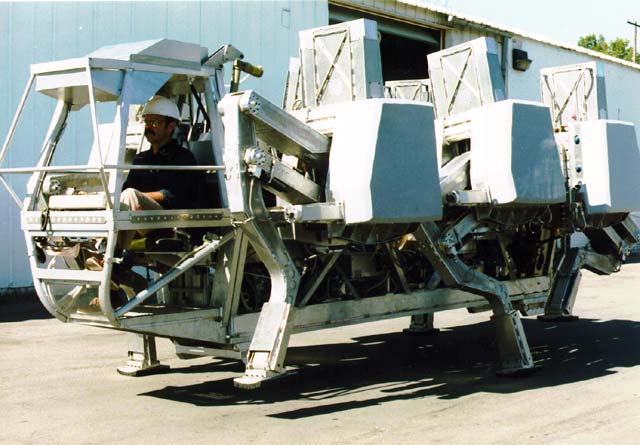
Not quite...This thing is neat, but it looks like a more "packaged" version of the OSU Adaptive Suspension Vehicle.
Even so, as this page shows, walking machines and designs have been around for a long while, even "ride on" models.
-
Re:ET Life
Since no one else on slashdot is contributing to the discussion, if you'd like to continue it in email feel free. My address is bsmith3 at charter dot net.
Anyway...
Tell me why I should expect an atheist scientist to give credence to creationist theories if they had supporting evidence? Everyone has biases, and a discussion of origins is inherently philosophical and will include people's biases.
Well, not all scientists are atheists. They come from all religious backgrounds and have beliefs as varied as anyone else. You might find a slightly higher proportion of atheists among scientists than the population at large, because science and atheism both tend to attract people with strict, logical minds.
This also seems like a convenient place to point out that Pope JP II has gone on record as saying the theory of evolution is not necessarily in conflict with Catholic theology. Not knowing your faith more than that you are Christian, I have to hope you're not one of the sort who refer to the Pope as the Great Satan of Rome, otherwise you won't give a whit about that.
About the dating methods mentioned on creationscience.com, I'm going to do more reading on some of them. The primarily geological ones (sediments, volcanic debris, continental erosion) don't seem to account for the massive geological changes that the Earth has gone through in its lifespan. The continents weren't always where they are now, many things which used to be sediments a few million years ago are mountaintops now, and so forth. Obviously, if you reject an age > 6000 years for Earth in the first place, those aren't good explanations. But if you're going to try to find inconsistencies in geology, you have to make sure that the theories already there don't easily explain away your evidence. Some of the other stuff there isn't so easy to dismiss, so I'll be doing some more reading later on.
Question: is there any mechanism known (and I am ignorant) by which molecules may be created initially in order to form amino acids?
Well, if you've got carbon, hydrogen, oxygen, and nitrogen, you've got all the building blocks in place. Stuff like methane, ammonia, and of course carbon dioxide and water can form naturally, and these can form the amino acids.
You demonstrated that some amino acids form naturally, but what about the molecules they are formed from - do all 20 amino acids naturally form, or only some?
There are now 22 known amino acids actually. As far as I know, not all of them have been shown to form outside of biological processes. That, of course, doesn't constitute proof that they can't form naturally.
Really? Some questions for evolution:
* Why do humans shun rape as a sickening act?
* Why do humans practice self-sacrifice for the love of another that is not necessarily their own offspring?
* Why do humans sometimes feel prone to compassion towards the weak and unpriviliged?
Three quick guesses that might not necessarily be all that great....
Rape: Females should tend to seek the fittest mate, having another forced on them goes against their genetic best interests. The males don't want to see it happen because that female might have chosen them as a mate instead. Incidentally, the male's genetic prerogative is to fertilize as many females as possible. This might explain why men don't appear as sympathetic to rape victims as other women, and also why you almost never hear of a man being raped (or at least, you don't hear them complain). These different approaches to reproduction can also be used to explain the different attitudes of men and women towards consent - the "men are pigs" phenomenon, you might call it.
Self sacrifice: Say you have two groups of bunnies. One bunny stands up to the marauding fox and saves his mate and cubs at the cost of his life. Another bunny runs away and his cubs are eaten. The first bunny has passed the test of natural selection and his offspring have a chance. The second bunny has not. He's survived to try again, but any number of things may stand in his way. The first bunny's offspring aren't guaranteed survival, but they're obviously more likely than the dead ones.
Compassion: This one is harder. Compassion is in general beneficial to the species as a whole, but it's harder to specifically state why.
Note that none of these three traits is confined only to humans. Plenty of animals want to choose their own mating partners and become plenty upset when another attempts mating with them. Animals risk, and often lose, their lives all the time providing for their own offspring or protecting a flock/herd/what-have-you.
Of course, the words "love" and "compassion" indicate emotions, and suggest that a purely scientific analysis isn't what you're after. And I don't think science alone can explain them either. I'm just pointing out that those emotions don't necessarily run counter to what evolution might suggest.
And why would God use one method to create His masterpiece (murder, rape, greed, selfishness, cruelty, etc) and then later declare these attributes to be sickening and morally wrong? It is obvious that those things happened and were necessary for natural selection, yet under evolution you must presume that they were natural and good processes (Genesis 1:31).
Obviously God has higher expectations of us than of the animals. There has never been a revelation to even the chimpanzees or dolphins, who appear to have very similar physical capacities for thought. God calls his whole creation good; we have to assume that includes carnivores which must kill for food. Or were they all herbivorous before sin entered the world? That's not meant to be trite or insulting; I honestly don't know the consensus among literalists about what the carnivores ate before Adam and Eve sinned and brought death to the world.
I think that evolutionists don't fully comprehend the creation theory and consider it. When reading creation information they must think with the mind of a creationist so they can see how everything fits together. I have to think like an evolutionist to fully appreciate their arguments when I read their websites - and I feel that evolutionists often miss this.
I agree. Here, I was going to write a bit about the biblical story, with some questions and some insights about my point of view as a decidedly non-atheist person who believes evolution is a valid scientific theory. But I quickly realized it would get too long. So, I'll finish it up later and, if you choose to continue the conversation, I've love to have your opinions and views on it. Again, bsmith3 at charter dot net. -
Reprogram it to implement this...
Amateur Physics for the Amateur Pool Player Third Edition
...and it'll all come out right.
--Blair -
Not just manuals... RFCsThink of RFCs and you generally think of stodgy prose, about as scintillating as professional wall painting competitions ("Oh he really put out for those last square feet, Al!"). But some of them can be quite fun. My favorites come from RFC 2410, The NULL Encryption Algorithm and Its Use With IPsec. For those not familiar, the NULL algorithm is essentially a do-nothing algorithm: what goes in comes out. It's a way to specify, for instance, authentication only for an IPsec policy. Some excerpts:
2.1 Keying Material
Like other modern ciphers, e.g., RC5 [RFC-2040], the NULL encryption algorithm can make use of keys of varying lengths. However, no measurable increase in security is afforded by the use of longer key lengths.
2.4 Performance
The NULL encryption algorithm is significantly faster than other commonly used symmetric encryption algorithms and implementations of the base algorithm are available for all commonly used hardware and OS platforms.
2.5 Test Vectors
The following is a set of test vectors to facilitate in the development of interoperable NULL implementations.
test_case = 1
data = 0x123456789abcdef
data_len = 8
NULL_data = 0x123456789abcdef
test_case = 2
data = "Network Security People Have A Strange Sense Of Humor"
data_len = 53
NULL_data = "Network Security People Have A Strange Sense Of Humor"
And finally:
At the time of this writing there are no known laws preventing the exportation of NULL with a zero (0) bit key length.
We should warn the Bush administration of the dangers of allowing exports of this powerful algorithm! -
Re:eh?
This thought occurred to me as well. The major stumbling block that I see is how to connect two of these matrixed-carbon poles together.
If I wanted to build a gigantic geodesic dome, I could use this material to form the edges of the triangular panels, but how would I form the connectors at the corners? If I have to transition to another material to make the joint (one of the photos in the article showed an aluminum end-cap), how much strength do I lose?
For that matter, how does this material help me create stronger panels for my dome? Could you form a sandwich with it, sort of like the aluminum honeycomb material used in Formula One race cars?
Chip H. -
LabanWriterBad news: 3D mo-cap and physics modeling are certainly nifty ideas, but are neither cheap nor simple to implement -- much less readily available.
Good news: Your friend doesn't really need them.
The key insight is the realization that the issue is not one of technology per se but of conceptualization. In other words, you don't need a Beowulf cluster, you need a notation system for representing dance movement, and tools for scoring/editing/viewing sets of such data.
Fortunately, there is such a system: LabanWriter. It's even free as in beer. Here's a bit from the project web site:
LabanWriter is a software program that permits dance to be copied, edited and stored on a computer. It utilizes the symbols for Labanotation, a movement language devised by Rudolph Laban in the 1920's to record dance on paper. The program includes more than 700 symbols that indicate parts of the body, direction, levels, and types of movement and the durations of each action.
As far as I know, the source is closed and the binaries are Mac only, but that may not be so terrible. Given the academic background of the project, source might be available for a someone looking to do a port.LabanWriter is a graphical notation editor for Laban Movement Notation, which can be used for recording dances (or any type of movement) in written form. The new version allows users to export their scores in various image formats and has been completely Carbonized. LabanWriter is free for Mac OS X and Mac OS 9.
FWIW, there are several other similar projects linked off of the main page. I'd be surprised if somewhere in all of that there weren't an answer for you.
-
Re:New Scientist Article
Thanks for the clarification! I scoured the web for the real journal article but didn't find it. I did find an abstract for one of the 1993 papers you mentioned, so I wondered about the mass discrepancy. Better luck helping reporters get it straight in the future. Take their presence as a sign that your work is interesting to lay people.
Since I'm a little rusty, I dug up some articles about type I and II supernovae, and white dwarves and the Chandrasekhar limit. I also found a stellar who's who which says HR 8210 is IK Pegasi, at RA 21h26m Dec +19.3. My Sky Atlas 2000.0 shows a 6th-magnitude star there, but it's not marked.
-
Can't spell GEEK without EE!!Sounds like it's still (and will be for a long time) a great time to be an electrical/computer engineer! Of course, it's not worth it if you don't enjoy what you're doing, especially in EE fields!
Proud ECE student at The Ohio State University,
-
The epicenter wasn't any miles below the surfaceIt's incorrect to say that the epicenter was 4.7 miles below the surface. The epicenter is, by definition, on the surface. That 4.7 mile metric is the distance between the center and the epicenter.
You Slashdotters are the last folks I'd expect to go along with the common assumption that "epicenter" is just a highfalutin' word for "center".
Well, actually I guess these guys are.
-
localdomain may work but isn't canonically correct
Blockpoth the quoster:
Shouldn't your local domain be just "localdomain" (without any top-level domain)? Linux installations typically default to localhost.localdomain, and I think that's the standard.
No. (Although using ".localdomain" doesn't suck as badly as naming your private network "slashdot.org" and assuming that your NATbox will prevent anyone from seeing this posturing..) In practice, using ".localdomain" probably won't break anything as a pseudo-TLD for an RFC 1918-conformant private IP space, presuming you're talking about a home network that's not going to have anything complex depending on absolutely strict, standards-compliant DNS behavior, but it's actually defined as a domain "having an A record pointing to the loop back IP address and is reserved for such use. Any other use would conflict with widely deployed code which assumes this use." I.e. for DNS purposes, the only
RFC 2606, "Reserved Top Level DNS Names", says that the TLD for a private network space should be one of the following:
- .example
- .test
- .invalid
Ole
-
localdomain may work but isn't canonically correct
Blockpoth the quoster:
Shouldn't your local domain be just "localdomain" (without any top-level domain)? Linux installations typically default to localhost.localdomain, and I think that's the standard.
No. (Although using ".localdomain" doesn't suck as badly as naming your private network "slashdot.org" and assuming that your NATbox will prevent anyone from seeing this posturing..) In practice, using ".localdomain" probably won't break anything as a pseudo-TLD for an RFC 1918-conformant private IP space, presuming you're talking about a home network that's not going to have anything complex depending on absolutely strict, standards-compliant DNS behavior, but it's actually defined as a domain "having an A record pointing to the loop back IP address and is reserved for such use. Any other use would conflict with widely deployed code which assumes this use." I.e. for DNS purposes, the only
RFC 2606, "Reserved Top Level DNS Names", says that the TLD for a private network space should be one of the following:
- .example
- .test
- .invalid
Ole
-
Great. Yet Another BandaidAh, the Firewall approach to security. Don't fix the problem. Just slap on another bandaid. Paging Captain Murphy!
Why bother with firewalls at all? Private internets do the same thing more effectively with less hassle. Plus users get to use services that just don't work with firewalls. The only purpose of firewalls seems to be to accomodate people who can't be bothered switching to DHCP.
-
Re:The Fallacy of Schools as places of Learning
Bull. Schools are made for education. I've had teachers at the High School and University level that did nothing but tell completely irrelevant stories all day. One of them in high school, would occassionaly just start chanting, "Hey Hey LBJ How many babies..." for no particular reason. (I'm not kidding). I had another at the college level that would repeatedly insult students who asked questions. Yet at the same time, I've had teachers and classes that left me thinking about things for hours, days, weeks after class ends.
There are times in high school / college GECs and even some core curriculum when you are jumping through hoops, but AI with Jim Davis, Software Systems with Paul Sivilotti, 3D Graphics with Rick Parent, LISP with Matt Curtin, Algorithms with Mathias, Discrete Math with Chris Miller, etc
My first quarter at Ohio State, I had Samdeep Prabhu for an intro programming course. He was a grad student teaching his first class (of about 40-45 students). I was a quiet guy sitting in the back corner of the classroom. 3 years later I ran into him on campus. He greeted me by name (I didn't recognize him at first) and asked how my CS program was going and offered a little advice about some of the classes I was in. Now that's a teacher.
From a slightly different perspective, classes are only half of what a school is about. There is something to be said about being immersed in a culture of 25,000 people attending a university. In an environment like this you can learn as much from your peers as you do from your classes. -
Re:The Fallacy of Schools as places of Learning
Bull. Schools are made for education. I've had teachers at the High School and University level that did nothing but tell completely irrelevant stories all day. One of them in high school, would occassionaly just start chanting, "Hey Hey LBJ How many babies..." for no particular reason. (I'm not kidding). I had another at the college level that would repeatedly insult students who asked questions. Yet at the same time, I've had teachers and classes that left me thinking about things for hours, days, weeks after class ends.
There are times in high school / college GECs and even some core curriculum when you are jumping through hoops, but AI with Jim Davis, Software Systems with Paul Sivilotti, 3D Graphics with Rick Parent, LISP with Matt Curtin, Algorithms with Mathias, Discrete Math with Chris Miller, etc
My first quarter at Ohio State, I had Samdeep Prabhu for an intro programming course. He was a grad student teaching his first class (of about 40-45 students). I was a quiet guy sitting in the back corner of the classroom. 3 years later I ran into him on campus. He greeted me by name (I didn't recognize him at first) and asked how my CS program was going and offered a little advice about some of the classes I was in. Now that's a teacher.
From a slightly different perspective, classes are only half of what a school is about. There is something to be said about being immersed in a culture of 25,000 people attending a university. In an environment like this you can learn as much from your peers as you do from your classes. -
Re:The Fallacy of Schools as places of Learning
Bull. Schools are made for education. I've had teachers at the High School and University level that did nothing but tell completely irrelevant stories all day. One of them in high school, would occassionaly just start chanting, "Hey Hey LBJ How many babies..." for no particular reason. (I'm not kidding). I had another at the college level that would repeatedly insult students who asked questions. Yet at the same time, I've had teachers and classes that left me thinking about things for hours, days, weeks after class ends.
There are times in high school / college GECs and even some core curriculum when you are jumping through hoops, but AI with Jim Davis, Software Systems with Paul Sivilotti, 3D Graphics with Rick Parent, LISP with Matt Curtin, Algorithms with Mathias, Discrete Math with Chris Miller, etc
My first quarter at Ohio State, I had Samdeep Prabhu for an intro programming course. He was a grad student teaching his first class (of about 40-45 students). I was a quiet guy sitting in the back corner of the classroom. 3 years later I ran into him on campus. He greeted me by name (I didn't recognize him at first) and asked how my CS program was going and offered a little advice about some of the classes I was in. Now that's a teacher.
From a slightly different perspective, classes are only half of what a school is about. There is something to be said about being immersed in a culture of 25,000 people attending a university. In an environment like this you can learn as much from your peers as you do from your classes. -
Re:The Fallacy of Schools as places of Learning
Bull. Schools are made for education. I've had teachers at the High School and University level that did nothing but tell completely irrelevant stories all day. One of them in high school, would occassionaly just start chanting, "Hey Hey LBJ How many babies..." for no particular reason. (I'm not kidding). I had another at the college level that would repeatedly insult students who asked questions. Yet at the same time, I've had teachers and classes that left me thinking about things for hours, days, weeks after class ends.
There are times in high school / college GECs and even some core curriculum when you are jumping through hoops, but AI with Jim Davis, Software Systems with Paul Sivilotti, 3D Graphics with Rick Parent, LISP with Matt Curtin, Algorithms with Mathias, Discrete Math with Chris Miller, etc
My first quarter at Ohio State, I had Samdeep Prabhu for an intro programming course. He was a grad student teaching his first class (of about 40-45 students). I was a quiet guy sitting in the back corner of the classroom. 3 years later I ran into him on campus. He greeted me by name (I didn't recognize him at first) and asked how my CS program was going and offered a little advice about some of the classes I was in. Now that's a teacher.
From a slightly different perspective, classes are only half of what a school is about. There is something to be said about being immersed in a culture of 25,000 people attending a university. In an environment like this you can learn as much from your peers as you do from your classes. -
Re:The Fallacy of Schools as places of Learning
Bull. Schools are made for education. I've had teachers at the High School and University level that did nothing but tell completely irrelevant stories all day. One of them in high school, would occassionaly just start chanting, "Hey Hey LBJ How many babies..." for no particular reason. (I'm not kidding). I had another at the college level that would repeatedly insult students who asked questions. Yet at the same time, I've had teachers and classes that left me thinking about things for hours, days, weeks after class ends.
There are times in high school / college GECs and even some core curriculum when you are jumping through hoops, but AI with Jim Davis, Software Systems with Paul Sivilotti, 3D Graphics with Rick Parent, LISP with Matt Curtin, Algorithms with Mathias, Discrete Math with Chris Miller, etc
My first quarter at Ohio State, I had Samdeep Prabhu for an intro programming course. He was a grad student teaching his first class (of about 40-45 students). I was a quiet guy sitting in the back corner of the classroom. 3 years later I ran into him on campus. He greeted me by name (I didn't recognize him at first) and asked how my CS program was going and offered a little advice about some of the classes I was in. Now that's a teacher.
From a slightly different perspective, classes are only half of what a school is about. There is something to be said about being immersed in a culture of 25,000 people attending a university. In an environment like this you can learn as much from your peers as you do from your classes. -
Firewalls are stupid.More proof that firewalls are stupid. If you don't want people hacking your machine, don't put it on a public network. The machine I'm using right now is on a private network -- meaning my IP number is useless outside the network. This gives me all the protection of a firewall, and none of the hassle. And no limits on what ports I can access!
Plus it means my company doesn't need as much IP space. That was the original purpose of this concept.
-
Re:Evil. EVIL!
The XP feature that sets the clock via the internet isn't evil, but it seemed on topic to somethign that *is* evil. Amongst other things, it will require continous internet access to a "trusted time server" any time you have a "trusted application" loaded.
As for "Authentication is already a part of existing time protocols". That authentication is to protect you from external attack. The Microsoft version of "autenticated time" is aimed at the legitimate owner of the computer. Big difference.
Have you read the MS-DRM-OS patent? If you haven't, it's probably more evil than you realize. It cripples itself in all sorts of wonderful ways. It's nothing but a list of things it wont do, or blocks the user from doing.
I really love how it's going to require a DRM-CPU too.
- -
Evil. EVIL!Jeez. OK, MS does a lot of evil things. But people really jump through hoops in order to attribute EVIL MOTIVES to every little thing they do. This time you've almost qualified for the Olympics -- or maybe the circus.
Authentication is a useful part of any Internet protocol. That's how you prevent spoofing and unauthorized use of servers. (Authentication is already a part of existing time protocols.) And authentication nowadays is always based on encryption. End of conspiracy theory.
That being said, Microsoft DRM really sucks. It's badly engineered, and gives no thought to usability. No, wait, those are positive features, because they'll limit the technology's acceptance!