Slashdot Mirror
Domain: openbsd.org
Stories and comments across the archive that link to openbsd.org.
Comments · 2,959
-
OpenBSD..
.. runs your FreeBSD binaries (if you can't get source)..
.. remember most "Linux" code is just generic UNIX C..
.. Be safe, run OpenBSD.
-
Is this on topic?As seen on Adequacy.org, News for Grown Ups.
The Linux operating system was born in 1991 and was created by one man, a
Finnish student coincidentally named Linux Torvalds. Since these humble
beginnings, a multi-million dollar
industry has sprung up to exploit the commercial potential of Linux, but
until recently Linux has eluded mainstream acceptance. However, due to the
recent economic downturn together with uncertainty over changes to Microsoft's pricing policy, Linux is
now being touted as a serious contender to Microsoft Windows. While there
are many other alternatives to Windows, including BSD which is based on SUN's (Stanford University Network - correction by bc) server-grade Solaris operating system,
none have commanded the same level of media attention as Linux.
Linux Mandrake is just the
latest in a long line of quirkily christened versions of Linux. Previous
versions of Linux have been named Red Hat, Slack Ware,
Storm and Coral. In stark contrast to the mundane names such
as 98, ME or NT preferred by Microsoft, the crazy
names of each Linux release hint at its renegade nature.
My foray into the world of Linux began by downloading a "CD image" from
the Linux web site. But don't worry, this isn't software piracy, it's
perfectly legal! Linux is shareware, meaning that it can be freely
redistributed without fear of a visit by the Business Software Alliance. The free
availability of Linux is a major reason for its popularity among
cash-strapped students and self-styled anti-capitalist hackers.
Before installing new software, it is always advisable to read the
documentation. Unfortunately, an unpleasant surprise was in store for me
in the "required configuration" section of the manual.
I was shocked to learn that Linux Mandrake only runs on Pentium
processors, meaning that my hopes of testing the water with my old Gateway 486 were dashed. Furthermore, a
whopping 32 megabytes of memory are required to run Linux! Although the advocates of Linux self-righteously
boast the efficiency of their chosen operating system and deride the
"bloatware" produced by Microsoft, it appears that their claims are
blatantly incorrect. Although my humble 486 will happily run Windows 95,
it seems that Linux requires far more powerful, and more expensive,
computer hardware. Is this really the sign of a lean, mean operating system?
Of course not.
Sadly, not even being able to install Linux is just the first of my many
complaints. A brief perusal of the
features of Linux Mandrake reveals that Linux is sorely lacking many
crucial productivity applications. For example, why isn't the industry
standard web browser, Internet Explorer, included with Linux? Despite the
best efforts of the experts at the Internet
Engineering Task Force to encourage adoption of the Internet Explorer
standard, the creators of Linux seem to think that they know better. By
refusing to adhere to recognised standards, Linux is simply undermining
its own credibility.
Similarly, almost all of the world's most popular and widely used software
is completely incompatible with Linux! It may surprise you to learn that
your copy of Microsoft Office, Outlook Express, or Lotus Notes will not
work under Linux. Those who wish to use their computer for recreational
purposes are also out of luck, for almost all of the most popular games
are unavailable for Linux. Although a wide range of software is freely
available for Linux, these pitiful offerings are mostly unfinished, unreliable and do not
bear comparison to their commercial counterparts.
Computer security is also an area that seems to have been overlooked by
the developers of Linux. In these times when hacking and viruses are
commonplace, it defies belief to learn that no anti-virus software is available for
Linux. To add insult to injury, there is no Linux version of the popular
ZoneAlarm firewall. By using Linux,
you are issuing an open invitation to the hordes of ne'er-do-wells on the
Internet.
The shortcomings of Linux are obvious. Without even installing Linux
Mandrake, I have exposed several fundamental flaws. Surely it is not too
much to expect that, after ten years of development, the creators of Linux
would have addressed these problems? The real question that the
prospective Linux user must ask himself is, "Why bother?" After all,
Microsoft Windows comes free with most PCs and there simply isn't a need
to replace it, particularly not with a product of inferior quality.
Although it is always tempting to support the underdog, Windows XP will
be the deserved victor in the battle ahead. I recommend that those
Adequacy readers who are hoping to upgrade their operating system
patiently wait for the release of Windows XP, rather than foolishly
wasting their time, effort and money on Linux. -
Last-minute Christmas giftWell, I too am off to see the family and exchange gifts. We are having a surprise guest(at least it was a surprise to me) at the house who is a big fan of open source software.
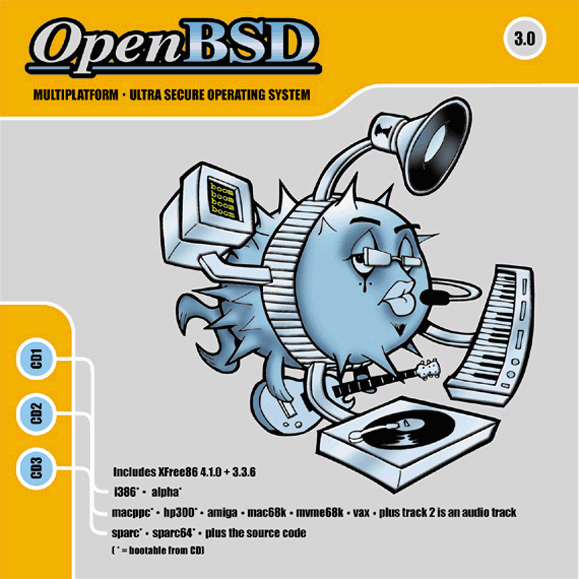
So, my last-minute gift to him is a copy of the new OpenBSD 3.0.
I inscribed it:
Time since last remote root exploit:
OpenBSD: 4.5 years
Microsoft Windows: 4.5 days.Merry Christmas! My condolences for you guys that have to work.
-
We all know that Microsoft lies, but...
This is a really, really, really big one. It should be in the newspapers. Microsoft has claimed some time ago (free karma to the one who posts a link) that closed source, for-profit software and operating systems are more secure because the company can actually *hire* people to do security audits of the source code, whereas open source developers aren't motivated to do it because it's really boring, and there's no glory in it.
Now, we all know that OpenBSD has proved them wrong, by proving not only that open source developers *want* to do hardcore security audits of the source code, but that doing hardcore security audits on source code prevents security holes from being released into the wild. OpenBSD hasn't had a remotely exploitable security hole in the default install in FOUR YEARS! Windows XP has been in release for for all of about two months, and already there's a major security exploit found.
This proves by Microsoft's OWN ADMISSION, either they do not hire people to do the hardcore security audits they say they can, or if they do, they can't do it as well as the volunteers who "obviously" don't do it at all because there's no monetary motivation to do so.
With lies like this, Microsoft couldn't get into a Better Business Beurau if they paid each of its members a billion dollars. -
SignificanceThe real reason this is of significance is because it is finally giving MS some very bad press for their security blunders.
Now, of course there will be dozens of MS apologists on this thread, and you can do a lot of apologizing about this bug, after all they got a patch out before there were any known uses of the exploit, and on the other hand this vulnerability leaves your computer more wide open than almost any that have come before, but I'm not interested in taking that debate any further, as that is what the rest of the thread is about.
The reason I think this story has become significant is because this bug is actually getting reported by large news organizations. Slashdot might run an article every time some script kiddie finds a new hole in IIS, but when is the last time you heard about that on your local news?
This bug, however, has actually been featured on all the big news organizations, thanks to the government statement. I saw a two-minute piece on it on CNN and a 30-second piece on Fox News, both feturing the governments warning that the patch would not be enough and everyone should disable UPnP on their machine. Flipping by CNN Headline News, I noticed the headline at the bottom, "Win XP hyper-vulnerable to hackers."
It is getting people to be concerned about security that will get something done about it; security isn't a selling point right now. When was the last time you saw an OS (besides OpenBSD) listing security as its top feature?
So think what you will about the impact of the bug itself, our government should be applauded for once for finally getting the media spotlight on security.
-
Re:comment from a former Microsoft developer
So what is up with those buffer overflows...do Microsoft developers hate users and not care about quality? Well, no. It only takes one buffer overflow in the whole system that hundreds of developers have worked on, to make it vulnerable.
It takes only one buffer overflow in the whole system that any number of developers, from one to one million, have worked on to make it vulnerable.
It doesn't matter how careful you are. Zero defects at the individual level is a pipe dream. The goal of software quality assurance is that you test code to determine whether it conforms to the specifications with no astonishing side effects. Structured implementation (use of safe libraries, re-use of validated code) can reduce the effort and increase the quality of code.
Want to eliminate buffer overflow? It's easy. Just write a routine ONCE that sucks up characters and puts it into a buffer, debug the corner cases ONCE to ensure you can't go beyond the boundaries, and use that routine for all your work, without exception. Not even when marketing comes in and says "Hey, you didn't come out on top in performance when HAL Magazine ran their tests!" Oh, and your QA people have to actually try to execute some kind of buffer overflow as one part of their suite of test cases...
When a buffer overflow is discovered "in the wild," you find out the source of the buffer overflow and take appropriate action -- against the coder and against QA as well. You have to show these people that you MEASURE them by this sort of stuff.
By the way, don't forget that code should check for attempts to go "outside the box" by using unusual character sequences like ".." in URLs, too. Again, write a single block of code that does the job right, test the hell out of the corner cases, and use that code, without exception.
A Google search yields some interesting approaches. I would like to see the adoption as part of the ANSI definition of the C language an extension to the STR* library routines that are length-safe, such as the STRL* routines found in NetBSD; see the man page and the discussion in the Secure Programs HOWTO.
Don't kid anyone. Buffer overflow can be avoided, by putting in place the proper process and discipline to do the job right.
-
Re:Non-Americans Response?Yes, Canada is a bit more lenient. For example, James Joyces Ulysees is available for download in Canada because it's in the public domain there. There are many different editions available in Canadian bookstores. This is not so in the U.S.
Also, there's no encryption export restrictions in Canada, which is why OpenBsd and ZeroKnowledge are based up there.
Hopefully if Canadians keep pressure on the government, free speech won't be as restrictive as it is in the U.S.
-
Re:Oh, stop with the Windows security remarks alre
I agree with you to some extent. But your argument does not hold up if you compare it to an operating system with a focus on security.
OpenBSD hasn't had a remote hole (in the default install) in 4 years. Windows, Linux (the majority of Linux distros anyway), and other operating systems are a lot less concerned about security, and often find exploits in them.
If Linux was run on 98% of computers, there would probably be a few less exploits than Windows. But if it was OBSD, I would be willing to bet there wouldn't be anywhere near as many as Windows or Linux. -
Firewalls anyone?
Look, I don't use XP, so I don't know how well that "firewall" it has built-in actually works.
But really, folks, anyone who connects to the Internet NOT BEHIND A FIREWALL is playing with fire ANYWAY, regarless of OS.
Windows <insert version here> may be less secure than some alternatives but still, I'd think most folks should know by now what a firewall is and understand the importance of having one.
Oh, and BTW: a firewall is a firewall, not an app running on your desktop OS. Host-based firewalling is a nice addition to your security, but shouldn't be your only security. -
Windows XP Slogan
Now they can be just like that other secure operating system.
"Windows XP - Four minutes without a remote hole in the default install." -
Perfect Code? It does exist...
-
Perfect Code? It does exist...
-
ADEQUACY GIVES THUMBS DOWN TO MANDRAKE!!#@$As seen on Adequacy.org, News for Grown Ups.
The Linux operating system was born in 1991 and was created by one man, a Finnish student coincidentally named Linux Torvalds. Since these humble beginnings, a multi-million dollar industry has sprung up to exploit the commercial potential of Linux, but until recently Linux has eluded mainstream acceptance. However, due to the recent economic downturn together with uncertainty over changes to Microsoft's pricing policy, Linux is now being touted as a serious contender to Microsoft Windows. While there are many other alternatives to Windows, including BSD which is based on SUN's (Stanford University Network - correction by bc) server-grade Solaris operating system, none have commanded the same level of media attention as Linux.
Linux Mandrake is just the latest in a long line of quirkily christened versions of Linux. Previous versions of Linux have been named Red Hat, Slack Ware, Storm and Coral. In stark contrast to the mundane names such as 98, ME or NT preferred by Microsoft, the crazy names of each Linux release hint at its renegade nature.
My foray into the world of Linux began by downloading a "CD image" from the Linux web site. But don't worry, this isn't software piracy, it's perfectly legal! Linux is shareware, meaning that it can be freely redistributed without fear of a visit by the Business Software Alliance. The free availability of Linux is a major reason for its popularity among cash-strapped students and self-styled anti-capitalist hackers.
Before installing new software, it is always advisable to read the documentation. Unfortunately, an unpleasant surprise was in store for me in the "required configuration" section of the manual. I was shocked to learn that Linux Mandrake only runs on Pentium processors, meaning that my hopes of testing the water with my old Gateway 486 were dashed. Furthermore, a whopping 32 megabytes of memory are required to run Linux! Although the advocates of Linux self-righteously boast the efficiency of their chosen operating system and deride the "bloatware" produced by Microsoft, it appears that their claims are blatantly incorrect. Although my humble 486 will happily run Windows 95, it seems that Linux requires far more powerful, and more expensive, computer hardware. Is this really the sign of a lean, mean operating system? Of course not.
Sadly, not even being able to install Linux is just the first of my many complaints. A brief perusal of the features of Linux Mandrake reveals that Linux is sorely lacking many crucial productivity applications. For example, why isn't the industry standard web browser, Internet Explorer, included with Linux? Despite the best efforts of the experts at the Internet Engineering Task Force to encourage adoption of the Internet Explorer standard, the creators of Linux seem to think that they know better. By refusing to adhere to recognised standards, Linux is simply undermining its own credibility.
Similarly, almost all of the world's most popular and widely used software is completely incompatible with Linux! It may surprise you to learn that your copy of Microsoft Office, Outlook Express, or Lotus Notes will not work under Linux. Those who wish to use their computer for recreational purposes are also out of luck, for almost all of the most popular games are unavailable for Linux. Although a wide range of software is freely available for Linux, these pitiful offerings are mostly unfinished, unreliable and do not bear comparison to their commercial counterparts.
Computer security is also an area that seems to have been overlooked by the developers of Linux. In these times when hacking and viruses are commonplace, it defies belief to learn that no anti-virus software is available for Linux. To add insult to injury, there is no Linux version of the popular ZoneAlarm firewall. By using Linux, you are issuing an open invitation to the hordes of ne'er-do-wells on the Internet.
The shortcomings of Linux are obvious. Without even installing Linux Mandrake, I have exposed several fundamental flaws. Surely it is not too much to expect that, after ten years of development, the creators of Linux would have addressed these problems? The real question that the prospective Linux user must ask himself is, "Why bother?" After all, Microsoft Windows comes free with most PCs and there simply isn't a need to replace it, particularly not with a product of inferior quality.
Although it is always tempting to support the underdog, Windows XP will be the deserved victor in the battle ahead. I recommend that those Adequacy readers who are hoping to upgrade their operating system patiently wait for the release of Windows XP, rather than foolishly wasting their time, effort and money on Linux.
-
Re:i'm newHey don't feel bad. I use linux for various things at home and I'm moderately advanced user. Can compile my own kernel, setup proxies, and other various things but one thing frustrates me to no end and that is linux distros and various BSD flavors that still see fit to utilize human unreadable (cryptic) config tools to do things like partition the hard drive.
OpenBSD is probably the most notorious of the bunch. Theo may have a secure operating system but his installer requires me to pull out a calculator to partition a hard drive as everything is shown in blocks. How many people here know offhand how many 512k blocks are in 384 megs plus whatever block you are starting the partition on? I mean jesus freaking A get something at least marginally friendly for the base install as thats all it is. I don't care if I have to sit down for hours reading a how to or faq to configure something after the install is complete but the full functionality that some people need does not at all necessitate making it arcane for the sake of being arcane.
-
Re:that is what I hate.
Guilt by association. Most likely you are not spending hours upon hours patching that shitty OS, its shitty Web Server and then watch another HUGE hole that 'script kiddies' can easily exploit crop up the next day requiring you to spend more spend more hours upon hours. I can give you examples of OSes that do not have this problem. Here's one.
-
Re:Interesting, isn't it?There is only one Linux kernel, which seems to progress just fine without another competing project nipping at its feet and instigating flamewars.
This is patently untrue. The Linux kernel is in constant competition with a myriad of other open systems out there, such as FreeBSD, OpenBSD, and SCO OpenServer. What is going on just happens to be on a much wider field than piddly desktop environments.
For example, there have been endless flamewars over FreeBSD's superior VM or Linux's POSIX compliance. In the end, you just have to realize that there are operating systems that are specialized in certain areas. Use the best tool for the job. If you happen to run a high-traffic Internet portal, then FreeBSD is certainly your ideal system. If you are the artistic type and enjoy dabbling in the GIMP or running your own mail server for your home network, then Linux is definitely the right tool for the job.
None of this specialization would have been possible if these other systems hadn't existed. Competition is the mother of invention, contrary to the popular proverb, and I don't doubt for a minute that Linus et al. would be resting on their laurels contemplating the wonders of FAT32 if it hadn't been for the fierce competition.
-
Re:This whole article is moot.
Just ask the pen-test and vuln-dev mailing lists and read what contributors have to say. Check Jan Johansson's comments here. Oh, and yeah - a couple of people in Usenet too.
-
Re:I'm waitting on our 3 OpenBSD CDsthere is little documentation on tweaking the system.
Did you try the postgresql docs?
FreeBSD, OpenBSD
The options SYSVSHM and SYSVSEM need to be enabled when the kernel is compiled. (They are by default.) The maximum size of shared memory is determined by the option SHMMAXPGS (in pages). The following shows an example of how to set the various parameters:
options SYSVSHM
options SHMMAXPGS=4096
options SHMSEG=256
options SYSVSEM
options SEMMNI=256
options SEMMNS=512
options SEMMNU=256
options SEMMAP=256
Linux blows OpenBSD's performance away.
When you're done reading the postgresql docs, try the openbsd faq -
Fixes
Actually, OpenBSD 3.0 was available for download since nov 25th, and a few patches (security fixes) are already available.
Here is the list: http://www.openbsd.org/errata.html
Don't forget to update to OpenSSH 3.0.1
-J -
swap encryption ? use OpenBSD
-
swap encryption ? use OpenBSD
-
Anyone using wu-ftpd...
Anyone using wu-ftpd has only themselves to blaim if anything happends to their servers. This application has a bug history making Microsoft look like what OpenBSD claims to be. There are many free and secure and certainly more extensible options available, so why distros still stick with wu is beyond my understanding.
-
Eat it
Or use a read-only, anonymous ftpd like publicfile and avoid getting owned.
We have things like sftp-server for authentication and uploads. There are very few legitimate reasons to keep using ftp for uploads. Are you still using telnetd too? -
Re:Openbsd is already dead*
-
yesterday, there was no air80% of Slashdot
users
- are nothing more than incompatent linux users.
- Linux is dead. Linux will never
- be what you hoped it would. Why,
- you
- a bunch of rejects who can't help
distributions?
Damn, _this_ Linuxdistro is missing 1 thing. I think I will start my own..
-
A couple of thoughts- it would probably be illegal to target it abroad but then again why would the feds care?
- If youre worried about the american AV-firms being leaned on or something like that i'd suggest F-Secure, Finnish high-tech AV-detection and they also have encryption products etc, check it out.
- "Is Linux Safe?" has come up several times.. If you are really paranoid you should use OpenBSD. It's about as secure as an operating system gets AFAIK. Personally i'll stay with Linux as I have for a long time.
- It's really really scary to see the amount of reports of new laws on "anti-terrorism" and how FBI etc is getting more and more authority. It's kind of a dark future we're moving into - I hope they realise what they are doing to basic freedom before its too late.. Im glad that Europe hasn't gone as far (yet?) though..
-
Adequacy Reviews MandrakeAs seen on Adequacy.org, News for Grown Ups.
The Linux operating system was born in 1991 and was created by one man, a
Finnish student coincidentally named Linux Torvalds. Since these humble
beginnings, a multi-million dollar
industry has sprung up to exploit the commercial potential of Linux, but
until recently Linux has eluded mainstream acceptance. However, due to the
recent economic downturn together with uncertainty over changes to Microsoft's pricing policy, Linux is
now being touted as a serious contender to Microsoft Windows. While there
are many other alternatives to Windows, including BSD which is based on SUN's (Stanford University Network - correction by bc) server-grade Solaris operating system,
none have commanded the same level of media attention as Linux.
Linux Mandrake is just the
latest in a long line of quirkily christened versions of Linux. Previous
versions of Linux have been named Red Hat, Slack Ware,
Storm and Coral. In stark contrast to the mundane names such
as 98, ME or NT preferred by Microsoft, the crazy
names of each Linux release hint at its renegade nature.
My foray into the world of Linux began by downloading a "CD image" from
the Linux web site. But don't worry, this isn't software piracy, it's
perfectly legal! Linux is shareware, meaning that it can be freely
redistributed without fear of a visit by the Business Software Alliance. The free
availability of Linux is a major reason for its popularity among
cash-strapped students and self-styled anti-capitalist hackers.
Before installing new software, it is always advisable to read the
documentation. Unfortunately, an unpleasant surprise was in store for me
in the "required configuration" section of the manual.
I was shocked to learn that Linux Mandrake only runs on Pentium
processors, meaning that my hopes of testing the water with my old Gateway 486 were dashed. Furthermore, a
whopping 32 megabytes of memory are required to run Linux! Although the advocates of Linux self-righteously
boast the efficiency of their chosen operating system and deride the
"bloatware" produced by Microsoft, it appears that their claims are
blatantly incorrect. Although my humble 486 will happily run Windows 95,
it seems that Linux requires far more powerful, and more expensive,
computer hardware. Is this really the sign of a lean, mean operating system?
Of course not.
Sadly, not even being able to install Linux is just the first of my many
complaints. A brief perusal of the
features of Linux Mandrake reveals that Linux is sorely lacking many
crucial productivity applications. For example, why isn't the industry
standard web browser, Internet Explorer, included with Linux? Despite the
best efforts of the experts at the Internet
Engineering Task Force to encourage adoption of the Internet Explorer
standard, the creators of Linux seem to think that they know better. By
refusing to adhere to recognised standards, Linux is simply undermining
its own credibility.
Similarly, almost all of the world's most popular and widely used software
is completely incompatible with Linux! It may surprise you to learn that
your copy of Microsoft Office, Outlook Express, or Lotus Notes will not
work under Linux. Those who wish to use their computer for recreational
purposes are also out of luck, for almost all of the most popular games
are unavailable for Linux. Although a wide range of software is freely
available for Linux, these pitiful offerings are mostly unfinished, unreliable and do not
bear comparison to their commercial counterparts.
Computer security is also an area that seems to have been overlooked by
the developers of Linux. In these times when hacking and viruses are
commonplace, it defies belief to learn that no anti-virus software is available for
Linux. To add insult to injury, there is no Linux version of the popular
ZoneAlarm firewall. By using Linux,
you are issuing an open invitation to the hordes of ne'er-do-wells on the
Internet.
The shortcomings of Linux are obvious. Without even installing Linux
Mandrake, I have exposed several fundamental flaws. Surely it is not too
much to expect that, after ten years of development, the creators of Linux
would have addressed these problems? The real question that the
prospective Linux user must ask himself is, "Why bother?" After all,
Microsoft Windows comes free with most PCs and there simply isn't a need
to replace it, particularly not with a product of inferior quality.
Although it is always tempting to support the underdog, Windows XP will
be the deserved victor in the battle ahead. I recommend that those
Adequacy readers who are hoping to upgrade their operating system
patiently wait for the release of Windows XP, rather than foolishly
wasting their time, effort and money on Linux. -
Re:pdksh
> Last I checked, OpenBSD was using pdksh
Yeah, it appears so. Ash is
OpenBSD removed Ash around four years ago, according to their CVS. -
A Review of Mandrake 8.1As seen on Adequacy.org, News for Grown Ups. The Linux operating system was born in 1991 and was created by one man, a Finnish student coincidentally named Linux Torvalds. Since these humble beginnings, a multi-million dollar industry has sprung up to exploit the commercial potential of Linux, but until recently Linux has eluded mainstream acceptance. However, due to the recent economic downturn together with uncertainty over changes to Microsoft's pricing policy, Linux is now being touted as a serious contender to Microsoft Windows. While there are many other alternatives to Windows, including BSD which is based on SUN's (Stanford University Network - correction by bc) server-grade Solaris operating system, none have commanded the same level of media attention as Linux.
Linux Mandrake is just the latest in a long line of quirkily christened versions of Linux. Previous versions of Linux have been named Red Hat, Slack Ware, Storm and Coral. In stark contrast to the mundane names such as 98, ME or NT preferred by Microsoft, the crazy names of each Linux release hint at its renegade nature.
My foray into the world of Linux began by downloading a "CD image" from the Linux web site. But don't worry, this isn't software piracy, it's perfectly legal! Linux is shareware, meaning that it can be freely redistributed without fear of a visit by the Business Software Alliance. The free availability of Linux is a major reason for its popularity among cash-strapped students and self-styled anti-capitalist hackers.
Before installing new software, it is always advisable to read the documentation. Unfortunately, an unpleasant surprise was in store for me in the "required configuration" section of the manual. I was shocked to learn that Linux Mandrake only runs on Pentium processors, meaning that my hopes of testing the water with my old Gateway 486 were dashed. Furthermore, a whopping 32 megabytes of memory are required to run Linux! Although the advocates of Linux self-righteously boast the efficiency of their chosen operating system and deride the "bloatware" produced by Microsoft, it appears that their claims are blatantly incorrect. Although my humble 486 will happily run Windows 95, it seems that Linux requires far more powerful, and more expensive, computer hardware. Is this really the sign of a lean, mean operating system? Of course not.
Sadly, not even being able to install Linux is just the first of my many complaints. A brief perusal of the features of Linux Mandrake reveals that Linux is sorely lacking many crucial productivity applications. For example, why isn't the industry standard web browser, Internet Explorer, included with Linux? Despite the best efforts of the experts at the Internet Engineering Task Force to encourage adoption of the Internet Explorer standard, the creators of Linux seem to think that they know better. By refusing to adhere to recognised standards, Linux is simply undermining its own credibility.
Similarly, almost all of the world's most popular and widely used software is completely incompatible with Linux! It may surprise you to learn that your copy of Microsoft Office, Outlook Express, or Lotus Notes will not work under Linux. Those who wish to use their computer for recreational purposes are also out of luck, for almost all of the most popular games are unavailable for Linux. Although a wide range of software is freely available for Linux, these pitiful offerings are mostly unfinished, unreliable and do not bear comparison to their commercial counterparts.
Computer security is also an area that seems to have been overlooked by the developers of Linux. In these times when hacking and viruses are commonplace, it defies belief to learn that no anti-virus software is available for Linux. To add insult to injury, there is no Linux version of the popular ZoneAlarm firewall. By using Linux, you are issuing an open invitation to the hordes of ne'er-do-wells on the Internet.
The shortcomings of Linux are obvious. Without even installing Linux Mandrake, I have exposed several fundamental flaws. Surely it is not too much to expect that, after ten years of development, the creators of Linux would have addressed these problems? The real question that the prospective Linux user must ask himself is, "Why bother?" After all, Microsoft Windows comes free with most PCs and there simply isn't a need to replace it, particularly not with a product of inferior quality.
Although it is always tempting to support the underdog, Windows XP will be the deserved victor in the battle ahead. I recommend that those Adequacy readers who are hoping to upgrade their operating system patiently wait for the release of Windows XP, rather than foolishly wasting their time, effort and money on Linux.
-
Re:A serious question...
I would leave the FreeBSD docs alone. There are enough little differences to be really annoying for the new guy (such as yourself). It is similar to all the little differences between the different versions of windows. All the docs for OpenBSD are electronic. The FAQ will probably answer your cvs question. And don't forget the manpages. The problem with the manpages is that you don't know what you are looking for until you find it. Use 'man -k keywork' or the web interface to do searchs. Also check out OpenBSD Journal. For installation there are lots of files of interest on the CD or ftp site such as the INSTALL.* files. It may be worth your while to print some of those off.
You are kinda screwed if you dont want online docs. At the same time *BSD is a moving target so dead tree versions tend to get out of date quickly.
-
whhaaaaaaaaa......?
Since when does Theo DeRaadt do Linux coding? Even more puzzling, since when does he write VB code?
-
Re:I don't really see how
Okay, your reasoning to why Linux is superior to certain BSD derivatives is sickeningly unresearched and ignorant even at face value. You tend to lead me to the conclusion that you were put off by the lack of a GUI installer.
Maybe it's because I absolutely love
Gnu tools............... BSD is better, but still not
there. It's tools share a lot in common with
Wow, where do I even begin to flame you? You love certain GNU tools? BAM! Most are included in an extended standard install for FreeBSD, just choose them WHEN YOU RUN THE INSTALLER, many are included with the base installation! Ever notice how GNU packages [as well as most open-source UNIX-type aimed software packages) are PERFECTLY USABLE between BSDs and Linux, usually without the Linux Compatability Layer? Clearly not, or you would not have stated that "BSD is not quite there." You wanted all said hardware platform support? Look No Further Than The OpenBSD.org Supported Hardware Platform List.
In addition, OpenBSD offers a better track record for remote security than any Linux. FreeBSD, used for many enterprise applications (see Hotmail, CDROM.com, etc) is said to have superior networking capabilities than Linux, but many do debate this.
Those working on the BSD projects have better knowhow than this Minix fork known as Linux, pay homage. -
The release page
-
The release page
-
Re:Server Upgrade Question
You want a server? Don't want a GUI? Go with OpenBSD. Seriously. That Red Hat stuff is bad for you. A solid 100% of crack attempts to my box come from owned boxes running...guess what? Red Hat 6.2. Just like you are.
You want to try IPtables, do you? What are you, joking? Because as someone who runs a Linux 2.4 system behind OpenBSD firewalling, I can tell you, IPtables is a joke. Come to the system with a real packet filter. OpenBSD. You will never look back. -
Re:Server Upgrade Question
You want a server? Don't want a GUI? Go with OpenBSD. Seriously. That Red Hat stuff is bad for you. A solid 100% of crack attempts to my box come from owned boxes running...guess what? Red Hat 6.2. Just like you are.
You want to try IPtables, do you? What are you, joking? Because as someone who runs a Linux 2.4 system behind OpenBSD firewalling, I can tell you, IPtables is a joke. Come to the system with a real packet filter. OpenBSD. You will never look back. -
Re:Have fun integrating WinCVS in Visual Studio!I can understand the firewall replacement (Proxy server -> linux based system), but replacing sourcesafe with CVS?
No offense, but I think you're reflecting your own prejudices rather than any real issue. This has actually been one of the most appreciated aspects of the migration. WinCVS is perfectly workable and usable, even with Visual Studio. What's the big deal about keeping a WinCVS window open, and Alt-Tabbing to it to do commits? Keep in mind that the CVS checkout model is significantly more powerful than that of VSS: typically, developers work with the entire source tree checked out, keeping a complete copy of the repository locally. So the anal checkin-checkout model required by VSS disappears, and you're mainly doing commits, only when you need to commit a change, while keeping the source checked out.
None of the developers at this client even murmured about it - once they got used to the improved checkout model, and found how much quicker remote version control became, they were sold.
Usability? Once it's configured by someone who knows what they're doing (e.g. me
Here's another way to answer your implied question: the fact that Visual Studio only integrates with VSS is simply another example of Microsoft's undesirable product tying, which restricts customer's options. When I pointed this out to the IT manager at this company, he was open to investigating alternatives to Visual Studio. Besides, since they're now migrating from ASP to JSP, Visual Studio is no longer really appropriate, and has begun being replaced by IDEs like JBuilder and NetBeans - the latter being open source, and having excellent CVS integration.
There are a couple of solutions for using visual sourcesafe over the internet though, fast and reliable, with all the benefits of VSS: integration in visual studio's tools and visual browsing of the database. Two things CVS will not bring you.
If by "visual browsing of the database" you mean browsing the repository, again, since developers typically work with the entire source tree checked out, they can browse the repository locally using WinCVS or even simply Windows Explorer. This is actually a big benefit over VSS. If you want to browse parts of the repository that aren't locally checked out, you can simply use a web interface, like cvsweb (the one used in this case) or ViewCVS. Here are a couple of arbitrary example repositories: cvsweb (OpenBSD) and ViewCVS (GNU).
Another argument in favor of CVS is since that's what many open source projects use, familiarity with CVS is an asset. The developers I work with liked that idea.
-
impressive indeed..all for $30
Wow, a $30 patch for a $250 OS that might make you feel less venerable. I don't mind people trying to make a living selling binaries. I just don't understand why people would buy such things when free alternatives are available. GPG not enough security? Try OpenBSD.
If the answer is that the free alternatives are too hard to administer and set up, go get help. There are Linux User Groups (LUGs) everywhere. Take the hundreds of dollars you as an individual would spend on canned binaries and hire someone to help you out. If you are a business, save yourself thousands of dollars the same way.
The world is always changing. Sometimes it hurts, as when 250 fine programers get laid off. As long as the world remains free, the changes will be for the better. Just think of that talent being liberated. All of those nifty Windows tricks are unlikely to be released even if NA itself goes belly up.
-
mad cows :-)
-
Sysadmin is boring
That's funny, because I actually was going not to prolong my subscription to Sysadmin: I subscribed to it a year ago and am disappointed how boring it is. No good shell scripts, no information about my favorite operating system, lots of annoying commercials. Only Merlin's articles were good. They should look at some german magazines and learn how to do an interesting and enthusiastic Unix-publication. I mean Linux Magazine and iX.
But now since the excellent TPJ is back, I'll extend my subscription of course
-
Re:How Linux Fares
-
In theory...... you could be able to use ASP2PHP while staying in a familiar (Windows/IIS) environment as long as possible:
- Install PHP on your IIS server.
- Convert your ASP to PHP using ASP2PHP and get it running on Windows/IIS/PHP.
- Install Apache with PHP on the Windows box. Get your site running on Windows/Apache/PHP.
- Install a new box with some securish Unix lookalike or other and move the site over.
Whose idea was it to put Windows servers on the 'net in the first place, anyway?
Cheers
-
Migration tool: ASP2PHPI haven't seen any posts about it, but I think that ASP2PHP deserves some attention. A migration could (theoretically) be done like this:
- Download and install PHP for IIS on Windows.
- Convert your ASP pages to PHP (using ASP2PHP).
- Get it running on IIS.
- Replace IIS with Apache (still on Windows).
- Replace Windows with some secure Unix lookalike or other.
Cheers
-
OpenBSD
Use OpenBSD. It supports French, German, Spanish and Italian languages (along with English.) And it's more secure than Linux.
-
OpenBSD CD set includes full source code.My suggestion, pick up the Current OpenBSD CD set while you still can.
Shipped from Canada or Europe to avoid those pesky American laws.
And while you're at it, you can pick up the 'OpenBSD Globe' T-shirt with the very relevant slogan 'Make Crypto Not Munitions', and a timely quote from Ben Franklin.
OpenBSD will run on pretty much all of the same hardware that will run Mac/Win, and then some. -
Re:Old PC
OpenBSD has excellent documentation and FAQs. Just be sure to read, and re-read so you understand what's going on.
-
Hahah!
-
Re:Standard Theo Behaviour
Just go to OpenBSD Journal and search for the thread called "License audit progress". Then you will find a nice list of programs which had incompatible license with their defined goals. He managed Wietse Wenema to change Tcpwrappers' license, and he is bragging that he even got Xerox to change license. Also, don't make much assumptions about the case from the ports@ mailing list. It doesn't have much info about the emailings about the license which resulted in the pulling of the two programs. Theo is not a saint, and he definitely said some unfortunate things, but so did DJB. Also, as others pointed out, Theo is merely sticking to their goals. I think what we see here is two colliding giants and neither of them is backing off.
Vilmos -
Re:Is there any point...
I have a fairly well justified sense of security, thank you very much. You know how OpenBSD talks about "4 years without a remote hole"? Well, MacOS has gone 17 years without a remote hole. The only known attacks are the same as they were in 1984:
- social engineering -- convincing the user to run your code -- just like any single user OS
- file sharing for dummies -- o777 permission or weak password -- just like any shareable OS
- local root access -- if you can sit down at the mouse, you're in -- duh
If there were an exploitable buffer in MacOS 1 through 9, crackers have had plenty of time to find it.
-
Re:BSD?
Problably because there has been a focus on security in bsd, specifically OpenBSD. Why re-invent the wheel? Another reason might be that Linux has greater market share than the BSDs.