Slashdot Mirror
Domain: oracle.com
Stories and comments across the archive that link to oracle.com.
Comments · 1,490
-
Re:2nd Array or Tape
I mean, get a SL8500 - only 2.1 Petabytes of tape backup space!
You misread a comma as a decimal. With filled-out slots, the library can hold 2,100PB, or 2.1 exabyte. Or, the equivalent of over half a million 4TB hard drives.
>We have two of these at work, and with just 3000 slots each and not the biggest tape drives, they can each store around 15PB.
-
Re:2nd Array or Tape
exactly, tape is the solution for backup problems. Unless you're dealing with mickey mouse storage problems, tape is what you want.
I mean, get a SL8500 - only 2.1 Petabytes of tape backup space!
Of course its one of those boring-but-works solutions so nobody cares about it, and none of the slashdot kiddies can think of using it, not when there's unlimited cloud and additional raid array buzzwords to be spouted!
And remember, a backup is not a backup unless its stored somewhere away from the fiery, drippy, bangy or collapsey disaster that destroyed your main storage.
-
Re:Database Upgrades?
I don't know what database technology they are using but if they are using SQL, they are probably using an ENUM: http://docs.oracle.com/cd/E179... https://dev.mysql.com/doc/refm... http://www.postgresql.org/docs...
-
Couldn't resist
Now for the big problem: HP or Dell.
There's always Oracle hardware.... OK this is self-confessed flamebate!
-
Re:I think you over estimate non-engineers
public String getSum(int numA, int num2) {
if (numA == num2)
{
return "" + numA << 1;
}
return ""+(numA + num2);
}Much better, see?
http://docs.oracle.com/javase/...
Sadly, you broke the terrible code.
-
Pot calling the kettle black?
Oracle Linux Support offers support for any existing Red Hat Enterprise Linux installations. Is this a case of pot calling the kettle black?
-
Re:idle time
The idle loop is alive and well in embedded systems. In some cases energy use is minimized by using a slow clock chosen for some small fraction of idle time, in others by sleeping between bursts of fast processing.
x86 idle power reduction under unix started sometime in the late 1990s
https://blogs.oracle.com/bholler/entry/the_most_executed_code_inOther OS starting using it around 2000
http://en.wikipedia.org/wiki/System_Idle_ProcessThus seti@home launched in 1999 could legitimately claim it made use of otherwise wasted CPU cycles on the Mac and Windows 95 clients.
-
Re:Funny ...
Download Java from here instead:
http://www.oracle.com/technetwork/java/javase/downloads/index.html
No Ask.com toolbar, the option for online or offline installers as well a multitude of different platforms. I've NEVER, EVER downloaded Java anywhere else because of my habit of going to this site first (it's where you get the JDK after all).
I really wish more people knew about this. Seems like everyone prefers to whine rather than find a solution.
Also FWIW, if you pine for the days of offline installers for Adobe Flash (since they got rid of the offline installers from the main Flash page), go here:
http://www.adobe.com/products/flashplayer/distribution3.html
-
Re:Odd...
Well when Oracle published and were pushing this it didn't exactly foster good feelings:
-
Java, C#, and JavaScript all have graphics libs
Java, C#, and JavaScript all have graphics and canvas component libraries. All these libraries render graphics differently on different systems. In the C++ universe, programmers have had to use 3rd-party libs like Qt, so a C++ standard library for graphics is long overdue.
-
Re:Maximum precision?
I never made any such claim. If you doubt the veracity of my statement, open a JavaScript console (Chrome, Firefox, Rhino, whatever) and try it yourself.
When you're done with that, go read What Every Computer Scientist Should Know About Floating-Point Arithmetic. I cribbed the example directly from the article. -
Re:Open CPUs
Yes.
-
Re:BTRFS filesystem
I know, I shouldn't respond to a troll, but I'm feeling generous today.
There you go again. Acting like you know what you're talking about, but you don't. ZFS and BTRFS have
Exactly dick to do with what I said. The filesystem doesn't matter. The operating system doesn't even matter.
Um, excuse me? The filesystem absolutely does matter. Traditionally, the filesystem assumes that any data retrieved from the drive has been put there, earlier. Obviously, drives don't do that 100% reliably. It's an important innovation, that these newer filesystems will add their own checksums to the data that they write, so they can detect and sometimes fix corrupted reads.
I'm talking about infrastructure and architecture, while you're blubbering on about the hardware.
Get your head out of the clouds. Everything does come down to hardware. In fact, given your other posts about hardware, I sometimes doubt that you actually interact with the hardware that you talk about.
Ideally, a RAID would be able to recreate the missing block, but I can't find any reference to a RAID doing that.
That's because you have no experience as a network administrator in a professional environment. Because then you'd know that's the very thing RAID was designed to do: Recover from hardware failure, which includes sectors becoming unreadable.
That's an aspect of software. Of course a RAID with sufficient parity will recover from a total drive failure. It's much harder to find reference to how a particular RAID will respond to intermittent errors. But if you're not just a blowhard, I'd like to see some of your links to documents describing how the RAIDs that you know will handle drive read errors. Not total failures. Just read errors.
Speaking of RAID, ZFS has its own concept of RAID that supports up to triple parity, with a different architecture than a normal storage system. Still, I haven't found any reference to how it handles drive read errors.
It surely doesn't help that modern computers have many gigabytes of memory, but almost none have ECC on that memory.
That's because ECC adds an extra layer of complexity to solve a problem that doesn't occur very often in computers, and when it does, the most severe consequence is usually that the computer crashes or behaves abnormally. For residential, and even most commercial uses, ECC memory just isn't needed. But for a select few use scenarios where data integrity is absolutely critical -- such as, say, nuclear power plants, air traffic control systems, certain types of hospital equipment, or financial processing systems, the added cost is justified because they need high availability/high reliability of those systems.
What a horrible attitude to data integrity. Computer crashes, I lose data. Computer behaves abnormally, worst case scenario is it calculates some important thing wrong, say the root of an important filesystem B-tree, and the filesystem needs to go through an expensive repair. My data are important to me. I use my computer for my personal financial processing, and I know I'm not alone. My old computer had an extra 128kB of memory to provide parity checks for the other 1MB. I imagine that stupid traditions of cost-cutting are why my new computer does not have 2GB of memory to provide ECC for the other 16GB.
Your consumer-grade computer's memory is a piece of shit. It's made with commodity capacitors and ICs that are stamped out in bulk for super cheap.
And your server memory isn't? Back up a moment... I thought OP was talking about being able to detect bitrot in family photos, and now you're telling him he should buy a server with memory lovingly crafted for high reliability? Which reliability i
-
Re:Cross language - what .Net gets right
Passing in registers is not a standard C parameter passing method
There's no such thing as "a standard C parameter passing method". Passing in registers is a perfectly legitimate C parameter passing method, used on several RISC architectures, such as SPARC, MIPS, 32-bit ARM, 64-bit ARM, and 64-bit {PowerPC/Power Architecture} (and probably most other RISC architectures), as well as x86-64 and z/Architecture.
If there are more parameters than fit in the registers available for parameter passing, or if the parameters are in the variable-length portion of the argument list, they might be passed on the stack, and if the called function has no prototype in scope, the compiler might be forced to pass everything on the stack, but, in all other cases, if the ABI supports it, parameters can and will be passed on the stack.
-
Re:SMP contention basically gone from critical pat
The filesystem work on HAMMER2 (the filesystem successor to HAMMER1) continues to progress but it wasn't ready for even an early alpha release this release. The core media formats are stable but the freemap and the higher level abstraction layers still have a lot of work ahead of them.
Have you considered space maps for tracking free space? I thought that was one of the more interesting ideas in ZFS.
Anyway, great work on the SMP scalability. It is refreshing to see a concerted effort in reworking the system to be more SMP friendly, rather than the profuse and convoluted locking that most others have adopted.
-
Oracle/Sun document that discusses this
There are statistics that cover the expected frequency of events caused by radiation in the first couple of pages.
http://docs.oracle.com/cd/E19095-01/sf3800.srvr/816-5053-10/816-5053-10.pdf
-
Re:Fixed-point arithmetic
Don't use floating point if you can avoid it.
If you can't, and the results are EXTREMELY important (remember, floating point is an APPROXIMATION of numbers), then you have to read What Every Computer Scientist Should Know About Floating Point Numbers. (Yes, it's an Oracle link, but if you google it, most of the links are PDFs while the Oracle one is HTML).
If you're worried about your cloud provider screwing with your results, then you're definitely doing it wrong (read that article).
And yes, lots of people, even scientists, do it wrong because the idealized notion of what a floating point type is and how it actually works in hardware is completely different. Floating point numbers are tricky - they're VERY easy to use, but they're also VERY easy to use wrongly, and it's only if you know how the actual hardware is doing the calculations can you structure your programs and algorithms to do it right.
And no actual hardware FPU or VPU (vector unit - some do floating point) implements the full IEEE spec. Many come close, but none implement it exactly - there's always an omission or two. Especially since a lot of FPUs provide extended precision that goes beyond IEEE spec.
-
No, for many reasons
The short answer is no. The long answer is no
Start with reading Goldbergs classic paper "What Every Computer Scientist Should Know About Computer Arithmetic" Sun's floating point group made some improvements to the paper and paid for rights to redistribute. Oracle continues to do so. http://docs.oracle.com/cd/E19957-01/806-3568/ncg_goldberg.html
If that isn't depressing enough, and you use trig functions, read http://www.scribd.com/doc/64949170/Ng-Argument-Reduction-for-Huge-Arguments-Good-to-the-Last-Bit you can get the source from netlib for "fdlibm" which is under a BSD flavor license.
If the purely software issues haven't made you realize that you haven't got much of a prayer, please note that different revs of the same intel chips sometimes provide slightly different results (sometimes intentionally, sometimes as a result of tweaking the order of execution in the out of order execution engine). Older x87 arithmetic was 80-bit, newer x64 arithmetic is pure 64-bit, providing no end of fun. Using the SSE instructions provides more variation.
If the pretty much (in principle) "simple" and potentially deterministic software issues aren't enough consider the reality of hw. Chessin has a very good, yet amusing, explanation of the key problems http://queue.acm.org/detail.cfm?id=1839574
Lest you think they only apply to a particular generation of boutique processor, most HPC ensembles are now built out of standard server motherboards and chips.
http://www.csm.ornl.gov/srt/conferences/ResilienceSummit/2010/pdf/michalak.pdf The issue of undetected soft errors is big and growing, as can be seen from the activity in the literature. SC13 "ACR: Automatic Checkpoint/Restart for Soft and Hard Error Protection" (which has lots of good citations of earlier work, including field data such as 27 soft errors per week leading to fatal node failures (that is, wrong enough results that while the hw didn't detect any problem, the issue caused the node to crash) on just one ensemble (ASC Q). its going mainstream in that HPCwire caught wind and in 31 Oct 2013 had a nice tabloidesqe writeup entitled "Addressing the Threat of Silent Data Corruption"
Neutron's don't only disrupt memory elements, but can hit logic as well. See the upcoming issue (already available via IEEE xplorer for member/subscribers) JOURNAL OF SOLID-STATE CIRCUITS, VOL. 49, NO. 1, JANUARY 2014 The 10th Generation 16-Core SPARC64 Processor for Mission Critical UNIX Server" which details the lengths some (but not many) go to ensure that there are no undetected errors (wide range of techniques, ranging from where wires are placed on the chip, ECC, parity, residue arithmetic, automatic retry, etc.). No doubt there are some good (similar) papers in the IBM Technical Journal.
No doubt a good literature search would turn up dozens of other papers, and circuit design textbooks cover some of the territory.
In principle, interval arithmetic could provide a solution (you might not get the same interval, but if the intervals nest, you have consistent results and if they are disjoint you have a bug
-
Java TZUPDATER utility behind Oracle paywall.
Sure. Just go changing the time zone rules again. Good luck patching older versions of Java you're stuck supporting if you don't have a paid Oracle support contract that gives you access to the TZUPDATER utility.
See here: http://www.oracle.com/technetwork/java/javase/timezones-137583.html#tzu
Sun used to provide that tool for free. So did Oracle (until about a year ago.)
-
Re:Why?
If they come from a company retained pool, that company retained pool would be an asset on the companies balance sheet. So taking it from there lowers the company's value by 76M
From the Oracle financial report, last page:
Stock-based compensation expenses: We have excluded the effect of stock-based compensation expenses from our non-GAAP
operating expenses and net income measures. Although stock-based compensation is a key incentive offered to our employees, and we
believe such compensation contributed to the revenues earned during the periods presented and also believe it will contribute to the
generation of future period revenues, we continue to evaluate our business performance excluding stock-based compensation expenses.
Stock-based compensation expenses will recur in future periodsHowever, they are detailed in the Stock Holding Pattern filings, which show as of September 2013 74.98% of the company is held by the company, and 25.02% of the company is held publicly (which is an increase of 0.01 percentage points since June 2013).
http://www.oracle.com/us/industries/financial-services/share-holding-pattern-sep2013-2031438.pdf
-
Re:Why?
If they come from a company retained pool, that company retained pool would be an asset on the companies balance sheet. So taking it from there lowers the company's value by 76M
From the Oracle financial report, last page:
Stock-based compensation expenses: We have excluded the effect of stock-based compensation expenses from our non-GAAP
operating expenses and net income measures. Although stock-based compensation is a key incentive offered to our employees, and we
believe such compensation contributed to the revenues earned during the periods presented and also believe it will contribute to the
generation of future period revenues, we continue to evaluate our business performance excluding stock-based compensation expenses.
Stock-based compensation expenses will recur in future periodsHowever, they are detailed in the Stock Holding Pattern filings, which show as of September 2013 74.98% of the company is held by the company, and 25.02% of the company is held publicly (which is an increase of 0.01 percentage points since June 2013).
http://www.oracle.com/us/industries/financial-services/share-holding-pattern-sep2013-2031438.pdf
-
May be an attack via the network controller.
I read the original article, but I don't see any part where someone recorded what was going out the speaker and looked at it. If someone is sending data over audio, it will show on a scope. Clearly that's not going to do much unless the receiving side has some kind of modem code listening for it.
Then there are claims like "It seemed to send TLS encrypted commands in the HostOptions field of DHCP packets." Attacking via DHCP packets is plausible; DHCP clients get told a lot of things they're supposed to do, and some of the older vendor-specific extensions are very insecure. But TLS? TLS isn't used within the DHCP protocol itself. There's a way to store DHCP configuration info in an LDAP server and have a DHCP server access it via LDAP.
If someone is seeing strange DHCP packets, and reloading the BIOS won't help, it's possible that what's going on involves an attack via the network controller. The fancier network controller parts now have CPUs and EEPROM. This may be an attack which puts code in the network controller which in turn patches the BIOS.
The people studying this need to list exactly what network ICs the machines involved are using. Some network devices are too dumb to be used as an attack vector, but some have whole protocol stacks, WiFi support, remote administration support, etc. It would not be surprising if those were attackable.
I've expected attacks via network controllers for years. That's been used to attack servers. There's a known attack on PCI controllers which can survive rebooting and reloading the BIOS.
If the machine has wireless networking hardware and the attack exploits the network controller, it may be able to do wireless networking even if the user thinks they have the hardware disabled. Time to open up the machine, clip onto the JTAG port on the network controller, and read out the device memory with a JTAG debugger. Compare the dumps with other machines.
-
Re:Irony not lost on me
Has Oracle/Sun also adapted LLVM/Clang for Solaris, or are they staying w/ GCC?
If you mean "as their official compiler", the answer to both questions is "no"; they have, instead, Sun^WOracle Solaris Studio's compilers. If you mean "in their package system", they could offer both, but currently only appear to offer GCC 3 and GCC 4.5.
How about IBM in AIX,
If you mean "as their official compiler", the answer to both questions is "no"; they have, instead, IBM XL C/C++.
or HP in HP/UX?
If you mean "as their official compiler", the answer to both questions is "no"; they have, instead, HP C/aC++.
-
Re:Already considering uninstalling firefox
Java updates every 3 months. Every release they do fixes a gaggle of remote-exploit-without-authentication security holes, and comes with a warning such as "Due to the severity of these vulnerabilities, and the reported exploitation of CVE-2013-1493 "in the wild," Oracle strongly recommends that customers apply the updates provided by this Security Alert as soon as possible." Exactly what reason do you have to believe that their latest release not only has no known vulnerabilities at the time of that release, but will have no known vulnerabilities for the entire time that that release is current, when there has been evidence to the contrary for *every* past release for *years*?
-
Re:Oracle is now involved
They hopefully will convince Mozilla to back this out, and
figure out a better UI for the user to deal with. A small red clickable icon
that leads to more clicking is not going to fly with non-tech users.From Link:
Donald Smith 2013-10-22 22:03:01 PDT
Disclaimer: I'm in the Java SE Product Management team at Oracle.
Just to add to my colleague in Engineering Joe McGlynn's comment #61 -- we're happy to help here however we can. We do frequently speak with mcoates, but are happy to plug into any other channels the mozilla team think would be worthy (as we seemed to somehow miss this one until it was too late I think we need more contact/channels). For example, I think we can help address questions related to the Java 6 (and Java 5, for that matter) updates as they are still supported and do receive updates along with the latest public baseline(s).
As comment #50 notes, bugzilla is not forum software - so I'll leave it at that and send @bsmedberg a quick note and continue to try to catch up wit @coates.
First I've heard that Java 5 and 6 are not considered dead yet.
Yeah, I don't know what he thinks he's talking about. According to Oracle's own website, public updates to Java 5 ended in October 2009, and Java 6 in February 2013.
Enterprises can apparently pay to continue receiving critical bug fixes, but that hardly seems relevant to the discussion.
-
Re:Unix Workstation
I was thinking that too, until I found this: http://docs.oracle.com/cd/E23824_01/html/E24456/desktop-123.html
It ships with GNOME 2.30. It is UNIX. It has ZFS. DTrace. Zones. A full GNU stack.
This could actually work as a really good desktop while the Linux distributions sort their mess out. -
Re:GPU Programming is a PITA
-
Re:Yeah, but they nailed the "documentation" part
I'd be careful on that one. This is about Oracle and well they have PostgresSQL beat by a mile: http://www.oracle.com/pls/db121/homepage
And that's 100k pages is just the free stuff. They have another ten million for the people who have licenses
-
They have 2 kernels
One based off of RedHats and one based off Kernel.org. The RHEL kernel has alot more code it in, naturally.
http://www.oracle.com/technetwork/server-storage/linux/technologies/uekr2-features-1897094.html
Some features:
PV Huge Pages
dtrace
ocsf2
btfrs
ksplice..From what I have seen on Oracle systems OEL is better for largest systems with heavy workloads.
If your running Oracle, IMHO it makes sense to run a tuned kernel. If you've already invested in the Oracle stack, then it makes sense to me to run Oracle Linux as well. Why have unnecessary bloat in there? Sure you could always compile and tune it yourself. Any improvements are sent back to kernel.org.
-
Re:If there's such a market.. why the Ask toolbar?
How am I supposed to take a platform seriously if the fundamental piece that has to be installed by all developers
You had me up until said you "all developers".
Developers need the Java Developers Kit, which notably doesn't prompt you to install toolbars. Nor does the JRE installer on the Java developer site (which used to be java.sun.com).
Unfortunately, unless you know to grab the installer from there...
-
Re:Wake me up...
Java 8, Unsigned Integer Arithmetic API, not an unsigned type but helps doing integer arithmetic using signed types
-
Re:Java and the JVM
Java Op Code is very stable. Since Java 1.0 all that's changed with the opcode is a couple new operations and couple deprecations. There's still around 100 codes total.
This page seems to indicate it's slightly over 200 in Java 7.
-
This is amazing!
You mean I can run a server out of my home?! That's amazing!
How is this easier than spinning up a TurnkeyLinux appliance on an old Pentium 4 (or better) desktop you can get for free in almost any part of the country?
Let's see - I need to buy the RaspberryPi, a case, and a power brick at a (practical) minimum, which puts the system in the $75+ range - compared to a repurposed desktop that will cost around $0. Of course, the difference is in the monthly power bill - the old Pentium 4 desktop will use much more power. You could avoid that expense by running your appliances under, say, VirtualBox if you normally keep your desktop on 24x7....
Oh yeah, the TOS of most ISPs would preclude any server type work on a residential account, at least that is the case here in the US.
-
Re:Why would you want a single button???
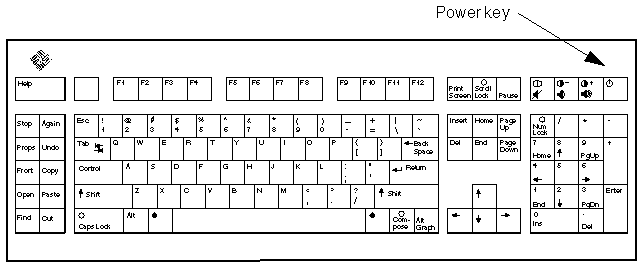
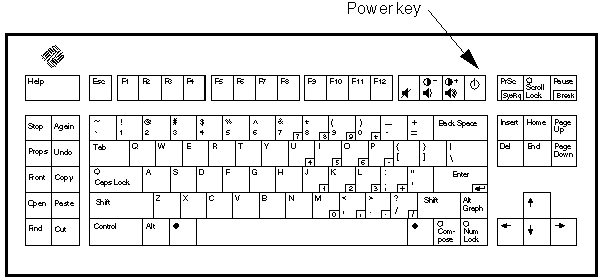
A single button that, if hit, would reboot the system???? That's is the stupidest shit I've ever heard. If you hit it by accident, goodbye to your work. Remember that when you hit CTRL-ALT-DEL in DOS, it didn't even give you a prompt to shut down, it just rebooted. Who in their right mind would want that in a single key??
SUN... Except that it wasn't reboot, but power off...
See: keyboard_a.tif.gif and keyboard_b.tif.gif
If you happen to have one of those keyboards, the key also works in Linux, as I found out one very, very bad day...
-
Re:Why would you want a single button???
A single button that, if hit, would reboot the system???? That's is the stupidest shit I've ever heard. If you hit it by accident, goodbye to your work. Remember that when you hit CTRL-ALT-DEL in DOS, it didn't even give you a prompt to shut down, it just rebooted. Who in their right mind would want that in a single key??
SUN... Except that it wasn't reboot, but power off...
See: keyboard_a.tif.gif and keyboard_b.tif.gif
If you happen to have one of those keyboards, the key also works in Linux, as I found out one very, very bad day...
-
What kills AMD is a per-core license.
Oracle's Enterprise database costs $47,500 per processor core. There is no way in heck that I'd choose AMD over Intel when I have to run more cores to get the same performance.
Microsoft SQL Server Enterprise costs $6,874 per processor core.
AMD has a heavy investment in the server space. They should negotiate lower per-core license costs in these cases; license parity with Intel is throwing them out of the data center.
As the developers of x86-64, they should have a patent portfolio to do serious damage to 64-bit x86 systems vendors. Use it.
-
Re:I meant "not PowerPC Macs"
Manufacturer of what?
Manufacturer of the computer. Mostly I was trying to exclude PowerPC Macs from a discussion of the future direction of NPAPI.
amd64 armel armhf i386 ia64 kfreebsd-amd64 kfreebsd-i386 mips mipsel powerpc s390 s390x sparc
Now let me rephrase my question: For which of these platforms are NPAPI plug-ins still released?
Obviously amd64, i386 and the variants of it listed are. Also armel (and armhf, which is backwards compatible with armel but adds usage of hardware floating point) and sparc. Other plugins may support other architectures, but these platforms have Oracle-supported versions of the Java plugin available.
-
Re:I meant "not PowerPC Macs"
Manufacturer of what?
Manufacturer of the computer. Mostly I was trying to exclude PowerPC Macs from a discussion of the future direction of NPAPI.
amd64 armel armhf i386 ia64 kfreebsd-amd64 kfreebsd-i386 mips mipsel powerpc s390 s390x sparc
Now let me rephrase my question: For which of these platforms are NPAPI plug-ins still released?
Obviously amd64, i386 and the variants of it listed are. Also armel (and armhf, which is backwards compatible with armel but adds usage of hardware floating point) and sparc. Other plugins may support other architectures, but these platforms have Oracle-supported versions of the Java plugin available.
-
Re:and so meanwhile...
BSD style contributions are basically waiving all rights on your code, so of course they accept those too. It's functionally the same as putting your code in the public domain in this context, except for the copyright notice clause that only impacts the credits of the software. There's nothing in there restricting sale or profit: "This version allows unlimited redistribution for any purpose as long as its copyright notices and the license's disclaimers of warranty are maintained". "Any purpose" includes using your contribution in a derived work that's not open-source at all. That's the whole point of the BSD style licenses.
The reason people like GPL licenses is that everyone involved is compelled to share all related code. If MariaDB creates a cool extension to the database, in a regular GPL situation they would need to share it under the GPL terms to people they sell it to. This is not a theoretical point, as things like Commercial Extensions for MySQL Enterprise Edition popped up at multiple points in the database's history, making up part of why the company had commercial value to sell. They were only able to create those but not share the source because they had full copyright ownership on all of the code.
GPL with copyright assignment breaks the share with the community model, by letting the company who owns the copyright ignore those rules for the work they do. There's a long history of companies keeping a dual-licensed GPL codebase for commercial purposes like that, both from MySQL AB and companies like TrollTech. People used to give otherwise good open source contributors a free pass for making money this way. But Monty's past moves have been so bad for the MySQL community that there's this whole wasteful battle between Oracle MySQL and MariaDB going on, diluting the value of both projects. You can't really give him the benefit of the doubt here on what he intends to do with his license again.
-
Re:Bandwidth of tape is terrible
A few years ago, I was involved in the conversion of the Stanford AI lab tape archive to modern media. This involved reading thousands of reels of 1/2" magnetic tape. It was a slow process. Volunteers were loading a tape onto a tape drive every 15 minutes for weeks.
Tape has changed a lot since the early 80's. Modern tape drives can sustain over 500MB/sec compressed each. And they tend to live in automated tape libraries that load and unload the tapes without human intervention. A library like that can do TByte/sec of IO.
-
Re:Bandwidth of tape is terrible
A few years ago, I was involved in the conversion of the Stanford AI lab tape archive to modern media. This involved reading thousands of reels of 1/2" magnetic tape. It was a slow process. Volunteers were loading a tape onto a tape drive every 15 minutes for weeks.
Tape has changed a lot since the early 80's. Modern tape drives can sustain over 500MB/sec compressed each. And they tend to live in automated tape libraries that load and unload the tapes without human intervention. A library like that can do TByte/sec of IO.
-
Re:This is pointless
That is true for something like SD, but modern tape drives can do well over 500MB/sec in compressed streaming mode, and have native uncompressed capacities of 8.5TB.
That means that even with a midrange tape library with 56 drives, your talking a read/write bandwidth of 27GB/sec (aka 1/3 Tbit/sec). Tape bandwidth scales linearly with the number of drives in the library, and things like the the SL8500 from STK can support up to 640 drives.
It still faster if you have a PB of data you need shipped from NY to LA to write it to tape, put it on a plane and read it back in LA. Plus, it all fits nicely into a big suitcase. Furthermore, even for smaller amounts of data (say 10-20TB a day) the cost of a tape drive and an next day delivery is going to be significantly less than the Gbit/sec or so of bandwidth required to ship a similar amount of data in most places in the US.
-
What the hell
Package your ruleset.xml into DeploymentRuleSet.jar
Packaging your ruleset allows the desktop administrator to apply cryptographic signatures [emphasis mine] and prevent users from overriding your policy. This requires usage of a trusted signing certificate. The easiest route to get a signature is to buy one from a certificate authority like Symantec/Verisign, Comodo, GoDaddy, or any other; [...]. The default certificate authority list contains about 80 authorities from which you may purchase a signing certificate [emphasis mine].
-- Introducing Deployment Rule Sets, Java Platform Group blog
Why in the name of the everliving fuck would anyone think this step was a good idea? The file is already located in a directory that can only be written by root (or Administrator, as OS appropriate). Why require a signature? This adds zero security. If you have root on the machine, you can add a self-signed CA to the trusted CA list anyway. Do they have a kickback arrangement with Verisign or something?
-
Re:ZFS for Windows?
It doesn't have to be POSIX compliant to have it ported to it and it doesn't require somebody to pay for licensing. With the Features of ZFS one could argue that a port to at least Windows Server would be great and it would garnish quite a following from those who've had to put up with the way NTFS views disk volumes and storage. There are applications that run well on Windows, especially on the Server side of things so I wouldn't call it dead quite yet. Besides, with Server 2012 we now have Storage Spaces and ReFS which brings some ZFS features to the table, but it's nowhere as sophisticated ad ZFS. There's already been one attempt but it doesn't appear to be actively maintained and it's read only. Oracle has software for Windows Server that interfaces to the Sun ZFS Storage Server (SAN) that works at the VSS level. It's not exposing a ZFS filesystem to windows either, but ZFS is configurable in the SAN. That's a hefty uplift if you're already in deep with EMC or NetApp.
-
Re:Android is finished.
Yes the adresses are 64 bit. And the extra registers of the ARMv8 architecture would be used. The only downside is that array indexes are 32 bit. So you can't have an array with more than 2^32 elements. Pretty reasonable compromise to keep 32 bit compatibility. But longs in java are already 64 bit. So if your program uses long data types, it will get a speed increase by moving to 64 bit.
http://en.wikipedia.org/wiki/64-bit_computing#32-bit_vs_64-bit
http://www.oracle.com/technetwork/java/hotspotfaq-138619.html#64bit_description -
Re:How about...
I feel like the only geek/nerd/social outcast on Slashdot who's aware of the developer's download page for the JRE/JDK:
http://www.oracle.com/technetwork/java/javase/downloads/index.html
It's where I get my Java downloads for development as well as end-user runtimes, and they're completely clean and without toolbars. I've given up being snarky to those who complain about the toolbar though - they just need to be educated, which is what this post is for.
I also feel like the only geek/nerd/social outcast on Slashdot who doesn't hate Java/Oracle.
-
Re:Whew!
After using JDeveloper and Oracle Middleware for the past 4 months my opinion of Oracle has greatly lowered. Not to mention the forms for EBS don't work with any Java after Oracle changed the vendor name. https://blogs.oracle.com/ptian/entry/solution_for_error_frm_92095
As much as I'd love to give Oracle hell over such a stupid mistake... the Eclipse Foundation (which includes contributions from the likes of Google and IBM) made the same mistake... relying on the java.vendor field to detect which JVM is running.
-
Re:Whew!
After using JDeveloper and Oracle Middleware for the past 4 months my opinion of Oracle has greatly lowered. Not to mention the forms for EBS don't work with any Java after Oracle changed the vendor name. https://blogs.oracle.com/ptian/entry/solution_for_error_frm_92095
-
Oracle will have the patch when they buy MariaDB
Do all the dedicated volunteers think their work won't be sold to Oracle? Also, they wouldn't want to break compatibility with this: http://www.oracle.com/technetwork/database/migration/mysql-093223.html
-
Re:After 3 iPhones, I switched to Windows Phone 8
at least until they add the improved notification APIs in 4.3+, which most apps cannot support unless they want a maximum of 10% of the market for at least a year
Obviously Android could do with a feature like Reflection. If only they'd chosen a language that supported it for their platform.