Slashdot Mirror
Domain: pik-potsdam.de
Stories and comments across the archive that link to pik-potsdam.de.
Comments · 43
-
Re: An interesting prospect, but also an edge cas
Skeptical science dot com? You might as well have posted from dailykos or Fox News for all those biased jerks are worth reading.
My comment stands. Oceans have continued to rise at same slow pace since last ice age (despite false claims from faked up pseudo science web sites).
Its a pop science, not pseudo-science site. Its accurate, but simplified, and its widely respected in the scientific community as a reliable and accurate public science site.
However. You want actual papers huh?
http://www.pik-potsdam.de/~ste...
http://www.meteo.psu.edu/holoc...
http://www.meteo.psu.edu/holoc...
http://science.sciencemag.org/...
http://www.pnas.org/content/pn...I'm sure theses others, but those where just some of the references off the *very* page you dishonestly try to handwave as 'pseudoscience".
You can't just throw mud like that at widely respected sources of information without at least justifying who so much of the scientific community is wrong, but random AC on the internet is right
-
Re:No shit ...
This is hilarious. NY isn't sinking. Overall global sea level rise has REMAINED at about 1mm/year for about 300 years. [Lonny Eachus, 2015-09-05]
Avg. sea lvl. rise has been about 0.9-1.0 mm/year for centuries. It rose a bit faster part of 20th Cen., but some say it's DEcelerating. [Lonny Eachus, 2015-09-04]
Lonny backpedals away from his stronger claim that sea level has been rising at "exactly the same rate for 300 years."
How did Lonny read the first sentence in Houston and Dean 2011 stating that sea level rose by 1.7mm/y over the 20th century, but not admit that it contradicts his mistaken claim about "< 1mm per year rate for hundreds of years"?
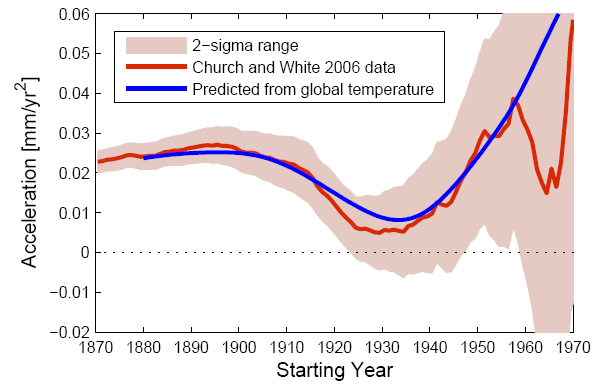
It's especially amusing that Jane/Lonny cites the exact paper which was already debunked in the links I've repeatedly given him. Since the code I just gave Jane/Lonny reproduces figure 2 in Rahmstorf and Vermeer 2011, Lonny already had all the code and data he needed to see that Houston and Dean 2011 had been prebunked for years.
Even Houston and Dean said "there is consensus among the authors that sea level accelerated from 1870 to 2004." They just cherry-picked 1930, the starting point with the lowest best-fit acceleration. Then they pretend to question if "sea level has accelerated during the 80 years from 1930–2010" and somehow ignore the fact that best-fit accelerations are even higher starting after 1930.
On top of that, anyone who cites Houston and Dean 2011 to support a claim that global sea level is "DEcelerating" should be aware that this is the result of a simple mistake where they neglected to take into account the fact that the southern hemisphere has more ocean than the north. When Rahmstorf and Vermeer 2011 corrected their error, the best-fit acceleration was positive.
The most hilarious bit, however, might be their response to these corrections. Houston and Dean had selectively cherry-picked a single starting date of 1930, then Rahmstorf and Vermeer calculated figure 2. Like my figure on page 2, Rahmstorf and Vermeer didn't selectively cherry-pick a starting year like Houston and Dean did. Quite the opposite!
How do Houston and Dean respond? They actually complained that Rahmstorf and Vermeer were somehow being "selective". This brazen reversal of the facts might have surprised me before I saw Jane baselessly accuse Layzej of cherry-picking for loading the entire UAH dataset, then Jane suggested only using data since 1998 and kept demonstrating that he would never grasp that irony.
If Jane/Lonny really had "many counterexamples", it's strange that he cited the one paper that had already been repeatedly prebunked and another regional paper which Houston and Dean cited while trying to explain away the fact that the southern hemisphere has more ocean than the north. Again, Lonny doesn't seem likely
-
Re:No shit ...
This is hilarious. NY isn't sinking. Overall global sea level rise has REMAINED at about 1mm/year for about 300 years. [Lonny Eachus, 2015-09-05]
Avg. sea lvl. rise has been about 0.9-1.0 mm/year for centuries. It rose a bit faster part of 20th Cen., but some say it's DEcelerating. [Lonny Eachus, 2015-09-04]
Lonny backpedals away from his stronger claim that sea level has been rising at "exactly the same rate for 300 years."
How did Lonny read the first sentence in Houston and Dean 2011 stating that sea level rose by 1.7mm/y over the 20th century, but not admit that it contradicts his mistaken claim about "< 1mm per year rate for hundreds of years"?
It's especially amusing that Jane/Lonny cites the exact paper which was already debunked in the links I've repeatedly given him. Since the code I just gave Jane/Lonny reproduces figure 2 in Rahmstorf and Vermeer 2011, Lonny already had all the code and data he needed to see that Houston and Dean 2011 had been prebunked for years.
Even Houston and Dean said "there is consensus among the authors that sea level accelerated from 1870 to 2004." They just cherry-picked 1930, the starting point with the lowest best-fit acceleration. Then they pretend to question if "sea level has accelerated during the 80 years from 1930–2010" and somehow ignore the fact that best-fit accelerations are even higher starting after 1930.
On top of that, anyone who cites Houston and Dean 2011 to support a claim that global sea level is "DEcelerating" should be aware that this is the result of a simple mistake where they neglected to take into account the fact that the southern hemisphere has more ocean than the north. When Rahmstorf and Vermeer 2011 corrected their error, the best-fit acceleration was positive.
The most hilarious bit, however, might be their response to these corrections. Houston and Dean had selectively cherry-picked a single starting date of 1930, then Rahmstorf and Vermeer calculated figure 2. Like my figure on page 2, Rahmstorf and Vermeer didn't selectively cherry-pick a starting year like Houston and Dean did. Quite the opposite!
How do Houston and Dean respond? They actually complained that Rahmstorf and Vermeer were somehow being "selective". This brazen reversal of the facts might have surprised me before I saw Jane baselessly accuse Layzej of cherry-picking for loading the entire UAH dataset, then Jane suggested only using data since 1998 and kept demonstrating that he would never grasp that irony.
If Jane/Lonny really had "many counterexamples", it's strange that he cited the one paper that had already been repeatedly prebunked and another regional paper which Houston and Dean cited while trying to explain away the fact that the southern hemisphere has more ocean than the north. Again, Lonny doesn't seem likely
-
Re:Let's see
Total coverage & volume of world's glaciers, ice sheets and sea ice shrinking - confirmation for warming.
Total ocean heat content to 2 km depth - confirmation of warming
Global increase in heat records compared to cold - confirmation of warming
-
Re:A question for all the"deniers".
The mean temperature may rise 0.6C.
Current state-of-the-art climate models span a range of 2.6–4.1 C, most clustering around 3 C, according to http://www.pik-potsdam.de/~ste...
-
Re:We've gone beyond bad science
Look for example on page 38 here. This is easily found information.
-
Re:queue the denialists!
We also have weak guesses for, what is supposed to be the most rigorous part of the theory of AGW, the radiative forcing for CO2 in our world. Uncertainty of a factor of two are commonplace. From page 42 of that link:
Finally, in the ensemble studies, by far most of the climate model versions have climate sensitivity near 3C, and only a small number of models have sensitivities below 2C or above 4C. I have argued here for the âoeconsensusâ range of past IPCC reports of 3C +/- 1.5C, as the goal of this paper is to revisit the basics. But taking all ensemble studies and other constraints together, my personal assessment (and that of a growing number of other researchers) is that the uncertainty range can now be described more realistically as 3C +/- 1C.
This is a 2008 paper.
I find it kind of odd that you would say one thing and then quote from a paper that contradicts your statement. Just saying - this sort of thing tends to make observers think your theory lacks credibility.
Thus, the various models for AGW are based on weak data for all but the most recent human history. And they are based on very poorly understood climate dynamics.
Mmm. Yet your own understanding and theory is sufficient to give you confidence that anthropogenic GHG emissions magically DON'T contribute to climate whilst simultaneously GHGs of natural origin do. Yet you apparently are unable to articulate what that theory is.
(a) Why do GHGs of anthropogenic origin have different radiative properties to GHGs from natural sources? Or alternatively, what effect is currently counteracting the extra latent heat trapped by anthropogenic emissions such that we are not experiencing a temperature change due to the increased conetration of GHGs - describe this effect in detail, including observations and repeatable, experimental evidence. (b) If the current temperature event is not due to our emissions, what is causing this event? (Whilst simultaneously dampening the effect of our own GHG's to the exact negative of the said change in baseline temperature)
Finally, it's worth noting that the sums of public money spend on AGW mitigation, such as development of renewable energy technologies and subsidies, carbon dioxide emission markets, development of alternative transportation (for example, biofuels and electric cars), and now, AGW reparations, currently are many tens of billions a year which possibly could go up to hundreds of billions a year. The same advocates for those huge expenditures also control funding for climatology research. There is a huge conflict of interest.
Yet you claim that (a) we need to maintain this research because "not enough" is understood about the climate (b) That using alternative energy will magically send us broke even though people are making so much money off it. In fact, they are (apparently) making so much money they are able to afford the expense of time travel to travel back in time to each observation of the radiative properties of CO2 (and other GHGs) and interfere with these experiments in some way, thus continuing the premise that these gases are GHGs - and even travelling to other planets to repeat the deception there. Where did this tech come from? Aliens I'd assume.
Perhaps you should repeat Tyndall's experiment and attempt to catch a chrono/astro/galacto-naut in the act of fiddling with it, thus proving this vast time conspiracy.
That is my evidence.
I remain a little sceptical...
Now, let's move on to the matter of Tuvalu. A poster, Impy the Impiuos Imp had noted that AGW mitigation involves a radical destruction of human innovation and a great increase in human poverty. You posted "Except that moving inward from the sea, fo
-
Re:queue the denialists!
Can you not even remember what you said in the past?
No, I don't have perfect memory. Thank you for the reminder. I can now adequately address your concerns.
Let's briefly go over the actual evidence. The problem is considered to be "climate change" which is better described, scientifically, by the term, anthropogenic global warming (which I usually refer to as AGW).
What actual evidence is there for AGW? The CO2 concentration data is pretty good for the recent past and ice cores give decent estimates through to the past 800k years or so. Thirty years of really good global climate data from satellite, a century and a half of moderately good proxy data from weather stations through to the mid-19th century, and progressively weaker temperature proxy data as we look further into the past.
We also have weak guesses for, what is supposed to be the most rigorous part of the theory of AGW, the radiative forcing for CO2 in our world. Uncertainty of a factor of two are commonplace. From page 42 of that link:Finally, in the ensemble studies, by far most of the climate model versions have climate sensitivity near 3C, and only a small number of models have sensitivities below 2C or above 4C. I have argued here for the âoeconsensusâ range of past IPCC reports of 3C +/- 1.5C, as the goal of this paper is to revisit the basics. But taking all ensemble studies and other constraints together, my personal assessment (and that of a growing number of other researchers) is that the uncertainty range can now be described more realistically as 3C +/- 1C.
This is a 2008 paper.
Thus, the various models for AGW are based on weak data for all but the most recent human history. And they are based on very poorly understood climate dynamics.
Finally, it's worth noting that the sums of public money spend on AGW mitigation, such as development of renewable energy technologies and subsidies, carbon dioxide emission markets, development of alternative transportation (for example, biofuels and electric cars), and now, AGW reparations, currently are many tens of billions a year which possibly could go up to hundreds of billions a year. The same advocates for those huge expenditures also control funding for climatology research. There is a huge conflict of interest.
That is my evidence.
I'll just note that it is my opinion that we're seeing a massive scientific fraud occurring as a result of this conflict of interest.
Now, let's move on to the matter of Tuvalu. A poster, Impy the Impiuos Imp had noted that AGW mitigation involves a radical destruction of human innovation and a great increase in human poverty. You posted "Except that moving inward from the sea, for many people, will mean that their country will no longer exist."
I took this (rightly, I still think) to mean that you thought that the territorial integrity of Tuvalu was more important than the suffering of the entire human race. Why should I care when so much is at stake?
It probably was a bit callous to note that Tuvalu can always move elsewhere and to imply (rightly, I still think) that there is little value to the existence of Tuvalu as a country. And these countries have problems because of their flaws not because of AGW. It is not that hard to move elsewhere. If your country falls apart because you are incapable of such a feat, then it's not my problem nor should it be.
At this point, it might have again been a bit callous to suggest "How could [come] everyone wants my stuff rather than just taking modest steps to improve their own lives?" It's not that hard to move when your home becomes a bit untenable. And by what right should you claim my wealth, just because you can't adapt?
For some reason, we're supposed -
Re:Bah Humbug! Twice nothing ...
You've previously said: "Dictionaries do not accurately define words, they merely list popular usage. If you want technical accuracy, consult an encyclopedia, not a dictionary. "
That's why I'm referring to technical statements like these:
In 2005, 11 national science academies signed a joint statement saying "It is likely that most of the warming in recent decades can be attributed to human activities
In 2007, 13 national science academies signed a joint statement referencing the earlier 2005 statement, and added: "Recent research strongly reinforces our previous conclusions. It is unequivocal that the climate is changing, and it is very likely that this is predominantly caused by the increasing human interference with the atmosphere. These changes will transform the environmental conditions on Earth unless counter-measures are taken. Our present energy course is not sustainable."
-
Re:Pollution not a valid argument for the left
If I may be permitted to make an analogy:
There's a certain chemical, (6aR,9R)- N,N- diethyl- 7-methyl- 4,6,6a,7,8,9- hexahydroindolo- [4,3-fg] quinoline- 9-carboxamide, which some claim produces hallucinations and other related physical and psychological effects in large mammals.
Others claim that the amount of this toxin ingested - a few micrograms - is insufficient to make any difference to such large mammals that usually weigh upto 100 kilos and beyond.
Think of EVERY SINGLE medicine or drug in the world! Your dosage is usually in exactly the same ratio to your body mass as CO2 in the atmosphere - that is to say, it's in parts per million. Yet, they produce powerful, often fast-acting effects in the body.
The climate system is similarly complex. A "small" change in one of its components can produce powerful, fast-acting feedbacks. I think that should be fairly obvious!
The point is that a change in composition of 0.01% is actually quite high for CO2. What you should be looking at is the amount of forcing it introduces into the system per unit of change, not how big or small the change is. Take a look here. Your intuition is irrelevant. Model and actual results matter.
-
Re:Doing more damage than we can reverse.
Here's a start:
https://secure.wikimedia.org/wikipedia/en/wiki/List_of_weather_records
Notice how many heat records have been recorded since 2000, and how most cold records are much older.
And here's a paper describing the statistical relationship between climate and extreme weather:
http://www.pik-potsdam.de/~stefan/Publications/Nature/rahmstorf_coumou_2011.pdf
-
Re:What happened to geology for its own sake?
Here (PDF) is a 2009 paper on the subject. Check out Fig. 6 on page 5. The estimates for 2100 range from around 80 to 180 cm depending on the scenario. Of course there could be events that we can't foresee that would change that but more than 8-10 feet by 2100 seems to be beyond reasonable given what we currently know. If we keep on with business as usual though 30 feet might be possible by 2200.
-
Re:Sun - Earth Connections
You are right. There is some speculation that x-rays may seed clouds. It is not yet clear that this is the case. If it is, it is not yet clear whether this would act as a positive or negative forcing. This would depend on where the clouds formed - low clouds warm while high cool. Are there other potential impacts of x-ray/magnetic fluctuations?
Here feulner and rahmstorf have modeled the Wolf, Sporer, Maunder, and Dalton minimums with reasonable accuracy. They then used the model to project the impact of another extended minimum this century: http://www.pik-potsdam.de/~stefan/Publications/Journals/feulner_rahmstorf_2010.pdf
This is just one paper and is certainly not the final answer, but it is interesting nonetheless. It will be interesting to see how this plays out.
-
Re:Oh good...
Jeremy Irwin posted this further down the thread.
That link requires AGU membership. For non-members: Feulner and Rahmstorf's paper (pdf)
My thanks to him.
-
Re:Oh good...
That link requires AGU membership. For non-members: Feulner and Rahmstorf's paper (pdf)
-
How about...
When Canada decides to transform USA into its personal powerplant?
Banana republics are so... 20th century. Solar republics will be so much more democratic. (Or at least less volatile. Electricity doesn't stand disruptions in transport.)
-
water circulation
Water takes about 400 years to go full cycle from surface to bottom to surface again.
Do you have a reference for that. No really i am serious. I have seen figures from 100-1000 years for ocean turnover. Yet i have failed miserably at finding good references.
Not any more. I had that oceanography course a Very Long Time Ago and no longer have the text book. AFAIK is was some kind of average accounting for volume of flow and distance. Recent generations have probably had time to come up with better estimates, but A 2004 EES lecture shows what you have, a guesstimate of 100-1000 years for thermohaline circulation. Some water is going to take a long time to turn over. Other water will go the short route.
-
Re:What is the net effect?
You quoted from newscientist.com. But this is a "pop" science source. Not a peer-reviewed scientific journal.
You're absolutely right that peer-reviewed journal articles are far superior to pop science sources. But the New Scientist articles he quoted accurately reflect the science in those peer-reviewed journals, which I've linked extensively so you can compare.
But perhaps this all is a cycle, because there is peer-reviewed scientific basis for the prediction of catastrophic "Global Cooling."
Huh? What in the full paper led you to that bizarre conclusion?
-
Re:What is the net effect?
One of the catastrophic outcomes of climate change are large sea level rises due to ice melt in the polar regions. Presumably there are models that predict how this could occur with global warming. So the question is, do these data agree with these models?
The last article I read in Science compared model prediction of sea level rise, and found that observations showed the sea levels rising even faster than the models predicted. Perhaps this was just short-term weather, though: more recent measurements may indicate agreement with the models.
-
The consensus is "Inaction is inexcusable"
"That completely misrepresents the opinion of climatologists."
Ummm, no it doesn't. It's just that you're about 10yrs out of date in the consensus game.
Please refer to the recent climate confrence in Copenhagen (basically an interim IPCC report), the confrence gave six key messages as listed in their report (warning 5mb pdf). Key message #5 was Inaction is inexcusable
The conference was organised by a "star alliance" of research universities: Copenhagen, Yale, Berkeley, Oxford, Cambridge, Tokyo, Beijing - to name a few. It included 2500 participants from 80 countries and had 1400 scientific presentations.
The folk at Nature have also echoed their sentiments.
True this does not mean "at all cost" but that is a pedantic nitpick rather than a misrepresentation of the consensus opinion on the part of the OP. -
Re:Oh this "best fit"
And the positive feedback between C02 and H20 alleged
Really? Seems plausible to me. Warm water has a higher vapor pressure than cold water, which leads to more water vapor in the atmosphere.
From that the nov55.com site:
The ice accumulates for about 80 thousand years and then melts for about 20 thousand years. Scientists used to assume that ice ages were a natural result of ice accumulating and melting in a cyclic manner. But the timing is too precise for natural environmental effects, which vary a lot. I therefore theorize that the cause is hot spots rotating in the earth's center and heating the oceans. Rotations in the earth's molten center could cycle in a precise way. It cannot be a coincidence that the tilt of the earths orbit also cycles at the same interval of 100 thousand years. Perhaps the central core of the earth is pulled off center causing more heat to get to the surface where there are more oceans.
Ha ha ha, that's a good one. Wait --- he's serious? This guy's a crackpot. That fact throws into doubt both his claims and the claims of the people to whom he links.
-
Re:You missed the point.
These basic conclusions have been endorsed by at least 30 scientific societies and academies of science,[6] including all of the national academies of science of the major industrialized countries.[7][8][9]
(http://en.wikipedia.org/wiki/Global_warming)
7) http://royalsociety.org/displaypagedoc.asp?id=13619
8) http://royalsociety.org/displaypagedoc.asp?id=20742
9) http://www.pik-potsdam.de/aktuelles/archiv/aktuelle/dateien/G8_Academies%20Declaration.pdfWhile a small minority have voiced disagreement with these findings,[10] the overwhelming majority of scientists working on climate change agree with the IPCC's main conclusions.[11][12]
10) http://www.nationalpost.com/news/story.html?id=164002
11) http://royalsociety.org/downloaddoc.asp?id=1630
12) http://www.sciencemag.org/cgi/content/full/306/5702/1686And honestly, I was being lazy and just quoting Wikipedia which hardly took any effort. Now imagine if you weren't being stubbornly predisposed in your opinion how easily you could have affirmed the scientific community's consensus yourself instead of wasting my time.
The best way to realize how strong the consensus is, is by looking at all the peer-reviewed literature published in scientific journals each year and tally up how many are dealing with global warming related studies and how many (if any) are attempting to contest global warming.
Honestly, I know you are wrong.
(yes, I do study environmental science). -
Re:Let me guess...
Um, what? The thermohaline cycle is when the wind-driven surface currents, like the Gulf Stream, move water from the equator to the poles, during which it cools and sinks and heads back to start the cycle over.
The Gulf Stream is one of the wind-driven components of the meridional overturning circulation. The thermohaline circulation is the density-driven component. See here, here, here, and here.
I did neglect to mention that stopping the Gulf Stream would also stop the cool water flowing back in the opposite direction, which could cause various Atlantic islands to get rather more tropical.
The cold water is deep water. If islands get more tropical it's because less surface heat is being transported northward, not because less cold water is being transported southward.
But, regardless, saying the Gulf Stream would shut down is exactly correct.
It's exactly wrong, according to what oceanographers mean by the term "Gulf Stream".
'Europe', no. Northern Europe, yes.
As I said, see Gregory et al., which is one of the main model intercomparison studies. I quote: "Although THC weakening mitigates the CO2 warming in the Atlantic region (see also section 3), there is no cooling over any substantial region in any of the TRANSIENT experiments, because the CO2 effect is larger." When you see those scary temperature anomaly maps with huge cooling, what you're looking at is generally a freshwater hosing experiment which doesn't have CO2 forcing in it, just a freshwater response which is supposed to be analogous to the true warming-induced response.
A northern European "ice age" is not really the main concern with an MOC slowdown/collapse. The main impact is probably shifts in regional precipitation patterns.
And anyone who says we need a 'large amount' of warming to collapse the current is just, essentially, guessing.
That may be a "guess", but it's an informed one, based on oceanographic modeling and paleoclimate evidence. As such, it's at least more credible than someone who says that we need little warming to collapse the current.
We don't know how much it will take, and it's probably very dependent on Greenland glaciers, which are currently melting faster than expected.
See Jungclaus et al., GRL (2006). They find that even in a high Greenland melt rate scenario, the MOC weakening in the 21st century (under a fairly high-forcing SRES A1B BAU scenario) increases from 30% to 42% by 2100. That's not insignificant, but it's not a collapse either, and they predict a recovery in the 22nd century.
It's not the last word on the subject by any means, but most researchers in this field are converging on the opinion that it's hard to collapse the MOC in a modern interglacial period. If you've just come out of an interglacial and still have some of the bigger continental ice sheets lying around, that's different.
If you want to assert it won't happen until the earth heats up that much, well, that's kinda silly.
It's backed up by highly cited published research. It's kinda silly to ignore that research, unless you're aware of any new work which I'm not. If you are, what is the citation?
But, yes, without the Gulf Stream clearing out the warm water, it would essentially keep building up in the Gulf of Mexico, and any hurricane that made it past Florida would get a giant energy boost.
Likewise: what scientific papers back up your claim that every
-
How is Global Warming still a controversy?
When international summit after international summit after international summit all recognize global warming and the human influence how can you still deny it? When from every article in a referred scientific journal about climate change from 1993 to 2003, there isn't even ONE that disagrees with the consensus that that Earth's climate is being affected by human activities, how is it not obvious? When even international panels like the InterAcademy Council and the Intergovernmental Panel on Climate Change can agree on the human impact, what "controversy" is there?
It is so painfully obvious that we do make a difference, that CO2 concentration is much higher than ever seen before, as shown by the Keeling Curve. And I can only hope most people understand that high CO2 levels lead to high temperatures and I don't have to spell that out.
It's not a debate. There is no "maybe." There's no confusion. The entire world's academic and scientific community have come to a consensus on it, but apparently some people here just don't get it.
Its at the point where both U.S. presidential hopefuls have made it both policy and goals to cut down on emissions, its not even politically dividing.
Global warming is real, it does exist, we do contribute, and if you think otherwise you're honestly in denial.
-
Download climate data and models
Repost of my AC post:
Lots of data at NCDC.
Simple interactive Java climate model JCM5.
3D general circulation model EdGCM (based on NASA GISS Model II, state of the art in 1983 and what James Hansen himself used in his famous 1988 testimony to Congress).
For more modern and advanced models
There are a variety of Earth System Models of Intermediate Complexity (EMICs) which are not fully 3D models but represent a lot of physics and don't require a supercomputer. One such is UVic; there are many more (here).
You can even get full blown state of the art GCMs which run on supercomputers, like NASA GISS Model E or NCAR CCSM, but expect to run them for most of a year to get any kind of result -
Models
I've hit my 30 comment limit so I have to post anonymously, but:
Lots of data at NCDC.
Simple interactive Java climate model JCM5.
3D general circulation model EdGCM (based on NASA GISS Model II, state of the art in 1983 and what James Hansen himself used in his famous 1988 testimony to Congress).
For more modern and advanced models
There are a variety of Earth System Models of Intermediate Complexity (EMICs) which are not fully 3D models but represent a lot of physics and don't require a supercomputer. One such is UVic; there are many more (here).
You can even get full blown state of the art GCMs which run on supercomputers, like NASA GISS Model E or NCAR CCSM, but expect to run them for most of a year to get any kind of result -
Re:Emerging from an ice age will have that effectIf you read the scholar.google.com papers, 1.1C is caused by increased solar activity. You mean, these papers?
Rahmstorf et al. (2004)
Foukal et al. (2006)
Stott et al. (2003) Human activity is responsible for 50% of CO2, the other 50% is volcanic sources. It's been some time since volcanic sources could compete with human activity for CO2 production; current anthropogenic CO2 production is about 100x larger than that of volcanic activity. That makes human activity culpable for about 0.05C in two hundred years. That is very far from what pretty much every other study ever done in climatology has found.
Also note that even that paper finds that anthropogenic activity competes equally with solar forcing before 1955, and exceeds it after 1955. Of course this paper attributes global warming to cosmic forces No, it doesn't. It attempts to associate glaciation cycles with cosmic rays. It doesn't say anything about the relatively recent phenomenon of global warming. We've reached the technological ability to see the change, and like Chicken Little run around declaring the "the sky is falling". Are you denying that climate change, whatever its source, has serious potential impacts that we should be concerned about? -
Re:Right, so...
Shaviv's conclusions disagree with most other work on solar variations and global warming. The cosmic ray connection is particularly tenuous. Foukal et al.'s 2006 paper in Nature gives a good review of the work in the field; for a specific critique of Shaviv's work, see this rebuttal by eleven climatologists as well their more detailed analysis; there have been other criticisms in the literature, but that is a fairly good summary.
-
Re:Risk assessment is lowered, politics apart
I believe the pertinent proof is that during periods of lower temperatures (such as following volcanic eruptions, etc.) we have less plant life. Global coolings leads to less plant life, so logicaly it follows that global warming would lead to higher plant life. In addition, looking at the historical record of the Earth, periods hotter than now have more plant life.
This is described somewhat by Nasa.
OK, now that there is proof on the table, can you change your world view - or is this a religion to you? -
Re:Solar Activity Coinciding with Climate Change
I couldn't even find a "Schroeter Institute for Research in Cycles of Solar Activity" in the telephone book, at least not in Waldmünchen. However a Miss Landscheidt is listed for the address given as the Insitute's address. c.f. this (german), search for "schröter"
-
This is called a LPHI event
Low Probability, High Impact. I once attended a presentation by Stefan Rahmstorf, a well known professor of physics of the oceans, in which he talked about these events.
On his website, you'll find a simulation of the worst case szenario. There is also an animation! -
This is called a LPHI event
Low Probability, High Impact. I once attended a presentation by Stefan Rahmstorf, a well known professor of physics of the oceans, in which he talked about these events.
On his website, you'll find a simulation of the worst case szenario. There is also an animation! -
This is called a LPHI event
Low Probability, High Impact. I once attended a presentation by Stefan Rahmstorf, a well known professor of physics of the oceans, in which he talked about these events.
On his website, you'll find a simulation of the worst case szenario. There is also an animation! -
Re: SimEarth
SimEarth used to do this. It was just a game of course, but the models were quite detailed and realistic as far as they went, and you could learn a lot from it about the way these variables interacted. It even had classic models like Lovelock's Daisyworld .
-
already been done
so basically this is just an incredibly remedial version of DaisyWorld. No news here.
-
Re:Climate, not weatherOne of the factors is ocean flow. Here is a link to a german professor that claims that a slight change of temperature will have dramatic effects since it will change the salt concentration in the upper layers of the arctic ocean.
The gulf stream is powered by cold water sinking to the bottom at the arctic ocean, so a slight change in mass density could change the direction of the gulf stream producing an ice age in northern Europe. Have a look at the nice pics.
-
Earth's oceans are key to climate change
- What does global warming have to do with the oceans?
Some of the highly counter-intuitive effects (described below) of global warming may not be appreciated without an understanding of the contribution made to climate by the Earth's oceans.
- Why are the oceans so important to climate?
Simply because the world's seawater stores millions of times more heat than the atmosphere, and the warm sea currents from tropical oceans transport some of this heat to northern continents like the USA and Europe which would otherwise be permanently freezing cold due to their northerly latitude. Warm sea currents are vital to agriculture and our continued well-being.
- Could the vital warm sea currents ever stop due to climate change?
Yes, the warm sea currents that keep the planet warm have an Achilles heel -- sea currents stop moving if the saltiness of the seawater falls be low a critical level (the density of seawater depends on its saltiness, reduced-salt seawater won't sink as it normally does in the coldest polar regions, and without sinking seawater the ocean currents stop moving).
One of the agreed effects of increasing Carbon Dioxide emissions is that rainfall will increase in northern latitudes, diluting the seawater. In the limit dilution shuts down the warm sea currents.
- What is the most important warm sea current?
The Gulf Stream is the most important warm sea current because it can alter worldwide climate by various positive feedback mechanisms. The climate and food production of the USA and Europe, for example, both depend on the Gulf Stream keeping the climate warm enough to grow crops.
- How secure is the Gulf Stream?
The Gulf Stream is known to be sensitive to changes in rainfall over the Atlantic. Rahmstorf's bifurcation model of Atlantic thermohaline circulation is widely accepted by independent scientists. This model implies the Atlantic Ocean has only tw o stable modes of circulation -- ON and OFF. The Atlantic Ocean is currently in the ON mode with an active Gulf Stream. 100000 years ago, it went into the OFF mode when the Gulf Stream shut down causing a worldwide massive Ice Age. The model shows the likely cause of the shutdown was increased rainfall.
- How is the present-day Gulf Stream doing?
The Gulf Stream changes slightly in intensity from year to year, but overall its average state in recent decades is stable and active. However, the situation should be monitored closely because it is unknown exactly how much additional rainfall the Gulf Stream can tolerate without shutting down. The Rahmstorf model predicts a critical threshold of about 1Sv/yr (10^6m/yr) (sustained increase) which is ~50% above current long-term average rainfall, whereas rainfall over Northern Europe has actually been increasing only by about 2% a year over the last 20 years -- a total rise of 40% which is currently below the 50% threshold. Conclusion: the Gulf Stream looks safe now but vulnerable to future rainfall increases.
- How would plants survive a Gulf Stream shutdown?
Most agricultural plants probably wouldn't survive. The summer air temperature in the US Mid-West, for example, would be just 32F(0C) which would stop all agricultural production.
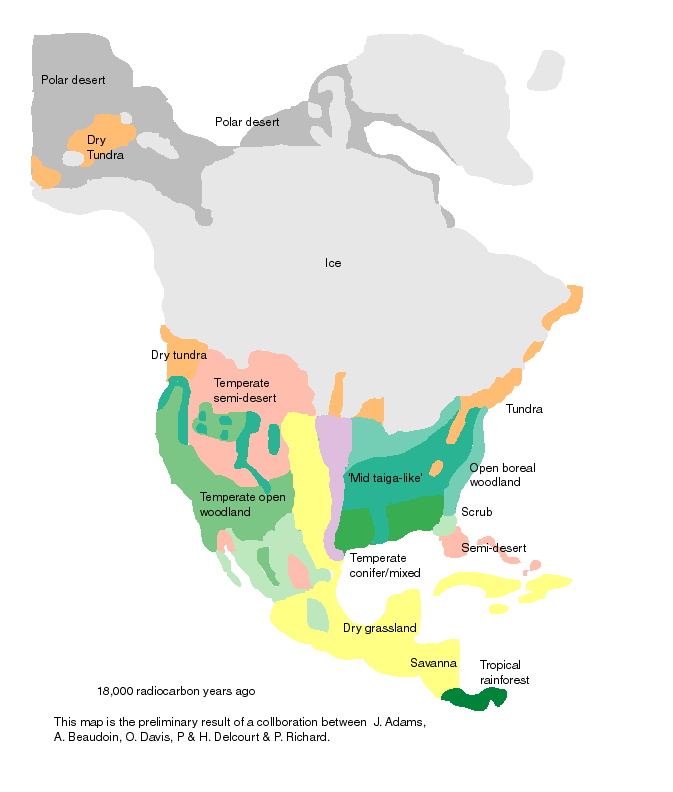
The ORNL has researched the types of vegetation in the US in present-day conditions and in zero-Gulf Stream conditions.
- US vegetation for Gulf Stream OFF (Ice Age conditions)
- US vegetation for Gulf Stream ON (present day conditions)
- What does global warming have to do with the oceans?
-
Links to science:He are links to two diffenent groups of scientist. They are both somewehat controversial, but I have had much fun reading aboutv their work. Read and judge for yourself.
The danish solar physicist Henrik Svensmark claims that there is a close link between solar activity and cloudforming, which again affects average earth temperature. He finds a nice correlations between temperature and the number of solar spots. Some of his theories are being tested at CERN. If I remember correctly the UN climate council has admitted that solar activity was responsible for the rise in temperature in the first half of this century.
The gulf stream is being driven by cold water that sinks in the basin between Greenland and Norway. The german physicist Stefan Rahmstorf claims that when the icecap melts ic creates a layer of freshwather on top of the ocean. This fresh water is so light that eddies do not form, and therefore it does not sink. His simulations showthat this effect can (within 50 years) force the gulf stream turn west outside spain, leaving northern europe very cold. Computer simulatuons may be largely insecure, but I think that he does show a mechanism by which a 2 degree temperature change end up having a dramatic effect on the climate where I live.
BTW: The american oil industry is sponsoring a lot of scientist to work on reports showing that there is no global warming going on, so we have FUD against FUD.
-
Earth's oceans are essential to climate
- Why are the oceans so important to climate?
Simply because the world's seawater stores millions of times more heat than the atmosphere, and the warm sea currents from tropical oceans transport some of this heat to northern continents like the USA and Europe which would otherwise be permanently freezing cold due to their northerly latitude. Warm sea currents are vital to agriculture and our continued well-being.
- Could the vital warm sea currents ever stop due to climate change?
Yes, the warm sea currents that keep the planet warm have an Achilles heel -- sea currents stop moving if the saltiness of the seawater falls below a critical level (the density of seawater depends on its saltiness, reduced-salt seawater won't sink as it normally does in the coldest polar regions, and without sinking seawater the ocean currents stop moving).
One of the agreed effects of increasing Carbon Dioxide emissions is that rainfall will increase in northern latitudes, diluting the seawater. In the limit dilution shuts down the warm sea currents.
- What is the most important warm sea current?
The Gulf Stream is the most important warm sea current because it can alter worldwide climate by various positive feedback mechanisms. The climate and food production of the USA and Europe, for example, both depend on the Gulf Stream keeping the climate warm enough to grow crops.
- How secure is the Gulf Stream?
The Gulf Stream is known to be sensitive to changes in rainfall over the Atlantic. Rahmstorf's bifurcation model of Atlantic thermohaline circulation is widely accepted by independent scientists. This model implies the Atlantic Ocean has only two stable modes of circulation -- ON and OFF. The Atlantic Ocean is currently in the ON mode with an active Gulf Stream. 100000 years ago, it went into the OFF mode when the Gulf Stream shut down causing a worldwide massive Ice Age. The model shows the likely cause of the shutdown was increased rainfall.
- How is the present-day Gulf Stream doing?
The Gulf Stream changes slightly in intensity from year to year, but overall its average state in recent decades is stable and active. However, the situation should be monitored closely because it is unknown exactly how much additional rainfall the Gulf Stream can tolerate without shutting down. The Rahmstorf model predicts a critical threshold of about 1Sv/yr (10^6m/yr) (sustained increase) which is ~50% above current long-term average rainfall, whereas rainfall over Northern Europe has actually been increasing only by about 2% a year over the last 20 years -- a total rise of 40% which is currently below the 50% threshold. Conclusion: the Gulf Stream looks safe now but vulnerable to future rainfall increases.
- How would plants survive a Gulf Stream shutdown?
Most agricultural plants probably wouldn't survive. The summer air temperature in the US Mid-West, for example, would be just 32F(0C) which would stop all agricultural production.
The ORNL has researched the types of vegetation in the US in present-day conditions and in zero-Gulf Stream conditions.
- US vegetation for Gulf Stream OFF (Ice Age conditions)
- US vegetation for Gulf Stream ON (present day conditions)
- Why are the oceans so important to climate?
-
Some important non-junk research
Rahmstorf's bifurcation model of Atlantic thermohaline circulation is widely accepted by independent scientists, implying the Atlantic Ocean has only two stable modes of thermohaline circulation -- implications discussed here
-
A better URL
-
Global warming could cause new ice age
What can global warming do? According to the widely accepted Rahmstorf bifurcation model of Atlantic thermohaline circulation, small increases above a threshold level in freshwater precipitation over the North Atlantic region can trigger a long-term Gulf Stream shutdown, a.k.a. an Ice Age.A super-threshold increase in freshwater supply to the North Atlantic area is one of the most stable effects predicted in simulations by coupled ocean-atmosphere models of climate for any future increased levels of atmospheric CO2.
Would an ice age be so bad? Well, which of the two states below do you prefer?
A. Gulf Stream OFF image of US vegetation (Ice Age conditions)
or
B. Gulf Stream ON image of US vegetation (present day conditions)
What does an ice age do? On land, agricultural productivity in the major food producers like the US and N.Europe would collapse due to freezing temperatures. Reduced ocean circulation would also cut precipitation in other regions of the world, creating droughts. In the sea, the much reduced ocean circulation would be unable to replenish marine nutrients in vital high-latitude oceans, i.e., marine productivity and fishing harvests would also collapse.
-
Yes and no
I too am perturbed by the goofy distinction that people like to draw between what is "natural" and what is "unnatural", as if humans are any less a part of nature than any other creature.
Having said that, however, I have to respond: we ARE different than the other animals, in that we have vastly more power to change our environment than most animals do.
Populations of living beings simultaneously adapt to their environment, and attempt to adapt their environment to themselves. Ideally, the result of many different species doing this all at once is a balance, called homeostasis, that is a healthy environment for a wide variety of creatures. For more on this, read about Lovelock's Daisyworld.
Humans modify their environment, just like any other creature. There is nothing inherently wrong with this. But we have the ability to do it on a timescale that is orders of magnitude faster than that of any other creature. The reason that we have the potential to do so much damage to our environment is not that we are (individually or collectively) more powerful than the planet -- we've got nothing on the motion of geologic plates -- but we operate on a different timescale.
Homeostasis is the product of many different species, all with different survival priorities and mechanisms, trying to change their environment to suit themselves. The result is a balance that is not ideal for any of them, but is generally good for all of them and more robust than an "ideal" solution would be. This balance can come to be because all the competing species are exerting approximately the same degree of influence over their environment, integrated over time. Humans have the ability to break that balance, because our actions can drive the environment one direction very hard for a few years, then reverse and drive it in some other direction. If we do this enough, we can really screw things up because there is never enough time for the system to come back to balance -- the system keeps looking for local minima, but is continuously driven out of them before it able to settle.
Anyway, this perspective on the human impact is relevant to environmental issues in general, and the impact of genetic engineering is no exception. I would also argue that you can look at cultural/social evolution through the same set of glasses (i.e. a complex and chaotically driven system that seeks a homeostatic local minima). In this case, the same arguements may pertain directly to the impact that, say, genetic screening and rational baby design will have on our culture.