Slashdot Mirror
Domain: pppl.gov
Stories and comments across the archive that link to pppl.gov.
Comments · 88
-
Re:This has been going on for quite a while...
So which of the three methods outlined in this 1976 clairvoyant report, from the which this magic graph was lifted, is the method that will provide us with practical fusion energy: is it the theta pinch, the mirror machine or the tokamak? Did you ever look at the actual report?
As it happens there is well funded effort to build a tokamak, which should demonstrate break-even in about 20 years. It is called ITER, and is mentioned in the summary. Unlimited funding would reduce the schedule but is unlikely to cut it in half no matter how much money was provided, since lots of experimentation will be needed to work out the technical issues. The roughly 226 tokamaks that have been built (yes, a lot of work has been done, and amazingly the U.S. government is not the only source of funding for research in the world) have provided a lot of experience to work with but more work needs to be done as it scales up.
The other two concepts in the document are dead as viable approaches at present.
The report envisions that a total of $65 billion (current dollars) would be needed (pretty much regardless of funding schedule) to produce a demonstration fusion reactor, the actual US expenditure since that time has been about $30 billion, but of course a large chunk of that (about $10 billion) went into the dead-end NIF which failed.
ITER expects to build that demonstration fusion reactor for a total cost of about $20 billion, and has a solid technical case to support it.
But the report writers, making a pitch for extravagant funding, really had no idea what funding or schedule made sense because they were guessing about technical feasibility of any of the concepts.
It is time to give this chart a decent rest.
-
Re:This has been going on for quite a while...
Here's the thing, there was a machine proposed at PPPL, called FIRE after TFTR was shut down. Fire was a compact R0=2m, a=0.5m high field B=10T machine. It was never funded. Mainly because the magnets would have needed to be made of copper and it would have boiled off a couple million gallons of liquid nitrogen to keep them cool every shot.
The MIT venture, common wealth fusion, is proposing a tokamak device called spark. It is exactly the same as FIRE. The only difference, is the use of REBCO high temperature super conductor to build the magnets instead of copper because REBCO didn’t exist when FIRE was proposed.
-
Deiterium-Tritisum Fusion no good for power
I'm afraid that this design, like nearly all modern fusion designs, relies on deuterium-tritium fusion. Both are awkward, expensive, and even dangerous to produce and refine. Tritium, in particular has a quite short half-life and is best refined from nuclear waste at fission plants. If you are already producing enough tritium to run fusion reactors, you already have more than enough fission plants to provide far more and far more reliable energy. There are numerous old papers laying out the difficulties, such as http://fire.pppl.gov/fesac_dp_.... Note that it's theoretically possible to generate more tritium than is currently generated by switcing to "breeder" fission reactors, but those have proven extremely dangerous to manage due to their use in creating plutonium, which is quite useful for nuclear weapon building. It's a very dangerous technology, and the generation of tritium on a commercial scale would be tied to creating _far_ more plutonium than is currently created.
The only currently feasible, safer, and scalable source of deuterium and tritium for fusion reactors is solar sails, capturing the more refinable percentage of such particles in solar wind. Since a solar sail is already capturing approximately 20 KW/square meter of sail from electromagnetic solar radiation, that is a vastly safer and easier to handle power source than collecting and shipping the isotopes of hydrogen to the necessary fusion reactor. Much like building a vast array of breeder reactors to generate tritium for fusion reactors, there is _no point_ to trying to run a fusion plant when the collection and refinement plant itself generates far more directly usable energy than can even theoretically be produced by D-T fusion.
I'll simplify by using the metaphor a colleague gave me recently. The refinement of deuterium and tritium for fusion power is like heating homes by burning the signs and posters put up to protest nuclear power plants. It can be done in theory, but it is not efficient and does not scale well.
-
Re: Cue the flood...
Ah, I see that they must have added power production to the original DEMO goals. If you consult : this 2009 142 slide presentation there is not a single mention of power production as one of the facets of the project, it is relegated entirely to a follow-on project.
-
Re:WHAT radioactive materials?
You were given plenty of information to find things on your own at whatever level is appropriate (even if the other AC got the 50 MW wrong, when it was 10 MW), but apparently you need to be spoon fed:
TFTR via PPPL's own website although it is very barren
A review paper on TFTR, which includes the example 10 MW fusion power shot 80539.
A more detailed paper on a 5 MW fusion power result
This all took 30 seconds to find with a google search for "TFTR fusion", would have all been covered if you looked at all at any summary of fusion history, whether on Wikipedia, or some place like PPPL. It takes far longer to create links to all of these than it does to find them.
It sounds like you are the type of person trying to use "Please provide a reference" as a roadblock, to shoot down others because they don't want to spend twice the effort it would have taken you to find things on your own to present them to you. You also provide no references to any of your claims. If you continue such tactics, you will only end up with a false sense of victory as people won't take the effort to spoon feed you when you were given more than enough information to find every reference you could possibly need (unless you have some sort of learning disability...).
Heck, you could have even just copy pasted the "Farnsworth fusor" name also already given to you and find anything from wikipedia level articles including discussion of high school level examples, to commercial products that involve almost a watt of fusion reactions as a neutron source.
So are you actually interested in learning and have any excuse why you could find this info (in less time than it would have taken to write your reply)? Or do you just want to bully people around and look like you are right with minimal effort...
-
Re:Fission = bad, but not super-bad
Oh boy, that is so utterly wrong.
But okay, I will do a quick google search for you and pass on the first result I find.
http://fire.pppl.gov/fusion_la... -
Re:Spherical Torus
Spherical Torus?
I wondered the same thing. However, the National Spherical Torus Experiment web site has this explanation:
The magnetic field in NSTX forms a plasma that is a torus since there is a hole through the center, but where the outer boundary of the plasma is almost spherical in shape, hence the name “spherical torus” or “ST”.
There are also some links to more detailed descriptions.
-
Re:Fusion
Putting a lot into it, just not getting as much out of it. Congress is cutting funding for ITER because it's way over budget and like any International project it's got too many cooks in the kitchen so to speak. A lot of higher ground research is going on overseas and the US is starting to lose ground in key areas including nuclear energy and particle physics. I'd rather see $20 billion put into those research areas than the F35 for example.
-
Re:I'd not trust the authors too much.
The article you cite seems rather crude and out of date, considering there are now various in depth design studies of reactors (and not just tokamaks) that carefully account for the amount of lithium needed and the rate of tritium production. That is now a large part of what such design studies work towards understanding and improving (it is obviously not a trivial problem).
True - but it showcases the underlying problem rather well. Do you have links to any of those studies of actual blanket costs and performance?
And the process does involve excess neutrons. If the blanket is made of litium-7, the reaction that produces a tritium releases another neutron. This can be helped by D-D reactions too, which while not useful by themselves for producing a net gain in power compared to the easy of the D-T reaction, you still get neutrons out of various deuterium only machines today. This allows designs that have projected 5-20% excess production of tritium.
No, the tritium fusion process does not produce excess neutrons exactly as I said, and yes, as I said, there are reactions that cause neutron multiplication (I did not treat this at length though, I just mentioned the best multiplier known). The multiplication in lithium is not large, and it is not clear that it can cover all the losses and end up with breeding break-even. I note that recent EFDA's (the European fusion consortium) recent press releases on the subject merely claim that they believe the problem to be "soluble". This PPPL study from 2010 estimates a net breeding ratio of exactly 1.0, which means fusion plants will require fission plants to breed their start-up tritium inventory.
-
Jeff Freidberg said it best
Jeff Freidberg laid out the cause of the problem at the last FPA Meeting.
-
Jeff Freidberg said it best
Jeff Freidberg laid out the cause of the problem at the last FPA Meeting.
-
Re:Awesome
This is not much to go on but slide 13 has a bit on the vortex development:
http://fire.pppl.gov/FPA12_Richardson_GF.pdf
This thesis though should hit the sweet spot:
http://www.cs.ubc.ca/~jgregson/images/JamesGregsonMAScThesis.pdf
-
Nuclear: only interim solution, permanent waste
It takes about five years, lots of concrete = lots of CO2 emissions, to build a 1GW reactor. You'd need to complete about one per week for the next 35 years to replace ONE-SEVENTH of the energy we now get from fossil fuels. (Pascala and Socolow, Science pdf 2004) (Stanford pdf on implementing sustainable energy.) Finish one reactor per week. Good luck with that.
And if you managed that, you'd run out of fuel for those reactors within a couple of decades. (Don't start with the but-but thorium!, or fusion, or god-knows-what-all. The testing and permitting on new tech would take us way past peak oil.)
You'd have to take care of the expected waste, plus the unexpected waste from accidents, for ever.
Meanwhile, Germany is implementing soloar and energy efficiency and is AHEAD of its targets.
The more time, effort, and money we waste chasing nukes, the less we have for a real solution. -
Re:hard to get excited
I wonder where the 3D printers fans will be in 40 years when not a single of their revolutionary predictions will have come to pass?
<1980>
I wonder where the microprocessor fans will be in 40 years when not a single of their revolutionary predictions will have come to pass?
</1980>Hey, I wonder whether you'll be back here in 40 years to admit you were wrong? I'd better bookmark this story.
It's funny that you say that since fusion performance has been increasing faster than Moore's law.
I'm glad you brought that up. To carry the simile further, Fusion hasn't produced a functioning transistor, yet. To show the scales in parallel isn't accurate -- the Fusion progress scale is way WAY to the left, before the point where multiple working transistors on a substrate succeeded in any practical way.
(Yeesh. Mix metaphors much?)
-
Re:hard to get excited
I wonder where the 3D printers fans will be in 40 years when not a single of their revolutionary predictions will have come to pass?
<1980>
I wonder where the microprocessor fans will be in 40 years when not a single of their revolutionary predictions will have come to pass?
</1980>Hey, I wonder whether you'll be back here in 40 years to admit you were wrong? I'd better bookmark this story.
It's funny that you say that since fusion performance has been increasing faster than Moore's law.
-
What is SEP [Re:Awesome]
in case you're wondering its the kind of ion drive Deep Space 1 (NSTAR) , progressing technology but not some crazy new thing.
Actually, Deep-Space 1 was an ion engine-- specifically, an electrostatic ion thruster.
Solar Electric Propulsion for asteroid missions-- at least the ones I've been involved in analyzing-- tends to be Hall thrusters (aka "Stationary Plasma Thrusters"), which are higher thrust and use energy more efficiently (in terms of less energy per unit of impulse), but aren't as fuel efficient (in terms of more propellant per unit impulse). Some people call Hall thrusters a form of ion engine (after all, the exhaust is plasma, which is ionized), but it's a different kind of thing from classic ion engines.
http://nmp.nasa.gov/ds1/tech/sep.html
http://htx.pppl.gov/ht.htmlThat's what I figured it was. I'm somewhat disappointed NASA decided to hype it up with green terms. Solar! Electric!
"Electric propulsion" is a generic word for any sort of rocket engine in which the reaction mass is given energy from electricity (rather than, say, chemical energy). There are a whole array of different technologies to do this, each of which has advantages and disadvantages.
Solar electric propulsion narrows that down to specify that the power source is solar. This is in contrast to, say, Nuclear electric propulsion (NEP) in which a nuclear reactor is the power source, or conceptually beamed-power electric propulsion, in which the power comes from a laser or microwave beam. A SEP system is very different from a NEP, but actually, a SEP using an ion engine looks a lot like SEP using, say, a magnetoplasmadynamic thruster (although the details will be different).
I'm sorry if you think that the term "Solar Electric Propulsion" is green. From my point of view, it's simply descriptive.
-
Re:great!
A report EFDA in preparation for ITER here. It gives shot cycle times:
- Jet: 30 minutes
- DIII-D: 14 minutes
- ASDEX: Just under 30 minutes
- FTU: 20 minutes
- RFX: 10 minutes
It even discusses replacement schedule of some equipment for ITER, with only a few blanket modules replaced per year and a complete replacement only every 10 years, for example. The time between shots is referenced as 1600 seconds here due to the limitations it places on computing requirements (so repetition rate would be ~2000 seconds since the plasma shots will be up to 400 seconds).
The introduction in the full text of the paper here discusses how HiPER will be designed with a target of 10 Hz repetition rate for a 100 full power shot sequence.
The report here mentions how the Omega laser system is designed around a 30 minute repetition rate.
20-30 per working day for JT-60
Even the ones I references as being kind of slow, NIF and Z-machine, are one shot per day, not weeks and months between shots.
The smaller projects I've worked on typically ran every 2-5 minutes when cycling during a normal day, limited by them typically using underpowered, but free (due to inheriting from previous experiment) cooling system. Their run campaigns were limited by staffing, as when the handful of people were busy analyzing data, no one was left to run the machine. Larger machines I've worked on had technicians and large teams to run 5+ shifts a week, and would run for at least a third of the year. Time not running was typically spent calibrating, repairing, upgrading diagnostics, and occasionally power supplies, most of which are components a production reactor would not have. Larger machines had a much more diverse diagnostic suite, so were much harder to organize and get things ready for a full run campaign, for reasons unrelated to plasma or neutron damage. The larger machines also could run into budget reasons running for a larger part of year due to staffing (technicians assigned to more than one thing) and power costs.
Neutron damage, failures due to plasma damage, and over all maintenance costs and cycling are a MAJOR issue that fusion research needs to address before becoming commercial. But that still doesn't mean your "hours, days, and even weeks" accurate for anything currently or in the near future.
-
Re:great!
A report EFDA in preparation for ITER here. It gives shot cycle times:
- Jet: 30 minutes
- DIII-D: 14 minutes
- ASDEX: Just under 30 minutes
- FTU: 20 minutes
- RFX: 10 minutes
It even discusses replacement schedule of some equipment for ITER, with only a few blanket modules replaced per year and a complete replacement only every 10 years, for example. The time between shots is referenced as 1600 seconds here due to the limitations it places on computing requirements (so repetition rate would be ~2000 seconds since the plasma shots will be up to 400 seconds).
The introduction in the full text of the paper here discusses how HiPER will be designed with a target of 10 Hz repetition rate for a 100 full power shot sequence.
The report here mentions how the Omega laser system is designed around a 30 minute repetition rate.
20-30 per working day for JT-60
Even the ones I references as being kind of slow, NIF and Z-machine, are one shot per day, not weeks and months between shots.
The smaller projects I've worked on typically ran every 2-5 minutes when cycling during a normal day, limited by them typically using underpowered, but free (due to inheriting from previous experiment) cooling system. Their run campaigns were limited by staffing, as when the handful of people were busy analyzing data, no one was left to run the machine. Larger machines I've worked on had technicians and large teams to run 5+ shifts a week, and would run for at least a third of the year. Time not running was typically spent calibrating, repairing, upgrading diagnostics, and occasionally power supplies, most of which are components a production reactor would not have. Larger machines had a much more diverse diagnostic suite, so were much harder to organize and get things ready for a full run campaign, for reasons unrelated to plasma or neutron damage. The larger machines also could run into budget reasons running for a larger part of year due to staffing (technicians assigned to more than one thing) and power costs.
Neutron damage, failures due to plasma damage, and over all maintenance costs and cycling are a MAJOR issue that fusion research needs to address before becoming commercial. But that still doesn't mean your "hours, days, and even weeks" accurate for anything currently or in the near future.
-
Liquid Lithium
I've been working at PPPL this summer, and that's the latest idea
-
Re:My first thought... shuttle tiles
The problem isn't the temperature alone, it's also that heavy atoms will pollute the plasma if they come loose at all. The Princeton Plasma Physics Laboratory is working on a liquid-lithium walled reactor to try and handle several of these problems. Check out LTX (Lithium Tokamak Experiment).
-
This is an ongoing debate
Ph.D student in fusion here. (I was one of the authors of this Ask Slashdot.)
It's important to note that there are a range of opinions on this. Everyone thinks ITER is a good idea, at the right price. That price was originally quoted at $5-billion (with the U.S. picking up 9% of that) when the U.S. made the decision to join in 2003; today the construction cost is estimated at somewhere north of $20-billion. Hopefully now with Motojima as Director-General, this cost will stop rising. (From what I hear, he's being very rigorous about cost and schedule control and pushing the team hard on these fronts.)
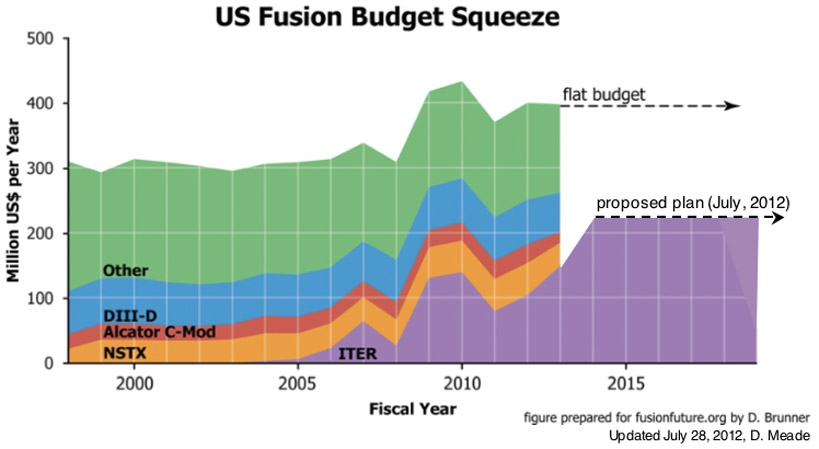
The problem for the U.S. is that participation in ITER doesn't make sense without a strong domestic program in place to take advantage of the results that come out of it. And without a (temporary) surge in U.S. fusion funding to get over the ITER construction "hump", the entire domestic program might be "squeezed" out of existence. Check out the graph here:
http://fire.pppl.gov/FusionFuture_USbudget_profile.jpg
So it's not so much a matter of "is ITER good science?" (it is!). The question is: "is ITER the right path for the U.S. at a cost of 9% of $20-billion or $25-billion, without a commitment to sustain the domestic program through the ITER construction phase?"
I urge everyone here to go to our website that we set up at fusionfuture.org, which has a lot of information about this issue. We still need your help - the House has restored funding for the domestic fusion program, but the current Senate version of the bill still has the domestic fusion budget slashed (and the fusion experiment at MIT entirely closed down). There is still work to do!
-
Link to the original article at the lab
-
Re:Actively stabilized fusion
I am in agreement with most of your thoughts except the polywell neutron claim. Have they published with statistically significant neutron yields? I'd like to read it if so. The General Fusion guys will definitely have to deal with severe Richtmyer-Meshkov instability when the shockwave breaks out of the molten metal into the plasma at the center, and then Rayleigh-Taylor instability when the plasma itself if compressed. Question is, how uniform of a shockwave will they need? Who knows. The CDX-U and LTX tokamaks at PPPL http://www.pppl.gov/lithiumtokamak.cfm have run, apparently with some success, using a liquid lithium limiter. But liquid lead? Yeah yikes, I'm not aware of any liquid Pb-using fusion experiments. The stated values for the vapor pressures of molten Li and Pb at their melting points are 1.63E-08 Pa and 4.21E-07 Pa respectively, I'm surprised that lead's VP is 26 times HIGHER than that of Li's. Scary. On the other hand, vortex rings can apparently be very stable and remain highly segregated from the medium they are propagating in over surprising amounts of time. http://www.youtube.com/watch?v=XJk8ijAUCiI
-
Re:Energy Independence
You've seen little advance because you're not reading much on the matter I think
In short we are within a factor 10 of achieving ignition, meaning a long, self-sustained fusion reaction outputting more energy than is expended to maintain it. In 1968 we were within a factor of 1000 of achieving this.
The ITER deadline for achieving his is 2020.
-
Re:Inertial confinement vs. magnetic confinement
I've heard a different version of this story. ITER was never going to be built in the US, it was always a fight between Japan and France, the two biggest partners in ITER; the US contribution is relatively small (but the US did back the Japan site). ITER got sited in Cadarache and the Japanese got the Fusion Materials Facility as a consolation prize.
The problem with ITER in the US (according to one of my professors) is that the money for ITER comes out of the general DOE fusion budget. Hence less money for independent research programs. There was a segment of the community pushing for a smaller, US tokamak, versus jumping into ITER. The project was/is called FIRE.
Energy Policy Act of 2005 passed overwhelmingly by Congress and signed on August 8, 2005 by the President endorses FIRE if ITER falters. If at any time during the ITER negotiations, the Secretary of Energy determines that the construction and operation of ITER becomes unlikely or infeasible, the secretary shall submit to Congress, along with the President's budget request for the following year, a plan for implementing a domestic burning plasma experiment such as the Fusion Ignition Research Experiment (FIRE), including costs and schedules for the plan.
-
Re:Inertial confinement vs. magnetic confinement
Well we (meaning humanity, not the United States) have achieved plasma discharges several hours long in the TRIAM-1M tokamak in Japan.
We have also achieved plasma conditions in pure deuterium plasmas in which, had the reactors been fueled with "live" fuel (50% deuterium, 50% tritium), the Q-value (energy out / energy in) would have been greater than one.
There have also been two experiments in which 50%D/50%T "live" fuel has been used. One is the Joint European Torus (JET) in Culham, England, near Oxford. It's still operating today, albeit on "inert" fuel (100% D). Even with 100%D, some amount of fusion still goes on, so it's not totally "inert", but it's far less than with 50%D/50%T. The other experiment was the Tokamak Fusion Test Reactor (TFTR) in the United States at the Princeton Plasma Physics Lab (PPPL). That's now disassembled.
The problem is that we haven't done all of these things at the same time, yet. That's why we're building ITER
ITER, the big reactor being built in Cadarache, France, will achieve Q=10. It was supposed to achieve "ignition", in which self-heating of the plasma is enough to keep it hot, and you can turn off the external heating (corresponding to Q=infinity), but the ITER consortium had to cut the budget when the U.S. pulled out of the project in 1998. Of course, then the U.S. rejoined in 2003, but by then the plan was set on "ITER Lite". It's not supposed to be done construction until 2018, though, and there's a chance of further schedule slippage approaching 100%. It's going to run for 25 years.
If you go to slide #25 of this presentation by Chris Llewellyn-Smith, you can see that the current "fast-track" plan for a commercial fusion plant has the first plants operating in 2048. Of course, that presentation was in 2005, and the ITER schedule has slipped by about four years since then, so we can say that if we somehow manage to stick to the "fast-track" plan from now on (we won't), there could be operating fusion power plants in the 2050s.
Yes, it's a long-term plan. That doesn't mean it's not worth funding. There still is no other energy source that can compete with its theoretical benefit. The only ones that come close in ability to provide a large amount of energy are fission and solar, and they have the disadvantages, respectively, of long-lived actinide waste, and massive land use.
-
Re:Go watch BBC's Earth serries.
Apropo the immense global disaster of
so getting started early and possibly avoiding an immense global disaster seems only prudent.
Apparently (according to olduvai theory) energy production per capita can't keep up with energy consumption, and over the next few years we're going to see a percipitous drop in energy per capita on account of overreliance on non renuable resources. Due to our reliance on energy for things such as feeding the populations of our cities and sustaining our medical infrastructure this is predicted to result in the deaths of billions of people (in the absence of new renuable energy technologies, and I do actually mean "billions"). Here are the sources for those interested:
(10 pages) Olduvai revisited 2008
(1/2 page) http://en.wikipedia.org/wiki/Olduvai_theory#Details_of_theory>Wiki article on Olduvai theory
Footnote 2 of this article is interesting in its own right
(1/3rd of a page) wiki article applying the Malthusian catastrophe to energy consumption
Read the section titled "The Silent Lie" (p3-4) of this article Thoughts on Long-Term Energy Supplies: Scientists and the Silent LieI wonder if our society's attitude towards renewable energy isn't a lot like societies attitude in the US towards slavery in the first half of the 19th century. There's on camp with a vested economic interest in a morally unacceptable behavior, and another camp protesting the moral (people die) and practical (we die) consequences of this behavior. The only difference being that our problem is time critical.
-
Re:And Appropriately
When did economic growth become more important than human lives? Money is a tool that humans invented to serve them, not the other way around. In fact, I think that the merits of continuous growth should be called into question. No rate of growth can be sustained forever. Here is an article from Physics Today that shows the mathematics of why growth cannot be sustained: http://fire.pppl.gov/energy_population_pt_0704.pdf
If economic growth will end eventually, and doesn't really increase our happiness why has it become a goal worth killing for?
-
Please, try to get your facts rightThe apparent problem is that you appear to not realize that laboratory plasma physicists are the ones arguing for the Electric Universe concepts against the mathematicians who play with beautiful equations all day long. Translation: pln2bz has read that a few (less than ten) people who seem to have affiliation with a plasma physics lab are "arguing for the Electric Universe concepts".
Fact: even in the MRX (Magnetic Reconnection Experiment, attached to the Princeton Plasma Physics Lab http://www.pppl.gov/projects/pages/magnetic_reconnect.html) there are (apparently) no laboratory plasma physicists so arguing. EU is highly testable. Translation: only if those doing the marketing of the idea are not required to show how, in any meaningful detail.
Fact: to the extent that the rich variety of theories, models, hypotheses, etc that comprises mainstream science is inconsistent with "EU", then said EU has been tested, repeatedly
Fact: Some of those who've commented on the EU ideas presented by pln2bz have not, in fact, "read the evidence". However, many have, and have questioned it and challenged it. So far, your track record in answering these direct, pertinent questions and challenges has been nearly perfect (you've failed to answer, almost every time). -
Alfvén is smiling in his grave!Are astrophysicists just unaware, or are they being malicious? Neither.
They have spent a decade or three researching magnetic reconnection - in the lab, via in situ space probes, and by remote sensing (a.k.a. using telescopes) - and have developed descriptions of the behaviours of plasmas, building on Alfvén's work and these discoveries, that match the observed phenomena nicely.
Take a look at the Magnetic Reconnection Experiment (http://mrx.pppl.gov/), as an example of lab-based plasma physics work on magnetic reconnection.
But maybe you know something about the behaviour of plasmas that the thousands of researchers - experimentalists, theorists, 'observers', and those who simulate plasmas in computers - don't, or have missed?
Why not write a paper to Nature, or Science, giving chapter and verse of the holes in their work? -
Re:Stellarators aren't new
Princeton? I'm sure you know (as do I - I grew up not far from there and a friend of the family worked at PPPL) that they already did quite a lot of experimentation with the Tokomak design, and held the world record for fusion back in the 90s. In fact, the Stellerator is sort of an optimized Tokomak; the overall shape of the plasma is still a torus (Mmmm, donuts!) but it's "twisted" so it's not the same cross-section in all spots.
I haven't read enough to really grasp why that's better, but 12MW is going to be a bit more powerful than the TFTR was. -
Princeton did it first
I've visited the Princeton Plasma Physics Lab, and they have one of these things in the final stages of construction
http://www.pppl.gov/polImage.cfm?doc_Id=27&size_co de=Doc
Either the NYU team did something new that's not mentioned in the article, or this is non-news -
Magnetically confined plasma fusion reactors
Related links: * LDX@MIT
* Physics of magnetically confined fusion [pdf]
* The main principles of magnetic fusion
* Magnetic fusion experiments at LANL
* High density magnetic fusion
* Has a good bit on magnetic confinement
* Can a magnetic field be used to contain plasma?
* International Thermonuclear Experimental Reactor
* What's happening in fusion?
* Design of magnetic fields for fusion experiments [pdf]
* Wikipedia article on the topic
* Magnetized target fusion bibliography
* Plasma physics bibliography
* Databases for plasma physics
* Plasma physics laboratories
* List of plasma physicists
* Plasma on the internet -
Doh!
A stellarator is not a new design. The first examples were built here in 1951.
-
Re:Cut to the Solar Chase: Nuclear Reactions.By the very definition of half-life, the most intense radioactive waste is the stuff that breaks down the fastest.
Which reminds me of something regarding nuclear fusion. Some time back, shortly before the Princeton University TFTR tokamak reactor was to go live, we were taking a tour of the reactor. The graduate student showing us around mentioned that in preparing to handle Tritium (half life of 12.3 years), the reactor had to maintain negative pressure and they had to account for an insanely small amount of all the Tritium (sorry, can't remember the figure) because with such a short half-life it was incredibly radioactive. Moreover, because hydrogen is so abundant in every living thing, it would be readily integrated and thus wreak havoc in living tissue.
There was also an interesting story about why the flywheels (used to store energy to light the reaction) were mounted underground, in thick reinforced concrete on vertical shafts... think about what happens if the shaft is horizontal and a piece breaks of in a 45-degree upward trajectory.
-
Re:Nuclear Engineering...
The Princeton Plasma Physics Lab does fusion research and development, and because it is Department of Energy funded everything there, including salaries, is available to the public on request.
-
Re:We are gnats on an elephant
A fun fact I like to wow people with is where the hottest and coldest places in the known universe are; New Jersey and Colorado.
Well at least they were. Princeton's Tokamak is no longer running and lot's of people have BECs now. -
Re:Next generation?
http://en.wikipedia.org/wiki/Tokamak
http://www.pppl.gov/projects/pages/tftr.html
http://w3.pppl.gov/~dstotler/SSFD/
There ya go. Top 3 links from google for reference (and play, the third one is fun).
-nB -
Re:Next generation?
http://en.wikipedia.org/wiki/Tokamak
http://www.pppl.gov/projects/pages/tftr.html
http://w3.pppl.gov/~dstotler/SSFD/
There ya go. Top 3 links from google for reference (and play, the third one is fun).
-nB -
Re:This fails the head-scratch test.Ah. Alright, I think I understand your position. A couple of quotes selected from this article:
http://fusedweb.pppl.gov/FAQ/section1-physics.txt
I. What sort of fusion reactor is the sun? Fortunately for life on earth, the sun is an aneutronic fusion reactor, and we are not continually bombarded by fusion neutrons. Unfortunately, the aneutronic process which the sun uses is extremely slow and harder to do on earth than any of the reactions mentioned above. The sun long ago burned up the "easy" deuterium fuel, and is now mostly ordinary hydrogen. Now hydrogen has a mass of one (it's a single proton) and helium has a mass of four (two protons and two neutrons), so it's not hard to imagine sticking four hydrogens together to make a helium. There are two major problems here: the first is getting four hydrogens to collide simultaneously, and the second is converting two of the four protons into neutrons.
Regarding D + He3 aneutronic fusion:If the reactor is optmized (run in a He3 rich mode) the number of neutrons can be minimized. The neutron power can be as low as about 5% of the total. However, in a 1000 megawatt reactor, 5% is 50 MW of neutron power. That is [still] a lot of neutron irradiation. This lower neutron level helps in designing structural elements to withstand neutron bombardment, but it still has radiation consequences.
I apologize for the rather simplistic answers provided by the article, but it does a nice job of summarizing where I would tend to ramble on. -
Re:Why so slow? Why no larger investments?ITER will NOT generate power. It's not even close.
This isn't one of ITER's goals. There are other projects that are designed to address these issues. IFMIF is designed to address the environmental, safety and economic concerns of fusion power http://www.frascati.enea.it/ifmif/. Sometime after ITER and IFMIF there would be DEMO which would first replicate ITER's performance and the preliminary track would then be to produce 1 GW of electric power with DEMO. From there it would be PROTO, a prototype reactor. Concurrent to ITER there are several projects planned such as IGNITOR http://www.frascati.enea.it/ignitor/ and FIRE http://fire.pppl.gov/
Fusion plasmas today already put out more energy then we put in, but we can't turn that energy into electricity yet.
Do you have a source for this? I know of only two tokamaks that have performed D-T fusion, JET (16.1 MW, Q = 0.6) and TFTR (10.7 MW, Q = 0.27). JT-60 has achieved plasma performance which corresponds with Q = 1.25, however JT-60 is not designed to handle tritium fuel and hence has never performed D-T fusion. No machines have exceeded breakeven with D-T fusion.
The main problem (as I see it) with fusion has nothing to do with plasma, but has to do with materials.
I disagree with you about the plasmas not being a main problem, however I agree that the materials side also requires a lot of research and development.
-
It's a plasma, contained by magnetic fields.However, it's not a simple plasma. It would have to be a high energy density plasma, in order to look solid and act solid.
The example I found of a Tocamac plasma is only red, but is 20-30 million degrees C. However, the lightsabers in the original (and therefore One True) Star Wars were white. This means they must be considerably hotter. The page I found on near-solid high energy density plasmas also talks about tens of millions of degrees - my gut feeling would be that to produce totally solid white plasma would require 40-50 million degrees C.
Now, plasmas at that kind of temperature could quite reasonably be expected to slice through almost anything - steel included. Furthermore, anything that was vaporised would be repelled by the magnetic field and thus travel AWAY from the wielder. This does mean that if you are fighting someone with a lightsaber, you will get sprayed with high-energy plasma every time they hit something.
There is one minor problem, though. Energy. If you want to maintain something at 50 million degrees, AND a containment field, a couple of duracel batteries won't cut it. Even lithium batteries will go flat very quickly. My guess is that the handle of the lightsaber, therefore, contains a wormhole linked to a gigantic anti-matter reactor.
All you REALLY need to do, then, is find out where your opponent's reactor is hidden and turn it off. Their lightsaber will then be useless. -
Re:Yeah Right...
Deep Space 1's "ion drive" is a plasma drive. Perhaps what you're thinking of would be more like Hall thrusters, MHD thrusters, Pulsed Plasma Thusters, or VASIMR. All of which exist and have been tested to some degree in vacuum chambers and some of which have actually flown. They were not necessarily invented by NASA, but then neither was velcro, Tang, or kevlar, but those things are all still useful.
-
Interesting
Their method of heating the plasma to temperatures hot enough for fusion seems to be by using particles accelerated by magnetic reconnection. (hmm.. that wiki needs love)
Magnetic reconnection in traditional fusion reactors is seen as a bad thing because it shoots particles in unpredictable directions that often can't be contained by the confining magnetic fields. So it results in a loss of plasma density and also eventually puts small holes in the sides of the reactor.
If these particles are that energetic it seems to make sense that they could be used to heat the plasma if they could be controlled. No idea if they are energetic enough to be used alone though.
That magnetic reconnection thingy is also what causes the northern lights. -
Re:Why not fusion?
-
Re:Simple question:
Absolutely. There's a pretty interesting report online suggesting a system which would reform gasoline using electrolysis. This powerpoint presentation (http://fire.pppl.gov/fpa03_cohn.ppt) suggests that the cost could be around $1000 including a turbocharger and result in an efficiency increase of about 20%, as I recall. As much as 40% with a hybrid powertrain.
And this system is demonstrated by a reputable group (MIT, DoE and presumably Princeton), unlike this other guy. -
Re:Tabletop fusion isn't going to happen
Thanks for clarification, you are right. The plasma wouldn't burn a huge hole in the ground, rather it will destabilize and cool. Anyone that works(ed) on the project TOKAMAK here? By the way, I found this little 'Tokamak' game, it's kind of fun if you like this kind of stuff. here.
-
Re: More Evidence for Tabletop Fusion
I may not be the GP, but I'll throw in my $.02 as a fusion science researcher. (I work on a magnetic confinement device myself.)
1) The running joke of fusion is that it's always 30-50 years away. This is more due to meager funding levels than anything else. At a talk by a PPPL scientist a few years back, it was mentioned that if one plots the price of oil and the amount allocated for fusion research versus year, they track rather nicely. (The 70's were a great time to be in the field!)
Why the meager funding? Fusion researchers kind of shot themselves in the foot in the late 50's and 60's, before much of the underlying plasma physics was well understood. TFTR (the Tokamak Fusion Test Reactor, built in the late 70's, ran through the 90's) turned up physics phenomena that were unexpected and needed to be understood. (That can still be said for many devices today, which are built to specifically analyze these phenomena.) When Nature deals you a bum hand, you have to go back to the drawing board -- and push things off for another decade. Politicians don't like that -- especially when they've been coerced into thinking past their next election!
ITER will be a very large-scale test device. Some of the phenomena that we see disrupting our current experiments are related to physical device size. Additionally, fusion power production is volumetric, while losses from the plasma come from the surface area of the confined plasma. Therefore, scaling up the size will boost fusion output, making it easier to "breakeven" (power out == power in) and, in ITER's case, very likely "ignite" (after reaching a critical temperature, you can turn off external heating and the plasma burning supplies the rest).
Of course, such scaling takes Lots of Money. Superconducting magnet coils are pricey; so is requisite neutron shielding. Current designs incorporate a Lithium "blanket" which will both absorb the 14 MeV neutrons (shielding) and produce tritium (amazingly, more T than you seed the plasma with initially!). One of the biggest question marks is in the field of materials. Nothing has been built that is going to take the neutron punishment that ITER will dish out to plasma-facing surfaces. It is such an important task to design materials that can sustain bombardment that a separate facility will be constructed simultaneously with ITER in Japan to study neutron bombardment exclusively. This has implications in the divertor material (high-Z tungsten or something lighter?) as well as blanket design.
2) My personal opinion is that it is best to stick with our Gen-IV nuclear plants when it comes to fission. These are meltdown-proof, high-efficiency plants that are designed for rapid implementation, should there be a willing buyer. A tabletop-size fusion device would be a relatively inefficient method of starting a fission plant; there are plenty of natural neutron sources that can be made by mixing radioactive materials together. Essentially, it'd be cheaper to use our existing designs for a big fission plant than mixing a fusion reactor's blanket design with a subcritical fission design.
-
Re:Japan and France
I failed to link something: this
-
Crystal Fusion -- yes, Energy source -- no
Disclaimer: I am a plasma physicist conducting active research on a magnetic confinement device.
TFA implies towards the end that crystal fusion has potential to become an energy source (i.e. exceeding "breakeaven," the condition where energy input is balanced by energy output). I sincerely doubt this will be the case. That said, the real benefit to this crystal fusion device is not producing energy, but as a cheap neutron generator.
To put things in perspective, consider the fusion rates between crystal fusion and TFTR (the most successful D-T "hot" fusion device built to date). From the FIRE place:
"Note: crystal fusion produced 800 deuterium-deuterium fusion reactions per second compared to 50,000,000,000,000,000 deuterium-deuterium fusion reactions per second in magnetic fusion (e.g., TFTR)."
Small, cheap neutron sources would be a great boon for many fields, such as petroleum reserve discovery and material science research. When it comes to a real energy source, though, a practical first step is to actually decide where to build the ITER.