Slashdot Mirror
Domain: primatelabs.com
Stories and comments across the archive that link to primatelabs.com.
Comments · 66
-
Re:From my HPC days
And naturally, right after I posted the parent, I found the cache sizes.
These are for a 16-core Threadripper 1950X:
L1 instruction cache: 32 KB x 16
L1 data cache: 64 KB x 16
L2 cache: 512 KB x 16
L3: 32 MB x 4http://wccftech.com/amd-ryzen-threadripper-1950x-cpu-performance-benchmarks-leak/
https://browser.primatelabs.com/v4/cpu/3324737
I'm not a CPU expert but it seems clear that L1 and L2 cache is per-core (makes sense) but L3 cache is shared... I'm going to guess that a group of 4 cores shares one 32 MB cache, since 4 * 4 is 16.
-
Re:A good number of people don't need good laptops
Naw, I think people have a lower tolerance for slow shit than you give them credit for. Anything below a core m3-6y30 such as what is found in the lowest end Surface Pro is basically a non-starter. Yes a core2duo was good in its day but it is crippled running modern software, even web browsers, with how demanding sites are now. Basically, if the performance doesn't match or exceed this it's DOA.
-
Re:Performance
The nexus 6 is a total slouch. Modern phones such as the iphone 7 and the S8 are completely on par with midrange desktop systems. https://browser.primatelabs.co...
The A10 fusion is only slightly slower than an i7 6600U. This a completely reasonable solution. The S8 is even faster. It's a crazy new world we are in. At this rate... In the near future our phones will faster than our desktops lol -
Re:A10 Fusion?
Interestingly, it turns out that Apple's version of the A10 Fusion is roughly twice as fast as AMD's fastest A10 Fusion model (and in fact roughly the same speed as their current A10 non fusion)
AMD A10 Fusion: https://browser.primatelabs.co...
AMD A10: https://browser.primatelabs.co...
Apple A10 Fusion: https://browser.primatelabs.co... -
Re:A10 Fusion?
Interestingly, it turns out that Apple's version of the A10 Fusion is roughly twice as fast as AMD's fastest A10 Fusion model (and in fact roughly the same speed as their current A10 non fusion)
AMD A10 Fusion: https://browser.primatelabs.co...
AMD A10: https://browser.primatelabs.co...
Apple A10 Fusion: https://browser.primatelabs.co... -
Re:A10 Fusion?
Interestingly, it turns out that Apple's version of the A10 Fusion is roughly twice as fast as AMD's fastest A10 Fusion model (and in fact roughly the same speed as their current A10 non fusion)
AMD A10 Fusion: https://browser.primatelabs.co...
AMD A10: https://browser.primatelabs.co...
Apple A10 Fusion: https://browser.primatelabs.co... -
Make a new computer better than my "sad" old one!
WARNING: If you're "still" using a computer that's more than 2 years old because its good enough, this post may male you feel like you made the right decision.
Sad? No, this is sad. I would love to buy a new Apple (I need a laptop, and I need to stick with Apple because of various constraints). Unfortunately, they won't sell me a new one that's much better than my "sad" old one.
I started looking for a replacement for my 2012 MacBook Pro a few months ago, fully expecting to buy myself a performance boost. I couldn't believe that Apple simply doesn't make a laptop that's significantly faster than my four year old computer.
Here's the benchmark for my 2012 MacBook Pro: http://browser.primatelabs.com/geekbench3/4933459
Compare that with the results from recent MBPs: http://browser.primatelabs.com/mac-benchmarks
Wow. It's four years later and I still can't buy a significant performance boost from Apple. The best I can do is an almost unnoticeable bump in speed.
Maybe more people would stop using "sad" old computers if Apple gave them a compelling reason to upgrade.
-
Make a new computer better than my "sad" old one!
WARNING: If you're "still" using a computer that's more than 2 years old because its good enough, this post may male you feel like you made the right decision.
Sad? No, this is sad. I would love to buy a new Apple (I need a laptop, and I need to stick with Apple because of various constraints). Unfortunately, they won't sell me a new one that's much better than my "sad" old one.
I started looking for a replacement for my 2012 MacBook Pro a few months ago, fully expecting to buy myself a performance boost. I couldn't believe that Apple simply doesn't make a laptop that's significantly faster than my four year old computer.
Here's the benchmark for my 2012 MacBook Pro: http://browser.primatelabs.com/geekbench3/4933459
Compare that with the results from recent MBPs: http://browser.primatelabs.com/mac-benchmarks
Wow. It's four years later and I still can't buy a significant performance boost from Apple. The best I can do is an almost unnoticeable bump in speed.
Maybe more people would stop using "sad" old computers if Apple gave them a compelling reason to upgrade.
-
Re:It's no ARMv8
Both the A8X and the Broadwell Core M have a TDP of ~4.5W, so they give us a good comparison between the latest and greatest ARM vs. x86 CPUs:
http://browser.primatelabs.com/geekbench3/compare/2959187?baseline=3338936
Lets compare against the nVidia Tegra K1 as well, which has a TDP of 5W vs. the Core M's 4.5W:
http://browser.primatelabs.com/geekbench3/compare/2959187?baseline=3347052
As you can see, Intel is actually competing well against the best ARM can offer in their own backyard. The A8X does ~5% better in multi-threaded workloads, it has 3 cores vs. Core M's 2 cores. Single threaded, the A8X is ~26% slower than Core M. Despite having 4 cores, the Tegra K1 has ~16% worse multi-threaded performance than the Core M with 2 cores and ~53% slower single threaded performance. When you consider most GUI/web applications are single threaded (which is mostly what people use tablets for) Broadwell Core M is the best tablet chip on the market right now. Its only going to get better with Skylake.
At the same time, ARM hasn't been able to really touch Intel's home turf in the high performance market.
On the topic on instruction sets, honestly the most important difference between x86 and ARM is having an x86 design gives you a distinct advantage in the market for computers that run Windows. Given that there is no disadvantage for x86 in any other market segment (Android, Chrome, Mac, etc.) why would Intel switch to ARM when there is only upside to x86 and no downside?
-
Re:It's no ARMv8
Both the A8X and the Broadwell Core M have a TDP of ~4.5W, so they give us a good comparison between the latest and greatest ARM vs. x86 CPUs:
http://browser.primatelabs.com/geekbench3/compare/2959187?baseline=3338936
Lets compare against the nVidia Tegra K1 as well, which has a TDP of 5W vs. the Core M's 4.5W:
http://browser.primatelabs.com/geekbench3/compare/2959187?baseline=3347052
As you can see, Intel is actually competing well against the best ARM can offer in their own backyard. The A8X does ~5% better in multi-threaded workloads, it has 3 cores vs. Core M's 2 cores. Single threaded, the A8X is ~26% slower than Core M. Despite having 4 cores, the Tegra K1 has ~16% worse multi-threaded performance than the Core M with 2 cores and ~53% slower single threaded performance. When you consider most GUI/web applications are single threaded (which is mostly what people use tablets for) Broadwell Core M is the best tablet chip on the market right now. Its only going to get better with Skylake.
At the same time, ARM hasn't been able to really touch Intel's home turf in the high performance market.
On the topic on instruction sets, honestly the most important difference between x86 and ARM is having an x86 design gives you a distinct advantage in the market for computers that run Windows. Given that there is no disadvantage for x86 in any other market segment (Android, Chrome, Mac, etc.) why would Intel switch to ARM when there is only upside to x86 and no downside?
-
Re: Yes - known for years.
i5, i3, to a notebook, they are mostly the same thing...
But Core M isn't. BECAUSE!
Your argument is truly convincing. But hey, maybe a benchmark could shed some light.
http://browser.primatelabs.com... - MacBook (Early 2015) with Intel Core M-5Y51 @ 1.20 GHz (first MacBook listed)
Single-Core Score Multi-Core Score
2591 5407
http://browser.primatelabs.com... - Dell Inc. XPS 13 9343 with Intel Core i3-5010U @ 2.10 GHz (only Core i3 Dell XPS)
580 1202Ouch?
-
Re: Yes - known for years.
i5, i3, to a notebook, they are mostly the same thing...
But Core M isn't. BECAUSE!
Your argument is truly convincing. But hey, maybe a benchmark could shed some light.
http://browser.primatelabs.com... - MacBook (Early 2015) with Intel Core M-5Y51 @ 1.20 GHz (first MacBook listed)
Single-Core Score Multi-Core Score
2591 5407
http://browser.primatelabs.com... - Dell Inc. XPS 13 9343 with Intel Core i3-5010U @ 2.10 GHz (only Core i3 Dell XPS)
580 1202Ouch?
-
Not the whole story
Geekbench's own numbers put the iPad Air at 4528, only 10% off the i5. Which is astounding, because five years ago Intel's ULV CPUs were hitting 2000-2500 on the same benchmark while Apple's new A4 was 200.
The flagship ARM CPUs cost a tenth as much as Intel's chips, consume a fraction of the power, and have been roughly doubling performance every year while Intel has virtually plateaued*. If that trend continues, by the end of this year they'll have surpassed Intel on virtually every metric.
Of course, AMD reached pole position a decade ago until Intel's Core 2 decisively took back the lead. Intel may repeat history with Skylake; if not, the computer world could get a lot more interesting over the next few years.
(*on clock speed and IPC they're been scarcely improving 10% a year; IPW is increasing somewhat faster but still well behind ARM designs)
-
Re:See nothing that says this is x86
Here are (only two) benchmark results...
http://browser.primatelabs.com... -
Re:18B on 75B
It's faster
Actually, it scores 958 on geek bench. An iPhone 6 scores 1612. So it's about 60% of the speed.
http://browser.primatelabs.com...
http://browser.primatelabs.com...it's got more memory
True, but then its OS uses more memory, and its applications run in a garbage collected VM that causes more memory usage. The result - the iPhone does better at multitasking tests than even 4GB android devices like this. Even with only 1GB of RAM, the iPhone jetsams apps less often than android.
https://www.youtube.com/watch?...a better screen and is built at least as well if not better than an iPhone 6
The screen quality is entirely debatable, as is the build quality. Reviews though tend to say that the OnePlus One's plastic case feels odd and gets dirty quickly.
Basically, the iPhone offers more value to the customer than you're giving it credit for.
-
Re:18B on 75B
It's faster
Actually, it scores 958 on geek bench. An iPhone 6 scores 1612. So it's about 60% of the speed.
http://browser.primatelabs.com...
http://browser.primatelabs.com...it's got more memory
True, but then its OS uses more memory, and its applications run in a garbage collected VM that causes more memory usage. The result - the iPhone does better at multitasking tests than even 4GB android devices like this. Even with only 1GB of RAM, the iPhone jetsams apps less often than android.
https://www.youtube.com/watch?...a better screen and is built at least as well if not better than an iPhone 6
The screen quality is entirely debatable, as is the build quality. Reviews though tend to say that the OnePlus One's plastic case feels odd and gets dirty quickly.
Basically, the iPhone offers more value to the customer than you're giving it credit for.
-
Re:ancient in tech years?
Your 3Ghz chip from 2002: scores 700 odd on geek bench
An iPhone scores 2900
A modern 3Ghz chip scores 16500
No, processor speeds have not plateaued.
-
Re:ancient in tech years?
Your 3Ghz chip from 2002: scores 700 odd on geek bench
An iPhone scores 2900
A modern 3Ghz chip scores 16500
No, processor speeds have not plateaued.
-
Re:ancient in tech years?
Your 3Ghz chip from 2002: scores 700 odd on geek bench
An iPhone scores 2900
A modern 3Ghz chip scores 16500
No, processor speeds have not plateaued.
-
Re:'Mobile' no more.
Correction - The Surface Pro's i3 scores 3250 . Sorry.
-
Weird situation with Mac Pro
With this new iMac and its display, the Mac Pro is starting to look a bit bleaker. I actually think it starts to look a little weird.
Performance-wise, if you configure this iMac with the 4 GHz processor, you get the fastest CPU, at least 25% faster than the Mac Pro in single-threaded tasks according to this benchmark. Mac Pro still has Ivy Bridge-architecture Xeons.
And the current Mac Pro can't drive a 5K display, but it's true that it can drive up the three 4K displays.
So the Mac Pro doesn't really make sense anymore unless you need its graphics cards to support OpenCL applications, or you want the parallelism of 8 or 12 cores, or you need its ECC RAM.
-
Re:I can't believe your comparing a desktop CPU ..
Yes... because modern smartphones are much faster than single core 1Ghz desktop CPUs. They're roughly as fast as 3Ghz dual cores
-
Re:I can't believe your comparing a desktop CPU ..
Yes... because modern smartphones are much faster than single core 1Ghz desktop CPUs. They're roughly as fast as 3Ghz dual cores
-
Re:forgettiing
Actually, lets take a look...
Single core 1GHz (we'll give it the benefit of the doubt, and make it a CoreSolo, the fastest 1GHz chip ever made): http://browser.primatelabs.com...
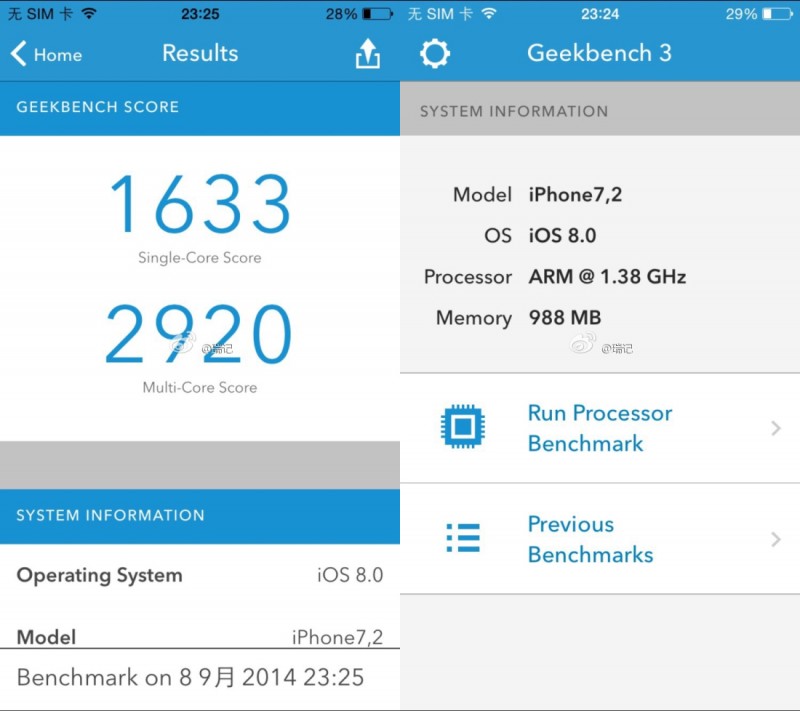
That scores 443/440 for multithreaded/single threaded respectively on geek bench.A modern mobile phone: http://cdn.macrumors.com/artic...
That scores 2920/1633 respectively.So yes, a current mobile phone is much more powerful than a 1Ghz single core machine. In fact, it's roughly as powerful as a 3Ghz Dual core: http://browser.primatelabs.com...
-
Re:forgettiing
Actually, lets take a look...
Single core 1GHz (we'll give it the benefit of the doubt, and make it a CoreSolo, the fastest 1GHz chip ever made): http://browser.primatelabs.com...
That scores 443/440 for multithreaded/single threaded respectively on geek bench.A modern mobile phone: http://cdn.macrumors.com/artic...
That scores 2920/1633 respectively.So yes, a current mobile phone is much more powerful than a 1Ghz single core machine. In fact, it's roughly as powerful as a 3Ghz Dual core: http://browser.primatelabs.com...
-
Re:lockin
-
Re:Even runs on iPhone 5s...
I just looked up what exact model my MBP was. It was a MC226LL/A, running a Intel Core 2 Duo T9600 at 2.8 GHz. That particular model averages about 2800, but there are scores in the 2500s, and there were lower end MBP 17s released that year.
So yes, the new iPhone does match a 2009 MBP 17. In any case, we agree that this is a fast phone (not to discount the new Nexus or other top-of-the-line Androids, which as fast or faster).
I think the thing with desktops / laptops is that we reached "way, way fast enough" a while back. The most processor-intensive thing most people will do is play 1080p content via YouTube or Netflix, which is a pretty low bar to clear. Couple that with declining computer sales at the same time as increasing smartphone sales, and it's definitely easy to see why the gap is narrowing. That's why I think it's inevitable that we'll get an ARM-based MacBook at some point.
-
Re:Even runs on iPhone 5s...
Yes, the 5s is incredibly fast. With a Geekbench score of 2523, it's faster than a 2011 Mac Mini (which were not slow machines by any means).
Which 2011 mac mini are you talking about?
http://browser.primatelabs.com/geekbench2/search?page=2&q=mac+mini+2011&utf8=%E2%9C%93
The scores for a 2011 macbook range from 5500 to 9500 depending on the model.
So... less than half as fast as a low end computer from 2 years ago? Ok... I'll buy that.
And the 5S is in the same ballpark as a Galaxy Note 3, Sony Xperia Z1, or LG Nexus 5... sure I'll buy that too.
Smartphones have the general performance of entry level PCs from 5+ years ago? Sounds plausible.
-
Re:Just Stop. Please. It's Time to Stop.
I hate to say it, but in the world of end-user apps, Javascript won. (Note that I'm not talking about niche applications like 3D rendering or server software.) And I write this as a committed Mac and iOS developer. Moore's Law and improved JS compilers have made Javascript responsive enough for 99.9% of applications. Native end-user apps will stumble along for a while, but they're walking dead.
There are no more technological hurdles for Javascript to overcome. The payment model is the last nut to crack. Firefox is working on that. Maybe it'll take a bigger player to make it happen. But make no mistake: it will happen. It'll happen because it's cheaper to pay one development team that can deploy to every device.
As recently as last year, Facebook moved away from mobile to native, but that move already looks amazingly dated. Since Facebook moved from "HTML5" to native ObjC, Apple released the iPhone 5, which was over twice as fast as the 4s, and then the 5s, which is about twice as fast as the 5. The Javascript version of Facebook may have felt unresponsive on an iPhone 4 or 4S, but those days are history.
A lot of people may be reading this and thinking "yeah, yeah, people have been talking about 'write once, run anywhere' for decades." They're right—we've been staring at the oncoming freight train for decades, and now it's finally here. If you write end-user apps and you're not polishing your Javascript right now, that train will roll right over you.
-
Re:Just Stop. Please. It's Time to Stop.
I hate to say it, but in the world of end-user apps, Javascript won. (Note that I'm not talking about niche applications like 3D rendering or server software.) And I write this as a committed Mac and iOS developer. Moore's Law and improved JS compilers have made Javascript responsive enough for 99.9% of applications. Native end-user apps will stumble along for a while, but they're walking dead.
There are no more technological hurdles for Javascript to overcome. The payment model is the last nut to crack. Firefox is working on that. Maybe it'll take a bigger player to make it happen. But make no mistake: it will happen. It'll happen because it's cheaper to pay one development team that can deploy to every device.
As recently as last year, Facebook moved away from mobile to native, but that move already looks amazingly dated. Since Facebook moved from "HTML5" to native ObjC, Apple released the iPhone 5, which was over twice as fast as the 4s, and then the 5s, which is about twice as fast as the 5. The Javascript version of Facebook may have felt unresponsive on an iPhone 4 or 4S, but those days are history.
A lot of people may be reading this and thinking "yeah, yeah, people have been talking about 'write once, run anywhere' for decades." They're right—we've been staring at the oncoming freight train for decades, and now it's finally here. If you write end-user apps and you're not polishing your Javascript right now, that train will roll right over you.
-
Re:"Pretty Much All of Them"
There are cross-platform benchmarks comparing performance across different phone OSes; it would be in Apple's best interests to cheat on those.
-
Shield matches Baytrail
"Whether we’re talking about Cortex A15 in NVIDIA’s Shield or Qualcomm’s Krait 400, Silvermont is quicker. It seems safe to say that Intel will have the fastest CPU performance out of any Android tablet platform once Bay Trail ships later this year."
Geekbench has 2.39 GHz baytrail Baytrail matching 1.91 GHz Shield so I would hardly call that prediction "safe" given that there will be a number of new tablets out in that timeframe.
http://browser.primatelabs.com/geekbench3/compare/9041?baseline=52725
-
Or using industry measures
It's telling you are speaking outside your area of expertise, there's a rather large optimization gap between Apple's in-house iOS vs Samsung's use of Android.
http://www.primatelabs.com/blog/2013/03/samsung-galaxy-s-4-benchmarks/ The analysis shows the new Samsung flagship is significantly faster than competing phones including the HTC One, and its predecessor, the Samsung Galaxy S3. However, the S3 also benchmarked faster than the iPhone 5.
So slower than the last generation of Samsung Phones
-
Re:From 1.8GHz i5 to 1.3 GHz i5
I'm really curious to see the benchmark comparisons between the previous MacBook Air with the 1.8GHz dual core i5-3427U (Turbo Boost up to 2.8GHz) and the new MBA with a 1.3GHz dual core i5-4250U (Turbo Boost up to 2.6GHz).
http://www.primatelabs.com/blog/2013/06/macbook-air-benchmarks/
Performance about the same; battery life worlds better. (12 hours!)
-
Re:boo fucking hoo. fine stay away
-
Re:boo fucking hoo. fine stay away
-
Re:boo fucking hoo. fine stay away
-
Re:Another Fluff Peice
Care to find an Android phone that benches higher than an iPhone 5? But what if I want a mll screen ith a powerful processor?
I assume you meant small screen with a powerful processor... The HTC One S is a great option with a 4.3 inch screen. It also has a lot more style than an iPhone. I like the blue one personally, but TMo just shipped a black one with red trim if that's your thing. It's been available since April. If that doesn't float your boat, try the gsmarena phone finder. I see 53 android phones with 4.5in screen and a dual core 1.4ghz+ processor.
-
Re:Another Fluff Peice
Care to find an Android phone that benches higher than an iPhone 5? But what if I want a mll screen ith a powerful processor?
I assume you meant small screen with a powerful processor... The HTC One S is a great option with a 4.3 inch screen. It also has a lot more style than an iPhone. I like the blue one personally, but TMo just shipped a black one with red trim if that's your thing. It's been available since April. If that doesn't float your boat, try the gsmarena phone finder. I see 53 android phones with 4.5in screen and a dual core 1.4ghz+ processor.
-
Re:Why?
I was looking at a few different comparisons and anecdotes when I made that generalization. For instance, the iPhone 5 is nearing the performance of the early-2006 Mac mini in several areas, and I saw a report regarding performance comparisons between the iPad 2 and a contemporary MacBook Pro with regards to handling various tasks in iMovie. Granted, neither of those is conclusive by any means, nor do they even specifically test the processor. As such, I intentionally hedged my statement by leaving it rather broad.
-
Re:Let's see
so the iphone has gone from single core to dual core, over 5x faster according to geekbench and a larger screen, all while maintaining the same or better battery life according to Apple? That sounds like a success to me.
-
Re:My desktop computer is way more powerful than t
And in other news, the Asus Transformer Prime is 4x as fast as the Cray. Android (NVIDIA Tegra 3 T30 1300 MHz (4 cores) ) vs Apple (Apple A5 (32nm) 1000 MHz (2 cores) )
I hate how everything must be compared against Apple iProducts. I don't recall every comparisons of yesteryear being brand specific.
Well, then you have a memory like a sieve. Comparisons were always to something well known to the audience addressed - and judging by sales, even most Fandroids assume "Asus Transformer Prime" is an Autobot.
-
Re:My desktop computer is way more powerful than t
And in other news, the Asus Transformer Prime is 4x as fast as the Cray. Android (NVIDIA Tegra 3 T30 1300 MHz (4 cores) ) vs Apple (Apple A5 (32nm) 1000 MHz (2 cores) )
I hate how everything must be compared against Apple iProducts. I don't recall every comparisons of yesteryear being brand specific.
Well, then you have a memory like a sieve. Comparisons were always to something well known to the audience addressed - and judging by sales, even most Fandroids assume "Asus Transformer Prime" is an Autobot.
-
Re:My desktop computer is way more powerful than t
And in other news, the Asus Transformer Prime is 4x as fast as the Cray. Android (NVIDIA Tegra 3 T30 1300 MHz (4 cores) ) vs Apple (Apple A5 (32nm) 1000 MHz (2 cores) )
I hate how everything must be compared against Apple iProducts. I don't recall every comparisons of yesteryear being brand specific. I don't care if the iPhoneX is 2x as fast as iPhoneX-1, or the iProductY is 2x as fast as the Cray. Give me damn benchmarks or clock speed of current day standards, and not a commercial.
-
Re:My desktop computer is way more powerful than t
And in other news, the Asus Transformer Prime is 4x as fast as the Cray. Android (NVIDIA Tegra 3 T30 1300 MHz (4 cores) ) vs Apple (Apple A5 (32nm) 1000 MHz (2 cores) )
I hate how everything must be compared against Apple iProducts. I don't recall every comparisons of yesteryear being brand specific. I don't care if the iPhoneX is 2x as fast as iPhoneX-1, or the iProductY is 2x as fast as the Cray. Give me damn benchmarks or clock speed of current day standards, and not a commercial.
-
Re:WGAF?
This is an S3 scoring 2283 on GeekBench. It seems they have only one data point for the iPhone 5 (here, but more will follow) vs many datapoints for the S3 (here). Note that there are two versions of the S3 (1.4 and 1.8 GHz) plus a lot of variability in each version. The slower 1.4 GHz S3 scores 950, the faster one 2,059. The 1.8 GHz version ranges between 1,233 and 2,283. I really don't know what could make all of that difference within the same version, maybe other apps running in parallel with the benchmark? We'll see if there is similar variance for the iPhone 5. The iPhone 4S ranged from 455 to 851.
Where the iPhone 5 bests the Galaxy is in the performances of the memory. The custom CPU makes the difference. The S3 compensates with the extra cores.
-
Re:WGAF?
This is an S3 scoring 2283 on GeekBench. It seems they have only one data point for the iPhone 5 (here, but more will follow) vs many datapoints for the S3 (here). Note that there are two versions of the S3 (1.4 and 1.8 GHz) plus a lot of variability in each version. The slower 1.4 GHz S3 scores 950, the faster one 2,059. The 1.8 GHz version ranges between 1,233 and 2,283. I really don't know what could make all of that difference within the same version, maybe other apps running in parallel with the benchmark? We'll see if there is similar variance for the iPhone 5. The iPhone 4S ranged from 455 to 851.
Where the iPhone 5 bests the Galaxy is in the performances of the memory. The custom CPU makes the difference. The S3 compensates with the extra cores.
-
Re:WGAF?
This is an S3 scoring 2283 on GeekBench. It seems they have only one data point for the iPhone 5 (here, but more will follow) vs many datapoints for the S3 (here). Note that there are two versions of the S3 (1.4 and 1.8 GHz) plus a lot of variability in each version. The slower 1.4 GHz S3 scores 950, the faster one 2,059. The 1.8 GHz version ranges between 1,233 and 2,283. I really don't know what could make all of that difference within the same version, maybe other apps running in parallel with the benchmark? We'll see if there is similar variance for the iPhone 5. The iPhone 4S ranged from 455 to 851.
Where the iPhone 5 bests the Galaxy is in the performances of the memory. The custom CPU makes the difference. The S3 compensates with the extra cores.
-
Re:S3 Iphone 5
Galaxy S III > Iphone 5
http://browser.primatelabs.com/geekbench2/search?q=Samsung+Galaxy+S+III
Is that that best you can do? Possible faked or overclocked CPU benchmarks? How about comparing default spec versus default spec? Those are pretty irrelevant if they were either falsified or on a device with an overclock because a "phone" is supposed to be usable in your pocket and have battery life measured in hours around at least a work day long rather than minutes.
-
Re:Galaxy SIII is 2059... not exactly slower..
and there is at least 1 1.4gz bench clocking in at over 2000:
http://browser.primatelabs.com/geekbench2/1032880
so relevant.