Slashdot Mirror
Domain: railway-technology.com
Stories and comments across the archive that link to railway-technology.com.
Comments · 22
-
Re:It's missing the full pictureHere's a better link. As I read it, the idea is to use extra electricity from intermittent power sources such as wind and solar to produce hydrogen, which can then be stored and transported to where it's needed. That seems far better than trying to store electricity in huge batteries.
Thompson's calculations, based on a 2007 set of figures from India Rail, estimate that as much as three billion barrels of crude oil - or the equivalent of 214 million tonnes of CO2 - could be saved over one year by transitioning from diesel to hydrail.
"The two magic properties of hydrogen are the ability to store and transport it," Thompson says. "It's that utility of time and place which is unique to the hydrogen economy. And that's what you can't do with the existing power grid."
There's also an economic reason behind investing in windmills instead of diesel oil, as Busch explains: "We have fluctuations in wind and solar energy which gives us the chance to produce energy for very, very cheap."
-
Re:What am I missing?
It would take a person the best part of that 10 seconds just to realize what was happening
From TFS:
enabling automatic systems to shut down
They use such systems in Japan to, for instance, protect shinkansen trains in the event of an earthquake. The system is entirely automated so human response times are irrelevant and the consequences of a bullet train running into a destroyed tunnel or bridge at full tilt don't bear thinking about. And it works: there has never been a fatal accident on the shinkansen network (excluding suicides).
-
Re:They're leaves.
They're not "just leaves".
I thought this looked familiar, and sure enough, google turned up this article from 2007 about the system and the guy who spent eight years and 5 million GBP to try to solve it.
"Every time a train runs over a pile of leaves, they are squashed into a hard, black, shiny, Teflon-like substance that makes it more difficult for trains to slow down and stop."
"Rofin-Sinar created a monster. The final version of the laser railhead cleaner contains two lasers capable of producing 2kW each. The pulsed energy is channelled via a fibre optic, which delivers a round beam in a straight line across the rail.
The pulsed beam hits the rail 25,000 times per second. The leafy mulch absorbs each 5,000C pulse of light, causing it to heat rapidly, expand and lift off the rails. Tests have found that the laser cleaner also works on oil, grease, ice and other problematic substances." -
Nuremberg: fully automated subway, works.
I live in Nuremberg, Germany. 2 of 3 subway lines are fully automatic. They run much more often than with drivers, and this is actually MIXED operation: the third line, that is still driver operated, shares the tracks on the middle section through the city. Nuremberg was the first city to have such a mixed-mode subway.
They are on time for the most part, stop within a few cm of where they are supposed to each time, and are just a normal part of life. I've read about an occasional hiccup but never experienced one myself, and I don't think it's more than it would be in the "old system". The biggest stops were due to worker strikes, not technology issues. They didn't lay off anyone, by the way.
Anyway, it is just unexciting business as usual for me any more, nothing special.
Video (1min): https://www.youtube.com/watch?...
-
Re:Submission with a spelling error, say it isn't
WE DON'T HAVE VERY MANY AUTOMATIC TRAINS IN THE WORLD, the reason is because they have to contend with stupid drivers and jaywalkers.
Really? Bet you $500 it has more to do with unions than safety. Most trains can not stop to avoid drivers or jaywalkers. That's why there are train crossings where the cars and peds stop.....simply because the train can not. Trains are much easier to automate than cars or planes, having been done as early as 1961. Today there are several automated passenger trains, I rode on one at the San Fran airport earlier this year.
Self-driving cars will never succeed.
Driverless cars will probably be mandatory in the future, and my guess is that the insurance will become so prohibitively high, that you'll find it much cheaper to buy an automated car.
Year 2045, scene courtroom
Lawyer: So, sir, you (incredulously)willing chose to drive the vehicle by hand?
Defendant: Yes, I did! I just wanted to exercise my right to enjoy driving my car
Lawyer: Well, there you have it, ladies and gentlemen of the jury, the defendant freely admits to wanton and willfully endangering everyone else on the road! You must find him guilty!
Or if you prefer the scene from I,Robot:
Lt. John Bergin: What is the matter with you? Traffic Ops tells me you're driving your car manually. You ran two trucks off the road!
-
Re:Why all the fuss?
The earthquake problem can be handled like the Japanese bullet trains, sensor network and automated shutdowns
http://www.railway-technology.com/features/feature122751 -
Re:I suspect...
Heck, even trains, the one kind of vehicle that could drive itself completely safely today, are still manned by "drivers" who spend their time pushing a button to tell the computer they're still alive, because passengers would be scared without drivers and unions prevent their removal from the trains.
Well except in at least Copenhagen, Denmark, where our metro is without in-train operators. As far as I know there is no union for the operating computers, as they have yet to gain sentience.
-
Why only people like us come here
Ruby
rails
Ruby on rails
Soap
Ajax
Ajax soap
Python
Perl
Java
Is it any wonder normal people think we're strange? (Ignore the rest of this comment, as it presently has too few characters per line (currently 8.5) but thankfully I can paste slashdot's retarded "error" message in the comment to correct this travesty) -
Re:Trams are the wrong solutionRail doesn't necessarily mean heavy. Meh. It pretty much does. It's the nature of the beast. If you're carrying a lot of people in a single vehicle, you need a vehicle which can carry the weight. Trams range from 20-50 tonnes per vehicle.
e.g.
http://www.edinburgh-tram.co.uk/tram.htm
http://www.railway-technology.com/projects/sheffield-tram/specs.html
Then you need an infrastructure which can handle the weight of the vehicles. This is usually also very expensive per mile. And keep in mind also that rolling friction on steel rails is a lot less than friction from a rubber tire on a roadway. Rolling resistance is secondary to air resistance and the effect on efficiency is much lower than simply going from internal combustion to electric. Trolley buses have most of the advantages of trams without the disadvantages.
I have no problem with rail used appropriately. You get a train carrying hundreds of people up to speed and then let it roll for 200 miles to another city you have one of the most efficient transport mechanisms in existence even if it weighs 200 tonnes. But stop/start that same train every 2 miles and it's a completely different story.
A much better solution in the second case is to use small vehicles which can pull into offline stations allowing other vehicles to continue non stop with no acceleration or deceleration. -
Re:8 miles?
They might or might not have taken the same approach for a light passenger train as they take for the huge diesel freight trains.
Well, I'll be.... I always suspected there were hydraulically driven trains, but until I saw the link, I thought that diesel/electric, or pure electric was the only other way.
I still like the Chevy more. The Prius is butt-ugly -
Re:Physics is a bitch isn't it
Apparently, the US are interested in high speed trains. The French would like to tender for the high speed line from LA to San Francisco or something like that. http://www.railway-technology.com/projects/califo
r nia/.
The project will cost about $10bn US.
Running a TGV fast on recently installed track (this is the new line going out to the east of France from Paris to Strasbourg, an area of France previously not served by high speed trains.
You can go from Paris to London in Eurostar (also a TGV equivalent) in 2:40 right now, and it will be 2:20 soon. That's about 280 miles, with a tunnel under the English Channel... you can do Paris-Marseille (480 miles) in 3 hours, because there's more track where you can really stay at high speed. The tunnel and the UK side of the tracks means that the Eurostar doesn't spend too much time at 300km/h which is about the top service speed, usually. -
Re:Did you ever think that, with those resources
just attach hyrails to each car
c k/mitchell/ for examples. computer control can be added with speed sensors and automated traffic management to hyrails so the driver doesnt drive the vehicle on the track but only on the road. -
Re:Useless pollingSince when would increasing funding for mass transit in preference to highways take away your ability to drive?
It will not. But if you have confortable public transportation, quiet, with free electricity and Wifi, and twice faster as a car, why would you drive? I think US, which more than 50% richer, can afford 1st class seats of the ICE, Shinkansen, TGV, or second class of newer french regional trains. Combine that with decent and frequent buses and metro.
-
Re:Mostly right
You don't need to limit yourself to one rail to provide automation. Some of the existing implementations include:
- Vancouver Skytrain
- Kuala Lumpur light rail
- Singapore metro system
I have seen these first hand, from my travels, and can say that they work very well without having a driver. -
Re:Mostly right
I won't comment on the cost ratios indicated by the above poster, as I assume their sources are thoroughly researched.
However, I can compare -- from a user standpoint -- the Seattle monorail and the Skytrain system in Vancouver, BC.
In terms of noise level, the Skytrain seems far quieter than the Seattle monorail. Noise level (or lack thereof) is a serious consideration with the Skytrain system, due to the fact that it passes through numerous residential suburbs of Greater Vancouver.
Most of the Skytrain is elevated, in some cases directly above vehicle traffic. In terms of space, while the tracks themselves likely take more room than a single rail, I would suspect that the cars themselves are similar in width -- hence, the physical space occupied by the working systems is not likely to be substantially different.
From a safety standpoint, there have certainly been deaths on the Skytrain system -- these have typically been due to people walking on the tracks, or workers being where they shouldn't. The system has been running since 1986 -- I do not personally recall any derailments, although I won't claim it is impossible.
In any case, if anyone is interested in reading more about the Skytrain system (and perhaps thoroughly comparing it to a typical monorail system), here are two interesting links:
http://www.railway-technology.com/projects/vancouv er/
http://www.translink.bc.ca/Transportation_Services /SkyTrain/default.asp -
Already been done.
But just how safe and secure will these new automated lines be?
Singapore's NorthEast Line is fully automated and hasn't been hacked.
http://www.railway-technology.com/projects/sing-ne -
This was to be expected.
Even China cannot justify the expense of a maglev train from Bejing to Shanghai.
I remember reading somewhere that they've decided to construct a regular high speed rail line instead, similar to France's TGV or Germany's ICE. Economically, it makes a lot more sense, and until the dedicated high speed line is constructed, the trains can use the current railroad infrastructure that is already in place.
Here's a link to the proposal, which has been in planning for a while already. The Chinese have already constructed a prototype high-speed train engine based on the Swedish X2000 train.
Regular high-speed rail as opposed to a maglev line also makes expansion to other regions of the country a lot easier.
Still, a long-distance maglev line would have been really cool, and there's got to be a region where it would make economical sense as well. Maybe we'll see one in Japan first. -
Re:Vegas to LA
Whetever. Look, someone suggested that it's physically impossible to build a railway from SF to LA because of geography. It's not.
-
Re:Deutsches MuseumDefo
Some stuff in the UK
- London : The Jubilee Line Extension
- Anything Brunel Did!
- The Millenium Dome (the exhibit was so-so - even if it was the biggest attraction in the UK whilst it was open -, but the Dome itself is excellent!)
- The London Eye
-
Parry People Mover
Related to this is the Parry People Mover which has been developed by a small company in Wales. This is designed as a light urban tansit system using flywheel to run the "people movers". The flywheels in these lightweight cars are recharged by either onboard LPG internal combustion engines or by electric motors fed from recharging points at stations.
They have been trialed on the Welsh Highland Railway and on the island of Mauritius omngst several other schemes - a quick Google search will turn up a lot more information about some of the trials.
While not a total success it is good to see innovation in this area. -
Re:JFK airport monorailIt's not a monorail. The train runs on two rails, and gets its power from a "third rail" and linear induction strip.
Pics of the type of track you'll see:
http://www.trackwalker.ca/Skytrain/206xover2.htm
http://www.trackwalker.ca/Skytrain/trmaint2.htmA link that explains the technology:
http://www.railway-technology.com/projects/airtrai n/It's the same technology as the Scarborough SRT (Toronto), Vancouver Skytrain, Detroit PeopleMover, and several systems in Asia like Bangkok.
-
Re:Switching
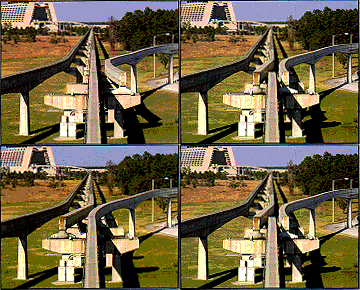
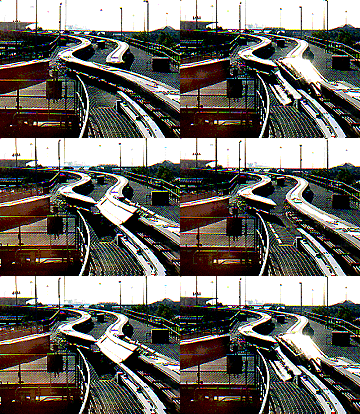
Monorail.org has a nice page on how monorails switch.The short summary. Yes, it is possible using various techniques (flexible/segmented sections of monorail beam, beam replacement, etc.).
The page also explains that the "monorails can't switch" myth was due to a particularly bad and bulky implementation at Wuppertal, and that the myth has since been perpetuated by various shady sources such as Microsoft Encarta.
Monorail switches are *STILL* more complex than "normal" bi-rail switches. Their moving parts are such an important proportion of the total infrastructure that their mechanism will always be more onerous, complex, slow-moving and cumbersome than bi-rail switches.
This has profound impacts on many aspects, who all eventually touch safety:
- It takes longer to turn a switch.
A mainline bi-rail switch can be turned and secured in less than 30 seconds. - Monorail switches are quite bulky and complex, has they often
have to move
the whole track
about (isn't that funny that those two pictures are taken
from the "switch myth"
page of the monorail.org
website???)
Birail switches mechanisms are wholly contained within the track cross section, and their actuating mechanism be very unobtrusive. - Since monorail switches have to move the whole track about,
the length of the switches is necessarly restricted to practicability,
and this has a direct bearing on the speed they can be negociated
in reverse position (the shorter they are, the slower you have
to go through).
The French Train à Grande Vitesse switches can be taken as fast as 150 miles per hour in reverse position. - Derailments on monorail will very often send the whole train
flying through the air, crashing below.
Birail derailments can be as benign as a wheel on the ground that can be re-railed within minutes by the train crew using a re-railer frog (the yellow Y-shaped tool near the rear of the engine - sorry, that's the best I could find in 10 minutes on Google). And birail viaduct tracks are required to have guard rails inside the track anyway to prevent derailed cars to leave the track. - Signalling systems must take account of this by having a longer safety margin where a train can be brought to a safe stop in case a switch doesn't turn properly.
- This means a greater distance between trains and thus a lower capacity for each track.
- By being more complex, switches are more expensive. In turn, there will be less switches on the network, making it less efficient and more difficult to go around a problem (like a disabled train).
- The single-beam track may seem sleek and more efficient than a heavy viaduct, but you *NEED* to have a way of quickly evacuating a train in case of emergency. So you will need a catwalk that is parallel to the tracks, the structure of which will destroy much of the sleekness of the beam track.
- It takes longer to turn a switch.