Slashdot Mirror
Domain: realclimate.org
Stories and comments across the archive that link to realclimate.org.
Comments · 1,734
-
Re:That's what?
"When MacIntyre asked for the code and the raw data, Mann said no. Repeatedly."
This is rubbish, although McIntyre did seem to have trouble tracking the data down for himself, I am glad to see that you didn't.
"It's not science if it's not reproducible, and it's not reproducible if it's not thoroughly documented and completely published."
The journals "Science" and "Nature" are by far the two most respect scientific journals on the planet and any scientist from any field would give thier left testicle to have just one publication in either. They are certainly not going to risk their reputation by publishing anything that cannot be peer-reviewed because of a lack of data or methodology. Again I point to the recent "hockey stick" paper by Mann et. al. in "Science", although I do agree it's a bummer these journals have a dollar cost associated with them.
Add in the subsequent violation of the refereeing rules in a journal actually named Climage Change in order to get supporting papers published, and the smell of a politically motivated con job becomes very strong.
It's worth noting that in Mann's CV he is listed as a reviewer for the journals Science, Nature and Climage Change (plus a fistfull of other respected journals). The reason for this impressive list is simple; Mann is recognised the world over as being at the top of his field.
Now please don't take this to mean that I am using a logical fallacy (ie: arguing from a position of authority) because Mann's work has been independently confirmed many times over. What I am saying is that the politics is such that someone at the top of this particular field might as well have a large bull's eye painted on his forehead when it comes to attacks from political hacks (such as the "based on two trees thing").
"I am an engineer reasonably capable of reading words of more than two syllables. But I don't even have to be capable of understanding any of the science to be suspicious of Mann."
My own father is also a (retired) mechanical engineer who was for many years the Chief Engineer of a large company that made and modified assembly line machines for auto-companies. We had many debates over climate change, his misunderstandings were mainly due to the fact that engineering does not involve a lot in the way of statistical analysis. If it was difficult to convince my own father then I don't really expect my posts to change anyone's mind here on slashdot.
Coincidently RC has a recent article by a guest writer from the American Institute of Physics on this theme.
By all means be suspisiuos, after all that is what a skeptic does. What a skeptic doesn't do however is dismiss scientific arguments on the basis of political conspiracy theories. I put it to you again that your are (unwittingly) letting someone else's politics intefere with your science and that much of what is said on McIntyre's behalf in the blogosphere is not supported by McIntyre himself (ditto with Mann). -
Re:That's what?
"Germans are telling us GW is taking a hiatus, which means most all of our previous models are wrong"
The German paper used the same models but with slightly different assumptions and they arrived at similar conclusions about the long term trend (post - 2015). It's an interseting paper but the Germans themselves would agree it's complete nonsense to say it "means most all of our previous models are wrong".
"I would love it if someone has a link to an article about an accurate computer model of the weather system, but I've never found one."
There is no single accurate model and there never will be. Accuracy is a function of mankinds future actions, the precision of observations and the resolution of the numerical analysis amoung other things. The models themselves are basically Finite Element Analysis models, thus the need for very powerfull number crunchers. They account for forcings and some of the major feedbacks but cannot account for feedbacks we know very little about ( thus the hand-wringing about "tipping points"). It's generally agreed that at best they can only predict large scale climate changes (ie: continental proportions).
The MET office in the UK is a good source of info on models and even has a computer program you can tinker with yourself (I will let you find that yourself). Thier list of climate center sites is also very useful.
The IPCC site has become close to useless since it's last redesign and it is difficult to find stuff on it. However the MET office provides an accesible way to read the reports. The IPCC does not conduct science, it reviews it. The RANGE of conclusions in the report are derived from thousands of simulations from various models and are distilled down to worst, best and most likely senarios.
Yes I know the MET is a single source, it just happens to be a good one and will point you in the right direction. If you are looking for a good climate mythbusting site then you might want to try realclimate.
"[TFA] makes me cringe."
Ditto! -
Re:Sigh. This meme is very old and very wrong...
RH figures are usually quoted for sea level. The issue of water vapour is much more complex that my post which only conveys the concept not the details. Here are a couple of links with further info, Water vapour, climate forcings, note that H2O is a minor forcing in the stratosphere, closer to ground it is a feedback.
-
Re:Sigh. This meme is very old and very wrong...
Water vapour
Climate forcings, note that H2O is only a forcing in the stratosphere, closer to ground it is a feedback.
Unlimited as in downloads. Obviously if you turn all the water on the planet into steam overnight then we are in big trouble the next morning. -
Re:Yesm but...
>> Who said anything about him abusing his power? All I said is that he can't just propose a theory, call anyone who disagrees either idiots or paid Oil company stooges, and then insist they be prosecuted and measures be put in place by fiat just because he's smart and knows better than everyone else.
Ummm, yes he can. He has no more power to dictate that we listen to him than is granted by his own fame and prestige, which he earned fair and square. If he wants to squander it on intemperate statements, that's his business.
>> I could also easily say that the other side of the argument is populated by left wing, government teat sucking, go along to get grants scientists who re-enforce their own group think.
That is also your right. Of course, that's utter bollocks, and nobody would care because who the hell is sycodon anyways. But go ahead.
>> How long did Science have a consensus that black s were inferior? Ot that the world was flat? Or pick any other absurd past belief. Those guys thought they were smart and knew it all. But they were wrong...and these guys could be wrong too.
Ah, yes, the old "science is sometimes wrong" card. Imperfect though it may be, it is still the best guess we have, and you can't simply replace science-as-it-is with science-as-you-hope-it-will-be-because-you'd-hate-to-cut-back-on-your-driving. Not if you want to remain honest.
>> When the news about the Sun spots (or lack thereof) came out the guy who had several years ago theorized (a real honest to gosh scientists mind you) that the Sun had more to do with warming than man said that Nature ( or one of the science journals) had declined to publish paper because it was "too controversial". He wasn't right wing. He wasn't undermining respect for scientific conclusions, he wasn't using pseudoscience. But he was effectively silenced because no one could have him going against AGW.
Can you name "the guy"? Can you tell me which journal refused to publish his paper? Can you show me the peer review notes that failed to find flaws in the paper itself, but nevertheless refused to publish? Your third-hand, vaguely recalled anecdote means nothing.
Once we have a specific instance to discuss, I can draw my own conclusions. Until then, the preceding paragraph is mere assertion without proof. Every shady, pseudoscientific field -- from astrology to the moon landing denialists to the folks who still insist there is a link between vaccines and autism -- is littered with THAT EXACT SAME ANECDOTE! Replace a few key phrases and you're done.
Speaking of phrases that need replacing, "the Sun had more to do with warming than man" has to go. You're insinuating that the vast bulk of the climatologists are too stupid to look up. The morons in question believe that their climate models actually do factor in the existence of the Daystar. It's not hard deciding who to believe.
Read this, and try to understand it before you get back to me. I'll be able to tell if you haven't.
>> Lastly, no one needs to undermine respect for scientific conclusions when they are all over the place and overly alarmist. Manhattan under water, FL gone or some such nonsense. End of civilization as we know it. AHhhhhh!
>> What crap. Your Science has been hijacked by Politics.
Hijacked or not, at least my science is peer reviewed. More than I can say for yours.
-
Re:About weather changes and global warming...
You're referring to Svensmark ? There are problems with this theory. Take a look at this this this and in particular this
In summary this theory imagines that low cloud formation is promoted by increased cosmic rays that form cloud condensation nuclei. Changes in solar output cause changes in the amount of cosmic rays that reach earth to do this. Low clouds increases the planet's albedo which reduces forcing. However, the theory suffers from a number of problems including not being able to reconcile the size of nuclei produced and the size of the nuclei needed to form clouds (there is an order of magnitude difference); not explaining preference of nuclei formed in this manner versus other nuclei in even greater abundance such as salt particles; not providing observations on actual additional low cloud formation and the effect; and finally this theory must suppose a long term trend in cosmic particles to account for the long term in global temperature change, and there is none.
-
Re:About weather changes and global warming...
You're referring to Svensmark ? There are problems with this theory. Take a look at this this this and in particular this
In summary this theory imagines that low cloud formation is promoted by increased cosmic rays that form cloud condensation nuclei. Changes in solar output cause changes in the amount of cosmic rays that reach earth to do this. Low clouds increases the planet's albedo which reduces forcing. However, the theory suffers from a number of problems including not being able to reconcile the size of nuclei produced and the size of the nuclei needed to form clouds (there is an order of magnitude difference); not explaining preference of nuclei formed in this manner versus other nuclei in even greater abundance such as salt particles; not providing observations on actual additional low cloud formation and the effect; and finally this theory must suppose a long term trend in cosmic particles to account for the long term in global temperature change, and there is none.
-
Re:About weather changes and global warming...
You're referring to Svensmark ? There are problems with this theory. Take a look at this this this and in particular this
In summary this theory imagines that low cloud formation is promoted by increased cosmic rays that form cloud condensation nuclei. Changes in solar output cause changes in the amount of cosmic rays that reach earth to do this. Low clouds increases the planet's albedo which reduces forcing. However, the theory suffers from a number of problems including not being able to reconcile the size of nuclei produced and the size of the nuclei needed to form clouds (there is an order of magnitude difference); not explaining preference of nuclei formed in this manner versus other nuclei in even greater abundance such as salt particles; not providing observations on actual additional low cloud formation and the effect; and finally this theory must suppose a long term trend in cosmic particles to account for the long term in global temperature change, and there is none.
-
Re:About weather changes and global warming...
You're referring to Svensmark ? There are problems with this theory. Take a look at this this this and in particular this
In summary this theory imagines that low cloud formation is promoted by increased cosmic rays that form cloud condensation nuclei. Changes in solar output cause changes in the amount of cosmic rays that reach earth to do this. Low clouds increases the planet's albedo which reduces forcing. However, the theory suffers from a number of problems including not being able to reconcile the size of nuclei produced and the size of the nuclei needed to form clouds (there is an order of magnitude difference); not explaining preference of nuclei formed in this manner versus other nuclei in even greater abundance such as salt particles; not providing observations on actual additional low cloud formation and the effect; and finally this theory must suppose a long term trend in cosmic particles to account for the long term in global temperature change, and there is none.
-
Re:1906
The various ways water vapor affects temperature are many and complex; so complex, in fact, that none of the computer models even pretend to take it into account because the formulas would take far too long to solve. Which, BTW, is one reason the computer models are unable to predict what's going on with any pretense of accuracy.
Googling for "climate models water vapor" yields 1,750,000 hits. Here's what RealClimate says:
Any mainstream scientist present will trot out the standard response that water vapour is indeed an important greenhouse gas, it is included in all climate models, but it is a feedback and not a forcing.
Seems like water vapor is included in the models. -
Re:1906
From wikipedia on Arrhenius in 1896 (and don't even mention that you don't know who he was).
Arrhenius estimated that halving of CO2 would decrease temperatures by 4 - 5 ÂC and a doubling of CO2 would cause a temperature rise of 5 - 6 degrees Celsius[3]or 7 - 11 degrees Fahrenheit. Recent (2007) estimates from IPCC say this value (the Climate sensitivity) is likely to be between 2 and 4.5 degrees. What is remarkable is that Arrhenius came so close to the most recent IPCC estimate.
Greenhouse has been an issue for a very long time. Just not trendy until recently.
Climate science is complex. Do not base your opinions on half baked fringe stuff. Go to the real science first. e.g. Realclimate first.
-
Re:Evidence?
Here is an article that may clear up your confusion about the 'hockey stick', if that's not enough then you can always ask M.Mann to set you straight.
Notice that contrary to your assertion that there is some sort of conspiracy to stiffle critics and ruin their carers, Mann's web site goes to the trouble of pointing out it's own critics in the "other opinions" section on the RH side of the page.
Skepticisim: First you post an "insightfull" anti-science troll worthy of M.Chrichton, then you do exactly what you claim this cospiracy is doing by backing up your claim with politically inspired psuedo-science regurgitated from a right-wing rag. That is not skepticisim, it is in fact what phycologists call "projection".
Occam's razor: Would indicate that it is YOU allowing YOUR politics to intefere with science and this global conspiracy of which you speak is nothing but a figment of your imagination brought about by your apparent inability to be skeptical of your own assumptions. -
Re:Climate Science
but our climate "experts" were claiming in the 1970's that we were destined for an ice age.
Except, no, they weren't.
There was much less data available three decades ago (duh!), but even still there 7 peer-reviewed papers in the 1970s predicting global cooling. There were 42 predicting warming.
And believe it or not, science tends to progress over the years. Decades ago doctors endorsed cigarettes, but no one even tries to cite that as a counter to the idea that cigarette smoking causes cancer and heart disease.
There was a brief spike of "OMG ice age!" stories in the popular press in the 1970s. Why? Because we had some nasty winters (at least on the East Coast) in the 70s, so the idea of an ice age (proposed in a minority of papers based on inadequate data) captured the popular imagination.
The idea that there was scientific consensus - or even a strong suspicion - in the 1970s predicting an ice age is pure bunk.
Unless we radically cahnge our economy-- empower government, and ultimately live life the way they want us to.
Your right to swing your fist ends where my nose begins. Your right to pollute the air ends where my lungs begin. Neither of these concepts requires a overly-powerful government to enforce.
We now understand that CO2 emissions from burning fossil fuels are a form of pollution that damages the biosphere.
-
Re:The 1830 Problem
PS: from http://www.realclimate.org/index.php/archives/2007/03/cosmoclimatology-tired-old-arguments-in-new-clothes/#more-412 (feel free to ignore):
"The irony is that Svensmark ignores (in addition to the lack of trend in GCR) the fact that the night-time temperature has risen faster than the day-time temperature, which I did pester him about on a Nordic Meteorology Meeting in Copenhagen in 2002. A journalist from Jyllands Posten present at the conference got the message, as my criticism was echoed in a news report the following day ("Klimaforskere i åben krig" [translation 'Climate researchers in open war'], May 28, 2002): It's tricky to explain how a warming caused by decreasing albedo would be stronger at the night-side (dark) of the planet." -
Re:Oh goody...
It's funny the weatherman can't predict whether it will rain in a week yet the GW movement knows the exact temperature 100 years from now.
I was going to expend a lot of space explaining the basics of chaos theory mathematics but then I decided to let someone else do it.
http://www.realclimate.org/index.php?p=204
Although ultimately chaos will kill a weather forecast, this does not necessarily prevent long-term prediction of the climate. By climate, we mean the statistics of weather, averaged over suitable time and perhaps space scales (more on this below). We cannot hope to accurately predict the temperature in Swindon at 9am on the 23rd July 2050, but we can be highly confident that the average temperature in the UK in that year will be substantially higher in July than in January. Of course, we don't need a model to work that out - historical observations already give strong evidence for this prediction. But models based on physical principles also reproduce the response to seasonal and spatial changes in radiative forcing fairly well, which is one of the many lines of evidence that supports their use in their prediction of the response to anthropogenic forcing.
Fortunately, the calculation of climatic variables (i.e., long-term averages) is much easier than weather forecasting, since weather is ruled by the vagaries of stochastic fluctuations, while climate is not. Imagine a pot of boiling water. A weather forecast is like the attempt to predict where the next bubble is going to rise (physically this is an initial value problem). A climate statement would be that the average temperature of the boiling water is 100ÂC at normal pressure, while it is only 90ÂC at 2,500 meters altitude in the mountains, due to the lower pressure (that is a boundary value problem).
Now you either accept that a chaotic system can be characterized statistically, or you have to admit that you don't believe in computers--because this is the *same math* that described the quantum physics that makes most of the modern world work. If you're going to accept that it works in one realm you have to accept that it works in the other.
-
Re:I think it would be nice if there were a law
Transparency is a good thing and western politics is already more or less transparent (if one has the time and inclination), but western politics is still just as machevellian as it ever was.
-
Re:And they say ...
Except that's not actually the conservative position esposed by Buckley - that was just his quote for the founding of a magazine.
It's not "just" a quote, its his a pithy summary of his own thoughts. It's his summary of the conservative ideology.
And make no mistake, progressives are wrong 10 or 100 times as often as conservatives.
So give at least 10 examples of times when the modern (post-1955) conservative movement has been right on a major issue. Should be easy if you're right.
like the many failed utopias
If we're going back to the 1800s, I'm laying slavery at the feet of the conservatives, abolition on the shoulders of the progressives. Massive, massive win for the progressives.
As for utopianism, many of these 19th century utopian communities were extremely Christian, heavy on the Old Testament - hardly progressive. But the secular and progressive ones pioneered such "failed" ideas as equality for women and public schooling.
or the crazy 19th century health fads.
Citation needed that "crazy 19th century health fads" were somehow the exclusive domain of progressives. Kellogg, for example, was a Seventh-Day Adventist who favored segregation. (Of course, his ideas that a vegetarian diet and execise are good for you are hardly crazy. He was even right about probiotics; but his love of enemas, plus his extreme views about sex, let us file him in the "crazy" bin.)
*Of course* if you look at the ideas that actually *worked*, the progressivs are nearly always right - but that's trivially true, and not very interesting.
So according to you, progressives have lots of ideas, many of them bad, but nearly all of the ideas that worked came from them? So you admit that conservatives rarely have ideas that work?
Are the progressive wrong on the danger of global warming, or were they wrong when I was young on the danger of the coming ice age?
There was no scientific consensus of a ice age coming soon back in the 70s. It was a misinterpretation by popular media. I am unaware that were any progressive ties to this.
On the other hand, there is strong scientific consensus that "global warming" is real and is largely anthropogenic.
And the deliberate conflating of the two by anti-science conservatives shows, yet again, why few smart - or at least, smart and honest - people will align themselves with this movement.
It's an easy illusion to think of the way things are now as better in every way then the way things were, since we're comfortable with the familiar, and what about even better ways of living that we missed in our rush to pick something that sounded good at the time?
When were these "better ways of living" around? Back when we had segregation? When women were second-class citizens? When America was so dominated by ignorance that we had to argue over whether science should be taught in science classes?
Whoops, we're still in the total grip of that last one, and the partial grip of the second. And really, one look at the inner cities and the prisons show that the first hasn't gone away either. Still lots of progress needed.
Are there some good policy ideas in the past? Sure. I was recently arguing that we ought to return to the Eisenhower days' top marginal tax rate of 90%. But as a whole, that era of segregation, McCarthyism, and sexism belongs in the dustbin.
-
Re:Cue the rationalists....
The last time that I checked the predictions weren't matching the observed temps. We weren't having anywhere near the "predicted" level of so called global warming.
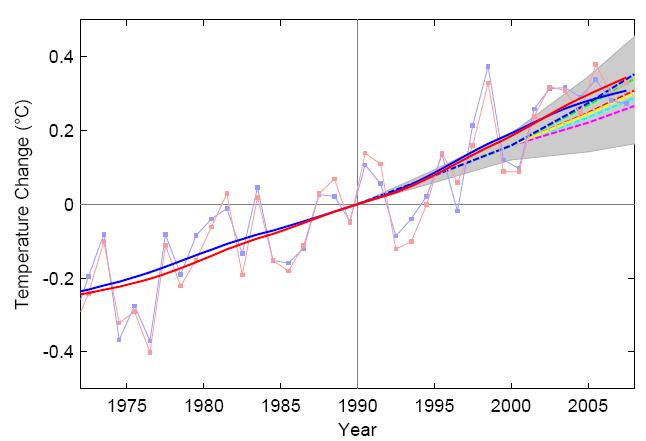
In point of fact, we are pretty close to the predicted level of global warming. Here is a comparison of the predictions made in the mid-1990s to the observations; solid lines are observations, dashed lines are models. This is from the Rahmstorf et al. paper last year in Science. They're a little off, but given the large year-to-year fluctuations in temperature and the high autocorrelation of those fluctuations, the uncertainty in the smoothed trend overlaps the uncertainty in the model projections (see the gray error bars); you can see that uncertainty for one model (GISS ModelE) here.
You need a much larger difference between observations and models to statistically conclude that there is a real discrepancy. As I said, this takes about 30 years; you can't conclude anything on the basis of 10 years. If current temperatures stay flat for another 10-15 years, we can start to say that there's a real discrepancy. Right now, we can't.
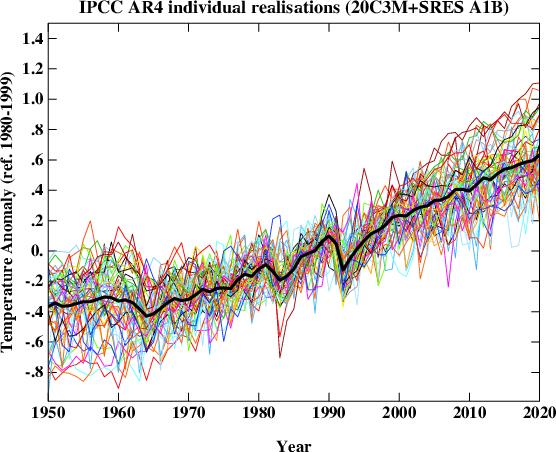
And if you look over more than the last 10 years, it becomes even more obvious that there is not some huge deviation between models and observations: see here (where the red line is the multi-model mean). This is from the IPCC AR4 report.
Note, for instance, that the deviation between models and observations in the 1940s is larger than the deviation today. But you don't see skeptics screaming that the 1940s disprove global warming. Maybe that's because (a) it's an example of where the climate temporarily warmed more than the models predicted, and (b) the discrepancy lasted about 10 years and then the models went back into closer agreement with observations. Discrepancies between models and observations on such short terms are statistically inevitable, and anybody who tells you that they always have to match up in perfect lock step is lying to you.
It's already in place today to speak out or voice any information against the entire global climate change thing will get you socially black listed and being called a long list of names to basically through out everything you've researched in order to keep their status quo.
Give me a break. GOOD science gets published. Hell, even BAD science gets published (looks at Schwartz's climate sensitivity estimate). You can find serious disputes in the literature about the effects on global warming on hurricanes, the magnitude of climate sensitivity, the trends in ocean heat content, etc. You are simply unable to tell the difference between a legitimate scientific critique and some armchair blog analysis. Case in point: "We weren't having anywhere near the `predicted' level of so called global warming."
It doesn't matter what the evidence says.
Maybe to people who have little knowledge of science.
-
Re:of course you realize ...
I read the response from RealClimate.org, and I have to say that while the article itself was just ad hominem attacks, the postings below it contained useful information. I found it interesting that Monckton managed to assemble what at first glance is a list of plausible objections, these just doesn't stand up on investigation. I was especially interested that most of his references didn't support his assertions - without the time to peruse them in detail this had escaped me (and, I suspect, many others)
Again, duh. Pretty much every model in the world requires its parameters to be calibrated from data; you can pretty much never calculate anything from first principles, unless you're talking particle physics. That doesn't mean that models aren't predictive. The question is whether you can adjust the parameters to reproduce the observed climate without substantial input from anthropogenic forcings, and the answer is no.
Nevertheless, it is rarely reported that a lot of the forcings introduced are guesswork to fit the past climate data and that there is more than one forcing profile that can fit that data. Because this is skipped it's really easy to make the results look dodgy.
That's not a real journal, it's an un-peer reviewed newsletter, and the paper was written by a journalist, not a scientist.
So they've amended their disclaimer to note. When I read it, that disclaimer did NOT note that it was not the policy of APS to publish without peer review of some sort.
It's another weakness of the global warming side that any arguments against them tend to be ridiculed rather than rationally refuted. The response given at realclimate.org is a good example of this. Thankfully, some of the people responding to the article took the time to address the issues raised. To the non-expert, on casual reading, the paper looks convincing. Rather than say "Oh, but he's a journalist" a more detailed response might be appropriate. A high handed attitude only puts peoples backs up.
-
Re:of course you realize ...
And that of the people predicting climate disaster now many are the same ones that predicted climate disaster back in the '70's, but the other way (ice-age).
Oh really? Who are these people who are predicting ice ages in the 1970s, and which of them are today predicting climate disaster?
"Scientists in the 1970s were predicting an imminent ice age" is a myth, based on basically one paper by Rasool and Schneider, plus some confusion with scientists talking about ice ages in thousands or tens of thousands of years.
You might read this to start.
And they're all dead wrong.
On the contrary, they reproduce temperatures quite well and precipitation decently.
The data is really spotty until 50 years or so ago so there's no idea how accurate they are.
We have reasonable data for over 100 years, and even 50 years of data tells us a lot about how accurate they are, as the measurement error is quite smaller than the visible trend.
None of them are predictive.
That's nonsense. Even a simple two-equation energy balance model is decently predictive for global temperature, and the GCMs do much better, not just time trends but also spatial patterns, for atmospheric and ocean temperatures, top-of-atmosphere radiative fluxes, precipitation at least at the zonal level, etc.
And none of them match the spotty historical data without what they call "forcing"
You have no idea what you're talking about, do you?
Of course they don't match the historical data without forcing. Forcing is what makes the climate change: changes in greenhouse gases, solar irradiance, sulphate aerosols, etc. With no forcing, the climate just hovers around an equilibrium state.
You're simply saying "models can't reproduce warming temperatures unless you include a source of heating". Well duh.
and what everyone else calls "fiddling with parameters until it looks kinda right".
Again, duh. Pretty much every model in the world requires its parameters to be calibrated from data; you can pretty much never calculate anything from first principles, unless you're talking particle physics. That doesn't mean that models aren't predictive. The question is whether you can adjust the parameters to reproduce the observed climate without substantial input from anthropogenic forcings, and the answer is no.
Here's an interesting paper (from a real journal).
That's not a real journal, it's an un-peer reviewed newsletter, and the paper was written by a journalist, not a scientist. Monckton's "critique" is just a horrible train wreck of absurd errors, some of which are being detailed here, here, and here.
Since you quote that part specifically, I should note that his claim that the IPCC takes its feedbacks from one paper is absurd. The feedback factor is just another word for "climate sensitivity"; model based computations of the feedbacks are found in chapter 8 of the latest IPCC WG1 report, and observational estimates of the sensitivity are found in chapter 9. The relevant sections cite dozens of papers.
Dismissing valid objections with supporting evidence just because it doesn't say "Climate Modeller" on a business card is foolish.
Let me know when you have any valid objections with supporting evidence.
-
Re:Create more deserts?
"But it does show that there is MUCH we don't know about the issue."
I agree but recognise that the same can be said about any area of scientific enquiry. Science is more than a seemingly contradictory pile of factoids, it's a way of thinking that is never 100% certain about anything, and can never prove anything to anyone. But if it's not the best model of the Universe that we have then may God strike me down before I hit submit.
"unless you count a consensus of scientists as evidence"
A scientific opinion is not evidence, at best it is an "expert witness statement". However consensus is an intergral part of the "republic of science", scientific consensus is implied by the term "scientists say", eg: "Scientists say the Earth orbits the Sun". Have a google and find out what the consensus on GW actualy says and then we can discuss.
Vested interests cut both ways, IMHO the track record of science is much more impressive than the track record of politics and industry. Here are a couple of blogs to practice the art of skepticisim on. The first is run by a bunch of climate scientists who contributed to the IPCC, it's founder is M.Mann the guy who came up with the much maligned "hockey stick", the second is from nature.com. Other excellent sites include NASA, NOAA, WMO, MET, CSIRO and countless other (not so excellent) sites from national scientific and meterological institutions across the globe. -
Re:Yeah, turn up the sun.
The best way to offer scientific "proof" is to set a controlled experiment. That is, an experiment that can be repeated as many times as desired, and in which all the independent variables can be controlled. With the Earth, we have only one chance. The closest we can get to "proof" is the fact that increasing levels of carbon dioxide causing global temperatures to rise was predicted over fifty years ago. The best climate models we have today and the data we've collected indicate that this is in fact what is happening and will continue to happen. Moreover, the models predict increased severity of hurricanes and droughts. I'm not sure how many people have to die before you'll admit there's "harm in the long run." Care to give us a number?
-
Re:Sure...Yes, because all of those samples are from pre-industrial times. In those cases the earth warmed up a little, some CO2 was released, causing more warming, releasing more CO2, etc. (Yes, I know it's not as simple as that, a warmer earth has less ice and absorbs more light, and water vapor and other gas concentrations will change as well...)
This warming we are experiencing now is due at least in part to humans creating CO2 by burning fossil fuels, not from CO2 naturally being released. We caused a significant increase in CO2 concentrations and CO2 has been known to absorb IR radition for over 100 years. Don't talk to me about CO2 lag, sunspots, or cosmic rays - show me the science that proves you can increase the concentration of a strong IR absorbing molecule (CO2) and not increase the temperature of the planet.
RealClimate.org has a good discussion on CO2 lag for anyone interested.
-
Re:Sure...
A budding GW denier eh? Well don't give up! Learn more and get right back to us with your next poorly-researched knee-jerk conclusion!
http://www.realclimate.org/index.php/archives/2007/04/the-lag-between-temp-and-co2/
-
Re:What we know about global warming (for sure)
What is AGW? I have no idea what you talking about because I don't know what AGW means.
Anthropogenic Global Warming. The theory that Global Warming is happening and that man is the primary cause, as a consequence of excessive CO2 emissions. And you don't believe in that, as is evidenced from your post, so I'm certainly not mischaracterizing your position.
The major contributor? Water!
Please, do some more reading, clearly you need to further educate yourself. I'd start here. For example, here's is their article on the role of water vapour in GW. Yeah, the page is a bit heavy on the science and numbers... but if you want to have a reasonable, educated discussion on the topic, believe it or not, you need to understand both of those things.
-
Re:What we know about global warming (for sure)
What is AGW? I have no idea what you talking about because I don't know what AGW means.
Anthropogenic Global Warming. The theory that Global Warming is happening and that man is the primary cause, as a consequence of excessive CO2 emissions. And you don't believe in that, as is evidenced from your post, so I'm certainly not mischaracterizing your position.
The major contributor? Water!
Please, do some more reading, clearly you need to further educate yourself. I'd start here. For example, here's is their article on the role of water vapour in GW. Yeah, the page is a bit heavy on the science and numbers... but if you want to have a reasonable, educated discussion on the topic, believe it or not, you need to understand both of those things.
-
Re:You are spot on..
Have you not been paying attention? The dispute on the influence of the SUN and whatever is also warming Mars. Sorry, I didn't think it needed spelled out.
And yet, still, no links or references. Just discussion of some mysterious, anonymous "scientists". And you completely ignore the rest of my post, probably because you have no rebuttal.
So, how about *I* provide a link discussing the topic of "warming" on Mars. Oh, and before you start, here's a link discussing the "warming" on Jupiter. Alright, now it's your turn.
Meanwhile, ask yourself: If GW is due to solar forcing, why aren't we seeing the exact same trends on Venus? Or Neptune? Or Saturn? Or Jupiter (no, Jupiter is not experiencing GW, see the preceding link)? Why just Earth and Mars?
Or, maybe it's just the obvious: Earth and Mars are both experiencing independent climate change, but for different reasons, neither of which is related to solar output. But the anti-AGW folks need *some* sort of proof, and so they're cherrypicking their results, and then claiming victory.
-
Re:What we know about global warming (for sure)
It's only called scientific debate if the points being debated are worth discussing. Otherwise it's called manufactured controversy, and it's a pointless waste of energy.
For example, there are those who persist in talking about Mars and Jupiter warming up. Of course, if they were to do just a little research, they'd discover that Jupiter's "warming" is highly localized and probably internally driven, and Mars' "warming" is probably due to regional climate changes to due planetary orbital characteristics. And that's ignoring the fact that some of the most dramatic warming on earth (the last 50 years) has occurred while the climates of both planets have been relatively stable. And yet, surprise surprise, the anti-AGW crowd simply ignores those reasonable scientific conclusions and continues parroting these findings as proof that AGW isn't happening.
Manufactured controversy. The media loves it, as do intelligent design proponents, electric universe wackos, and basically anyone else with crazy, fringe ideas ("teach the *controversy*", they love to shout). But it's a complete waste of time. And it's also really fucking annoying.
-
Re:Why is this even being debated?
It is true that there were some predictions of an "imminent ice age" in the 1970s, but a cursory comparison of those warnings and today's reveals a huge difference.
Today, you have a widespread scientific consensus, supported by national academies and all the major scientific institutions, solidly behind the warning that the temperature is rising, anthropogenic CO2 is the primary cause, and it will worsen unless we reduce emissions.
In the 1970s, there was a book in the popular press, a few articles in popular magazines, and a small amount of scientific speculation based on the recently discovered glacial cycles and the recent slight cooling trend from air pollution blocking the sunlight. There were no daily headlines. There was no avalanche of scientific articles. There were no United Nations treaties or commissions. No G8 summits on the dangers and possible solutions. No institutional pronouncements. You could find broader "consensus" on a coming alien invasion.
Quite simply, there is no comparison.
If you want some additional detail, Real Climate has discussed this, and William Connelly has made a hobby of gathering everything that was written about global cooling at the time.
(From: http://gristmill.grist.org/story/2006/11/23/18534/222) -
Re:this would prove the skeptics right!
That's your summary, but it's obvious you didn't bother to understand the article.
You: need falsifiable hypothesis
From my link:The validity of models can be tested against climate history. If they can predict the past (which the best models are pretty good at) they are probably on the right track for predicting the future - and indeed have successfully done so.
You: uncertainty
From my link:Where the critics of the models are both wrong and illogical, however, is in assuming that the models must be biased towards alarmism - that is, greater climate change. It is just as likely that these models err on the side of caution.
You: error bars
From my link:In an effort to be more rigorous, the most recent report of the IPCC has quantified degrees of doubt, defining terms like "likely" and "very likely" in terms of percentage probability.
You: cloud modelling is error prone
Most modellers accept that despite constant improvements over more than half a century, there are problems. They acknowledge, for instance, that one of the largest uncertainties in their models is how clouds will respond to climate change
You: financial market modelling
From my link:Of course, in some ways financial markets are much trickier to model than the climate, depending as they do on human behaviour. What's more, trading based on computer models alters the nature of the very thing you're trying to predict.
So... human behavior changes the forward prediction.
You take bullet points for your summary then refuse to explain them, as if they aren't addressed in the very article I linked. You then claim that these models aren't validated. Shame on you. Did you read it or did you just skim and not bother even following links?!
Here's another article to read from the same series (that was linked in the article I gave you, BTW)
MYTH:Chaotic systems are not predictable
And a quote from it since you likely won't read it through:While weather and to some extent climate are chaotic systems, that does not mean that either are entirely unpredictable, as this demonstration neatly illustrates.
You: "week by week"
That's called *weather* my friend. And this article even defines climate for you:Climate, however, is the bigger picture of a region's weather: the average, over 30 years (according to the World Meteorological Association's definition), of the weather pattern in a region. While weather changes fast on human timescales, climate changes fairly slowly. Getting reasonably accurate predictions is a matter of choosing the right timescale: days in the case of weather, decades in the case of climate.
In actuality, climate modelling is more important than your financial modelling. Climate modellers are striving for more accuracy all the time, and making models more and more accurate with more data sources isn't "tweaking" as it may be in your models. Plus, *lives* depend on climate models, as opposed to your financial models. Someone losing a million dollars is nothing compared with a million people losing their livelihood, or worse, their lives.
Read through the rest of the article series, and follow all the links. Be curious about science. That's my best advice.
-
Re:There is warming, and there is "warming".
Beside hopelessly confusing weather and climate, you have also been mislead about the UN. The IPCC reports are here, you can talk directly to some of the scientists who contributed to the report here. An attribution graph showing the contributions of man to both warming (GHG) and cooling (mainly sulphates) can be found in the IPCC's 2007 SPM or you could have a look at this one.
Now please realise that the IPCC does not come up with new science, it is a UN body that gathers scientists from every national science body on the planet and reviews published scientific papers. They do not have ONE report they have ~20yrs worth of reports.
Assuming you are not just a rabid anti-science troll can you please post some evidence for your claims such as...
ALL greenhouse gas "global warming" theories require the upper atmosphere to warm proportionally to the surface temperature....the greenhouse warming models allow for local, temporary variations, but NOT for a record cold hemisphere...the UN has retracted their famous, hysterical report about greenhouse warming...Some of the very scientists who were quoted in that IPCC report tried to get their names removed
Note: I work on the same basis as the IPCC, ie: I only accept evidence that is backed by peer-reviewed publications. -
Re:Iron + Ocean = Global Cooling
Seriously...
Here is a link to a review of the idea, the site is run by some well published climate scientists who have contributed to the IPCC reports over the roughly two decades the project has been running. Their conclusion regarding the application of the idea....
"I would put ocean fertilization on the avoid list, along with planting trees. It's too hard to pin down the actual amount of CO2 removed from the atmosphere by your actions. It's also not a long-term solution, since the ocean leaks. Humankind would have to keep fertilizing the ocean indefinitely in order to preserve the claimed CO2 drawdown. If you're concerned about climate change, build a windmill. Ocean fertilization does not seem to me suitable to be the basis for a reliable financial commodity, or a practical tool for geo-engineering climate."
I also happen to agree with the tree thing when it comes to implementing a cap and trade system for CO2. As he says himself elsewhere, trees are worth preserving for other reasons.
I don't dispute the fact that iron dust can increase phytoplankton but I certainly dispute the claim that dumping iron into the ocean is a practical solution to AGW. Unless of course the iron is in the form of a machine that can harvest power from the tides, winds or waves of the ocean.
If you haven't done so I would suggest you read (or at least spend a half hour to skim) the IPCC reports, particularly the latest SPM and the attribution graph. (Note: The IPCC does not come up with it's own science, rather it is a review of the published litrature. All reviewers and authors of the reprots are published scientists in a relevant field, every national science body on the planet is represented by a scientist. IMHO getting this many boffins and scientific institutions to agree on anything would tend to indicate the reports are on the conservative side.)
"Why do people get so defensive about these topics?"
Personally? I don't like to see people taken for a ride due to deliberate misinformation, I also don't like the outright hostility toward "environmentalists" from the US administration that goes unquestioned by many of it's citizens. The only scientific debate I have witnessed that comes close to the political perversion of the AGW debate is the tabacoo debate that went from the 60s thru to the late 80's. In some instances it's even the same people spreading the bull$hit. I realise AGW is not the only problem in the world, nor is it the worst. But it's one of a handfull of serious threats to ALL of us and we can choose to do something sensible about it. My personal choice for the number one threat? - ignorance. -
You seem to imply there is a problem.You seem rather intelligent, try offering a solution rather then bitching
Solution? Do nothing. It's the same 'solution' offered by the head of NASA and other seemingly intelligent people. I mean, what's the hurry? Where is there any evidence that warming is bad?
Ten years ago, the cult was threatening us with the infamous hockey stick. Computer models were predicting "runaway" global warming. According to the IPCC we were on the cusp of exponential warming. "Oh noes!!11one1! We's all gonna DIES!one1!!"
Then something funny happened... Someone noticed that if you took the model and entered random data, it produced the same hockey stick graph. Gee, do tell... of course, they denied, denied, denied that it was a complete fraud. Yet the most damning evidence is that now, almost ten years later, their predictions simply didn't materialize. 1998 was anomalously hot and temps have not rocketed out of control since then.
Frankly, the only problem I see is global warming cultists preaching fire and brimstone, despite having their alarmist predictions disproven by observation repeatedly.
[And yes, before some global warming cultist chimes in... Griffin did later cede to peer pressure and apologize for making those statement, but to my knowledge he has never rescinded those statements.]
-
Re:So now we have the
>> REALLY!!??! You're joking, right? How many millions of people have died due to the banning of DDT?
http://www.salon.com/news/feature/2007/06/29/rachel_carson/
>> Where are the food shortages and mass starvation I read about so long ago?
Safely contained in the third world, where folks like yourself don't need to worry about them.
>> Why are we all not dying from skin cancer due to the depleted Ozone layer?
Mostly because the world got together and greatly reduced the amount of CFCs getting into the atmosphere. The ozone layer has been slowly recovering since.
>> Aren't we supposed to be in an ice age now?
Simple answer: no. Climate scientists predicted no such thing.
http://www.realclimate.org/index.php/archives/2008/03/the-global-cooling-mole
http://www.realclimate.org/index.php?p=94
Methinks you need to find better examples. -
Re:So now we have the
>> REALLY!!??! You're joking, right? How many millions of people have died due to the banning of DDT?
http://www.salon.com/news/feature/2007/06/29/rachel_carson/
>> Where are the food shortages and mass starvation I read about so long ago?
Safely contained in the third world, where folks like yourself don't need to worry about them.
>> Why are we all not dying from skin cancer due to the depleted Ozone layer?
Mostly because the world got together and greatly reduced the amount of CFCs getting into the atmosphere. The ozone layer has been slowly recovering since.
>> Aren't we supposed to be in an ice age now?
Simple answer: no. Climate scientists predicted no such thing.
http://www.realclimate.org/index.php/archives/2008/03/the-global-cooling-mole
http://www.realclimate.org/index.php?p=94
Methinks you need to find better examples. -
Funny, maybe. Insightfull, no.
"I'll go with waiting for science to get all the facts right and remove political/personal agendas."
Assuming you are serious, what is your definition for "facts" and how will you know when you have ALL of them?
I mean there are 11,000+ google scholar hits for papers using or citing the SEAWIFS data set. I don't even see the paper referenced in either link let alone a credible understanding of the biosphere. This is not to say the paper is wrong, it's just that the spin in the article is making me dizzy and I want to vomit.
As you can see from all the amount of research using the SEAWIFS data set there is no need for you to wait. And that's just one data set, our collective knowledge of climate (and the biosphere in general) has exploded since the 80's and the only political/personal agendas you need remove are the ones that are stopping you from being a true skeptic and practicing the scientific method.
Unfortunately this means getting a basic grasp of the existing body of knowledge and evidence, if that's too much then you may find reputable blogs worth a try, especially for mythbusting.
BTW: Whoever modded you insightfull also does not understand the scientific method. Science will never "get all the facts", waiting for that oxymoronic event to occur implies either ignorance or some sort of political/personal agenda. -
MOD parent up.I want to give you half the mods points I have gained from my post - seriously!
Here are a couple of reasons why...
I consider myself a skeptic in the traditional sense and find the 'gospel truth' a somewhat nauseating term when used in earnest. Specifically I subscribe to Carl Sagan's view of scientific skepticisim and I am a fan of James Randi.
Quoting Margret Mead.
On the subject of climate change in particular I am not a climatologist but I do have a BSc. I have been following the conversation since 1981 (I even recall reading the infamous national geographic article on the coming ice age as a teenager during the 70's). I was unconvinced that any of the theories and observations were significant until the mid to late 90's. Around 1999 I started swimming against the stream here on slashdot by posting comments supporting the work of the IPCC and the thousands of scientists who have contributed to it over the last couple of decades. I would describe myself as an informed layman in the area of climatology but I certainly don't claim to know the "gospel truth" about anything.
As for Gore's slide show faithfully representing the science in what was at the time the current IPCC report, here is a rewiew written by some climatoligists who contributed to the IPCC. Being an Aussie, Gore's political beliefs are of little interest to me and have zero relevance to determining the accuracy of his doco.
"as evidenced by the rush to invent credible explanations after criticism in the "inconvenient documentary" that followed"
I'm not sure what you are refering to when you say an "inconvienient documentary" but if you mean The Great Global Warming Swindle then I urge you to take a second look at that "evidence" now the dust has settled.
"some prevailing consensus"
By no means does any consensus represent "case closed" that is not how science works and I'm sure you understand that even if others don't. I was specifically refering to "the consensus" as defined in the third IPCC report and widely reported elsewhere. This particular consensus is not mearly opinion it is in fact an excellent example of how the "republic of science" is supposed to work.
A scientific consensus provides the credibility behind the journalistic phrase "scientists say" and is an intergral part of the scientific method. A strong scientific consensus is derived from many repeated experiments and observations over a period of time by a large number of independant investigators and data sets. A strong scientific consensus must not only survive healthy skepticisim but it must also continue to encourage attacks by genuine skeptics. Extrodinary claims, etc, etc.
IMHO a strong consensus is doomed to be overly conservative when applied to a complex problem which is still poorly understood in a miriad of ways, but that is simply my own opinion. The only anecdotal evidence I have to support that opinion is the speed at which the Artic ice cap has disintegrated. Again, that's how science works (slow and skeptical) and I'm confident the causes and implications of the rapidly vanishing ice cap will be vigoursly debated over the next few years until a new consensus emerges.
Again, thank-you for your refreshingly thoughtfull and insightfull reply. -
OT
"Its the reason people believe that 100 years of industrial evolution on this planet can corrupt over 4.5 billion years of naturally occuring weather cycles."
No, robust science is the reason I (and I dare say most people here) accept the message that has come from the IPCC and every other national science body on the planet.
It is intellectually lazy (at best cynical) to disagree with something just because some random lobbyist uses it to push an agenda. The problem with "for hire" lobbyists is they are members of the old boys club, expert liars, and schooled in the art of manipulation, they belive what they are paid to belive. If anything lobbyists (and in many cases politicians) have tried to hide and discredit the science in exactly the same way tobbaco lobbyists did in the 80's.
In fact if you look up one Fred Singer you will find a "fossil fuel lobbyists" and a "tobacco lobbyists" all wrapped up into one person, decorated with ancient qualifications and honarary degrees. Until the last couple of years Fred and other like-minded lobbyists had been very successfully spreading mis-information that is then repeated ad-nauseum on slashdot by geeks who often have sufficient education in physics and chemistry to know better. I also belive much of that derision on slashdot was due to the messenger, ie: people heard the IPPC's message coming out of Al Gore's mouth and instinctively started taking pot shots at what they percieved to be "Al Gore's crackpot theory".
However in the interests of "fair and balanced", I will point out there are still a tiny minority of scientists who disagree with some parts of the IPCC consensus, here is a list of them. You will find that their arguments have been debunked many times over, a good place to start looking for such mythbusting and the shenanigans of anti-science lobbyists is here
If you don't want to go through the pain of educating yourself on the science and politics of climate change then I have one simple question that may clear things up for you. Since CO2 is known to trap heat and we are pumping 10Gt/yr of it into the atmosphere, how is that trapped heat disipated back into space, or alternatively what absorbs the excess CO2 so that it unable to trap heat in the first place?
BTW: Please don't take the above as a personal attack, your only human and we are all vunerable to well crafted bullshit from outside our sphere of expertise (which incidently is the reason why the scientific method is considered usefull). -
Re:The way things are goingwe tire of you because you refuse to acknowldge basic climate science and refuse to follow proper scientific methods. Funny how you claim the mantle of "basic climate science" and "proper scientific methods" then proceed to establish a position contrary that to virtually every actual climate scientist out there. 1. CO2 is a very minor greenhouse gas
The first two are correct, just ask any climate scientist, however that doesn't disprove AGW.
2. The amount of CO2 re release into the atmosphere is pathetic compared to the other gases - a mere 0.28%
3. The hottest years on record predate the industrial revolution
The 3rd point, depending on timeframe, I'd argue, if I recall the medieval warming period wasn't as warm as previously thought and warm only confined to Europe, but I'm not certain.
Besides the worrying thing isn't the current temperature, it's how fast they are rising, and how fast they may rise in the future. 4. There are a number of other factors such as the above that you can't/don't give an explaination for (solar activity being one), and you simply resort to either the "your workin for big oil" or the "i'm more rightgous than you" defense, neither of which is a valid scientific defense. To my knowledge no one has a working climate model that can explain the current warming with any source other than CO2. However, I'm not an expert, or even a decent amateur, if you want to argue climate science take the arguments from climate scientists.
In my opinion the only line of argument you could take that has some validity of convincing me AGW is false is explaining why the entire community of climate scientists is so massively mistaken. I can't conceive of any scientific argument you could make on this forum that the scientists dedicating their lives to studying global warming haven't already gone through. -
Stop babbling talking points and look at the data.We better do something quick because the temperature hasn't increased on Earth in 10 years. You're clearly wrong. It takes a real lack of understanding of statistics to think that you can't have a cold year or two and still have an overall warming trend. This is what happens when you confuse short-term weather trends for long term climate shifts.
Please direct your attention to the record of global temperatures from 1880-2007.
Let's take a look at 1998 & 1999. 1998 was the third warmest year on record, with an average global temperature of 14.72 C. The following year dropped 0.26 C, and it took until 2005 to top that temperature at 14.76 C, with last year being 14.73 C.
OH NOES! GLOBAL WARMING IS TEH LIE!
1995 - 14.35
1996 - 14.46 (+.11)
1997 - 14.49 (+.03)
1998 - 14.48 (-.01)
1999 - 14.52 (+.04)
2000 - 14.57 (+.05)
2001 - 14.56 (-.01)
2002 - 14.59 (+.03)
2003 - 14.66 (+.07)
2004 - 14.68 (+.02)
2005 - 14.68 (+.00)
Do you see the clear, upwards trend once statistical noise is removed now?
P.S.: What inconvenient global warming on Mars?
Mars temperatures explained.
Also, please explain what common source could be warming Mars and Earth during the past few years when Total Solar Irradiance was on the decline from 2000-2005. -
Re:Collecting data
"Yes, we do. Don't project your own ignorance onto others."
"Then please, give me facts that can prove that we are 100% responsible for climate change..."
For fun facts and conservative predictions/estimates, check here, here and here. If reading is too much (there are over 10,000 peer-reviewed papers on the subject), grit your teeth and watch or at least listen to Gore's presentation. According to some well known scientists involved with the IPCC, it's a good rendition of the reports.
Paradoxicaly, demanding proof proves your ignorance. -
Re:Self limiting to a certain extent?
Under-population threatens to be a serious problem to developed economies in future - this is partly why immigration is allowed in such large numbers.
Assuming we ever get there. Have a look at Jared Diamond's Collapse. I agree that it could be an issue if we do get there, but it is not clear to me that we will.I'm not saying it'll happen for sure, but I can well believe that in 30 years we'll look back on worries about over-population the same way we look at 70s worries about global cooling today.
Plese stop repeating this meme - it is simply not true. -
Re:Ya
Don't get me wrong, education is no cure for a crappy personality, there are plenty of sloths and sycophants in academia. There are also the 'Ian Paisley" type reviewers who will put up rediculous objections that make it obvious to all they only skimmed the conclusion. Having said that, a half-hearted review by a semi-literate proffessor is still better than no review at all.
"I think there's room for improvement. Have people really ask questions and punch holes, note the questions and the defense and attach them to the theory, so people can see what questions have been asked and answered."
Yes, I agree that citations could be organised in a more usefull way. For a more fluid argument, sites moderated by practising scientists like this and this are becoming more common. Relating this back to the original point, if a degree only teaches you how to reseach a question it was worth the effort.
rant/
There is also the phenomena that when one has deep knowledge/insight/enthusiasim for a subject or procedure they tend to see others around them as incompetent, flippant or just plain crazy, others may see them as idealistic, pedantic or arrogant, neither 'side' is 100% correct.
No matter what the question, observation, or methodology, it is all ultimately based on one or more articles of faith. Once you realise that bit of philosophical trivia the question becomes: "What do I belive and why?". I belive in the philosophy of science because it's social implementation (the Frankenstien industrial revolution) has so far been usefull. Ironically I think the only way we can stop Frankenstien's shit from killing our garden is by the application of more science. On a more personal level accepting that the Universe 'just is' is a more elegant answer than 'God did it', neither POV is more liberating or correct than the other. -
Re:Mistargeted law suit?
Right, random moron mouthing off on slashdot with the usual "correlation not equal to causation" bromide (which you didn't phrase accurately) must be believed over the overwhelming scientific consensus regarding anthropogenic global warming/climate change. Regarding solar output variability and the recent rise in average global temperatures: read this.As for "I don't understand where these people are coming from saying that warmer temperatures are bad", try asking the people in coastal areas and island nations such as Tuvalu, who have already been displaced, what they feel.
-
Re:The slippery slope creationists help wet....
Don't get your knickers in a knot. The basic problem here is you do not understand what science is and therfore have no point of reference to determine quality. Your demand for proof demonstrates your ignorance on the subject (note: 'ignorance' is not an insult here, it simply means you don't know something). I recommend you read Carl Sagan's "Demon haunted world" as a starting point for understanding the concept of scientific skepticisim.
If you are really interested in climatology talk to some climatologists. If nothing else they may help aleviate your ignorance of how and why science works.
And at least have a go at reading the IPCC reports before you demand evidence from me that is widely available (in particular try to understand how figure 2 in the 2007 SPM was derived). -
Hostility to Science, and Avoiding Indoctrination
Firstly, the level of many of the posts here, the reflexive and snide referral to the principles of atmospheric science as religion indicate to me that an increasingly large group in society are hostile to science. Here is a New York Times article that argues just that, that there is a rising tide of anti-intellectualism building in America today.
As for the accusations of indoctrination, I believe that climate science should be taught in schools. However, it should be taught at a far more advanced level than they typical caricatures that appear in popular culture. Students should first be taught about the physics of electromagnetic radiation, about absorption, reflection, and emission. They should be given an understanding of how some wavelengths transparently pass through some materials, while others wavelengths are absorbed by the same materials. In my experience, students today typically have a terrible understanding of these concepts.
They should also be taught some basic atmospheric science. For example, they should know why the air becomes cooler as altitude increases (up to the thermosphere at least) because the reduced pressure causes the air molecules to move more slowly. This means that they should be familiar with gas laws, and with the concept of adiabiabatically raising a parcel of air. They should be taught about the latent heat in water vapor and also about relative humidity and the capacity of air to hold water vapor. They should understand that raising a parcel of air causes it to cool, thus reducing the amount of water vapor it can hold. When the water vapor condenses to form clouds, heat is released, causing the parcel of air to rise even faster...this is the main mechanism of storms.
Finally, they should be taught the mechanisms of the greenhouse effect. They should especially be taught that the typical pop culture caricature of the greenhouse effect is wrong. The greenhouse effect is typically portrayed as a sheet of gas reflecting infrared radiation back to Earth. This is not the way it works. Instead, increased carbon dioxide, especially at high altitudes (where it is dry) makes it more difficult for infrared radiation to escape to space. The high altitude carbon dioxide causes the Earth's infrared radiation to be emitted to space at a higher altitude. However, since the air is cooler at higher altitude, the infrared radiation is emitted to space less effectively, thus causing an increase in temperature of the entire system. Here is a nice summary.
If the material is taught in a logical scientific way, then I believe that it cannot be called indoctrination. If the students are familiar with the detailed science underlying the field of climate science, then they will be more able to judge between authentic and fallacious arguments. Mandating that this material be taught is really not that different than mandating that chemistry be taught.
-
Re:Hydrogen? Carbon?
No. At best your going to have an average of different locations at certain temperatures but that has no real reflection of the situation.climate zones depend on climate falling within a given statistical range or anything, or that changing that range would be a change to a completely different zone. What was I thinking?
First, A feedback can have a forcing effect.
Look, you can argue against definitions all you want. Feedback is, by definition, not forcing.
That is to say that a feedback can raise temperatures which under the Co2 model would generally be a forcing.
No! That is feedback. It occurs in response to a long-lasting stimulus, and only in response to that stimulus. Feedback can be positive or negative. What you described is known as "positive feedback".
Water vapor is a feedback and a forcing though, I though I made that clear.
You made it clear that you're wrong.
But under the Co2 models, they aren't prepared to account for water vapor as a variable which is why you see explanations using it as a constant.
In *NO* model is water vapor a constant.
And no, water doesn't average 10 days in the atmosphere because the saturation points differ.
Wow, do we need to go all the way back to the definition of the word average?
I suggest you quite getting your information from loaded sites designed to convince you regardless of the truth. Real science and at least one of the scientist contributing to it is one of them.
I suggest you get your data from somewhere other than your a**^H^H^Himagination. -
Re:Hydrogen? Carbon?
No, well. yes and no. It would be a feedback no matter how you looked at it because it isn't a driving source. Solar energy being the most common alternative to Co2. But water vapor can stay in the atmosphere quite a bit longer then a couple days.
The average is about ten days. Remember the word "average" in my post? That word has meaning.
"To demonstrate how quickly water reacts, I did a GCM experiment where I removed all the water in the atmosphere and waited to see how quickly it would fill up again (through evaporation from the ocean) . The result is shown in the figure. It's not a very exciting graph because the atmosphere fills up very quickly. At Day 0 there is zero water, but after only 14 days, the water is back to 90% of its normal value, and after 50 days it's back to within 1%. That's less than 3 months. Compared to the residence time for perturbations to CO2 (decades to centuries) or CH4 (a decade), this is a really short time." -
Re:Hydrogen? Carbon?
Yes H20 is a greenhouse gas in that it traps heat, but the amount of water vapour in the atmosphere is a function of temprature and pressure. In other words the H20 content of the atmosphere is stable. The only side effect of releasing 10Gt/pa of water vapour would be 10Gt/pa more rain (good thing if it all fell here in SE Australia).
The side effect of releasing the current 10Gt/pa of CO2 is that 7Gt of it will not be absorbed back into the biosphere. Some of it stays in the atmosphere and heats things up. The rest of it will dissolve in the oceans raising their acidity, which in turn lowers the planktonic biomass, which then lowers the amount of CO2 the biosphere can convert to limestone, which means next year more CO2 hangs around,....rinse & repeat until the blue globe of death appears.
BTW: Climatologists realise CO2 is not the only problem gas, they take this into account by using a standard unit called CO2_equivalents, the units are also used to quantify cooling effects such as reflection from ice. Personally I think it's confusing and can't fathom why W/m2 is so hard for policy makers to deal with, but IANAC or a policy maker. -
Re:Money well spent?
CO2 doesn't have a radioactive half-life, but it lasts a long time.