Slashdot Mirror
Domain: realclimate.org
Stories and comments across the archive that link to realclimate.org.
Comments · 1,734
-
Re:Unbelievable
The alarmists are the ones who do the "it doesn't matter if two opposite things happen, both are evidence that catastrophic climate change is going to destroy the world!" thing.
And the denialists are the ones who cherry-pick outliers to prove their case:
Preliminary data reported from the reference glaciers of the World Glacier Monitoring Service (WGMS) in 2018 from Argentina, Austria, China, France, Italy, Kazakhstan, Kyrgyzstan, Nepal, Norway, Russia, Sweden, Switzerland and United States indicate that 2018 will be the 30th consecutive year of significant negative annual balance (> -200mm); with a mean balance of -1247 mm for the 25 reporting reference glaciers, with only one glacier reporting a positive mass balance (WGMS, 2018).
-
Re: AGW Denier trolls are out in force
In the 70s, we thought we were gonna have another ice age.
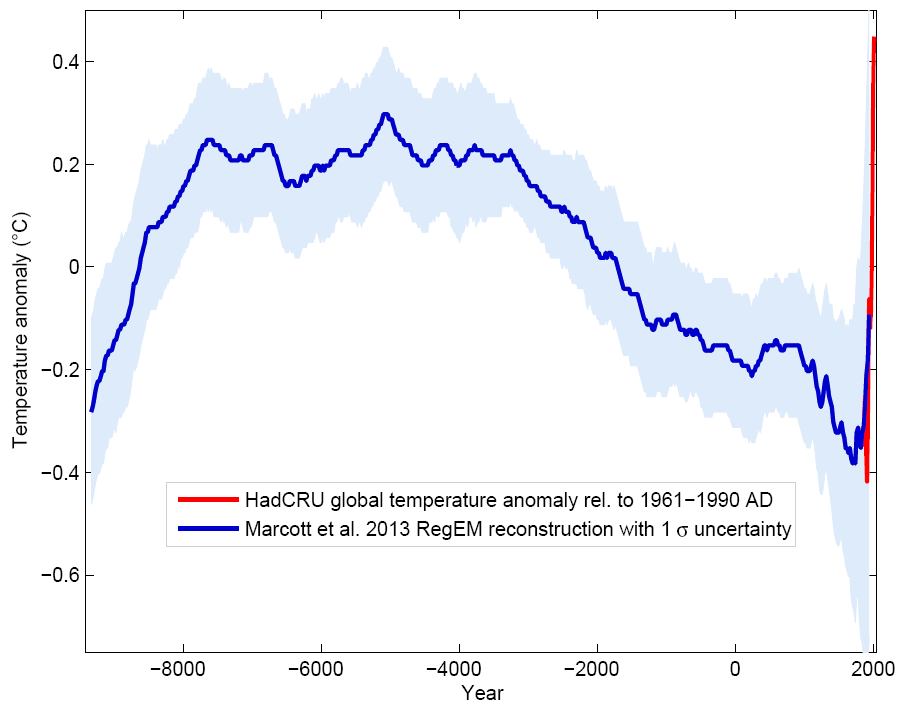
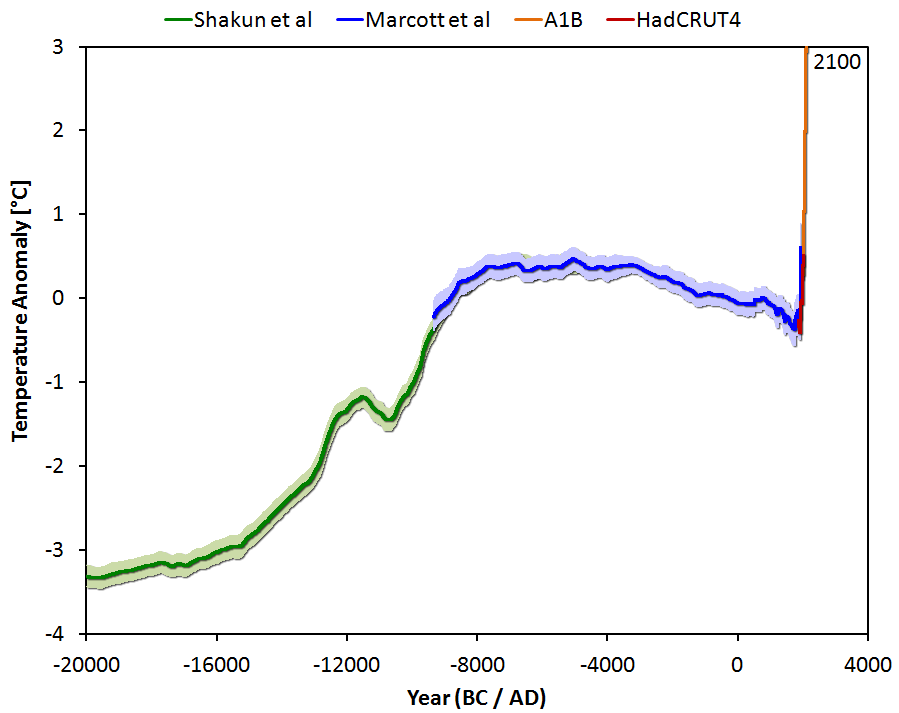
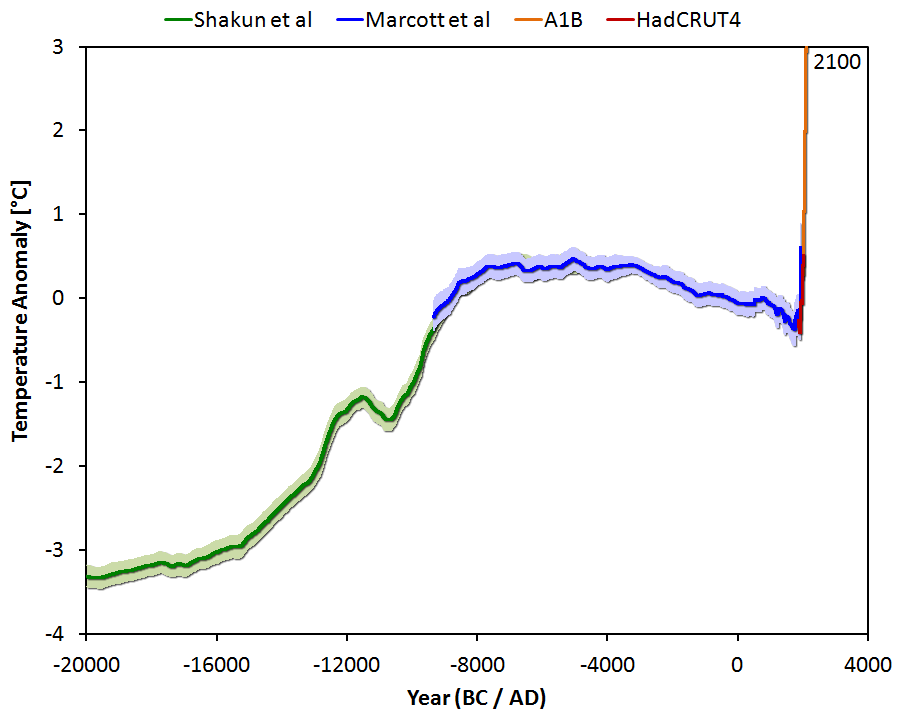
In the '70s we thought that a doubling of CO2 would lead to 2-3C warming. That's exactly what we're seeing. That's why the observed warming on the right side of this graph is vertical. Here's an Exxon scientist in 1978:
"What is considered the best presently available climate model for treating the Greenhouse Effect predicts that a doubling of the CO2 concentration in the atmosphere would produce a mean temperature increase of about 2 C to 3 C over most of the Earth. The model also predicts that the temperature increase near the poles may be two to three times this value.
- J.F. Black, Products Research Division, Exxon Research and Engineering Co.
-
Re: AGW Denier trolls are out in force
Are you sure?
We've erased 8000 years of cooling in decades. Can you guess what the next few have in store?
-
Re: AGW Denier trolls are out in force
Are you sure?
We've erased 8000 years of cooling in decades. Can you guess what the next few have in store?
-
Re: All of these models take that and far longer
The biggest sign of how climate models are inadequate is that *not a single one* has shown to predict the climate or even the trend at any level of accuracy. They are all far off from actual observations.
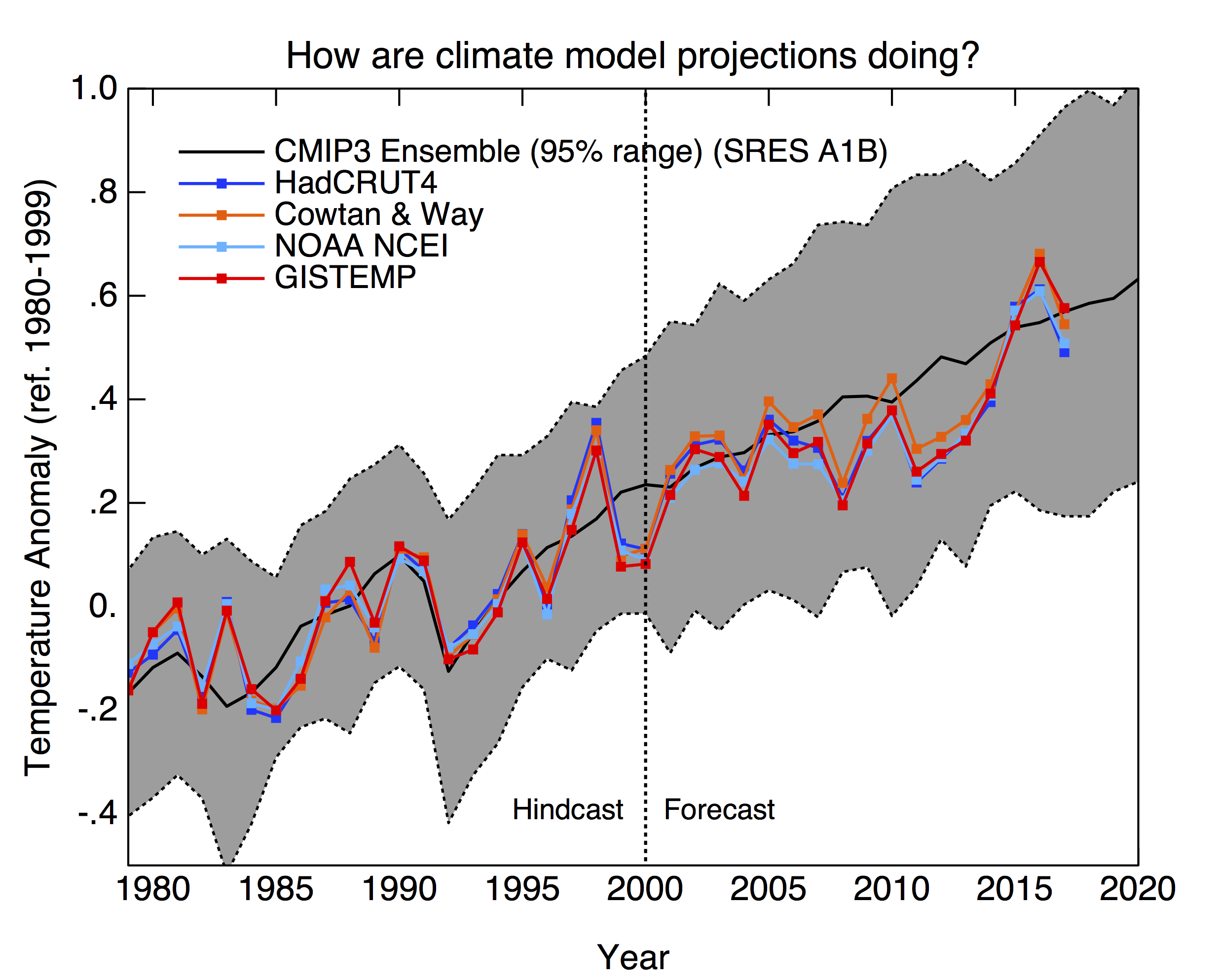
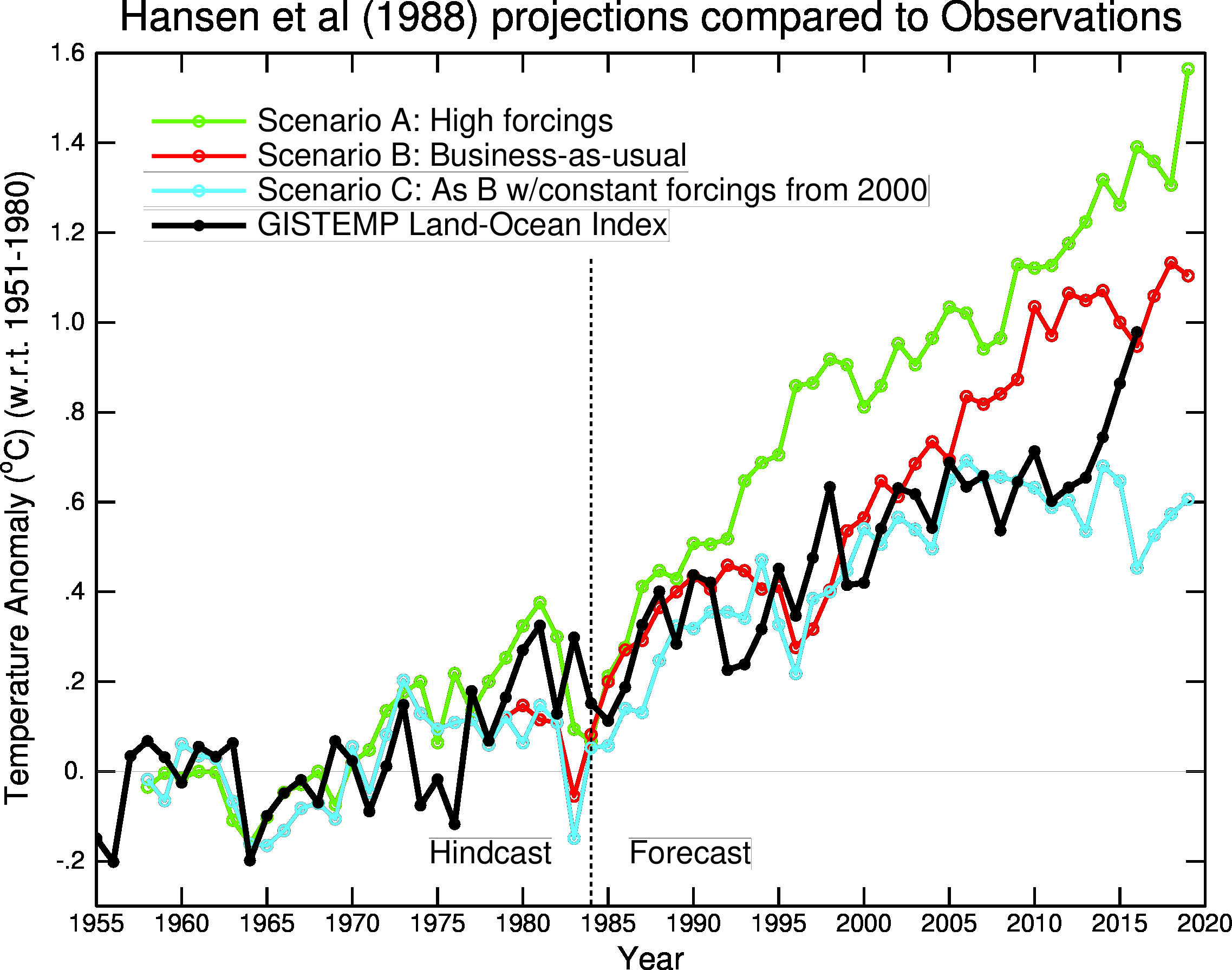
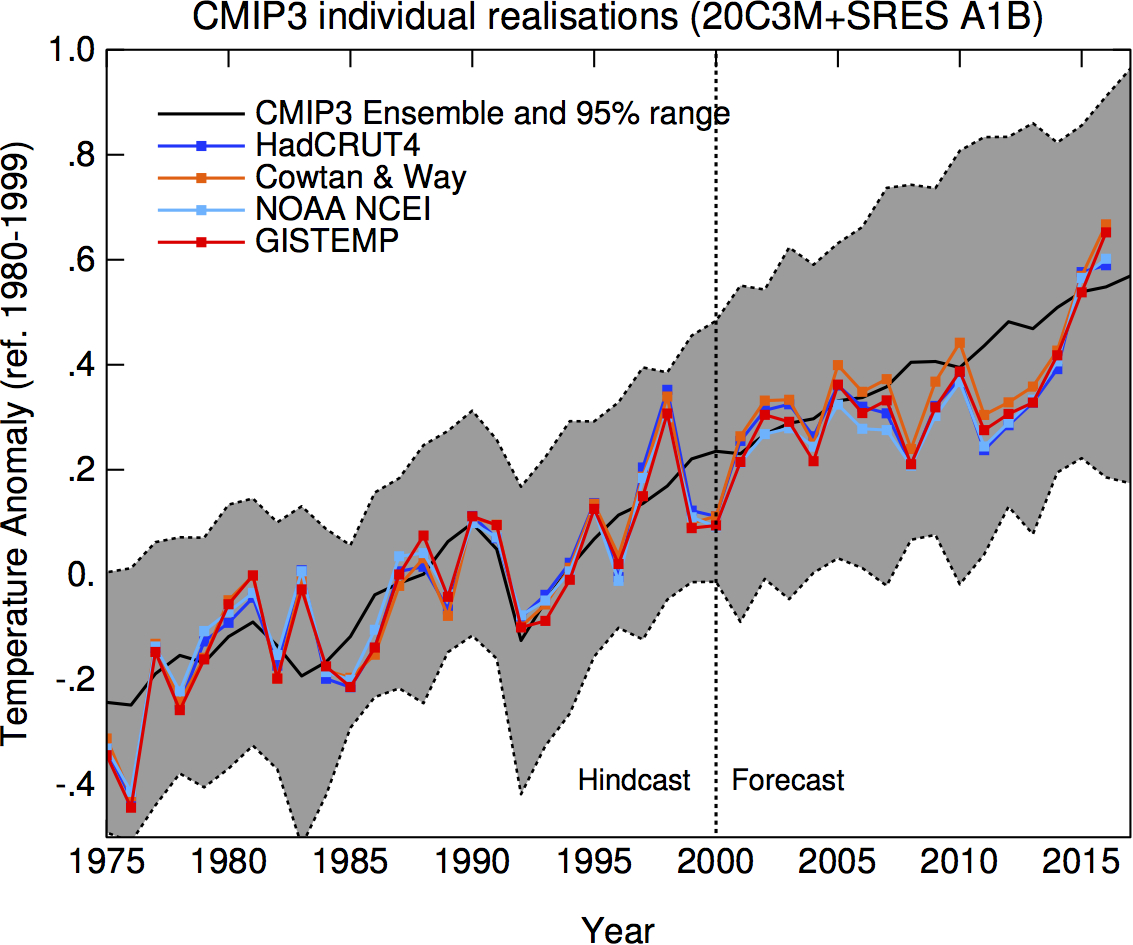
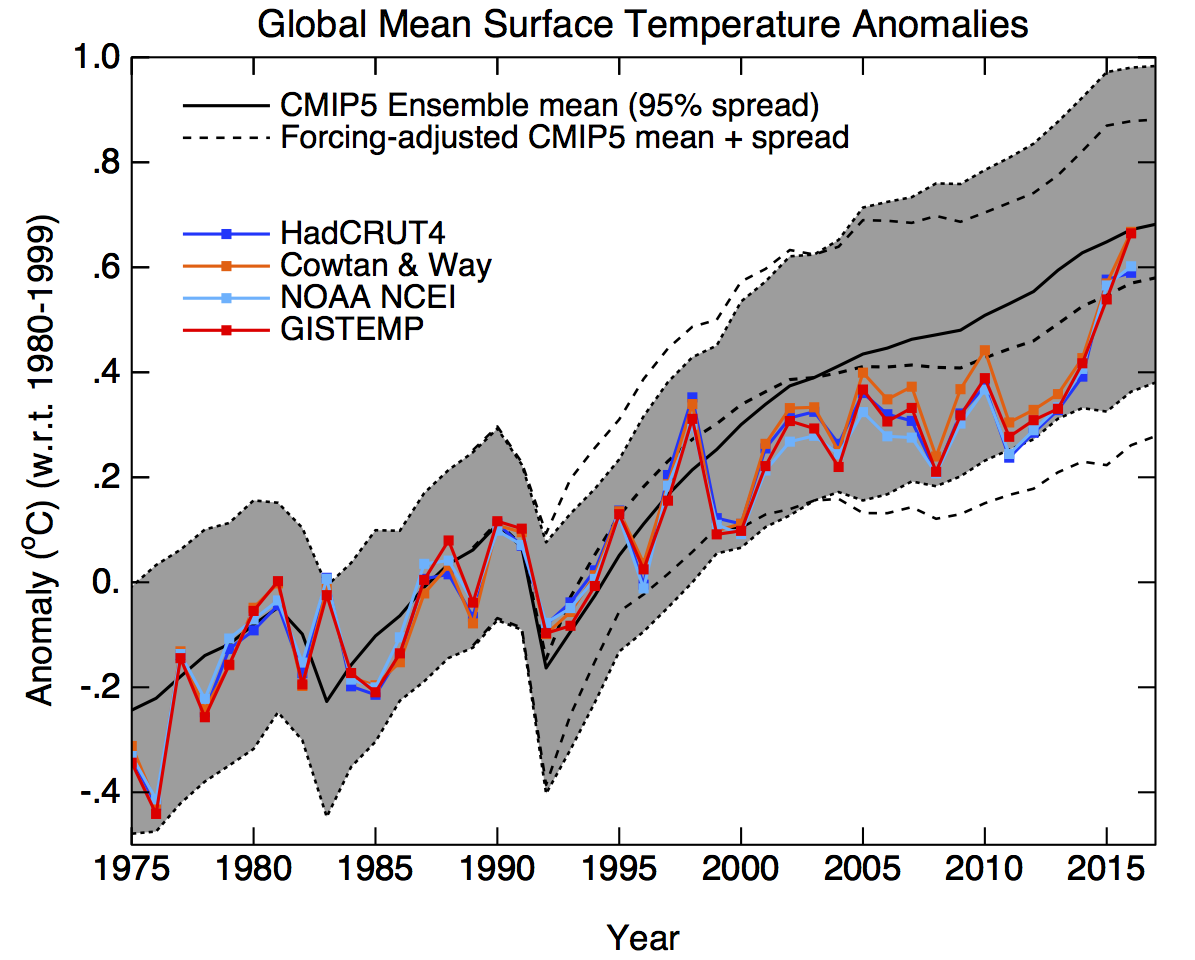
Here is a comparison of climate model projections to observations. They show good agreement between the two:
-
Re:It's Called Science
More conspiracy theories. Funny how Spencer's own temperature reconstruction agrees with the "manipulated" GISS data. Spencer must be part of the conspiracy!
And Dr. Spencer conclusion is pretty definitive - everything starting at zero in 1979 (when the satellite and radiosonde data record begins)
But he didn't start at 1979. He pins everything at 1983. Not 1979. Any guess why? Because if he didn't, it would have looked more like this. Is there any part of you that is the least bit curious? That asks, "if the temp trend since 1983 is exactly as the models projected then how can we conclude that the models failed?"
-
Re:It's Called ScienceSome details on how this changes the results are available here:
"...which yields a OHC trend of 1.21 ± 0.72 x 10^22 J/yr (previously 1.33 ± 0.20 x 10^22 J/yr),"
-
Resplandy et al. correction and response
Resplandy et al. correction and response is up at RealClimate. They acknowledged both the low uncertainty and the high central estimate errors that Nic raised. They also modified some of their assumptions with the effect of raising their central estimate above what it would have been if they only corrected their calculations.
-
Re:"we didn't sample it right"
Climate change model is to my knowledge completely unable to provide verifiable predictions...
Here is a comparison of observations to climate models that shows you are wrong.
-
Re: Al Gore isn't somebody you go to for science
There is no such thing as a model being proven. The models make predictions with margins of errors, which are then compared to the actual measurements.
Since you're trying to pose as a smartass, here's a question for you: name the top 3 of the "120 reputable" models, "top" defined, for example, as having the largest impact factor. Show us the predictions, the margins of error and compare it with actual measurements.
Otherwise, you're just sprouting bullshit.
Here's a comparison of climate model projections including the uncertainty ranges to observations. The models are actually doing pretty well.
-
Re: Al Gore isn't somebody you go to for science
Reality denial? Yep, reality denial is what you do.
In real life, models are pretty much aligned with observations.
-
Re: Al Gore isn't somebody you go to for science
Indeed. Let's see how the models are doing.
http://www.realclimate.org/ind...
It appears that all observations are well within the models' 95% confidence level spread. That is, the models, even those from over a decade ago are doing quite well.
Not surprising, given the amount of work that goes into them.
-
Re:What is the correct temperature
Oops, here is part ii.
-
Re:What is the correct temperature
Blackbody radiation absorption for CO2 is at less than 11%. Absorption in the lower atmosphere is saturated so can only be absorbed in the troposphere, where CO2 is much less common, and yet no measurements have found a "hot spot" that high up.
No, the absorption of infrared is not saturated in the lower atmosphere. Here are a couple of posts about that:
-
Not [entirely] pro-fossil-fuel FUD. NIMBY FUD also
I'm gonna go out on a limb here and claim that this is a product of bias and mental issues by the authors.
Much like how the authors of SuperFreakonomics couldn't have resisted their "one clever trick to fix global warming" chapter thanks to their personal biases. Which came back to bite them.
Also, the claim made in the paper is clearly false, even fraudulent.
Whether due to bias or to drum up publicity, I don't know. But they actually show that they are wrong.
More on that below. First a word or two on authors.David W.Keith is a pusher of solar and geoengineering as a solution for climate change.
Also, best way to solve that climate change, according to him, is to start spraying sulfuric acid into air.
And he owns and runs a geoengineering company.
Which kinda runs on tar sands money.Carbon Engineering is funded by several government and sustainability-focused agencies as well as by private investors, including Microsoft founder Bill Gates and oil sands financier N. Murray Edwards.[5][6][7]
Lee Miller on the other hand really hates them windmills.
And both windmills and photovoltaics should be kept out of the cities, tucked away somewhere in the desert.In fact, he's done resear... I mean he played with computer models to "prove" that installing windmills will basically... stop the wind. Well... slow it down.
Someone should have told him about all those sails we used to use globally, that we're no longer using.I.e. That a reduction of things to preindustrial levels actually requires reduction of wind speeds as well.
Or remind him that the air moved by the wind is a fluid. Like water.
And just like how water in the sea doesn't stop moving because of all the boats blocking it from moving freely... neither will global air currents actually slow down.
And even if they do - we could just reduce the number of flags and start driving cars only downwind, while wearing more tight fitting clothes, right?
Or tell him about the chance that his model is NOT REALLY a completely accurate representation of reality.As for the study... It claims the following:
generating today's US electricity demand (0.5 TWe) with wind power would warm Continental US surface temperatures by 0.24 C.
...
The warming effect is: small compared with projections of 21st century warming, approximately equivalent to the reduced warming achieved by decarbonizing global electricity generation, and large compared with the reduced warming achieved by decarbonizing US electricity with wind.It also claims that solar effect would be smaller but that's besides the point, unless you're looking for more bias fodder.
The issue is that those "approximately equivalent" and "large compared with the reduced warming achieved by decarbonizing US electricity" are COMPLETELY ignoring that the US is a part of a global system.
As seen from the graph they've provided.They claim a warming of 0.24C over Continental US from 0.5TWe produced with wind power, by 2080, at which point it would level out.
At the same time they claim a cooling of about -0.48C over Continental US from -
Re:Alarmist much?
You are correct, that is what it says. What it says in detail is a bit more nuanced - it agrees with most studies, that most areas of Antarctica have been losing ice mass (continental ice - sea ice extents are not covered here) but that those areas assumed by other studies as well to have been gaining ice, have been gaining more than assumed. But if this is the case it is Good News (tm). However, one study does not a summer make, but corroboration that this is the case would be nice (but only if that is what the evidence supports). If Antartica really is gaining ice, that's great, especially given it means that other sources of sea level rise must be quite significant and taking the edge off is helpful.
Zwally said: Lead Author Jay Zwally: "I Know Some Of The Climate Deniers Will Jump On This," But "It Should Not Take Away From The Concern About Climate Warming."
The study is at odds with dozens of others. Since the original report was from 2015, hopefully there has been more analysis of the paper, and the original and more data by now, so we might be able to confirm the trend, or new analyses might have confirmed previous research. This link might be interestin: http://www.realclimate.org/ind...
-
Re:Really awesome...
You don't just go in and start changing data the way you want.
Which is why I said:
Maybe your time would be better spent understanding why the modifications are made and the techniques used to do the modifications.
Because scientists don't just adjust the data for arbitrary reasons. When adjustments are made they have to be defended before other scientists who will quickly call out any unjustified changes. If you think otherwise it's up to you to show in a scientific manner why the changes are unjustified. Just believing they are doesn't make it so.
When talking about long term obviously the further you go out into the future the less sure you are about what will happen. It's unknown what future CO2 (and other greenhouse gas) emissions will be. It's unknown what the sun will do. It's unknown what major volcanic eruptions will happen. Yet, if you look at the 30 year time frame of the classical climatological period as defined by the WMO the big climate models do a pretty good job. If you start talking about 100 years from now there is far more uncertainty.
-
Re:Open Source - Open Data
Congratulations, you just sent your own credibility deeper into the gutter:
-
Re: Duh
Climate models are generally successful in that observations are within the range of uncertainty.
-
Re:Proof that CO2 does not cause warming
Perhaps that's why the models don't match the data, and run quite a bit hotter than actual data.
Actually climate models match the observations pretty well. Dr. Spencer needs to update his graph. Also, I'm curious how the model runs and the observations can all start from the same zero point in 1983. At the very least there should be a discrepancy between the HADCRUT and UAH starting points. So he shifted everything to start at the zero point in 1983 which is a pretty unscientific thing to do.
-
Re:Proof that CO2 does not cause warming
recent peer-reviewed data points to 1.3 to 1.6 deg K for doubling of CO2,
The study you linked to gives a 95% confidence range of 1.1 to 4.45. That is in line with other estimates. See also this overview: http://www.realclimate.org/ind...
-
Re:Could these readings be skewed?
While it doesn't address what CO2 comes from volcano's, but we can also tell what percent of CO2 is natural vs from burned fossil fuels using carbon isotope ratio from the atmosphere:
-
Re: The Best People
That comparison is utterly dishonest, but you don't know enough to know it. There's a more complete set of comparisons available here: http://www.realclimate.org/ind...
At a glance, that site doesn't seem to be very conclusive. I'm sure it looks conclusive to believers though. Clearly you can draw graphs a lot of different ways.
It's almost like the dataset was deliberately chosen to maximise the difference!
Yeah, imagine that! Exaggerated messaging on climate. I guess there's a first time for everything.
[Lot's of critiques of Spencer graph deleted.]
All this graph massaging is counter to the original point that the "models fit the data". Apparently, whether "the models fit the data" is an extremely complex question with a somewhat ambiguous answer.
This is why the red-team-blue-team thing is so incredibly stupid. The public can't actually interpret any of this evidence.
Hence my original point:
Average blue team flag waver has no more clue than average red team flag waver. Blue team believes what blue team captains say, based on blue team member's emotion and self-regard. Red team similar. Not much of it has anything to do with science.
Regardless, all the name-calling and general assholishness on climate seems guaranteed to produce zero meaningful change. One side pushes and the other pushes back in defense. If you want to actually accomplish something, then you're going to have to heal some of the divide in the country. Not likely any time soon.
-
Re:The scariest bit isn't mentioned
Realclimate has a good article on this which concludes: "The methane hydrates in the ocean, in cahoots with permafrost peats (which never get enough respect), could be a significant multiplier of the long tail of the CO2, but will probably not be a huge player in climate change in the coming century."
Another article looks at a "worst case scenario" for Arctic methane and finds it "At worst comparable to CO2 except that CO2 lasts essentially forever."
-
Re:The scariest bit isn't mentioned
Realclimate has a good article on this which concludes: "The methane hydrates in the ocean, in cahoots with permafrost peats (which never get enough respect), could be a significant multiplier of the long tail of the CO2, but will probably not be a huge player in climate change in the coming century."
Another article looks at a "worst case scenario" for Arctic methane and finds it "At worst comparable to CO2 except that CO2 lasts essentially forever."
-
Re: The world is not a static system
Climate model projections compare well with observations. Here's the latest comparisons:
-
Re:Climate Change is real.
The temperature of a gas is a measure of the average kinetic energy of the molecules in the gas. Kinetic theory of gases. This is old school stuff that I shouldn't need to cite for you. The rate of collisions is a function of the density of the gas. So we know that the CO2 in the atmosphere is colliding with other molecules. In fact the collisions are far more common than the CO2 molecule emitting a photon.
I found this response in a post at Real Climate that explains what is going on with greenhouse gases and other gases in the atmosphere fairly well. It is response #9 by Paul Schopf:
It is first necessary to understand that molecules are made up of atoms (with mass) are held together by bonds, much like two balls linked by springs, and therefore have ways of vibrating at specific frequencies.
The bonds between two atoms in a molecule are particularly strong, and can only vibrate at very high frequencies (emphasize frequencies over energies) well above the frequency of infrared or the solar radiation spectrum.
However, molecules with 3 or more atoms can vibrate by changing the angles between the three atoms, and they can vibrate at additional (lower) frequencies. Molecules like CO2 and H2O have vibrational frequencies within the infrared range. In these vibrations, the strong bonds between Carbon and Oxygen may still have very high vibrational frequencies, but the two Oxygen atoms can vibrate toward or away from each other at this lower frequency.
Molecules with more than 3 atoms can vibrate in even more ways (which means more and more frequencies). Examples are CH4, CFCs, etc.
When upward radiation close to the right frequency hits a CO2 molecule, it can excite the vibrational mode at that frequency. The outward radiation is reduced by the amount of energy that goes into the vibration. We see the reduced amount of outward radiation in the spectra observed by downward looking satellites.
[The observant student then might ask why the energy that goes into the vibration does not just get sent back out to space by emitting a photon – after all, if the same molecule gets hit over and over with photons won’t the vibrational energy increase and increase? There are two answers: the simple part is that yes, the energy can be re-emitted, but the direction of the emitted photons does not have to have the same upward angle. In fact, the extra energy will as likely go down as up. On average, only half of the incoming energy continues on an upward path, half heads back toward Earth to participate in the answer to question 3.
The second answer comes from equipartion of energy. Temperature is a measure of the kinetic energy of the molecules. This kinetic energy is made up of not only the vibrational energy, but also the rotational energy and the classical kinetic energy of moving molecules.
When one molecule with high vibrational energy bumps into another molecule (even one without a vibrational mode) some of that vibration can go into kicking the other molecule into faster motion or higher rotation. So energy gets lost from the vibrational mode and transferred into the general temperature of the surrounding gas. The CO2 molecule has a unique way to absorb energy at a particular frequency, but that energy gets transferred very quickly to its neighboring molecules, most of which have no way to emit radiation at that frequency.]
-
Re:Read Karl Popper
And for a more complete explanation of what we've been discussing I came across this:
-
Re:Just a PR release
To learn how raw data is collected and processed into a global surface temperature, go to http://www.realclimate.org/ind....
WARNING: Understanding will require work on your part.
-
Re:Grab some popcorn
We can't accurately predict the weather for 5 days
Can't predict a coinflip either, yet we can predict very accurately the average result of 10,000 coinflips. Same with climate, which is a long-term aggregate of countless individual weather events. But sure, all those thousands of egghead climate scientists from all over the planet are obviously just making shit up, right? And apparently coordinating it all in a massive global conspiracy.
It's not a fact.
Then how do you explain the vast amount of peer-reviewed evidence supporting it that's cited in the IPCC reports? Gonna wave that all away?
There certainly is a huge monetary motivation to say it's NOT a fact.
Fixed that for you. And if you doubt me, let me know if you find any monetary motivation bigger than $33 trillion in stranded assets. Or perhaps just compare salaries.
Everything they do makes it LOOK like they are covering shit up.
According to whom? Certainly the studies cited in the IPCC reports are about as clear as it can get. Every scientific institution and meteorological department in the world endorses its conclusions - are all of them also covering this shit up, risking their reputations and sabotaging everything science stands for? Or perhaps other interests just want you to think so? There's certainly plenty of direct evidence for that.
You want data? Oh we deleted it.
You have an opinion we don't agree with?
Then provide evidence to back it up, or STFU. That's how science works.
The curves don't match what we said was going to happen ten years ago?
They look OK to me.
Don't get me started on having Al Gore as a spokeman
Haha, nobody elected Gore as any sort of spokesman other than himself, and certainly he has ZERO to do with the scientific case for AGW. That's like saying the entire Republican party are frauds because Trump is kind of a dick.
show me a solution that does NOT put us back into the dark ages
Well first off, the type of solution has NOTHING to do with the existence of the problem. Seriously, are you really going to deny the problem even exists just because you don't like someone's proposed solution to it? Is that rational?
Second, there are any number of proposed solutions. Pick some that you like. Nuclear is fine by me, if you can make an economic case for it (and certainly in some areas it makes a lot of sense). Solar and wind are obvious choices to be part of the energy mix, particularly in areas where there's lot of sun and/or wind. Geothermal, wave power, thorium - there are plenty of carbon-neutral energy sources to choose from.
And for intermittency, power companies already have to deal with that, since no power plant is perfect - e.g. coal plants are offline 40-60% of the time, so they have to be covered too. The answer is wide distribution and redundancy from a variety of sources ("the wind always blows somewhere") with some storage
-
Re:Someone said once...
Actually during the past few record hot years the observations are firmly in the middle of the confidence range. Climate model projections compared to observations
In one sense climate is the envelope within which weather is expected to vary. As long as 95% of the observations are within the 95% confidence range of the models then they are doing a reasonable job.
-
Re: uh oh
I had a similar experience but from a physical chemistry perspective. When you look at the IR+RAMAN spectra for CO2 and H2O it becomes clear that there is absolutely no amount of CO2 that will cause significant warming (the peaks from CO2 are already highly saturated, meaning adding more isn't going to make it any warmer--like having 50 washrags stacked on your chest and trying to get warm by stacking 50 more directly on top of them, where H2O is like a blanket).
Any observed warming can be easily explained with water vapor concentrations, which have also been increasing. The method to deal with that kind of warming doesn't involve shutting down all industry in the world and instituting global communism. In fact, since H2O is in such a tight equilibrium that warming can be fixed in a few days if it becomes bad enough that we have to do it.
You might want to read these articles about why your "CO2 is saturated" argument is wrong:
A saturated gassy argument - Part II
Also, I'm curious how you think we can fix the warming in a few days by doing something about water vapor? With over 70% of the planet covered by water I don't see any way of significantly affecting the level of water vapor in the atmosphere.
-
Re: uh oh
I had a similar experience but from a physical chemistry perspective. When you look at the IR+RAMAN spectra for CO2 and H2O it becomes clear that there is absolutely no amount of CO2 that will cause significant warming (the peaks from CO2 are already highly saturated, meaning adding more isn't going to make it any warmer--like having 50 washrags stacked on your chest and trying to get warm by stacking 50 more directly on top of them, where H2O is like a blanket).
Any observed warming can be easily explained with water vapor concentrations, which have also been increasing. The method to deal with that kind of warming doesn't involve shutting down all industry in the world and instituting global communism. In fact, since H2O is in such a tight equilibrium that warming can be fixed in a few days if it becomes bad enough that we have to do it.
You might want to read these articles about why your "CO2 is saturated" argument is wrong:
A saturated gassy argument - Part II
Also, I'm curious how you think we can fix the warming in a few days by doing something about water vapor? With over 70% of the planet covered by water I don't see any way of significantly affecting the level of water vapor in the atmosphere.
-
Re:If the other article I read is correct...
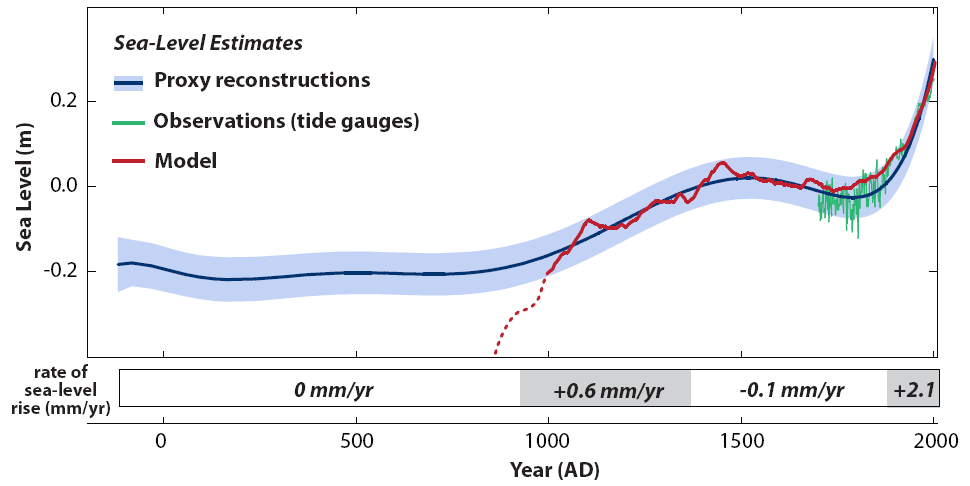
According to this article, if we ignore the modern climate change induced sea rise, there was about 24cm of sea level rise over the past 1800 years, almost all of it concentrated in the period of 1000-1400 AD.
-
Re:Another thing they don't tell you about the mod
Ahhh. I see, an award winning NASA scientist, who presents data rather than models, is a quack.
Does not invalidate his data, though.
It's funny how denialists accuse scientists of making shit up and then latch on to the first one who does, when his opinions match their ideology.
-
Global cooling was not forecasted in the 70s.
Yeah, that never happened.
"Yeah, that never happened" is correct! Anonymous Coward says something accurate for a change.
There was no scientific consensus nor prediction by scientists that the Earth was "entering a global cooling phase."
Citations: http://journals.ametsoc.org/doi/pdf/10.1175/2008BAMS2370.1
http://physicstoday.scitation.org/do/10.1063/PT.5.8199/full/
https://www.scientificamerican.com/article/how-the-global-cooling-story-came-to-be/
http://www.realclimate.org/index.php/archives/2005/01/the-global-cooling-myth/"
http://www.factcheck.org/2015/03/cruz-on-the-global-cooling-myth-and-galileo/ -
Re:Sheer FUD, mixed with outright falsehoods
The graphic from wattsupwiththat is bad.
See http://www.realclimate.org/ind... for more information.
-
Re:Holy shit, stop the insanity
As long as you don't admit that the models are wrong, you're opposed to science.
Oh the irony.
Sigh. Fine, we'll do this again. Yes, of course the models are not perfect - they do not (and cannot) predict every last short-term wiggle. To a "black and white" viewpoint then that means they're *always* wrong - even when they reliably nail the long-term trend for over thirty years. This of course does not mean they are not still very useful to climatologists that know how to use them (and as long as you don't admit that, you're opposed to science, yes?)
So with that out of the way, when the models don't match closely to what we observe, we want to know why, so that we can improve them. From your own first link (again):
..both internal variability and external forcing contribute to the ‘slowdown’. The externally forced contribution is due to the combined cooling effects of a succession of moderate early twenty-first century eruptions, a long and anomalously low solar minimum during the last solar cycle, increased atmospheric burdens of anthropogenic sulfate aerosols, and a decrease in stratospheric water vapour
As you point out, internal variability (ENSO etc) alone is very unlikely to account for the discrepancies, but your own citation says that internal variability and the short-term external forcings listed above are responsible for the so-called "pause" (in tropospheric warming specifically), and the models do not adequately account for these (again, no surprise to actual climatologists). Meanwhile, other (and more important) climate models are tracking nicely; for example, "ocean warming estimates over a range of times and depths agree well with results from the latest generation of climate models" (which is accelerating rapidly).
if you think the cause was volcanoes and solar activity, this paper talks to you. You'll have to find some other explanation.
So when your first link from 2017 explicitly calls out volcanoes and solar activity (among other things) as significant factors, you cite a paper from 2013 (four years out of date) to claim that it can't be those - despite that same paper explicitly not ruling out external forcings like those as being a factor. You really need to read your own citations more closely.
Seriously, do you look at this and say, "Oh yeah, that's right"? If so, what is wrong with you?
I look at that and say, "I see it's 5 years out of date, big surprise". Then I say "what is that graph even representing? There's no labels". Then I look at more up-to-date data. (NB I'm assuming from your example that you're fine with linking to images on blogs, but at least try to use something current and well-sourced?)
-
Re:Holy shit, stop the insanity
As long as you don't admit that the models are wrong, you're opposed to science.
Oh the irony.
Sigh. Fine, we'll do this again. Yes, of course the models are not perfect - they do not (and cannot) predict every last short-term wiggle. To a "black and white" viewpoint then that means they're *always* wrong - even when they reliably nail the long-term trend for over thirty years. This of course does not mean they are not still very useful to climatologists that know how to use them (and as long as you don't admit that, you're opposed to science, yes?)
So with that out of the way, when the models don't match closely to what we observe, we want to know why, so that we can improve them. From your own first link (again):
..both internal variability and external forcing contribute to the ‘slowdown’. The externally forced contribution is due to the combined cooling effects of a succession of moderate early twenty-first century eruptions, a long and anomalously low solar minimum during the last solar cycle, increased atmospheric burdens of anthropogenic sulfate aerosols, and a decrease in stratospheric water vapour
As you point out, internal variability (ENSO etc) alone is very unlikely to account for the discrepancies, but your own citation says that internal variability and the short-term external forcings listed above are responsible for the so-called "pause" (in tropospheric warming specifically), and the models do not adequately account for these (again, no surprise to actual climatologists). Meanwhile, other (and more important) climate models are tracking nicely; for example, "ocean warming estimates over a range of times and depths agree well with results from the latest generation of climate models" (which is accelerating rapidly).
if you think the cause was volcanoes and solar activity, this paper talks to you. You'll have to find some other explanation.
So when your first link from 2017 explicitly calls out volcanoes and solar activity (among other things) as significant factors, you cite a paper from 2013 (four years out of date) to claim that it can't be those - despite that same paper explicitly not ruling out external forcings like those as being a factor. You really need to read your own citations more closely.
Seriously, do you look at this and say, "Oh yeah, that's right"? If so, what is wrong with you?
I look at that and say, "I see it's 5 years out of date, big surprise". Then I say "what is that graph even representing? There's no labels". Then I look at more up-to-date data. (NB I'm assuming from your example that you're fine with linking to images on blogs, but at least try to use something current and well-sourced?)
-
Re:Holy shit, stop the insanity
As long as you don't admit that the models are wrong, you're opposed to science.
Oh the irony.
Sigh. Fine, we'll do this again. Yes, of course the models are not perfect - they do not (and cannot) predict every last short-term wiggle. To a "black and white" viewpoint then that means they're *always* wrong - even when they reliably nail the long-term trend for over thirty years. This of course does not mean they are not still very useful to climatologists that know how to use them (and as long as you don't admit that, you're opposed to science, yes?)
So with that out of the way, when the models don't match closely to what we observe, we want to know why, so that we can improve them. From your own first link (again):
..both internal variability and external forcing contribute to the ‘slowdown’. The externally forced contribution is due to the combined cooling effects of a succession of moderate early twenty-first century eruptions, a long and anomalously low solar minimum during the last solar cycle, increased atmospheric burdens of anthropogenic sulfate aerosols, and a decrease in stratospheric water vapour
As you point out, internal variability (ENSO etc) alone is very unlikely to account for the discrepancies, but your own citation says that internal variability and the short-term external forcings listed above are responsible for the so-called "pause" (in tropospheric warming specifically), and the models do not adequately account for these (again, no surprise to actual climatologists). Meanwhile, other (and more important) climate models are tracking nicely; for example, "ocean warming estimates over a range of times and depths agree well with results from the latest generation of climate models" (which is accelerating rapidly).
if you think the cause was volcanoes and solar activity, this paper talks to you. You'll have to find some other explanation.
So when your first link from 2017 explicitly calls out volcanoes and solar activity (among other things) as significant factors, you cite a paper from 2013 (four years out of date) to claim that it can't be those - despite that same paper explicitly not ruling out external forcings like those as being a factor. You really need to read your own citations more closely.
Seriously, do you look at this and say, "Oh yeah, that's right"? If so, what is wrong with you?
I look at that and say, "I see it's 5 years out of date, big surprise". Then I say "what is that graph even representing? There's no labels". Then I look at more up-to-date data. (NB I'm assuming from your example that you're fine with linking to images on blogs, but at least try to use something current and well-sourced?)
-
Re:warming models wrong
You didn't even look at the link, did you? Nor was I "refuting" the paper - you seem to be projecting your own idea of motives rather than reading what I'm saying. The link merely offered updated comparisons between model projections from various dates, and current observations of actual temperatures, such as in this graph. If you believe that's in error, do please cite something.
If you have a link to a non-paywalled version of the paper then I'd be interested to see more detail, but the quote I showed above specifically describes the solar variations, volcanism etc as the externally-forced contribution, and clearly distinct from internal variability (maybe read it more closely). The models use long-term averages & expected values for these forcings, so e.g. an actual volcanic eruption (or no eruptions at all) will of course give different results - potentially far outside normal model parameters, if the eruption is a significant one.
Perhaps this is the source of your confusion over the paper? If you think otherwise, please cite what makes you believe that.
-
Re:warming models wrong
Of course the models are "deficient", in that there are a whole range of external forcings that they can only approximate, in addition to internal variability. They're never going to be perfect; there are always going to be discrepancies in parameters like human sulphate emissions or the deviation from average levels of volcanic activity in a given year. That's why they do multiple runs with a range of likely values, and update those runs as we find out more. The paper was written as a part of the effort to identify which particular external parameters are responsible for the observed discrepancies.
But that's a long way from "fully admitting them to be wrong", as you claimed. I'm sure you realise (even if the Daily Caller doesn't) that short-term imperfections do not make models useless, so I'm assuming you're misrepresenting this for a reason. Or perhaps you're just unaware that recent years' temperatures have now caught up to (and in some cases exceeded) the most likely business-as-usual projections from even 30 year old model runs - entirely validating the oft-made point that while climate models cannot predict all short-term variations, it usually averages out in the long run.
-
Re:As hurricanes continue to increase in frequency
Citation needed
http://www.realclimate.org/ind...
The author is a leading expert on tropical cyclones. His article contains references to peer-reviewed papers.
-
Cycle?
Funny looking cycle.
Aren't cycles supposed to follow a repeating pattern, rather than starting in a repeating pattern then suddenly take off? -
Re:More "trust me" science
The problem is all the models have predicted more warming than has happened.
Not true. Here's an up to date overview of a bunch of models, compared to observations.
http://www.realclimate.org/ind... -
Re:More "trust me" science
-
Sunrise: east or west? Comparing prediction
Forget the real world. >Because real-world results don't matter. What did your MODEL that hasn't successfully predicted sunrise direction for the last 15 years say?
If you are snarking about climate models, in fact the climate models have been remarkably accurate over the last fifty years. Here's the Berkeley Earth comparison between models and measurements: http://static.berkeleyearth.or... (See also: https://www.skepticalscience.c... https://www.theguardian.com/en... )
And why have you been ignoring more accurate satellite-based measurements of the sunrise and selectively using only ground-based measurements that have been, errr, corrected from the original data?
You ARE aware that satellite measurements are heavily corrected, right? The satellites see a line-of-sight average of microwave emissions, and there is a rather long and controversial process to turn microwave emission intensity into middle troposphere temperatures. One researcher (John Christy) has a correction method that produces an output that says that global warming is real, but it's on the low end of the predicted values. http://www.realclimate.org/ind... Other researchers using the same data, however, come up with other answers.
The ground measurements, on the other hand, have had relatively minor corrections to account for changes of the type of thermometer, the corrections being well-documented, and (an important thing to note) the change due to corrections making no significant difference to the final conclusion.
-
Re:Science versus politics
Point 1: Scott Adams pointed out that when asked the question "how much of global warming is caused by humans, and how much is natural" in debates and televised interviews, no scientist had an answer.
The answer is 50-70% according to this latest research.
Don't confuse the effects on Arctic ice with global warming. This research is saying that 50-70% of the ice melt is caused by the temperature increase from global warming. Our current best estimate is that 100% of global warming is caused by human activity.
-
Re:Isn't this just virtue signaling at this point?
Sea level rise has not been constant for hundreds of years.
http://www.realclimate.org/ind...Frequency of floods is increasing.
https://journalistsresource.or...Climate science is more than common sense or what you happen to think is true, unfortunately.
-
Re:Isn't this just virtue signaling at this point?
because sea level rise has been constant for hundreds of years and storms occur, naturally
Sea level rise has sharply accelerated in past 100 years compared to the centuries before that. This means that sea defences have be build higher on an accelerated pace too. And even if the height of your defences keeps up with the rising waters, the cost of an occasional breach will rise quicker. http://www.realclimate.org/ima...