Slashdot Mirror
Domain: regmedia.co.uk
Stories and comments across the archive that link to regmedia.co.uk.
Stories · 25
-
Intel Sues Ex-Engineer For Trying To Steal 3D XPoint Technology On His Way To Micron (theregister.co.uk)
Intel has filed a lawsuit last week against one of their former hardware engineers, alleging they tried to steal confidential chip blueprints to potentially pass on to Micron. "The lawsuit [...] is the latest twist in the tale of Intel and Micron's difficult partnership over 3D XPoint memory," reports The Register. From the report: The legal complaint, aimed at former employee Doyle Rivers, alleges that having "secretly" accepted a position at Chipzilla's former bedfellow, Micron, Rivers had a go at taking confidential trade and personnel data with him as he left. Intel alleged that a few days before leaving, "Rivers tried to access and copy a 'top secret' designated Intel file that Intel's electronic security system blocked from being copied."
Chipzilla said the document was related to what it was at pains to say is its "independent" work to productize the 3D XPoint tech into its Optane product line. In other words, blueprints secret to Intel. No one outside Intel, "including Micron" had been privy to such data, the complaint alleged. Intel's security system stopped the file from escaping, but according to the complaint, that did not stop Rivers from allegedly hoovering up a selection of personnel files into a USB device plugged into his computer. The chipmaker also claimed that Rivers "aggressively" recruited his former colleagues to join him on his grand adventure to pastures new. Intel demanded that Rivers return the USB drive, but he apparently "never responded" to them. Instead, "he handed the USB device over to his new employer." It was later discovered by a forensic investigator that it had been wiped. Intel is now demanding "a neutral forensic investigator" be allowed to take a look at Rivers' PC to see what was on there, and when exactly the USB stick was erased. There's a deadline of November 16 for Rivers to agree to this probing. -
Dutch Government Report Says Microsoft Office Telemetry Collection Breaks EU GDPR Laws (theregister.co.uk)
"The Register reports that Microsoft has been accused of breaking EU's GDPR law by harvesting information through Office 365 and sending it to U.S. servers," writes Slashdot reader Hymer. "The discovery was made by the Dutch government." From the report: The dossier's authors found that the Windows goliath was collecting telemetry and other content from its Office applications, including email titles and sentences where translation or spellchecker was used, and secretly storing the data on systems in the United States. Those actions break Europe's new GDPR privacy safeguards, it is claimed, and may put Microsoft on the hook for potentially tens of millions of dollars in fines. The Dutch authorities are working with the corporation to fix the situation, and are using the threat of a fine as a stick to make it happen.
The investigation was jumpstarted by the fact that Microsoft doesn't publicly reveal what information it gathers on users and doesn't provide an option for turning off diagnostic and telemetry data sent by its Office software to the company as a way of monitoring how well it is functioning and identifying any software issues. Much of what Microsoft collects is diagnostics, the researchers found, and it has seemingly tried to make the system GDPR compliant by storing Office documents on servers based in the EU. But it also collected other data that contained private information and some of that data still ended up on U.S. servers. -
Nasty Adobe Bug Deleted $250,000 Worth of Man's Files, Lawsuit Claims (gizmodo.com)
Freelance videographer Dave Cooper has filed a class action lawsuit against Adobe, alleging that an update to Premiere Pro came with a flaw in the way it handles file management that resulted in the deletion of 500 hours of video clips that he claims were worth around $250,000. Adobe has since patched the bug. Gizmodo reports: Premiere creates redundant video files that are stored in a "Media Cache" folder while a user is working on a project. This takes up a lot of hard drive space, and Cooper instructed the video editing suite to place the folder inside a "Videos" directory on an external hard drive, according to court documents. The "Videos" folder contained footage that wasn't associated with a Premiere project, which should've been fine. When a user is done working on a project they typically clear the "Media Cache" and move on with their lives. Unfortunately, Cooper says that when he initiated the "Clean Cache" function it indiscriminately deleted the contents of his "Videos" folder forever.
Cooper claims that he lost around 100,000 individual clips and that it cost him close to $250,000 to capture that footage. After spending three days trying to recover the data, he admitted that all was lost, the lawsuit says. He also apparently lost work files for edits he was working on and says that he's missed out on subsequent licensing opportunities. On behalf of himself and other users who wish to join the suit, he's asking the court for a jury trial and is seeking "monetary damages, including but not limited to any compensatory, incidental, or consequential damages in an amount that the Court or jury will determine, in accordance with applicable law." -
Facebook Is Not Protecting Content Moderators From Mental Trauma, Lawsuit Claims (reuters.com)
A former Facebook contract employee has filed a lawsuit, alleging that content moderators who face mental trauma after reviewing distressing images on the platform are not being properly protected by the social networking company. Reuters reports: Facebook moderators under contract are "bombarded" with "thousands of videos, images and livestreamed broadcasts of child sexual abuse, rape, torture, bestiality, beheadings, suicide and murder," the lawsuit said. "Facebook is ignoring its duty to provide a safe workplace and instead creating a revolving door of contractors who are irreparably traumatized by what they witnessed on the job," Korey Nelson, a lawyer for former Facebook contract employee Selena Scola, said in a statement on Monday. Facebook in the past has said all of its content reviewers have access to mental health resources, including trained professionals onsite for both individual and group counseling, and they receive full health care benefits. More than 7,500 content reviewers work for Facebook, including full-time employees and contractors. Facebook's director of corporate communications, Bertie Thomson, said in response to the allegations: "We take the support of our content moderators incredibly seriously, [...] ensuring that every person reviewing Facebook content is offered psychological support and wellness resources." -
EFF Defends Bruce Perens In Appeal of Open Source Security/Spengler Ruling (perens.com)
Bruce Perens co-founded the Open Source Initiative with Eric Raymond -- and he's also Slashdot reader #3872. "The Electronic Frontier Foundation has filed an answering brief in defense of Bruce Perens in the merits appeal of the Open Source Security Inc./Bradley Spengler v. Bruce Perens lawsuit," reads his latest submission -- with more details at Perens.com: Last year, Open Source Security and its CEO, Bradley Spengler, brought suit against me for defamation and related torts regarding this blog post and this Slashdot discussion. After the lower court ruled against them, I asked for my defense costs and was awarded about $260K for them by the court.
The plaintiffs brought two appeals, one on the merits of the lower court's ruling and one on the fees charged to them for my defense... The Electronic Frontier Foundation took on the merits appeal, pro-bono (for free, for the public good), with the pro-bono assistance of my attorneys at O'Melveny who handled the lower court case...
You can follow the court proceedings here
"Sorry I can't comment further on the case," Perens writes in a comment on Slashdot, adding "it's well-known legal hygiene that you don't do that." But he's willing to talk about other things.
"Valerie and I are doing well. I am doing a lot of travel for the Open Source Initiative as their Standards Chair, speaking with different standards groups and governments about standards in patents and making them compatible with Open Source." -
Facebook Flat-Out 'Lies' About How Many People Can See Its Ads, Lawsuit Alleges (theregister.co.uk)
A new lawsuit claims that Facebook exaggerates how many people can see its ads, thereby defrauding advertisers. "In other words, it is alleged not quite as many eyeballs are seeing Facebook's ads as its salespeople charge for," writes Thomas Claburn via The Register. From the report: In a complaint filed on Wednesday in a US district court in Oakland, California, plaintiffs Danielle Singer and her company Project Therapy, LLC claim the Potential Reach and Estimated Daily Reach figures that Facebook provides to advertisers are wildly inflated. As an example, the complaint claims that Facebook's purported Potential Reach among 18-to-34-year-olds in each U.S. state is greater the actual population of 18-to-34-year-olds in each of those states.
"Based on a combination of publicly available research and Plaintiffs' own analysis, among 18-34 years-olds in Chicago, for example, Facebook asserted its Potential Reach was approximately 4 times (400 per cent) higher than the number of real 18-34 year-olds with Facebook accounts in Chicago," the complaint states. And in Kansas City, the complaint asserts, the number provided by Facebook was 200 per cent higher than the actual number of 18-to-54-year-olds with Facebook accounts in the area. What's more, the court filing contends that former Facebook employees, described as confidential witnesses, have acknowledged that Facebook is fine with inflated numbers. The attorneys representing Singer and her biz, which supposedly spent over $14,000 on Facebook ads, are seeking class-action certification in order to represent other affected Facebook advertisers. According to the complaint, "a former Facebook employee who worked in the infrastructure/mapping team stated that those who were responsible for ensuring the accuracy of the Potential Reach at Facebook were indifferent to the actual numbers and in fact 'did not give a sh--.'" They also said the "Potential Reach" statistic is "like a made-up PR number." -
Oracle Challenges Pentagon's $10 Billion Cloud Computing Contract (theregister.co.uk)
Oracle has filed an official complaint with the U.S. government over plans to award the Pentagon's lucrative cloud contract to a single vendor. Rebecca Hill writes via The Register: The Joint Enterprise Defense Infrastructure (JEDI) contract, which has a massive scope, covering different levels of secrecy and classification across all branches of the military, will run for a maximum of 10 years and is worth a potential $10 billion. In spite of this pressure from vendors and the tech lobby -- as well as concerns from Congress -- the US Department of Defense (DoD) refused to budge, and launched a request for proposals (RFP) at the end of last month. Oracle is less than impressed with the Pentagon's failure to back down, and this week filed a bid protest to congressional watchdog the Government Accountability Office asking for the RFP to be amended.
In the protest, the database goliath sets out its arguments against a single vendor award -- broadly that it could damage innovation, competition, and security. Reading between the lines, it doesn't want either of Amazon or Microsoft or Google to get the whole pie to itself, and thus endanger Oracle's cosiness with Uncle Sam. Summing up its position in a statement to The Register, Oracle said that JEDI "virtually assures DoD will be locked into legacy cloud for a decade or more" at a time when cloud technology is changing at an unprecedented pace. -
Atari Accuses Journalists of Making Stuff Up So They Produce Recordings of the Interview (theregister.co.uk)
An anonymous reader quotes a report from The Register: Legendary games company Atari has accused a Register reporter of making stuff up and acting unprofessionally following an interview earlier this year in San Francisco at the launch of its new games console, the Atari VCS. In that article, we were critical of the fact that the machine did not work, and that its chief operating officer Michael Arzt, whom we spoke to, appeared unable to answer even the most basic questions about the product. We were shown "engineering design models" that were said to be "real" yet turned out did not work, and pointed out as much.
In the article, we wrote: "What happens if we plug this into our laptop, we ask Mike. I don't know, he says. Will it work? I don't know. If we plug it into a different games machine, will it work? No. So it's custom hardware and software? I don't know about that." Presumably this is where Atari feels that the reporter "wrote what he wanted instead of what was discussed with him." Which makes this clip tough to explain -- and we'll give you a clue: your humble Reg hack is the one with the British accent... This is a clip of Atari having no idea about its own controller. The Register goes on to provide more examples of how Atari "is so full of crap..." The accusations started via the company's Facebook page, where a potential buyer of an Atari VCS posted a link to the Reg article and asked the company to explain it. The full interview between the journalist and Atari can be found here. -
Atari Accuses Journalists of Making Stuff Up So They Produce Recordings of the Interview (theregister.co.uk)
An anonymous reader quotes a report from The Register: Legendary games company Atari has accused a Register reporter of making stuff up and acting unprofessionally following an interview earlier this year in San Francisco at the launch of its new games console, the Atari VCS. In that article, we were critical of the fact that the machine did not work, and that its chief operating officer Michael Arzt, whom we spoke to, appeared unable to answer even the most basic questions about the product. We were shown "engineering design models" that were said to be "real" yet turned out did not work, and pointed out as much.
In the article, we wrote: "What happens if we plug this into our laptop, we ask Mike. I don't know, he says. Will it work? I don't know. If we plug it into a different games machine, will it work? No. So it's custom hardware and software? I don't know about that." Presumably this is where Atari feels that the reporter "wrote what he wanted instead of what was discussed with him." Which makes this clip tough to explain -- and we'll give you a clue: your humble Reg hack is the one with the British accent... This is a clip of Atari having no idea about its own controller. The Register goes on to provide more examples of how Atari "is so full of crap..." The accusations started via the company's Facebook page, where a potential buyer of an Atari VCS posted a link to the Reg article and asked the company to explain it. The full interview between the journalist and Atari can be found here. -
FCC Accuses Stealthy Startup of Launching Rogue Satellites
Back in January, the FCC pulled permission from Silicon Valley startup Swarm Technologies to launch four satellites into space after what it says was an "apparent unauthorized launch." IEEE Spectrum reports that the unauthorized launch consisted of four experimental satellites that the FCC had decided were too small to be noticed in space -- and hence pose an unacceptable risk of collision -- but which the company may have launched anyway, using a rocket based in India. The federal regulator has since issued a letter to Swarm revoking its authorization for a follow-up mission to launch four new, larger versions of its "SpaceBee" satellites. From the report: Swarm was founded in 2016 by one engineer who developed a spacecraft concept for Google and another who sold his previous company to Apple. The SpaceBees were built as technology demonstrators for a new space-based Internet of Things communications network. Swarm believes its network could enable satellite communications for orders of magnitude less cost than existing options. It envisages the worldwide tracking of ships and cars, new agricultural technologies, and low cost connectivity for humanitarian efforts anywhere in the world. The four SpaceBees would be the first practical demonstration of Swarm's prototype hardware and cutting-edge algorithms, swapping data with ground stations for up to eight years.
[...]
The FCC told the startup that the agency would assess "the impact of the applicant's apparent unauthorized launch and operation of four satellites... on its qualifications to be a Commission licensee." If Swarm cannot convince the FCC otherwise, the startup could lose permission to build its revolutionary network before the wider world even knows the company exists. An unauthorized launch would also call into question the ability of secondary satellite "ride-share" companies and foreign launch providers to comply with U.S. space regulations. -
US Government Has 'No Right To Rummage' Through Anti-Trump Protest Website Logs, Says Judge (theregister.co.uk)
A Washington D.C. judge has told the U.S. Department of Justice it "does not have the right to rummage" through the files of an anti-Trump protest website -- and has ordered the dot-org site's hosting company to protect the identities of its users. The Register reports: Chief Judge Robert E. Morin issued the revised order [PDF] Tuesday following a high-profile back and forth between the site's hosting biz DreamHost and prosecutors over what details Uncle Sam was entitled to with respect to the disruptj20.org website. "As previously observed, courts around the country have acknowledged that, in searches for electronically stored information, evidence of criminal activity will likely be intermingled with communications and other records not within the scope of the search warrant," he noted in his ruling. "Because of the potential breadth of the government's review in this case, the warrant in its execution may implicate otherwise innocuous and constitutionally protected activity. As the Court has previously stated, while the government has the right to execute its Warrant, it does not have the right to rummage through the information contained on DreamHost's website and discover the identity of, or access communications by, individuals not participating in alleged criminal activity, particularly those persons who were engaging in protected First Amendment activities." The order then lists a series of protocols designed to protect netizens "to comply with First Amendment and Fourth Amendment considerations, and to prevent the government from obtaining any identifying information of innocent persons." -
Apple's 'Shoddy' Beats Headphones Get Slammed In Lawsuit (theregister.co.uk)
A lawsuit (PDF) filed Tuesday in U.S. District Court in Oakland, California, recounts the frustrations of five plaintiffs who found that Apple's Powerbeats 2 and Powerbeats 3 headphones did not perform as advertised. They are also claiming the company is refusing to honor warranty commitments to repair or replace the failed units. The Register reports: The complaint seeks $5,000,000 in damages and class action certification, in order to represent thousands of similarly afflicted Beats customers who are alleged to exist. "In widespread advertising and marketing campaigns, Apple touts that its costly Powerbeats (which retail for $199.95) are 'BUILT TO ENDURE' and are the 'BEST HEADPHONES FOR WORKING OUT,'" the complaint says. "But these costly headphones are neither 'built to endure' nor 'sweat & water resistant,' and certainly do not have a battery that lasts for six or twelve hours. Instead, these shoddy headphones contain a design defect that causes the battery life to diminish and eventually stop retaining a charge."
The complaint attributes the shoddiness of Apple's Powerbeats headphones to cheap components. Citing an estimate in a recent Motley Fool article, the complaint contends that Apple's Beats Solo headphones cost $16.89 to make and retail for $199.95: a markup of more than 1,000 per cent. That figure actually comes from a Medium post by Avery Louie, from hardware prototyping biz Bolt. -
New MH370 Analysis Again Suggests Plane Came Down Outside Search Area (theregister.co.uk)
An anonymous reader shares a report: New analysis of images thought to depict wreckage from missing Malaysian Airlines flight MH 370 suggest the Boeing 777 came down to the north of the area searched during efforts to find the plane. A new document [PDF] released yesterday by Geoscience Australia (GA) detailed analysis of four images captured by the PLEIADES 1A Earth-imaging satellite on March 23rd, 2014, not long after the March 8th disappearance of the plane. The images were provided to GA by the French Ministry of Defence. The images depict an area to the north and east of the area searched by underwater survey, and in-between areas where search and rescue operations were conducted in the wake of the plane's disappearance. The image displays the areas covered by underwater survey in yellow and the search and rescue zones in red. Extensive manual analysis of the images -- there was not enough data to use machine learning -- yielded a dozen objects that researchers were happy to classify as "probably not natural." Several of those objects were clustered in the northern parts of the areas depicted in the photos. The document is at pains to point out that it is not possible to identify the objects as airplane debris. The new analysis referred back to drift pattern analysis made on debris known to have come from MH370 and released in December 2016. That analysis suggested the search area be extended by 25,000km2. More detailed drift analysis released in April 2017 also called for a new search to the north, as did a July talk by scientists from Australia's Commonwealth Scientific and Industrial Research Organisation. -
Linux Kernel Hardeners Grsecurity Sue Open Source's Bruce Perens (theregister.co.uk)
An anonymous reader shares a report from The Register: In late June, noted open-source programmer Bruce Perens [a longtime Slashdot reader] warned that using Grsecurity's Linux kernel security could invite legal trouble. "As a customer, it's my opinion that you would be subject to both contributory infringement and breach of contract by employing this product in conjunction with the Linux kernel under the no-redistribution policy currently employed by Grsecurity," Perens wrote on his blog. The following month, Perens was invited to court. Grsecurity sued the open-source doyen, his web host, and as-yet-unidentified defendants who may have helped him draft that post, for defamation and business interference. Grsecurity offers Linux kernel security patches on a paid-for subscription basis. The software hardens kernel defenses through checks for common errors like memory overflows. Perens, meanwhile, is known for using the Debian Free Software Guidelines to draft the Open Source Definition, with the help of others.
Grsecurity used to allow others to redistribute its patches, but the biz ended that practice for stable releases two years ago and for test patches in April this year. It offers its GPLv2 licensed software through a subscription agreement. The agreement says that customers who redistribute the code -- a right under the GPLv2 license -- will no longer be customers and will lose the right to distribute subsequent versions of the software. According to Perens, "GPL version 2 section 6 explicitly prohibits the addition of terms such as this redistribution prohibition." A legal complaint (PDF) filed on behalf of Grsecurity in San Francisco, California, insists the company's software complies with the GPLv2. Grsecurity's agreement, the lawsuit states, only applies to future patches, which have yet to be developed. Perens isn't arguing that the GPLv2 applies to unreleased software. Rather, he asserts the GPLv2, under section 6, specifically forbids the addition of contractual terms. -
FedEx Will Pay You $5 To Install Flash (theregister.co.uk)
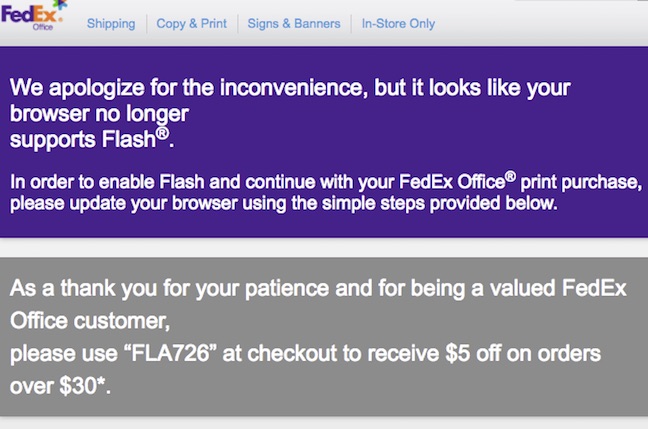
FedEx's Office Print department is offering customers $5 to enable Adobe Flash in their browsers. Why would they do such a thing you may ask? It's because they want customers to design posters, signs, manuals, banners and promotional agents using their "web-based config-o-tronic widgets," which requires Adobe Flash. The Register reports: But the web-based config-o-tronic widgets that let you whip and order those masterpieces requires Adobe Flash, the enemy of anyone interested in security and browser stability. And by anyone we mean Google, which with Chrome 56 will only load Flash if users say they want to use it, and Microsoft which will stop supporting Flash in its Edge browser when the Windows 10 Creators Update debuts. Mozilla's Firefox will still run Flash, but not for long. The impact of all that Flash hate is clearly that people are showing up at FedEx Office Print without the putrid plug-in. But seeing as they can't use the service without it, FedEx has to make the offer depicted above or visible online here. That page offers a link to download Flash, which is both a good and a bad idea. The good is that the link goes to the latest version of Flash, which includes years' worth of bug fixes. The bad is that Flash has needed bug fixes for years and a steady drip of newly-detected problems means there's no guarantee the software's woes have ended. Scoring yourself a $5 discount could therefore cost you plenty in future. -
College Fires IT Admin, Loses Access To Google Email, Successfully Sues IT Admin For $250K (theregister.co.uk)
An anonymous reader quotes a report from The Register: Shortly after the American College of Education (ACE) in Indiana fired IT administrator Triano Williams in April, 2016, it found that it no longer had any employees with admin access to the Google email service used by the school. In a lawsuit [PDF] filed against Williams in July, 2016, the school alleges that it asked Williams to return his work laptop, which was supposed to have the password saved. But when Williams did so in May that year, the complaint says, the computer was returned wiped, with a new operating system, and damaged to the point it could no longer be used. ACE claimed that its students could not access their Google-hosted ACE email accounts or their online coursework. The school appealed to Google, but Google at the time refused to help because the ACE administrator account had been linked to William's personal email address. "By setting up the administrator account under a non-ACE work email address, Mr Williams violated ACE's standard protocol with respect to administrator accounts," the school's complaint states. "ACE was unaware that Mr Williams' administrator account was not linked to his work address until after his employment ended." According to the school's court filing, Williams, through his attorney, said he would help the school reinstate its Google administrator account, provided the school paid $200,000 to settle his dispute over the termination of his employment. That amount is less than half the estimated $500,000 in harm the school says it has suffered due to its inability to access its Google account, according to a letter from William's attorney in Illinois, Calvita J Frederick. Frederick's letter claims that another employee set up the Google account and made Williams an administrator, but not the controlling administrator. It says the school locked itself out of the admin account through too many failed password attempts. Williams, in a counter-suit [PDF] filed last month, claims his termination followed from a pattern of unlawful discrimination by the school in the wake of a change in management. Pointing to the complaint she filed with the court in Illinois, Frederick said Williams wrote a letter [PDF] to a supervisor complaining about the poor race relations at the school and, as a result of that letter, he was told he had to relocate to Indianapolis. -
College Fires IT Admin, Loses Access To Google Email, Successfully Sues IT Admin For $250K (theregister.co.uk)
An anonymous reader quotes a report from The Register: Shortly after the American College of Education (ACE) in Indiana fired IT administrator Triano Williams in April, 2016, it found that it no longer had any employees with admin access to the Google email service used by the school. In a lawsuit [PDF] filed against Williams in July, 2016, the school alleges that it asked Williams to return his work laptop, which was supposed to have the password saved. But when Williams did so in May that year, the complaint says, the computer was returned wiped, with a new operating system, and damaged to the point it could no longer be used. ACE claimed that its students could not access their Google-hosted ACE email accounts or their online coursework. The school appealed to Google, but Google at the time refused to help because the ACE administrator account had been linked to William's personal email address. "By setting up the administrator account under a non-ACE work email address, Mr Williams violated ACE's standard protocol with respect to administrator accounts," the school's complaint states. "ACE was unaware that Mr Williams' administrator account was not linked to his work address until after his employment ended." According to the school's court filing, Williams, through his attorney, said he would help the school reinstate its Google administrator account, provided the school paid $200,000 to settle his dispute over the termination of his employment. That amount is less than half the estimated $500,000 in harm the school says it has suffered due to its inability to access its Google account, according to a letter from William's attorney in Illinois, Calvita J Frederick. Frederick's letter claims that another employee set up the Google account and made Williams an administrator, but not the controlling administrator. It says the school locked itself out of the admin account through too many failed password attempts. Williams, in a counter-suit [PDF] filed last month, claims his termination followed from a pattern of unlawful discrimination by the school in the wake of a change in management. Pointing to the complaint she filed with the court in Illinois, Frederick said Williams wrote a letter [PDF] to a supervisor complaining about the poor race relations at the school and, as a result of that letter, he was told he had to relocate to Indianapolis. -
College Fires IT Admin, Loses Access To Google Email, Successfully Sues IT Admin For $250K (theregister.co.uk)
An anonymous reader quotes a report from The Register: Shortly after the American College of Education (ACE) in Indiana fired IT administrator Triano Williams in April, 2016, it found that it no longer had any employees with admin access to the Google email service used by the school. In a lawsuit [PDF] filed against Williams in July, 2016, the school alleges that it asked Williams to return his work laptop, which was supposed to have the password saved. But when Williams did so in May that year, the complaint says, the computer was returned wiped, with a new operating system, and damaged to the point it could no longer be used. ACE claimed that its students could not access their Google-hosted ACE email accounts or their online coursework. The school appealed to Google, but Google at the time refused to help because the ACE administrator account had been linked to William's personal email address. "By setting up the administrator account under a non-ACE work email address, Mr Williams violated ACE's standard protocol with respect to administrator accounts," the school's complaint states. "ACE was unaware that Mr Williams' administrator account was not linked to his work address until after his employment ended." According to the school's court filing, Williams, through his attorney, said he would help the school reinstate its Google administrator account, provided the school paid $200,000 to settle his dispute over the termination of his employment. That amount is less than half the estimated $500,000 in harm the school says it has suffered due to its inability to access its Google account, according to a letter from William's attorney in Illinois, Calvita J Frederick. Frederick's letter claims that another employee set up the Google account and made Williams an administrator, but not the controlling administrator. It says the school locked itself out of the admin account through too many failed password attempts. Williams, in a counter-suit [PDF] filed last month, claims his termination followed from a pattern of unlawful discrimination by the school in the wake of a change in management. Pointing to the complaint she filed with the court in Illinois, Frederick said Williams wrote a letter [PDF] to a supervisor complaining about the poor race relations at the school and, as a result of that letter, he was told he had to relocate to Indianapolis. -
A Ham Radio Software Company Has Been Blacklisting Users For Leaving Negative Reviews (theregister.co.uk)
Gandalf_the_Beardy quotes a report from The Register: The Register reports on the story of Jim Giercyk, an amateur radio enthusiast who had his copy of the popular Ham Radio Deluxe (HRD) software revoked after posting a negative review. Other radio hams have followed up with us regarding claims that this was not an isolated incident and others may have had their license keys blacklisted for being publicly critical of the company. And just to be clear: by blackballing keys, installed copies of the software stop working. Giercyk, a professional musician in South Carolina, U.S., says that after his dealings with HRD Software (which has since reinstated his software key) and the statement made by the developer's co-owner Dr Michael Carper, he takes issue with claims made by the company. Giercyk, aka N2SUB, told us on Tuesday: "The issue is not the refusal of service, the issue is that HRD disabled my software, and then offered to enable it in exchange for the removal of an online review of their product. It's extortion, not refusal of service." Giercyk also said that since he went public about his blacklisting last week, he has received messages from other users who have stories of their software keys being revoked by HRD without their knowledge for speaking up about having a bad support experience. A number of other readers pointed out a collection of bad reviews posted on hobbyist site eHam by customers who had their license keys blacklisted. HRD told us some of those users could have written their assessments after requesting a refund and deactivating their software, thus their licenses will appear revoked. Meanwhile, Reddit threads and follow-up discussions to Giercyk's catalyst forum post reveal similar stories of keys being revoked after critical comments about Ham Radio Deluxe have appeared online. Other sources allege some amateur radio forums have in the past deleted posts critical of HRD. -
US Navy Faces $600M Lawsuit For Allegedly Pirating 3D VR Software (hothardware.com)
An anonymous reader quotes a report from HotHardware: The U.S. Navy has been accused of pirating 3D software after first testing a software package offered by Germany company Bitmanagement Software GmbH. The company is suing the United States of America for nearly $600 million. HotHardware reports: "According to the court filing, Bitmanagement licensed its BS Contact Geo software for use on 38 Navy computers from 2011 to 2012. This limited rollout was 'for the purposes of testing, trial runs, and integration into Navy systems.' While this test period was underway, the Navy reportedly began negotiating to license the software for use on thousands of additional computers. However, even as the negotiations were ongoing, the Navy decided to go ahead and initiate its full-scale rollout without actually paying for the software. In total, the initial 38 computers allegedly swelled to 104,922 computers by October 2013. As of today, BS Contact GEO is claimed to be installed on 558,466 Navy computers, although 'likely this unauthorized copying has taken place on an even larger scale' according to the filing. As if the unauthorized installation of software onto hundreds of thousands of computers wasn't enough, Bitmanagement is alleging that the Navy during 2014 began disabling the Flexwrap software that is tasked with tracking the use of BS Contact Geo and helping to prevent it from being duplicated. When this software piracy was taking place, the retail price of a single BS Contact Geo license was $1067.76. With nearly 600,000 computers now in play, Bitmanagement is seeking a whopping $596,308,103 in damages. The lawsuit, which alleges willful copyright infringement was filed on July 15th." -
Debian Founder's 2015 Death Ruled A Suicide (theregister.co.uk)
gosand writes: According to a story on The Register, the death of Ian Murdock in late 2015 has been ruled a suicide. This news brings some closure to the sad ending of his life. An interesting note from the article that I never knew before: "he was the Ian in Debian; his girlfriend at the time, Debra Lynn, was the Deb." Debian has truly been a cornerstone in the Linux world, and the founder will be missed. The medical report was obtained on Wednesday by CNN journalists. -
Microsoft Removes the 'X' From Windows 10 Update Leaving No Way Out (theregister.co.uk)
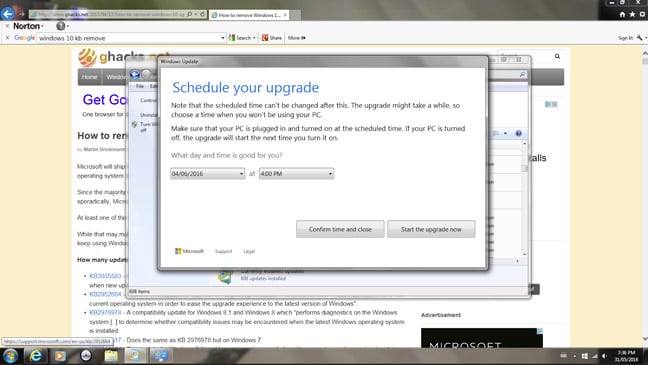
simpz writes: The Register reports that Microsoft has changed the Windows 10 update dialog and no longer shows the "X" close button. They say once agreed to there is no obvious back-out method and it is now out of step with Microsoft's own documentation on this. They have a screenshot of this. As noted above, the latest move is out of step with Microsoft's Knowledge Base documentation, which says you can re-schedule your upgrade. -
Sued For Using HTTPS: Companies In Crypto Patent Fight (theregister.co.uk)
yoink! writes: According to an article in The Register, corporations big and small are coming under legal fire from CryptoPeak. The Company holds U.S. Patent 6,202,150, which describes "auto-escrowable and auto-certifiable cryptosystems" and has claimed that the Elliptic Curve Cryptography methods/implementations used as part of the HTTPS protocol violates their intellectual property. Naturally, reasonable people disagree. -
Sneak Peek At Sun's SPARC Server Roadmap
The folks at The Register have gotten their hands on Sun's confidential roadmap from June, which outlines the company's plans for SPARC product lines. The chart has some basic technical details for the UltraSPARC T-series and the SPARC64 line. The long-anticipated "Rock" line is not mentioned. "We can expect a goosed SPARC64-VII+ chip any day now, which will run at 2.88 GHz and which will be a four-core, eight-threaded chip like its 'Jupiter' predecessor. This Jupiter+ chip is implemented in the same 65 nanometer process as the Jupiter chip was, and it is made by Fujitsu, a company that is in the process of outsourcing its chip manufacturing to Taiwan Semiconductor Manufacturing Corp. ... not only has Sun cut back on the threads with [the 2010 UltraSPARC model, codenamed Rainbow Falls], it has also cut back on the socket count, keeping it at the same four sockets used by the T5440 server. And instead of hitting something close to 2 GHz as it should be able to do as it shifts from a 65 nanometer to a 45 nanometer process in the middle of 2010, Sun is only telling customers that it can boost clock speeds to 1.67 GHz with Rainbow Falls." -
IBM's Transistor Data Revealed
Atryn writes "After last week's story — Intel and IBM both announcing breakthroughs in chip design enabling continued adherence to Moore's Law — many folks wondered how and why the two companies' announcements came out simultaneously. The Register explains it, and as a bonus they are releasing a leaked copy of IBM's future research documentation (PDF)."