Slashdot Mirror
Domain: reuk.co.uk
Stories and comments across the archive that link to reuk.co.uk.
Comments · 16
-
Transformer? Use a voltage multiplier...
A bit of googling turns up this cheap IC that would do the job (it's specifically made for running USB or LED devices off of low-voltage power sources).
But kudos to her for making the thing work & winning the prize. Anything that encourages kids to get into STEM is a good thing.
-
Desulfate lead acid batteries instead
The FA talks about Li-ion batteries but I've read about people buying dead car batteries real cheap and bringing them back to life by desulfating them with a simple circuit based on a 555 timer. The idea is to pulse the battery at its resonant frequency of about 4 MHz with high voltage pulses to break up the lead sulfate crystals that often cause a battery to fail. Car batteries might be a cheaper alternative to Li-ion batteries for a home system. Here's a link to the circuit:
http://www.reuk.co.uk/Battery-Desulfation.htm -
Re:Backup and fill-in
However, I'm pretty sure this isn't the case in Germany: it's farther north, it's not that sunny, it probably doesn't get that hot in the summer, and it gets cold in the winter and at night.
Germany has one of the highest rates of solar installation in the world.
According to this insolation map most of Finland receives only a tad less useful solar radiation than most of Germany - one gradation step on their scale.
Plus, cold temps actually make most PV systems work more efficiently. Those arizona summers can knock nearly 40% off the efficiency.
-
Re:Makes sense...
I believe trees for the most part lose their leaves because water freezes in winter and this would make it difficult to keep nutrients flowing to the leaves. Nature has established a balancing act based on the needs of a particular species in a given geographical context. What is being balanced will vary. It is not all about solar input in plants.
For the solar panels it could be a heat issue. I remember reading a few months back that solar panel efficiencies drop when it gets too hot. Here is one article making reference to this:
http://www.reuk.co.uk/Effect-of-Temperature-on-Solar-Panels.htm
-
An at home
solar dish. Put a Stirling engine at the focal point. Cover the dish in Mylar.
http://www.reuk.co.uk/Stirling-Engine-Solar-Power.htm
You could also use it to hold guacamole dip.
-
Re:*HUGH* Pickens?
"And the 600MW means nothing of how much electricity the turbine will produce over the year."
Of course it means nothing over a year, since MW is a rate unit, i.e. a unit of energy per time.
To be fair, I believe what you were trying to say is that it will not always be producing electricity at a rate of 600MW. To find out what the true average rate, you assume the wind speeds follow a weibull distribution, and you integrate over time assuming that distribution.
On line calculator: http://www.reuk.co.uk/Calculate-kWh-Generated-by-Wind-Turbine.htm
-
Re:Finally
Ok. Quick list before I head home from my engineering job.
Solar cell (photovoltaic) efficiencies.
http://en.wikipedia.org/wiki/Solar_cell
Power grid issues with Wind and Solar.
http://www.nytimes.com/2008/11/10/business/10grid.html?_r=4&oref=slogin&oref=slogin
http://www.nytimes.com/2008/08/27/business/27grid.html
A host of nonpartisan (I'm independant BTW) issues can be found in the wikipedia articles for Geothermal and Tidal (waveform hydroelectric) power. Ironically enough, they can generate power, but are equally horrible for the environment in other ways. Not to mention they are extremely cost prohibitive in most circumstances.
http://en.wikipedia.org/wiki/Geothermal_energy
http://en.wikipedia.org/wiki/Hydrogen_sulfide
Worldwide we are producing about 10GW of power using geothermal today. Overall, thats not alot. And geothermal has many construction and engineering hurdles to overcome that are different with EACH installation which increases costs and can reduce overall output. Technology can solve this problem, yet again, its not there yet. Not reliably anyways.
http://en.wikipedia.org/wiki/Tidal_power
http://en.wikipedia.org/wiki/Severn_Barrage
http://www.reuk.co.uk/Severn-Barrage-Tidal-Power.htm
Even if they start the Severn Barrage right this second, it would not be fully operational and completed until 2020 at the earliest. The construction costs are nearly $40 billion (24bn. pounds), and the total power output would be around 8.6GW under ideal circumstances. Output is dependant on variable scenarious such as weather (which can also cause damage) and current. Expected average output is about 2GW. Current nuclear technology can generate upwards of 1.4-1.5GW of power per reactor with multiple reactors built at each plant.
http://www.reuk.co.uk/Severn-Barrage-Tidal-Power.htm
So, about that extensive data you have seen. Want to provide some links that have hard numbers and are based in facts or do you want to sit over there and provide no helpful commentary yourself other than to say I'm wrong and you're right? -
Re:Finally
Ok. Quick list before I head home from my engineering job.
Solar cell (photovoltaic) efficiencies.
http://en.wikipedia.org/wiki/Solar_cell
Power grid issues with Wind and Solar.
http://www.nytimes.com/2008/11/10/business/10grid.html?_r=4&oref=slogin&oref=slogin
http://www.nytimes.com/2008/08/27/business/27grid.html
A host of nonpartisan (I'm independant BTW) issues can be found in the wikipedia articles for Geothermal and Tidal (waveform hydroelectric) power. Ironically enough, they can generate power, but are equally horrible for the environment in other ways. Not to mention they are extremely cost prohibitive in most circumstances.
http://en.wikipedia.org/wiki/Geothermal_energy
http://en.wikipedia.org/wiki/Hydrogen_sulfide
Worldwide we are producing about 10GW of power using geothermal today. Overall, thats not alot. And geothermal has many construction and engineering hurdles to overcome that are different with EACH installation which increases costs and can reduce overall output. Technology can solve this problem, yet again, its not there yet. Not reliably anyways.
http://en.wikipedia.org/wiki/Tidal_power
http://en.wikipedia.org/wiki/Severn_Barrage
http://www.reuk.co.uk/Severn-Barrage-Tidal-Power.htm
Even if they start the Severn Barrage right this second, it would not be fully operational and completed until 2020 at the earliest. The construction costs are nearly $40 billion (24bn. pounds), and the total power output would be around 8.6GW under ideal circumstances. Output is dependant on variable scenarious such as weather (which can also cause damage) and current. Expected average output is about 2GW. Current nuclear technology can generate upwards of 1.4-1.5GW of power per reactor with multiple reactors built at each plant.
http://www.reuk.co.uk/Severn-Barrage-Tidal-Power.htm
So, about that extensive data you have seen. Want to provide some links that have hard numbers and are based in facts or do you want to sit over there and provide no helpful commentary yourself other than to say I'm wrong and you're right? -
Re:Cool; Now to expand to the great lakes
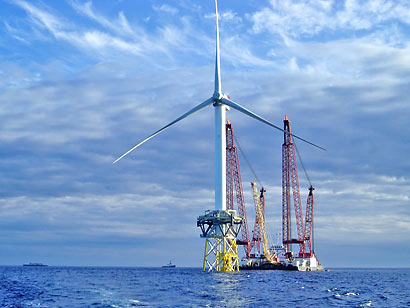
I Bet the turbines are similar to these: http://www.reuk.co.uk/OtherImages/repower-5mw-wind-turbine.jpg
There is a motorized & computer-controlled 360 Degree bearing surface where the generator housing nacelle attaches to the vertical supporting column. The computers on-board each generator keep their own weather sensors for wind speed and direction as well as for power demands of the cluster of wind generators and they calculate how best to pitch their blades and what direction to point or if they need to feather their pitch because of an incoming storm, etc...
General Electric has a detailed drawing of one of their models here: http://www.gepower.com/prod_serv/products/wind_turbines/en/36mw/index.htm -
Re:Tidal is different from wind
Actually they have offshore windmills all wrong - they should be putting the spinning bits Under the water to take advantage of the tidal currents around the UK, these have a number of advantages: -
1) There's much more energy density in all that dense water that's moving around (even if it doesn't move as quickly as the wind)
2) Most importantly, tidal currents are very, very predictable (unlike the wind). You can easily work out years ahead exactly how much energy you are going to be getting from each tidal turbine.
3) Although any tidal turbine is going to experience times of slack water, the nature of tides is such that given a sufficient geographic spread, this will happen at different times in different places.
4) Tidal turbines are effectively invisible - the business end is entirely underwater. (Although there are, of course, questions about the effect of spinning blades on fish, and the problems of fishing boats.) Compare that to a 1000ft high windmill.
Some estimates put the amount of energy available around the Channel Islands (off the northwest coast of France) at anything up to 25GW - which is hardly surprising given a local tidal range of 10-12m.
Other areas around the UK (such as the Bristol Channel) have an equally high potential.
Why aren't we putting more effort into developing what seems to be the ultimate renewable energy resource - reliable, predictable, and with minimal impact on the environment? -
Re:The requirements...
Hmm.. Or for 10 Gigawatts, you could use a solar plant about 10x10 miles in the Nevada desert. This sceme http://www.reuk.co.uk/Nevada-Solar-One.htm Delivers 64 Mw for 350 acres = 45 watts per sqr meter. 10 x10 miles = 260 000 000 m2, x 45 (watts) = 11.7 GigaWatt supply. Yup ok, day only - but you are charging car batteries, so you could work out a scheme that does that in the day. They reckon it costs around $0.07/Kwh.
You are right on one thing though - probably better to just generate & use electricity directly than to mess about with Hydrogen, etc. Think of all the plastic/glass you would need to contain the algea and collect the gas.. -
Re:Give me figures.
Solar cells, or a combination of mirrors and sterling engines, will probably always beat out organisms for pure efficiency. Doesn't mean we don't also want the organisms. Particularly when the object of the exercise is hydrogen production, since water electrolysis isn't very efficient either. In practical economic terms, bioproduction of hydrogen (or other fuels) may make more sense than using generated electricity.
I think the crux there is whether you want Hydrogen or Bio-fuel at all. Improvements in Batteries are making straight-forward electric cars more and more feasable - just use the electricity from solar/wind/tidal (and for that matter nuclear) directly, bypass the large inefficiency involved in Hydrogen or Biomass generation/storage (most of the storage methods for Hydrogen cars are very poor - less than 2% Hydrogen for overall stored weight). For example, (from another thread) I calculated you needed about 100x100 miles of Nevada desert to generate the complete daytime US gridload (approx 1 TerraWatt). This scheme in Nevada:
http://www.reuk.co.uk/Nevada-Solar-One.htm
Delivers 64 Mw for 350 acres = 45 watts per sqr meter.
100 x100 miles = 26 000 000 000 m2.
x 45 (watts) = 1.17 TerraWatt supply.
Cost? Figures vary, but Nevada Solar quote about $0.07/Kwh, wind and others maybe a little less. I wonder how algea would compare, in terms of cost, land/water used, and so on.. -
More details...
Ok, additional info to my original post..
You would need to build a solar plant of about 100 x 100 Miles in the Nevada desert to generate the USAs electricity. USA had around 743 GigaWatt (0.743 TerraWatt) installed generating capacity in 1998 - I will dig out a newer figure, but lets say about 1 TerraWatt today.. This scheme in Nevada:
http://www.reuk.co.uk/Nevada-Solar-One.htm
Delievers 64 Mw for 350 acres = 45 watts per sqr meter.
100 x100 miles = 26 000 000 000 m2.
* 44 (watts) = 1.17 TerraWatt supply. Is 100x100 miles too much? How does it compare to coal-strip mining?
It is true that the sun doesnt shine at night - so in reality you would have a mix - wind power, tidal, etc - backed up with ready-to-roll capacity, pumped hyroelectric storage, and new tech like very large SuperCapacitors. Technology is moving all the time..
Cost? Figures vary, but Nevada Solar quote about $0.07/Kwh, wind and others maybe a little less. With oil hitting $80 a barrel this looks good, its hard to compare to Nuclear because of the huge hidden subsidies it recieved, both in terms of research and hidden unknown costs like waste disposal and decomissioning..
More links on power schemes..
http://www.renewableenergyaccess.com/rea/news/story?id=46415
http://www.treehugger.com/files/2006/08/worlds_largest_4.php
http://sfgate.com/cgi-bin/article.cgi?f=/c/a/2006/06/21/BUG9VJHBLB1.DTL
http://www.dw-world.de/dw/article/0,2144,1321857,00.html
http://www.pvresources.com/en/top50pv.php
http://news.bbc.co.uk/1/hi/scotland/glasgow_and_west/6031995.stm
As for Three Mile Island, read this link. Years later, when they could actually inspect inside the reactor, they were horrified to see just what a mess it was in - a huge glob of melted reactor fuel nearly breached the containment vessel - it was very very close to a Chernobyl type meltdown..
http://americanhistory.si.edu/tmi/tmi03.htm
-
Re:Congratulations!
Let us say the figure is 2 KWh daily per m^2. Your 100x100 km piece of desert has 10,000,000,000 m^2, thus it makes 2*10^10 GWh daily. Another quick check with wikipedia tells me that annually the USA consumes 29000 TWh. The figure is for 2005. 29000 TWh is 29,000,000 GWh. The gap between 29,000,000 and 20*365 is substantial. You will need a bigger solar farm by several magnitudes. And you will never build it, it is a pipe dream.
Way, way out. 29000 TWh (av supply 3.3 TerraWatts) is ALL power - including the calorific value of oil for transport & heating, not just electric. USA had around 743 GigaWatt (.743 Tw) installed ELECTRIC generating capacity in 1998 - I will dig out a newer figure, but lets say about 1 Tw today.. This scheme in Nevada:
http://www.reuk.co.uk/Nevada-Solar-One.htm
Delievers 64 Mw for 350 acres = 45 watts per sqr meter.
45 * 10 000 000 000 = 450 000 000 000 watts for 100x100km, or 450 GigaWatts supply..
I did make a mistake - the original quote was 100x100 MILES not km..
= 26 000 000 000 m2, *45 = 1170 Gigawatts supply..
As for Three Mile Island, read the link. Years later, when they could inspect the reactor, they were horrified to see just what a mess the reactor was in - it was very very close to a Chernobyl type meltdown..
http://americanhistory.si.edu/tmi/tmi03.htm -
Re:Please Mod Parent Up
This is how some load levelling is actually done at modern power plants.
Plants? National Grids, in some instances! Dinorwig Power Station in North Wales can bring 1800MW online in 16 seconds. It also has diesel generators and what's basically a massive UPS so that it can actually self-start if the whole grid is down, to help kick-start the entire national grid. All built inside a mountain. I visited before they installed the turbines, that was one big rock chamber...
Yes, Pump storage plants will become increasingly important if we move to less constant renewable sources of energy. -
Re:Electric Emoticon Announcement
.1 Richter microquakes, yes, of course. Sometimes going up to even 2 to 3 on the Richter scale- but just because pressure is building for a larger quake doesn't mean that all movement is stopped. The Mid Atlantic ridge, while useless for the above energy example, is a good example of perpetual quakes, it's litterally spreading (divergent) apart at 2.5cm/year. On second thought, that's a good example- more traditional methods of geothermal energy extraction from that specific ridge line allow Iceland to generate Geothermal energy, with one hot plant producing over 90MW of electricity, and geothermal energy being 13% of the energy production for the island.