Slashdot Mirror
Domain: roughlydrafted.com
Stories and comments across the archive that link to roughlydrafted.com.
Comments · 990
-
Re:And by "support" you mean..
Darwin is a hybrid kernel that uses low level elements of Mach paired with higher level elements of BSD, not two different kernels.
However, NeXT developed OpenStep as a universal operating system environment that actually ran in production on Solaris, the Win NT kernel + OS, as well as the Mach/BSD kernel ported to various hardware.
Apple planned to port that layer on top of the Mac OS too (providing a Yellow Box that could run like Java anywhere), then realized it made more sense to use Mach/BSD and port the Mac appearance on top of OpenStep, and ended up making enough modifications to kill any backward compatibility with the OpenStep specification.
That's what Mac OS X is.
-
Re:What's the point of multitasking?
In all seriousness , the reason the iPhone and the iPod Touch do not multitask is not related to hardware or software. The sole reason Apple enforces the no-multitask policy is to ensure that multiple running apps don't drag down the system. Apparently, WinCE has a tendency to be bogged down when running multiple apps and Apple wants to avoid that.
http://www.roughlydrafted.com/2008/03/13/iphone-20-sdk-the-no-multitasking-myth/
-
Re:Please develop Android apps instead
Well you can say "I told you so" when Android reaches an installed base that is approaching that of the iPhone.
When that happens, we can talk about whether multi-vendor differentiation and platform fragmentation (different screen resolutions, missing hardware features, different peripheral connectors, etc) will render the Android platform cohesive enough to support the software sales volumes of the iPhone/iPod touch.
Note that Windows Mobile and Java ME haven't achieved a cohesive platform that developers can really expect to target that is even now (after a decade) as large as Apple has created on the iPhone in the last year and a half.
* 30 million iPhone+iPod touch, pretty much all identically compatible.
* 50 million WinMo licenses (many now obsolete), fractured into touchscreen-lacking "Windows Smartphones" with tiny displays, Pocket PC PDAs, Treo-like button phones, and HTC style mini-puter mobile devices, all with different connectors and hardware features.
* 100s mlllion JavaME, fractioned into hundreds phones with incompatible runtimes that make successfully targeting the "platform" with significantly complex software virtually impossible -
Re:Not to be an apologist...
By "opposite" you mean that developers wouldn't be making a decent cut for their software (like the Xbox), or that Microsoft wouldn't be selling enough similarly equipped hardware to create a viable market (like Windows Mobile)?
-
Re:Not to be an apologist...
Is there any evidence that there is any real volume of software being returned through the Apple App Store, or is the conversation just a theoretical, fear mongering bunch of sensationalism?
Sounds like complaining about sand getting in your shorts while laying on the beach.
-
CIA, monitor the US
Having the American CIA monitoring elections in other countries during the Bush Administration is like Microsoft looking for security vulnerabilities in Linux and Mac OS X.
Kaspersky Sells Mac AntiVirus Fear Using Charlie Miller... Mac AntiVirus Foe
-
Re:In other words...
Yes, have you used the Wii store? It's a steaming pile of shit compared to iTunes.
Nintendo knows how to make fun gameplay, not how to market software or develop interfaces.
Ever play a Wii game?
"Hello!" Press A!
"I'm a cute star creature!!" Press A!
"I can give you a powerup!" Press A!
"Feed me star bits!" Press A!
"Do you want this or that type?" Select A or B on screen.
"Here you go!!!!!!" (animated delay) Press A! -
Re:And DRM in the fucking *headphones*.
The EFF, and specifically Fred von Lohmann, is not only taking a shaky position here, but expressing it ignorantly. The group is getting good at going on witch hunts without really knowing what they're talking about.
For starters, comparing Apple against Microsoft, Ford, Toyota is not just stupid, but apeshit retarded. Microsoft isn't a principally hardware maker, but its hardware IS all encrusted with DRM, from the Xbox to Zune. It also promotes WMA/WMV DRM on files and HD-DVD style end to end video output DRM on PCs, so von Lohmanns' comments are ridiculous.
Ford and Toyota all use proprietary parts in their vehicles that can not be swapped out for third party bits from any supplier a user might want to pick from.
But secondly, the guy doesn't even verify the information he's complaining about at full speed. Fred von Lohmann is a shoot first, gather details later kind of guy. He was the same EFF staffer who wrote, "Apple is among the worst offenders when it comes to messing around with stuff you've already paid for. But iTunes 7.2 is likely to be remembered for the especially wicked tricks it plays on iTunes customers."
That's the same whiney moralist language he's using here, but he was wrong about iTunes 7.2 removing the ability to rip tracks to CD. That didn't stop him from prattling on about it.
Von Lohmann thought iTunes could no longer burn and re-rip music after reading about it in a blog. He was wrong, because the blogger he believed was also mistaken. However, von Lohmann did not correct his posting accusing Apple of "removing the feature" from iTunes; he also cited [EFF's Peter] Eckersley's "previous revelations" [erroneous nonsense about metadata spying in iTunes] as proof Apple could not be trusted.
-
Re:Single-point Rebuttal
Money. And while you're lusting after your "not bad looking smart chick," she's monopolizing the ad market, fucking over advertisers and content producers both, and using that money to develop fun apps and tools. But she isn't generating revenue for smartphone developers. So good luck with writing Android apps as a hobby while you fantasize about Google Corporation as your ideal woman.
The rest of the world is writing mobile software for Apple's platform, not because it tickles their fantasies, but because it makes them money. That's how things get done.
-
Re:comparing prices of xPhone apps
He's quoting from an earlier article by the same guy who wrote that AI article, which at this point is pretty dated. (Right after the iPhone was announced.) It's the one referred to in his recent article when alleging ABI Research shenanigans.
Obviously no, he didn't consider IE Mobile at that point particularly "real." Opera was probably the best alternative, but didn't really compare back in the mid-8 releases. Skyfire wasn't even an inkling back then, and wouldn't release anything for over a year. Fennec, obviously, would be about 2 years from a preview release. -
Re:I have to ask
The Xbox failed in Japan and Asia largely because of cultural differences in gaming preferences.
Considering how much of the worldwide market for gaming is based in Asia, yes market share and installed base does matter in console gaming as it has a major impact on how much attention Microsoft can get behind its console from developers.
Also, given that console sales are initially sold at a loss, failing to sell large volumes in Asia means that the console price can't come down as quickly as if it were selling globally in high volume.
There is less cultural resistance to the iPhone because Japanese developers can build games suited to the Asian audience with relatively little overhead (it's much cheaper to develop $1 mobile games than $70 game console titles).
Apple has pretty decent market share going into Japan, as many users get an iPhone in addition to their existing phone, much like BlackBerry users often carry two phones. The meme about the iPhone not being well regarded in Japan because there are fancier hardware handsets available was a key flaw in the original story; that's simply not the case. UI matters.
And third, Apple's ability to sell the iPhone in large volumes, along with the iPod touch, means that the company has enormous economies of scale working to its advantage in bringing down iPhone costs and advancing its hardware in 3.0.
How Apple Is Changing the PC Software World... Back
-
Re:comparing prices of xPhone apps
The software distributor takes a cut. In this case, Handango takes 50% to 70% (really!) of developers' revenues.
Obviously Microsoft can't take a cut if it's not even involved in the transaction. Which is why the company is now getting ready to launch SkyMarket to destroy the ineffectual WiMo stores and replace them with a place WiMo developers can pay Microsoft to distribute their software, just like Apple.
And Adobe Flash on mobile devices is a liability, not a feature. Try browsing the web without Flash on your desktop browser and you'll realize how fast and less shitty the web is without Adobe's crapware layer of ad distribution and anti-HTML web sites.
Microsoft plans 'Skymarket' apps store for Windows Mobile 7 in 2009
-
Re:comparing prices of xPhone apps
Actually that listing of software was taken from the top most popular software titles from the Windows Mobile site Microsoft was recommending to its developers at the time (before it decided to cut its "ecosystem" down to launch its own store, sort of like it killed PlaysforSure with the Zune, before failing there too).
And "bias" is something you can evaluate. Anyone with a fair intellect can learn from biased sources. Nobody needs a tard warning them of "bias," so do us a favor and return to playing games in your mom's basement on your tricked out Windows PC.
-
Re:I'd say no.
Actually Atari failed in early video games because it exercised no control over games, resulting in a huge glut of unplayable junk that finally collapsed in 1982. It was Nintendo that brought back gaming, and only through a licensing program that verified that the third parties had paid Nintendo fees and met some quality assurance program (which was probably mostly fees).
No "open gaming" effort, and there have been many, has ever established a better market than that offered by the winning DRM/licensed, closed platform since: NES, SuperNES, Genesis, N64, PlayStation, PS2, Xbox, PS2, Wii - and handheld games are the same.
To suggest that Apple should give up its blockbuster App Store and adopt a loser mobile software market like "open" Palm OS or Windows Mobile is just as absurd as expecting Nintendo/MS/Sony to open up gaming to anyone, royalty free.
-
Re:you know
Xerox invested a million dollars in Apple as part of a deal to develop its rough ideas into a consumer product. Apple's Mac had very little in common usability-wise with the Xerox technology. The Star was fantastically expensive idea for selling an entire office of networked systems and in no way competed against the Mac.
Microsoft was a third party developer with Apple, ripped off its software wholesale to create a direct competitor, violated its contracts with Apple, and later stole portions of QuickTime while leaving the scene.
Office Wars 3 - How Microsoft Got Its Office Monopoly
-
Re:Not so hippocritical
Apple did "develop this on their own," it's called MobileMe. There will also be Push Notifications in Snow Leopard. Apple only licensed Exchange ActiveSync to be able to develop its own implementation of Microsoft's proprietary push for Exchange compatibility, which is a feature that runs in addition to Apple's own push software.
Microsoft did not hand Apple magical software beans that turned the iPhone into a PC running its Win32 Outlook code.
EAS is not an "embedded Exchange Client," its just a way to send push notifications to mobile devices from an Exchange Server, Microsoft efforts to clone and kill RIM's BES.
Inside MobileMe: Apple's Push vs Exchange, BlackBerry, Google
-
Re:the secret:
There was never any significant market for Pocket PC / WinCE PDAs. Gartner once talked about the entire market for PDAs as being close to 10 million per year, but that counted BlackBerry phones as PDAs (but not Palm Treos; guess who Gartner was working for).
Take out Windows Mobile devices and the WinCE pool dries up into a light dusting of ridiculousness.
No, HTC wants to use Android because its free and unrestricted, not "because they can." The problem with Android is that it doesn't "just work" yet. One thing Microsoft has done in the last ten years of WinCE work is get its phone stack working across a wide variety of hardware. That's why HTC doesn't just poop out its existing phones in Android versions.
There is a huge amount of work involved in getting any smartphone finished. It's basically a computer running whatever "mobile OS" runs the interface, tied to a self contained cellular unit with all sorts of its own oddities that require lots of time to get working properly.
The problem for Microsoft is that the world doesn't need that sort of integration. Users want a nice phone that works, not a huge array of slightly different phones that all look like crap.
-
Re:the secret:
Actually, HTC has made 80% of all Windows Mobile devices ever sold. Which makes it very curious why Microsoft's greatest partner by far has chosen to advocate and pioneer development of Android, making the first (T-Mobile G1) and announcing the second (the Vodaphone).
The only reason HTC isn't more vocal is that Microsoft paid it to shut up about Android at MWC, just as it did with LG, the other founding member of the Google OHA with Android phones planned , but only chatting up Windows Mobile 6.5 at the event.
Why did Microsoft need to pay these companies for their headlines? And why are they both still making Android phones if they're happy with Microsoft?
Microsoft: HTC has made 80% of all Windows Mobile phones
Did Microsoft kill Android at Mobile World Congress 2009? -
Re:the secret:
Actually, HTC has made 80% of all Windows Mobile devices ever sold. Which makes it very curious why Microsoft's greatest partner by far has chosen to advocate and pioneer development of Android, making the first (T-Mobile G1) and announcing the second (the Vodaphone).
The only reason HTC isn't more vocal is that Microsoft paid it to shut up about Android at MWC, just as it did with LG, the other founding member of the Google OHA with Android phones planned , but only chatting up Windows Mobile 6.5 at the event.
Why did Microsoft need to pay these companies for their headlines? And why are they both still making Android phones if they're happy with Microsoft?
Microsoft: HTC has made 80% of all Windows Mobile phones
Did Microsoft kill Android at Mobile World Congress 2009? -
Re:Well one thing's for sure
It will also feature an apparent "global opt out" program on its remote wipe capabilities.
-
Re:An edge?
Windows Mobile doesn't really have touch support 'similar to the iPhone,' but instead supports stylus-oriented resistive screens rather than finger-savvy capacitance sensing technology used on the iPhone. That results in users needing to press methodically and deliberately on the screen, an entirely different experience compared to the iPhone. Resistance-stylus screens are required to keep alive the fantasy of Bill Gates' future of Tablet PCs, where everyone walks around writing on electronic pads with big screens.
Never mind that that approach has failed to take off for twenty years now, pioneered by GRiD, developed graphically by Apple in the Newton, briefly sold successfully by Palm before it moved into smartphones with mini keys, and replicated by a series of Windows CE devices that never went anywhere. Stylus touch screens are another videophone, something everyone anticipates for the future despite a long history of deliberate rejection in the market.
-
Re:Microsoft has opened retail stores before
Yes marketing is powerful.
Speaking of the Mojave Experiment, what really happened was that Microsoft took people and showed them a controlled experiment on computers that were well equipped for the time, better than people were using at home. There was no exposure of Vista to those user's existing hardware or software.
That's a great way to dispel the problems of Vista as fictional, when the real complaints were actually 1) performance 2) compatibility with existing software and 3) missing drivers for lots of hardware.
Windows 7 is just Vista SE.
Also, businesses aren't embarked upon to break even, but that does seem to be the best Microsoft's proponents can hope for every time the company tries to enter a new market. Seems that the company doesn't do too well unless it's in a monopoly position where customers have no other choice. Which brings us back to the very low bar set for Microsoft.
Not that I want you to stop admiring your naked, fundamentally retarded god. Go right ahead, please. It's very entertaining to watch you reverentially grovel before incompetence.
-
Re:Microsoft has opened retail stores before
There were no customers though, that's the tricky bit.
I remember going there. It was a bizarre empty space of rows of software boxes. They tried to make it hands on, but there wasn't really anything interesting going on, and nothing really anyone would want to buy in a retail store. That's why it closed two years later. It wasn't really a store so much as a show of thing.
Apple planned cybercafes in 1997 that similarly fizzled, but when the company got serious about retail, they brought on a retailer CEO to the board, and hired a team of big name merchandizing and retail real estate experts.
Microsoft has put the thing in charge of a marketing droid from Dreamworks who had been a manager at Walmart, and who answers to the COO, who sees the plan as a way to, in his words:
"transform the PC and Microsoft buying experience at retail by improving the articulation and demonstration of the Microsoft innovation and value proposition so that itâ(TM)s clear, simple and straightforward for consumers everywhere"
I am not making that up - good luck with that.
Microsoft to open new retail stores like Apple
-
Re:Who or what is the target for WebOS?
No, WebOS hasn't "been in the works for years." Palm has been fooling around with Linux for a long time, but to suggest that WebOS has been in development for any period of time, and particularly longer than Android, is ridiculous.
WebOS is not really a "Linux platform" any more than Android is (that is, nothing in common with desktop Linux or LiMo as far as app development goes), both are just new things on top of a Linux kernel.
Android was announced shortly after the iPhone, and had been in development for some time at that point. Google bought a company called Android and developed its Java-like dev platform over several years. Android's SDK became public at the same time as the iPhone's SDK plans in late 2007, and both emerged in 2008.
Remember that early last year, Palm was readying its Linux-based Foleo, which was a more conventional Linux platform using a custom-built widget framework called HxUI, based on the LiTE toolbox. It was not running WebOS or anything really like it.
Palm completely pulled WebOS out of its ass within 2008 to have something to demo, and the new "operating system," which is really just a WebKit-based Dashboard, won't be ready until lat this year. This thing hasn't been "gestating for years" any more than Microsoft's ridiculous Surface bathtub. It's a hail mary pass.
As to why Palm wouldn't use Android: the company desperately wants to maintain proprietary ownership of an OS that can differentiate its hardware, because its hardware isn't special enough to stand out on its own. With HTC building the Treo, how would an Android Palm ever be more attractive than an Android HTC unit, or any other Android phone from any number of handset makers that can build better hardware than Palm? The company figured that out that lesson the hard way when it licensed Windows Mobile.
The only two smartphone companies doing really well right now (in terms of growth) are RIM and Apple, and both have proprietary software platforms that integrate well with their hardware (outside of the Storm that is). WiMo, Android, and Symbian are all fighting to offer OS software (trying to play the Microsoft) in a hardware market where the OS is now free. When the software is free, the hardware has to stand out. Palm's doesn't.
The hardware specs on the iPhone are fair, not incredible. It has a crappy 2006 camera for example. People buy it for the software, which adds value because it does unique things and can't be obtained elsewhere. If the iPhone ran Android, Symbian, Windows Mobile, or the Palm OS, Apple would have had a hard time competing against more experienced hardware makers with bigger numbers in their stats.
Palm is trying to be Apple, quite obviously. The problem is that Palm has no blockbuster revenue stream from Macs and iPods, nor retail/marketing acumen, nor any position in digital downloads with iTunes. So Palm is really like RIM, except that its position in the enterprise has faded off into the sunset.
Will Google's Android Play DOS to Appleâ(TM)s iPhone?
-
Re:What happened to BeOS?
No they bought the BeOS company. The engineers largely fled, with many of them going to Apple, including Newton guy Steve Sakoman and DominicGiampaolo, the engineer behind BeOS' metadata file system who ended up designing Apple's Spotlight metadata search architecture for example.
The Egregious Incompetence of Palm
Interestingly, Palm followed all of the armchair advice that pundits offered for Apple, with completely disastrous results:
â License its OS to other hardware makers
â Copy Microsoft's Windows strategies
â Compete directly against Microsoft in IT markets
â Split into hardware and software companies
â Buy Be, Inc. for its BeOS
â Adopt the Linux kernel
â License Windows from MicrosoftWhat Palm is doing with WebOS is taking WebKit and making essentially a Dashboard-oriented PDA, where apps are just HTML+ JavaScript widgets. That allows Palm to claim that it is "multitasking" while not actually running any real significant applications. That's a pretty decent strategy for Palm, but sure isn't the iPhone Killer that the media has made it out to be.
Palm Pre: The Emperor's New Phone
Why Apple's Tim Cook Did Not Threaten Palm Pre -
Re:What happened to BeOS?
No they bought the BeOS company. The engineers largely fled, with many of them going to Apple, including Newton guy Steve Sakoman and DominicGiampaolo, the engineer behind BeOS' metadata file system who ended up designing Apple's Spotlight metadata search architecture for example.
The Egregious Incompetence of Palm
Interestingly, Palm followed all of the armchair advice that pundits offered for Apple, with completely disastrous results:
â License its OS to other hardware makers
â Copy Microsoft's Windows strategies
â Compete directly against Microsoft in IT markets
â Split into hardware and software companies
â Buy Be, Inc. for its BeOS
â Adopt the Linux kernel
â License Windows from MicrosoftWhat Palm is doing with WebOS is taking WebKit and making essentially a Dashboard-oriented PDA, where apps are just HTML+ JavaScript widgets. That allows Palm to claim that it is "multitasking" while not actually running any real significant applications. That's a pretty decent strategy for Palm, but sure isn't the iPhone Killer that the media has made it out to be.
Palm Pre: The Emperor's New Phone
Why Apple's Tim Cook Did Not Threaten Palm Pre -
Re:What happened to BeOS?
No they bought the BeOS company. The engineers largely fled, with many of them going to Apple, including Newton guy Steve Sakoman and DominicGiampaolo, the engineer behind BeOS' metadata file system who ended up designing Apple's Spotlight metadata search architecture for example.
The Egregious Incompetence of Palm
Interestingly, Palm followed all of the armchair advice that pundits offered for Apple, with completely disastrous results:
â License its OS to other hardware makers
â Copy Microsoft's Windows strategies
â Compete directly against Microsoft in IT markets
â Split into hardware and software companies
â Buy Be, Inc. for its BeOS
â Adopt the Linux kernel
â License Windows from MicrosoftWhat Palm is doing with WebOS is taking WebKit and making essentially a Dashboard-oriented PDA, where apps are just HTML+ JavaScript widgets. That allows Palm to claim that it is "multitasking" while not actually running any real significant applications. That's a pretty decent strategy for Palm, but sure isn't the iPhone Killer that the media has made it out to be.
Palm Pre: The Emperor's New Phone
Why Apple's Tim Cook Did Not Threaten Palm Pre -
ReligiOS
They should merge the soul of BeOS in with AmigaOS and maybe the Palm OS to release ReligiOS, keeper of of the faith.
They could sell it to those gullible televangelist audiences as JesOS, market it to fundamentalist Jews as the Messiah OS, and to fervent Muslims as MuhammaDOS.
Imagine all the faithful putting aside their wars and terrorism and instead taking their angst to alt.systems.advocacy.religios to flame each other in a more figurative sense. I'm sure all the gods in heaven would approve.
-
Don't have to wait long
Snow Leopard is already known to be coming with slimmed down applications http://www.roughlydrafted.com/2008/06/29/solving-the-mystery-of-snow-leopards-shrinking-apps/
-
Re:Interesting Analysis
If Apples patent is fairly specific and not overly broad, it can only stop Palm from using the same implementation as Apple. If Palm, or anyone else for that matter, wants to implement similar functionality they'll be forced to develop a Novel, non-infringing implementation. This is innovation by it's very definition.
I agree that if Apple were to start suing anyone that attempted to develop multi-touch implementations that do not violate their patent, then they could be accused of stifling innovation. However, that hasn't happened yet and there is little evidence that they are planning on it. Most of this speculation is based on responses that were made during the quarterly conference call, and taken out of context to create the appearance that Apple has been threatening Palm.
Taken from roughlydrafted.com:
Question: "Now a number of competitors coming for iPhone. Their own variance on customer experience, Palm Pre, Android, Windows. How do you think about sustaining your leadership in sector?"
Cook: "I would say, first of all, it's difficult to judge products that are not yet in the market. The iPhone has sold over 17 million units thus far. It's received the highest overall customer satisfaction from many different surveys. And we've said since the beginning software's the key ingredient, and we believe we're still years ahead on software. I would include with software the Applications Store ad you've seen the explosion with half a billion downloads.
When you think of having multiple variations of displays, of resolutions and input methods, and of hardware, it's a big challenge to a software developer and it's not very enticing to build a different app for every one of these things. But we'll see what people will do. We approached this business as a software platform business, so we've approached it fundamentally different than those who approached it only from a hardware point of view.
We are confident with where we are competitively. We're watching the landscape, we like competition. As long as they don't rip off our IP, and if they do, we'll go after anybody that does. I thought that might be your next question, so that's why I wanted to get that out."
Question: "Are you referring to Palm when you say ripping off IP?"
Cook: "I'm not talking about any specific company. I'm just making a general statement. We think competition is good, it makes us better. But we will not stand to have our IP ripped off. We will go after them with every weapon at our disposal. I don't think I can be more clear than that."
As to the idea that patents allow companies to be lazy b/c they no longer need to innovate, that's a valid concern. However, if you've followed Apple closely enough you'd see that it's not their style, at least not when Steve is at the helm. He was ousted originally, in part, due to his willingness to sacrifice the Lisa profit margins on the Mac, which was a lot cheaper and had much smaller margins and was more capable. Leaving Apple in the hands of those that believed milking the platform for all it was worth was a better business strategy than actually innovating. After Jobs' return, the company has placed innovation above all else and it has proved to be the better strategy for the company.
Now that Steve is at least temporarily out of the CEO chair, it is possible that the scenario everyone is afraid of will come to pass. However, I believe that there are enough intelligent people, in key positions that share his devotion to innovation over quick profit that the fears are unwarranted, at least for now. The trick will be maintaining that outlook 2 and 3 CEO's into the future. -
Re:Windows 7 == Financial Calamity
Saying Vista "got bad press" in a weakly passive voice is like saying Bush "got beat up by the Liberal Media" during his 8 years of destruction.
What really happened was that both arrived like turds on the surface, were hailed as wonderful by PR-driven flacks, celebrated and defended for far too long by a timid media, only to ultimately be frowned upon after the people rejected them, resulting in a mild castigation by the media as an exercise in populist appeasement.
Vista was an Edsel, stop making excuses for Microsoft's fuckup. You don't have to find golden corns in the turd for us.
Windows 7 is to Vista what McCain/Palin is to Bush: another attempt to pull off the same shit, wrapped with a banner of newness to suggest a whole new game was afoot.
-
Re:Waiting..
Don't hate the player, hate the game.
You can complain about Apple's patents, but the reason it patents is because it can. The reason it has to patent is because if it doesn't, it gets attacked.
Tearing into companies that file every patent they can is like blaming citizens for carrying guns in a country that makes gun ownership legal while failing to police criminals. Why not seek to fix the system rather than complain about a symptom you don't like?
Perhaps you are blinded by ignorant idealism? Apple, and every other corporation, isn't going to play a different game until the rules change. Everyone knows that the patent system needs reform, they just don't agree on what the game should look like. So come up with a solution and find consensus. We don't really need additional complaint about game players who are playing according to the ridiculous rules of the game.
Apple's Billion Dollar Patent Bluster
-
Re:Waiting..
The only thing "similar" about the LG Prada phone and the iPhone was that both were rectangular boxes with a screen on one side.
Two years after the iPhone, LG still can't poop out anything but junk. It copied the iPod to deliver the US "chocolate" phone, and its Prada follow-ups have all been assclown imitations of the iPhone.
If the iPhone was "inspired" by something, it was probably the iPod. Your desperate attempts to suggest that it wasn't original seem to suggest that there are better alternatives that the rest of us just never heard of. Where are these wonderful devices, and why isn't LG, Microsoft, Motorola, Nokia, Sony, Samsung, etc selling them?
-
Re:Waiting..
Apple has nearly $30 billion in the bank now. It didn't need money from AT&T to start developing the iPhone.
But the thing is, no matter where Apple got the money, it needed a viable business model for investing those millions into developing the iPhone as a product.
What past examples are there of Apple using its patents to destroy competitors? There may well be examples, but I'm not aware of any. I am aware of a number of cases where Apple has been hit by patent trolls and benefitted from having a patent portfolio to use defensively. Creative, Burst, etc. Apple is always being sued by a half dozen patent groups at any given time.
On the other hand, the only example I can recall of recent patent threats to stop competition have been Microsofts', used to threaten Linux supporters and developers.
Apple has indicated it won't allow itself to be ripped off by cloners, but has specific patents in hand that cover a single product. It's not threatening to sue specific products out of business to prevent competition as Ballmer did.
-
Re:Waiting..
Apple has nearly $30 billion in the bank now. It didn't need money from AT&T to start developing the iPhone.
But the thing is, no matter where Apple got the money, it needed a viable business model for investing those millions into developing the iPhone as a product.
What past examples are there of Apple using its patents to destroy competitors? There may well be examples, but I'm not aware of any. I am aware of a number of cases where Apple has been hit by patent trolls and benefitted from having a patent portfolio to use defensively. Creative, Burst, etc. Apple is always being sued by a half dozen patent groups at any given time.
On the other hand, the only example I can recall of recent patent threats to stop competition have been Microsofts', used to threaten Linux supporters and developers.
Apple has indicated it won't allow itself to be ripped off by cloners, but has specific patents in hand that cover a single product. It's not threatening to sue specific products out of business to prevent competition as Ballmer did.
-
Re:Steve Jobs heart-lung transplant surgery next w
Well actually, "ironic" would be an iPhone-interfaced hospital device failing, causing his death. But there is nothing to suggest that hospital equipment should be outfitted with mobile touch interfaces. It sounds like a terrible idea in fact.
On the other hand, recall that Apple developed unique, sophisticated IP on top of the basic UI concepts originating at Xerox, and those were stolen wholesale by Apple's key software development partner, Microsoft. Much of the world now thinks that MS invented or co-invented much of what it actually ripped off from Apple in the early 80s, and then forced Apple to agree to license to the company in exchange for two years of Excel exclusivity in 1985.
Microsoft continued to steal Apple's IP, including direct theft of portions of QuickTime that MS, using Intel, included in Video for Windows.
So the REAL IRONY would be Apple spending millions to make multitouch usable in a mobile device, and then letting its competitors once again rip it off and claim ownership again.
"Fool me twice... can't get fooled again" or whatever.
Anything in Apple's patents that isn't a valid, unique invention will be thrown out by the courts, just as Apple threw out half of the burst.com patents.
It's also useful to remember that the media is now made up of lying whores who say what they think will get the most attention, rather than journalists who are reporting what is actually happening. There is good reason to believe that Apple will not sue Palm, but is rather wielding its patents defensively, just as it has with the iPod. Remember when Apple sued Creative out of business? Oh right, that didn't happen. It was Creative who sued Apple, which in turn used its patent portfolio to turn Creative into a partner.
-
Re:Apple showed it is never too late.
Microsoft didn't invest money in Apple. Microsoft settled a lawsuit Apple had filed against them for stealing QuickTime code and that was part of it.
http://www.roughlydrafted.com/RD/RDM.Tech.Q1.07/592FE887-5CA1-4F30-BD62-407362B533B9.html
It's a long and rambling article but it gets to the truth towards the end.
-
Re:Apple in the enterprise
Yes, I'm aware of the Xserv, but that's all they really have on the server end. I was saying it would help them to have a greater variety of configurations.
Well, XServes are configurable, you can get one from one 2.8GHz Quad-Core Intel Xeon (quad-core) to two 3.0GHz Quad-Core Intel Xeon (8-core) processors. Ram can be 2GB (2x1GB) to 32GB (8 x 4GB). RAID can be added, and hard disks can be 1 80GB Serial ATA ADM @ 7200-rpm to 3 300GB SAS ADM @ 15,000-rpm. Now there's only two graphics options, one has no graphics and the other has an ATI Radeon X1300 64MB SDRAM with VGA Adapter. I'd like to see more options, a second graphics card even. I'd like to see more expansion options too, they only have two slots with SCSI, Ethernet, and Finer channel being the only options there.
XServes have some options, but like you say not as many.
As far as Linux on the server, yes, that's what I use now for many purposes.
Well as I said earlier a big reason I'd setup a Linux server instead of getting a Mac for one is because I have a Linux PC. Although relatively old, more than 2 years old, it would cost a lot less to upgrade it than to buy a new computer server, OSX or Windows. I'll probably have to upgrade it anyway, the distro installed is Linspire but I'd like to install Ubuntu and it doesn't have Firewire or a higher capacity DVD.
if Apple creates an effective Exchange competitor
It may be just a rumor but I've read Snow Leopard will have out-of-the-box support for Microsoft Exchange Server. Not knowing about an Apple competitor to Exchange I did a quick Google and found this, "Apple's Mobile Me Takes On Exchange, Mobile Mesh".
Falcon
-
Re:Finally
Except for a multitouch screen. And Android doesn't support Bluetooth any better than Apple's nearly worthless level of support.
What exactly do you even have in mind when you say "all the features"? Because the features of the iPhone that are novel are not supported in Android, and those that are nothing special. What sets the iPhone apart is mainly its user interface, its software store, its smart integration into iTunes/iPod stuff. Android offers none of those things. It give users a DIY-UI, a software "store" without security, merchandising, or sales, and no PC connectivity.
-
Re:I Use A Mac...
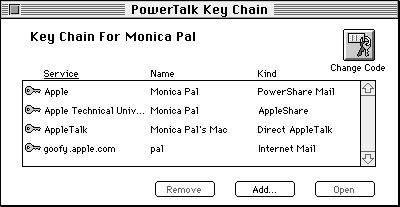
Yeah, relatively - OS X stores passwords in a proper way: in the central "Keychain", to which you may only get access to by supplying your user credidentials. Does your Linux or Windows have anything like that? No? Trolling failed, then, you Linux/Windows luser of ignoramus stance
Somebody, please mod down this AC's +1 Insightful. Yes, Linux has an equivalent of the Keychain. If you use Gnome, it's called the Keyring. If you use KDE, it's called the Wallet. They all work equally well. Props to Apple, though, for first implementing it way back in 1994 as part of the PowerTalk add-on pack to System 7.5
Screenshot of System 7.5 Keychain:http://www.roughlydrafted.com/RD/Q4.06/9D82740A-139C-432C-8279-AD2D4E04892E_files/img008.jpg
-
Zune Sales Still in the Toilet. Not LUZ to you.
Despite a lot of slippery astroturf, Zune never caught on and sales are still in the toilet. There are few bigger failures out there.
-
Zune Sales Still in the Toilet. Not LUZ to you.
Despite a lot of slippery astroturf, Zune never caught on and sales are still in the toilet. There are few bigger failures out there.
-
Zune Sales Still in the Toilet. Not LUZ to you.
Despite a lot of slippery astroturf, Zune never caught on and sales are still in the toilet. There are few bigger failures out there.
-
Re:Stresstest
"Begin Intellectual Property Reform: rather than just the usual extension of copyright terms, Obama's staff recognizes the "need to update and reform our copyright and patent systems to promote civic discourse, innovation and investment while ensuring that intellectual property owners are fairly treated." That includes "opening up the patent process to citizen review [to] reduce the uncertainty and wasteful litigation that is currently a significant drag on innovation."
"Obama's running mate has been criticized for supporting current policy on copyright, but an exposure of government policy to sources of light outside of the lobbyists currently illuminating the dark caves of Washington is likely to change things dramatically."
-
Re:No need
GW Bush probably didn't personally torture anyone either. The problem is that his administration's policies allowed torture camps and supported torture as an ineffectual "intelligence gathering" method, just as Bush's administration promoted the idea that the markets would do better without the rule of law.
Bush furthered the deregulation policies of Phil Gramm and Alan Greenspan, particularly in the area of derivatives, first with Enron and then in the housing market.
While banks were giving suspect loans, they were driven to do so by the insatiable, unregulated derivatives market, which expected that layers of wealth could be extracted from a bubble that would never burst, because it involved real estate. That was disastrously wrong, and has now pulled the pin on the entire credit market.
Don't revise history to blame the poor trying to get a house; it was deregulation: an attempt to have markets without the rule of law.
-
How about the "Longhorn" features?
Oh, hell, how about the features promised for Cairo? This is their third iteration of the standard bait-and-switch; any announcement of ridiculous new features in Windows that doesn't append "Windows has a long history of selling vaporware it never had a chance of shipping" (as this one does) isn't worth the bits it's made of.
But it would at least be nice if someone pretended to remember all the vaporware we were promised for the last couple of big releases.
I'm glad there's a non-Silverlight link, as well, but isn't it astonishing how quickly "this technology will make your web browsing experience niftier!" shades into "something that was possible before is now impossible unless you install our crapware!"?
-
Re:You're missing one.
Problem with Windows Mobile: the software market is dysfunctional: no central app store like Apple for at least another year, sites like Handango take 40-70% of your revenues, and WiMo market share is dying. Dropped from 24% in 2004 to 12% this year. Look at apps that are available: ugly, expensive, and lame-o. Consumers aren't attracted to that, and the installed base is falling apart. Microsoft sold 18 million in the last year, not even twice as many as the iPhone, except that the iPhone is one platform; all the WiMo devices are slightly different, with different features and capabilities, from non-touch tiny Smartphone screens to larger Palm-style Pocket PC form factors.
Look at RIM: Apple just passed them in sales this quarter. RIM sells replacement phones to a relatively slow growing base (19 million subscribers total, again less than double Apple's sales this year). Its installed base is also spread across a variety of different models.
Palm is dead.
Symbian is big but struggling. Difficult to develop for, has the same problems with marketing apps as WiMo. Nokia sells a lot of phones, but most don't run Symbian but only the feature phone Nokia OS. It's Symbian products are split between different hardware types, and the overall Symbian market is currently split between three platforms.
Flash Lite and Java struggle to run on hundreds of slightly different phones, which all have the same software marketing problems. Android is basically just a semi-consistent version of Java ME, the hardware will still be all over the place. Installed base is currently very small, and the G1 isn't going to help in that regard.
Apple's iPhone has a single installed base of over ten million units, and growing dramatically. It has a wildly profitable marketing system for software, good development tools that share a lot in common with Mac development, and a customer base that spends money. There is no real variation in hardware to deal with, nor problems between the software/hardware vendor.
So if you want to do mobile software to make a political statement, or because you like a certain technology, or just want to keep yourself busy, you have several options. If you want to make money, you write iPhone software and sell it to the ten million iPhone users and several million other iPod touch users.
Five More iPhone Myths
Myth 6: iPhone Developers will Flock to Android
Myth 7: iPhone Buyers will Flock to Android
Myth 8: iPhone will lose out to Steve Ballmer's Windows Mobile 7 in 2010
Myth 9: iPhone Unable to Penetrate Europe Due to Symbian Dominance
Myth 10: RIM's BlackBerry Will Contain iPhone Expansion -
Re:You're missing one.
Problem with Windows Mobile: the software market is dysfunctional: no central app store like Apple for at least another year, sites like Handango take 40-70% of your revenues, and WiMo market share is dying. Dropped from 24% in 2004 to 12% this year. Look at apps that are available: ugly, expensive, and lame-o. Consumers aren't attracted to that, and the installed base is falling apart. Microsoft sold 18 million in the last year, not even twice as many as the iPhone, except that the iPhone is one platform; all the WiMo devices are slightly different, with different features and capabilities, from non-touch tiny Smartphone screens to larger Palm-style Pocket PC form factors.
Look at RIM: Apple just passed them in sales this quarter. RIM sells replacement phones to a relatively slow growing base (19 million subscribers total, again less than double Apple's sales this year). Its installed base is also spread across a variety of different models.
Palm is dead.
Symbian is big but struggling. Difficult to develop for, has the same problems with marketing apps as WiMo. Nokia sells a lot of phones, but most don't run Symbian but only the feature phone Nokia OS. It's Symbian products are split between different hardware types, and the overall Symbian market is currently split between three platforms.
Flash Lite and Java struggle to run on hundreds of slightly different phones, which all have the same software marketing problems. Android is basically just a semi-consistent version of Java ME, the hardware will still be all over the place. Installed base is currently very small, and the G1 isn't going to help in that regard.
Apple's iPhone has a single installed base of over ten million units, and growing dramatically. It has a wildly profitable marketing system for software, good development tools that share a lot in common with Mac development, and a customer base that spends money. There is no real variation in hardware to deal with, nor problems between the software/hardware vendor.
So if you want to do mobile software to make a political statement, or because you like a certain technology, or just want to keep yourself busy, you have several options. If you want to make money, you write iPhone software and sell it to the ten million iPhone users and several million other iPod touch users.
Five More iPhone Myths
Myth 6: iPhone Developers will Flock to Android
Myth 7: iPhone Buyers will Flock to Android
Myth 8: iPhone will lose out to Steve Ballmer's Windows Mobile 7 in 2010
Myth 9: iPhone Unable to Penetrate Europe Due to Symbian Dominance
Myth 10: RIM's BlackBerry Will Contain iPhone Expansion -
Re:You're missing one.
Problem with Windows Mobile: the software market is dysfunctional: no central app store like Apple for at least another year, sites like Handango take 40-70% of your revenues, and WiMo market share is dying. Dropped from 24% in 2004 to 12% this year. Look at apps that are available: ugly, expensive, and lame-o. Consumers aren't attracted to that, and the installed base is falling apart. Microsoft sold 18 million in the last year, not even twice as many as the iPhone, except that the iPhone is one platform; all the WiMo devices are slightly different, with different features and capabilities, from non-touch tiny Smartphone screens to larger Palm-style Pocket PC form factors.
Look at RIM: Apple just passed them in sales this quarter. RIM sells replacement phones to a relatively slow growing base (19 million subscribers total, again less than double Apple's sales this year). Its installed base is also spread across a variety of different models.
Palm is dead.
Symbian is big but struggling. Difficult to develop for, has the same problems with marketing apps as WiMo. Nokia sells a lot of phones, but most don't run Symbian but only the feature phone Nokia OS. It's Symbian products are split between different hardware types, and the overall Symbian market is currently split between three platforms.
Flash Lite and Java struggle to run on hundreds of slightly different phones, which all have the same software marketing problems. Android is basically just a semi-consistent version of Java ME, the hardware will still be all over the place. Installed base is currently very small, and the G1 isn't going to help in that regard.
Apple's iPhone has a single installed base of over ten million units, and growing dramatically. It has a wildly profitable marketing system for software, good development tools that share a lot in common with Mac development, and a customer base that spends money. There is no real variation in hardware to deal with, nor problems between the software/hardware vendor.
So if you want to do mobile software to make a political statement, or because you like a certain technology, or just want to keep yourself busy, you have several options. If you want to make money, you write iPhone software and sell it to the ten million iPhone users and several million other iPod touch users.
Five More iPhone Myths
Myth 6: iPhone Developers will Flock to Android
Myth 7: iPhone Buyers will Flock to Android
Myth 8: iPhone will lose out to Steve Ballmer's Windows Mobile 7 in 2010
Myth 9: iPhone Unable to Penetrate Europe Due to Symbian Dominance
Myth 10: RIM's BlackBerry Will Contain iPhone Expansion -
Re:You're missing one.
Problem with Windows Mobile: the software market is dysfunctional: no central app store like Apple for at least another year, sites like Handango take 40-70% of your revenues, and WiMo market share is dying. Dropped from 24% in 2004 to 12% this year. Look at apps that are available: ugly, expensive, and lame-o. Consumers aren't attracted to that, and the installed base is falling apart. Microsoft sold 18 million in the last year, not even twice as many as the iPhone, except that the iPhone is one platform; all the WiMo devices are slightly different, with different features and capabilities, from non-touch tiny Smartphone screens to larger Palm-style Pocket PC form factors.
Look at RIM: Apple just passed them in sales this quarter. RIM sells replacement phones to a relatively slow growing base (19 million subscribers total, again less than double Apple's sales this year). Its installed base is also spread across a variety of different models.
Palm is dead.
Symbian is big but struggling. Difficult to develop for, has the same problems with marketing apps as WiMo. Nokia sells a lot of phones, but most don't run Symbian but only the feature phone Nokia OS. It's Symbian products are split between different hardware types, and the overall Symbian market is currently split between three platforms.
Flash Lite and Java struggle to run on hundreds of slightly different phones, which all have the same software marketing problems. Android is basically just a semi-consistent version of Java ME, the hardware will still be all over the place. Installed base is currently very small, and the G1 isn't going to help in that regard.
Apple's iPhone has a single installed base of over ten million units, and growing dramatically. It has a wildly profitable marketing system for software, good development tools that share a lot in common with Mac development, and a customer base that spends money. There is no real variation in hardware to deal with, nor problems between the software/hardware vendor.
So if you want to do mobile software to make a political statement, or because you like a certain technology, or just want to keep yourself busy, you have several options. If you want to make money, you write iPhone software and sell it to the ten million iPhone users and several million other iPod touch users.
Five More iPhone Myths
Myth 6: iPhone Developers will Flock to Android
Myth 7: iPhone Buyers will Flock to Android
Myth 8: iPhone will lose out to Steve Ballmer's Windows Mobile 7 in 2010
Myth 9: iPhone Unable to Penetrate Europe Due to Symbian Dominance
Myth 10: RIM's BlackBerry Will Contain iPhone Expansion