Slashdot Mirror
Domain: royalsociety.org
Stories and comments across the archive that link to royalsociety.org.
Comments · 45
-
Re:"Scientists"
The Royal Society was founded 28 November 1660 - "in Newton's day" as a previous poster stated. The previous poster was talking specifically about the Royal Society, and not the foundations of the scientific method.
" And the term "scientist" wasn't around for a couple centuries after that?"
Which part of the above sentence from the original post is confusing you?
Haruchai , None of it confused me. lgw posted that the Royal Society was founded in Newton's day, to which you cited the foundations of the scientific method being significantly before Newton was born. I was simply pointing out that you didn't address Igw's point. Please read the thread again. As for the origin of the word scientist in English, dictionary.com places its origins between 1825 and 1835 - again within Igw's claim that the term scientist wasn't around for a couple centuries after Newton's days.
-
Re:"Scientists"
The Royal Society was founded 28 November 1660 - "in Newton's day" as a previous poster stated. The previous poster was talking specifically about the Royal Society, and not the foundations of the scientific method.
" And the term "scientist" wasn't around for a couple centuries after that?"
Which part of the above sentence from the original post is confusing you?
-
Re:"Scientists"
You do know that the Royal Society was created in Newton's day, right? And the term "scientist" wasn't around for a couple centuries after that?.
The foundations of the scientific method were laid by Francis Bacon (1561-1626) influenced by Copernicus (1473-1543) and Galileo.(1564-642). Newton was born in 1642
The Royal Society was founded 28 November 1660 - "in Newton's day" as a previous poster stated. The previous poster was talking specifically about the Royal Society, and not the foundations of the scientific method.
-
Re:Stuff underground gets wet already
No, we don't know how quickly the water will rise
Really, all the Union of Concerned Scientists claims the most likely rise by 2050 is 6-16 inches. The Royal Society claims between 1.5 and 3 ft by 2100.
Those seem like some pretty specific numbers to me. So which is it? Do we know or don't we? I thought the consensus was that the science was settled.
This is so confusing, can the AGW crowd please pick a prediction and stick with it?
Captcha: breaths Seems appropriate for the conversation
-
Re:Planetary Dyson Sphere
Oh, it's possible and worth considering. The problem is that climate science deals a lot with chaotic systems.
Like the economy. In the UK there's a Monetary Policy Committee which sets interest rates based on looking at all the data.
https://en.wikipedia.org/wiki/...
If you had something analogous for climate control they'd look at all the data for he last year, try to work out what events might alter climate for the coming one (El Nino) and set the flow rate. If there was a volcanic eruption they could decide to change things at the next meeting.
In fact that's one advantage to controlling temperature via a sulphate pump over trying to regulate global CO2. Another is that you can't actually regulate global CO2 if China is responsible for most of the increases and they refuse to be regulated.
Have to consider unintended consequences as well, probably just an increase in acid rain
The Royal Society did a report on geoengineering where they concluded this was not an issue
https://royalsociety.org/topic...
https://royalsociety.org/~/med... page 45
The enhanced stratospheric sulphate layer which followed the eruption of Mt Pinatubo led to a signifi cant reduction in stratospheric ozone, with global ozone about 2% below the expected values (Harris et al. 1997). Tilmes et al. (2008) suggest that Arctic ozone depletion following geoengineering of the sulphate layer could be substantially increased and cause a delay in 'recovery' of the Antarctic ozone layer by perhaps up to 70 years (see also Submission: Tilmes). Also important could be more subtle changes in ozone in the middle latitude lower stratosphere; the connection between decadal scale climate variability and stratospheric ozone is increasingly being discussed (see for example, Baldwin et al. 2003; Shaw & Shepherd 2008). Indeed there is a range of so far unexplored feedback processes, which could become important with a permanently engineered sulphate layer. These could include increased stratospheretroposphere exchange (STE), driven by aerosol heating in the tropical lower stratosphere. This could have a long-term impact on stratospheric water vapour, and radiative forcing (see Joshi & Shine, 2003); increased STE would also lower the lifetime of the aerosol layer, calling for increased injections to maintain a particular value of the optical depth.
Changes in surface water and soil moisture as well as in solar radiation intensity at the surface would both be expected to have an impact on the biosphere and there are indications that the carbon cycle did change after the eruption of Mt Pinatubo since changes in the rates of increase of atmospheric CO2 and CH4 were observed (IPCC 2007a). No assessment of this in the geoengineering context has yet been carried out. An increase in acid rain appears to be unlikely to be a problem, as the perturbation to the global sulphur cycle by these stratospheric emissions is quite small (natural volcanic emissions are ~50 MtS/yr, and industrial emissions are much larger).
Delivering between 1 and 5 MtS/yr to the stratosphere is feasible. The mass involved is less than a tenth of the current annual payload of the global air transportation, and commercial transport aircraft already reach the lower stratosphere. Methods of delivering the required mass to the stratosphere depend on the required delivery altitude, assuming that the highest required altitude would be that needed to access the lower tropical stratosphere, about 20 km, then the most cost-effective delivery method would probably be a custom built fl eet of aircraft, although rockets, aircraft/rocket combinations, artillery and balloons have all been sugg
-
Re:Planetary Dyson Sphere
Oh, it's possible and worth considering. The problem is that climate science deals a lot with chaotic systems.
Like the economy. In the UK there's a Monetary Policy Committee which sets interest rates based on looking at all the data.
https://en.wikipedia.org/wiki/...
If you had something analogous for climate control they'd look at all the data for he last year, try to work out what events might alter climate for the coming one (El Nino) and set the flow rate. If there was a volcanic eruption they could decide to change things at the next meeting.
In fact that's one advantage to controlling temperature via a sulphate pump over trying to regulate global CO2. Another is that you can't actually regulate global CO2 if China is responsible for most of the increases and they refuse to be regulated.
Have to consider unintended consequences as well, probably just an increase in acid rain
The Royal Society did a report on geoengineering where they concluded this was not an issue
https://royalsociety.org/topic...
https://royalsociety.org/~/med... page 45
The enhanced stratospheric sulphate layer which followed the eruption of Mt Pinatubo led to a signifi cant reduction in stratospheric ozone, with global ozone about 2% below the expected values (Harris et al. 1997). Tilmes et al. (2008) suggest that Arctic ozone depletion following geoengineering of the sulphate layer could be substantially increased and cause a delay in 'recovery' of the Antarctic ozone layer by perhaps up to 70 years (see also Submission: Tilmes). Also important could be more subtle changes in ozone in the middle latitude lower stratosphere; the connection between decadal scale climate variability and stratospheric ozone is increasingly being discussed (see for example, Baldwin et al. 2003; Shaw & Shepherd 2008). Indeed there is a range of so far unexplored feedback processes, which could become important with a permanently engineered sulphate layer. These could include increased stratospheretroposphere exchange (STE), driven by aerosol heating in the tropical lower stratosphere. This could have a long-term impact on stratospheric water vapour, and radiative forcing (see Joshi & Shine, 2003); increased STE would also lower the lifetime of the aerosol layer, calling for increased injections to maintain a particular value of the optical depth.
Changes in surface water and soil moisture as well as in solar radiation intensity at the surface would both be expected to have an impact on the biosphere and there are indications that the carbon cycle did change after the eruption of Mt Pinatubo since changes in the rates of increase of atmospheric CO2 and CH4 were observed (IPCC 2007a). No assessment of this in the geoengineering context has yet been carried out. An increase in acid rain appears to be unlikely to be a problem, as the perturbation to the global sulphur cycle by these stratospheric emissions is quite small (natural volcanic emissions are ~50 MtS/yr, and industrial emissions are much larger).
Delivering between 1 and 5 MtS/yr to the stratosphere is feasible. The mass involved is less than a tenth of the current annual payload of the global air transportation, and commercial transport aircraft already reach the lower stratosphere. Methods of delivering the required mass to the stratosphere depend on the required delivery altitude, assuming that the highest required altitude would be that needed to access the lower tropical stratosphere, about 20 km, then the most cost-effective delivery method would probably be a custom built fl eet of aircraft, although rockets, aircraft/rocket combinations, artillery and balloons have all been sugg
-
Re:Clever Move
If you look on page 48 of the pdf you'll see
https://royalsociety.org/~/med...
An increase in acid rain appears to be unlikely to be a problem, as the perturbation to the global sulphur cycle by these stratospheric emissions is quite small (natural volcanic emissions
are ~50 MtS/yr, and industrial emissions are much larger).Delivering between 1 and 5 MtS/yr to the stratosphere is feasible. The mass involved is less than a tenth of the current annual payload of the global air transportation, and commercial transport aircraft already reach the lower stratosphere. Methods of delivering the required mass to the stratosphere depend on the required delivery altitude, assuming that the highest required altitude would be that needed to access the lower tropical stratosphere, about 20 km, then the most cost-effective delivery method would probably be a custom built fl eet of aircraft, although rockets, aircraft/rocket combinations, artillery and balloons have all been suggested. Very rough cost estimates based on existing aircraft and artillery technology suggest that costs would be of the order of 3 to 30 $/kg putting the total annual cost at 10s of billion dollars (US National Academy of Science 1992; Keith 2000; Blackstock et al. 2009). The environmental impacts of the delivery system itself would of course also need to be carefully considered.
-
Re:Clever Move
The particulates are, if anything, countering the warming
We need global regulations to establish a minimum particulate output for diesel engines to stop people using particulate filters.
Actually I wonder if you could use high sulphur jet fuel to introduce sulphur dioxide into the atmosphere to do geoengineering.
The Royal Society did a report on geoengineering here which mentions sulphate aerosols - basically the SO2 forms droplets which increase the albedo and cool the planet
-
Re:Clever Move
The particulates are, if anything, countering the warming
We need global regulations to establish a minimum particulate output for diesel engines to stop people using particulate filters.
Actually I wonder if you could use high sulphur jet fuel to introduce sulphur dioxide into the atmosphere to do geoengineering.
The Royal Society did a report on geoengineering here which mentions sulphate aerosols - basically the SO2 forms droplets which increase the albedo and cool the planet
-
Re:Climate change solved!
The Royal Society in the UK did a report on geoengineering and concluded sulphate aerosols for example could be used to effect "a reduction of solar input by about 2%" to "balance the effect on global mean temperature of a doubling of CO2" for "total annual cost at 10s of billion dollars". Check out the Royal Society's report.
https://royalsociety.org/topic...
Delivering between 1 and 5 MtS/yr to the stratosphere is feasible. The mass involved is less than a tenth of the current annual payload of the global air transportation, and commercial transport aircraft already reach the lower stratosphere. Methods of delivering the required mass to the stratosphere depend on the required delivery altitude, assuming that the highest required altitude would be that needed to access the lower tropical stratosphere, about 20 km, then the most cost-effective delivery method would probably be a custom built fl eet of aircraft, although rockets, aircraft/rocket combinations, artillery and balloons have all been suggested. Very rough cost estimates based on existing aircraft and artillery technology suggest that costs would be of the order of 3 to 30 $/kg putting the total annual cost at 10s of billion dollars (US National Academy of Science 1992; Keith 2000; Blackstock et al. 2009). The environmental impacts of the delivery system itself would of course also need to be carefully considered.
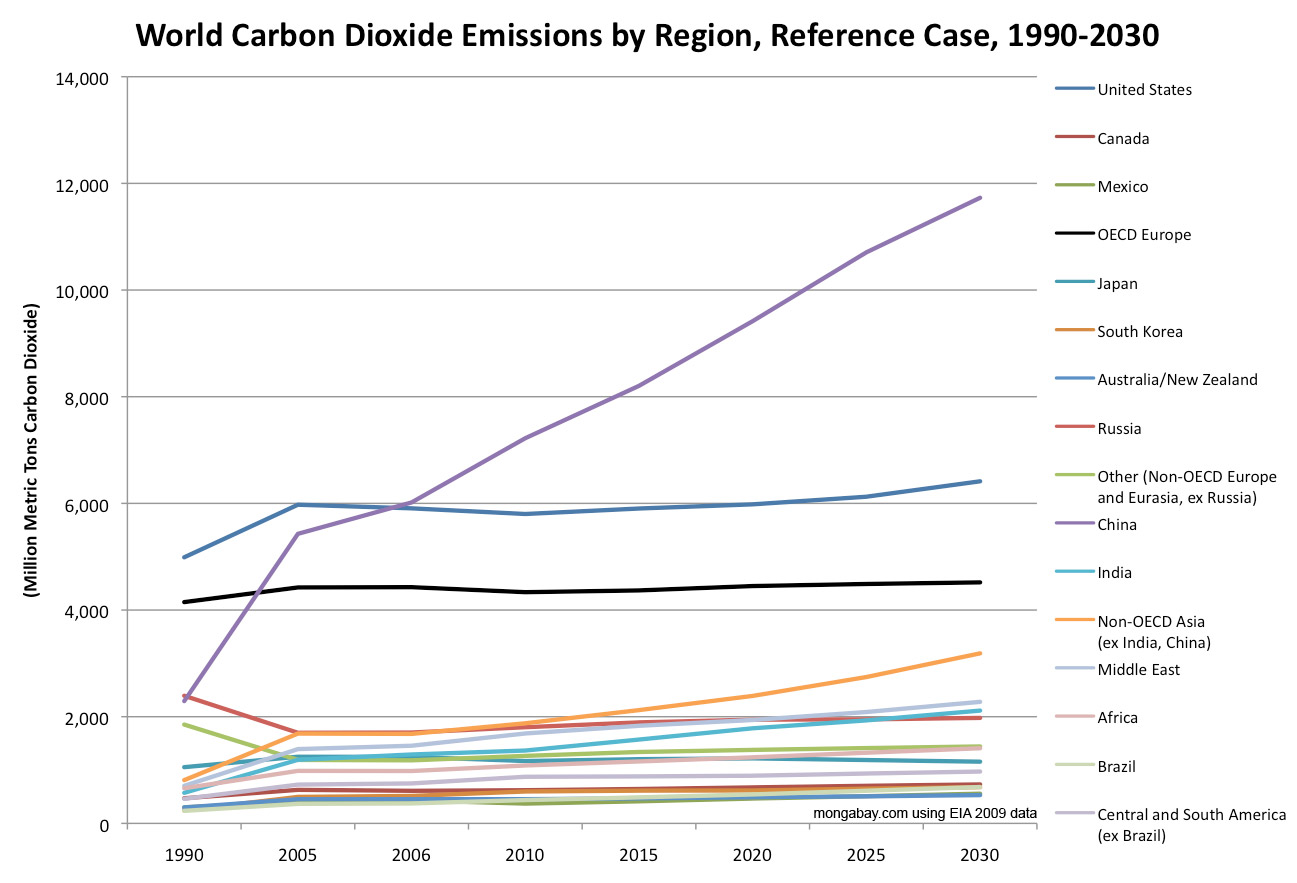
I reckon if global warming turns out to be bad, something like this will be done because it's easier to get the Chinese to chip in for it than it is to get them to cripple their economy with steep CO2 emissions cuts. And if the Chinese won't cut CO2 emissions, global CO2 emissions won't come down
https://photos.mongabay.com/09...
Another nice thing about this sort of scheme is that you don't need to be able to accurately predict long term climate. You simply need to look at the trend over the last few years and increase or decrease your sulphate pumping rate.
It's like having a human controlled thermostat for that planet.
-
Re:Without even reading the $500 billion plan...
Yeah another option is called Nuclear Winter
Seriously though, based on scientific evidence Global Warming is not going to be a big problem within the next 100 to 200 years anyway (it'll be a problem but we've plenty of other bigger problems). This is based on the scientists own data, too lazy search for the links (you have to skip the media spin and go to the various actual research projection charts - here's one link that's not the one I'm think off but backs it up: https://royalsociety.org/topic... ). The rate of change only picks up after that period. 200 years is a long time when it comes to cities, towns etc- go look at our cities 200 years ago. If there are cities that are underwater 200 years from it's likely that we actually want them there
We've had very crappy weather before industrialization too. It's just that we've been lucky to have a period of relatively stable climate ( https://en.wikipedia.org/wiki/... ).
What I'm curious about is if we cut our oil usage at the "likely good case" scenario how different would the outcome be compared to the "use it till it's too expensive" scenario (we are likely to stop burning fossil fuels at such high rates within the next 50 years due to peak oil and pollution concerns alone). Or is it too late in some ways? Can the scientists even know with good certainty?
-
Re:EU Funding
The UK gets more out than it puts in. Even if we diverted all that money back into science, which we won't, it would still be less than we get now.
-
Re:Statements taken out of context and manipulated
Get your facts straight. He was not "dismissed." He resigned from the UCL. He resigned from the Royal Society. Just as importantly, neither of those positions are real jobs. He's not losing any money from the resignations.
Tim Hunt clarified his original comments in a BBC interview immediately after the conference in Korea. He backed up the original claims by Connie St. Louis and the other witnesses that heard his talk. He confirmed what they had witnessed and reported.
-
Re:Show me a climate model for the past 16 years
I don't know your reference for saying that "the models are broken". In my understanding the models used e.g. in IPCC reports, are quite good.
It is completely unreasonable to dismiss them just because they are not perfect. The proper approach is to study the discrepancies, reason about their possible causes and estimate the effect of the errors on the question you are seeking to answer with the model.
Look at this
http://www.drroyspencer.com/20...
What I don't get is why they don't chuck out the models that are bad, keep the ones that are good and invent ones that are better. Right now it almost seems like they do the opposite - the ones that predict OMG! Runaway Global Warming! get loads of press time. And the ones that don't predict anything too drastic get largely ignored and the people that made them called evil deniers.
Actually that's what denier really means. If you think the world is warming slowly but it's no great problem like the satellite temperature measurements say you're an evil denier. In fact unless you support massive CO2 cuts now on the basis of the most alarmist model you're a denier. I.e. it's really an argument about policy, not whether you think the world will be 0.5 degree C or 1.0 degree C warmer in a hundred years time.
You can see that when geoengineering is brought up. The Royal Society did a study that showed that Sulphate aerosols for example could be used to effect "a reduction of solar input by about 2%" to "balance the effect on global mean temperature of a doubling of CO2" for "total annual cost at 10s of billion dollars". So we don't need to rely on the precautionary principle to tell us we need to cut our CO2 emissions to zero now just in case. We can go on as we are, monitor temperature and build ourselves a planetary thermostat quickly and cheaply if it becomes necessary. Of course the 'cut CO2 now' lobby hate this.
They also hate it when you point out that CO2 emissions in Europe and the US are trending down. China's CO2 emissions are increasing massively. If you want a global CO2 cut you'd need to get China to stop industrializing. Which they won't do
http://photos.mongabay.com/09/...
Or of course that the actual satellite measurements of temperature are undershooting all the models - you need to use the adjusted temperature measurements from ground stations. And the adjusted temperature measurements only do that because the past has been getting cooler. Those cavemen better watch out, pretty soon it will be below absolute zero when they are.
What this is really about is that you've got people who'd make a load of money if everyone was forced to by CO2 permits. It's pure rent seeking by them. Or people who know deep down we're all sinners for our materialistic lifestyle and want to force everyone into the modern equivalent of sackcloth and ashes to repent.
-
1,500 electrode bionic eye implanted already
There are a couple of groups working on commercial bionic eyes, one implant with 1,500 electrodes (that's actually high enough resolution to be useful for recognizing objects) did allow some previously blind people to read text, in a human study between 2005-2010:
Link to the original paper with PDF download: HTML, PDF
Published in the journal Proc Royal Soc B: http://royalsociety.org/news/retinal-implant/
In the media: forbes.com February 2012
-
Re:Global warming is a scam.
Global warming is a scam.
http://tinyurl.com/globalwarmingisascam
That site is loaded with pseudo-scientific data & outright lies. A few examples:
- It claims NASA studies have shown that the sun is responsible for GW. This is a lie. NASA said the opposite. Go the NASA Web site & verify by yourself (http://climate.nasa.gov/)
- The "founder of the Weather Channel" (John Coleman) is not a climate scientist. If you watch his YouTube series, you'll notice how he's confusing weather (short-term) with climate (long-term)
- The "GW swindle" documentary has been sued in court for misrepresenting the opinions of the scientists interviewed. ex: Sir David King, the Government's former chief scientist.
- The typical strawman of "CO2 is not a pollutant" has been addressed many times over. No scientist claimed CO2 was a pollutant. It is the excess of CO2 coming form industrial waste that is having heat trapping effects and causes ocean acidification: http://royalsociety.org/document.asp?id=3249
- The US senate is no authority on GW. The US Academy of Sciences is. The latter subscribes to man-made GW.
- etc..
There is a difference between the FACTS of GW, and the solutions proposed. The only thing that I agree with that site you mentioned, is that some of the policies & the utilization for political ends of GW are questionable.
-
Re:You missed the point.
These basic conclusions have been endorsed by at least 30 scientific societies and academies of science,[6] including all of the national academies of science of the major industrialized countries.[7][8][9]
(http://en.wikipedia.org/wiki/Global_warming)
7) http://royalsociety.org/displaypagedoc.asp?id=13619
8) http://royalsociety.org/displaypagedoc.asp?id=20742
9) http://www.pik-potsdam.de/aktuelles/archiv/aktuelle/dateien/G8_Academies%20Declaration.pdfWhile a small minority have voiced disagreement with these findings,[10] the overwhelming majority of scientists working on climate change agree with the IPCC's main conclusions.[11][12]
10) http://www.nationalpost.com/news/story.html?id=164002
11) http://royalsociety.org/downloaddoc.asp?id=1630
12) http://www.sciencemag.org/cgi/content/full/306/5702/1686And honestly, I was being lazy and just quoting Wikipedia which hardly took any effort. Now imagine if you weren't being stubbornly predisposed in your opinion how easily you could have affirmed the scientific community's consensus yourself instead of wasting my time.
The best way to realize how strong the consensus is, is by looking at all the peer-reviewed literature published in scientific journals each year and tally up how many are dealing with global warming related studies and how many (if any) are attempting to contest global warming.
Honestly, I know you are wrong.
(yes, I do study environmental science). -
Re:You missed the point.
These basic conclusions have been endorsed by at least 30 scientific societies and academies of science,[6] including all of the national academies of science of the major industrialized countries.[7][8][9]
(http://en.wikipedia.org/wiki/Global_warming)
7) http://royalsociety.org/displaypagedoc.asp?id=13619
8) http://royalsociety.org/displaypagedoc.asp?id=20742
9) http://www.pik-potsdam.de/aktuelles/archiv/aktuelle/dateien/G8_Academies%20Declaration.pdfWhile a small minority have voiced disagreement with these findings,[10] the overwhelming majority of scientists working on climate change agree with the IPCC's main conclusions.[11][12]
10) http://www.nationalpost.com/news/story.html?id=164002
11) http://royalsociety.org/downloaddoc.asp?id=1630
12) http://www.sciencemag.org/cgi/content/full/306/5702/1686And honestly, I was being lazy and just quoting Wikipedia which hardly took any effort. Now imagine if you weren't being stubbornly predisposed in your opinion how easily you could have affirmed the scientific community's consensus yourself instead of wasting my time.
The best way to realize how strong the consensus is, is by looking at all the peer-reviewed literature published in scientific journals each year and tally up how many are dealing with global warming related studies and how many (if any) are attempting to contest global warming.
Honestly, I know you are wrong.
(yes, I do study environmental science). -
Re:You missed the point.
These basic conclusions have been endorsed by at least 30 scientific societies and academies of science,[6] including all of the national academies of science of the major industrialized countries.[7][8][9]
(http://en.wikipedia.org/wiki/Global_warming)
7) http://royalsociety.org/displaypagedoc.asp?id=13619
8) http://royalsociety.org/displaypagedoc.asp?id=20742
9) http://www.pik-potsdam.de/aktuelles/archiv/aktuelle/dateien/G8_Academies%20Declaration.pdfWhile a small minority have voiced disagreement with these findings,[10] the overwhelming majority of scientists working on climate change agree with the IPCC's main conclusions.[11][12]
10) http://www.nationalpost.com/news/story.html?id=164002
11) http://royalsociety.org/downloaddoc.asp?id=1630
12) http://www.sciencemag.org/cgi/content/full/306/5702/1686And honestly, I was being lazy and just quoting Wikipedia which hardly took any effort. Now imagine if you weren't being stubbornly predisposed in your opinion how easily you could have affirmed the scientific community's consensus yourself instead of wasting my time.
The best way to realize how strong the consensus is, is by looking at all the peer-reviewed literature published in scientific journals each year and tally up how many are dealing with global warming related studies and how many (if any) are attempting to contest global warming.
Honestly, I know you are wrong.
(yes, I do study environmental science). -
Re:Huh?
Yes, water vapor is the major green house gas only being augmented by carbon dioxide. This just points out that most of the people in the global warming camp know about as much real science as most kindergarten classes.
Normally I try to be more civil, but this calls for a "Hey dumbass, Ken Caldeira has forgotten more about climate science than you will ever know".
In particular, he is well aware of the greenhouse effect of water vapor. See here for more discussion.
A more sensible fellow was interviewed on TV recently who said that most of our climate change is driven by the Sun
Why is he more sensible? Because it supports the conclusions you want to reach? In particular, why is this fellow's claim more sensible given the large amount of evidence that most of the modern global warming is not driven by the Sun (e.g., here, here).
and that the best way for us to spend our capital in regards to climate change is to learn to adapt
We're going to have to adapt regardless, because we're already committed to some anthropogenic climate change even if there were no natural change, but that doesn't mean that we shouldn't mitigate the problem. It's less expensive to adapt if you have a less extreme climate to adapt to. A real solution, as noted by pretty much every economist who works in this area, is a combination of mitigation, adaptation, and technological R&D. Read Nordhaus's latest book for a good lay overview of the policy problem.
The climate is composed of myriad systems that we still haven't enumerated, cannot properly inter-relate (since we don't know them all) and already contain enough energy that we couldn't drive them in a particular direction if we wanted.
We can't dial in an exact climate state, but we can drive the climate in different directions. We're already doing it with CO2. Reducing CO2 will reduce and slow the warming due to CO2. This is not a difficult concept. The system doesn't respond instantaneously, and it's not realistic to completely halt emissions, but we can slow them to mitigate the resulting climate change.
if somehow we did manage to force a change, the system would likely react in a way we wouldn't be able to foresee
It is not really that hard to figure out that returning CO2 emissions to closer to pre-industrial levels will direct the Earth system to closer to a pre-industrial climate.
-
A good read, if you are interested.
Here's a paper from 2003 that is an excellent read, if you are really interested in a very strong, coherent, and comprehensive hypothesis of the change from geochemistry to biochemistry, that is, abiogenesis:
On the origins of cells: a hypothesis for the evolutionary transitions from abiotic geochemistry to chemoautotrophic prokaryotes, and from prokaryotes to nucleated cells
(Royal Society Publishing - Phil. Trans. R. Soc. B (1990-) - Volume 358 - Number 1429/January 29, 2003)In a nutshell, it offers a hypothesis of life having evolved in FeS and NiS deposits around ancient deep sea geothermal vents. The nature of such rocks is that they form small compartments which acted as "cell walls" to hold early biomolecules in such concentrations to be able to begin biochemistry. Over time, the biochemistry for lipid synthesis began, at which point eubacteria and archaebacteria diverged as they evolved very different mechanisms for making lipid membranes. This gave rise to the first free life forms, prokaryotic bacteria. It is then further hypothesized that Eukaryotes evolved from archaebacteria involved in a symbiotic relationship which became endosymbiotic with a eubacteria that eventually became mitochondria. And so on and so forth. Read the paper. It lays it all out very well and the hypothesis seems to fit very well with available data, both in the geologic record and the phylogenies of various modern archaebacteria, eubacteria, and eukaryotes.
It is perhaps the most coherent, comprehensive, well-supported treatment of the idea of abiogenesis I have ever read.
-
Re:Pollution/Habitat loss, not global warming!
We have serious problems with pollution and habitat loss, none with "Global Warming" which is nothing but a scam to take advantage of Gaia-worship and gullible fools.
It's incredible what kind of nonsense gets modded insightful. A scam by whom? By the national academies of science of all developed countries: http://royalsociety.org/displaypagedoc.asp?id=20742 Why would they take part in a scam? What would just about all major scientific organizations and a vast majority of individual scientists involved in climate research have to gain by putting their reputations on the line in order to "take advantage of Gaia-worship and gullible fools"? What would they have to gain from it? -
Re:What a waste.
Agreed, and just for reference (since Slashdot, along with the rest of the media, seem unwilling to link to them):
Here is what he originally said: http://www.guardian.co.uk/science/blog/2008/sep/11/michael.reiss.creationism
Here is the clarification just one day later: http://royalsociety.org/news.asp?id=8004
No. His clarification is the blog post that you linked to, which was authored and posted by him. Part of his original statement was the sound file posted at the top of that blog post, in which he was speaking to a reporter. The second link you're referring to is not only a further clarification on his original clarification, but it's just a second-hand quote published by the Public Relations arm of his employer.
In other words, that second-hand clarification doesn't really count (in my personal view at least). Public Relations departments do not speak for their employees. They speak for their company/organization, in this case they speak for The Royal Society. Public Relations departments do not clarify. They confuse, they censor, they edit, they rewrite, and sometimes, yes, they'll even lie.
There is a reason controversial topics are rarely ever put to rest by the PR spokesperson. If a dicy personal statement needs to be clarified, it needs to be clarified by the original primary source. And in this case, it was! The Professor clarified in writing what he said in that recorded interview with the (slightly hostile) reporter. In other words, that blog post was already that Professor's own personal attempt at doing damage control (much to the horror of The Royal Society's PR spokesperson -- I'm sure).
-
Re:Nonsense
You (and the Slashdot editors) committed a serious blunder: you failed to read what he actually said.
http://www.guardian.co.uk/science/blog/2008/sep/11/michael.reiss.creationism
http://royalsociety.org/news.asp?id=8004Even if the Guardian summary ("Teachers need to accommodate the differing world views of students from Jewish, Christian or Muslim backgrounds â" which means openly discussing creationism and intelligent design as alternatives to evolutionary theory") were true, I don't think it warrants the kind of Muslim-esque head-on-a-platter firestorm we saw yesterday.
-
Re:please, please ...
Citation please, where he did this?
royal society did the right thing.
Both The Royal Society and Reiss are entirely in agreement that creationism should not be taught as a science: http://royalsociety.org/news.asp?id=8004
-
Re:What a waste.
Agreed, and just for reference (since Slashdot, along with the rest of the media, seem unwilling to link to them):
Here is what he originally said: http://www.guardian.co.uk/science/blog/2008/sep/11/michael.reiss.creationism
Here is the clarification just one day later: http://royalsociety.org/news.asp?id=8004
I think he expressed his views rather poorly in what was said originally, making it easy to misread unless you look very closely. And it was reasonable to express criticism over that. But the media should not ignore the clarification after it has been made.
Sure, there's a valid argument that it's better not to mention creationism at all (even to debunk it and explain why it isn't science, as Reiss was suggesting), but let's be clear: he was not advocating teaching creationism.
To suggest otherwise is just the sort of thing IDers want - do we really want them to be able to say "Leading scientists support teaching creationism in science lessons"? Of course not, which is why this myth should not be propagated.
-
Re:Discussion != Endorsement
Um, telling them it's not science?
Exactly. Which is what the Royal Society and Professor Reiss are saying. From http://royalsociety.org/news.asp?id=8004 :
"Creationism has no scientific basis. However, when young people ask questions about creationism in science classes, teachers need to be able to explain to them why evolution and the Big Bang are scientific theories but they should also take the time to explain how science works and why creationism has no scientific basis."
xehonk's suggestion was not that we tell them it's not science, his suggestion was that it shouldn't be mentioned at all.
-
They didn't "back-pedal"
They corrected sloppy journalism http://royalsociety.org/news.asp?id=8004
-
Royal Society doesn't support teaching Creationism
So why is the Royal Society bothering?
They're not: http://royalsociety.org/news.asp?id=8004
(It's one thing for the media to misrepresent them, but it's rather poor for Slashdot to post this, when it's old news, and already debunked by the Royal Society, and without even linking to their statement. But I guess I shouldn't be surprised...)
-
Re:It /should/ be discussed in science classes
Yes, it is what he had in mind: http://royalsociety.org/news.asp?id=8004 :
The Royal Society is opposed to creationism being taught as science. Some media reports have misrepresented the views of Professor Michael Reiss, Director of Education at the Society expressed in a speech yesterday.
Professor Reiss has issued the following clarification. "Some of my comments about the teaching of creationism have been misinterpreted as suggesting that creationism should be taught in science classes. Creationism has no scientific basis. However, when young people ask questions about creationism in science classes, teachers need to be able to explain to them why evolution and the Big Bang are scientific theories but they should also take the time to explain how science works and why creationism has no scientific basis. I have referred to science teachers discussing creationism as a worldview'; this is not the same as lending it any scientific credibility."
The society remains committed to the teaching of evolution as the best explanation for the history of life on earth. This position was highlighted in the Interacademy Panel statement on the teaching of evolution issued in June 2006.
There might be valid criticisms against using the term "worldview", and maybe he did or didn't explain himself poorly. But this whole thing looks to be a media misreporting.
It's also just the sort of myth that plays into creationist hands - I can hear it now: "Even leading scientists of the Royal Society support teaching creationism in schools". It's not true.
-
Re:1906
Here is some recent evidence against Svensmark's theory:
-
Re:About weather changes and global warming...
You're referring to Svensmark ? There are problems with this theory. Take a look at this this this and in particular this
In summary this theory imagines that low cloud formation is promoted by increased cosmic rays that form cloud condensation nuclei. Changes in solar output cause changes in the amount of cosmic rays that reach earth to do this. Low clouds increases the planet's albedo which reduces forcing. However, the theory suffers from a number of problems including not being able to reconcile the size of nuclei produced and the size of the nuclei needed to form clouds (there is an order of magnitude difference); not explaining preference of nuclei formed in this manner versus other nuclei in even greater abundance such as salt particles; not providing observations on actual additional low cloud formation and the effect; and finally this theory must suppose a long term trend in cosmic particles to account for the long term in global temperature change, and there is none.
-
How is Global Warming still a controversy?
When international summit after international summit after international summit all recognize global warming and the human influence how can you still deny it? When from every article in a referred scientific journal about climate change from 1993 to 2003, there isn't even ONE that disagrees with the consensus that that Earth's climate is being affected by human activities, how is it not obvious? When even international panels like the InterAcademy Council and the Intergovernmental Panel on Climate Change can agree on the human impact, what "controversy" is there?
It is so painfully obvious that we do make a difference, that CO2 concentration is much higher than ever seen before, as shown by the Keeling Curve. And I can only hope most people understand that high CO2 levels lead to high temperatures and I don't have to spell that out.
It's not a debate. There is no "maybe." There's no confusion. The entire world's academic and scientific community have come to a consensus on it, but apparently some people here just don't get it.
Its at the point where both U.S. presidential hopefuls have made it both policy and goals to cut down on emissions, its not even politically dividing.
Global warming is real, it does exist, we do contribute, and if you think otherwise you're honestly in denial.
-
Re:it's you who is advocating massive change
Why doesn't anyone want to talk about the known increase in solar radiation over the last 30 years?
Because there isn't one. See here. Solar irradiance has been on average flat since 1960, although there were some ups and down until the mid-1980s, after which it's definitely been quite flat on average. (By flat I mean the trend; there's the usual 11-year solar cycle oscillation too.) If anything there's been a very slight decrease over the last 30 years.
AFAIK, we don't have numbers going back any further, but it seems fairly obvious that if there is more solar radiation entering the earths atmosphere, the climate will change.
We do have numbers going back further, although they're pre-satellite, and if you go even further back they become indirect (inferred from counting sunspots and such).
The fact is, the average amount of solar radiation entering the Earth's atmosphere has changed very little over the last 30 years. Even if you ignore the greenhouse effect, increases in solar irradiance are far too small to produce the observed warming.
Maybe we won't run out of oil because it isn't really made from dead trees and dinosaurs.
Ok, not only is that a totally crackpot theory, but it's also irrelevant. Our estimates of how much oil there is aren't based on adding up how many dead trees and dinosaurs we think there used to be. They're based on going all over the world and digging for oil and seeing how often we find it. How the oil got there doesn't matter to our measurements of how much is there now.
The oil companies have a massive financial interest in how much oil is left. I can assure you, they have studied this question thoroughly from every angle, even more than the scientific community has.
All the problems with non-biogenic oil formation theories aside, it's possible to tell the difference between organic and non-organic carbon sources by looking at isotopic ratios. Oil is made of organic carbon. (That's one of the several lines of evidence which tell us that the excess carbon now in the atmosphere is due to our burning of fossil fuels, by the way.)
I've been meaning to find some numbers, but I have a hard time understanding the amount of decaying organic matter necessary to create the 80+ million barrels/day of oil pumped from the ground in 2005. I know were talking about geologic time scales here, so I'd be interested in seeing some numbers about how many trees and dinos that adds up to.
This overview has some numbers.
I'd also be interested to find out how trees and dinos ended up 10k+ feet below the surface of the earth. Some of these are 35k+ feet (7+miles) deep.
You can build up a lot of material on top of it over 500 million years. Also, rock is porous. Oil sinks.
I doubt there were many trees or dinosaurs on Hyperion or Titan, 2 of Saturns moons. Yet, they have pools of hydrocarbons,
"Hydrocarbons" aren't always oil; the pools on Titan are things like methane and ethane, which are formed by chemical reactions in Titan's atmosphere. Hydrocarbons exist even in comets and interstellar dust, but they're not oil.
I'm just concerned that global warming is really another scam to take more of my money in the form of taxes to "save the earth".
Sheesh, lay off the conspiracy theories. Scientists don't get together in a back room and decide what scam to cook up next. There is plenty of legitimate scientific evidence, starting from basic atom-light physics and conservation of energy, and working up to our understanding of atmospheric and ocean circulation.
If I remember correctly, when I was a kid, the big fear was we we
-
it is the journal not the field
Policy on copyright does differ from field to field, but it is more a matter of the journal than the field. Some journals have enlightened practices, some do not. For example, the Royal Society, which is the UK equivalent of the publisher of Physical Review Letters, has a very enlightened policy, and lets you publish under a creative commons license and retain copyright. The American Physical Society has a far more outdated policy, which looks like it will finally change.
-
Re:Rodents of unusual size?
The scientific paper is available if you want to take a look.
Who are you going to rely on for your large rodent information? The Dread Pirate Roberts or Proceedings of the Royal Society B? I'm sure the Royal Society can track *anything*. -
Re:Rodents of unusual size?
The scientific paper is available if you want to take a look.
Who are you going to rely on for your large rodent information? The Dread Pirate Roberts or Proceedings of the Royal Society B? I'm sure the Royal Society can track *anything*. -
Changeable Theory for Cosmic Rays??!!!
Henrik Svensmark is one of the main proponents of the theory that cosmic rays have an impact on climate. Following is a quote from an article by Henrik Svensmark written in May 2000:
The influence of solar variability on climate is currently uncertain. Recent observations have indicated a possible mechanism via the influence of solar modulated cosmic rays on global cloud cover. Surprisingly the influence of solar variability is strongest in low clouds (less than or equal to 3 km), which points to a microphysical mechanism involving aerosol formation that is enhanced by ionization due to cosmic rays. If confirmed it suggests that the average state of the heliosphere is important for climate on Earth.
Citation: Marsh, N. G. and H. Svensmark. "Low Cloud Properties Influenced by Cosmic Rays". Physical Review Letters. 85, 4 (2000).
His ideas involve cosmic ray influence on LOW CLOUDS. In that case, under the theory, fewer cosmic rays imply fewer low clouds, which would imply a warmer climate. This idea has significant weaknesses which are covered here for example. One of the main problems with this idea is that cosmic rays have, since 1985 trended in the opposite direction necessary to explain the warming.
Now you seem to be suggesting that someone has reversed the theory, and now say that cosmic rays influence HIGH CLOUDS?!! Who exactly has made this postulate? Where are your citations? What are the reasons for the switch? Without such information, I have to strongly suspect that what you say comes straight from an oil industry funded PR firm that is responding to growing public knowledge about the science.
-
Re:discredit global warming theories? no way
READ THE EFFING ARTICLE!!!
-
Re:discredit global warming theories? no way
There are two separate factors here: the actual heat flux from the sun, and the influence of the sun on the Earth's magnetic field, which can result in changes in the cosmic ray flux. The theory goes that fewer cosmic rays means fewer clouds, which means a warmer climate. What you will find if you read this article published in the Proceedings of the Royal Society A, is that all of the solar parameters, be they the heat flux from the sun, or the cosmic ray flux trend in exactly the wrong direction to explain the warming since 1985. To quote the conclusion of this article:
There are many interesting palaeoclimate studies that suggest that solar variability had an inuence on pre-industrial climate. There are also some detection-attribution studies using global climate models that suggest there was a detectable inuence of solar variability in the rst half of the twentieth century and that the solar radiative forcing variations were amplied by some mechanism that is, as yet, unknown. However, these ndings are not relevant to any debates about modern climate change. Our results show that the observed rapid rise in global mean temperatures seen after 1985 cannot be ascribed to solar variability, whichever of the mechanisms is invoked and no matter how much the solar variation is amplied.
-
Re:discredit global warming theories? no way
Perhaps you should ACTUALLY READ the article I linked to. That article, published in the Proceedings of the Royal Society A by Mike Lockwood of Rutherford Appleton Laboratories (ever heard of Rutherford?) discounts ANY significant solar influence on the warming that has occurred since 1980. The article gives data on both absolute energy output, and cosmic ray flux. All of the solar parameters, including cosmic ray flux trend in OPPOSITE DIRECTION NEEDED TO ACCOUNT FOR THE RECENT WARMING. Why don't you read the information I post before trying to unethically disseminate your misinformation.
-
Re:discredit global warming theories? no way
Brace yourself for a propaganda deluge from climate change denialists now that solar activity IS actually increasing (at least as part of its usual cycle). Never mind that solar activity has trended downwards since 1980, and yet we have experienced the most significant GLOBAL warming since then, including the shocking drop in arctic sea ice this fall. Climate change denialists know no shame.
-
Read the actual article at the link below (PDF)
The article referenced was actually published in the September 2006 edition of the Proceedings of the Royal Society A: http://journals.royalsociety.org/content/h107x295723j3734/fulltext.pdf
-
Watch that movie again!
Soylent Green came out in 1973.
The lead character's room mate, "Sol," was played by Edward G. Robinson. The author of the book on which the movie was based, Harry Harrison, was on set during the filming. (Among other things, he suggested that a character visiting a butcher bring her own plastic bag with her.) Robinson, best known for his tough-guy gangster roles, asked Harrison what the hell his character was about. Harrison told him, (paraphrasing) "You're me, as a dying old man. You remember the world before everything went to shit."
One of the things Sol rants about to Charton Heston? The greenhouse effect.
Also, the big ugly secret of the movie -- Soylent Green is People -- is just a sympton. Soylent Green is supposed to be made of krill and plankton. Heston's character finds a secret research study commissioned by the Soylent Corporation revealing that humanity has managed to kill off the ocean ecosystem. -
Re:Tits?
Have you seen the Haptic Pen. It provides feedback based on the type of material. A solid surface locks the system, while soft squishy materials just slow the pen down a bit.