Slashdot Mirror
Domain: rutgers.edu
Stories and comments across the archive that link to rutgers.edu.
Comments · 426
-
Re:Non-story
That's not true. Actually the largest underrepresented voter group is men, since 1980. http://www.cawp.rutgers.edu/si...
Now if a company started a program to help men get out and vote, I would say that is pretty biased as well.
Anyway, your point about non-voters leaning Democrat (I'm not sure that's true unless you're excluding all white non-voters, or all male non-voters) is about inequality of outcome, which I'm fine with. If you help everybody across the board and that happens to help Democrats, that doesn't bother me. Inequality in opportunity is more serious. Things like "We're going to help underrepresented group X, screw everybody else" are morally problematic to me.
-
surprise surprise
All those DMI links are 404 errors....and the Rutgers university pretty pictures show that spring is trending down 3 times faster than winter is trending up. Have a guess what happens when snow cover is decreasing 3 times faster than it is accumulating. How much do you think is going to turn into glaciers...spring
Lynwood the denier links to denier sites full of fake news again.
-
Re: Not just a bathroom law
I do not trust the APA anymore in regards to LGBT and its stances on mental illness in this subject matter. They are just as political as the rest of us. They place politics over medical evidence or attempt to form that evidence to fit their narrative and stay as middle-of-the-road as possible.
Confirmation bias abound...
http://www.rci.rutgers.edu/~ju...
http://www.newyorker.com/scien... (opinion article, but still relevant)
https://www.lifesitenews.com/n... (article from former APA President, although this news source is rather right-leaning)
https://drhurd.com/2012/03/29/... (Another opinion article discussing this issue)
-
Re:On Average Our Planet Has Been Much Warmer
Yes, Mann is one of the authors of that paper. Do you have better evidence, from better proxies, that contradicts it? The MWP event was indeed global in impact, but none of your links show that it was warmer than today, averaged globally.
Of your cited links, the first two are for the same paper, which notes glacial fluctations globally at that time, advancing and retreating, but does not address global average temperatures in any way.
The third link (second paper) actually says ocean temperatures have been cooling for 10,000 years, but reversed this trend 150 years ago. And specifically it says MWP ocean temperatures matched those ~60 years ago (i.e. cooler than today):
[Indo-Pacific temperatures] are within error of modern (~1950 CE) values between 900 and 1200 CE during the Medieval Warm Period (MWP) and are colder by 0.75 +/- 0.35C between 1550 and 1850 CE during the Little Ice Age (LIA), followed by nonmonotonic warming in the past 150 years
The final link is to a bunch of extrapolation and speculation, but the cited paper examines southern South America temperatures specifically, and while the paper finds some relatively warm temperatures there (compared to 1901–1995 averaged temperatures, not today's) it makes no claims about global temperatures, and certainly doesn't claim that they were higher than today. Like many "skeptical" sites the link confuses "current warm period" with "the last few years", yet you'll find nearly all papers define that baseline as the average of 20th century temperatures; around 0.5 degrees C cooler than today's temperatures.
-
Too late
Woops, looks like this has already been invented. http://edison.rutgers.edu/pate...
-
Re:Tit for Tat
Cancer clusters are subject to the Texas sharpshooter fallacy. If you search a country with hundreds of millions of people there will be lots of places where the incidence of cancer is high, purely by chance. Also, you picked the Wikipedia article that lists cancer clusters, but the Wikipedia article about cancer clusters mentions that 5% to 15% are statistically significant. And even statistically significant clusters can end up being caused by chance if you search enough places for them.
Also see this (PDF linked from the Wikipedia article on Texas sharpshooter fallacy).
given a typical registry of eighty different cancers, you could expect twenty-seven hundred and fifty of California's five thousand census
tracts to have statistically significant but perfectly random elevations of cancer. So if you check to see whether your neighborhood has an elevated rate of a
specific cancer, chances are better than even that it does--and it almost certainly won't mean a thing. -
Re:**including** U.S. service members?
Yale professor:
http://yaledailynews.com/blog/...From the Rutgers Dean of Students:
"There is no such thing as Free Speech"
http://deanofstudents.rutgers....Santa Clara University is telling students to call 911 over "bias incidents".
http://www.scu.edu/provost/div...Idiot progressive says that computers can be racist as well:
http://www.dailymail.co.uk/sci...Idiot progressive accuses people of being racist when in fact the stupid bitch confuses her own search history for racist topics suggested by twitter. The cow was LOOKING for racist stuff about herself... didn't find it apparently... then saw her search history and said "oh there's the racism I was trying to find"... Morons.
http://www.independent.co.uk/n...You think this is hard, shithead? Easiest thing in the world. All I'm doing is walking outside and pointing at the Sun. Its right there. See it?
You're wrong.
https://www.youtube.com/watch?... -
Re:Seems he has more of a clue
Interesting, most of the references on your linked page is from 2006, the newest is 2011. NASA seems to think that there is Decreased snow cover (the 2011 reference), yet when you follow their link to the actual data, you see the snow cover anomaly hovers around zero; if there newest reference is that far off now, one wonders about the older stuff.
-
Nuclear War Proponent?
Even if we had a full out nuclear exchange during the height of the cold war the majority of humans would survive.
To some degree this question, academically, relies on having a good model of the Earth's atmosphere, but the effects of nuclear fallout specifically have been very well studied. It was certainly the intention to render large parts of the Earth uninhabitable even in a first strike scenario; what makes you think that that goal was not achieved during the arms race?
Here's a recent paper for you to consider. Key quote: "Nevertheless, a misperception that the nuclear-winter idea has been discredited has permeated the nuclear policy community." It's a pretty complex topic, but I think you're better off listening to the actual scientists on this one.
-
Re:Whoa whoa whoa
The day when congress is 80%+ female and 95% of Fortune 1000 CEOs are women is the day the social injustice warriors get to step up and complain about being oppressed.
1) What the fuck is a "social injustice warrior"?
2) What does the gender of CEOs and congresscritters have to do with whether one gender or another has the right to complain about oppression? If we are all supposed to be treated equally, then their genders do not matter. Only if you are trying to disguise inequality as equality does the percentage of one gender vs another matter. -
Re:Whoa whoa whoa
It is standard simpleton thinking to say things like "sexism is bad" or "racism is bad," etc. By themselves those things are basically character flaws to which we all have in varying degrees.
The problem is when those things are combined with power. The day when congress is 80%+ female and 95% of Fortune 1000 CEOs are women is the day the social injustice warriors get to step up and complain about being oppressed.
-
Re:Everyone should just say "interesting"
Are you sure about that? People usually say the sea ice is increasing in extent, but that the land ice (the bit that might raise sea levels) is shrinking rapidly.
NASA and its climate partners (like GISS, NCDC) have been saying that. I don't know who else is saying that, unless they're quoting those sources.
RECORD sea ice this year. Sea ice forms around the generally WARMEST locations in Antarctic (lowest altitude, near the sea), and even so requires a consistent -2 degrees C to form. How is the rest supposed to be melting if it's colder than that?
Granted, temperature is not distributed completely evenly, and SOME part of the Antarctic is always melting. This allows the alarmists to scream and cry about the part that is. But the rest isn't. Quite the contrary: even when the alarmists were screaming about the "massive" melting of the Western Antarctic land ice sheet, the Eastern Antarctic was gaining more ice than the West was losing.
Of course it's Spring now in the Antarctic, and that will give the alarmists something to scream about as the record ice retreats a little. But if it's anything like the Northern Hemisphere was this year, even in summer it will continue to set new highs. As for the other hemisphere lately:
Does this look abnormally low to you? That's arctic ice right now.
Ice mass on Greenland is way above normal. And we're just coming out of summer!
Northern Hemisphere snow cover was at an all-time high in September.
NASA's own satellite temperature records often disagree with them. That's why they ignore it and you seldom hear about it. -
Re:Weather is NOT climate
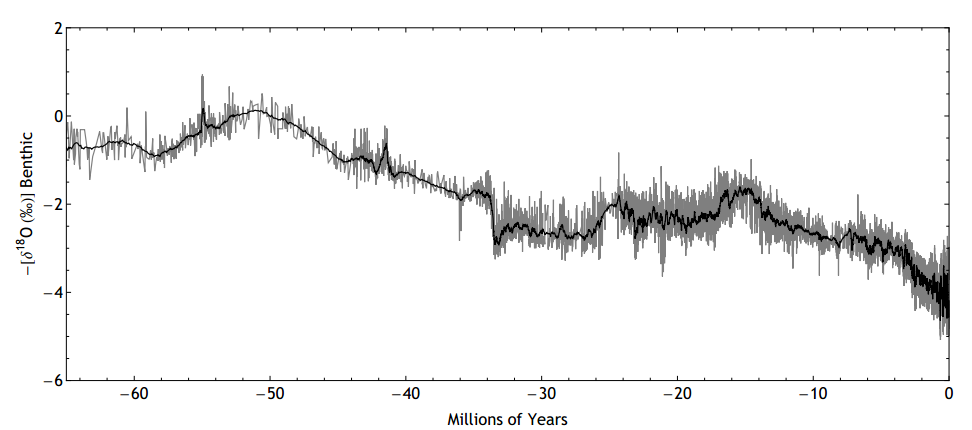
GP stated figures for the last 60 million years. Your graph covers less than 2.5% of that range, so it doesn't have anywhere near enough data to refute the GP's claim.
However, if you look at the graph of the last 65 million years, you'll see that we are, quite literally, the coldest we've been during that entire period.
-
Re:Weather is NOT climate
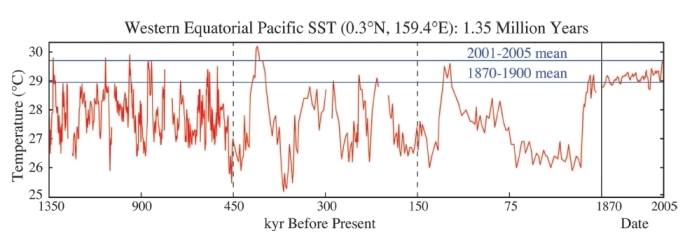
If you look at the temperature over the last millionish years...
http://math.ucr.edu/home/baez/...you can see it's been this hot many times before without human intervention.
you can see the temperature made a major move upwards a looooong time before the 1800's. from 26c to 29c. Humans almost certainly had nothing to do with that or other massive temperature shifts between 26 and 30c that have occurred repeatedly over the last millionish years.This particular move may be enhanced by humans. 7 billion human beings are having widespread effects on the planet. And it looks like we may be on target for 11 billion humans instead of 9 billion humans.
That's a lot of Co2, methane from cows, asphalt paved and building covered ground that used to be forest in most places.
But we are not even at a record temperature yet, similar temperature moves have happened many times (dozens, scores?) over the last million years without humans being the cause.
Based on the evidence of the historical record the temperature could fall 3 degrees shortly after it peaks. Well after we are dead of course.
Right now, I think the most likely course is temperatures will continue to rise slowly- we'll see the oceans rise by 20" by 2100.
And we'll have *too many* people. Way over the carrying capacity of the earth. We've overbred and it really doesn't matter what we do if we don't get the population down. We are just moving deck chairs on a sinking Titantic.
Here's the last 10 million years
http://4.bp.blogspot.com/-6ftZ...It shows a pretty strong correlation between co2 and temperature. It also shows the co2 level has fluctuated a lot without humans around and that the temperature has been as high and lower many times in the last 10 million years.
Here's the last 65 million years
http://mpe.dimacs.rutgers.edu/...We are at the bottom of a 65 million year long cooling period.
Here's the last 2.4 billion years
http://geology.utah.gov/survey...We could just be exiting a near ice age. It looks like much of the time, the average temperature of the earth has been about 72F. About 10 degrees warmer than it is now. Humans could be the cause- but even without human interaction, the temperature seems likely to return to the mean at some point in the future. On a billion year scale, the current temperatures are uncommonly low.
-
OLD NEWS
This is already done in Mexico City. The net result has been to INCREASE pollution. While air quality in the city did not change at all, residents simply kept their old car when they bought another one. Now they had 2 cars and could drive every day of the week because they had different plates. As a result they kept older cars that might have been salvaged running longer, producing more pollutants over the long run and also forcing the poor that could only afford one car to be the only group in compliance with the spirit of the law. Car purchases in Mexico city sky rocketed while new car production remained stagnant, meaning people were buying older used cars. Basically this law caused Mexico city to suck in every 20 year old jalopy from every neighboring city and town just so residents could get to work on time.
There have been many studies done on this. Here's just the first that popped up in Google.
Citation:
http://www.rci.rutgers.edu/~in... -
Re:To long, didn't check.
I'll undermine your 'proof by authority' by pointing out that the best you can possibly get from my assertion is a fallacy of false generalization. In fact, I'll go so far as to say that GP is correct. Some mathematicians are unsatisfied by computer proofs. Possibly most mathematicians. I've apparently gone on record calling the majority of mathematicians "idiots". Worse, I'm on the job market. Good thing my real name isn't on this account!
If I get tenure, I'll get to put my name to my opinions. If I'm a tenth as cranky and outspoken as Doron Zeilberger, I'll be satisfied. -
Re:./ sinks to a new low
The ability for a non-human disease to cause such a negative impact is interesting.
The horse was a big city crisis.
A 1000-pound horse will defecate from 4 to 13 times per day. On the average, this horse's manure will contain about 31 pounds of feces and 2.4 gallons (~ 20 pounds) of urine, totaling up to 50 pounds of manure (not including bedding) per day as excreted.
New York City had 100,000 horses on the streets in 1900. The stench of the manure could be over-powering and flies spread diseases. Dead horses were simply shoved to the sides of streets in summer, as you can see in uncensored photographs of the era. It was simply impossible to clear the carcasses quickly enough.
-
Re:she
-
Re:Stupid
with current trends there is a very high risk of not having enough snow
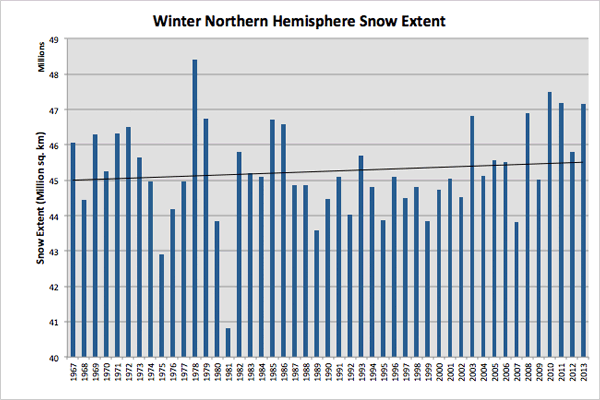
Winter northern hemisphere snow cover trend is on the increase - not decrease - since decades back.
http://climate.rutgers.edu/sno...
If I understand this graph right it doesn't show amount of snow but how wide area that receive any snow at all? Anyway, the research done for Oslo 2022 olympics paint a risky picture, with emphasis on risky. The research is not saying that there won't be good winters, but that the risk of bad winters is increasing. And this winter seems to be one of them.
-
Re:Stupid
with current trends there is a very high risk of not having enough snow
Winter northern hemisphere snow cover trend is on the increase - not decrease - since decades back.
-
bedbug arena!
bedbug trap invented in New Jersey
figures.
-
It's a trap!
"Good Times" is widely known as the most dangerous computer virus of all time.
"Goodtimes will re-write your hard drive. Not only that, but it will scramble any disks that are even close to your computer. It will recalibrate your refrigerator's coolness setting so all your ice cream goes melty. It will demagnetize the strips on all your credit cards, screw up the tracking on your television and use subspace field harmonics to scratch any CD's you try to play.
"It will give your ex-girlfriend your new phone number. It will mix Kool-aid into your fishtank. It will drink all your beer and leave its socks out on the coffee table when there's company coming over. It will put a dead kitten in the back pocket of your good suit pants and hide your car keys when you are late for work.
"Goodtimes will make you fall in love with a penguin. It will give you nightmares about circus midgets. It will pour sugar in your gas tank and shave off both your eyebrows while dating your girlfriend behind your back and billing the dinner and hotel room to your Discover card."
Seriously, just don't do it.
-
Re:I work at SearsCrap, wasn't logged in.
I'd argue most of those malls ALREADY have many of those things.
With respect, you're flat out incorrect in some cases, and misguided in others.Many malls are pushing 50-75 shops, so that's a LOT of electric and telco already present
As you can see here , the electrical consumption of your average mall runs around 9 Watts/sq ft. Even a moderate Data Center load is going to be around 75 Watts/sq ft just in terms of IT load. Once you factor in Mechanical Cooling, it's just going to go up from there. Furthermore, even if a mall had say a 10 MW electrical feed, you're obviously going to want 2 or more separate, dedicated feeds for your Data Center. You don't want to share that feed with the mall. Any disturbance on that mall's feed could impact your own. So when the maintenance guys at the mall screw up and accidentally single phase a compressor on their chiller, you don't want to have the fault on your line. Thus, any way you slice it, you're putting in your own feed(s). Figure in also, you have to think whether the local electrical utility planned for an additional several Megawatts of power in this particular section of their grid. Perhaps they had planned for maybe a 10-15% growth in the mall's load, but not quite for a sudden 5-10 MW being dropped on the circuit(s).
Malls are often near highways which is where most of the fibre got laid so it's easy to add.
Again, you're missing the point. In some cases, yes, lots of fiber trunks are laid where the freeways and highways are. This isn't always the case, but I'll go with it. You still have to get comm into your facility, and I'm continuing to say that this is going to be a little more of a hassle if you're adjacent to a busy, functioning mall.
Many malls already have basic backup generators (plus natural gas and such already ran) in place for stores, not to data center standards, but in place.
Irrelevant. Yes, some malls have cute, little natural gas generators to run their Fire/Life Safety Systems (elevators, emergency lighting, security system, etc) as required by code but a) this is not even slightly close to what you'll need to run a Data Center and b) even if it were, you'll want your own dedicated generators for your Data Center. Do you really want to run the risk of not being able to power your Data Center during a utility outage because the elevator to the Cinnabon needs to run?
These shops aren't "that big" that they need major renovation into data centers, they'r plain brick boxes right now. They are more the size of a telecom CO office. t's only now that everybody is Blade servers + SAN that it would even be practical to use the space.. again because they are SMALL enough not to be a major drain on power resources like the major centers are. I understand your point, as I work for a steel melting mill and many data centers are starting to catch up with OUR power usage.
I don't think you are getting my point. This isn't about the physical space in the building, it's about all the other things. To your point, the Blades and SAN configuration does indeed take up a smaller footprint than some of the older hardware, but it is DRAMATICALLY more energy intensive (thus my reasons for harping on things like electrical utility, generators, and cooling). A moderate Data Center with around 75,000 square feet of raised floor is probably going to draw somewhere between 5 and 10 Megawatts. I'd say that's probably very close (if not beyond) many industrial applications.
as far as security, the best security is often in plain sight. most of the abandon mall properties I see (at still used malls) are kept up on the surface pretty well. There's plenty of security already for the mall (to watch for parking lot vandals and robbers, etc)and these would not have any foot tra
-
Re:I work at Sears
I'd argue most of those malls ALREADY have many of those things.
With respect, you're flat out incorrect in some cases, and misguided in others.
Many malls are pushing 50-75 shops, so that's a LOT of electric and telco already present
As you can see here, the electrical consumption of your average mall runs around 9 Watts/sq ft. Even a moderate Data Center load is going to be around 75 Watts/sq ft just in terms of IT load. Once you factor in Mechanical Cooling, it's just going to go up from there. Furthermore, even if a mall had say a 10 MW electrical feed, you're obviously going to want 2 or more separate, dedicated feeds for your Data Center. You don't want to share that feed with the mall. Any disturbance on that mall's feed could impact your own. So when the maintenance guys at the mall screw up and accidentally single phase a compressor on their chiller, you don't want to have the fault on your line. Thus, any way you slice it, you're putting in your own feed(s). Figure in also, you have to think whether the local electrical utility planned for an additional several Megawatts of power in this particular section of their grid. Perhaps they had planned for maybe a 10-15% growth in the mall's load, but not quite for a sudden 5-10 MW being dropped on the circuit(s).
Malls are often near highways which is where most of the fibre got laid so it's easy to add.
Again, you're missing the point. In some cases, yes, lots of fiber trunks are laid where the freeways and highways are. This isn't always the case, but I'll go with it. You still have to get comm into your facility, and I'm continuing to say that this is going to be a little more of a hassle if you're adjacent to a busy, functioning mall.
Many malls already have basic backup generators (plus natural gas and such already ran) in place for stores, not to data center standards, but in place.
Irrelevant. Yes, some malls have cute, little natural gas generators to run their Fire/Life Safety Systems (elevators, emergency lighting, security system, etc) as required by code but a) this is not even slightly close to what you'll need to run a Data Center and b) even if it were, you'll want your own dedicated generators for your Data Center. Do you really want to run the risk of not being able to power your Data Center during a utility outage because the elevator to the Cinnabon needs to run?
These shops aren't "that big" that they need major renovation into data centers, they'r plain brick boxes right now. They are more the size of a telecom CO office. It's only now that everybody is Blade servers + SAN that it would even be practical to use the space.. again because they are SMALL enough not to be a major drain on power resources like the major centers are. I understand your point, as I work for a steel melting mill and many data centers are starting to catch up with OUR power usage.
I don't think you are getting my point. This isn't about the physical space in the building, it's about all the other things. To your point, the Blades and SAN configuration does indeed take up a smaller footprint than some of the older hardware, but it is DRAMATICALLY more energy intensive (thus my reasons for harping on things like electrical utility, generators, and cooling). A moderate Data Center with around 75,000 square feet of raised floor is probably going to draw somewhere between 5 and 10 Megawatts. I'd say that's probably very close (if not beyond) many industrial applications.
as far as security, the best security is often in plain sight. most of the abandon mall prope
-
Re:wrong
Either Mt. Pinatubo or Mt. St. Helens were far larger than that in terms of energy and vastly more effective at coupling the debris into the upper atmosphere. Add to that the large amounts of sulfur compounds they emitted. So, where was the massive weather disruption or global cooling (or warming for that matter)? It didn't happen. It hasn't happened then or even with Krakatoa or other massive eruptions of less than Yellowstone or Mt. Toba scale.
Both Pinatubo and Krakatoa had noticeable climatic consequences. But those effects lasted only a few years, on the surface. (Krakatoa probably affected ocean heat for many decades.) Tambora helped cause "the year without a summer".
16 nukes wouldn't do much, but a large number of nukes could cause a nuclear winter. For the climatic consequences of that, see this paper.
-
Re:wrong
Either Mt. Pinatubo or Mt. St. Helens were far larger than that in terms of energy and vastly more effective at coupling the debris into the upper atmosphere. Add to that the large amounts of sulfur compounds they emitted. So, where was the massive weather disruption or global cooling (or warming for that matter)? It didn't happen. It hasn't happened then or even with Krakatoa or other massive eruptions of less than Yellowstone or Mt. Toba scale.
Both Pinatubo and Krakatoa had noticeable climatic consequences. But those effects lasted only a few years, on the surface. (Krakatoa probably affected ocean heat for many decades.) Tambora helped cause "the year without a summer".
16 nukes wouldn't do much, but a large number of nukes could cause a nuclear winter. For the climatic consequences of that, see this paper.
-
This is the path to madness
We need to stop this madness. Even if we assume that fall-out outside of India/Pakistan's borders is not severe if they were to ever have a war that turned nuclear, the entire world will suffer the climatological consequences. See the following link (warning, PDF)
-
Tinkertoy implementationWell, it'd be more fun to make a tinkertoy implementation of the paper computer simulator, wouldn't it? http://www.rci.rutgers.edu/~cfs/472_html/Intro/TinkertoyComputer/TinkerToy.html
something done by Daniel Hillis and Margaret Minsky (minsky's daughter?) at M.I.T. in 1977
http://en.wikipedia.org/wiki/W._Daniel_Hillis#Education_and_research -
Re:Depends...
Some of my wife's relatives are of the "forward-to-all every-damn-thing-that-hits-my-mailbox" type. Naturally, every email address in the relative's address book is in the CC: line. So every desktop that sees those emails now has her email address, with predictable results.
I have a boilerplate response that I send (repeatedly) to friends, family, and various administrators, who do this. I really don't want to get mail with 800+ recipients' email addresses. Also of use is a template for bogus rumors linking to http://www.snopes.com/ .
It goes something like this:
xxxxx,
Sending email to lots of people who might not want their email addresses exchanged with random strangers, or others, is pretty rude. We get enough junk email without having all of your contacts' virus infested machines having a copy of my email address on them. I suspect that current privacy legislation prohibits this sort of behaviour. If you must send email messages out to lots of people, please use the Bcc header rather than "To:" or "Cc:"
Here is a copy of a message I typically send out to people who send me huge lists of strangers addresses:
I cannot recall if I have mentioned this to you recently, but I figure I will mention it again. Most of this is "boilerplate" that I send to everyone who makes the same mistake that you did, hopefully it is not too impersonal...
The message you just sent included the email address of ALL (or at least A LOT) of the recipients in either the "To:" or the "Cc:" fields, so that all recipients could view the others' email addresses. I recognize that there are reasons why it might be nice to include all recipients in an easily viewed format, but in general I think it is a bad idea. What with the amount of junk email that we all get, and the increased incidence of email worms/viruses which spread by finding new addresses to send themselves to, exposing private email addresses of your corespondents to each other is a bad idea.
In the recent past I have started receiving email viruses addressed to email addresses that are directly linked to people using them in legitimate "mass mailings" such as yours. If any one of the listed people's machines is or ever gets infected, all of your recipients could start getting junk and/or virus email from those infected machines. This is only one small reason for avoiding the practice. There are larger security and privacy issues to consider too.
Much better is to use the "bcc" header whenever possible when sending to large numbers of recipients. It looks neater to each recipient not having to read through a huge list of addresses, and provides some privacy protections. Here is some information about "bcc" in email in case it might be of use to you:
http://www.cs.rutgers.edu/~watrous/bcc-for-privacy.html
Thanks for your attention to this issue.
-
Re:Addie the Atom Says...
[Y]es, in an all out war with Russia or China we would need to strike more than 1,000 targets. [C]ontrary to popular belief [fueled] by Hollywood, this would neither kill all human nor plunge us into a nuclear winter.
According to your own research? The latest studies indicate that even a small-scale exchange (between India and Pakistan, for example) would cause widespread crop failures and famines. You haven't cited any sources; here are some of mine:
Consequences of Regional-Scale Nuclear Conflicts (2007)
Massive global ozone loss predicted following regional nuclear conflict (2008)
-
Re:Addie the Atom Says...
[Y]es, in an all out war with Russia or China we would need to strike more than 1,000 targets. [C]ontrary to popular belief [fueled] by Hollywood, this would neither kill all human nor plunge us into a nuclear winter.
According to your own research? The latest studies indicate that even a small-scale exchange (between India and Pakistan, for example) would cause widespread crop failures and famines. You haven't cited any sources; here are some of mine:
Consequences of Regional-Scale Nuclear Conflicts (2007)
Massive global ozone loss predicted following regional nuclear conflict (2008)
-
Re:Addie the Atom Says...
yes, in an all out war with Russia or China we would need to strike more than 1,000 targets. and contrary to popular belief fueld by Hollywood, this would neither kill all human nor plunge us into a nuclear winter.
From a wikipedia article...
A minor nuclear war with each country using 50 Hiroshima-sized atom bombs as airbursts on urban areas could produce climate change unprecedented in recorded human history. A nuclear war between the United States and Russia today could produce nuclear winter, with temperatures plunging below freezing in the summer in major agricultural regions, threatening the food supply for most of the planet. The climatic effects of the smoke from burning cities and industrial areas would last for several years, much longer than previously thought. New climate model simulations, which are said to have the capability of including the entire atmosphere and oceans, show that the smoke would be lofted by solar heating to the upper stratosphere, where it would remain for years.
Here is the original source It has a really neat video with a well spoken guy!
Z
-
Re:Maybe just a random troll.
Their resources page reads like a Who's Who of, well, sites anyone can link to?
We’re proud to provide you with the following resources:
Professional Organizations and Governmental Agencies
American Bar Association
Library of Congress
American Association of Justice
Association of Trial Lawyers of AmericaNews and Information
The Wall Street Journal
CNN Legal News
The National Law Journal
Law.comLegal Resources
United States Federal Law
U.S. Code SearchAnd the footer text of their pages:
Content copyright 2012. Yes It Is No Piracy - DMCA Remover. All rights reserved.
Clearly they were in the DCMA removal business.
-
Re:Is this different from sport?
There is little evidence that using Adderall, etc, actually improves academic performance. The few studies whcih have been done actually correlate worse academic performance with unprescribed stimulant use. Perhaps you could argue that it is the weaker students using them to begin with. PDF Warning (see page 8 for correlative overview): http://mss3.libraries.rutgers.edu/dlr/outputds.php?pid=rutgers-lib:38417&mime=application/pdf&ds=PDF-1 There is a growing body of evidence that those who do benefit may actually be self-medicating undiagnosed attention defficit symptoms: http://jad.sagepub.com/content/15/4/263.short http://www.tandfonline.com/doi/abs/10.1080/15433714.2010.525402
-
Re:Interesting Algorithm
> Romney has been skyrocketing in terms of female popularity lately...
Baloney. One ABC poll showing a post-convention bounce isn't significant. This is a clear long-term historical trend over multiple election cycles.
It's also becoming important in young voters.
Republicans are obviously going to have to change their approach to stay competitive in national elections. The demographics aren't working for them.
Here's the facts, Jack
http://www.cawp.rutgers.edu/fast_facts/voters/gender_gap.php
-
Re:There are no Facts
now if only we can figure out what to do with the 600,000 (minimum) extra babies...
Jonathan Swift had a solution to that problem in 1729, I bet it would still work today.
-
Some examples
Stephen Greenfield, the best professor I ever had, happened to be one who mainly taught undergraduate math to math, physics, and engineering students and graduate math. However, he had a passion for teaching unlike I'd ever seen and he worked on a course at Rutgers to teach math to non-sciency types.
The last paragraph on this page has a description of the course.
The course diary has tons of material in it.
If you browse Stephen Greenfield's homepage, you'll find a wealth of teaching that might be able to be applied. He's since retired, but his page is still up, so make use of it!
-
Some examples
Stephen Greenfield, the best professor I ever had, happened to be one who mainly taught undergraduate math to math, physics, and engineering students and graduate math. However, he had a passion for teaching unlike I'd ever seen and he worked on a course at Rutgers to teach math to non-sciency types.
The last paragraph on this page has a description of the course.
The course diary has tons of material in it.
If you browse Stephen Greenfield's homepage, you'll find a wealth of teaching that might be able to be applied. He's since retired, but his page is still up, so make use of it!
-
Some examples
Stephen Greenfield, the best professor I ever had, happened to be one who mainly taught undergraduate math to math, physics, and engineering students and graduate math. However, he had a passion for teaching unlike I'd ever seen and he worked on a course at Rutgers to teach math to non-sciency types.
The last paragraph on this page has a description of the course.
The course diary has tons of material in it.
If you browse Stephen Greenfield's homepage, you'll find a wealth of teaching that might be able to be applied. He's since retired, but his page is still up, so make use of it!
-
Some examples
Stephen Greenfield, the best professor I ever had, happened to be one who mainly taught undergraduate math to math, physics, and engineering students and graduate math. However, he had a passion for teaching unlike I'd ever seen and he worked on a course at Rutgers to teach math to non-sciency types.
The last paragraph on this page has a description of the course.
The course diary has tons of material in it.
If you browse Stephen Greenfield's homepage, you'll find a wealth of teaching that might be able to be applied. He's since retired, but his page is still up, so make use of it!
-
Re:Proffessional help appreciated.
Isn't his a version of the "think of the children"?
Related reading: Jonathan Swift: A Modest Proposal
-
Re:We're constantly flirting with extinction
So, while the USA and Russia might be able to ruin each other, and France and the UK can each pick out a country at random to nuke if they desire, the majority of the world will read about it in the paper the next day.
Or read it real time on Twitter....
A localized nuclear exchange of sufficient yield would most likely have a severe impact on the remaining global population.
Scientific American published a (currently pay-walled) article on 2009-12-30 entitled "South Asian Threat? Local Nuclear War = Global Suffering." Quoting the summary:
Nuclear bombs dropped on cities and industrial areas in a fight between India and Pakistan would start firestorms that would put massive amounts of smoke into the upper atmosphere.
The particles would remain there for years, blocking the sun, making the earth’s surface cold, dark and dry. Agricultural collapse and mass starvation could follow. Hence, global cooling could result from a regional war, not just a conflict between the U.S. and Russia.
Cooling scenarios are based on computer models. But observations of volcanic eruptions, forest fire smoke and other phenomena provide confidence that the models are correct.
The article is based on a 2007 Rutgers study by the same authors: "Nuclear Winter revisited with a modern climate model and current nuclear arsenals: Still catastrophic consequences."
Three additional papers on these implications, examining the range from nuclear terrorism to global nuclear war are available here: http://www.envsci.rutgers.edu/~gera/
-
Re:We're constantly flirting with extinction
So, while the USA and Russia might be able to ruin each other, and France and the UK can each pick out a country at random to nuke if they desire, the majority of the world will read about it in the paper the next day.
Or read it real time on Twitter....
A localized nuclear exchange of sufficient yield would most likely have a severe impact on the remaining global population.
Scientific American published a (currently pay-walled) article on 2009-12-30 entitled "South Asian Threat? Local Nuclear War = Global Suffering." Quoting the summary:
Nuclear bombs dropped on cities and industrial areas in a fight between India and Pakistan would start firestorms that would put massive amounts of smoke into the upper atmosphere.
The particles would remain there for years, blocking the sun, making the earth’s surface cold, dark and dry. Agricultural collapse and mass starvation could follow. Hence, global cooling could result from a regional war, not just a conflict between the U.S. and Russia.
Cooling scenarios are based on computer models. But observations of volcanic eruptions, forest fire smoke and other phenomena provide confidence that the models are correct.
The article is based on a 2007 Rutgers study by the same authors: "Nuclear Winter revisited with a modern climate model and current nuclear arsenals: Still catastrophic consequences."
Three additional papers on these implications, examining the range from nuclear terrorism to global nuclear war are available here: http://www.envsci.rutgers.edu/~gera/
-
Re:Tuition math lesson
Dont know where you get your numbers from.
USA Today: In 2009-10, average published tuition and fees for in-state students at public flagship universities in the U.S. are $8,353, compared to $7,797 at all public doctorate-granting universities and $7,020 at all public four-year institutions:
http://www.usatoday.com/news/education/2009-10-20-college-costs_N.htmAnnual in-state commuter student tuition at state schools in my area
Delaware - about 11,500. http://www.udel.edu/admissions/finance/
NJ Rutgers - $12,755. http://admissions.rutgers.edu/Costs/TuitionAndFees.aspx
NY SUNY - $14,750. http://www.suny.edu/student/paying_tuition.cfm
Pennsylvania - 15,000 - 17,500. http://tuition.psu.edu/tuitiondynamic/rates.aspx?location=up -
Re:Do you even bother to edit submissions anymore?
Oh, can I try?
Evangelos Georgiadis of MIT and Doron Zeilberger of Rutgers, along with Zeiberger's computer Shalosh B. Ekhad, have written a paper entitled, "How to Gamble If You're In a Hurry," in which they propose new ways of studying gambling from a mathematical perspective. They criticize previous scholarship following the Kolmogorov measure-theoretic paradigm, including Kelly (1956), Breiman (1961), and Dubins and Savage (1976), on the grounds that the mechanisms they provide for winning do not take into account real-life constraints such as the finite divisibility of money, the finite duration of the game, the finite resources of the opponents, and the possibility of uneven payoff in the game. Rather than proposing a single strategy that provides an optimal outcome to an unrealistic scenario, Georgiadis and Zeilberger provide a Maple package that calculates the best strategy given a set of real-world criteria, including the probability of winning a game, the amount of money you have, and the time within which you must complete your gambling. The paper thus represents a movement from using mathematics to derive single solutions to highly abstract problems to using algorithms that can generate optimal solutions for more concrete problems. Also, Zeiberger advances an attempt at cuteness by putting condescending words about humanity in his computer's mouth, the irony of which is heightened by the realization that Shalosh B. Ekhad is nothing more than Zeiberger's ventriloquist dummy.
-
Re:Do you even bother to edit submissions anymore?
Oh, can I try?
Evangelos Georgiadis of MIT and Doron Zeilberger of Rutgers, along with Zeiberger's computer Shalosh B. Ekhad, have written a paper entitled, "How to Gamble If You're In a Hurry," in which they propose new ways of studying gambling from a mathematical perspective. They criticize previous scholarship following the Kolmogorov measure-theoretic paradigm, including Kelly (1956), Breiman (1961), and Dubins and Savage (1976), on the grounds that the mechanisms they provide for winning do not take into account real-life constraints such as the finite divisibility of money, the finite duration of the game, the finite resources of the opponents, and the possibility of uneven payoff in the game. Rather than proposing a single strategy that provides an optimal outcome to an unrealistic scenario, Georgiadis and Zeilberger provide a Maple package that calculates the best strategy given a set of real-world criteria, including the probability of winning a game, the amount of money you have, and the time within which you must complete your gambling. The paper thus represents a movement from using mathematics to derive single solutions to highly abstract problems to using algorithms that can generate optimal solutions for more concrete problems. Also, Zeiberger advances an attempt at cuteness by putting condescending words about humanity in his computer's mouth, the irony of which is heightened by the realization that Shalosh B. Ekhad is nothing more than Zeiberger's ventriloquist dummy.
-
Re:What could possibly go wrong
Heck, forget unintended consequences; people have been pointing out for ages the problem with solutions like this one. First, it's only masking. So it must continue to operate and grow ever bigger and bigger of an operation. If it ever fails -- or, if we find some other devastating unintended consequence and have to stop -- all of the "masked" effects suddenly appear in a very short amount of time. Second, we already know that spraying high-altitude sulphate particles is bad for both ozone and acid rain, decreases sunlight available to plants, provides an uneven heat compensation profile, and would likely cause major drought in monsoon areas. Third, this does nothing to address the other (and potentially larger) consequences of ever-rising CO2 levels, such as ocean acidification.
Some geoengineering proposals have promise. This is not one of them.
-
Re:BJs aplenty
-
Re:Here's a better idea.
I think Rutgers disagrees with you regarding how dangerous it is to be a Cop
Oh, looky there... Taxi driver is third most dangerous job for workplace violence... after police officer (1st) and private security (2nd)
Oh and this article on Forbes says Mining and Police/security are about tied as most dangerous jobs with 13 deaths per 100,000 workers
-
Re:CorrectionMobile hydrogen storage is also a solved problem, and it's much safer than gasoline.
Miami, in its test, set fire to two cars, one with hydrogen and the other gasoline. While both created fires when ignited, the gasoline fire engulfed the entire car causing total damage, whereas the hydrogen flame vented vertically and failed to spread to the rest of the vehicle....Similarly, in 1997, a vehicle safety study by the automaker Ford concluded hydrogen is potentially a better fuel source than gasoline when proper controls are built into the vehicle.