Slashdot Mirror
Domain: sandia.gov
Stories and comments across the archive that link to sandia.gov.
Comments · 342
-
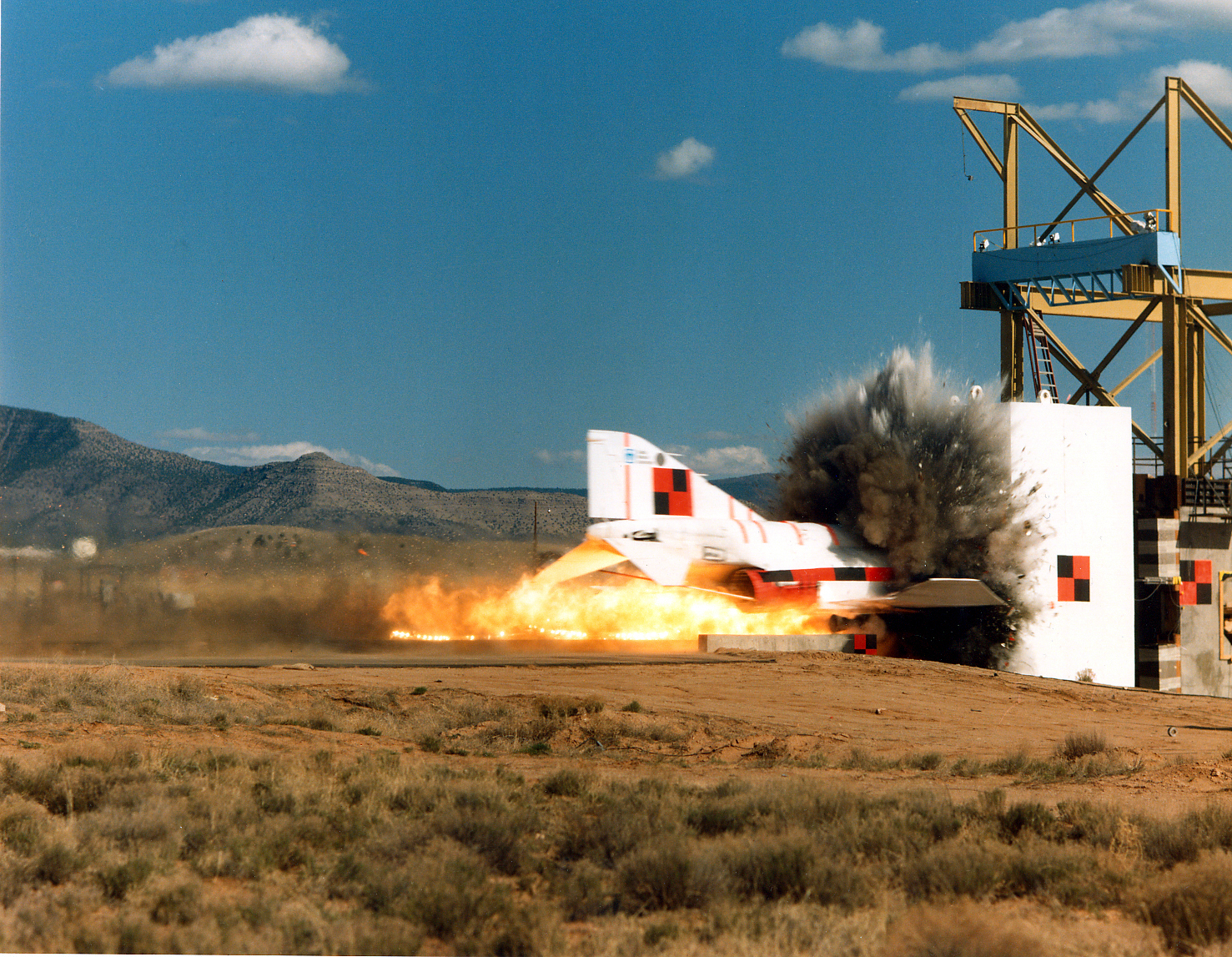
High-res image of Z machine (and press release)
-
Ek=(mv^2)/2, where v=at^2So how did they get such a big energy increase? From their press release:
The new achievement -- temperatures of billions of degrees -- was obtained in part by substituting steel wires in cylindrical arrays 55 mm to 80 mm in diameter for the more typical tungsten wire arrays, approximately only 20 mm in diameter. The higher velocities achieved over these longer distances were part of the reason for the higher temperatures.
(The use of steel allowed for detailed spectroscopic measurements of these temperatures impossible to obtain with tungsten.)
The paper that proposes a model to explain the results says that the final plasma was pinched down to 3.6mm. If a glass tube containing fusable material (D+T ?) were at the center of the hohlraum, it would also get crushed from the inrushing plasma. -
Sure it does.
From the Sandia website:
http://www.sandia.gov/news-center/news-releases/20 06/physics-astron/hottest-z-output.html
"First, the radiated x-ray output was as much as four times the expected kinetic energy input.
Ordinarily, in non-nuclear reactions, output energies are less -- not greater -- than the total input energies. More energy had to be getting in to balance the books, but from where could it come?"
The above line doesn't make sense if total output energies weren't greater than total input energies. Nor could they have put in this zinger at the beginning:
"The unexpectedly hot output, if its cause were understood and harnessed, could eventually mean that smaller, less costly nuclear fusion plants would produce the same amount of energy as larger plants." -
Re:Sounds like this happened 8 years ago too...
Here's a bigger version: http://www.sandia.gov/media/images/jpg/Z02.jpg
I stole it from this page: http://www.sandia.gov/media/z290.htm -
Re:Sounds like this happened 8 years ago too...
Here's a bigger version: http://www.sandia.gov/media/images/jpg/Z02.jpg
I stole it from this page: http://www.sandia.gov/media/z290.htm -
Re:How are they holding it?
This one is way more bitchin... http://www.sandia.gov/media/images/jpg/f4_image2.
j pg -
Re:"Some unknown energy source is involved"
Bwah? That's the most interesting part, to me. I mean, they MUST have had that sucker plugged into a surge protector. From where did the energy appear?
Well, given these are high-energy physycists working at Sandia National Labs, and they've been able to consistenly replicate this, I don't think we're talking about any perpetual-motion quackery here.
It's safe to assume that when they say it generated more energy than input to the system, they're right. They just need to try and figure out the details now. -
Research paper abstract
For the curious, here's the actual abstract from the research paper, as published in Physical Review Letters:
Ion Viscous Heating in a Magnetohydrodynamically Unstable Z Pinch at Over 2×10⁹ Kelvin
Pulsed power driven metallic wire-array Z pinches are the most powerful and efficient laboratory x-ray sources. Furthermore, under certain conditions the soft x-ray energy radiated in a 5 ns pulse at stagnation can exceed the estimated kinetic energy of the radial implosion phase by a factor of 3 to 4. A theoretical model is developed here to explain this, allowing the rapid conversion of magnetic energy to a very high ion temperature plasma through the generation of fine scale, fast-growing m=0 interchange MHD instabilities at stagnation. These saturate nonlinearly and provide associated ion viscous heating. Next the ion energy is transferred by equipartition to the electrons and thus to soft x-ray radiation. Recent time-resolved iron spectra at Sandia confirm an ion temperature Ti of over 200 keV (2×10⁹ degrees), as predicted by theory. These are believed to be record temperatures for a magnetically confined plasma.
Also, there's a press release from Sandia National Labs. -
Here's Sandia's write-up
Rather than reading a digest from a science news site (not that it's a bad writeup) here is the press release from Sandia themselves.
Personally, I think the picture of the Z-machine is one of the coolest looking things I've seen. =) -
Here's Sandia's write-up
Rather than reading a digest from a science news site (not that it's a bad writeup) here is the press release from Sandia themselves.
Personally, I think the picture of the Z-machine is one of the coolest looking things I've seen. =) -
Re:How are they holding it?
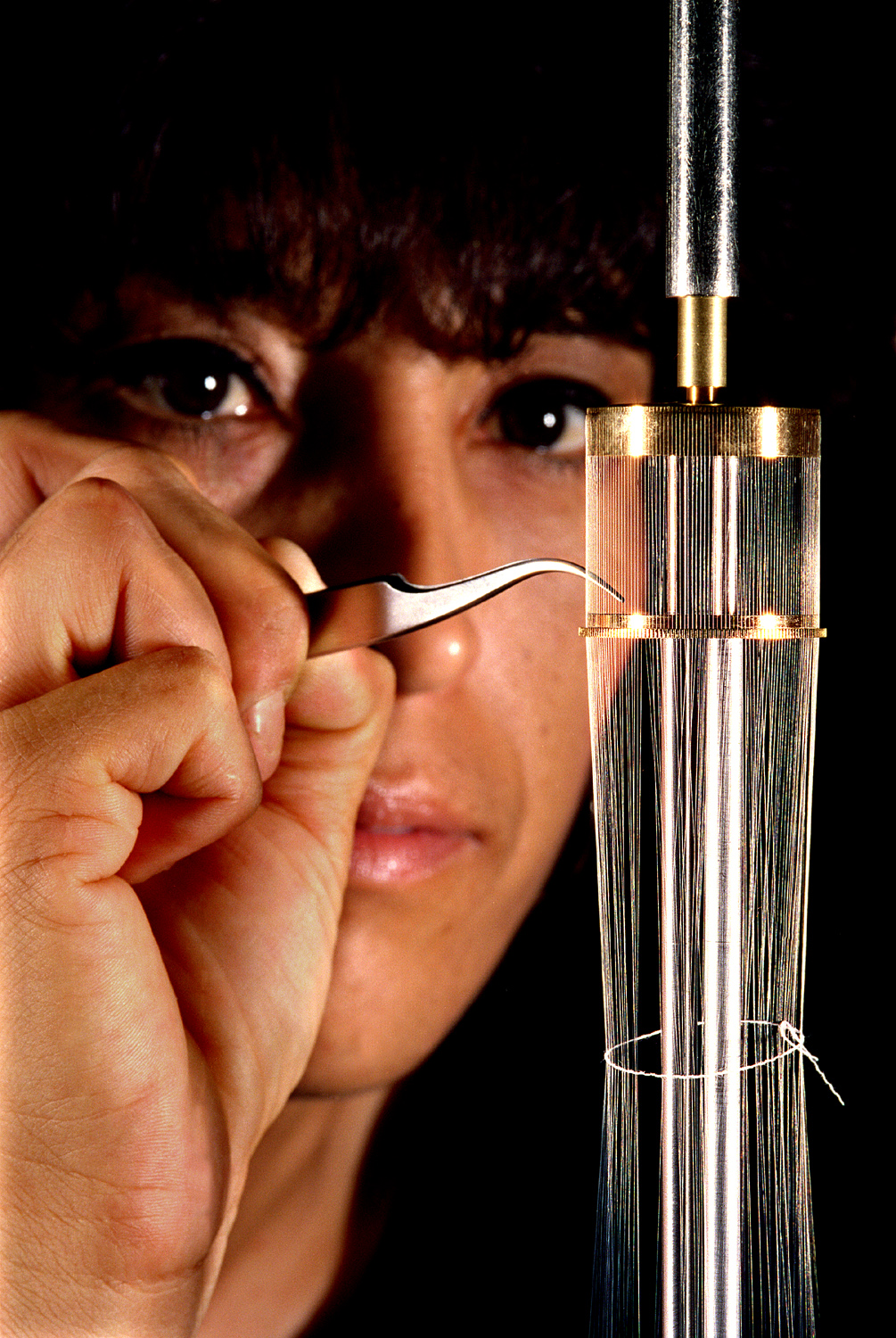
The container that holds the experiment is called a holhraum, just a cylindrical metal thingy. In the middle, wires are vertically strung around in a circle (see this pic). When you pass a current through the wires, they want to move towards eachother (Ampere's law). Since the situation is symmetrical, they all move towards the center, and the intense current, motion, and collision, turn the wires into a hot plasma, that doesn't stick around for long. The whole thing is over in well under a second, and the container holding the plasma is destroyed.
-
Hello 2003.The paper is 2 years, 2 months old. Many of the arguments will still be valid, but the code in all cases will have evolved considerably. In addition, other code has certainly been developed (there's a hard real-time UDP patch for Linux, for example) and the state of affairs is - if anything - much more muddled today.
Documentation like this is great and extremely valuable. It would be much more valuable, however, if it remained current. For example, can the ABISS project (which improves block I/O) be used at all? What do the numbers look like, when using profiling tools like Web100 (which profiles TCP communications)?
Has anyone run the Linux or one of the *BSD kernels through DAKOTA, KOJAK or PAPI to determine where, precisely, bottlenecks are within the kernels? It's easy to theorise, but isn't it cleaner to measure?
Now, I'm not saying these things aren't being done. They probably are, somewhere, by someone, but if the results aren't getting published we don't really know what impact what changes are going to have. The current method of evolving Operating System code in general is often a mix of personal theory and subjective experience based on non-random samples of activity. That can't really be a good way to do things, can it?
If I'm wrong, feel free to say. If I'm right, then maybe it would be a good thing if someone (possibly me) put together some kind of testing kit for measuring Linux kernel performance and actually measured the stats for Linux kernels on some kind of regular basis. -
PC104 uses vertical stacking...
... unfortunately it looks ugly.
It has however, have a standard spec: http://www.pc104.org/technology/PDF/PC104%20Spec%
2 0v2_5.pdf
and has been around for quite some time (1992 by the looks of that document)Random pictures for the uninitiated:
-
Re:'Stacking Comptuers'
Perhaps it was the PC/104 Linux Minicluster (IEEE P996.1)? (Some pictures provided).
Sandia National Labs have this interesting article on a Linux computer that is built
vertically with the power unit at the base, and optional modules which are stacked
on top of each other (CPU Modules, Dual PCMCIA Interface Modules, Hubs, KVM Switch and End Plate Wiring). -
Re:this is old news
> Anyone remember reading about this in Tom Clancey's book "Rainbow Six"???
Clancy based those devices (which were heartbeat sensors, if I recall correctly) on the DKL LifeGuard, which Sandia Labs proved to be pretty much an expensive box of useless electronic components. -
Re:Unfortunately, it's not a passive energy sourceWith photovoltaic systems you have the nasty chemicals currently associated with manufacture
Sandia National Labs has an interesting non-photovoltaic solar power plant. Aimable mirrors focus light on a target, the target gets hot, molten salt transfers the heat to a heat exchanger which generates steam which drives a turbine. They can store enough heat in a vat of molten salt to continue producing power 24 hours a day, the efficiency exceeds that of the cheaper photovoltaics, and unlike wind, output power can be controlled to handle peak loads.
-
Re:A little time discrepancy...
The cobalt was stuck for three weeks. The warning sirens are a government regulation, something to do with informing workers of radiation source. The robot was brought in, but it took a while for the team (from Albuquerque) to get ready to go to White Sands with their robot.
This slashdot article is dupe. See sandia.gov for more poorly written details.
No, they wouldn't be fired; they work at a national lab
-
It's been done, at SandiaSomebody at NASA didn't do their homework. Very similar spherical hopping robots were developed in 1997 at Sandia, with DARPA funding. They actually work; they're not just a proposed project with pretty pictures. "Where we want to go is Mars and the moon. With a hopper, you could go much farther from the lander. You could throw out a dozen of these to search in all directions."
There's some interest in this as a new generation of land mine. Dump out a few hundred of these and they wait for a target, like a convoy, to come along. When they find a suitable target, the hopper that found it calls for backup, and the hoppers in the neighborhood swarm to attack the target.
-
Re:key word is catalyst
I hate to burst your bubble, but most crop plants achieve only 1 to 2 percent efficiency, with sugarcane being an exception at 8%.
Source: http://www.life.uiuc.edu/govindjee/whatisit.htm
Scientific-grade solar cells are about 15% to 20% efficient with some going as high as 24%
Source: http://www.udel.edu/PR/UDaily/2006/nov/solar110205 .html
Solar Stirling engines achieve nearly 30% efficiency at an installation at Sandia National Laboratories.
Source: http://www.sandia.gov/news-center/news-releases/20 04/renew-energy-batt/Stirling.html
So I'm sorry to say that plants SUCK at converting sunlight into energy we can use. As the first link states, the initial reaction in photosynthesis is nearly 100% efficient, but as biological processes consume that energy, the total efficiency for the system drops significantly. Work is being done to attempt to make "biological solar cells" which use the initial reaction in photosynthesis as their method of light harvesting, but to date nothing has been produced.
Electricity storage for vehicles is a bit of a problem, unfortunately. I haven't got any links declaring that one solved. -
Re:What display?
This might work: http://www.sandia.gov/media/NewsRel/NR2001/vizcor
. htm
I saw this thing in person. It's amazing. -
Re:National Solar Thermal Test Facility
Blast it, must have typo'd the URL:
Questions Frequently Asked by NSTTF Visitors About Solar Energy -
Incandescent's days may be numbered
I'm an LED flashlight geek, so I'm realistic when it comes to lighting a house with LEDs. I'd be surprised if in 20 years we weren't replacing CFLs with LED bulbs, but at the moment it's not a worthwhile investment.
Right now, I'm happy with my CFLs: for the wattage needed to light my living room and foyer with incandescents (140 watts), I can light my whole apartment on a dark October day. It's definitely a mood-lifter to not have to worry about my electric bill, or have the place look like a funeral home.
OTOH, incandescents may not be so quick to fade away: the efficiency of tungsten filaments can be significantly increased by using crystals instead of wires. -
Re:article sort of misleading on mpp/cluster
Not just misleading on mpp/cluster. Also dated with respect to Amdahl's law.
William Camp, a center director (http://www.cs.sandia.gov/), from Sandia National Laboratories, says that "contrary to Amdahl's expectation, we can routinely" do better. He also says that "Amdahl neglected the overhead due to communications". From a talk found at http://www.blu.org/meetings/2003/11/NovBlu.pdf and qualified a little more in http://www.top500.org/corner/articles/article_15.p hp. -
Dept. of Energy? Weapons Computers??
In case you are wonder what the DOE needs teraflop weapons computers for...
think ICBM, baby... http://www.sandia.gov/media/online.htm -
Re:Solar Powered Hydrogen Generator?Why would I cover my car roof? I'd cover the garage's roof. And if that wasn't enough area I could dedicate a quarter acre or so of the pasture out behind the house to it.
For a large installation such as the side of a house, you may find it cheaper and more productive to use tracking mirrors (heliostats) to focus sunlight to concentrate heat to drive a turbine or sterling engine (see Sandia's Solar Two) instead of spending the money on less-efficient solar cells. Engines, while not cheap, are usually at least 30% efficient, while only the most expensive solar cells are that efficient (most are about 12% efficient). And more/larger mirrors are cheap.
-
Re:Environmental loop...
At 7 square miles per plant, that is 7000 square miles,
actually, from the Sandia Website, it's 10,000 square miles. a farm 100 miles by 100 miles in the southwestern US could provide as much energy as is needed to power the entire country.
seems like they figured the cloudy days in that number . -
Re:Sandia National Labs - A different story
I am also a summer intern at Sandia. This is only my first year, and I have really enjoyed the work. However, with regard to the government-doesn't-care-about-deadlines statement above, I would disagree. I work on an open source project called Trilinos (a R&D100 2004 winner). We tagged our code a couple of weeks ago for the next release, and this deadline isn't going anywhere. As for the rest of the previous poster's comments, Sandia is a great place to work. It seems that they like to keep their interns, although my department (as a rule) only hires Ph.D.s, so getting job a after graduation can entail many, many summer internships.
-
Sandia National Labs
Tomorrow will be the last day of my 5th summer internship at Sandia Labs . I haven't worked anywhere else so I can't really compare, but I thought it was pretty enjoyable expereince overall. I did alot of web programming (mainly asp and PL/SQL web toolkit). Being a CS major, I found this job more suitable someone with an MIS background, but for 17.50 an hour I wasn't going to complain. I could have requested to get moved to another job, but I was too lazy. Now it seems that they want to hire me full time once I graduate. It's a very laid back environment here. You can pretty much come in whenever you want, and leave when ever you want. My manager was really cool, he never got on my case about anything. It's operated by the federal government so you know they are gonna push back the deadline for projects almost every time. The catch is to get a job at Sandia, you usually need some contacts working on the inside for you. If you can your foot in the door with Sandia, you will most likely be in good hands.
-
Go for Maximum Efficiency
Electromagnetic launchers are practical NOW. "Just accelerate the space cargo in a vacuum tube until escape velocity is achieved, while climbing a high mountain." Only one key technology has been needed, and it got invented just a couple years ago. At the END of that vacuum tube, a means is needed to keep the atmosphere from rushing in while still letting the cargo exit. The plasma valve is the answer to that problem.
-
Cool, but...
... Sandia National Lab's Z-Machine is about 20-times more powerful (http://www.sandia.gov/media/z290.htm)
-
Andy Richter?
Hey is that Andy Richter (from the Conan Obrien show) in that photo? Now we know why he quit...
http://www.sandia.gov/news-center/news-releases/20 05/images/nonlethal-weaponry_nr.jpg -
Quarter-shrinker, not rail gun!
The famous Sandia Z-machine is more of a quarter shrinker than a rail gun.
Sadly, the evolution of the English language nowadays seems to be directed by bad science fiction and gory video games. Real rail guns were projectile weapons so large they must be transported by rail - they can't be towed or moved with a truck without being disassembled because they are too heavy for roadbeds - and they have names like "Gustav", "Big Bertha" and "Schlanke Emma".
If the Z-machine was a gun (which it's not) it oughta be called a capacitive discharge cannon, not a rail gun. But I guess that's too hard to spell for kids today?
Those who ignore history are apparently in charge of revising the english language. Wikipedia and dictionary.com both use the "new" definition of railgun (although at least wiki has the grace to mention real railguns in passing).
Future historians are going to hate us for this one. -
Quarter-shrinker, not rail gun!
The famous Sandia Z-machine is more of a quarter shrinker than a rail gun.
Sadly, the evolution of the English language nowadays seems to be directed by bad science fiction and gory video games. Real rail guns were projectile weapons so large they must be transported by rail - they can't be towed or moved with a truck without being disassembled because they are too heavy for roadbeds - and they have names like "Gustav", "Big Bertha" and "Schlanke Emma".
If the Z-machine was a gun (which it's not) it oughta be called a capacitive discharge cannon, not a rail gun. But I guess that's too hard to spell for kids today?
Those who ignore history are apparently in charge of revising the english language. Wikipedia and dictionary.com both use the "new" definition of railgun (although at least wiki has the grace to mention real railguns in passing).
Future historians are going to hate us for this one. -
Sandia's press release.
Get it from the source!
http://www.sandia.gov/news-center/news-releases/20 05/nuclear-power/z-saturn.html -
Re:Just because we can do a thing...
Oh! oops. They really did use the magnetic field of Z to directly accelerate the plate! Apparently the way they circumvented the problem of vaporizing the plate with a huge current pulse is by staggering Z's laser triggered spark gaps to elongate the current pulse from tens to hundreds of ns. Very neat trick.
-
Does not.
The article's title is extremely misleading.
This does not bring rail guns any closer to reality, by which I mean it does not bring military rail guns any closer to reality.
The Z-machine is a hanger-sized experimental device akin to a particle accelerator. This was an experiment designed to study extremely high pressures, such as those thought to have been important in Jovian planetary formation.
Saying that this experiment brings rail guns closer to reality is like saying that the Large Hadron Collider (LHC) at CERN brings PPCs closer to reality. -
Government Labs
One place to check out is government labs, like Sandia National Labs, http://www.sandia.gov/ in Albuquerque New Mexico. I interned there starting my sophmore year in High School. Being a government lab rather than a corporation, they try to teach you rather than just squeeze as much work out of you as they can. They pay well too (7.75 per hour for High School and 13.00 for college freshman, going up by the year), and you can learn alot of useful things (I learned SQL, Java, and began programming there). There are other labs like it, Las Alamos and Lawrence Livermore being two. It is very competative, and if you don't get a chance, doing some form of volunteer work is probably a good alternative. Even if you don't get paid, it will look very well on your resume.
-
Re:Vampire Toys
They're already here:
Long-Life Biothermal Battery
The technology is based on a patented innovation in the utilization of thermoelectric materials, using nanoscale-based, thin-film materials to convert thermal energy produced naturally by the human body into electrical energy. The resulting power can be used to "trickle charge" batteries for medium-power devices such as defibrillators, or directly power low-energy devices like pacemakers.
or:
Researchers building biologically fueled microfuel cells
But unlike a hydrogen fuel cell, which has to be refueled with hydrogen periodically, the bio-microfuel cell will continue to produce electricity as long as the plant or other biological host remains alive. -
Re:military research, again
Hello? That's the NIF!
Why yes it is.
You've managed to go in full circle away from "the military wants this too" back to "the NIF is doing these experiments"!
To understand your confusion I was looking back at a post of yours in this thread in which you doubted that powerful lasers were to be used for nuclear stockpile stewardship:
Why would you go through all the trouble of testing the dueterium/lithium samples in a reactor when they could just as easily do a purity test?
and:
Maybe you have more info that would help, but I just can't fathom why anyone would attempt to test a fusion bomb in this manner.
Now, from the third paragraph of the article I linked:
By achieving ignition, NIF will allow weapons scientists to perform several kinds of experiments for the Department of Energy's Stockpile Stewardship Program to ensure that the U.S. nuclear arsenal remains safe and reliable.
If you read the article, you will see that NIF has indeed been sold primarily as a method to test the effects of aging on nuclear weapons.
But the idea is not to stick any part of an actual warhead in the middle of a room and blast it with lasers. It is to get better models for D-T fusion works.
We know the half-life of tritium pretty darn well, but we don't necessarily know how the yield of a warhead is affected by the gradually increasing ratio of deuterium to tritium.
As for the military.. some people may consider this a technical point, but the US military has not been in charge of the testing or development of nuclear weapons since 1946. This is a responsibility of the Department of Energy (a civilian agency), not the Department of Defense. The DOD helps out with tests and so on, but it is almost never in charge of any nuclear weapons work.
So it is trivially true that the military does not plan to test hydrogen bombs themselves. But they are very interested in it nevertheless. Similarly, the microlaser program which you linked to belongs to Sandia Labs, not the military. Sandia is a DOE facility, and therefore is a civilian operation.
HTH... -
Re:Jess is not open source
Jess is most definitely not open source and must be commercially licensed even for use by an individual http://herzberg.ca.sandia.gov/jess/download.shtml
:
"Note: Jess is not licensed under the GPL, the LPGL, the BSD license, or any other free software or open source license. Redistribution of the Jess source code under any free software or open source license is prohibited under this agreement." -
Re:Cost goes UP!
You're right, I was hasty about not including efficiency of conversion to mechanical energy.
However, from a fuel usage standpoint, electric power is only about 50% efficient (the best plants reach 60%, most are less), whereas a car is maybe 25%. So let's consider fuel -> mechanical for both systems.
Charging batteries is not very efficient when the batteries are more than say 50 or 60% full already. Your 80% figure is off considerably when you consider that the battery is probably not discharged more than about 50% due to the onboard prius electronics kicking in to keep it from being too low.
With say 60% efficient battery charging, and 80% efficient motor/transmission system you're talking about 48% efficient electricity from wall -> mechanical output efficiency.
With even 60% efficient fuel->wall electricity power plant (ignoring transmission losses), the net fuel-> mechanical efficient of the entire system is about 28%, only marginally better than the 25% you'd expect from a good honda or toyota engine. Interesting. Now the fuel burned at a power plant is cheaper and requires less refining so that's an issue. But it's interesting to see these numbers.
If you just look at dollars, then you've got about 48% efficiency wall electricity -> mechanical and 25% efficiency gasoline -> mechanical so you're using about 2 times as much fuel energy as electricity, so you do save a small amount of dollars, by my calculations around 2 cents per kilowatt hour output. Of course that gets eaten up by the over-baseline charge they put on the excess electricity you're using (over baseline electricity here costs about $0.17/kWh I think.)
At best, considering the time value of money and the premium on hybrids, you're not likely to break even vs buying a reasonably efficient gasoline only car, and you can't really reduce carbon emissions this way without changing the electric generation mechanism.
Now if you want to heat your house with the waste heat of a diesel engine while charging the car battery at night, you could do quite well, in a cold climate.
Of course, as they say, your mileage may vary. -
Re:This has all been gone over before...Photoelectric won't work, won't solve even a small fraction of our power needs, not remotely.
Don't confuse photoelectrics with photovoltaics.
For example, Sandia Labs has a plant currently in operation that produces 5MW in 9 acres, by focusing light onto a tower that heats molten salt which drives turbines. It can produce energy 24 hours a day.
The United States' generating capacity a few years ago was 813 gigawatts, so at
Realistically, you don't need a power generation mechanism to be able to handle the entire United States energy needs before you put it in production. You just need it to be cheap (and cheap after the costs of fighting NIMBY lawsuits are factored in).
Sandia's web site doesn't say what their cost per megawatt hour is, but they do say the entire facility is currently worth $120 million. Since this type of system uses nothing exotic, I would expect economies of scale to change the numbers quite a bit. Assuming a life of 30 years, they'd have to be able to reduce the cost by about a factor of 10 to be competitive with today's rates. It could happen.
-
1000 kW. Pfft... That's nothing frenchman!> for a maximum thermal power of 1000 kW.
This one generates about 10 Megawatts and runs on molten salt.
> [www.imp.cnrs.fr]
Now go away before I taunt you a second time! -
Definitely not new
This is a solar furnace, of which there are many in use today. The biggest one in the world is the Odeillo Solar Furnace located in Odeillo, France. The top 3 in use in the United States are at Sandia National Labs, Georgia Tech and the White Sands Missile Test Range. Awesome stuff!
One amusing side note is that Frank Gehry's popular postmodern buildings have been noted to act as solar collectors, effectively frying people passing by on the sidewalk. -
Re:Other green energy sources
One of the problems with solar energy is that its not constant.
for anyone who thinks that large scale solar power generation has anything to do with the dime-sized solar cells you played with in highschool, i invite you to do a quick search for:
"mirrors" "salt" "solar power"
high pollution production for cells that dont work a night?
try concentrated sunlight, heating salt so water can be boiled round the clock.
stable, simple, clean solar collection that works.
http://www.energylan.sandia.gov/sunlab/Snapshot/ST FUTURE.HTM
"The plant operated successfully until 1988... operating with 96% availability during its final year. It generated more than 38,000 megawatt-hours during its lifetime and consistently ran at its 10-megawatt rating."
Read the whole page and keep reading more if you want, it really is a sophisticated and inexpensive form of power generation that gave me a quite a 'good vibe' when i first came across it. this kind of simplicity would work so well for developing nations, cant you just imagine plants like this creating jobs and supplying energy to towns the world over.
-yours truly, AC -
Re:Conspiracy Theory?
oh, yeah, that's right. Sandia Labs is only in New Mexico, and not in Livermore
In order for something to be raided, it has to be owned by someone else, and the state has always been an ideal target. -
Re:Conspiracy Theory?
oh, yeah, that's right. Sandia Labs is only in New Mexico, and not in Livermore
In order for something to be raided, it has to be owned by someone else, and the state has always been an ideal target. -
Too much radiation up there......for 64-bit processors.
Only recently have Pentiums and other processors of the same level been qualified for radiation hardening in space applications (at the manned-spaceflight altitudes, which are full of radiation). The current level of technology has circuit pathways that are too small and are more easily affected by the exposure. (http://www.sandia.gov/media/rhp.htm --> decision to redesign the Pentium was only in Dec '98 and it was expected to take 2-3 years.)
Either way, whatever they eventually design to replace the Shuttle after its decommissioning in 2010 (or shortly thereafter) will likely be designed with 1990's technology.
-
Adventures in Supercomputing Challenge
The New Mexico National Labs (Los Alamos, Sandia, the universities (NMSU, UNM, etc) and others came together in a rather awesome program about 13 years ago. The Adventures in Supercomputing Challenge Program gives high school students access to modern supercomputers to do scientific programming projects. They are given mentoring and instruction by volunteers as well as volunteered CPU time and access. Schools lacking net access are provided it by the participants, etc. After all their work, there is a competition based on how much was learned, presentations, science done, and final reports. It is a lot of fun. It's really hard.
I was originally a student in it waaaay back when it was getting underway (1990 & 1991) and then acted as a mentor for the next 5 years. I had a first place team and a third place team in those five years. I worked with kids that were often C students because they were bored as h*ll in class and often after seeing what they could do would go on to work harder to improve their grades to get into some very good universities.
Kids often rose to the challenge far and above what I would have thought they'd do. If the kids needed to learn the necessary math for the scienc they wanted to do we'd crash course it. I had kids that had been doing second year algebra doing partial differential equations by the end of the six months of work and able to understand it, frex. They always learned the science and programming that was required as well. This was their work, not mine. I could give guidance and knowledge, but couldn't do the work for them. Some of the science done was thermodynamics, astrophysics, environmental science, and fluid dyanmics, frex.
Now you may not be able to donate supercomputing time, but you might want keep this in mind when you go to think about what HS kids are interested in. Kids are often interested in a lot. You just have to be willing to teach them in a way that they'll remember, show them its useful, and make it interesting.
-
Allow me to reinforce the point.
Here's a nice Sandia link that makes it absolutely clear that even a small-scale solar thermal installation can produce temperatures comparable to those in "nuclear explosions" the article here is only talking about 2000C. This solar furnace is used to test the "failure thresholds of high temperature ceramic and refractory materials." So why in the hell is a nuclear power plant the only option to produce the heat they need to use with their fancy ceramic filter? No doubt the solar furnace in that photo produces temperatures far in excess of what their ceramic filter can even tolerate.