Slashdot Mirror
Domain: sciencemag.org
Stories and comments across the archive that link to sciencemag.org.
Comments · 1,625
-
Re:Hiding the decline
Your concern about measurement tech would be more significant if there was a step change in the data when there was a step change in the measurement tech.
The step change doesn't exist because the instrumental record is what the entire reconstruction is calibrated against. The alignment to 1900 isn't happening spontaneously, but by design. You can check out the details in Marcott's paper here, and more detailed methodology in the supplementary notes.
-
Find the actual paper, not gizmodo crap.Well, it looks as if no-one has bothered to find the actual source, instead of relying on some clickbait advertising site's cut'n'paste.
Well, that took about 3 minutes. The paper is in Science. If you don't have a subscription, you'll need to try something like Sci-hub.
Abstract: The history of atmospheric O2 partial pressures (P-O2) is inextricably linked to the coevolution of life and Earthâ(TM)s biogeochemical cycles. Reconstructions of past P-O2 rely on models and proxies but often markedly disagree. We present a record of P-O2 reconstructed using O2 / N2 ratios from ancient air trapped in ice. This record indicates that P-O2 declined by 7 per mil (0.7%) over the past 800,000 years, requiring that O2 sinks were ~2% larger than sources. This decline is consistent with changes in burial and weathering fluxes of organic carbon and pyrite driven by either Neogene cooling or increasing Pleistocene erosion rates. The 800,000-year record of steady average carbon dioxide partial pressures (P-CO2) but declining P-O2 provides distinctive evidence that a silicate weathering feedback stabilizes P-CO2 on million-year time scales.
So, for starters, it's evident that the researchers (though not the non-geologists at Giz-wotsit) appreciate the difference between erosion (the mechanical break up and movement of rock) and weathering (the chemical alteration of the minerals that comprise that weathered rock). They're also well aware that with two processes in place, and a critical factor (temperature) being considerably variable in both time and space, then deconvolving what is actually going on is going to be quite difficult, if not impossible without more data (perhaps from looking at mineralogy variations in sediments deposited in different areas with different mean temperatures.
contrary to the impression that many people have got (I guess from Giz-thingy, the researchers were specifically not looking at air bubbles in the ice, but at air dissolved in the ice. "(ii) Only analyses of bubble-free ice with clathrates were considered. (para 3)" (Do I need to remind people that "clathrate" does not only mean "crystalline compound of hydrocarbon gases and water"? Probably.) They also look at the argon - nitrogen ratio to monitor for changes in the dissolution of oxygen, argon and nitrogen relative to each other due to changes in the immediate environment of the accumulating snowpack.
Could this be an artefact of measurement? Well, they've certainly considered (and rejected) that : "Our hypothesis is further supported by the observation that data from all four ice cores individually exhibit the same general trends and magnitudes of decreasing dO2
CO2 recorded in the cores does not change sufficiently or sufficiently consistently to explain the changes observed, so they ascribe a lot of the change to the weathering of pyrite - a reduced iron mineral - into oxidised iron salts ("rust", or iron-rich clays e.g. the glaucony/ glauconite familes).
There's a reason that people write papers, instead of using journalists to report their findings. It's because the details matter.
-
Re:The Self Reward Syndrome
Circadian rhythms, entrained both to light and activity, are starting to look pretty important to metabolism of consumed food. They're definitely important to the consumption of food, in that mucking up the internal clock results in overeating (in animal models). Body weight is not a simple arithmetic of calories eaten - calories exercised.
-
Re:Why do people continue to believe alarmist crap
The amount of anti-scientific drivel on
http://www.biologicaldiversity...
http://science.sciencemag.org/...
http://advances.sciencemag.org...
We have been doing it for tens of thousands of years...
http://science.sciencemag.org/...
http://science.sciencemag.org/...
I have to assume that lots of the anti-science types are just yanking everyone's chains for fun. It would be very disturbing to find out they actually believe the crap they type here.
-
Re:Why do people continue to believe alarmist crap
The amount of anti-scientific drivel on
http://www.biologicaldiversity...
http://science.sciencemag.org/...
http://advances.sciencemag.org...
We have been doing it for tens of thousands of years...
http://science.sciencemag.org/...
http://science.sciencemag.org/...
I have to assume that lots of the anti-science types are just yanking everyone's chains for fun. It would be very disturbing to find out they actually believe the crap they type here.
-
Re:Why do people continue to believe alarmist crap
The amount of anti-scientific drivel on
http://www.biologicaldiversity...
http://science.sciencemag.org/...
http://advances.sciencemag.org...
We have been doing it for tens of thousands of years...
http://science.sciencemag.org/...
http://science.sciencemag.org/...
I have to assume that lots of the anti-science types are just yanking everyone's chains for fun. It would be very disturbing to find out they actually believe the crap they type here.
-
Re:Why do people continue to believe alarmist crap
The amount of anti-scientific drivel on
http://www.biologicaldiversity...
http://science.sciencemag.org/...
http://advances.sciencemag.org...
We have been doing it for tens of thousands of years...
http://science.sciencemag.org/...
http://science.sciencemag.org/...
I have to assume that lots of the anti-science types are just yanking everyone's chains for fun. It would be very disturbing to find out they actually believe the crap they type here.
-
Some digging...
Try here. For the supplementary material go here.
Can't get the excerpt page but the main part is there, including their methodology. Which is flawed.
It's based on this study.
Which uses the number of unique
No problem in that. Referenced study shows that there are pretty high correlations on both national and subnational level.The problem with the original study (one this slashdot story is about) is where it claims to "show that politically excluded groups suffer from significantly lower Internet penetration rates compared with those in power, an effect that cannot be explained by economic or geographic factors.
Except their study uses ONLY geographic factors (i.e. geolocation) to determine the "internet penetration" within the "excluded groups".I.e. They are counting subnets in geographically remote places (away from the countries' main networks which tend to be in urban areas) and simply calling such groups of subnets "excluded".
Implying "ethnic favoritism" and political motivation for "exclusion" but never presenting any.
They never demonstrate the connection from subnets to actual people - "excluded" or not.
They never demonstrate "ethnic favoritism" or "political exclusion".
They never even demonstrate "exclusion".
For this study it is a presupposed "fact" that people (i.e. subnets) are somehow "excluded" by the mere fact that there are few of them in one place and a lot of them elsewhere.
It is borderline conspiracy theory nuttery, where being rural automagically means that "the man" is keeping you offline.When they DO try to present SOME kind of evidence for "exclusion", they do so in the supplementary material (page 21), based on the Ethnic Power Relations Dataset.
Where "exclusion effect" is presented across the entire country.
And where USA is situated between Zimbabwe and Nigeria, right next to UK and Canada which are standing shoulder to shoulder between Gabon and India.
While their error bars are universally so wide that South Africa (one of the countries in their study) has an "exclusion effect" just over zero and error bars ranging from -2.5 to 2.5.
The entire graph shows values from -5 to 5.
While Saudi Arabia, Butan, Congo and Egypt are near the bottom of the "exclusion" scale - the lands of internet freedom and political inclusion.Only thing they actually DO determine is that, when controlled for local GDP indicators, "excluded" groups DO have negative regression coefficient (-0.481, standard error of 0.094) - which are about twice lower than "distance to capital" (-0.942, s.e. 0.133).
I.e. Negative influence of being geographically distant from nation's capital is TWICE that from being "excluded".
Even when controlled for the influence of having no electricity (nighttime lights per capita) instead of for GDP, being away from the capital is still a greater negative factor (-0.703, s.e. 0.130) than "being excluded" (-0.539, s.e. 0.090).Meanwhile, higher GDP per capita (0.749, s.e. 0.155), road density (4.068, s.e. 0.833) and urbanization (2.782, s.e. 0.748) all show positive regression coefficients for "internet penetration".
I.e. Closer you are to roads, cities and more money - the greater the number of subnets.
Whodathunkit!In other words, their "conclusion" is not only cherry picking - it is pure confirmation bias in the face of their own results showing the exact opposite of their claims.
-
Re:DNA analysis?
has anyone compared the DNA of the final generations
Yes they did. It's in the Science paper at http://science.sciencemag.org/... (Sci-hub at http://science.sciencemag.org....) They sequenced several hundred of the mutant strains, plus, of course, multiple isolates of the wild-type strains (as wild types drift, even without deliberately applied evolutionary pressures).
to determine if they are genetically identical or radically different?
To no-one's surprise, when they sequenced up to a dozen isolates in a lineage which negotiated their "antibiotic landscape," they found small differences between individual isolates.
The paper is worth reading because your next three questions are probably answered before you formulate them.
-
Re:Not today, but maybe tomorrow
Keep in mind that by sending earth microbes we're giving life there a 3.8 billion year head start.
No we aren't. There is chemical evidence that life existed as soon as 300 million years of planet formation (i.e. about as soon as compatible conditions existed). We have actual fossils of life that formed 950 million years after planet formation.
-
Re:Training is immoral
just wait til they outsource professors to H1B...
H1b is a fairly common visa status for postdocs and non-tenure track faculty.
So, already there.
-
Re:Won't work in America
-
Yes and No
Create a "guest access" account on the router and allow that? Absolutely! No problem with that at all, especially since I can log who connects.
Remove all security and just turn my connection (and all liability in a nation not known for being especially scrupulous with it's accusations of wrong-doing) over to the whims of chaos?
No.
-
Hey Thiel likes Trump.
What's not to like about this?
Plenty and if you read this article in Science you'll gain some insight as to what many scientists think about it. http://www.sciencemag.org/news....
-
Re:Well....
Those are called previous publications - if you have access to any journals you are free to search for Dr. Timothy Mousseau. If you don't understand the terminology you need to learn more about reading, for instance research papers are very vocabulary intensive - here is a general guide on how to read scientific literature. Face reality that you have a losing position, radiation causes chemical changes in DNA and that is the active cause of biological deformities in well understood circumstances, demonstrated by samples collected from two heavily radioactive sites - one decades old, and one more recent. Idiot.
-
Re:Click bait?
Yeah, and why not just link to the original article, instead of the Gizmodo piece which is pretty much just an elementary school science report-style rephrasing of that article?
-
Re:Practical value?
Except that it's established there to "open the envelope" to determine whether something was a blind injection before making announcements. More to the point, the blind injection system wasn't even online during the first discovery.
-
Re: Useless technology
FOOF is even more fun https://en.wikipedia.org/wiki/... http://blogs.sciencemag.org/pi...
-
Re:This will never happen
Here is a Lamprey eel brain in a robotic body back from 2000. We are making progress.
-
Re:The real reason?
Maybe. Maybe not:
http://science.sciencemag.org/...
There have been several studies to date transplanting gut flora from "skinny" rats and mice into "obese" rats and mice resulting in weight loss with the same diet composition. They have also showed the reverse to be true.
Furthermore there seems to be some evidence that sugar-alcohols and artificial sweeteners may be better food for the growth of bacteria that favors an obese phenotype.
http://www.omicsonline.org/bac... http://www.scientificamerican.... http://www.nature.com/nature/j... http://www.nature.com/news/sug...
(FWIW - I am a doctor (MD) but I am not an endocrinologist/obesity researcher)
-
Re:More accurate statement....
A more accurate statement: 1. Over 90% of scientists think the Earth is more likely to be warming up than cooling down. Even skeptics usually agree with this. 2. Most of these scientists said humans had some sort of impact on the climate, but exactly how much was under debate. In fact, the consensus view at present is that the impact of CO2 is overestimated. Sources: IPCC using too many weasel words https://www.google.com/url?sa=... https://www.google.com/url?sa=... Sorry for the messy links.
Agreed, up to the "the consensus view at present is that the impact of CO2 is overestimated" part.
That doesn't seem to match what I'm reading and it's not evident from the two links you provide:
a single paper from "Science" in 2011 which cites a 66% probability of the ECS being between 1.7 and 2.6 degrees K, which seems offhand considerably lower than the consensus, and which is countered right in the same issue by a comment regarding the excessive sensitivity of their methods to boundary conditions http://science.sciencemag.org/...;
and a paper which suggests that the now well known recent overestimation of global average temp could include unpredicted external forcers such as ENSO, AMO, atmospheric effects, volcanic effects, etc.; increased stratospheric aerosol concentrations; or "a missing decrease in stratospheric water vapour (whose processes are not well represented in current climate models), errors in aerosol forcing in the CMIP5 models, a bias in the prescribed solar irradiance trend, the possibility that the transient climate sensitivity of the CMIP5 models could be on average too high or a possible unusual episode of internal climate variability not considered above". That's just mentioning the possibility that if the sensitivity were overestimated it would explain at least part of the prediction error, hardly a consensus view that it is overestimated.
Neither of these papers demonstrates that "the consensus view at present is that the impact of CO2 is overestimated".
In contrast, a quick google search provides, for instance, a paper from 2013, authored by a dozen luminaries, identifying the usual "estimates of the climate sensitivity for doubled CO2 concentrations of about 3C", and suggesting that taking into account long term effects like the change in albedo would put the sensitivity between 4–6C. http://onlinelibrary.wiley.com...
I'm not arguing that the estimate of the latter paper is correct, just that your suggestion that "the consensus view at present is that the impact of CO2 is overestimated" isn't supported either by the links you provide, or what I see being talked about. -
Re:Not so fast
Yes it's warming up. It's been warming up for over 1000 years.
You say these things with confidence but they are quite wrong, You may consider whether you could provide a citation for your statements before you commit them. In fact the global mean temperature has been falling for the last 1000 years - up until about 1850 when it suddenly rocketed upwards. See here for CO2 and temperatures over the last 1000 years: http://phosphorus.github.io/ap...
In fact it's been cooling for about 8000 years since the peak of the current interglacial. Up until about 150 years ago anyway.
You should consider reading the following if you are interested in paleoclimate: Zhao et al 1995, Petit et al 1999, Alley 1999, Thompson et al 2002, etc etc through to this one by Marcott in 2013: http://science.sciencemag.org/...
If Turkey can tell you're full of crap, isn't it a bit obvious guys?
Wow. The Turkish minister didn't even address the right organization. I'm sure your Göktürk is spectacular, but your minister is talking out of his ass here.
-
Re:The future of dosage?
For that matter, the machine would not be producing the drugs, it would just be packaging them. The drugs go in to the machine in some sort of loose form and the machine prints them into pills. Manufacturing is serious chemistry that would be hard to do in a fully automated manner in the field.
The third sentence is correct, but the first is wrong. This new machine does actually do complex chemical synthesis; for an overview of what's impressive about it (as well as which of the researchers' claims are not feasible) see this post: http://blogs.sciencemag.org/pi....
-
Re:No amount of evidence is enough
Our civilization is already set up for pre-industrial temperatures (our closets & coat racks are just a tiny fragment of this infrastructure), and the ideal temperature for economic productivity is 13C.
Also most places, even if considered in isolation, will not be positively effected by global warming in terms of crop yield.
-
Re:That's actually really surprising...
The 'bloody scrum of europeans killing each other over something cryptic' bit isn't exactly news; but TFA describes a relatively massive number of combatants, with isotopic signatures suggesting they came a considerable distance to reach the site and with equipment and healed wounds suggesting that they were comparatively experienced rather than just the local peasant militia(which, given the low population density of the place at the time, wouldn't have amounted to much). I have to wonder how this all worked logistically: ~1,200BC wasn't exactly renowned for its medical technology, regular agricultural surpluses, or food storage capabilities. Aside from motivating this many guys to slog all the way to this site, simply keeping them healthy and fed long enough so they could kill one another before disease or starvation got them must have been a real trick.
Actually it was... Healers back then seem to have had a pretty good track record with things like arrow extraction, they were probably able to sew up and to some degree disinfect stab and slash wounds and they could repair scull damage from blunt trauma (read: hand thrown rocks, sling shot projectiles and war clubs) which is pretty impressive. I once saw an old Zulu medicine man describe how you treat a scull fracture due to a blow from a war club. You usually have to drill into the scull making carefully sure you don't drill into the brain matter which takes training and specialist tools. Sometimes this is done simply to pull out a section of scull that is pressuring the brain, in other cases it is t relieve pressure on the brain in which case you get a sound that he described as a "like the one you hear when you open a can of soda". If there is an impact fracture like this one you may have to remove large fragments of bone, do some carving, chiselling and pick bone fragments out of the brain matter before you sew the wound up. There are recorded survival rates of up to 70-80%.
-
Re:Why conceal it?
DNA is DNA, it has no memory of how it was created -- through genetic engineering or through natural mutations which were then bred because humans or animals intentionally or inadvertently favored them in some way.
What a wonderfully ignorant statement that captures the very essence of this argument. While DNA has no "memory" of how it was created, DNA is not the only concern with GMO foods. GMO foods are engineered to contain genes that express proteins that are advantageous to the recipient plant. Proteins, when expressed the wrong way can wreak havoc on the humans (or animals) that consume them. About the agent that causes CJD: It is difficult to kill, it does not appear to contain any genetic information in the form of nucleic acids (DNA or RNA), and it usually has a long incubation period before symptoms appear. In some cases, the incubation period may be as long as 50 years. See Prions. Prions cannot be destroyed through cooking, and therefore would be present in any product manufactured from the ingredient that contained them. Not to say that GMO products will contain Prions, but if a GMO protein contained in a foodstuff was harmful, it could take decades before it was discovered.
Additionally, our understanding of how DNA works is laughably limited. While we know that DNA contains the instructions to produce a protein, the exact mechanisms that determine the expression of those genes are complicated and aren't always understood. Our understanding of how proteins work and how they interact with each other and RNA is even more limited, especially when you consider how many interactions that must be considered to determine if a GMO protein will be safe to consume.
What hubris you, and everyone who claims that a few years of very limited research, is enough to prove that something this complicated is absolutely safe and warrants no caution by the consumer.
As for myself:
“I am sufficiently proud of my knowing something to be modest about my not knowing all.”
Vladimir Nabokov, Lolita
-
And already published rebuttals...
Already the objections are being raised in print, so it's not like others are overlooking this study.
Of course, the eventual corrections or retraction won't get anywhere near the press the original study did. It never does.
-
Re:On Average Our Planet Has Been Much Warmer
-
Re:How does it stack up
Reminds me of "fusion power plants will be available in 10 years". But in reading the actual abstract, it seems that this is a black body absorption surface on top of a " thermal picture synthesizing device" and is a complete replacement not just a lossless interface. The diagram (F1A) shows connectors down to what I assume is the actual electron flow system that would feed into the rest of the "panel" which would collect the electrons into a usable electricity stream.
-
Re:How does it stack up
Reminds me of "fusion power plants will be available in 10 years". But in reading the actual abstract, it seems that this is a black body absorption surface on top of a " thermal picture synthesizing device" and is a complete replacement not just a lossless interface. The diagram (F1A) shows connectors down to what I assume is the actual electron flow system that would feed into the rest of the "panel" which would collect the electrons into a usable electricity stream.
-
Re:I think I understand TFS...
I think it's talking about gut bacteria and using highly resistant beneficial bacteria to prevent harmful bacteria moving in
No. The summary is so badly written that hard to tell what it is about, but the researchers tricked the mouse immune system into suppressing gut viruses so that the beneficial bacteria could recover faster after antibiotics. Here is a link to the paper.
But what is a "Poop transplant"?
-
Re:Radio exist we know this without seeing it.
That TED talk was awesome.
In terms of "spectrum" I think smell might take the sensory cake**. The senses don't nicely map to each other, so it depending on how we choose to define the problem any of them might win.
Vision lives within the same order of mangitude, wavelengths from ~380-720nm, with the ability to perceive maybe 10 million unique colors. But the sensitivity is tops, in theory able to detect a single photon.
Hearing ranges over 3 orders of magnitude, from 20-20,000Hz. Due to the logarithmic relationship between pitch and frequency, and the intricacies of the human ear, any of the other measures are pretty complex and frequency dependant. This is an excellent primer on the physics of hearing.
Back of the envelope, since humans are able to detect pitch differences on the order of 10 cents, if we're generous and give ourselves 11 octaves, we can maybe discern ~1,300 different pitches. Throw in timbre and loudness and things get more complicated. Sensitivity wise, there are frequencies in the lower register that have to be 60-70 dB before we perceive them.
Humans can possibly detect somewhere between a trillion and a quadrillion (but likely more than 80 million) odors, and the sensitivity to certain chemicals in the ppb to ppt range.
And it seems that sense of touch may be much more sensitive than previously thought. Like down to the nanometer scale, which is crazy.
**Even more than other types of cake, the sensory cake can be reasonably said to be a lie. Or at least, a cake with no universal truth value. -
NRO mirror
This is an old spy satellite for the Navy
No, not Navy: NRO. It was apparently the mirror built for the next-generation reconaissance satellite, which got cancelled.
Also, it's not the whole spy satellite-- it's just the mirror. http://www.sciencemag.org/news...some more links of interest:
http://www.sciencemag.org/news...
http://www.skyandtelescope.com... -
NRO mirror
This is an old spy satellite for the Navy
No, not Navy: NRO. It was apparently the mirror built for the next-generation reconaissance satellite, which got cancelled.
Also, it's not the whole spy satellite-- it's just the mirror. http://www.sciencemag.org/news...some more links of interest:
http://www.sciencemag.org/news...
http://www.skyandtelescope.com... -
Re:just apologize
Just one more thing. Science magazine had a special issue on human conflict.
http://www.sciencemag.org/site...tldr: they reviewed everything science had to say about human conflict -- anthropology, evolutionary biology, psychology, etc. They came to 2 conclusions:
1. Throughout all of human evolution, groups of people have had conflicts with other groups, and even extermination.
2. Throughout all of human evolution, humans have followed conflict with reconciliation. Their prime example was South Africa.
-
Re:icehouse earth
The critical issue is what are the biological effects. As far as the atoms in inorganic molecules, they can handle extremes rather well without any complaints. For organic molecules in living systems the situation is quite different and different living systems have a very wide diversity of responses as is evidenced by what survived the Paleocene-Eocene Thermal Maximum. Survival is not only a function of the amount of change that can be "adapted to", it is also a function of how fast organisms can evolve to reach new higher levels of adaptation in the presence of events that exceed the ability to adapt, except for brief periods. Too fast and we don't see evolution. Rather we see extinction.
If one looks at the fossil record in North America before and after the Paleocene-Eocene thermal maximum. Several things stand out. What were once broad redwood forests throughout much of Western North America before the maximum, rapidly became palm and palmetto forests afterward until Pleistocene glaciation. About 80% of the North American mammal fauna that preceded the maximum was replaced (ie went extinct).
Now keeping in mind that even though the Paleocene-Eocene Thermal maximum was but a brief spike in geological times, it nonetheless lasted at a minimum of 6,000 to 10,000 years. Consequently, it was rather of long duration relative to the Anthropocene global-warming, which has occurred with the past 200 years. Importantly, the rate of heating at present is about 36 time more rapid than the rate of heating that occurred during the Paleocene-Eocene thermal maximum.
Given that we are mammals, we might reasonably ask, how we expect to fare. Clearly, there are many ecological dimensions associated with such an answer, as the range of climate that we depend upon for our particular survival, has many components. One major component will be the availability of water. In a globally warmed world, we can expect two extremes to intensify. More evaporation over a planet whose surface is 2/3 water will mean far more water in the atmosphere, and so relatively coastal regions will see much greater rainfall, in many cases torrential during brief periods of time that can dramatically impact agriculture that depends on relatively stable periods for plant growth. Too much rain can wash away topsoil and the plants themselves or bury the plants in mud. In relatively terrestrial regions, we will see much higher soil temperatures that will tend to enforce regional high pressures leading to relatively less rain. Indeed, much of Central South America, Africa, the Middle East, and Asia are steadily drying out. Presently, the data suggest that this latter aspect has great potential to dramatically reduce world populations in these areas. A recent study suggests that humans are at considerable risk in the very near future, even in this very early stage of Anthropocene warming. Once montane glaciers that make it possible for rivers to flow during summer months are gone, this risk will rise dramatically, so much agriculture as it now exists will not be possible in areas like the Great Plains and parts of China and India that are currently regarded as "breadbaskets".
The irony is that in relatively coastal areas, where the bulk of the population lives, these regions are highly dependent upon oceanic productivity. About 50% of all protein consumed by humans is from the oceans. Unfortunately, with Anthropocene global-warming tightly coupled with high levels of carbon dioxide and the propensity of carbon dioxide to dissolve readily in seawater, the pH of the oceans is dramatically decreasing. In a few hundred years, the oceans will reach the threshold where calcium carbonate production will be virtually impossible. This is already true in many relatively shallow areas of the North Pacific under certain oceanographic conditions, where wind driven upwelling can effectively end oyster production by killing all spat. Since the vast majority of marine
-
Compared to the ITER
~cost about $5 billion, compared to the International Thermonuclear Experimental Reactor (ITER), the world's largest tokamak fusion reactor due to go online and begin producing energy in 2027. Which "is now expected to cost at least $21 billion and won't turn on until 2020 at the earliest."
Cite: http://www.sciencemag.org/news...Also worth noting is that ITER was also originally expected to only cost 5 billion to build.
-
25 hours
I'm impressed, normally Slashdot waits at least 4 days to repost the same misleading stories.
Summary:
Calories are clearly defined
Human biochemistry is not clearly understood
Calorie intake is not a sufficient data set to use for dietary advice
And none of the nutritional studies are any better -
Science Magazine has a better news brief summary
-
Re: Contrived Correlation
Yeah, I noticed, nw go look at NOAA's previous adjustments from 1980 until now.
That's the graph you asked for. The direct link to the journal, remember? Of course, once you got it you're changing the subject. Karl et al. 2015 Fig 2(b) shows the current adjustments and the "historical data from yesteryears". Fig 2(a) (backup) shows the previous adjustments, in case that will finally satisfy your goal post moving. Which it probably won't.
FYI, you're the ones trying to prove that man-made global warming is not just a hypothesis but a theory...
No, here I'm only "trying to prove" that NOAA's adjustments (before and after Karl et al.) clearly show less global surface warming over the last century than the raw data do. Which Fig 2 clearly proves. After talking with Sky Dragon Slayers like "Jane Q. Public" aka Lonny Eachus, it's clear that there's no point in trying to prove anything more complicated to internet trolls. (There's generally no point in trying to have any kind of discussion with them, except to spare others that pain.)
... it shouldn't be that hard to bring up the historical data from yesteryears to back up your argument.
Bringing up historical data is the whole point of the "without corrections" line in Fig 2(b) because it shows the "historical data from yesteryears". As I said, those data are publicly available. If you don't know where to get them, just ask for help politely and I'll consider helping you. But I've got very little patience for people like Jane/Lonny who just keep trying to change the subject and seem to get off on accusing scientists of fraud while asking me to volunteer my time to help them refine their libelous accusations.
-
Re: Contrived Correlation
" certainly won't admit he was wrong even though NOAA's adjustments (before and after Karl et al.) clearly show less global surface warming over the last century than the raw data do."
Completely false. Go and compare the charts from 1980 and everything between until now, which is the latest fabricated nonsense that you're linking to.
Completely false? Again, look at the direct link to the journal showing those "massive adjustments" made by Karl et al. 2015 in Fig 2(b) (backup). Notice that the green line marked "without corrections" shows less global surface warming over the last century than the black line marked "with corrections"? If not, just fit a trend to each dataset and notice that the green "without corrections" trend line has a steeper slope.
Why would NOAA "fabricate" corrections that result in less surface warming? If you really think they're "fabricating nonsense" then just use the publicly available raw data... which show more global surface warming over the last century.
Or if you're just trolling, keep trying to change the subject away from the simple fact that NOAA's adjustments (before and after Karl et al.) clearly show less global surface warming over the last century than the raw data do.
-
Re: Contrived Correlation
Here's how to tell the difference between a true skeptic and a conspiracy theorist. A true skeptic would actually look at the direct link to the journal showing those "massive adjustments" made by Karl et al. 2015 in Fig 2(b) (backup) then admit that Layzej and other scientists are right. In contrast, a conspiracy theorist won't click on links even though he specifically asked for them, and certainly won't admit he was wrong even though NOAA's adjustments (before and after Karl et al.) clearly show less global surface warming over the last century than the raw data do.
-
Re:record-shattering recording instruments
I've repeatedly told Jane/Lonny Eachus that true skeptics might wonder how Dr. Christy and Dr. Spencer also claimed agreement before satellite adjustments:
1997: "There isn't a problem with the measurements that we can find," Spencer explained. "In fact, balloon measurements of the temperature in the same regions of the atmosphere we measure from space are in excellent agreement with the satellite results." Dr. Christy explained further, "In particular, we've examined these two 'breaks' claimed by Hurrell and Trenberth. Even in these disputed intervals, we find excellent agreement between the two independent, direct atmospheric temperature measurements from balloons and satellites."
So Christy and Spencer claimed "excellent agreement" between their modeled satellite temperatures and balloons. Then other scientists found several mistakes in their model:
Hurrell and Trenberth 1997 found that UAH merged different satellite records incorrectly, which resulted in a spurious cooling trend.
Wentz and Schabel 1998 found that UAH didn't account for orbital decay of the satellites, which resulted in a spurious cooling trend.
Fu et al. 2004 found that stratospheric cooling had contaminated the UAH analysis, which resulted in a spurious cooling trend.
Mears and Wentz 2005 found that UAH didn't account for drifts in the time of measurement each day, which resulted in a spurious cooling trend.
After grudgingly fixing all these errors, Christy and Spencer might have deigned to explain why they claimed that their previously incorrect modeled satellite temperatures were in "excellent agreement" with balloon data. Instead, they appear to have (correctly) assumed that their unskeptical supporters won't notice or care if they repeat exactly the same claim with their new and differently modeled satellite temperatures.
A true skeptic might wonder how that's possible, but Jane/Lonny Eachus probably won't address this issue with anything but misdirection and baseless insinuations.
-
Why no article about the new planet yet?
Why no article about the new planet yet?
http://www.sciencemag.org/news...Christ, this is SlashDot. Someone cut through this shit and post the article of the year, please!
-
Re:needs a video
Buried in the paper which is blind-linked in the article:
http://advances.sciencemag.org...
http://advances.sciencemag.org...
http://advances.sciencemag.org...
http://advances.sciencemag.org...
http://advances.sciencemag.org..."All movies are accelerated by a factor of 2."
So they're triple speed videos. (If they meant that they're double speed they should have said they're accelerated by a factor of 1, or by 100 percent. I'm going to take them at their actual word.)
-
Re:needs a video
Buried in the paper which is blind-linked in the article:
http://advances.sciencemag.org...
http://advances.sciencemag.org...
http://advances.sciencemag.org...
http://advances.sciencemag.org...
http://advances.sciencemag.org..."All movies are accelerated by a factor of 2."
So they're triple speed videos. (If they meant that they're double speed they should have said they're accelerated by a factor of 1, or by 100 percent. I'm going to take them at their actual word.)
-
Re:needs a video
Buried in the paper which is blind-linked in the article:
http://advances.sciencemag.org...
http://advances.sciencemag.org...
http://advances.sciencemag.org...
http://advances.sciencemag.org...
http://advances.sciencemag.org..."All movies are accelerated by a factor of 2."
So they're triple speed videos. (If they meant that they're double speed they should have said they're accelerated by a factor of 1, or by 100 percent. I'm going to take them at their actual word.)
-
Re:needs a video
Buried in the paper which is blind-linked in the article:
http://advances.sciencemag.org...
http://advances.sciencemag.org...
http://advances.sciencemag.org...
http://advances.sciencemag.org...
http://advances.sciencemag.org..."All movies are accelerated by a factor of 2."
So they're triple speed videos. (If they meant that they're double speed they should have said they're accelerated by a factor of 1, or by 100 percent. I'm going to take them at their actual word.)
-
Re:needs a video
Buried in the paper which is blind-linked in the article:
http://advances.sciencemag.org...
http://advances.sciencemag.org...
http://advances.sciencemag.org...
http://advances.sciencemag.org...
http://advances.sciencemag.org..."All movies are accelerated by a factor of 2."
So they're triple speed videos. (If they meant that they're double speed they should have said they're accelerated by a factor of 1, or by 100 percent. I'm going to take them at their actual word.)
-
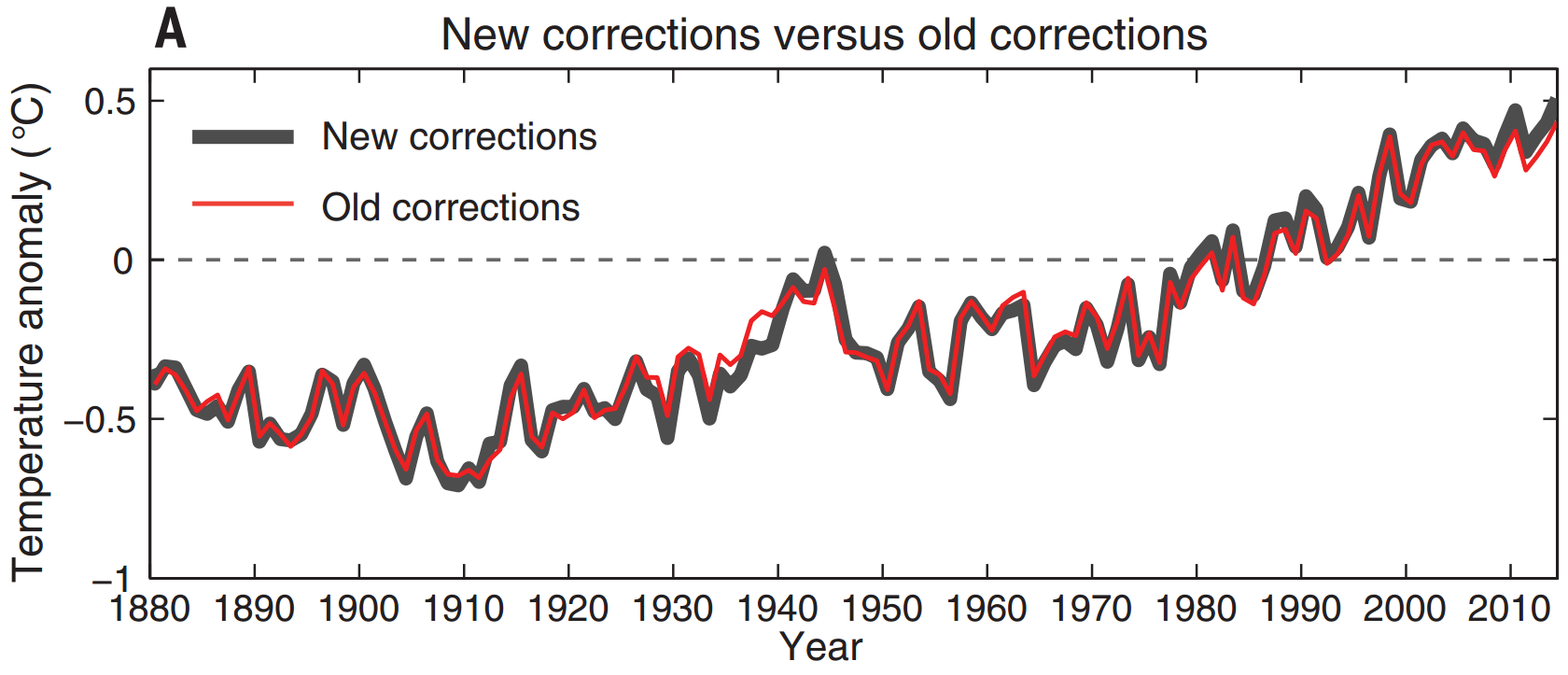
Here is the adjustment
Here is the "adjustment" you're referring to:
http://cdn.arstechnica.net/wp-...The recent correction is the difference between the black line and the red line. The temperature rise between 1959 and 2014 is about 0.9C. The adjustment, in the last two years, is just barely large enough to see, about 0.05C. Over the full period analyzed, the new global analysis changed the observed rate of warming from 0.065C/decade to 0.068C/decade, less than the noise.
Really, I need to point out that analyzing data sets is what science does. But, if you actually look at the data, even if you throw out the new corrections entirely, it doesn't make a difference. The corrections didn't change whether warming exists or not.
That image is from this article: http://arstechnica.com/science...
For reference, here is the paper with the adjustments explained: http://www.sciencemag.org/cont...
(Karl, et al., "Possible artifacts of data biases in the recent global surface warming hiatus," Science Vol. 348 no. 6242, 26 June 2015: pp. 1469-1472
DOI: 10.1126/science.aaa5632)