Slashdot Mirror
Domain: seul.org
Stories and comments across the archive that link to seul.org.
Comments · 231
-
Re:Easy Answer
Where are the commercial game ports for Linux? No one wants to make them, obviously, save for the FPS crowd (and there's only an Unreal Tournament for Linux because Epic passes the buck to Icculus to get the job done, not because they have the in-house talent to do it themselves). There are a few commercial games for Linux, yes, but only a few, and there's very little variety between them. In the open source world we have a few good games (the majority of them being FPS's, what a surprise), Battle for Wesnoth if you like strategy games (turn based ones, that is). Then we have the unfortunate, ugly ripoffs like "Secret Maryo Chronicles," and other games that look like they were developed for a C64. Plenty of selection, not a lot of quality.
The following publishers develop comemrcial linux games:
http://www.pompomgames.com/
http://www.garagegames.com/
http://www.introversion.co.uk/
http://frictionalgames.com/
http://sillysoft.net/
http://www.basiliskgames.com/
http://www.guildsoftware.com/
http://www.shrapnelgames.com/
http://www.rune-soft.com/
http://grubbygames.com/
http://www.caravelgames.com/
http://www.planewalkergames.com/
http://www.graalonline.com/
There are also the high profile ones such as neverwinter nights, the doom and quake series, unreal, etc.
There are many high quality independant titles such as neverball, you mentioned wesnoth, crimson fields, flight gear, torcs, the spring project, total annihilation 3d, tecnoballZ, powermanga, tile racer, pingus, clonk, freeciv, ultimate stunts, planeshift, scorched3d, VDrift, silvertree (not complete, but being created by the wesnoth guys so likely will not be vapor), ufo: alien invasion, scourge, etc.
http://spring.clan-sy.com/
http://www.wesnoth.org/
http://torcs.sourceforge.net/
http://www.flightgear.org/
https://icculus.org/neverball/
http://ta3d.darkstars.co.uk/
http://linux.tlk.fr/games/
http://tileracer.model-view.com/
http://pingus.seul.org/
http://www.clonk.de/
http://freeciv.wikia.com/
http://www.ultimatestunts.nl/
http://www.planeshift.it/
http://www.scorched3d.co.uk/
http://vdrift.net/
http://www.silvertreerpg.org/
http://ufoai.sourceforge.net/
http://scourge.sourceforge.net/
Many of these are very impressive independently made free games. Perhaps they lack the multi million dollar marketing budget and won't make your geofrce 8800 gtxz 45 x super elite ultra melt, but theya re *fun* games, and they are numerous. Also keep in mind this publisher and free game list is only what I could find in 1 hour of searching.
Then there are freed older commercial games such as warzone 2100, homeworld, descent 1 and 2, doom, quake, etc.
Lets not stop t -
Re:both
No, I can't make a job offer in a Slashdot reply. To make collaborative CAD tools, build on one of the Open Source efforts, such as http://geda.seul.org/.
-
Re:Please help us improve our documentation.
I'm confused.. what do you need a coder for? I googled Mike Perry man in the middle SSL, and I came across a discussion of things..
http://archives.seul.org/or/talk/Aug-2006/msg00316.html
but, as is stated, there's no work to be done on this issue. If a certificate is invalid, you probably have a man in the middle -- at least, that's how a tor user should take it. If it's not invalid, then accept it and go with trust.
From what I understand, these things are _already_ implemented.
As for getting the word out more, perhaps a full click-through screen with big red text saying "BAD!" and a little puny button that does a jump-around-the-page-on-mouseover thing four times before you can continue. Even place the button over the four most appropriate words in turn, so they're looking at the word after the button moves. Don't use runon sentences like I just did, and get rid of the yes/no popup with uniform, boring text that looks like the standard, "Do you want to blah blah or not?" box. Of course they want to do what they're trying to do. They just don't know they shouldn't want to.
I think that'd strike a negative for usability, though
-DrkShadow -
Re:memories
I have about 5kg worth of Mac disks with everything from various OS versions, apps, games, and tons of HyperCard stacks
3.5" floppies (especially the cheap ones of the past few years) tend to degrade pretty badly. My experience with 5.25" floppies, OTOH, hasn't been nearly as bad. Last time I checked, the boot floppies that came with my IIe back in the day still work, and they're about 22 years old now.
At some point, I still need to image all of my floppies just in case something does happen to them. I hooked the GS's hard drive up to a Linux box at home a couple or three weeks ago to image that...boots up in KEGS in a split-second, too. I'll need to do some 6502 assembly for a project I'm working on. With the assembler running in KEGS, the board-design software running natively, and the EPROM burner running in a WinXP VM under VMware, that's one machine doing the work of three.
-
Utter rubbishIt seems that first the linux people need to embrace the concept of cross platform development. Most linux developers I know don't want to build their stuff to run on all platforms, so it should be no surprise that vendors don't want to bother with developing cross platform either, and will simply target the platform that reaches the most uses.
If the cross platform toolkits were the easiest way to build apps, and those apps were every bit as good as ones developed targeting a single platform, things would change.Pardon me, but what the hell are you smoking? All of the applications I use on my Linux desktop are developed with highly portable (yep, cross-platform) toolkits such as GTK+ and Qt. Most run very well on many architectures and many kernels (Linux 2.4 and 2.6, *BSD including Darwin, Solaris, etc).
One data point. gEDA (the GPL Electronic Design Automation suite) has active users on Solaris, NetBSD, OSX and Linux. But when I'm working on it, I don't even have to thing about portability to those operating systems: keeping to some very simple rules makes porting as simple as "git clone ;
There have been several attempts to make a maintainable port to Windows, but such attempts always run up against the realization that Windows is so fundamentally different to all these other operating systems that it's almost as if it was designed to be hard to port too -- or, more importantly, from. [1]
Funny, that.
[1] There's something that sort of works now... but the bugs aren't due to lack of willingness to port or effort spent on it.
-
Re:Cvs is already done rightI manage a 7 GB CVS repository serving 200 developers and you are totally wrong. If I could get buy-in from the 10 or 20 relevant stakeholders I would change to mercurial in a pinch.
The GPL Electronic Design tools project will be moving to git soon. Unfortunately, not all of the developers are on platforms supported by git (and others just don't like git), so there is going to be a git-cvsserver set up to support them. This is generally considered to be a good way to do gradual migration.
-
Re:Wrong Preferred Document FormatsSchematic diagrams should be distributed in a format which a schematic editor, such as geda, can read.
Speaking of Wrong Preferred Document Formats...
"There is no supported Windows version " [of gEDA].
-
Re:why is the demand so high?
### It's the only system where I've seen games ship that are completely unplayable.
Which games would that be? At least judging from the ratings the PSP has a lot less low quality games then the DS:
http://pingus.seul.org/~grumbel/tmp/psp_vs_nds_met acritic.png -
Re:It's owned by Sony
Judging from the ratings the PSPs games aren't bad, in fact there are more and better ones then on the DS. However, I agree on the 'boring' part, those games that the PSP has might theoretically be good, but if I already played them half a years ago on the PS2 then thats worth nothing. The PSP is lacking good games that are designed from scratch to work with the system instead of just ported.
All that said, my DS is collecting dust just like the PSP, actually a bit more, since I like the PSP as eBook reader, but with the DS there are at least plenty of games that I can't get in a better version for one of the big consoles, with the PSP however there are almost none.
-
Re:Top rated games
Its the DS vs PSP all over again, just look at this little graph:
http://pingus.seul.org/~grumbel/tmp/psp_vs_nds_met acritic.png
What this shows is that the PSP gets better quality third-party titles and that the average PSP game is better then the average DS one, which this however fails to show is how much impact a game has on the market.
Both Nintendogs (83) and Brain age (77) for example scored rather low, but they did have quite a large impact. While many higher scoring PSP titles didn't have much impact at all. Why is that? Rather simple: Cute puppies attract new gamers, but are rather boring for normal gamers, since the game basically lacks any depth. Same with BrainAge, its basically just a glorified Flash/Javascript Mini game, nothing that would impress a normal gamer, but it comes nicely packaged, got some good advertisement and yet again attracts new people to games.
With the PSP on the other side you have half the games being the same games that got released on the PS2 half a year earlier, now they still might be good games if taken on their own, but there is little reason for anybody to actually buy them, since they already have played them (hard to beat 100mio PS2). And even those games that aren't simple ports are often simple sequels.
So to come back with to the Wii, its basically all the same, new games for new gamers. However the Wii has one huge problem, its not up against a PSP with its lackluster ports and sequels game offering, its up against the XBox360 and PS3 which has a ton of new and interesting games. Also the Wii has a serious lack in terms of third party support, even worse then the DS, most third parties do on the Wii exactly what they did to the PSP, ports of last years last-gen games (see PrinceOfPersia, Tiger Woods, Godfather, etc.). The new and interesting games aren't ending up on the Wii, but on the next gen hardware. This might not be an issue at all for the casual gamer that Nintendo attracts, but it certainly is a issue for all the normal gamers. -
Re:How Many Nodes Do You Need to Own?
That's fine for small networks, but for a network with hundreds or thousands of nodes, controlling 5 to 10 percent may become infeasible.
Tor scales to a few hundred nodes, but it doesn't scale indefinitely - all the routers are listed in a central directory to ensure that all clients use the same set of routers and the same set of public keys. -
Video Games
No, we all know that when bad things happen, it can only be the fault of video games.
-
Re:Drought now or drought later
Can't agree with you on that, just look at DS compared to PSP.
Look at NfS:Most Wanted, Tomb Raider or Burnout on the DS and tell me that those are not the perfect definition of making a quick buck with a crappy port. Those games are however only the tip of the iceberg, the DS has tons a bad games, in fact a lot more bad ones then the PSP, even so the DS has fewer games in total. Don't believe it? Just look at the ratings
There really aren't that much original games on the DS, lots of it are ports or sequels (Mario64, Advance Wars, Mario&Luigi, YoshiIsland2, Sonic, WarioWare, Final Fantasy), old franchises with new (worse) controls (Starfox, Metroid) or simply plain junk (to many to list). What sells the DS are in large part those 'non-games' BrainAge, Nintendogs and friends, most of those are first-party games by Nintendo. The PSP of course isn't without fault either, quite the oposite it gets far far to many PS2 games and far to little original ones, but that really just proves the point, if publishers see a way to make an easy buck, they will try doing so as hard as they can.
Overall I consider both DS and PSP a failures, hardware wise both do a good job at what they do, but in terms of games both are a huge disappointment, far away from the good old days of the SNES when there where a ton of original and good games created. On both the DS and the PSP I have a hard time finding anything interesting, since there simply is to little original and good stuff around (i.e. stuff like Yoshi Touch & Go is original, but simply not any good in the long run).
I don't see much change with that on the Wii, just like on the PSP and DS the developers can easily recycle a lot of old stuff. Why develop something new if the old stuff still sells enough? Even Nintendo is riding the sequel wave Mario, Zelda and Co. are all good and fine, but where is the Wii killer-game that goes beyond being a nice little Wiimote tech-demo?
-
Re:Average over lifetime
I havn't looked at the big consoles, but I recently did a little statistic of the NintendoDS and the PSP based on the review scores from Metacritic, you can find the resulting graph here. Some additional information, the average score is 65% for NintendoDS and 70% PSP. NintendoDS has 163 games available while the PSP has 195 games.
Short summary: The PSP has more games and better gamse, yet still loses on the market against the NintendoDS, most likly due to far to much PS2 recycling on the PSP.
-
Re:CAD Tools
Bit OT but check this out too http://www.geda.seul.org.
-
limited view-Think of the children.
#Commercial interruption!#
Flash also makes books(1) like this potentially available across platforms.*
*If you ever played with the software, you'll know what I mean.
(1) Note the bigger problem has nothing to do with technology.
"If you don't close your mind to the possibilities, Flash is an incredible development tool and let's my company do things that would not be possible with any other technology."
I use it (amoung other places. e.g. education) in my GUI research.
#We now return you to flash-bashing, already in progress# -
Re:First Person
why do people keep saying that games are near photrealistic?
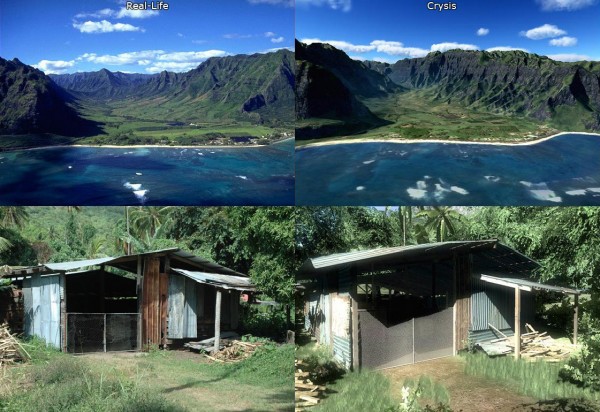
Because we are pretty close to photorealism, just look at this (GT on PS2) or that (Crysis). Its not quite photorealism, but already pretty close and those are games either already out or to come out in a few month, a late PS3 game or XBox360 game might look quite a bit better, not even mentioning what PS4 or XBox720 will be capable of. However this is just photorealism, as in non-moving images, where the realism falls apart is soon as you add motion into the mix. The reason that Oblivion didn't really look as good as it was supposed to wasn't the rendering, but the character animation and unrealistic physic engine, you don't want stuff to slide on the ground and enemy just falling to ground with a generic die animation, completly ignoring the sword hit you have them, things just don't work like that in real life. Neither does a car get a scratch in the paint when you drive it with 200mph against a wall. In many first person shooters the player doesn't even use his arms to climb a ladder. Its all stuff like that were even the most realistic graphics fall completly apart. Now I don't know if those physics and animation problems will be solve to a reasonable degree in this console generation or in the next, but in terms of pure rendering photo realism is really quite close and Final Fantasy movie quality rendering is something I definitvly expect in this console generation.
That said there are of course also effects that are not do able in realtime and probally won't for quite a while, like caustics for example, however since most of them can be faked, aproximated or simply avoided it will probally make little difference to the realism of realtime rendering.
-
Re:The problem is 2D control.
Then the camera sucks. That's not a problem of 3D, it's a problem with a specific game.
The fundamental problem is that you can't represent a 3D image on a 2D screen without loss of information. If you have a gap infront of you and a block further away it is impossible in a 3D game to tell exactly how far away it is, the only way to get the distance is by guessing. Simple example, how far do you guess are those blocks away from each other. Aproximatly 2 block sizes you might guess? Close, but totally wrong, lets enable shadows and look from it from another perspective. Woops, its actually a smaller block on the left and in the air, not an equally sized infront of the player. Now, this is an artificial example, but such situations happen all the time in 3D games, restrictive level design (don't just change platform sizes without giving clear hints, limit jumping puzzles to a streight line whereever possible, etc.) and a player controlled camera can help a bit, but it can't make the problem go away. Same is true for enemies, if you have an enemy infront of you the camera might be able to give a clear view, but if you have one behind you, one infront, one on your left and one on your right, the camera has a problem. Often you will also have plenty of level geometry inbetween you and the camera. Again there are solutions which will lessen the problem, but you can't make it go away completly. In 2D on the other side its very simply, the most complicated thing you might ever need is to zoom out, but beside from that everything is always in crystal clear view, no obscuring, no perspectivic problems, nothing, every distance can be messured down to the exact pixel count, in 3D that is simply not possible with a camera that stays attached to the player. -
Re:The problem is 2D control.
Then the camera sucks. That's not a problem of 3D, it's a problem with a specific game.
The fundamental problem is that you can't represent a 3D image on a 2D screen without loss of information. If you have a gap infront of you and a block further away it is impossible in a 3D game to tell exactly how far away it is, the only way to get the distance is by guessing. Simple example, how far do you guess are those blocks away from each other. Aproximatly 2 block sizes you might guess? Close, but totally wrong, lets enable shadows and look from it from another perspective. Woops, its actually a smaller block on the left and in the air, not an equally sized infront of the player. Now, this is an artificial example, but such situations happen all the time in 3D games, restrictive level design (don't just change platform sizes without giving clear hints, limit jumping puzzles to a streight line whereever possible, etc.) and a player controlled camera can help a bit, but it can't make the problem go away. Same is true for enemies, if you have an enemy infront of you the camera might be able to give a clear view, but if you have one behind you, one infront, one on your left and one on your right, the camera has a problem. Often you will also have plenty of level geometry inbetween you and the camera. Again there are solutions which will lessen the problem, but you can't make it go away completly. In 2D on the other side its very simply, the most complicated thing you might ever need is to zoom out, but beside from that everything is always in crystal clear view, no obscuring, no perspectivic problems, nothing, every distance can be messured down to the exact pixel count, in 3D that is simply not possible with a camera that stays attached to the player. -
Re:The problem is 2D control.
Then the camera sucks. That's not a problem of 3D, it's a problem with a specific game.
The fundamental problem is that you can't represent a 3D image on a 2D screen without loss of information. If you have a gap infront of you and a block further away it is impossible in a 3D game to tell exactly how far away it is, the only way to get the distance is by guessing. Simple example, how far do you guess are those blocks away from each other. Aproximatly 2 block sizes you might guess? Close, but totally wrong, lets enable shadows and look from it from another perspective. Woops, its actually a smaller block on the left and in the air, not an equally sized infront of the player. Now, this is an artificial example, but such situations happen all the time in 3D games, restrictive level design (don't just change platform sizes without giving clear hints, limit jumping puzzles to a streight line whereever possible, etc.) and a player controlled camera can help a bit, but it can't make the problem go away. Same is true for enemies, if you have an enemy infront of you the camera might be able to give a clear view, but if you have one behind you, one infront, one on your left and one on your right, the camera has a problem. Often you will also have plenty of level geometry inbetween you and the camera. Again there are solutions which will lessen the problem, but you can't make it go away completly. In 2D on the other side its very simply, the most complicated thing you might ever need is to zoom out, but beside from that everything is always in crystal clear view, no obscuring, no perspectivic problems, nothing, every distance can be messured down to the exact pixel count, in 3D that is simply not possible with a camera that stays attached to the player. -
Re:Face it, Vista will be hacked...
The more people use BSD/Linux/Amiga/whatever, the more companies will develop games for BSD/Linux/Amiga/whatever.
Yes, but by then the person who switched to BSD/Linux/(Amiga?) will have moved on to another hobby to fill his time. Provided senility hasn't overwhelmed his cognitive functions, that is. Seriously, has anyone stepped forward to take the place of Loki games? (Sort of impressive that the site is still there.) If I were a Linux newbie I might be hopeful about your plan, but we've regressed!I mean Pingus is fun for a while... but it doesn't take the place of Dawn of War. Neither can Heroes of Might and Magic III for Linux if you could manage to scrounge up a copy. (No, you can't have mine.)
There is some hope for Cedega, though I'm not currently impressed. It's not going to be able to replace my XP partition any time soon.
One of the ironies of modern electronic gaming is that the most free (as in GNU, ironically) and viable gaming platform is Windows. It's better than the locked down, DRM ridden consoles. Think of it, you can get horse armor on PC by making it yourself instead of paying for it. That's closer to Free Software than the current console model "it'll cost you, and don't dare try to hack our console." Of course, Vista may tip this, I think MS is learning some lessons from being a console maker.
Yes, the situation sucks. The real problem is that Microsoft still plays Monopoly with our PCs. It has very little to do with consumer choice.
-
Re:Junkware Unite!
You do, of course, have the choice of which of the jewels you would like to install. Nobody is forcing Realplayer on you. I don't remember seeing KaaZaa on the list of options.
The ftp client is gftp. It is reasonably usable.MAs others in the thread have said, if you know what you're doing there are maybe better ways of doing it. If you're new to ubuntu, and linux in general, then automatix can be invaluable for enabling mp3 and various firefox plugins.
-
Re:What OS[es]? Plus, my answers
The one thing I *don't* have is a graphical net explorer that wlil also show me the net in real time in a format that shows the network structure with traffic, etc. 3M has a tool, but it is only so-so (last time I tried it) and rather slow on the older Windows laptop I have available. I'd love to have a good FOSS app for this, preferably for use under Linux, but Windows is aceptable.
I use etherape in combination with iptraf for this. Both are open-source Linux apps. Etherape uses Gtk/Gnome widgets; iptraf is a console app that runs nicely in an ssh'd xterm from the firewall. I'm not sure what level of depiction you're looking for, but these two are worth a try regardless IMO.
-
Harvard General Counsel knows about RIAA and Tor?
-
Mincing words - the last time M$ sued a school
There's MS hate, and there's this. When was the last time MS sued a school, exactly? Never, that's right. Yes, MS did one time threaten to sue when it found rampant piracy in one district, but the gentleman/lady in question is obviously worried about license fees, so has no plans to pirate anything.
Man, the M$ shills are out in droves lately. I assume you are mincing words or playing with semantics in your capacity as active shill. MS went after lots of schools, at least in the US and in the UK. Who knows? Probably the same in other counties. Try searching a little for BSA or FAST and other branches of the main party, or even some semi-legitimate groups like BSI.Here's one example with what MS did in Portland, Oregon schools:
http://www.pcworld.com/news/article/0,aid,101601,0 0.asp Here are the results: http://www.seul.org/edu/acpe2002.html And here is the savings from just one school district dropping M$. Don't forget that the licensing fees are jus the tip of the ice berg. There are maintenance nightmares and hardware upgrades to deal with. http://www.k12ltsp.org/press_freedom_day.htmlYou can find many other cases where M$ went after schools. Did they sue? Maybe / maybe not. Did they threaten? youbetcha
Don't go on about "MS hate". It's called experience or brand recognition.
-
Here's a school that did it.
Have a look at this story (also here). It's the tale of how one school's sysadmin converted the computer lab to Linux (Mandrake), KDE, and a host of open-source education and productivity applications.
-
Pingus?
Another fun game was Lemmings, too bad psygnosis [...] sues cloners out of existence.
Are you claiming that Psygnosis is the reason why Pingus hasn't seen any updates?
-
Re:Software isn't the only open entity
> gEDA attempts to integrate PCB with schematic capture and other tools,
> but it's buggy on my setup (missing config files in Ubuntu, schematic
> doesn't get translated over to the board properly, no
> component-onto-board auto-place function to go with the schematic
> capture)
As the primary author of gEDA/gaf, I have some comments:
1) gEDA does not attempt to integrate PCB with schematic capture.
PCB is just one possible backend or target of a netlist that
can be generated from a schematic. This is intentional. Unlike
other more tightly integrated programs, you can always move to a
different layout package if PCB does not meet your requirements.
gEDA has a very open design flow. It just so happens that PCB is
the layout tool for gEDA/gaf.
2) gEDA does work (including going from schematic -> PCB), but
that does require a working setup. The fact that Ubuntu has a
broken install/setup is completely out of gEDA's control. Have
you filed a bug against Ubuntu or asked for help in resolving
this broken setup?
3) As far as component-onto-board auto-place, yeah, that's lacking,
but there are some mechanism in place to make this easier. Plus,
it's usually a good idea to spread out the components yourself to
get the most optimal layout.
4) Yes, gEDA does have a sharp/steep learning curve, but there is some
absolutely excellent documentation, particularly Bill Wilson's
tutorial which can be found at:
http://geda.seul.org/docs/current/tutorials/gsch2p cb/tutorial.html
Yes, you must read some documentation in order to use gEDA.
Sorry.
-Ales
http://geda.seul.org/ -
Re:Software isn't the only open entity
> gEDA attempts to integrate PCB with schematic capture and other tools,
> but it's buggy on my setup (missing config files in Ubuntu, schematic
> doesn't get translated over to the board properly, no
> component-onto-board auto-place function to go with the schematic
> capture)
As the primary author of gEDA/gaf, I have some comments:
1) gEDA does not attempt to integrate PCB with schematic capture.
PCB is just one possible backend or target of a netlist that
can be generated from a schematic. This is intentional. Unlike
other more tightly integrated programs, you can always move to a
different layout package if PCB does not meet your requirements.
gEDA has a very open design flow. It just so happens that PCB is
the layout tool for gEDA/gaf.
2) gEDA does work (including going from schematic -> PCB), but
that does require a working setup. The fact that Ubuntu has a
broken install/setup is completely out of gEDA's control. Have
you filed a bug against Ubuntu or asked for help in resolving
this broken setup?
3) As far as component-onto-board auto-place, yeah, that's lacking,
but there are some mechanism in place to make this easier. Plus,
it's usually a good idea to spread out the components yourself to
get the most optimal layout.
4) Yes, gEDA does have a sharp/steep learning curve, but there is some
absolutely excellent documentation, particularly Bill Wilson's
tutorial which can be found at:
http://geda.seul.org/docs/current/tutorials/gsch2p cb/tutorial.html
Yes, you must read some documentation in order to use gEDA.
Sorry.
-Ales
http://geda.seul.org/ -
Re:EDA software = perfect example of software lock
> I think one of the most awful aspects is that gEDA keeps promising and
> promising. They have very nice screenshots and feature lists. But they
> seem to be vapor. I think they're inhibiting others from starting a
> good FOSS EDA package. Maybe.
Huh?
1) I don't recall the gEDA project promising anything. Please point
out a specific instance of this? It has enabled many people to
use EDA software that would otherwise be completely unobtainable.
2) vapor? What do you base this statement on? Please check out the
http://geda.seul.org/ and more specifically the download
page at: http://geda.seul.org/download.html
If you want to see lots of examples of successful hardware projects
built with gEDA please check out:
http://geda.seul.org/links.html#projects
If anything the website, feature lists, and screenshots
unadvertise the capabilities of the gEDA suite.
-Ales
http://geda.seul.org/ -
Re:EDA software = perfect example of software lock
> I think one of the most awful aspects is that gEDA keeps promising and
> promising. They have very nice screenshots and feature lists. But they
> seem to be vapor. I think they're inhibiting others from starting a
> good FOSS EDA package. Maybe.
Huh?
1) I don't recall the gEDA project promising anything. Please point
out a specific instance of this? It has enabled many people to
use EDA software that would otherwise be completely unobtainable.
2) vapor? What do you base this statement on? Please check out the
http://geda.seul.org/ and more specifically the download
page at: http://geda.seul.org/download.html
If you want to see lots of examples of successful hardware projects
built with gEDA please check out:
http://geda.seul.org/links.html#projects
If anything the website, feature lists, and screenshots
unadvertise the capabilities of the gEDA suite.
-Ales
http://geda.seul.org/ -
Re:EDA software = perfect example of software lock
> I think one of the most awful aspects is that gEDA keeps promising and
> promising. They have very nice screenshots and feature lists. But they
> seem to be vapor. I think they're inhibiting others from starting a
> good FOSS EDA package. Maybe.
Huh?
1) I don't recall the gEDA project promising anything. Please point
out a specific instance of this? It has enabled many people to
use EDA software that would otherwise be completely unobtainable.
2) vapor? What do you base this statement on? Please check out the
http://geda.seul.org/ and more specifically the download
page at: http://geda.seul.org/download.html
If you want to see lots of examples of successful hardware projects
built with gEDA please check out:
http://geda.seul.org/links.html#projects
If anything the website, feature lists, and screenshots
unadvertise the capabilities of the gEDA suite.
-Ales
http://geda.seul.org/ -
Re:EDA software = perfect example of software lock
> I think one of the most awful aspects is that gEDA keeps promising and
> promising. They have very nice screenshots and feature lists. But they
> seem to be vapor. I think they're inhibiting others from starting a
> good FOSS EDA package. Maybe.
Huh?
1) I don't recall the gEDA project promising anything. Please point
out a specific instance of this? It has enabled many people to
use EDA software that would otherwise be completely unobtainable.
2) vapor? What do you base this statement on? Please check out the
http://geda.seul.org/ and more specifically the download
page at: http://geda.seul.org/download.html
If you want to see lots of examples of successful hardware projects
built with gEDA please check out:
http://geda.seul.org/links.html#projects
If anything the website, feature lists, and screenshots
unadvertise the capabilities of the gEDA suite.
-Ales
http://geda.seul.org/ -
Re:Software isn't the only open entityDon't be so pessimistic. Some people give back to the community in forms other than cash and software. Maybe if [she] designs something useful, [she'll] share it with the world. Commercial tools present a high barrier for entry to the hobbyist, which discourages open source hardware.
And this is precisely why I asked about an open source replacement. It's one thing to pay for a product if you're going to use it to make money. It's a far different thing to expect to pay the same money for a product only to use it for hobby work.
I design gadgets for the Commodore 64/128, and a quick estimate shows that at the prices I've seen around the web in the last few days, I would spend more on the software alone than I would spend on making one production-ready unit of every board I've designed since I started fiddling with this stuff (that's only about 10 unique designs), and if I tried to sell, there's no way I'd ever break even. Several years ago there was a slim chance, but today, forget about it. Today, all of the stuff I write or design is free and open source, and stuff I have written in the past I have since declared free also (where the source code still exists). I think that fits anyone's definition of "giving back." I must stress - I do not program for Linux, just Commodore.
Oh, and to the other gentlemen who have mentioned auto-routing and other high-end features as being too much to ask of FOSS, let me see..
- PCB, the very PCB editor I started with years ago, is a nice board editor with autorouter (which I have yet to use) and some other nice features, but that's only half of the needed setup.
- KiCAD has a decent schematic editor, 3D viewer, and some other stuff, but it just has problems on my box (apparently poor integration, very slow board editor, crashy).
- gEDA attempts to integrate PCB with schematic capture and other tools, but it's buggy on my setup (missing config files in Ubuntu, schematic doesn't get translated over to the board properly, no component-onto-board auto-place function to go with the schematic capture)
- gschem2xpcb looks like it would fill in well to convert those gEDA/gSchem schematics over to PCB in a way similar to Eagle's autoplace feature, but this is just a stand-alone command-line program with only the one function, and the author seems have a major aversion to the GPL. *shrug*
- The GIMP of course has tons of features and a really nice UI, and in particular it has vector graphics capabilities and multiple layers, but of course it's not adapted for PCB/schematic work.
- Eagle, for this particular list, has wonderful parts libraries (for which utilities exist to convert these to other formats) and good integration between schematic and board, but it has some serious screen refresh bugs, plus the aforementioned 4x3 inch board size limit.
Along with these, every other open source program I've looked into has at least one of the features I need. I was just hoping for a program that combines all of these already-existing, already written features into one Eagle-killing FOSS program.
-
Re:Good luck!
Its called gEDA and it rocks! http://www.geda.seul.org/ You can also try Eagle PCB http://www.cadsoft.de/ The trial version is still very capable!
-
Ruby
I saw the Python... but I didn't see anyone mention Ruby yet. Yes, there are also SDL bindings for Ruby http://www.kmc.gr.jp/~ohai/rubysdl.en.html or http://rudl.sourceforge.net/. And even a Rubygame library (styled after pygame) which is starting to incorporate OpenGL too.
-
Don't forget ruby!
"Rubygame has SDL as a backend, and is styled after the very nice pygame." It's in active developement but is very usable.
http://rubygame.seul.org/ -
Hidden Service Location Vulnerability
The following was posted on the tor-dev list last week...
Versions affected: all stable versions, and all experimental versions
up through 0.1.1.10-alpha.
Impact: If you offer a Tor hidden service, an adversary who can run a
fast Tor server and who knows some basic statistics can find the location
of your hidden service in a matter of minutes to hours.
Solution: You have three options:
1) Upgrade to Tor 0.1.1.12-alpha from the Tor download page [1]. You're
all set, though be aware that this is an alpha release so there may
be other bugs. You may also want to look through the release notes [2].
2) Turn off your hidden service until the final 0.1.1.x release is out.
It may be several months.
3) Stick with Tor 0.1.0.16 and manually configure a half dozen
EntryNodes. See the FAQ entry [3] for some hints about how to do this.
For details, click on the original posting. -
Re:Why fund Wikipedia?
The reason such anonymizing systems, like Tor are blocked from Wikipedia, is because they can be used by vandals/spammers who have been blocked from editing to continue vandalising the site. It's too bad that such measures have to be taken, but the real solution here is political, not technical. I think your method of using a Freenet-like decentralized system probably won't fly for the same reasons. Vandal fighting would become impossible, and it would become almost impossible to track which contributor added which content.
-
Re:A fork in the road...
Your point about Godwin is certainly well taken. That is pretty surprising.
Many of us don't have the choice of not allowing any g* packages. I'm not a heavy user of keymapping, but I couldn't get my work done without Ethereal. So I'll have Gnome libs on my workstation for the foreseeable future. I'm sure many others will have at least libs, and perhaps the entire Gnome desktop, to run other vital apps. gEDA http://www.geda.seul.org/ comes to mind, after seeing it in this month's Linux Journal.
While I'm a KDE person, for reasons that seem good to me, I've nothing against any desktop. The fact that there are so many users of each means that there is room (and a need) for both. I really dislike the fact that major distros are choosing one, and giving short shrift to another. A matter of economics, I suppose, but that doesn't mean that I have to like it.
Wouldn't it be sweet if half the energy devoted to the flamewars could be channeled into fixing the remaining cross-desktop compatability issues? It'll never happen, of course, as the flamers aren't typically the developers. But I'd like to see developers in either system regard interoperability issues as important at a minimum, and preferably critical.
Next, we should have perfect docs, and of course flying cars. -
Re:Rogers Cable in Canada banning bittorrent
tor completely anonymizes web traffic, and azureus supports it: http://tor.eff.org/ http://azureus.sourceforge.net/doc/AnonBT/Tor/how
t o_0.5.htm http://archives.seul.org/or/talk/Jun-2005/msg00075 .html And i2p anonymous network: http://www.i2p.net/ http://azureus.sourceforge.net/plugin_details.php? plugin=azneti2p&docu=1#1 Please note that you really should only use it for the tracker and http traffic. Or just keep using encrypted headers. -
Re:KTechLab
In a similar manner, look at http://www.geda.seul.org/
But these are electrical engineering tools. The original article seemed to be more about mechanical engineering tools. My guess is that people write what they need and what interestes them. Mechanical engineers might not have as much software skill as other diciplines. Mechanical engineering seems more "physical" and likely appeals to a different type of person than electrical engineering and computer engineering. Of course, I could just be a biased EE. -
Re:Already available..
> There should be some standard interchange format for the FPGA data. gcc should be able to take some C code an output FPGA intermediate programming data from it.
Smile! This stuff already exists for years:
You just have to build a library that
- shoves "compiled" logic chunks to the chip
- uses the FPGA-board's upload functionality as a pluggable driver
- does the resource management.
Everything else is already there.
- You can get some FPGA developer board to develop and test your library:
- You can use SPARK to compile your C-code to VHDL.
- I guess VHDL can be uploaded directly to the FPGA. If not maybe stuff like gEDA or similar stuff for VHDL helps...
- I am a total n00b in things of hardware design, but i found this in 1-2 hous of investigation and reading via wikipeda.
The problem is that FPGA-boards are pretty expensive... (The least expensive i found was some 66MHz devboard for 150$. The most expensive had 500MHz and a price tag of ~7000$!! [including a ton of golden analog contacts and stuff
-
Re:Copyright infringementShameless plug:
(semi-working Windows [unofficial] version)
I personally think it's fun enough to dedicate my time to its development.
-
Re:People use DOS?I'd have to disagree. Maybe all the NICs *you* run across, but few of the onboard ones that are so common these days, and none of the Gigabit ones that are more and more popular do. Of course, a NIC that works in a PC you're likely to want to run DOS on will likely have a DOS driver somewhere.
See http://tiny.seul.org/en/ for someone who's already done the work of stripping down Linux to run on an 8meg 486.
-
Re:Not extensive, but here's a start....
Pingus - it just needs some level designers.
-
Re:OS Competition Is Useless
They are in middle school special education classrooms in my city, somewhere in the US. I know. I put the machines there and supported them for ~1.5 years (although there wasn't much support to be done... damn things don't break).
http://www.seul.org/
http://www.k12linux.org/ -
Re:Such hypocrisy.
This has been partially discussed on the or-talk mailing list. I don't have much hope that Slashdot will actually do anything to fix this. I think they still haven't fixed their broken HTML.
-
Re:If there's anything I've learned...
Well, see gEDA for GPL electronic design automation software. In particular, they've been putting some development work into updating pcb, which has been around since the dawn of time. I've used pcb to make a few boards, it definitely has that late-80's X11-Athena feel to it but it's quite versatile once you get used to it.
For dirt cheap PCB fabbing for hobbyists, check out sparkfun's pcb pooling offer. There are also a lot of hobbyist-friendly PCB prototyping services out there, but they're mostly catering to actual engineering shops even if they don't mind working with hobbyists.
-
Re:Lemmings!
here.