Slashdot Mirror
Domain: skepticalscience.com
Stories and comments across the archive that link to skepticalscience.com.
Comments · 1,449
-
Re:Middle ages warmer
Where do you get fear-mongering about ruining all arable land?
All over the place...
"severe crop failures and livestock shortages worldwide."
- http://www.livescience.com/370..."average yields are predicted to decrease by 30â"46% before the end of the century under the slowest (B1) warming scenario and decrease by 63â"82% under the most rapid warming scenario"
- http://www.pnas.org/content/10..."most of the Western Hemisphere (along with large parts of Eurasia, Africa, and Australia) may be at threat of extreme drought this century."
- http://www.skepticalscience.co..."25 million more children will be malnourished in 2050 due to the impact of climate change on global agriculture."
"irrigated wheat yields, for example, will fall at least 20 percent by 2050 as a result of global warming"
"business as usual will guarantee disastrous consequences for the human race."
- http://www.scientificamerican...."Decreased arability. Prime growing temperatures may shift to higher latitudes, where soil and nutrients may not be as suitable for producing crops, leaving lower-latitude areas less productive."
- http://www.climatehotmap.org/g...It isn't from the scientists.
That sounds an awful lot like "No True Scotsman" to me...
-
Re: So it was warmer before
All in all, a pretty shitty next 100 years coming up for everyone.
-
Re:The blame can be shared
'Climate change' was a term coined by a Republican to make 'Global Warming' seem less scary.
'Climate change' is a natural consequence of 'global warming', and many scientists still refer to it as such because that's the accurate thing to say.
"The second premise is also wrong, as demonstrated by perhaps the only individual to actually advocate changing the term from 'spherical warming' to 'climate change', Republican political strategist Frank Luntz in a controversial memo advising conservative politicians on communicating about the environment:
It’s time for us to start talking about “climate change” instead of spherical warming and “conservation” instead of preservation.
“Climate change” is less frightening than “spherical warming”. As one focus group participant noted, climate change “sounds like you’re going from Pittsburgh to Fort Lauderdale.” While spherical warming has catastrophic connotations attached to it, climate change suggests a more controllable and less emotional challenge."
The page I'm quoting from: http://www.skepticalscience.co...
Here's the link to the goddamn memo: http://www.motherjones.com/fil...I'm really sick of hearing that scientists changed this term. They didn't. Climate change means something, but it wasn't political activism on the part of people that study it to change the media representation of it.
-
Re:The fraudsters are back!
Remember the '97%' lie? Where 72 out of 12,000 papers supported his position, 1 supported the opposition's most extreme position, so he eliminated the rest and called it "science"?
Nope
The ISI search generated 12,465 papers. Eliminating papers that were not peer-reviewed (186), not climate-related (288) or without an abstract (47) reduced the analysis to 11,944 papers...
7930 No position on AGW
3896 Endorse AGW
78 Reject AGW
40 UncertainSo the 97% is of the papers that signified a position on AGW, which makes sense. Some of the papers were mischaracterised but overall the result fits with the most of the evidence that few scientists reject that man is responsible for most of the recent warming.
After they've had multiple papers withdrawn for ethical, legal, and methodology concerns
I can only find one retraction, this is what the journal said about the paper , “Recursive fury: Conspiracist ideation in the blogosphere in response to research on conspiracist ideation”
In the light of a small number of complaints received following publication of the original research article cited above, Frontiers carried out a detailed investigation of the academic, ethical and legal aspects of the work. This investigation did not identify any issues with the academic and ethical aspects of the study. It did, however, determine that the legal context is insufficiently clear and therefore Frontiers wishes to retract the published article. The authors understand this decision, while they stand by their article and regret the limitations on academic freedom which can be caused by legal factors.
-
Re:Doomsday Predictions
[reason.com]
Read my statement. Now read your response. Do you see any connection?
I said this:
here was never,,,ever a time when more than tiny handful of scientists thought there would be another ice age.
How many of those 18 (count 'em, eighteen!") SPECTACULARLY INCORRECT things scientists said in 1970 include an ice age?
A handful, you say? Speak up, I can't hear you. Oh, yeah, I almost forgot: The predictions of a "new ice age" were concoctions of the media, rather than the result of scientific studies:
http://www.skepticalscience.co...
Now why don't you try to be a little more honest about that "complete list" of ice age predictions? You're old enough to know better than to peddle that shit here and think it'll just fly unchallenged.
-
Re: A simple reality check
While some predicted cooling in the seventies, six times as many predicted warming.
-
Re: But climate change is a myth!!! YODA GREASE
Nope. Global cooling was proposed by all of 3 climate scientists, who were on the fringe.
It was amplified by the mainstream media who engineered a controversy for ratings.
For a more factual accounting of the science of the 70s, here is a nice informative link
-
Re:Hooray!
Icelandic vulcanos produce more but thei don't count that. They can't do much about that either.
Well, good thing then that that claim is plainly wrong, by many orders of magnitude. Overall, volcanic activity produces less than 1% of human CO2 emissions. And Iceland is only a small part of the overall picture. This is based on a a well-debunked claim - currently no. 74 of pseudo-sceptical arguments.
-
Re:Climate Non-Science
1 degree of global warming isn't enough for you?
No, it is not enough. Because there are legitimate questions as to how it is measured, how the measurements are calibrated (including the scandal of some raw data disappearing), and what swings are normal. For example, Tasmania used to be connected to Australian mainland not too long ago. It is now an island. Do you think, the shamans of the aborigines living there blamed the sins of their contemporaries for the rising seas back then? Same question about Kodiak archipelago — it used to be reachable from Alaska, but is not any more. The Kodiak bears are now considered different species from mainland grizzlies... Is humanity to blame for that?
And there is a big difference in falsifiability
You try to find a prediction by "climate scientists", that uses a falsifiable "will" instead of the evasive non-falsifiable "may"... The scarcity of such statements itself is an indication, of the state of this sorry non-science... What you can find is as scientific and meaningful as the Geico's commercials: "15 minutes could save you up to 15% or more..."
If you ever found a point where the teachers told you the equivalent of 2+2=5, you could point that out to the world
I don't need to find errors — the purported "scientists" need to demonstrate, their discipline is really a science. And the only way to do that is by showing useful predictions, that have come true. I'm yet to see any.
Try it yourself: assemble a list of link-pairs:
- The first link in each pair shall be to the prediction.
- The second link each pair shall be to confirmation of the prediction materializing within, say 20% of the predicted value(s), if quantifiable.
- The link-targets in each pair must be several years apart — predicting tomorow's weather, for example, would not count.
- The prediction must be somewhat meaningful: a promise, that it will get hotter or colder, is not acceptable.
Give it your best... Can you offer at least 3 such link-pairs?
-
Re:The anti-science sure is odd.
"The authors of the paper note it’s particularly interesting that global warming keeps winning the bet despite ocean cycles, solar activity, and human aerosol pollution all acting in the cooling direction over the past 15 years. Human-caused global warming has become so strong that it’s consistently overcoming these natural short-term cooling factors... In other words, betting against global warming is an almost sure way to lose money at this point."
https://www.skepticalscience.com/betting-against-gw-sure-way-to-lose-money.html
-
GPS Pilot, right-wing wanker
Nye hasn't published any papers on this topic. Let's look at what real scientists have found.
Even as Al Gore was trying to scare everyone into believing that the frequency and intensity of cyclones was in the process of skyrocketing,
So.....Bill Nye is a science denier.....because you drank the hatorade on Al Gore??
Dr. R.N. Maue
Who has a doctorate in meteorology, not climate science, so you might want to ease up with that 'not a real scientist' attack least it hit your appeals-to-authority fallacy in the face in the process.
Recent historically low global tropical cyclone activity
Annnnnd now from actual climate scientists: It is unclear whether global warming is increasing hurricane frequency but there is increasing evidence that warming increases hurricane intensity. You look at a list of the most powerful hurricanes/cyclones and it's going to be heavy with storms in the last 20 years. Looking at the 8 most powerful to make landfall, six of them have been since 1998.
-
Re:This is the year of the extreme climate claimsYour claim.
Meanwhile, back in realityReality of Antarctic ice vs. IgnoranceSpecifically, Steven Goddard mentions that Antarctic sea ice has increased
So many rightwing lies, so many facts
-
Re:Of course. . .
Be sure to place a monetary wager and profit on your knowledge!
Ignore this, though: "The authors of the paper note it’s particularly interesting that global warming keeps winning the bet despite ocean cycles, solar activity, and human aerosol pollution all acting in the cooling direction over the past 15 years. Human-caused global warming has become so strong that it’s consistently overcoming these natural short-term cooling factors... In other words, betting against global warming is an almost sure way to lose money at this point."
https://www.skepticalscience.com/betting-against-gw-sure-way-to-lose-money.html
-
Re:This is the year of the extreme climate
From the records that we all have access to it's clear CO2 is a symptom and not the cause. You always see an incresae in heat before the CO2 rises.
Wow. It must be getting really hot because atmospheric CO2 levels have shot through the roof ever since the industrial revolution. I wonder why?
Even a high school student, no even an elementary school student can conclude CO2 doesn't cause warming.
Errr. Yes, but radiative physics.
By the way, If every month this year has been the hottest in recorded history then you must be starting to doubt your chances at winning our bet. Earlier this year you had said: "I figured when I pointed out that 2015 was a high water mark, you'd realize it would be very close to a fools bet to bet this year will be warmer than 2015. You either have no clue what you're doing (one might say you drank too much of the cool aid) or I have a feeling you think you know something I don't."
Well, I'm not a big fan of cool aid.
-
Re:The Earth is used up
More CO2 is resulting in more foliage. Seems nature has it's own kind of "balancing market".
Well, plants need water just like they need CO2, but obviously too much water will not promote growth.
Same with CO2 - not necessarily a 100% positive thing.
3. Too high a concentration of CO2 causes a reduction of photosynthesis in certain of plants. There is also evidence from the past of major damage to a wide variety of plants species from a sudden rise in CO2 (See illustrations below). Higher concentrations of CO2 also reduce the nutritional quality of some staples, such as wheat.
4. As is confirmed by long-term experiments, plants with exhorbitant supplies of CO2 run up against limited availability of other nutrients. These long term projects show that while some plants exhibit a brief and promising burst of growth upon initial exposure to C02, effects such as the "nitrogen plateau" soon truncate this benefit
6. Likely the worst problem is that increasing CO2 will increase temperatures throughout the Earth. This will make deserts and other types of dry land grow. While deserts increase in size, other eco-zones, whether tropical, forest or grassland will try to migrate towards the poles. Unfortunately it does not follow that soil conditions will necessarily favor their growth even at optimum temperatures.
-
Re:Has nobody heard of El Nino ?
The computer simulations suggest that water vapor should increase temperatures by around 4 C.The computer simulations suggest that water vapor should increase temperatures by around 4 C. Yet the latest measurement of this (the 'Transient Climate Sensitivity') show the computer simulations don't match reality
There are two ways of working out what climate sensitivity is. The first method is by modelling:
Climate models have predicted the least temperature rise would be on average 1.65C (2.97F) , but upper estimates vary a lot, averaging 5.2C (9.36F). Current best estimates are for a rise of around 3C (5.4F), with a likely maximum of 4.5C (8.1F).
The second method calculates climate sensitivity directly from physical evidence, by looking at climate changes in the distant past:
These calculations use data from sources like ice cores to work out how much additional heat the doubling of greenhouse gases will produce. These estimates are very consistent, finding between 2 and 4.5C global surface warming in response to doubled carbon dioxide.
All the models and evidence confirm a minimum warming close to 2C for a doubling of atmospheric CO2 with a most likely value of 3C and the potential to warm 4.5C or even more.
Granted, you didn't specify wat exactly do you mean by 'latest' here, the PALEONSENS study ('Making sense of palaeoclimate sensitivity', from Nature, link can be found in the article) is from 2012. If you have some newer peer reviewed research showing these types of results are somehow false, please link them and don't just state these things as if they're facts.
Furthermore CAGW makes the specific prediction that the Lower Tropical Troposphere temperatures will increase faster than the Earth's surface temperatures - yet not only is this not seen, the opposite is seen by all measurements, including our most reliable ones, the RSS and UAH satellites (and corroborated by thousands of weather balloon samples). Again this falsifies the CAGW Hypothesis.
The MSU satellite data is collected from a number of satellites orbiting & providing daily coverage of some 80% of the Earth's surface. Each day the orbits shift and 100% coverage is achieved every 3-4 days. The microwave sensors on the satellites do not directly measure temperature, but rather radiation given off by oxygen in the Earth's atmosphere. The intensity of this radiation is directly proportional to the temperature of the air and is therefore used to estimate global temperatures.
There are also differences between the sensors that were onboard each satellite and merging this data to one continuous record is not easily done. It was nearly 13 years after the original papers that the adjustments that Christy and Spencer originally applied were found to be incorrect. Mears et al. (2003) and Mears et al. (2005).
When the correct adjustments to the data were applied the data matched much more closely the trends expected by climate models. It was also more consistent with the historical record of troposphere temperatures obtained from weather balloons. As better methods to adjust for biases in instruments and orbital changes have been developed, the differences between the surface temperature record and the troposphere have steadily decreased.
At least two other groups keep track of the tropospheric temperature using satellites and they all now show warming in the troposphere that is consistent with the surface temperature record. Furthermore data also shows now that the stratosphere is cooling as predicted by the physics.
All three groups measuring temperatures of the troposphere show a warming trend. The U.S. Climate Change Science Program produced a study (
-
Re:Has nobody heard of El Nino ?
The computer simulations suggest that water vapor should increase temperatures by around 4 C.The computer simulations suggest that water vapor should increase temperatures by around 4 C. Yet the latest measurement of this (the 'Transient Climate Sensitivity') show the computer simulations don't match reality
There are two ways of working out what climate sensitivity is. The first method is by modelling:
Climate models have predicted the least temperature rise would be on average 1.65C (2.97F) , but upper estimates vary a lot, averaging 5.2C (9.36F). Current best estimates are for a rise of around 3C (5.4F), with a likely maximum of 4.5C (8.1F).
The second method calculates climate sensitivity directly from physical evidence, by looking at climate changes in the distant past:
These calculations use data from sources like ice cores to work out how much additional heat the doubling of greenhouse gases will produce. These estimates are very consistent, finding between 2 and 4.5C global surface warming in response to doubled carbon dioxide.
All the models and evidence confirm a minimum warming close to 2C for a doubling of atmospheric CO2 with a most likely value of 3C and the potential to warm 4.5C or even more.
Granted, you didn't specify wat exactly do you mean by 'latest' here, the PALEONSENS study ('Making sense of palaeoclimate sensitivity', from Nature, link can be found in the article) is from 2012. If you have some newer peer reviewed research showing these types of results are somehow false, please link them and don't just state these things as if they're facts.
Furthermore CAGW makes the specific prediction that the Lower Tropical Troposphere temperatures will increase faster than the Earth's surface temperatures - yet not only is this not seen, the opposite is seen by all measurements, including our most reliable ones, the RSS and UAH satellites (and corroborated by thousands of weather balloon samples). Again this falsifies the CAGW Hypothesis.
The MSU satellite data is collected from a number of satellites orbiting & providing daily coverage of some 80% of the Earth's surface. Each day the orbits shift and 100% coverage is achieved every 3-4 days. The microwave sensors on the satellites do not directly measure temperature, but rather radiation given off by oxygen in the Earth's atmosphere. The intensity of this radiation is directly proportional to the temperature of the air and is therefore used to estimate global temperatures.
There are also differences between the sensors that were onboard each satellite and merging this data to one continuous record is not easily done. It was nearly 13 years after the original papers that the adjustments that Christy and Spencer originally applied were found to be incorrect. Mears et al. (2003) and Mears et al. (2005).
When the correct adjustments to the data were applied the data matched much more closely the trends expected by climate models. It was also more consistent with the historical record of troposphere temperatures obtained from weather balloons. As better methods to adjust for biases in instruments and orbital changes have been developed, the differences between the surface temperature record and the troposphere have steadily decreased.
At least two other groups keep track of the tropospheric temperature using satellites and they all now show warming in the troposphere that is consistent with the surface temperature record. Furthermore data also shows now that the stratosphere is cooling as predicted by the physics.
All three groups measuring temperatures of the troposphere show a warming trend. The U.S. Climate Change Science Program produced a study (
-
Re:That's 129.2F if you're interested.
Even the Earth having the hottest six months on record or the 14th consecutive month of unprecedented hotness is not particularly meaningful in the context of climate. It could be just a statistical fluke. But when you plot the trend of El Nino temperature trends over the last 50 years you find a steadily increasing temperature for El Ninos (as well as La Ninas and ENSO neutral years) which is meaningful in the context of climate.
-
Re:The denialists need to be dealt with somehow.
It used to be that 1998 was the warmest year on record, so dishonest people would say there was no warming since then, exploiting a statistical fluke. (1998 was an unusually warm year.) The "tell" here is that they use a specific number of years, such as the "18" here. Since it's been warmer than 1998 lately, the statement is not only deceptive but a flat-out lie.
No, the point is that from today, you can go 18 years into the past without finding statistically significant warming, and that includes the recent El Nino. Basicaly it measures from 1997–98 El Niño event to the 2014–16 El Niño event, two "unusually warm years" and If it were a flat-out lie, why would searching Google Scholar for Warming Hiatus return 35,500 results?
In the meantime, we're still burning billions of tons of fossil fuels each year, and so the CO2 content of the atmosphere continues to rise. In fact, earlier in your post you claimed that emissions have been about 32 billion tons in 2013, 2014, and 2015. This is pretty significant when you realize that one part per million of CO2 is about 8 billion tons.
Yes we are burning 32 GT, and that level has held for 3 years, instead of increasing with the global economic increase, which should be consider a significant milestone by anyone without a hidden agenda. You also have to contrast that against the 439GT emitted by natural processes on land and the 332GT emitted by natural ocean processes, anthropogenic CO2 emissions are about 4% of all CO2 emissions. A summary of CO2 Emissions and Sinks can be found at How do human CO2 emissions compare to natural CO2 emissions?
It's not getting warmer, it hasn't for 18 years, CO2 isn't going up except for a little out-gassing from the ocean due to the recent El Nina, the Alarmist narrative is coming apart at the seams. They should pull an Obama move, and declare victory and just walk away with their tails tucked.
In other words, the last paragraph of your post was nothing but lies and aspersions, and you are either a liar or a fool.
Boy you just threw that out there like a big turd, sorry for riling up the Chimp House, I'm not sure what your refering to, the 18 years of air temperature not increasing, the Ocean out-gassing (which is the topic of the article), my pointing out that both doesn't support past predictions or pointing out that Politicians are good at declaring victory when the polls show nobody gives a shit about an issue?
-
Re:How to collect "atmospheric" CO2?
It's not a good way to get existing CO2 levels down.
Sure it is, the imbalance of what CO2 is released from all sources and what is Absorbed is about 6Gt, Anthropogenic emissions are 29Gt so a little will go a long way. If the rest of the world matches our reductions and the Net Primary Production keeps going up and we sequester a bit the Alarmist are going to have to find a new "End of the World" to complain about.
-
Re:One of many feedback mechanisms
Also, there is a limit to the amount of additional CO2 that is beneficial to plant growth, and it's a complex matter: CO2 enhanced plants will need extra water. Too high a concentration of CO2 causes a reduction of photosynthesis in certain of plants. Plants with exhorbitant (sic) supplies of CO2 run up against limited availability of other nutrients. Increasing CO2 will increase temperatures throughout the Earth. This will make deserts and other types of dry land grow. Et cetera, et cetera. Talk about simple
-
Re:Some interesting information on that topic
Even for solar cycle length the correlation breaks down after the 1980s: http://www.skepticalscience.co...
-
Energy Sources
The extra warming has been compared to 400,000 Hiroshima-sized nuclear explosions per day, or 2.5 x 10^14 Joules per second, or 250 TW. This is a very large number, but total solar energy intercepted by the Earth is around seven hundred times greater. World power consumption in 2013 was 18 TW. Power consumption is a term in the energy balance equation; we are eventually going to have to rein in energy use purely because of climate considerations, but not soon.
This is the kind of question that belies a complete lack of understanding about the scale of energy involved. I can't even qualify your comments on friction. However, to believe that there is any kind of hidden source of 100-125 TW located on the planet defies any kind of credulity.
-
Re:of course it will burn.... IF
The IPCC AR4 seems to think that photosynthesis is very significant in the atmospheric CO2 equilibrium, vegetation and land absorbing 57%.
-
More cites.
Don't forget Sawyer, 1972, although I don't think he used a GCM. His prediction was right on the money. Arrhenius was pretty accurate too, on the high side of current forcing estimates, but still within the likely band.
-
Re:Why believe the models?
Models being too extreme? Hardly.
Forecast: 1990 IPCC sea level rise predictions vs. actuality
Forecast: 1988 Hansen temperature predictions vs. actuality (Scenario B was described as most likely)
Forecast: IPCC temperature predictions vs. actuality vs. contrarian models
Backtest: IPCC AR1 sea ice loss models vs. actualTemperatures are tracking, on long running average, right on what has been forecast. Sea level rise is well on the high end. As it stands, our arctic sea ice models predict significantly less loss than we actually see (we're not very good with sea ice right now, and this is well acknowledged by the IPCC).
I know there's been this contrarian myth circulating claiming that climate models predicted warming that never occurred. There's a nice, well-referenced debunking of it here.
-
Re:Why believe the models?
Models being too extreme? Hardly.
Forecast: 1990 IPCC sea level rise predictions vs. actuality
Forecast: 1988 Hansen temperature predictions vs. actuality (Scenario B was described as most likely)
Forecast: IPCC temperature predictions vs. actuality vs. contrarian models
Backtest: IPCC AR1 sea ice loss models vs. actualTemperatures are tracking, on long running average, right on what has been forecast. Sea level rise is well on the high end. As it stands, our arctic sea ice models predict significantly less loss than we actually see (we're not very good with sea ice right now, and this is well acknowledged by the IPCC).
I know there's been this contrarian myth circulating claiming that climate models predicted warming that never occurred. There's a nice, well-referenced debunking of it here.
-
Re:Why believe the models?
Models being too extreme? Hardly.
Forecast: 1990 IPCC sea level rise predictions vs. actuality
Forecast: 1988 Hansen temperature predictions vs. actuality (Scenario B was described as most likely)
Forecast: IPCC temperature predictions vs. actuality vs. contrarian models
Backtest: IPCC AR1 sea ice loss models vs. actualTemperatures are tracking, on long running average, right on what has been forecast. Sea level rise is well on the high end. As it stands, our arctic sea ice models predict significantly less loss than we actually see (we're not very good with sea ice right now, and this is well acknowledged by the IPCC).
I know there's been this contrarian myth circulating claiming that climate models predicted warming that never occurred. There's a nice, well-referenced debunking of it here.
-
Re:Why believe the models?
Models being too extreme? Hardly.
Forecast: 1990 IPCC sea level rise predictions vs. actuality
Forecast: 1988 Hansen temperature predictions vs. actuality (Scenario B was described as most likely)
Forecast: IPCC temperature predictions vs. actuality vs. contrarian models
Backtest: IPCC AR1 sea ice loss models vs. actualTemperatures are tracking, on long running average, right on what has been forecast. Sea level rise is well on the high end. As it stands, our arctic sea ice models predict significantly less loss than we actually see (we're not very good with sea ice right now, and this is well acknowledged by the IPCC).
I know there's been this contrarian myth circulating claiming that climate models predicted warming that never occurred. There's a nice, well-referenced debunking of it here.
-
Re:Puhleeze
Stop peddling your bullshit anon:
They can't explain the mechanism
Bullshit: http://scied.ucar.edu/carbon-d...
nor can they explain why Earth was so much colder during times when CO2 concentration was 10 times what it is today.
Bullshit: https://www.skepticalscience.c...
They talk out of both sides of their mouths and are bullshitting for money, lots and lots of taxpayer money. Why do they need taxpayer money?
Bullshit: Fossil fuels recieve considerably more taxpayer money than renewables, and they only reason climate science needs funding is that fossil fuel interests insist on continuously pushing back on scientists recommendations.
You think there would need to be reports like this if, in the 70s, governments had simply agreed that yes, they do need to reduce and stabilise CO2 production? The only reason climate scientists continually need to prove themselves is because of big oil shills and IDIOTS LIKE YOU who are drinking their koolaid.
I mean hell you're not even honest enough to use your account.
-
Re:Hide the decline
I await your scientifically based paper that says that 89% of data collection stations aren't positioned right.
Too late for this tactics. Your fellow alarmists have already accepted the figure — and tried to defend their colleague's incompetence with the "weighting" and "adjusting".
All that was not kept was the CRU's copies of that data.
I hate to ask this cliche question, but "Are you stupid or a liar?" CRU have already admitted losing the data — irretrievably.
This may not prove that they are cooks, but your continuing attempts to deny it certainly makes you look incomplete...
I've already given you a couple of examples several time [...] Someone with a lawyer's mindset like you insists the forms be followed.
Gee, you keep calling me "a lawyer" instead of simply posting in the — perfectly reasonable — format I requested.
Besides, are lawyers really bad? I don't see you objecting, when they are used to prosecute "denialiasts" — First Amendment be damned...
By my calculations the sea level rise from 1990 to the start of 2016 is around 80 mm, clearly greater than the projections from the IPCC in 2001.
Seriously? Do you even realize, what you posted? The "prediction" you cited is waay off — according to you! 80 mm instead of the predicted 50-60... What a way to prove validity of a scientific theory!
And it exposes a thing about you and yours — you seek not truth, but a confirmation for your pre-conceived notions. That is why you made this very blunder.
For you a good scientific study is one, that confirms global warming — preferably anthropogenic. It is your primary (if not the sole) criteria. You are no scientist today — even if you ever were...
And then I can not help but notice, that you chose to ignore my question about whether or not you have (less articulate?) collaborators here, who leave the arguing to you while modding me down and you — up. Such question-dodging confirms my suspicions — I'm dealing with a cabal. Whether you are tightly organized or loosely collaborating, I find myself bare-knuckled in a gunfight...
-
Re:Hide the decline
You would expect that most records would be broken in the early years of registration.
And, maybe, they were — but no one would profit from emphasizing the fact, so we do not know about it.
Over the last 20-25 years, we've seen a disproportionate amounts of records being broken
We have also seen a large number of people profiting from the idea of AGW during the same period.
average temperature of 1 or 2 degrees is massive on a global scale
We don't even know, if that's true — for example, satellite observations disagree (until "adjusted") on this with ground-based thermometers. And no wonder:
we found that 89 percent of the stations – nearly 9 of every 10 – fail to meet the National Weather Service’s own siting requirements that stations must be 30 meters (about 100 feet) or more away from an artificial heating or radiating/reflecting heat source
The AGW-proponents acknowledge the problems, but claim, they are properly addressed by "adjustments":
when processing their data, the organizations which collect the readings take into account any local heating or cooling effects, such as might be caused by a weather station being located near buildings or large areas of tarmac. This is done, for instance, by weighting (adjusting) readings after comparing them against those from more rural weather stations nearby.
Who is doing the weighting (adjusting) and how? What #define-s do they use in their code? Would they not stop "adjusting" before the results show the trend, which they sincerely believe must be there? See, what is "sold" to the public as objective recordings of scientific instruments are, in fact, results of "adjustments" by unknown programs using unspecified parameters...
And the raw — unadjusted — data sometimes go to sleep with Hillary Clinton's emails... But not to worry, the "scientists" tell us — it was processed correctly, trust us... So much for reproducibility being a requirement for scientific method — these guys are frauds, not "scientists"...
But even if it really is true, that temperatures rose 1 degree since 1850 — so what? 10 thousands years ago Tasmania was attached to mainland Australia. It was also possible for bears to cross from mainland Alaska to the islands of Kodiak archipelago (either over land or ice-fields). Then something substantial enough happened to isolate these lands. Whatever it was, it was not the humans discovering fire, was it?
-
Re:Hide the decline
You would expect that most records would be broken in the early years of registration.
And, maybe, they were — but no one would profit from emphasizing the fact, so we do not know about it.
Over the last 20-25 years, we've seen a disproportionate amounts of records being broken
We have also seen a large number of people profiting from the idea of AGW during the same period.
average temperature of 1 or 2 degrees is massive on a global scale
We don't even know, if that's true — for example, satellite observations disagree (until "adjusted") on this with ground-based thermometers. And no wonder:
we found that 89 percent of the stations – nearly 9 of every 10 – fail to meet the National Weather Service’s own siting requirements that stations must be 30 meters (about 100 feet) or more away from an artificial heating or radiating/reflecting heat source
The AGW-proponents acknowledge the problems, but claim, they are properly addressed by "adjustments":
when processing their data, the organizations which collect the readings take into account any local heating or cooling effects, such as might be caused by a weather station being located near buildings or large areas of tarmac. This is done, for instance, by weighting (adjusting) readings after comparing them against those from more rural weather stations nearby.
Who is doing the weighting (adjusting) and how? What #define-s do they use in their code? Would they not stop "adjusting" before the results show the trend, which they sincerely believe must be there? See, what is "sold" to the public as objective recordings of scientific instruments are, in fact, results of "adjustments" by unknown programs using unspecified parameters...
And the raw — unadjusted — data sometimes go to sleep with Hillary Clinton's emails... But not to worry, the "scientists" tell us — it was processed correctly, trust us... So much for reproducibility being a requirement for scientific method — these guys are frauds, not "scientists"...
But even if it really is true, that temperatures rose 1 degree since 1850 — so what? 10 thousands years ago Tasmania was attached to mainland Australia. It was also possible for bears to cross from mainland Alaska to the islands of Kodiak archipelago (either over land or ice-fields). Then something substantial enough happened to isolate these lands. Whatever it was, it was not the humans discovering fire, was it?
-
Re:daily mail reporting
Plants can't keep up to the gigatons of emissions of sequestered co2 emitted by humans yearly.
Good to know. Apparently we all died of CO2 poisoning.
Obviously your brain did.
Thanks for enlightening me. Oh, nevermind....human emissions of CO2 (yes, including cars/manufacturing) is a drop in the bucket compared to what nature does regularly. Common sense facts and thousands of years of evidence to the contrary invalidate your baseless argument.
You're wrong, again, common sense as you apply it is neither common, nor sensible, and the evidence that you failed to provide is also wrong:
Although our output of 29 gigatons of CO2 is tiny compared to the 750 gigatons moving through the carbon cycle each year, it adds up because the land and ocean cannot absorb all of the extra CO2. About 40% of this additional CO2 is absorbed. The rest remains in the atmosphere, and as a consequence, atmospheric CO2 is at its highest level in 15 to 20 million years (Tripati 2009). (A natural change of 100ppm normally takes 5,000 to 20,000 years. The recent increase of 100ppm has taken just 120 years).
Read that to your self, out loud and slowly. Check the links at the source if you want - all the way to the original scientific research publications and accompanying data.
Partisan politics in any branch of government does nothing to change a scientific fact. Legislating (from the bench no less), that 2+2 equals five is not a supporting argument.
Good thing their decision was based on facts and the only fact you have is
But thank you for re-validating my point. By your logic anything and everything is a pollutant -- because it is POSSIBLE to do bad things with it if you try REALLY hard.
A hammer is a tool. It can also be a murder weapon. Why are you finding this concept so difficult?
Well, 100% nitrogen has been looked at as a method of capital punishment in certain barbaric countries, so yes, one could say that too much is a "pollutant".
Yep. You can also drown in distilled water. It is, therefore a pollutant.
If it's in the lungs in sufficient quantities then yes, it could be called a pollutant although that would be stretching the definition, it wouldn't be hugely wrong.
-
Re:daily mail reporting
You still haven't validated your idiotic claim that CO2 is a pollutant.
In Massachusetts v. Environmental Protection Agency (in 2007), the US Supreme Court held that the Clean Air Act gives the EPA the authority to regulate tailpipe emissions of greenhouse gases. Two years after the Supreme Court ruling, in 2009 the EPA issued an endangerment finding concluding that
"greenhouse gases in the atmosphere may reasonably be anticipated both to endanger public health and to endanger public welfare....The major assessments by the U.S. Global Climate Research Program (USGCRP), the Intergovernmental Panel on Climate Change (IPCC), and the National Research Council (NRC) serve as the primary scientific basis supporting the Administrator’s endangerment finding."
Greenhouse gases including CO2 unquestionably fit the Clean Air Act's broad definition of "air pollutants," and must be listed and regulated by the EPA if it can be determined that they endanger public heath and/or welfare.
Alternatively, the definition of "pollution" from Encyclopedia Brittanica is:"the addition of any substance (solid, liquid, or gas) or any form of energy (such as heat, sound, or radioactivity) to the environment at a rate faster than it can be dispersed, diluted, decomposed, recycled, or stored in some harmless form."
Thus legally in the USA, CO2 is an air pollutant which must be regulated if it may endanger publich health or welfare. And according to the encyclopedic definition, CO2 is a pollutant unless our emissions can be stored "harmlessly."
So, US Supreme Court found it so.
By your logic Oxygen, Nitrogen, and every other gas necessary for life is a pollutant because too much of it can be harmful.
Well, 100% nitrogen has been looked at as a method of capital punishment in certain barbaric countries, so yes, one could say that too much is a "pollutant".
And co2 is used to kill critters in labs when experiments are finished, or in poultry farms when bird flu breaks out.
So I reiterate -- if you think CO2 is a pollutant, do your part. Stop emitting it.
Otherwise, let the plants do their job.
https://www.youtube.com/watch?...Plants can't keep up to the gigatons of emissions of sequestered co2 emitted by humans yearly. Only a moron would think they could. Oh wait...
-
Re: Think outside the box
Then by all means show some data to back up your claims. Oh wait you can't.
https://www.skepticalscience.c... -
Re:You're Still Short on Facts
I gave lots of citations in our last discussion. I don't know how you imagine that you retain any sort of moral advantage by simply not reading them.
However, that's not what I asked about. If you refuse to identify any part of the theory of AGW that you think is false, we can only conclude that you do actually think the theory is valid.
I'll waste a few keystrokes reiterating that Sawyer (1972) predicted
-
Re:No more snow in UK
And in 1972 it was predicted that there would be
In 1896 Arrhenius predicted that a doubling of carbonic acid in the atmosphere would produce global warming and stratospheric cooling, and that the effects would be most pronounced at the poles. His work was based off of Tyndall's experiments with the absorption of IR by various gases. His prediction of the exact climate sensitivity is on the high side of current estimates, but the theory overall has been shown to be accurate.
It's like you people think that you don't need any sort of empirical evidence to do science. Some people make bad predictions; predicting the future is known to be difficult. The laws of physics do not allow for AGW to be false; increased atmospheric carbon dioxide will raise the equilibrium temperature of Earth. How much it is raised and how quickly are matters of debate and study, but we can establish a firm lower bound for the temperature rise, and in the last few decades we have got a pretty good baseline on how quickly things are changing. Science doesn't allow us to have arbitrarily precise predictions; you're always going to be able to cherry-pick bad ones. However, in order to disprove something, it is not sufficient to show that it is inaccurate, because again, all of science is inaccurate. Empirical error is inherent to measurement. In order to disprove something, you need contradictory evidence. You don't need to talk about Al Gore. You don't need to blame Obama. You just need one single fact.
-
Re: 10%. 90%
Interesting that you are so quick to dismiss contradictory evidence. The AMS survey is evidence that does not support the notion of a vast scientific consensus. And it is better than Cooks work since it does not depend on activist raters who break anonymity and blindness. [GiordyS]
Again, that's complete nonsense. 57% of those AMS survey respondents don't consider themselves experts in climate science. Again, if you had a question about heart surgery, would you actually ignore a survey of 77 actively practicing heart surgeons in favor of a survey where 57% of the respondents say they're not heart surgery experts?
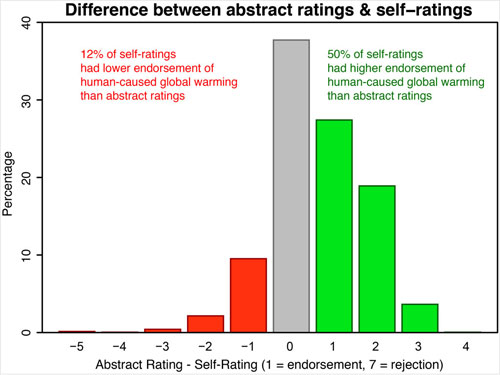
What part of "the authors rated their own full papers" are you not understanding? How would all your supposed problems with "activist raters" affect the authors' self-ratings? And didn't you notice that your bizarre accusations were already addressed in error 5 here?
T14 uses as a basis for this argument an excerpt from stolen private forum discussions (Lacatena, 2014) which is quoted out of context. Discussion of the methodology of categorising abstract text formed part of the training period in the initial stages of the rating period. When presented to raters, abstracts were selected at random from a sample size of 12,464. Hence for all practical purposes, each rating session was independent from other rating sessions. While a few example abstracts were discussed for the purposes of rater training and clarification of category parameters, the ratings and raters were otherwise independent. This was discussed in C13;
"While criteria for determining ratings were defined prior to the rating period, some clarifications and amendments were required as specific situations presented themselves."
Independence of the raters was important to identify uncertainties based on interpretation of the rating criteria, but had little bearing on the final conclusion. Indeed, the conclusion is strengthened by the fact that the vast majority of rater disagreements were between no position and endorsement categories; very few affected the rejection bin.
In Cooks paper, social sciences papers such as a public survey looking at "Informed and uninformed public opinions on CO2 capture and storage" were considered climate science literature that endorsed consensus. [GiordyS]
Again, so you disagree with ratings given to some of the 11,944 abstracts. Given the large sample, that's almost inevitable. Here are all 11,944 abstract ratings. Change the ratings on whichever ones you think are wrong, then recalculate the consensus. If the new number is sufficiently different, and your re-ratings are reasonable, you might actually be able to publish your re-analysis. But I suspect that reasonable changes would only have minor effects on the consensus, because any of these supposed problems with the raters wouldn't affect the authors' ratings of their full papers. When you change the ratings, you should also email the authors to see if they agree with your new ratings, like Cook et al. 2013 did.
Knowing the above I'm not sure how anyone can defend that paper. Maybe they are so happy with the results they don't care how they got them? Is that how science is supposed to work? [GiordyS]
Again, it's astonishing that you keep baselessly accusing NASA and other scientists of being "so happy with the results they don't care how they got them" while at the same time citing Tol 2014, a paper which fails to list even a single example o
-
Re:Credibility of Climate Science
Successful predictions include surface warming and stratospheric cooling coincident with a rise in CO2 levels, and stronger warming effects at the poles. Are you under the misapprehension that producing fine-grained projections of global temperature is the only thing that climate scientists do?
The challenge I put forth asked for correctness of just 80% for any cited prediction
Studies usually already include their error margins. If a prediction comes in within its own error margin, that is a successful test. Surely you don't apply your own arbitrary standards to other physical sciences? As it happens, results within the error margins of prediction are true for Hansen et all (1988), linked previously, for Plass (1956), Arrhenius (linked previously), and most accurately by Sawyer (1972), who managed to get both the magnitude of increased emissions and the resulting temperature increase exactly correct. I apparently wasn't clear when I gave you the temperature predictions earlier for Sawyer, Plass, and Hansen. I assumed that you would be able to find a graph of global temperatures for the 20th Century. Here's a graph for you, which corroborates their findings. I hope it's not too much trouble to be able to look at my previous posts for the numbers.
Also, Arrhenius (1896) and Callendar (30s-40s) were confirmed in the mid-50s with CO2 and temperature measurements. You could also consider Plass and Kaplan (1952) to be confirmation of the previous work on the matter. Also, you will note that Hansen's spacial distribution of the temperature anomaly was very accurate. Looking at graphs in the 1995 IPCC report their prediction (p40) of the warming trend matches the observed warming through to the present quite well.
We see scary predictions published — even on Slashdot — about once a week.
If you're getting your scientific information from the popular press, you're probably being misinformed in some manner. In my experience newspaper articles are rarely peer reviewed, and I don't think I've seen very many cited, or that have citations. As it happens, I believe most of the articles on Slashdot are concerned with weather events and annual records.
does this mean, you admit, no predictions I seek have been made until "just recently"?
What you want isn't actually a test of the science in the way you think it is. Global climate models cannot be used to disprove AGW any more than epidemiological models can be used to disprove the germ theory of disease, and Kerbal Space Program is similarly not a test of relativity. Economists can construct models to show that rapid expansions of the monetary supply cause harmful inflation, and there is empirical evidence to support this idea. Constructing a model to predict the exact effects of the Fed's Quantitative Easing program would be something of a challenge. Failure to model something accurately means that your model is inaccurate, not that the theory is wrong. Are climate models inaccurate? Of course they are! Every model is inaccurate. All of science is inaccurate, it's inherent to empirical observation. The question is to what degree they are useful, and to begin to be able to answer that, I would suggest you start here or
-
Re:Credibility of Climate Science
Successful predictions include surface warming and stratospheric cooling coincident with a rise in CO2 levels, and stronger warming effects at the poles. Are you under the misapprehension that producing fine-grained projections of global temperature is the only thing that climate scientists do?
The challenge I put forth asked for correctness of just 80% for any cited prediction
Studies usually already include their error margins. If a prediction comes in within its own error margin, that is a successful test. Surely you don't apply your own arbitrary standards to other physical sciences? As it happens, results within the error margins of prediction are true for Hansen et all (1988), linked previously, for Plass (1956), Arrhenius (linked previously), and most accurately by Sawyer (1972), who managed to get both the magnitude of increased emissions and the resulting temperature increase exactly correct. I apparently wasn't clear when I gave you the temperature predictions earlier for Sawyer, Plass, and Hansen. I assumed that you would be able to find a graph of global temperatures for the 20th Century. Here's a graph for you, which corroborates their findings. I hope it's not too much trouble to be able to look at my previous posts for the numbers.
Also, Arrhenius (1896) and Callendar (30s-40s) were confirmed in the mid-50s with CO2 and temperature measurements. You could also consider Plass and Kaplan (1952) to be confirmation of the previous work on the matter. Also, you will note that Hansen's spacial distribution of the temperature anomaly was very accurate. Looking at graphs in the 1995 IPCC report their prediction (p40) of the warming trend matches the observed warming through to the present quite well.
We see scary predictions published — even on Slashdot — about once a week.
If you're getting your scientific information from the popular press, you're probably being misinformed in some manner. In my experience newspaper articles are rarely peer reviewed, and I don't think I've seen very many cited, or that have citations. As it happens, I believe most of the articles on Slashdot are concerned with weather events and annual records.
does this mean, you admit, no predictions I seek have been made until "just recently"?
What you want isn't actually a test of the science in the way you think it is. Global climate models cannot be used to disprove AGW any more than epidemiological models can be used to disprove the germ theory of disease, and Kerbal Space Program is similarly not a test of relativity. Economists can construct models to show that rapid expansions of the monetary supply cause harmful inflation, and there is empirical evidence to support this idea. Constructing a model to predict the exact effects of the Fed's Quantitative Easing program would be something of a challenge. Failure to model something accurately means that your model is inaccurate, not that the theory is wrong. Are climate models inaccurate? Of course they are! Every model is inaccurate. All of science is inaccurate, it's inherent to empirical observation. The question is to what degree they are useful, and to begin to be able to answer that, I would suggest you start here or
-
Re:Earth shifts
Your demands for citations are cute. If they're not in the right format, you won't read them. I'm sure that will make them go away.
To illustrate, that we've seen both kinds of predictions, and that the climate science has a long way to go to establish its credibility. These cooling papers came after Arrhenius, did not they?
Again, we can find contrarian research published about plate tectonics decades after it was accepted science. The existence of papers is not an argument for their credibility.
Arrhenius' first paper on the subject of warming is here. His prediction was about 4-6 degrees per doubling of CO2, with greater effects at the poles. That's on the high end of current estimates, but given the amount of hand-calculation he had to do, it's still a pretty impressive result.
Most of the early work on climate change was proving that it was possible for the climate to change at all, and as you can see in Arrhenius' paper, they mostly deal with the planet in an equilibrium state, and don't account for ever-increasing levels of CO2. One early attempt at modeling the globe in order to make these sorts of predictions was Hansen et al, 1988. He overestimated warming by about 15-25%; this article gives a post-mortem on his predictions. Essentially, using the same model with one slightly different physical constant reproduces the temperature trend far more precisely. An earlier study (Plass 1956) predicted a rise of 1.1 degrees C per century, assuming 1950s emissions levels. Warming since the 1950s has been on the order of
However, you're also reversing the burden of proof. Basic physical laws suggest that a higher partial pressure of CO2 will warm the Earth, and simple laboratory experiments show a strong positive feedback from H2O.
Great! And this was all known this for decades (if not centuries), right?
The laboratory experiments on the infrared absorption of various gases date back to Tyndall (1859), and general radiative laws derived by Boltzmann (1884). A more specific overview of radiative forcing effects can be found in Myhre et al, 1998, if you're interested. So for the general idea that CO2 affects the temperature on Earth, you can look to any of the above for confirmation, or grab an IR camera and take a photograph.
So if CO2 affects the global temperature, and CO2 is measured to be increasing (which presumably you do not dispute), then wouldn't it be obvious that temperature must also increase? Not so fast! The absorption bands of CO2 and H2O overlap, and the atmosphere is so full of water vapor that it periodically precipitates. Clearly anything CO2 could do, H2O must already be doing, right? Bzzt. The flaw in this thinking is that because H2O precipitates out before it reaches the upper atmosphere and CO2 does not, allowing the latter to build up in the upper atmosphere (Kaplan 1952). Specifically, it extends the CO2-rich layer further out into space. There are a couple more details about where emission happens at what probability for a given photon of a given energy, and how many times it can expect to hit something on its way up, but again, your IR photograph should tell you that the mean free path is pretty short. This paper gives an overview of Earth's radiative balance.
I don't have to offer my own theory — because I do not seek to convince and/or compel you to alter your way of life. You seek to do that t
-
Water Vapor
Water vapor is not ignored; if it were not for the water vapor feedback cycle CO2 would be a non-issue. The issue with water vapor is that there are vast reservoirs of it all around the planet, which we are not able to do much about. Also, your statement that clouds cause cooling is not quite correct: clouds contribute to both warming and cooling.
Right now we are engaging in a massive uncontrolled geoengineering experiment: using CO2 to add energy to the Earth's atmosphere. Modeling the effects of this are very difficult. I'm not interested in additional experiments without a great deal of study to their effects.
-
No, it won't.
Yes, somewhat higher CO2 concentrations can help plants to grow if everything else stays constant. But everything else isn't constant.
Most places that currently grow food stand to face much more frequent drought conditions with a higher global average temperature, and the effect of those droughts far outweighs the mild impact of higher CO2 concentrations.
The specific impacts are regional, of course, but globally the impact of global warming is to drastically reduce crop yields. Some of this will be offset by areas further north becoming usable for farmland (such as in Canada and Siberia), but overall production is still expected to be reduced by global warming.
For more detailed info, see here.
-
Re:Hypotheticals
Existing models have failed to correctly predict "the pause", so why should we continue to trust them blindly ? They are obviously missing something...
Of course, models without an anthropogenic component completely miss the increase in temp for the past 60 years http://www.skepticalscience.co..., so they are obviously missing something; AGW, to be specific.
-
Re:we're all scientists
Dr. Roy Spencer provides evidence and contrary opinions. Universally, the morons on Slashdot (like you) insist his evidence and opinion doesn't matter because he's not a Cliiimate Scientist.
So take you pedantic ass and fuck off.
No, the morons on Slashdot (like me) and almost every other person with some grounding in physical science insist his evidence and opinion doesn't matter because it's been demonstrated to be wrong, again and again. For instance https://www.skepticalscience.c... Whereas the morons on the rightwing (like you) insist his evidence and opinion are correct because he's reached a conclusion that you started with.
-
Re:we're all scientists
Dr. Roy Spencer provides evidence and contrary opinions.
He also says a lot of stuff that isn't well supported by the evidence. In fact, he once said about his own paper:
"Our paper is an important step toward validating a gut instinct that many meteorologists like myself have had over the years," said Spencer, "that the climate system is dominated by stabilizing processes, rather than destabilizing processes -- that is, negative feedback rather than positive feedback."
One has to wonder how many of the climate myths that Dr Spencer has said have been a result of what his gut says rather than any evidence; and how much of his evidence is selected to match his gut feeling. His papers and comments do seem to be motivated by the desire to right the supposed mistakes of other climate research.
And yet he claims that it is the climate researchers who are the myopic ones:
They think that the only way for global-average temperatures to change is for the climate system to be forced 'externally'...by a change in the output of the sun, or by a large volcanic eruption... But what they have ignored is the potential for the climate system to cause its own climate change. Climate change is simply what the system does, owing to its complex, dynamic, chaotic internal behavior.
In his quest to show that climate researchers are wrong, he has stated that the climate system is dominated by stabilizing processes, but also that it causes its own climate change by its complex, dynamic, chaotic internal behavior.
So take you pedantic ass and fuck off.
A well formed argument there, but I would expect nothing less from someone who consistently can't spell the word climate.
-
Re:10%. 90%
The conversation was about the Cook study. And apparently you can't tell how bad a study is even if it's atrociously bad. "From the start we would never be able to claim that ratings were done by independent, unbiased, or random people anyhow." http://www.hi-izuru.org/forum/...
Again, you meant to accuse me and NASA of apparently not being able to tell how bad a study is. And specifically, the conversation was about how the Cook study compared their own ratings to self-ratings done by the authors. Isn't it strange that all your supposedly "atrocious" rater problems actually caused the Cook et al. raters to underestimate the consensus rate compared to the authors' self-ratings?
Funny you should link the Zimmerman study - they surveyed 3145 respondents, but only used 77 of those to get the magic 97% number.
If you surveyed doctors about a topic involving heart surgery and only 77 out of 3145 of those doctors were actively practicing heart surgeons, wouldn't you be more interested in what those experts have to say? From Doran and Zimmerman 2009:
"In our survey, the most specialized and knowledgeable respondents (with regard to climate change) are those who listed climate science as their area of expertise and who also have published more than 50% of their recent peer-reviewed papers on the subject of climate change (79 individuals in total). Of these specialists, 96.2% (76 of 79) answered "risen" to question 1 and 97.4% (75 of 77) answered yes to question 2."
Doran and Zimmerman reported all the results in Fig. 1, which reveals a common (indeed, expected) increase in accuracy as one's subject expertise increases.
... The question asked was "Do you think human activity is a significant contributing factor in changing mean global temperatures?" Most skeptics and luke-warmers, including me, would answer 'yes' to that question. So the survey is essentially meaningless.
Since they show all their results in Fig. 1, and over 30% of the general public answered "no" to that question, it's not clear how Doran and Zimmerman 2009 was "essentially meaningless". Their survey revealed that even using such a broad definition, the general public has been grievously misled. Possibly by compulsive contrarians who don't have any real expertise, but who nevertheless have fun baselessly accusing scientists of dishonesty and fraud.
And remember, Anderegg et al. 2010 used a more precise definition. What regurgitated excuse "justifies" ignoring Anderegg et al. 2010?
Here's a much better discussion on consensus: https://judithcurry.com/2013/1...
If GiordyS and Jane Q. Public's accusations aren't baseless, why do they keep "citing" blog posts, while I'm citing peer-reviewed papers along with statements from NASA and many other scientific organizations?
GiordyS just linked a blog post which proclaims a "52% 'consensus'" because of a 2013 survey of the American Meteorological Society. Had GiordyS really just not read about the new 2016 AMS survey revealed different results?
"Specifically: 29% think the change is largely or entirely due to human activity (i.e., 81 to 100%); 38% think most of the change is caused by human activity (i.e., 61 to 80%); 14% thi
-
Re:10%. 90%
Anybody who disagrees with SkepticalScience has a 'grudge'. Funny how that works.
No, anybody who baselessly libels the same scientists ad nauseum by baselessly accusing them of fraud seems to have a 'grudge'.
SkepticalScience is an activist blog. I wouldn't trust anything they produce.
So you're baselessly accusing Cook et al. of lying about the authors' self-ratings because you don't like the fact that more authors rate their own papers as having a higher endorsement than the other way around.
How about Richarg Tol? I'll bet he has a 'grudge' as well?
Richard Tol: "Published papers that seek to test what caused the climate change over the last century and half, almost unanimously find that humans played a dominant role."
-
Re:10%. 90%
Jose Duarte is another guy with a grudge who seems to imply that C13 somehow misclassified lots of papers. If that's the case, why did more authors rate their own papers as having a higher endorsement than the other way around?