Slashdot Mirror
Domain: slashdot.org
Stories and comments across the archive that link to slashdot.org.
Stories · 37,380
-
Alibaba Looks To Rural China To Popularize Its Mobile OS
itwbennett writes: E-commerce giant Alibaba Group hasn't given up on its YunOS mobile operating system, and is taking the software to China's rural markets through a series of low-cost phones, which will be built by lesser-known Chinese brands and will range from 299 yuan ($49) to 699 yuan. Slashdot readers may remember that in 2012, Google claimed it was a variant of its Android OS, sparking a clash that threatened to derail Alibaba's effort to popularize the mobile OS. -
Google Insiders Talk About Why Google+ Failed
An anonymous reader writes in with this story about what happened to Google+ from an employee perspective. "Last month, Google announced that it's changing up its strategy with Google+. In a sense, it's giving up on pitching Google+ as a social network aimed at competing with Facebook. Instead, Google+ will become two separate pieces: Photos and Streams. This didn't come as a surprise — Google+ never really caught on the same way social networks like Facebook, Twitter, or LinkedIn did....Rumors have been swirling for months that Google would change its direction with Google+. Business Insider spoke with a few insiders about what happened to the network that Google believed would change the way people share their lives online. Google+ was really important to Larry Page, too — one person said he was personally involved and wanted to get the whole company behind it. The main problem with Google+, one former Googler says, is the company tried to make it too much like Facebook. Another former Googler agrees, saying the company was 'late to market' and motivated from 'a competitive standpoint.'" -
Officials Say Russian Hackers Read Obama's Unclassified Emails
An anonymous reader points out that Russian hackers reportedly obtained some of President Obama’s emails when the White House’s unclassified computer system was hacked last year. Some of President Obama's email correspondence was swept up by Russian hackers last year in a breach of the White House's unclassified computer system that was far more intrusive and worrisome than has been publicly acknowledged, according to senior American officials briefed on the investigation. The hackers, who also got deeply into the State Department's unclassified system, do not appear to have penetrated closely guarded servers that control the message traffic from Mr. Obama's BlackBerry, which he or an aide carries constantly. But they obtained access to the email archives of people inside the White House, and perhaps some outside, with whom Mr. Obama regularly communicated. From those accounts, they reached emails that the president had sent and received, according to officials briefed on the investigation. -
Nepal Earthquake: Facebook To Google, How Tech Is Helping Survivors Reach Out
An anonymous reader writes: In the aftermath of the earthquake that struck Nepal, many social media sites and mobile applications have come up with features that could help locate friends and loved ones. From the Times of India: "Social networking website Facebook, and Google's Person Finder have helped locate the whereabouts of those stranded in quake-hit areas. For instance, members of one Himmatramka family residing in Birgunj in Nepal marked themselves safe on Facebook. 'Our relatives back in India were worried about our safety. So, we marked ourselves safe to inform them,' said Nitesh Himmatramka. -
Tiny Robots Climb Walls Carrying More Than 100 Times Their Weight
schwit1 writes: Mighty things come in small packages. The little robots in this video can haul things that weigh over 100 times more than themselves. The super-strong bots — built by mechanical engineers at Stanford — will be presented next month at the International Conference on Robotics and Automation in Seattle, Washington. The secret is in the adhesives on the robots' feet. Their design is inspired by geckos, which have climbing skills that are legendary in the animal kingdom. The adhesives are covered in minute rubber spikes that grip firmly onto the wall as the robot climbs. When pressure is applied, the spikes bend, increasing their surface area and thus their stickiness. When the robot picks its foot back up, the spikes straighten out again and detach easily. -
Think Tanks: How a Bill [Gates Agenda] Becomes a Law
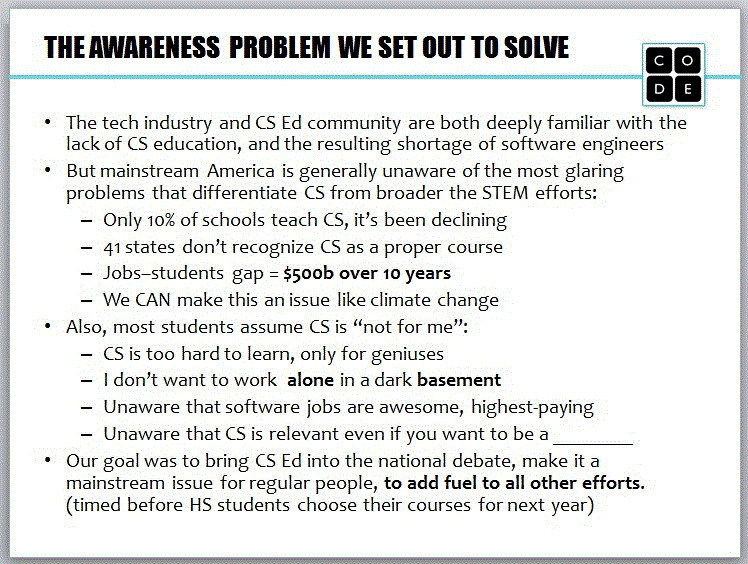
theodp writes: The NY Times' Eric Lipton was just awarded a 2015 Pulitzer Prize for investigative reporting that shed light on how foreign powers buy influence at think tanks. So, it probably bears mentioning that Microsoft's 'two-pronged' National Talent Strategy (PDF) to increase K-12 CS education and the number of H-1B visas — which is on the verge of being codified into laws — was hatched at an influential Microsoft and Gates Foundation-backed think tank mentioned in Lipton's reporting, the Brookings Institution. In 2012, the Center for Technology Innovation at Brookings hosted a forum on STEM education and immigration reforms, where fabricating a crisis was discussed as a strategy to succeed with Microsoft's agenda after earlier lobbying attempts by Bill Gates and Microsoft had failed. "So, Brad [Microsoft General Counsel Brad Smith]," asked the Brookings Institution's Darrell West at the event, "you're the only [one] who mentioned this topic of making the problem bigger. So, we galvanize action by really producing a crisis, I take it?" "Yeah," Smith replied (video). And, with the help of nonprofit organizations like Code.org and FWD.us that were founded shortly thereafter, a national K-12 CS and tech immigration crisis was indeed created. -
Think Tanks: How a Bill [Gates Agenda] Becomes a Law
theodp writes: The NY Times' Eric Lipton was just awarded a 2015 Pulitzer Prize for investigative reporting that shed light on how foreign powers buy influence at think tanks. So, it probably bears mentioning that Microsoft's 'two-pronged' National Talent Strategy (PDF) to increase K-12 CS education and the number of H-1B visas — which is on the verge of being codified into laws — was hatched at an influential Microsoft and Gates Foundation-backed think tank mentioned in Lipton's reporting, the Brookings Institution. In 2012, the Center for Technology Innovation at Brookings hosted a forum on STEM education and immigration reforms, where fabricating a crisis was discussed as a strategy to succeed with Microsoft's agenda after earlier lobbying attempts by Bill Gates and Microsoft had failed. "So, Brad [Microsoft General Counsel Brad Smith]," asked the Brookings Institution's Darrell West at the event, "you're the only [one] who mentioned this topic of making the problem bigger. So, we galvanize action by really producing a crisis, I take it?" "Yeah," Smith replied (video). And, with the help of nonprofit organizations like Code.org and FWD.us that were founded shortly thereafter, a national K-12 CS and tech immigration crisis was indeed created. -
FCC Chairman: a Former Cable Lobbyist Who Helped Kill the Comcast Merger
An anonymous reader writes: After Friday's news that the Comcast/TWC merger is dead, the Washington Post points out an interesting fact: FCC Chairman Tom Wheeler, who was instrumental in throwing up roadblocks for the deal, used to be a lobbyist for the cable and wireless industry. "Those who predicted Wheeler would favor industry interests 'misunderstood him from the beginning — the notion that because he had represented various industries, he was suddenly in their pocket never made any sense,' said one industry lawyer, who spoke on the condition of anonymity because he represents clients before the FCC." The "revolving door" between government and industry is often blamed for many of the problems regulating corporations. We were worried about it ourselves when Wheeler was nominated for his current job. I guess this goes to show that it depends more on the person than on their previous job. -
FCC Chairman: a Former Cable Lobbyist Who Helped Kill the Comcast Merger
An anonymous reader writes: After Friday's news that the Comcast/TWC merger is dead, the Washington Post points out an interesting fact: FCC Chairman Tom Wheeler, who was instrumental in throwing up roadblocks for the deal, used to be a lobbyist for the cable and wireless industry. "Those who predicted Wheeler would favor industry interests 'misunderstood him from the beginning — the notion that because he had represented various industries, he was suddenly in their pocket never made any sense,' said one industry lawyer, who spoke on the condition of anonymity because he represents clients before the FCC." The "revolving door" between government and industry is often blamed for many of the problems regulating corporations. We were worried about it ourselves when Wheeler was nominated for his current job. I guess this goes to show that it depends more on the person than on their previous job. -
Microsoft Increases Android Patent Licensing Reach
BrianFagioli writes: Microsoft may not be winning in the mobile arena, but they're still making tons of money from those who are. Patent licensing agreements net the company billions each year from device makers like Samsung, Foxconn, and ZTE. Now, Microsoft has added another company to that list: Qisda Corp. They make a number of Android and Chrome-based devices under the Qisda brand and the BenQ brand, and now Microsoft will be making money off those, too. -
Github DDoS Attack As Seen By Google
New submitter opensec writes: Last month GitHub was hit by a massive DDoS attack originating from China. On this occasion the public discovered that the NSA was not the only one with a QUANTUM-like capability. China has its own "Great Cannon" that can inject malicious JavaScript inside HTTP traffic. That weapon was used in the GitHub attack. People using Baidu services were unwitting participants in the denial of service, their bandwidth used to flood the website. But such a massive subversion of the Internet could not evade Google's watchful eye. Niels Provos, engineer at Google, tells us how it happened. Showing that such attacks cannot be made covertly, Provos hopes that the public shaming will act as a deterrent. -
Comcast Officially Gives Up On TWC Merger
An anonymous reader writes: Confirming speculation from yesterday, Comcast announced this morning that its attempt to merge with Time Warner Cable has been terminated. The announcement was very brief, but indicated that regulatory pressure was the reason they killed the deal. CEO Brian Roberts said, "Today, we move on. Of course, we would have liked to bring our great products to new cities, but we structured this deal so that if the government didn't agree, we could walk away." The Washington Post adds, "The move by regulators to throw up roadblocks shows that the government has grown concerned about massive media conglomerates bigfooting rivals that are finding success by streaming content over the Internet, analysts said. And after years of approving a wave of mergers in the industry — including that of Comcast and NBC Universal in 2011 — federal officials are taking a new tone, they said." -
Music Industry Argues Works Entering Public Domain Are Not In Public Interest
An anonymous reader writes: With news that Canada intends to extend the term of copyright for sound recordings and performers, the recording industry is now pushing the change by arguing that works entering the public domain is not in the public interest. It is hard to see how anyone can credibly claim that works are "lost" to the public domain and that the public interest in not served by increased public access, but if anyone would make the claim, it would be the recording industry. -
Yellowstone Supervolcano Even Bigger Than We Realized
The Washington Post reports that the "supervolcano" beneath Yellowstone National Park (which, thankfully, did not kill us all in 2004, or in 2008 ) may be more dangerous when it does erupt than anyone realized until recently. Scientists have today published a paper documenting their discovery of an even larger, deeper pool of magma below the already huge reservoir near the surface. From the article: On Thursday, a team from the University of Utah published a study, in the journal Science, that for the first time offers a complete diagram of the plumbing of the Yellowstone volcanic system. The new report fills in a missing link of the system. It describes a large reservoir of hot rock, mostly solid but with some melted rock in the mix, that lies beneath a shallow, already-documented magma chamber. The newly discovered reservoir is 4.5 times larger than the chamber above it. There's enough magma there to fill the Grand Canyon. The reservoir is on top of a long plume of magma that emerges from deep within the Earth's mantle. ... “This is like a giant conduit. It starts down at 1,000 kilometers. It's a pipe that starts down in the Earth," said Robert Smith, emeritus professor of geophysics at the University of Utah and a co-author of the new paper. ... The next major, calderic eruption could be within the boundaries of the park, northeast of the old caldera. “If you have this crustal magma system that is beneath the pre-Cambrian rocks, eventually if you get enough fluid in that system, enough magma, you can create another caldera, another set of giant explosions," Smith said. "There’s no reason to think it couldn’t continue that same process and repeat that process to the northeast.” -
Yellowstone Supervolcano Even Bigger Than We Realized
The Washington Post reports that the "supervolcano" beneath Yellowstone National Park (which, thankfully, did not kill us all in 2004, or in 2008 ) may be more dangerous when it does erupt than anyone realized until recently. Scientists have today published a paper documenting their discovery of an even larger, deeper pool of magma below the already huge reservoir near the surface. From the article: On Thursday, a team from the University of Utah published a study, in the journal Science, that for the first time offers a complete diagram of the plumbing of the Yellowstone volcanic system. The new report fills in a missing link of the system. It describes a large reservoir of hot rock, mostly solid but with some melted rock in the mix, that lies beneath a shallow, already-documented magma chamber. The newly discovered reservoir is 4.5 times larger than the chamber above it. There's enough magma there to fill the Grand Canyon. The reservoir is on top of a long plume of magma that emerges from deep within the Earth's mantle. ... “This is like a giant conduit. It starts down at 1,000 kilometers. It's a pipe that starts down in the Earth," said Robert Smith, emeritus professor of geophysics at the University of Utah and a co-author of the new paper. ... The next major, calderic eruption could be within the boundaries of the park, northeast of the old caldera. “If you have this crustal magma system that is beneath the pre-Cambrian rocks, eventually if you get enough fluid in that system, enough magma, you can create another caldera, another set of giant explosions," Smith said. "There’s no reason to think it couldn’t continue that same process and repeat that process to the northeast.” -
Learn About FIRST's New Embedded Linux Controller (Video)
Our interviewee today is Mike Anderson, an adviser to FIRST (For Inspiration and Recognition of Science and Technology) Team 116 at Herndon High School in Virginia. He's here to tell us about the new embedded Linux controller FIRST is using this year. It is apparently a bit short of documentation at this stage, so team 116 and others have been posting what they learn at Chief Delphi, which is 'the' FIRST online discussion forum (and fun to read to keep up with all things FIRST). We've talked about FIRST before. We've taken you to FIRST competitions, and looked behind the scenes at the building of a FIRST robot, and will no doubt keep covering a selection of FIRST activities in the future. -
Learn About FIRST's New Embedded Linux Controller (Video)
Our interviewee today is Mike Anderson, an adviser to FIRST (For Inspiration and Recognition of Science and Technology) Team 116 at Herndon High School in Virginia. He's here to tell us about the new embedded Linux controller FIRST is using this year. It is apparently a bit short of documentation at this stage, so team 116 and others have been posting what they learn at Chief Delphi, which is 'the' FIRST online discussion forum (and fun to read to keep up with all things FIRST). We've talked about FIRST before. We've taken you to FIRST competitions, and looked behind the scenes at the building of a FIRST robot, and will no doubt keep covering a selection of FIRST activities in the future. -
Learn About FIRST's New Embedded Linux Controller (Video)
Our interviewee today is Mike Anderson, an adviser to FIRST (For Inspiration and Recognition of Science and Technology) Team 116 at Herndon High School in Virginia. He's here to tell us about the new embedded Linux controller FIRST is using this year. It is apparently a bit short of documentation at this stage, so team 116 and others have been posting what they learn at Chief Delphi, which is 'the' FIRST online discussion forum (and fun to read to keep up with all things FIRST). We've talked about FIRST before. We've taken you to FIRST competitions, and looked behind the scenes at the building of a FIRST robot, and will no doubt keep covering a selection of FIRST activities in the future. -
Update: No Personhood for Chimps Yet
sciencehabit writes: In a decision that effectively recognizes chimpanzees as legal persons for the first time, a New York judge [Monday] granted a pair of Stony Brook University lab animals the right to have their day in court. The ruling marks the first time in U.S. history that an animal has been covered by a writ of habeus corpus, which typically allows human prisoners to challenge their detention. The judicial action could force the university, which is believed to be holding the chimps, to release the primates, and could sway additional judges to do the same with other research animals. Update: 04/21 21:39 GMT by S : Science has updated their article with news that the court has released an amended order (PDF) with the words "writ of habeas corpus" removed, no longer implying that chimps have legal personhood. The order still allows the litigation to go forward, but we'll have to wait for resolution. -
AMD Publishes New 'AMDGPU' Linux Graphics Driver
An anonymous reader writes: AMD has made available its new AMDGPU Linux graphics driver comprised of a brand new DRM/KMS kernel driver, a new xf86-video-amdgpu X11 driver, and modifications to libdrm and Gallium3D. This new AMDGPU driver is designed for supporting AMD's next-generation hardware with no support differences for currently supported Radeon GPUs. While yet to be released, this new AMDGPU driver is the critical piece to the new unified driver strategy with Catalyst where their high performance proprietary driver will now become limited to being a user-space binary component that uses this open-source kernel driver. -
Netflix Is Betting On Exclusive Programming
An anonymous reader writes: You may have heard of the recent launch of the new Daredevil TV show, and possibly the hit shows House of Cards and Orange is the New Black. They're all original programming from Netflix — the company that used to just mail DVDs to your door. But Netflix is now running a lot more than just those three shows — it has 320 hours of original programming planned for this year. This article discusses how Netflix is betting big on original, exclusive content, and what that means for the future of television. "Traditionally, television networks needed to stand for something to carve out an audience, he said, whereas the Internet allows brands to mean different things to different people because the service can be personalized for individual viewers. That means that for a conservative Christian family, Netflix should stand for wholesome entertainment, and, for a 20-year-old New York college student, it should be much more on the edge, he said.... 'We've had 80 years of linear TV, and it's been amazing, and in its day the fax machine was amazing,' he said. "The next 20 years will be this transformation from linear TV to Internet TV.'" -
New PCIe SSDs Load Games, Apps As Fast As Old SATA Drives
crookedvulture writes Slashdot has covered a bunch of new PCI Express SSDs over the past month, and for good reason. The latest crop offers much higher sequential and random I/O rates than predecessors based on old-school Serial ATA interfaces. They're also compatible with new protocols, like NVM Express, which reduce overhead and improve scaling under demanding loads. As one might expect, these new PCIe drives destroy the competition in targeted benchmarks, hitting top speeds several times faster than even the best SATA SSDs can muster. The thing is, PCIe SSDs don't load games or common application data any faster than current incumbents—or even consumer-grade SSDs from five years ago. That's very different from the initial transition from mechanical to solid-state storage, where load times improved noticeably for just about everything. Servers and workstations can no doubt take advantage of the extra oomph that PCIe SSDs provide, but desktop users may struggle to find scenarios where PCIe SSDs offer palpable performance improvements over even budget-oriented SATA drives. -
New PCIe SSDs Load Games, Apps As Fast As Old SATA Drives
crookedvulture writes Slashdot has covered a bunch of new PCI Express SSDs over the past month, and for good reason. The latest crop offers much higher sequential and random I/O rates than predecessors based on old-school Serial ATA interfaces. They're also compatible with new protocols, like NVM Express, which reduce overhead and improve scaling under demanding loads. As one might expect, these new PCIe drives destroy the competition in targeted benchmarks, hitting top speeds several times faster than even the best SATA SSDs can muster. The thing is, PCIe SSDs don't load games or common application data any faster than current incumbents—or even consumer-grade SSDs from five years ago. That's very different from the initial transition from mechanical to solid-state storage, where load times improved noticeably for just about everything. Servers and workstations can no doubt take advantage of the extra oomph that PCIe SSDs provide, but desktop users may struggle to find scenarios where PCIe SSDs offer palpable performance improvements over even budget-oriented SATA drives. -
New PCIe SSDs Load Games, Apps As Fast As Old SATA Drives
crookedvulture writes Slashdot has covered a bunch of new PCI Express SSDs over the past month, and for good reason. The latest crop offers much higher sequential and random I/O rates than predecessors based on old-school Serial ATA interfaces. They're also compatible with new protocols, like NVM Express, which reduce overhead and improve scaling under demanding loads. As one might expect, these new PCIe drives destroy the competition in targeted benchmarks, hitting top speeds several times faster than even the best SATA SSDs can muster. The thing is, PCIe SSDs don't load games or common application data any faster than current incumbents—or even consumer-grade SSDs from five years ago. That's very different from the initial transition from mechanical to solid-state storage, where load times improved noticeably for just about everything. Servers and workstations can no doubt take advantage of the extra oomph that PCIe SSDs provide, but desktop users may struggle to find scenarios where PCIe SSDs offer palpable performance improvements over even budget-oriented SATA drives. -
Comcast and TWC Will Negotiate With Officials To Save Their Merger
An anonymous reader writes with news about Comcast and Time Warner Cable's attempt to keep their proposed merger alive. "Comcast Corp. and Time Warner Cable Inc. are slated to sit down for the first time on Wednesday with Justice Department officials to discuss potential remedies in hopes of keeping their $45.2 billion merger on track, according to people familiar with the matter. The parties haven't met face-to-face to hash out possible concessions in the more than 14 months since the deal was announced. Staffers at both the Justice Department and the Federal Communications Commission remain concerned a combined company would wield too much power in the broadband Internet market and give it unfair competitive leverage against TV channel owners and new market entrants that offer video programming online, said people with knowledge of the review." -
Kingston HyperX Predator SSD Takes Gumstick M.2 PCIe Drives To 1.4GB/sec
MojoKid writes Kingston recently launched their HyperX Predator PCIe SSD that is targeted at performance-minded PC enthusiasts but is much less expensive than enterprise-class PCIe offerings that are currently in market. Kits are available in a couple of capacities and form factors at 240GB and 480GB. All of the drives adhere to the 80mm M.2 2280 "gumstick" form factor and have PCIe 2.0 x4 connections, but are sold both with and without a half-height, half-length adapter card, if you'd like to drop it into a standard PCI Express slot. At the heart of the Kingston HyperX Predator is Marvell's latest 88SS9293 controller. The Marvell 88SS9293 is paired to a gigabyte of DDR3 memory and Toshiba A19 Toggle NAND. The drives are rated for read speeds up to 1.4GB/s and writes of 1GB/s and 130 – 160K random 4K IOPS. In the benchmarks, the 480GB model put up strong numbers. At roughly $1 per GiB, the HyperX Predator is about on par with Intel's faster SSD 750, but unlike Intel's new NVMe solution, the Kingston drive will work in all legacy platforms as well, not just Z97 and X99 boards with a compatible UEFI BIOS. -
John Hawley Talks About UAV Controls (Video)
John 'Warthog9' Hawley was the boss sysadmin on kernel.org before he jumped to Intel in April, 2014, as an open hardware technical evangelist. He last showed up on Slashdot in June, 2014, with his Dr. Who-inspired Robot K-9. Now he's talking about flight computers for quadcopters, specifically ones based on MinnowBoards. Last month (April 2015) he was speaking at the Embedded Linux Conference + Android Builders Summit. That's where he and Timothy Lord had this conversation about flight controllers for UAVs, which makes it a fitting sequel to yesterday's video, which was also about controlling drones with real-time Linux. -
John Hawley Talks About UAV Controls (Video)
John 'Warthog9' Hawley was the boss sysadmin on kernel.org before he jumped to Intel in April, 2014, as an open hardware technical evangelist. He last showed up on Slashdot in June, 2014, with his Dr. Who-inspired Robot K-9. Now he's talking about flight computers for quadcopters, specifically ones based on MinnowBoards. Last month (April 2015) he was speaking at the Embedded Linux Conference + Android Builders Summit. That's where he and Timothy Lord had this conversation about flight controllers for UAVs, which makes it a fitting sequel to yesterday's video, which was also about controlling drones with real-time Linux. -
LA Schools Seeking Refund Over Botched iPad Plan
SternisheFan sends news that Los Angeles Unified School District is asking Apple for a refund of the district's effort to equip students with iPads. The project was budgeted at around $1.3 billion to equip its 650,000 students, though only about 120,000 iPads have been purchased so far. After the program went bad, the FBI launched an investigation into their procurement practices. The iPads weren't standalone education devices — they were supposed to work in conjunction with another device carrying curriculum from a company named Pearson. But the district now says the combined tech didn't meet their needs, and they want their money back. Lawyers for the local Board of Education are looking into litigation options. They've also notified Apple and Pearson they won't pay for any new products or services. -
Google Responds To EU Antitrust Claims In Android Blog Post
An anonymous reader writes Earlier today the European Union released a Statement of Objection against Google, asserting that the search giant's dominance violating antitrust rules and Android products hindering equal opportunities for market access among its rivals. Google has now released an official blog post in response to the Commission's proposed investigation. Regarding its Android devices, Hiroshi Lockheimer, VP of Engineering at Android writes: "The European Commission has asked questions about our partner agreements. It's important to remember that these are voluntary—again, you can use Android without Google—but provide real benefits to Android users, developers and the broader ecosystem." He continues: "We are thankful for Android's success and we understand that with success comes scrutiny. But it's not just Google that has benefited from Android's success. The Android model has let manufacturers compete on their unique innovations [...] We look forward to discussing these issues in more detail with the European Commission over the months ahead." -
NVIDIA's New GPUs Are Very Open-Source Unfriendly
An anonymous reader writes: The Nouveau driver developers working on open-source support for the GeForce 900 Maxwell graphics cards have found this new generation to be "very open-source unfriendly" and restricting. NVIDIA began requiring signed firmware images, which they have yet to provide to Nouveau developers, contrary to their earlier statements. The open-source developers have also found their firmware signing to go beyond just simple security precautions. For now the open-source NVIDIA driver can only enable displays with the GTX 900 series without any hardware acceleration. -
Samsung SSD On a Tiny M.2 Stick Is Capable of Read Speeds Over 2GB/sec
MojoKid writes: Samsung has just announced its new SM951-NVMe SSD, the industry's first NVMe SSD to employ an M.2 form-factor. Samsung says the new gumstick style drive is capable of sequential read and write speeds of 2,260 MB/sec and 1,600 MB/sec respectively. Comparable SATA-based M.2 SSDs typically can only push read/write speeds of 540 MB/sec and 500 MB/sec, while most standard PCIe versions muster just north of 1GB/sec. The Samsung SM951-NVMe's performance is actually very comparable to the Intel SSD 750 Series PCIe x4 card but should help kick notebook performance up a notch in this common platform configuration. -
Jack Thompson Will Be Featured In BBC Film 'Grand Theft Auto'
New submitter requerdanos writes: Former attorney and professional troll Jack Thompson is set to become a major motion picture figure, played by Bill Paxton, in the upcoming film Grand Theft Auto. According to Cinema Blend, "Paxton is in line to play Jack Thompson. A Miami lawyer, Thompson came into the public eye by frequently blasting Grand Theft Auto, creator Rockstar Games, and video game violence in general. Before that, he was known for attacking media companies who promoted both hip hop and sex. In 2008, allegations of professional misconduct, including harassment, defamation, intimidation, and false statements led to Thompson being disbarred." -
'We the People' Petition To Revoke Scientology's Tax Exempt Status
An anonymous reader writes: There has been a lot of interest in the activities of the Church of Scientology recently, especially since the release of Alex Gibney's documentary Going Clear. A petition against tax-exempt status for Scientology has been started on the U.S. White House petition website. If it receives more than 100,000 signatures, it will qualify for an official White House response. Even Slashdot has had its own run-ins with Scientology in the past — one of many internet sites to face legal threats from the Church. Has the time come for Scientology go "clear?" -
Hubble and the VLT Uncover Evidence For Self-Interacting Dark Matter
astroengine writes: A new study carried out by the ESO's Very Large Telescope and the NASA/ESA Hubble Space Telescope has revealed for the first time that dark matter may well interact with itself — a discovery that, at first glance, seems to contradict what we thought we knew about the nature of this invisible mass. "In this study, the researchers observed the four colliding galaxies and found that one dark matter clump appeared to be lagging behind the galaxy it surrounds. The dark matter is currently 5000 light-years (50 000 million million kilometers) behind the galaxy — it would take NASA’s Voyager spacecraft 90 million years to travel that far. A lag between dark matter and its associated galaxy is predicted during collisions if dark matter interacts with itself, even very slightly, through forces other than gravity. Dark matter has never before been observed interacting in any way other than through the force of gravity." -
New Samsung SSD 840 EVO Read Performance Fix Coming Later This Month
An anonymous reader writes: The Samsung SSD 840 EVO read performance bug has been on the table for over six months now. Initially Samsung acknowledged the issue fairly quickly and provided a fix only a month after the news hit the mainstream tech media, but reports of read performance degradation surfaced again a few weeks after the fix had been released, making it clear that the first fix didn't solve the issue for all users. Two months ago Samsung announced that a new fix is in the works and last week Samsung sent out the new firmware along with Magician 4.6 for testing, which will be available to the public later this month. -
SpaceX Dragon Launches Successfully, But No Rocket Recovery
New submitter monkeyzoo writes: SpaceX has successfully launched a Falcon 9 rocket carrying a SpaceX Dragon spacecraft en route to the International Space Station with supplies (including an Italian espresso machine). This was also the second attempt to land the launch rocket on a barge, but that was not successful. Elon Musk tweeted that the rocket landed on the recovery ship but too hard to be reused. Video of the launch is available on the SpaceX webcast page. -
IT Consultant Talks About 'Negotiating for Nerds' (Video)
Matt Heusser did a Slashdot video interview back in 2013 titled How to Become an IT Expert Companies Seek Out and Pay Well. Despite noise from a few yammerheads about Matt getting 'free advertising' on Slashdot, which is unlikely since the vast majority of Slashdot users are more likely to compete with him than to hire him, most of the people who saw that video (or read the transcript) knew he was giving helpful advice to peers who might want to get out of the cubicle and work for themselves.
Today, Matt is with us again. This video is about 'Negotiating for Nerds.' Matt talks about negotiating a pay raise or consulting fee increase, starting with learning who has the actual power to negotiate with you. This is essential knowledge if you are employed (or self-employed) in IT and want to make sure you're getting all you are worth. -
US Dept. of Education Teams With Microsoft-Led Teach.org On Teacher Diversity
theodp writes: Citing a new study that suggests academic achievement can benefit when children are taught by a teacher of their own race, the NY Times asks, Where Are the Teachers of Color? Towards that end, the Times reports that "Teach.org, a partnership between the Department of Education and several companies, teachers unions and other groups, is specifically targeting racial minorities for recruitment." Teach.org describes itself as a "public-private partnership led by Microsoft, State Farm and the U.S. Department of Education." To the consternation of some, the U.S. Dept. of Education delegated teacher recruitment to Microsoft in 2011. With its 2.2% African American/Black and 3.9% Latino/Hispanic tech workforce, who better to increase diversity than Microsoft, right? -
SpaceX Launch Postponed
An anonymous reader writes with news about SpaceX's launch today and second attempt to land its Falcon 9 rocket on a platform floating offshore in the Atlantic ocean. "You can watch live as SpaceX launches its Falcon 9 rocket and attempts to recover the first stage portion via an automated, barge-based landing plan in the Atlantic ocean, with the first take-off attempted scheduled for 4:33 PM ET, provided conditions remain good and pre-flight checks go well. A big part of this mission, designated CRS-6 and designed primarily as a resupply flight for the International Space Station, is getting a second chance at recovering Falcon 9's first stage rocket. Once the second stage and the Dragon spacecraft detach from that first stage rocket, it'll undergo a controlled descent as it attempts to touch down with SpaceX's ocean-borne landing platform." Update: 04/13 21:43 GMT by S : The launch was scrubbed because of lightning in a nearby cloud. It's been rescheduled for tomorrow at 4:10PM ET. -
SpaceX Launch Postponed
An anonymous reader writes with news about SpaceX's launch today and second attempt to land its Falcon 9 rocket on a platform floating offshore in the Atlantic ocean. "You can watch live as SpaceX launches its Falcon 9 rocket and attempts to recover the first stage portion via an automated, barge-based landing plan in the Atlantic ocean, with the first take-off attempted scheduled for 4:33 PM ET, provided conditions remain good and pre-flight checks go well. A big part of this mission, designated CRS-6 and designed primarily as a resupply flight for the International Space Station, is getting a second chance at recovering Falcon 9's first stage rocket. Once the second stage and the Dragon spacecraft detach from that first stage rocket, it'll undergo a controlled descent as it attempts to touch down with SpaceX's ocean-borne landing platform." Update: 04/13 21:43 GMT by S : The launch was scrubbed because of lightning in a nearby cloud. It's been rescheduled for tomorrow at 4:10PM ET. -
Book Review: Networking For System Administrators
Saint Aardvark writes Michael W. Lucas has been writing technical books for a long time, drawing on his experience as both a system and a network administrator. He has mastered the art of making it both easy and enjoyable to inhale large amounts of information; that's my way of saying he writes books well and he's a funny guy. Networking for System Administrators, available both in DRM-free ebook and dead tree formats, is his latest book, and it's no exception to this trend. Keep reading for the rest of Saint Aardvark's review. Networking for Systems Administrators author Michael W. Lucas pages 206 publisher Tilted Windmill Press rating 9/10 reviewer Saint Aardvark ISBN 0692376941 summary Explains networking to sysadmins - both juniors new to this career, and those who have been around for a while Like the title suggests, this book explains networking to sysadmins — both juniors new to this career, and those who have been around for a while but don't understand how those network folks live or what they need to do their job. If you're one of the latter, you might think "Oh I've read 'TCP/IP Illustrated' — I don't need another networking book." And it's true that there is overlap between these two books. But Lucas also explains about how to work with network folks: dealing with areas of shared responsibility, how to understand where your side ends, and how to talk to a network admin so that everyone understands each other — and more importantly, is both able and happy to help the other. This is something that is out-of-scope for a network textbook, and it's valuable.
So what's in this book? Lucas takes us through all the network layers, explaining how everything fits together. From physical ("If you can trip over it, snag it, break the stupid tab off the plastic connector at its end, or broadcast static over it, it's the physical layer.") to transport and application, he shows practical examples of how the OSI model maps (or doesn't) to the world of TCP/IP. He shows the happy path and the sad path at each layer, explaining how to understand what's going on and troubleshooting failures. This is the part with the strongest overlap with those other network textbooks. If system administration is a side gig (maybe you're a developer who has to maintain your own server), you'll have enough in this book to deal with just about anything you're likely to trip over. But if you're early in your sysadmin career, or you find yourself making the jump to Ops, you will want to follow it up with TCP/IP Illustrated for the additional depth.
Since you'll be troubleshooting, you'll need to know the tools that let you dump DNS, peer into packets, and list what's listening (or not) on the network. Lucas covers Linux and Unix, of course, but he also covers Windows — particularly handy if, like me, you've stuck to one side over the course of your career. Tcpdump/Windump, arp, netstat, netcat and ifconfig are all covered here, but more importantly you'll also learn how to understand what they tell you, and how to relay that information to network administrators.
That thought leads to the final chapter of this book: a plea for working as a team, even when you're not on the same team. Bad things come from network and systems folks not understanding each other. Good things — happy workplaces, successful careers, thriving companies and new friends — can come from something as simple as saying "Well, I don't know if it is the network's fault...why don't we test and find out?"
After reading this book, you'll have a strong footing in networking. Lucas explains concepts in practical ways; he makes sure to teach tools in both Unix/Linux and Windows; and he gives you the terms you'll use to explain what you're seeing to the network folks. Along the way there's a lot of hard-won knowledge sprinkled throughout (leave autonegotiation on — it's a lot better than it used to be; replace cables if there's any hint of flakiness in a server's network connection) that, for me at least (and be honest, you too) would have saved a lot of time over the years.
Who would I recommend this book to?- If you're a sysadmin at the beginning of your career, this book is an excellent beginning; take it, read it, and build on it — both with practical experience and further reading.
- If you're coming into system administration the back way (as a developer who has to manage their own server, say, or who shares responsibility for a networked service with other admins), I can't think of a better single source for the practical knowledge you need. You'll gain an understanding of what's going on under the hood, how to diagnose problems you encounter, and how to talk to either system or network administrators about fixing those problems.
- If you're a manager or senior sysadmin, buy this book and read it through before handing it to the juniors on your team, or that dev who keeps asking questions about routing and the firewall; you may learn a few things, and it's always good to read fine technical writing.
You can purchase Networking for Systems Administrators from amazon.com. Slashdot welcomes readers' book reviews (sci-fi included) -- to see your own review here, read the book review guidelines, then visit the submission page. If you'd like to see what books we have available from our review library please let us know.
-
Book Review: Networking For System Administrators
Saint Aardvark writes Michael W. Lucas has been writing technical books for a long time, drawing on his experience as both a system and a network administrator. He has mastered the art of making it both easy and enjoyable to inhale large amounts of information; that's my way of saying he writes books well and he's a funny guy. Networking for System Administrators, available both in DRM-free ebook and dead tree formats, is his latest book, and it's no exception to this trend. Keep reading for the rest of Saint Aardvark's review. Networking for Systems Administrators author Michael W. Lucas pages 206 publisher Tilted Windmill Press rating 9/10 reviewer Saint Aardvark ISBN 0692376941 summary Explains networking to sysadmins - both juniors new to this career, and those who have been around for a while Like the title suggests, this book explains networking to sysadmins — both juniors new to this career, and those who have been around for a while but don't understand how those network folks live or what they need to do their job. If you're one of the latter, you might think "Oh I've read 'TCP/IP Illustrated' — I don't need another networking book." And it's true that there is overlap between these two books. But Lucas also explains about how to work with network folks: dealing with areas of shared responsibility, how to understand where your side ends, and how to talk to a network admin so that everyone understands each other — and more importantly, is both able and happy to help the other. This is something that is out-of-scope for a network textbook, and it's valuable.
So what's in this book? Lucas takes us through all the network layers, explaining how everything fits together. From physical ("If you can trip over it, snag it, break the stupid tab off the plastic connector at its end, or broadcast static over it, it's the physical layer.") to transport and application, he shows practical examples of how the OSI model maps (or doesn't) to the world of TCP/IP. He shows the happy path and the sad path at each layer, explaining how to understand what's going on and troubleshooting failures. This is the part with the strongest overlap with those other network textbooks. If system administration is a side gig (maybe you're a developer who has to maintain your own server), you'll have enough in this book to deal with just about anything you're likely to trip over. But if you're early in your sysadmin career, or you find yourself making the jump to Ops, you will want to follow it up with TCP/IP Illustrated for the additional depth.
Since you'll be troubleshooting, you'll need to know the tools that let you dump DNS, peer into packets, and list what's listening (or not) on the network. Lucas covers Linux and Unix, of course, but he also covers Windows — particularly handy if, like me, you've stuck to one side over the course of your career. Tcpdump/Windump, arp, netstat, netcat and ifconfig are all covered here, but more importantly you'll also learn how to understand what they tell you, and how to relay that information to network administrators.
That thought leads to the final chapter of this book: a plea for working as a team, even when you're not on the same team. Bad things come from network and systems folks not understanding each other. Good things — happy workplaces, successful careers, thriving companies and new friends — can come from something as simple as saying "Well, I don't know if it is the network's fault...why don't we test and find out?"
After reading this book, you'll have a strong footing in networking. Lucas explains concepts in practical ways; he makes sure to teach tools in both Unix/Linux and Windows; and he gives you the terms you'll use to explain what you're seeing to the network folks. Along the way there's a lot of hard-won knowledge sprinkled throughout (leave autonegotiation on — it's a lot better than it used to be; replace cables if there's any hint of flakiness in a server's network connection) that, for me at least (and be honest, you too) would have saved a lot of time over the years.
Who would I recommend this book to?- If you're a sysadmin at the beginning of your career, this book is an excellent beginning; take it, read it, and build on it — both with practical experience and further reading.
- If you're coming into system administration the back way (as a developer who has to manage their own server, say, or who shares responsibility for a networked service with other admins), I can't think of a better single source for the practical knowledge you need. You'll gain an understanding of what's going on under the hood, how to diagnose problems you encounter, and how to talk to either system or network administrators about fixing those problems.
- If you're a manager or senior sysadmin, buy this book and read it through before handing it to the juniors on your team, or that dev who keeps asking questions about routing and the firewall; you may learn a few things, and it's always good to read fine technical writing.
You can purchase Networking for Systems Administrators from amazon.com. Slashdot welcomes readers' book reviews (sci-fi included) -- to see your own review here, read the book review guidelines, then visit the submission page. If you'd like to see what books we have available from our review library please let us know.
-
1980's Soviet Bloc Computing: Printers, Mice, and Cassette Decks
szczys writes Martin Maly rode the wave of computer evolution in the 1980's while living in the former Czechoslovak Republic. Computers themselves were hard to come by, peripherals were even more rare and so enthusiasts of the time hacked their own, like dot-matrix printers and computer mice. If your build was impressive enough, the government would adopt it and begin manufacturing the design somewhat widely. Was your first computer mouse built into a plastic spice container? We covered what the personal computer revolution was like in Eastern Bloc countries back in December. -
Microsoft Pushes For Public Education Funding While Avoiding State Taxes
theodp writes: After stressing how important the funding of Washington State education — particularly CS Ed — is to Microsoft, company general counsel Brad Smith encountered one of those awkward interview moments (audio at 28:25). GeekWire Radio: "So, would you ever consider ending that practice [ducking WA taxes by routing software licensing royalties through Nevada-based Microsoft Licensing, GP] in Nevada [to help improve WA education]?" Smith: "I think there are better ways for us to address the state's needs than that kind of step." Back in 2010, Smith, Steve Ballmer, and Microsoft Corporation joined forces to defeat Proposition I-1098, apparently deciding there were better ways to address the state's needs than a progressive income tax. -
Microsoft Pushes For Public Education Funding While Avoiding State Taxes
theodp writes: After stressing how important the funding of Washington State education — particularly CS Ed — is to Microsoft, company general counsel Brad Smith encountered one of those awkward interview moments (audio at 28:25). GeekWire Radio: "So, would you ever consider ending that practice [ducking WA taxes by routing software licensing royalties through Nevada-based Microsoft Licensing, GP] in Nevada [to help improve WA education]?" Smith: "I think there are better ways for us to address the state's needs than that kind of step." Back in 2010, Smith, Steve Ballmer, and Microsoft Corporation joined forces to defeat Proposition I-1098, apparently deciding there were better ways to address the state's needs than a progressive income tax. -
After EFF Effort, Infamous "Podcasting Patent" Invalidated
Ars Technica reports some good news on the YRO front. An excerpt: A year-and-a-half after the Electronic Frontier Foundation created a crowd-funded challenge to a patent being used to threaten podcasters, the patent has been invalidated. In late 2013, after small podcasters started getting threat letters from Personal Audio LLC, the EFF filed what's called an "inter partes review," or IPR, which allows anyone to challenge a patent at the US Patent and Trademark Office. The order issued today by the USPTO lays to rest the idea that Personal Audio or its founder, Jim Logan, are owed any money by podcasters because of US Patent No. 8,112,504, which describes a "system for disseminating media content representing episodes in a serialized sequence." The article points out, though, that the EFF warns Personal Audio LLC is seeking more patents on podcasting. Mentioned within: Adam Carolla's fight against these patents and our Q&A with Jim Logan. -
After EFF Effort, Infamous "Podcasting Patent" Invalidated
Ars Technica reports some good news on the YRO front. An excerpt: A year-and-a-half after the Electronic Frontier Foundation created a crowd-funded challenge to a patent being used to threaten podcasters, the patent has been invalidated. In late 2013, after small podcasters started getting threat letters from Personal Audio LLC, the EFF filed what's called an "inter partes review," or IPR, which allows anyone to challenge a patent at the US Patent and Trademark Office. The order issued today by the USPTO lays to rest the idea that Personal Audio or its founder, Jim Logan, are owed any money by podcasters because of US Patent No. 8,112,504, which describes a "system for disseminating media content representing episodes in a serialized sequence." The article points out, though, that the EFF warns Personal Audio LLC is seeking more patents on podcasting. Mentioned within: Adam Carolla's fight against these patents and our Q&A with Jim Logan. -
BitTorrent Launches Beta of Torrent-Based Browser Project Maelstrom
An anonymous reader writes BitTorrent today launched Project Maelstrom, the company's distributed browser, in beta. The company also released new tools on GitHub that let developers and publishers build content for the browser. Announced in December, Project Maelstrom, then just an invite-only alpha, was described as "the first torrent-based browser." The launch today is an open beta, meaning anyone can now try an early version of Maelstrom. You do, however, need a Windows computer. Windows users can download the beta now from here. Since the alpha, BitTorrent says it has improved stability, integrated support for automatic updates, and added DHT visualization for users when loading torrents. -
Amazon Gets Approval To Test New Delivery Drones
An anonymous reader writes: Amazon has been vocal in its complaints about how slow the FAA is in approving drones for test flights. In March they were finally given permission to test a drone they had developed six months prior, and they said the drone was already obsolete. Their complaints appear to have worked — yesterday, the FAA gave permission to test a new, updated delivery drone. According to the FAA's letter (PDF), the drone must stay at an altitude of less than 400 feet and at speeds of less than 100 mph.