Slashdot Mirror
Domain: slashdot.org
Stories and comments across the archive that link to slashdot.org.
Stories · 37,380
-
Truthy Project Uncovers Political Astroturfing On Twitter
An anonymous reader writes with a follow-up to the launch of the Truthy Project we discussed last month. "Tens of thousands of tweets this election season have turned out to be automated messages generated by employees of political campaigns, Indiana University researchers have found. Quoting: 'In one case, a network of nine Twitter accounts, all created within 13 minutes of one another, sent out 929 messages in about two hours as replies to real account holders in the hopes that these users would retweet the messages. The fake accounts were probably controlled by a script that randomly picked a Twitter user to reply to, and a message and a Web link to include. Although Twitter shut the accounts down soon after, the messages still reached 61,732 users.'" -
Firesheep Author Reflects On Wild Week
alphadogg writes "Firesheep, the Mozilla Firefox add-on released about a week ago that lets you spot users on open networks visiting unsecured websites, has given creator Eric Butler more than his 15 minutes of fame. More than 542,000 downloads later, Firesheep has thrown Butler into the middle of heated discussions regarding everything from the ethics of releasing the code to the legality of using it to the need for website vendors to clean up their security acts. Butler, who describes himself as a freelance Web application and software developer, reflects on the past week's happenings in a new blog post that reads in part: 'I've received hundreds of messages from people who are extremely happy that the issue of website security is receiving attention. Some, however, have questioned if Firesheep is legal to use. I'd like to be clear about this: It is nobody's business telling you what software you can or cannot run on your own computer. Like any tool, Firesheep can be used for many things. In addition to raising awareness, it has already proven very useful for people who want to test their own security as well as the security of their (consenting) friends. A much more appropriate question is: "Is it legal to access someone else's accounts without their permission."'" -
Facebook Punishes Devs Who Shared User IDs
A couple weeks ago, we discussed news that some Facebook application developers were selling or accidentally sharing user IDs to advertisers and data brokers in violation of Facebook's privacy terms. Now, the company writes that they've updated the policy to dictate how UIDs can be handled within applications, and also punished the offending developers by blocking access to the site's communication channels for a period of six months. Quoting: "While we determined that no private user data was sold and confirmed that transfer of these UIDs did not give access to any private data, this violation of our policy is something we take seriously. As such, we are taking action against these developers by instituting a 6-month full moratorium on their access to Facebook communication channels, and we will require these developers to submit their data practices to an audit in the future to confirm that they are in compliance with our policies. This impacts fewer than a dozen, mostly small developers, none of which are in the top 10 applications on Facebook Platform. We have also reached an agreement with Rapleaf, the data broker who came forward to work with us on this situation. Rapleaf has agreed to delete all UIDs in its possession, and they have agreed not to conduct any activities on the Facebook Platform (either directly or indirectly) going forward." -
33 Developers Leave OpenOffice.org
dkd903 writes "We all knew it would come to this, and it has finally happened — 33 developers have left OpenOffice.org to join The Document Foundation, with more expected to leave in the next few days. After Oracle acquired Sun Microsystems, OpenOffice.org fell into the hands of Oracle, as did a lot of other products. So, last month a few very prominent members of the OpenOffice.org community decided to form The Document Foundation and fork OpenOffice.org as LibreOffice, possibly fearing that it could go the OpenSolaris way." -
33 Developers Leave OpenOffice.org
dkd903 writes "We all knew it would come to this, and it has finally happened — 33 developers have left OpenOffice.org to join The Document Foundation, with more expected to leave in the next few days. After Oracle acquired Sun Microsystems, OpenOffice.org fell into the hands of Oracle, as did a lot of other products. So, last month a few very prominent members of the OpenOffice.org community decided to form The Document Foundation and fork OpenOffice.org as LibreOffice, possibly fearing that it could go the OpenSolaris way." -
MySQL 5.1 Plugin Development
Michael J. Ross writes "If you were to ask some database developers to cite their favorite strategies for expanding the functionality of the relational database management systems with which they work, you would probably hear a variety of answers. One individual might recommend the use of an alternate database engine optimized for the given application. Another might explain the many advantages of using stored procedures to replace SQL queries embedded in the source code of any programs that connect to databases. But one answer you likely would not receive involves changing the internals of the database engine itself. With the latest major release of MySQL, developers using that particular RDBMS are now able to extend the capabilities of the built-in database engines, by creating plug-ins. This is the topic of a book by Sergei Golubchik and Andrew Hutchings: MySQL 5.1 Plugin Development." Read on for the rest of Michael's review. MySQL 5.1 Plugin Development author Sergei Golubchik and Andrew Hutchings pages 288 pages publisher Packt Publishing rating 9/10 reviewer Michael J. Ross ISBN 978-1849510608 summary A practical and example-rich introduction to developing MySQL plug-ins. This title was released by Packt Publishing on 26 August 2010, under the ISBN 978-1849510608. On the publisher's page for the book, visitors will find a detailed description, the table of contents, a sample chapter (the fourth one in the book, "Information Schema Plugins," as a PDF file), and links to purchase the print and/or electronic versions of the book. There is also a link for downloading all of the sample code used in the book, except for the commands found in the first chapter. The sample code is sufficient to demonstrate the complexity of the subject area, and thus it is good that both authors possess a lot of experience in all of the primary technologies discussed in the book — particularly MySQL. In fact, Sergei Golubchik was one of the principal architects of the MySQL Plug-in application programming interface (API). Incidentally, in the "About the Authors" section, we read that he "has continued as a MySQL AB employee since 2000," which makes it sound as though he is still employed there (now Oracle); but then we are told that he resigned to join a startup firm, which is a bit confusing.
The book spans 288 pages, most of which are organized into ten chapters, followed by an appendix and an index. The first chapter explains the details of how to compile, link, and install MySQL User Defined Functions (UDFs), as well as proper MySQL plug-ins. For those people working on Windows platforms, numerous screenshots are provided, showing how to work with Microsoft Visual Studio (which is freely available). Readers learn how to use MySQL command-line utilities for building and packaging plug-ins, and the options needed to do so. The subsequent chapter focuses on UDFs — both normal and aggregate ones — which are technically not part of the MySQL Plugin API, although they may be in the future. However, they can be thought of as precursors to true plug-ins, because they are written in C/C++, loaded dynamically at runtime, and extend the capabilities of the MySQL server — in this case, by being callable from within SQL statements. The authors explicate how to install and utilize UDFs, and provide several examples.
The book's remaining chapters explore different types of plug-ins, starting with the most basic kind of all, Daemon plug-ins, which can run code utilizing a dedicated thread in the mysqld server process. Readers are shown how Daemon plug-ins are structured — including their declarations, types, status variables, and configuration system variables. To demonstrate these components, the authors dissect four separate sample plug-ins, line by line, with a great deal of helpful commentary. The next two chapters, 4 and 5, delve into schema-related plug-ins, starting with those that create tables, and ending with more advanced topics, such as how to access and output information about a server's internal data structures. These two chapters present almost half a dozen examples, as equally detailed as those of the earlier material.
During the past several years, all relational database systems are seeing increased use of full-text parsing, for various purposes. Chapters 6 and 7 show the reader how to create plug-ins that supplement the full-text search capabilities already baked into MySQL. The first sample plug-in presented by the authors could be used by PHP programmers for parsing their scripts, while another sample could be used by developers who need to match user input (which may include typos), using a Soundex algorithm. The final three chapters cover many aspects of storage engines, ranging from a basic read-only engine to a more complex one that supports indexes. The book concludes with an appendix that surveys the primary enhancements to the Plug-in API that database developers may see in versions of MySQL after 5.1.
On the publisher's site, there are no reported errata, but here are some that I found in just the first couple pages, to get the list started: "class [a] to" (page 1), "on [a] MySQL fork" (page 2), and "ask [the] questions" (page 2). Also, countless phrases and sentences in the book are oddly constructed, with multi-word adjectives missing hyphens, commas used where semicolons are called for, and sometimes both mistakes committed in the same sentence, such as the very first sentence of the preface. In fact, the lead author admits that he prefers reading fiction to a dictionary. Regardless, the information and instruction provided by the authors are generally clear to the reader, and ably illustrated with the sample code.
The book and thus the reader benefit greatly from the extensive MySQL experience and knowledge of the authors, reflected in the depth of coverage of the various topics. MySQL 5.1 Plugin Development brings together valuable information that is otherwise tedious to find — scattered throughout the API source code, official documentation, and online forum threads. For any programmer interested in unleashing the full potential of their MySQL servers through the creation and use of plug-ins, this book is an essential resource.
Michael J. Ross is a freelance website developer and writer.
You can purchase MySQL 5.1 Plugin Development from amazon.com. Slashdot welcomes readers' book reviews -- to see your own review here, read the book review guidelines, then visit the submission page. -
MySQL 5.1 Plugin Development
Michael J. Ross writes "If you were to ask some database developers to cite their favorite strategies for expanding the functionality of the relational database management systems with which they work, you would probably hear a variety of answers. One individual might recommend the use of an alternate database engine optimized for the given application. Another might explain the many advantages of using stored procedures to replace SQL queries embedded in the source code of any programs that connect to databases. But one answer you likely would not receive involves changing the internals of the database engine itself. With the latest major release of MySQL, developers using that particular RDBMS are now able to extend the capabilities of the built-in database engines, by creating plug-ins. This is the topic of a book by Sergei Golubchik and Andrew Hutchings: MySQL 5.1 Plugin Development." Read on for the rest of Michael's review. MySQL 5.1 Plugin Development author Sergei Golubchik and Andrew Hutchings pages 288 pages publisher Packt Publishing rating 9/10 reviewer Michael J. Ross ISBN 978-1849510608 summary A practical and example-rich introduction to developing MySQL plug-ins. This title was released by Packt Publishing on 26 August 2010, under the ISBN 978-1849510608. On the publisher's page for the book, visitors will find a detailed description, the table of contents, a sample chapter (the fourth one in the book, "Information Schema Plugins," as a PDF file), and links to purchase the print and/or electronic versions of the book. There is also a link for downloading all of the sample code used in the book, except for the commands found in the first chapter. The sample code is sufficient to demonstrate the complexity of the subject area, and thus it is good that both authors possess a lot of experience in all of the primary technologies discussed in the book — particularly MySQL. In fact, Sergei Golubchik was one of the principal architects of the MySQL Plug-in application programming interface (API). Incidentally, in the "About the Authors" section, we read that he "has continued as a MySQL AB employee since 2000," which makes it sound as though he is still employed there (now Oracle); but then we are told that he resigned to join a startup firm, which is a bit confusing.
The book spans 288 pages, most of which are organized into ten chapters, followed by an appendix and an index. The first chapter explains the details of how to compile, link, and install MySQL User Defined Functions (UDFs), as well as proper MySQL plug-ins. For those people working on Windows platforms, numerous screenshots are provided, showing how to work with Microsoft Visual Studio (which is freely available). Readers learn how to use MySQL command-line utilities for building and packaging plug-ins, and the options needed to do so. The subsequent chapter focuses on UDFs — both normal and aggregate ones — which are technically not part of the MySQL Plugin API, although they may be in the future. However, they can be thought of as precursors to true plug-ins, because they are written in C/C++, loaded dynamically at runtime, and extend the capabilities of the MySQL server — in this case, by being callable from within SQL statements. The authors explicate how to install and utilize UDFs, and provide several examples.
The book's remaining chapters explore different types of plug-ins, starting with the most basic kind of all, Daemon plug-ins, which can run code utilizing a dedicated thread in the mysqld server process. Readers are shown how Daemon plug-ins are structured — including their declarations, types, status variables, and configuration system variables. To demonstrate these components, the authors dissect four separate sample plug-ins, line by line, with a great deal of helpful commentary. The next two chapters, 4 and 5, delve into schema-related plug-ins, starting with those that create tables, and ending with more advanced topics, such as how to access and output information about a server's internal data structures. These two chapters present almost half a dozen examples, as equally detailed as those of the earlier material.
During the past several years, all relational database systems are seeing increased use of full-text parsing, for various purposes. Chapters 6 and 7 show the reader how to create plug-ins that supplement the full-text search capabilities already baked into MySQL. The first sample plug-in presented by the authors could be used by PHP programmers for parsing their scripts, while another sample could be used by developers who need to match user input (which may include typos), using a Soundex algorithm. The final three chapters cover many aspects of storage engines, ranging from a basic read-only engine to a more complex one that supports indexes. The book concludes with an appendix that surveys the primary enhancements to the Plug-in API that database developers may see in versions of MySQL after 5.1.
On the publisher's site, there are no reported errata, but here are some that I found in just the first couple pages, to get the list started: "class [a] to" (page 1), "on [a] MySQL fork" (page 2), and "ask [the] questions" (page 2). Also, countless phrases and sentences in the book are oddly constructed, with multi-word adjectives missing hyphens, commas used where semicolons are called for, and sometimes both mistakes committed in the same sentence, such as the very first sentence of the preface. In fact, the lead author admits that he prefers reading fiction to a dictionary. Regardless, the information and instruction provided by the authors are generally clear to the reader, and ably illustrated with the sample code.
The book and thus the reader benefit greatly from the extensive MySQL experience and knowledge of the authors, reflected in the depth of coverage of the various topics. MySQL 5.1 Plugin Development brings together valuable information that is otherwise tedious to find — scattered throughout the API source code, official documentation, and online forum threads. For any programmer interested in unleashing the full potential of their MySQL servers through the creation and use of plug-ins, this book is an essential resource.
Michael J. Ross is a freelance website developer and writer.
You can purchase MySQL 5.1 Plugin Development from amazon.com. Slashdot welcomes readers' book reviews -- to see your own review here, read the book review guidelines, then visit the submission page. -
VLC Developer Takes a Stand Against DRM Enforcement
jamie writes "The GPL gives Apple permission to distribute this software through the App Store. All they would have to do is follow the license's conditions to help keep the software free. Instead, Apple has decided that they prefer to impose Digital Restrictions Management (DRM) and proprietary legal terms on all programs in the App Store, and they'd rather kick out GPLed software than change their own rules." -
Apple Counter-Sues Motorola Over Touchscreen Patents
Earlier this month, we discussed news that Motorola had sued Apple, alleging infringement of 18 patents involving the iPhone, iPad, and other Apple devices. In response, Apple has now launched a pair of lawsuits alleging that Motorola is the infringing party, pointing to a number of patents involving touchscreen displays and multi-touch technology, and also methods for interacting with settings and data on a device. Apple wants the court to award them damages and prevent Motorola from continuing to sell the offending devices, which include the Droid, Droid 2, Droid X, BackFlip, Devour i1, Devour A555, Cliq, and Cliq XT. -
Calculating Environmental Damage From Space Tourism Rockets
MithrandirAgain writes "A new study from several scientists at the Aerospace Corporation claims spaceships that rely on rubber-based fuel could help cause climate change. The fuel apparently expels a black carbon soot into the stratosphere when burned with nitrous oxide, which could be contributing to global climate changes, like shrinking the icecaps. However, the authors are careful about their work being an end-all study and are 'inviting others to take a look.' Virgin Galactic, whose SpaceShipTwo just made its first solo flight (and uses the type of fuel discussed in the study), is listening to the scientists' concerns. CEO George Whitesides said, 'I think we and others in the industry welcome the opportunity to talk about all of these issues.' SpaceShipTwo does use a hybrid engine 'because of its significantly lower environmental impact than other designs,' and Whitesides stresses, 'I think as we look at this more, we'll find the impact will be far smaller than that set out in the paper. In any case, I welcome the conversation.'" -
Users Sue Google, Facebook, Zynga Over Privacy
Trailrunner7 writes "A raft of class action lawsuits filed in Federal court charge the globe's biggest social networking firms with violating federal communications privacy laws, allowing advertisers to profit from personal information harvested from users. Weeks after the Wall Street Journal blew the whistle on lax data privacy standards on Facebook, a string of class action suits attempt to hold the social networking giant, as well as game company Zynga and Google liable for what the suits contend are lax practices that allow advertisers to harvest personal information on Web users. The suits are seeking monetary damages on behalf of potentially millions of users of the three companies. The suits allege that the users' personal information has been leaked to advertisers and other unauthorized individuals, in violation of the companies' privacy policies and a number of state and federal statues protecting the confidentiality of electronic communications." -
Geocities To Be Made Available As a 900GB Torrent
An anonymous reader writes "Felt a shortage of the blink tag in your life lately? Well, have no fear. One year after Geocities was shut down in a cost-cutting move by Yahoo, a group self-styled as 'The Archive Team' have announced they will be releasing a ~900GB torrent file archive. It doesn't have every single site, but they believe they got most of it. The team believes that it's important to not just delete our digital culture, and as crazy as Geocities may have been, it was an important cultural milestone in the history of showing that anyone could create content online." -
IE6 Addiction Inhibits Windows 7 Migrations
eldavojohn writes "As anyone in the industry will tell you, a lot of money went into developing web applications specific to IE6. And corporations can't leave Windows XP for Windows 7 until IE6 runs (in some way) on Windows 7. Microsoft wants to leave that non-standard browser mess behind them, but as the article notes, 'Organizations running IE6 have told Gartner that 40% of their custom-built browser-dependent applications won't run on IE8, the version packaged with Windows 7. Thus, many companies face a tough decision: Either spend time and money to upgrade those applications so that they work in newer browsers, or stick with Windows XP.' Support for XP is going to end in April 2014. In order to deal with this, companies are looking at virtualizing IE6 only (instead of a full operating system) so that it can run on Windows 7 — even though Microsoft says this violates licensing agreements. IE6 is estimated to have roughly 16% of browser market share, and due to mistakes in the past it may never truly die." -
Launch Command Preserved In Power Failure, But Nuclear Designs Still Risky
With a follow-up to Tuesday's story, Martin Hellman writes "Slashdot reported that a system failure at Warren AFB in Wyoming affected 50 ICBMs and that 'various security protocols built into the missile delivery system, like intrusion alarms and warhead separation alarms, were offline.' Assuaging fears that America's nuclear deterrent might have been compromised during this failure, the source article notes that the missiles still could be launched from airborne command centers. Other reports cite an administration official offering assurances that 'at no time did the president's ability [to launch] decrease.' Given the difficulty of debugging software and hardware that is probably not a good thing. The history of nuclear command and control systems has too many examples of risky designs that favor the ability to launch over the danger of an accidental one." -
Time To Rethink the School Desk?
theodp writes "As part of its reimagine the 21st-century classroom project, Slate asks: Is the best way to fix the American classroom to improve the furniture? While adults park their butts in $700 Aeron chairs, kids still sprawl and slump and fidget and dangle their way through the day in school furniture designed to meet or beat a $40 price point. 'We've seen in adults that if you put them in the right chair, their performance increases,' says Harvard's Jack Dennerlein. 'Is the same true for children? I can't see why not.' For school districts with deep pockets, there are choices — a tricked-out Node chair from IDEO and Steelcase can be had for $599." -
CyberForensics
brothke writes "CyberForensics: Understanding Information Security Investigations is a new book written by a cast of industry all-stars. The book takes a broad look at cyberforensics with various case studies. Each of the book's 10 chapters takes a different approach to the topic. The book is meant to be a source guide to the core ideas on cyberforensics." Read on for the rest of Ben's review. CyberForensics: Understanding Information Security author Jennifer Bayuk (Editor) pages 167 publisher Humana Press rating 8/10 reviewer Ben Rothke ISBN 978-1607617716 summary New book written by a cast of industry all-stars The book notes that there is a cohesive set of concepts that binds cybersecurity investigators to a shared vision, of which is tries to be a source to. But at 150 pages, while all of the chapters are well-written and enlightening, the book does not have the breadth and depth needed to be a single source of all things cyberforensics.
Jennifer Bayuk is the books editor, who also wrote the introduction. I reviewed two of Bayuk's books on this site, Stepping Through the InfoSec Program and Enterprise Security For the Executive. Bayuk's introduction provides a historical background to the subject and puts things into context. The chapter uses a fantastic visual tool to explain the complete cyberforensic framework.
Chapter 2 is about the Complex World of Corporate CyberForencisc Investigations, and does a good job of detailing the various elements involved in getting various corporate departments integrated during an investigation. IT in an enterprise setting is fraught with challenges. Performing a forensic investigation in enterprise IT is even more challenging. Often these groups have different agendas and react quite different to a forensic event. The author uses the analogy of a puzzle, which can be complex to put together, but is challenging and necessary nonetheless.
Many of the chapters take a broader view of the topic, while others are quite detailed. Perhaps the best chapter in the book is chapter 6 – Analyzing Malicious Software from Lenny Zeltser. The chapter is an outgrowth of Zeltser's SANS Security 569 course on the topic. The chapter use of a case study to detail the behaviors analysis of malicious code provides an excellent synopsis of how to analyze and debug malicious code.
Chapter 7 on Network Packet Forensics from Eddie Schwartz is another exceptional chapter that provides the reader with a walk-through of using various digital forensic input to solve an incident.
Chapter 10 in Cybercrime and Law Enforcement Cooperation is about how to interface with law enforcement during a cyberforensic investigation. This may be the Achilles heel of forensics is that getting external cooperation is difficult at best, and often impossible. A recent example of this is when a friend of mine who had detailed information about the source of the Stuxnet worm. He attempted to share the information with law enforcement without much success. The various organizations were not receptive to it and didn't to take action on his well-researched claims.
The book is written for an experienced practitioner who wants an overview of current trends. This is not a for dummies type of book. Readers are expected to be comfortable with varied topics such as Wireshark packet capture, code analysis, investigations, and more. Those looking for an introduction to cyberforensics should definitely consider another title such as Computer Forensics for Dummies.
A problem with books of collaborations such as this is that they often lack a consistent stream of thought. This book is suffers from that, but to a limited degree. It is impossible for ten different authors wring about the same subject not to have different styles. An example of that is the use of the spelling of both CyberForensics and Cyberforensics in the book.
At 150 pages, the book is a relatively quick initial read, and covers numerous interesting areas.
The only downside to the book is that it has a prohibitive list price of $189.00 A month after its release, that price may be the reason why it has an Amazon Bestsellers Rank of #1,399,835.
While the book has excellent content, its exorbitant price will simply ensure that its sales will be eclipsed by the Pocket Oxford Latin Dictionary, coming in way ahead with an Amazon Bestsellers Rank of 182,392.
Ben Rothke is the author of Computer Security: 20 Things Every Employee Should Know.
You can purchase CyberForensics: Understanding Information Security from amazon.com. Slashdot welcomes readers' book reviews -- to see your own review here, read the book review guidelines, then visit the submission page. -
CyberForensics
brothke writes "CyberForensics: Understanding Information Security Investigations is a new book written by a cast of industry all-stars. The book takes a broad look at cyberforensics with various case studies. Each of the book's 10 chapters takes a different approach to the topic. The book is meant to be a source guide to the core ideas on cyberforensics." Read on for the rest of Ben's review. CyberForensics: Understanding Information Security author Jennifer Bayuk (Editor) pages 167 publisher Humana Press rating 8/10 reviewer Ben Rothke ISBN 978-1607617716 summary New book written by a cast of industry all-stars The book notes that there is a cohesive set of concepts that binds cybersecurity investigators to a shared vision, of which is tries to be a source to. But at 150 pages, while all of the chapters are well-written and enlightening, the book does not have the breadth and depth needed to be a single source of all things cyberforensics.
Jennifer Bayuk is the books editor, who also wrote the introduction. I reviewed two of Bayuk's books on this site, Stepping Through the InfoSec Program and Enterprise Security For the Executive. Bayuk's introduction provides a historical background to the subject and puts things into context. The chapter uses a fantastic visual tool to explain the complete cyberforensic framework.
Chapter 2 is about the Complex World of Corporate CyberForencisc Investigations, and does a good job of detailing the various elements involved in getting various corporate departments integrated during an investigation. IT in an enterprise setting is fraught with challenges. Performing a forensic investigation in enterprise IT is even more challenging. Often these groups have different agendas and react quite different to a forensic event. The author uses the analogy of a puzzle, which can be complex to put together, but is challenging and necessary nonetheless.
Many of the chapters take a broader view of the topic, while others are quite detailed. Perhaps the best chapter in the book is chapter 6 – Analyzing Malicious Software from Lenny Zeltser. The chapter is an outgrowth of Zeltser's SANS Security 569 course on the topic. The chapter use of a case study to detail the behaviors analysis of malicious code provides an excellent synopsis of how to analyze and debug malicious code.
Chapter 7 on Network Packet Forensics from Eddie Schwartz is another exceptional chapter that provides the reader with a walk-through of using various digital forensic input to solve an incident.
Chapter 10 in Cybercrime and Law Enforcement Cooperation is about how to interface with law enforcement during a cyberforensic investigation. This may be the Achilles heel of forensics is that getting external cooperation is difficult at best, and often impossible. A recent example of this is when a friend of mine who had detailed information about the source of the Stuxnet worm. He attempted to share the information with law enforcement without much success. The various organizations were not receptive to it and didn't to take action on his well-researched claims.
The book is written for an experienced practitioner who wants an overview of current trends. This is not a for dummies type of book. Readers are expected to be comfortable with varied topics such as Wireshark packet capture, code analysis, investigations, and more. Those looking for an introduction to cyberforensics should definitely consider another title such as Computer Forensics for Dummies.
A problem with books of collaborations such as this is that they often lack a consistent stream of thought. This book is suffers from that, but to a limited degree. It is impossible for ten different authors wring about the same subject not to have different styles. An example of that is the use of the spelling of both CyberForensics and Cyberforensics in the book.
At 150 pages, the book is a relatively quick initial read, and covers numerous interesting areas.
The only downside to the book is that it has a prohibitive list price of $189.00 A month after its release, that price may be the reason why it has an Amazon Bestsellers Rank of #1,399,835.
While the book has excellent content, its exorbitant price will simply ensure that its sales will be eclipsed by the Pocket Oxford Latin Dictionary, coming in way ahead with an Amazon Bestsellers Rank of 182,392.
Ben Rothke is the author of Computer Security: 20 Things Every Employee Should Know.
You can purchase CyberForensics: Understanding Information Security from amazon.com. Slashdot welcomes readers' book reviews -- to see your own review here, read the book review guidelines, then visit the submission page. -
How To Protect Against Firesheep Attacks
Monday we mentioned Firesheep, a plug-in that trivializes ID spoofing on social networks. Since then various security researches have come out to suggest How to Protect Yourself against Firesheep Attacks (submitted by Batblue). Of course the advice is pretty obvious: Don't use free Wi-Fi, use SSL, or a VPN. It seems to me that the big sites should start by redirecting all non-SSL traffic to https automatically. If you want to be insecure, you'd have to explicitly state that you can't encrypt for some reason. -
The Hobbit To Be Filmed In New Zealand After All
An anonymous reader writes "John Key, Prime Minister of New Zealand, has confirmed this afternoon that The Hobbit will be filmed in NZ, after weeks of uncertainty. From the article: 'The future of the $670m production hung in the balance after an actors union issued a no-work order on the films last month. Talks were held overnight with studio executives from Warner Brothers to resolve concerns about industrial laws in New Zealand.'" -
First Pictures of the (Fake?) PlayStation Phone
For some time now, rumors have been floating around that Sony was working on a concept for a mobile phone that also serves as a bona fide portable games console. Engadget now has pictures of a prototype for just such a device. According to the report, the PlayStation Phone will run Android, probably 3.0 (Gingerbread), and it sports "a 1GHz Qualcomm MSM8655 (a chip similar to the one found in the G2, but 200MHz faster), 512MB of RAM, 1GB of ROM, and the screen is in the range of 3.7 to 4.1 inches." The phone has "a long touchpad in the center which is apparently multitouch, and you can see in the photos that it's still bearing those familiar PlayStation shoulder buttons. For Sony buffs, you'll be interested to know that there's no Memory Stick slot here, but there is support for microSD cards." CT: Which would all be well and good if it was real. -
Alan Dabiri, Lead Software Engineer For StarCraft 2
The StarCraft 2 team spent most of Blizzcon talking about the map editor and custom games. We spoke with Alan Dabiri, a Lead Software Engineer for Wings of Liberty who worked on the user interface and helped out on the game's integration with Battle.net. He provided some more details about plans for making the map editor more approachable, the coming updates for Battle.net (including chat channels), and a bit about the development of Heart of the Swarm, the Zerg-themed expansion being worked on now. Read on for our conversation about StarCraft 2.Slashdot: Can you tell us how development has been split up now that you're maintaining Wings of Liberty, starting on Heart of the Swarm, and providing updates through Battle.net?
Alan Dabiri: Since we did just ship Wings of Liberty, obviously we want to support that product and focus on issues we need to correct. Balance is always a focus we want to make sure we get right. We are kind of split right now in terms of our work. We're supporting the game, we've released a few patches, we have more coming, and at the same time we've got people working on Heart of the Swarm. Now is really a good time when the designers and the artists are jamming on all the design ideas for it, and the programmers can hit up any bugs we missed, things we can improve. We've added features in patches, and we're adding more coming up here. It is a bit of a balancing act, but it's one that we're used to, just because we've supported our games well after their initial launch.
Slashdot: Can you talk a bit about the upcoming 1.2 patch?
Alan Dabiri: 1.2 is our next feature patch. We've got a few things going in. Probably one that people have been asking for a lot and they'll be excited to hear about is chat channels. We've also added customizable hot-key support. We shipped with a few different profiles you could pick from, but now we've actually implemented an interface where people can completely configure the hotkeys and set them up the way they want. We're going to have more balance stuff as well, and that's dependent on the feedback we get with our most recent patches, although things have been looking pretty good in that department.
Another thing from the Battle.net competitive side is that we're adding a couple of new leagues. I don't know if both of them are going to get into 1.2, but I believe the first one, Masters, will be going in. Right now the Diamond league is a top league, and it's a pretty wide range. You get people who [barely] meet the cut all the way to the top. The Masters league is a desire to split up that top a little bit and make it the top couple percent of those people. Then, we're eventually going to come along with the Grandmasters League, and that is going to be the top 200 people, and literally it's by invitation. These are really the cream of the crop, on the level of the pro-gamers.
Slashdot: Are you working to publicize or promote these leagues so that the average player can more easily view them?
Alan Dabiri: Yeah, that's another thing that's coming along. There are already these tournaments going on, right? One thing we want to do is to start showcasing replays from these games, so people can watch and say, "Oh, there's that awesome match between FruitDealer and whoever." So, we're going to start putting them right on the front [page]. There's basically a news carousel where you get the latest news, and we're going to start throwing games on there where you literally click on that and it will launch the replay. So we're going to start showcasing those top-level games.
Slashdot: A lot of your focus for this Blizzcon has been the map editor, the custom games, and the new tools. Is it one of your goals to encourage map makers to think of themselves as software developers in their own right?
Alan Dabiri: Yeah, absolutely. Here's the thing. We're making StarCraft 2, right? So we're bound by some stuff, like lore, etc. These guys -- the sky's the limit. And they've got such creativity, such imagination, that we just want to give them tools to make stuff, and let them do whatever they want. So one thing that's nice, when you say software developers or software engineers -- with the editor, you don't need a programming background or anything like that. We've made it in a way that while it is a very involved tool with a lot of complexity to it, you can get someone who's not a programmer making these maps. So that's the cool thing about it. We absolutely want to encourage that, because from our previous games, people do amazing stuff. We go on Battle.net and we look at these custom game lists, and we get blown away. We're not even sure how they did half this stuff.
Slashdot: Have you thought about releasing some sort of guide or tutorial for map making?
Alan Dabiri: Yeah. We realize that there's quite a bit of knowledge that has to be built up, and we are working on some documentation, some tutorials. I don't know the timelines for all those rolling out, and at what level, but I know we were at one point talking about having a dedicated website, almost like a Wiki, where we would post all this information. We've already got a forum for this, and we've had people responding to those posts. But we want to take even a more active role than that, where people can start asking questions and we can answer and everyone can benefit from the answers. We don't want people just floundering around. We'd like to help them out any way we can.
Slashdot: At one of the panels, it was mentioned that you'd be releasing some new tools. Will those be released incrementally, or can we expect them alongside Heart of the Swarm?
Alan Dabiri: The four maps we've show here? These are 100% made in the editor. Anyone outside can make these right now. So, using the editor, you kind of have every tool you need. The one thing they're missing right now is being able to generate the art assets, because we have specific file formats for our models and textures and whatnot. And so, just like we did with Warcraft 3 -- shortly after we shipped, we released our exporter for Macs, and stuff like that -- we're going to do the same here, too. We're working on our tools. We don't have a timeline yet on when we'll be able to get them out, but we want to get them out as soon as possible.
The funny thing is that some guys have reverse-engineered our formats, and they're already putting assets into the game! But they're missing the bells and whistles. There are a lot of features in the engine. So we're like to get that out to help them. Another thing we've been talking about -- in our campaign, if you're seen our in-game cinematics, you've got these awesome-looking characters talking to each other, and they have facial animation. They're lip-syncing. We want to get that out to the end user too. So, literally, they can make their own movies in the engine. [They can have] a mini-campaign they've created, and use our story-mode space to make their guys talk as well. I'm super excited to see what happens when that gets out.
Slashdot: We saw how the Outbreak mission in the single-player campaign inspired the Left 2 Die custom game. Will we see the reverse happen? (Outbreak was a mission in which zombies rose and swarmed your base at night. The onslaught abated when the sun rose, and you had a brief window to rebuild and go on the offensive before you had to bunker in again. The Left 2 Die custom game expands on that concept and makes it a co-op fight.)
Alan Dabiri: I would say that it already has happened. Some of the maps in our campaign were kind of inspired by concepts from Warcraft 3 maps. If you've played through the campaign, you know it's not the same as the multiplayer game. Every mission has a unique twist on it, and some of those twists have come from either mods that we've made or other styles we've played in different game, and then also new stuff we've come up with.
Bob Colyaco: Specifically, the prison-break mission, where you play as Tosh — that's very DotA-like.
Alan Dabiri: I think that's definitely going to happen some more, too. That's the cool thing about the campaign space: we can play around. Multiplayer, we've got to make sure that it's balanced — we can't really screw around with just going crazy. On the campaign side, we still want it balanced, but we can flex our muscles a little more, and really play around with cool game types.
Slashdot: Is it getting tougher to come up with new twists for the campaign?
Alan Dabiri: I don't know. There are a lot of ideas out there. There are a lot of ideas that were brought up for Wings of Liberty that we didn't have a chance to get to. So, I don't think we'll run out of ideas soon.
Slashdot: Dustin Browder had mentioned that one of the downsides to splitting StarCraft 2 into three campaigns was making, for example, Zerg fans wait for a the Zerg campaign. Are you feeling the pressure to step it up for them in Heart of the Swarm?
Alan Dabiri: Well, since it is a Zerg-focused campaign, you're going to see a lot more spaces in the Zerg world and the characters of the Zerg, so it's definitely going to be a cool thing for Zerg players. But, definitely, for the Zerg campaign and then the Protoss campaign, the guys who play those races are going to be excited about what we have in store for them.
Slashdot: Now that you've had some time to see people play Wings of Liberty, and you've had some time to reflect on it, is there anything that made you think, "We did this well, but we can see a better way to do it for Heart of the Swarm?"
Alan Dabiri: Absolutely. Yeah. There are tons of things. We have these lists of everything want to do, and obviously there's just not enough time in the world. We try to get in as much as we can, but we acknowledge that there are certain areas where we think, "You know what, this is cool, it works in Wings of Liberty, but there's so much more we can do with this." Back at the office before Blizzcon we were talking about replays, and how we want to really expand that area. Everyone loves replays. They like watching their own games, pro games. We want to add a ton of features to flesh out that concept. On Battle.net, there are a lot of things we want to add. The custom game interface, chat channels that we didn't get in for shipping the game but now we're adding. And the game itself; the user interface, the units, the composition -- everything is fair game, and we're always trying to improve.
Slashdot: How will the multiplayer be affected by the launch of the subsequent games?
Alan Dabiri: Since we do have the split of the campaign versus the multiplayer side, we can go crazy on the campaign side without affecting the multiplayer side. But at the same time, if you look at our previous RTS expansions, we have pretty full-featured expansions in the sense that — we don't just ship a new campaign and that's it. We touch a lot of the units, we add new units, we come up with new game mechanics, new tile sets, all that stuff. I think the multiplayer space is open for change and will have change to it. Right now, in fact, we're asking ourselves, "what are the areas where there's maybe something missing from the multiplayer side?" Maybe the composition of units that exist on one side. "What hole is there that we might want to fill?" It's kind of like what happened with Brood War. Brood War identified areas where [we decided] we could add some cool units and make it better. I think we'll do the same for our expansions.
Slashdot: You mentioned earlier the constant need for balance updates. Can you take us through the internal process for identifying and fixing a balance issue?
Alan Dabiri: There are a lot of different ways we get feedback. It comes both from external sources and internally. We've got several balance designers on our team who are, literally, pro-level players. They're top-ranked on the ladder. So, they have an insight into how these things work. But, at the same time, we also view games that are played on the ladder from other top level players. We view replays, we get feedback from pro-gamers, and we get feedback from lower-level players, who maybe aren't so good. That, combined with direct community feedback from forums and other types of communications, we take all that, and the final piece we mix together is the real hard stats. We collect a ton of stats. We know who's winning, we know the race matchup, we know what units you're making. We have all this.
So we can take all this info and provide it to the designers. With all of it taken as a whole, we can sit down and make some intelligent decisions. You know, it's real easy when a guy on the forums goes and says, "Oh, Terran is this," or "Zerg is that," but we're not going to just change the whole race based off of one guy. But when you have all this info, now you can make an informed decision. I think we have a real advantage.. because, to be honest, we didn't have a lot of these things earlier on for StarCraft 1. We'd play the game ourselves and listen to what people were saying outside, and hope that we're doing the right thing. We've got a lot of hard data now that we can lean back on.
Slashdot: Have you thought about cutting out parts of that data that are relevant to a particular debate and working that up into a visualization for the community?
Bob Colyaco: We've done that already, to a degree. If you go to StarCraft2.com, Dustin [Browder] wrote a post showing the win percentages and ratios, compared against regions and compared against leagues. So, for example, Diamond-level PvZ or Gold-level TvT.
Alan Dabiri: Yeah, we've actually provided a lot of data already, and we plan on doing more. Even in Warcraft 3, we had a web page that broke down game matchups, what maps people liked to play on the most. So, I think we have plans to also add that stuff. It's just cool information for the end user. They want to kind of geek out on that. And it helps the debates also, because a lot of times on the forums they'll argue one way or the other, but they don't have really hard stats. They just got done playing against Protoss, and they got beat, so suddenly Protoss is the most overpowered race there is.
Slashdot: Have you heard about the StarCraft AI competition?
Alan Dabiri: I did, yeah! That was really cool. We were excited to see that. The funny things is, with StarCraft 2, we've actually built a system where now they can do that in the game. I know with that [competition], they kind of had to work around the game. So it'll be really cool to see what they do with StarCraft 2, because you can actually make your own AI in a map, using the scripting language, and do different takes on build orders and what the AI does defeat other types of players.
Slashdot: What would you, personally, consider the most underrated aspect of Wings of Liberty?
Alan Dabiri: I think everyone knows we have a full, epic campaign, and everyone has seen those and played those. And everyone knows that for RTS games the multiplayer side is huge — e-sports or just playing with your friends. I think this custom angle that we're pushing at Blizzcon now -- while we had that in Warcraft 3, and we had a bunch of maps, DotA being the most popular one — I think we're really seeing an explosion there, and still a lot of people don't realize it's a feature of StarCraft 2. And now, with Battle.net the way it is, it's so easy to get these maps. You don't have to trade them or find them in other ways, they're all just up there. And we're also going to improve that mechanism so it's even easier.
But, I think this custom game aspect is really cool because it makes it so there are infinite games within this game. You can play the single-player and multiplayer of StarCraft 2, which are both super fun, but now you have another thing that just goes forever. Myself, I love going and just jumping into a map I've never heard of and saying, "Wow. There's so much imagination here. We would never have thought to make something like that." I think that's one area people will play more and more. There are people who are open to the two different sides I've already talked about, but [custom games] are something where we can get even more players in.
Slashdot: Is that served by the large size of the community?
Alan Dabiri: Definitely. Without a lot of people creating these maps and playing them, it's not going to go anywhere. It's going to fall away. But the Battle.net community, the Blizzard community is enormous. We have that momentum, we have that group of people. Literally, every day there are maps on there I've never seen. So, these guys are just coming out with maps, and the awesome ones rise to the top. And obviously there's always going to be the ones that aren't so great. With our community, and how passionate they are -- they were making maps during the beta, before you could even publish maps to Battle.net. I think that's awesome.
Slashdot: Going back to the e-sport aspect, what's your goal for a brand new player loading up StarCraft 2 and looking over the multiplayer? Are you trying to nudge them gently into participating in e-sports?
Alan Dabiri: No, I don't think that's our initial goal. That's one of the cool things about how the matchmaking system works on Battle.net now. You will converge into your comfortable zone. So, if you're playing StarCraft 2 and you're not that great of a player — after those first few placement matches, you will actually be playing against people of your equivalent level, and you'll find really fun games. You are going to go back and forth. You are going to win some and you're going to lose some. I think that's what's cool. We also have other angles; if you don't want to play against other players to start with, because maybe you're nervous and don't want to jump right in, we have co-operative play, where you play with other players against the computer. It's a really cool way to practice strategies.
This came from StarCraft and Warcraft 3, where a lot of players were making these "comp-stomp" games, which were you and a bunch of other guys against a computer. So, we thought, "Hey, you know what, this is a cool thing, a lot of people like to do it, so let's build it into the system." So, the intention when you come to the multiplayer side is to have a fun experience, to have a fun game. And this applies to all levels; you can be horrible at games or horrible at RTS games and still have a fun experience in StarCraft 2. But, at the same time, we cater all the way up to the top, where you've got these extremely high level players, who are just out of control. I watch them play and I'm amazed. The matching system works beautifully where everyone will go to a fun experience.
Slashdot: I know you don't want to say anything about release dates. But can you give us a feel for how much work needs to be done yet on Heart of the Swarm?
Alan Dabiri: Sure. I'll give you an example. For our previous RTS games, it took about a year for expansions to come out. The difference between StarCraft 2 and Warcraft 3 is that we're going to have a whole new campaign, and the campaign is going to be on the same level as with Wings of Liberty. Meaning the quality level, and [it'll be] enormous. So, obviously it's going to take a little more time than what we've previously done. But it's not going to take as long as the original game took. We were building the engine, we were building the infrastructure, so it's definitely going to be in a shorter time frame than that. But we do want to put a lot of features into the expansion. Historically, we've always done this. Our expansions have had tons of things -- it's not just a couple new maps. And we'll continue to do that.
-
Google's Gingerbread Man Has Arrived
Daetrin writes "Last weekend Google received the next statue in the sweets-themed series that commemorates the major updates of the Android OS. In the past this has meant that the release of the next SDK was right around the corner. However this time there's some doubt as to what the version number will actually be. Many sites (including Slashdot) have assumed that 'Gingerbread' was synonymous with '3.0,' but now there's some evidence that everyone may have jumped the gun and the next version will actually be 2.3." -
Global Warming's Silver Lining For the Arctic Rim
Pickens writes "According to Laurence C. Smith, an Arctic scientist who has consistently sounded alarms about the approach of global warming, within 40 years the Arctic rim may be transformed by climate change into a new economic powerhouse. As the Arctic ice recedes, ecosystems extend, and minerals and fossil fuels are discovered and exploited, the Arctic will become a place of 'great human activity, strategic value and economic importance.' Sparsely populated areas like Canada, Scandinavia, Russia and the northern United States — the northern rim countries, or NORCs — will become formidable economic powers and migration magnets. Predictions in Smith's new book The Earth in 2050 include the following: New shipping lanes will open during the summer in the Arctic, allowing Europe to realize its 500-year-old dream of direct trade between the Atlantic and the Far East, and resulting in new economic development in the north; NORCs will be among the few place on Earth where crop production will likely increase due to climate change; and NORCs will become the envy of the world for their reserves of fresh water, which may be sold and transported to other regions." -
Xbox 360 Jailbreaker May Need Real Jailbreak
An anonymous reader writes "Back in July, the Librarian of Congress officially made it legal to jailbreak your iPhone (or any phone). So why is it that the government is trying to prosecute Matthew Crippen for jailbreaking Xbox 360s? If convicted, he could face up to three years in prison, and lawyers are trying to prevent the author of a book about jailbreaking the original Xbox from testifying in Crippen's defense. What kind of law says it's okay to jailbreak the phone in your pocket, but not your gaming console?" -
The Future of the Most Important Human Brain
mattnyc99 writes "About a year ago, we watched live as neuroanatomist Jacopo Annese sliced the brain of Memento-style patient Henry Molaison (aka H.M.) into 2,401 pieces. Since even before then, writer Luke Dittrich — whose grandfather happened to be the surgeon to accidentally slice open the H.M. skull in the first place — has been tracking Annese and a new revolution in brain science. From the article in Esquire: 'If Korbinian Brodmann created the mind's Rand McNally, Jacopo Annese is creating its Google Maps. ... With his Brain Observatory, Annese is setting out to create not the world's largest but the world's most useful collection of brains. ... For the first time, we'll be able to meaningfully and easily compare large numbers of brains, perhaps finally understanding why one brain might be less empathetic or better at calculus or likelier to develop Alzheimer's than another. The Brain Observatory promises to revolutionize our understanding of how these three-pound hunks of tissue inside our skulls do what they do, which means, of course, that it promises to revolutionize our understanding of ourselves.'" -
OpenGL SuperBible 5th ed.
asgard4 writes "OpenGL SuperBible in its fifth edition is almost a complete rewrite. The authors threw out the discussion of old-style, fixed-function programming and replaced it with an introduction to OpenGL that is exclusively focused on using shaders from the very beginning. All the things that got deprecated with the advent of OpenGL 3 got removed, making it a more relevant and up-to-date book than the previous editions. The OpenGL SuperBible still strives to be the 'world's best introduction to OpenGL' according to the authors. Let's see if it can keep that promise." Read on for the rest of Martin's review. OpenGL SuperBible (Fifth Edition) author Richard S. Wright, Jr., Nicholas Haemel, Graham Sellers, Benjamin Lipchak pages 969 publisher Addison-Wesley Publishing http://www.awl.com rating 9/10 reviewer Martin Ecker ISBN 0-32-171261-7 summary : Quite possibly the best introduction to OpenGL 3.3 programming that focuses exclusively on graphics programming using shaders With the removal of the fixed-function pipeline, the OpenGL SuperBible is no longer quite the heavy-weight it used to be. It shrunk from more than 1200 to about 970 pages, which is not necessarily a bad thing. The book starts out with a basic introduction to 3D graphics, coordinate systems, and some basic math concepts, followed by short rundown of the history of OpenGL and a first little example program that renders a triangle. The authors even provide instructions on how to setup the C/C++ projects to build the example on Windows and MacOS. The writing is to the point but still verbose enough to easily follow the text. The authors analyze the example program in detail making it easy for a beginner to follow and understand the code. Overall, I really like the writing style and the flow of the book.
The next few chapters gradually introduce more and more OpenGL API functionality intermixed with new 3D graphics concepts, such as rendering points, lines, and polygons in various ways, alpha blending, how to use geometric transformations and projections, and how to move objects and the camera. Eventually, basic texture mapping is introduced with most of the basic things you need to know about the topic. In particular, specifying textures coordinates, sampling textures in the fragment shader, the various filtering modes (even anisotropic filtering), and texture compression are discussed. In a later chapter the authors do another deep dive into the topic of textures, in particular rectangle textures, cube maps, multitexturing, point sprites, and using texture arrays
Until this point the authors used haven't really talked much about shader programming yet. Most of the examples use simple pre-made shaders that don't really do much. This changes with chapter six titled "Nonstock Shaders" where we get a first glimpse of how to write our own shaders in GLSL, the OpenGL Shading Language. In particular, a fragment shader that uses a simple lighting model to light objects is developed.
After these introductory chapters presenting the basics of OpenGL programming, the next part of the book focuses on more advanced topics, beginning with buffer objects and how to use them to make your OpenGL programs run much more efficiently on modern hardware. Some of the examples presented in this part of the book include using render-to-texture to do reflections, tone mapping, and bloom. This part of the book closes with two fairly long chapters on advanced usage of the shader pipeline, in particular the transform feedback and the geometry shader stages. There is also some discussion on more advanced effects achievable with fragment shaders, in particular applying filters to images, such as a Gaussian blur or a Sobel filter. Finally, rendering geometry efficiently with vertex buffer objects and rendering many objects via geometry instancing is presented.
The final part of the book consists of 4 chapters explaining how to integrate OpenGL with the underlying operating system, in particular with Windows, Mac OS X, and Linux plus various other Unix flavors. The last chapter of this part of the book is about OpenGL ES, which is a version of OpenGL designed to be used especially on embedded system devices, in particular mobile phones and PDAs, to render real-time, interactive 3D graphics.
The book has a lot of images and diagrams throughout, though unfortunately not all of them are in color. There are however 24 color plates of the most interesting images in the middle of the book. The complete source code of the book, and even precompiled binaries for Windows and Mac OS X, can be downloaded from the book's webpage.
If you are new to both 3D graphics programming and OpenGL with a bit of C/C++ programming experience and you are eager to learn how to develop interactive programs with OpenGL, then this book is exactly right for you. The book is written in an easy to understand style without skimming the details (or even more advanced topics). It is the most comprehensive introduction to OpenGL that doesn't require a lot of previous knowledge I have seen to date. The decision to completely drop any discussion of the fixed-function pipeline turned out to be an excellent choice. Finally there is a book that no longer wastes the reader's time with the parts of OpenGL that nobody who does serious graphics development uses and instead presents up-to-date information on how to do 3D graphics on modern graphics hardware.
All in all, the OpenGL SuperBible in its fifth edition succeeds very well in keeping its promise to be the best introduction to OpenGL and 3D graphics programming. Even after you're done working your way through the main parts of the book you will always come back to the handy OpenGL API reference in the appendix of the book.
The review author has been involved in real-time graphics programming for more than 10 years and works as a professional game developer for High Moon Studios in sunny California.
You can purchase OpenGL SuperBible (Fifth Edition) from amazon.com. Slashdot welcomes readers' book reviews -- to see your own review here, read the book review guidelines, then visit the submission page. -
OpenGL SuperBible 5th ed.
asgard4 writes "OpenGL SuperBible in its fifth edition is almost a complete rewrite. The authors threw out the discussion of old-style, fixed-function programming and replaced it with an introduction to OpenGL that is exclusively focused on using shaders from the very beginning. All the things that got deprecated with the advent of OpenGL 3 got removed, making it a more relevant and up-to-date book than the previous editions. The OpenGL SuperBible still strives to be the 'world's best introduction to OpenGL' according to the authors. Let's see if it can keep that promise." Read on for the rest of Martin's review. OpenGL SuperBible (Fifth Edition) author Richard S. Wright, Jr., Nicholas Haemel, Graham Sellers, Benjamin Lipchak pages 969 publisher Addison-Wesley Publishing http://www.awl.com rating 9/10 reviewer Martin Ecker ISBN 0-32-171261-7 summary : Quite possibly the best introduction to OpenGL 3.3 programming that focuses exclusively on graphics programming using shaders With the removal of the fixed-function pipeline, the OpenGL SuperBible is no longer quite the heavy-weight it used to be. It shrunk from more than 1200 to about 970 pages, which is not necessarily a bad thing. The book starts out with a basic introduction to 3D graphics, coordinate systems, and some basic math concepts, followed by short rundown of the history of OpenGL and a first little example program that renders a triangle. The authors even provide instructions on how to setup the C/C++ projects to build the example on Windows and MacOS. The writing is to the point but still verbose enough to easily follow the text. The authors analyze the example program in detail making it easy for a beginner to follow and understand the code. Overall, I really like the writing style and the flow of the book.
The next few chapters gradually introduce more and more OpenGL API functionality intermixed with new 3D graphics concepts, such as rendering points, lines, and polygons in various ways, alpha blending, how to use geometric transformations and projections, and how to move objects and the camera. Eventually, basic texture mapping is introduced with most of the basic things you need to know about the topic. In particular, specifying textures coordinates, sampling textures in the fragment shader, the various filtering modes (even anisotropic filtering), and texture compression are discussed. In a later chapter the authors do another deep dive into the topic of textures, in particular rectangle textures, cube maps, multitexturing, point sprites, and using texture arrays
Until this point the authors used haven't really talked much about shader programming yet. Most of the examples use simple pre-made shaders that don't really do much. This changes with chapter six titled "Nonstock Shaders" where we get a first glimpse of how to write our own shaders in GLSL, the OpenGL Shading Language. In particular, a fragment shader that uses a simple lighting model to light objects is developed.
After these introductory chapters presenting the basics of OpenGL programming, the next part of the book focuses on more advanced topics, beginning with buffer objects and how to use them to make your OpenGL programs run much more efficiently on modern hardware. Some of the examples presented in this part of the book include using render-to-texture to do reflections, tone mapping, and bloom. This part of the book closes with two fairly long chapters on advanced usage of the shader pipeline, in particular the transform feedback and the geometry shader stages. There is also some discussion on more advanced effects achievable with fragment shaders, in particular applying filters to images, such as a Gaussian blur or a Sobel filter. Finally, rendering geometry efficiently with vertex buffer objects and rendering many objects via geometry instancing is presented.
The final part of the book consists of 4 chapters explaining how to integrate OpenGL with the underlying operating system, in particular with Windows, Mac OS X, and Linux plus various other Unix flavors. The last chapter of this part of the book is about OpenGL ES, which is a version of OpenGL designed to be used especially on embedded system devices, in particular mobile phones and PDAs, to render real-time, interactive 3D graphics.
The book has a lot of images and diagrams throughout, though unfortunately not all of them are in color. There are however 24 color plates of the most interesting images in the middle of the book. The complete source code of the book, and even precompiled binaries for Windows and Mac OS X, can be downloaded from the book's webpage.
If you are new to both 3D graphics programming and OpenGL with a bit of C/C++ programming experience and you are eager to learn how to develop interactive programs with OpenGL, then this book is exactly right for you. The book is written in an easy to understand style without skimming the details (or even more advanced topics). It is the most comprehensive introduction to OpenGL that doesn't require a lot of previous knowledge I have seen to date. The decision to completely drop any discussion of the fixed-function pipeline turned out to be an excellent choice. Finally there is a book that no longer wastes the reader's time with the parts of OpenGL that nobody who does serious graphics development uses and instead presents up-to-date information on how to do 3D graphics on modern graphics hardware.
All in all, the OpenGL SuperBible in its fifth edition succeeds very well in keeping its promise to be the best introduction to OpenGL and 3D graphics programming. Even after you're done working your way through the main parts of the book you will always come back to the handy OpenGL API reference in the appendix of the book.
The review author has been involved in real-time graphics programming for more than 10 years and works as a professional game developer for High Moon Studios in sunny California.
You can purchase OpenGL SuperBible (Fifth Edition) from amazon.com. Slashdot welcomes readers' book reviews -- to see your own review here, read the book review guidelines, then visit the submission page. -
Inside a Full-Body-Scanning X-Ray Van
Velcroman1 writes "In August, Slashdotters learned that full-body scanners were roaming the streets in vans: 'The same technology used at airport check points, capable of seeing through clothes and walls, has also been rolling out on US streets where law enforcement agencies have deployed the vans to search for vehicle-based bombs. Fox took a ride in one of the $800,000 vans, videotaping the entire event — and continues the debate about security, privacy, and health risks." -
Julian Love, Lead Technical Artist for Diablo 3
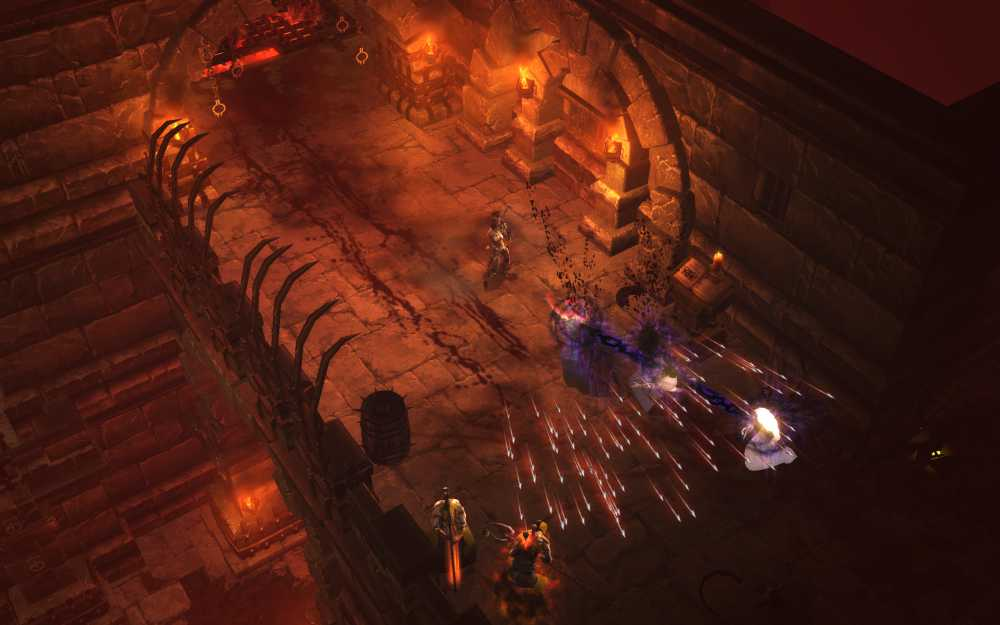
At Blizzcon this past weekend, we got a chance to speak with Julian Love, lead technical artist for Diablo 3. We discussed skill runes — items that modify the form and function of your character's spells and abilities — as well as the newly announced PvP Battle Arenas, the Demon Hunter class (and why it took so long to create), the future beta test and the importance of getting the game in front of players to collect feedback. Read on for our discussion about Diablo 3.Slashdot: Could you explain your role on the Diablo 3 team?
Julian Love: A lot of people don’t know what a lead technical artist does, or even a technical artist. So, the easiest way to understand it is: all the things that your player does in the game, all the skills that they have, have visuals attached to them, usually done with special effects. That’s really the focus of what my team does that you can see in-game. We are very tightly coupled with the design team to help them visualize and even come up with a lot of the player skills – what they are and what they do.
Slashdot: One thing I noticed while playing the demo was that the skill runes modify the art on the abilities quite a bit. That seems like a lot of work.
Julian Love: You bet. It is a lot of work, and it wasn’t our original intention to do that, because we were thinking, “That’s a lot of skills.. .and that’s a lot of runes..how is that even going to be possible?” So, initially we thought, “Well, we’ll just do some things that aren’t so visual.” But, what we found was that they felt kind of broken. We noticed that the players would pick up the game and the places where we had done those kinds of graphical changes, they would play those skills over every other one that didn’t do it. It was clear that if we’re going to have this system, we’re going to have to commit to making graphical changes on everything, so you don’t have this case where people are shying away from a skill simply because it felt unsatisfying.
Slashdot: How much extra work is that for you in the art department?
Julian Love: I can tell you it’s at least five times as much extra work. Sometimes it’s more, sometimes it’s less. What we’re really shooting for is enough graphical change that the skill doesn’t feel broken and that it contributes strongly to the feel of customizing your character. That’s the other key that we hit on. This is a way for us to bring another level of customization to characters that I don’t think people necessarily think about. The tendency is to think about things like “How come I can’t change his skin color,” or “how come I can’t give him tattoos?” And in our game, your character is this big (holds fingers a few inches apart). It’s not very large on screen. So, those kinds of things don’t have a lot of utility or value. Your character is covered in armor, what good is a tattoo?
But your skills are big and powerful and cover a lot of the screen, so being able to customize those is something that will really have a lot of impact for player customization. So, for that we looked up and just said we’re going to have to commit. We’re going to have to find ways to do it. Sometimes it’ll be a little easier, and sometimes, in the case of things like Hydra, where we’re literally making different hydras, or in the case of, say, Plague of Toads, where we’re making totally different kinds of toads, those are going to be a little harder. But, it’s going to be worth it as long as it’s fun.
Slashdot: Yeah. I was playing a Witch Doctor, and I used the spell that summons a zombie for you, and I got a rune that turned it into a swarm of bears. We got a real kick out of that.
Julian Love: Yeah! Zombie Bears! It’s kind of funny, that’s one of the skills that came up – the way we work is that we sit down and throw a lot of crazy ideas out, and sometimes it’s a little scary, throwing an idea that you think “I’m not sure how the group will react. This is kind of wacky.” And I remember sitting in the group and they were saying, “What are we going to do? We need something else.” And I said, “I’m not even sure why this works, but I’m just going to say it: Zombie Bears!” And everybody went, “Yes!” And that was it. Look at the way to it feels to play that skill in the game – it just sounds fun, right?
Slashdot: Definitely. Now that you can modify these skills so heavily, it seems like you can go through the game as, say, a Wizard, and play it one way, and then play it through again as a Wizard and have a completely different experience.
Julian Love: Absolutely. The character customization is one part of it, but another really important part is replayability. The fact that you can go back and re-explore your class, explore other classes. As limited as Diablo 2 was compared to Diablo 3, you still have people playing it ten years later. You have a hundred thousand people online sometimes, playing Diablo 2. So, replayability is a big, important factor, and skill runes definitely contribute to that by providing so many more build possibilities for people to keep exploring.
Slashdot: Regarding the new PvP system, are there going to more game types than just small teams facing off?
Julian Love: We don’t have any plans right now that we’re announcing for different types of games. It’s an idea we’re a fan of. We think that there are some things we might be able to do with it, but right now we’re primarily focused on bringing Battle Arenas to the game.
Slashdot: How has that affected the way you’re implementing PvP in the rest of the game.
Julian Love: The only place we’re actually implementing PvP is in the Battle Arena structure. That’s a key point. By bringing PvP out of the PvE game and giving it its own space, we’re providing a more structured and fun PvP experience. We can do things there that were much harder to deliver, like team play. It was really hard to do meaningful team play in Diablo 2. Not that some players didn’t find a way to impart that structure. It’s just a lot easier when it’s already there. Especially when you start to bring in Battle.net and being able to do much fairer matches. Really, if you think about the Diablo 2 experience, it’s much more about ganking people who are unsuspecting. People didn’t fight each other unless they thought they could win. It really wasn’t what I would call fun for everyone.
But by bringing it out and giving it its own space, you have a better chance of injecting that fun into the PvP experience. Now, at the same time, we’re really improving what most people consider the PvE experience, especially for those people who weren’t interested in being ganked unfairly. Nobody liked to take a waypoint into a zone and show up dead, and have no idea what happened, only to find out that somebody killed them before they loaded. When you do enough of that, you start chasing people out of those games, and eventually out of Diablo 2 itself. That’s not something we want to provide.
Slashdot: When a new player logs into Diablo 3 and sees the PvP options, what is your goal for what they’re encouraged to try.
Julian Love: Our goal is first to communicate that it’s going to be a fun experience. We’ve done it as short, cycled rounds, and one of the reasons we’ve done that is so when you do die –because if you engage in PvP, you’re going to get killed, right? – but nobody likes to stand around dead for too long, watching all their buddies have fun. So, shortening the rounds gives you a chance to come back and get some revenge before the rounds are up. A part of the reasoning behind that is to make sure people are having fun; to get over the intimidation factor with PvP. “Oh, I don’t want to do it, I don’t want to die!” Well, you die in PvE, right? We want to communicate that this is easy, engaging, and can really be a lot of fun.
Slashdot: Is that where you’re going with skill-matching over Battle.net, to make sure beginners play against beginners?
Julian Love: We’ll have a system very similar to how StarCraft works in terms of trying to match people up fairly. Part of the reason is to avoid people saying, “I’m going to go get my level 80.” “Well, I’m going to go get my level 90.” That kind of thing happened in Diablo 2 where people would just one-up each other to the point where it was a fair fight, at which point everybody left because nobody wants to do that. It’s a lot more fun when everybody is playing together and they are much more on the same level.
Slashdot: It was mentioned at the panel that there would be things like achievements and vanity rewards for PvP. Is that something that will carry over to the PvE game as well?
Julian Love: There will be achievements and vanity rewards for sure in the PvE game. I don’t think we have any plans for how much or what those things are. It’s still a work in progress.
Slashdot: Is there going to be a beta test?
Julian Love: There will be a closed beta. We don’t have an announcement about when that will be. I don’t think we have any specific announcements yet about what you’re going to be able to do in the closed beta.
Slashdot: Is that something you’re more hesitant to put in front of players? Would you rather keep things under wraps?
Julian Love: No, no. Well, there are some things we have to keep under wraps. Story. Diablo 3 is going to be a lot about story. It’s going to have a much deeper story, a much more compelling story, a story you’re much more engaged in. Obviously, there are whole parts of the story we don’t want to reveal. So we’re going to want to be careful about exposing the story to everybody and spoiling the experience. But at the same time, putting the game in front of people and getting feedback is a core part how we go about making games. That’s why there’s a playable build here at Blizzcon. So that we can get it in front of people and find out what works. In fact I was just down on the show floor earlier today, watching people play the game, and I noticed a number of things that made me say, “You know what, we’re got to go back to the office and tweak that!” There’s a few things that aren’t quite right. And the things I’ve noticed today? You know, I’ve been watching this game played at the office for the last year, and the things I saw today aren’t things I’ve seen before. So, there's huge value in having people outside of the office play the game.
Slashdot: Can you give us an example of one of those situations?
Julian Love: I saw a case where somebody hadn’t quite figured out how to get their skills on the left and right mouse button. It was just one person, but I think there’s something to that – people running around without using their skills. I think we’re going to take a look at that. We never really stop iterating on the UI for the game, and I think there’s something more we can do to get it just perfect. So that we don’t have what I would maybe call “fail cases.” We want to make sure that everybody would get it.
Slashdot: So far we’ve seen some very constrained dungeons – a tomb, a fiery dungeon – are we going to see more of the wide-open spaces that were common in Diablo 3?
Julian Love: Absolutely. Last Blizzcon we primarily showed an outdoor, open-space area – the desert – and this year there was a desire to give players something a little bit different. At the same time, we wanted to deliver something that was in line with the development process for the game, and not something that was pulled out and built separately for the show. Even last year’s [build], that’s still content we’re using for the game, but there was more putting it together for the show. This year, we really just wanted to take some section of the game, exactly as it is, put it in front of everybody, and see how it works.
Slashdot: Characters. From a fan perspective, it seems like a very long time between the announcements of, say, the Wizard, the Monk, and the Demon Hunter. Can you explain the timeline of what goes into developing these classes?
Julian Love: We don’t have a fixed timeline. But here’s what happens: We always start out with some really basic goals for a class. How they’re supposed to feel, broad parameters, how they feel thematically, and how they should feel gameplay-wise. For instance, with the Demon Hunter, we wanted a ranged class. But we wrestled with it, early on, about what the thematics would be. And by that I mean the beginning of the Diablo 3 project. That’s how far back the Demon Hunter goes. But we decided at some point to just put it on ice, and that’s a thing we do often. Sometimes you can just work your piece of clay to the point where you don’t know what it’s supposed to be anymore. So the best thing you can do is not to cut it, but to put it on ice for a while. Let it sit, let it percolate. It gives us the space to come back later.
Then, suddenly, it might make a lot more sense. You get this moment of clarity for the class. This has happened to just about every class in some way, shape, or form. Early on with the Barbarian, we had the same kind of thing happen, where we were really trying to push the physicality to the point where we were ignoring ways we could make him more crazy. There was this moment, after getting some space from it, where we were said it was alright to start giving him some of this god-power, through the Ancients. We did the same thing with the Demon Hunter. “You know what would really make this ranged class work is if we underscore the thematic elements going on in the storyline with the incoming demon invasion.” It let us create this bounty hunter-type class with a really dark, gothic vibe, which really suits our world well. It gave us a new feel, a character we didn’t have at that point. It filled the need for a ranged class, giving them the pistol crossbows to shake things up. We thought, “You know what, that just all works.” So what was a struggle before suddenly becomes crystal clear. And that takes time!
-
Mazda Claims 70 mpg For New Engine, No Hybrid Needed
thecarchik writes "There's no word on when the new version of the Mazda2 will finally reach the US but when it does we can reveal that it will return a fuel economy of 70 mpg — without the aid of any electric motors. This is because the car will feature Mazda's next-generation of drivetrain, body and chassis technologies, dubbed SKYACTIV. The new Mazda 2 will come powered by a SKYACTIV-G engine, Mazda's next-generation direct injection gasoline mill that achieves significantly improved fuel efficiency thanks to a high compression ratio of 14.0:1 (the world's highest for a production gasoline engine)." I wonder if a real-life-real-drivers 70 mpg car is what will actually arrive, or if such promises will dissolve like Chevy's promises about the Volt did. -
Gosling Reacts To Apple's Java Deprecation
Kurofuneparry writes "Apple has announced that Java is deprecated as of the most recent update to OS X. This shot across the bow is getting some responses. To Jobs' claim that 'Sun (now Oracle) supplies Java for all other platforms,' James Gosling is quoted as saying that 'simply isn't true.' Much talk of a coming turf war is to be had. This certainly can't be unrelated to statements from Jobs recently covered on this website and is sure to make waves. Apple has enjoyed significant success recently accompanied by a widespread sense that they can do no wrong in business or design. However, is deprecating Java a mistake? It doesn't take much insight to connect the dots and see that Apple has starting marking friends and enemies relative to the increasingly heated fight for mobile and other platforms." -
Gosling Reacts To Apple's Java Deprecation
Kurofuneparry writes "Apple has announced that Java is deprecated as of the most recent update to OS X. This shot across the bow is getting some responses. To Jobs' claim that 'Sun (now Oracle) supplies Java for all other platforms,' James Gosling is quoted as saying that 'simply isn't true.' Much talk of a coming turf war is to be had. This certainly can't be unrelated to statements from Jobs recently covered on this website and is sure to make waves. Apple has enjoyed significant success recently accompanied by a widespread sense that they can do no wrong in business or design. However, is deprecating Java a mistake? It doesn't take much insight to connect the dots and see that Apple has starting marking friends and enemies relative to the increasingly heated fight for mobile and other platforms." -
Vint Cerf Keeps Blaming Himself For IPv4 Limit
netbuzz writes "Everyone knows that IPv4 addresses are nearly gone and the ongoing move to IPv6 is inevitable if not exactly welcomed by all. If you've ever wondered why the IT world finds itself in this situation, Vint Cerf, known far and wide as one of the fathers of the Internet, wants you to know that it's OK to blame him. He certainly does so himself. In fact, he does so time and time and time again." -
Physicists Say Graphene Could Create Mass
eldavojohn writes "Graphene has gotten a lot of press lately. The Nobel prize-winning, fastest-spinning, nanobubble-enhanced silicon replacement is theorized to have a new, more outlandish property. As reported by Technology Review's Physics Blog, graphene should be able to create mass inside properly formed nanotubes. According to Abdulaziz Alhaidari's calculations, if one were to roll up graphene into a nanotube, this could compactifiy dimensions (from the sheet's two down to the tube's one), and thus 'the massless equations that describe the behavior of electrons and holes will change to include a term for mass. In effect, compactifying dimensions creates mass.' What once would require a massive high-energy particle accelerator can now be tested with carbon, electricity, and wires, according to the recent paper." -
Physicists Say Graphene Could Create Mass
eldavojohn writes "Graphene has gotten a lot of press lately. The Nobel prize-winning, fastest-spinning, nanobubble-enhanced silicon replacement is theorized to have a new, more outlandish property. As reported by Technology Review's Physics Blog, graphene should be able to create mass inside properly formed nanotubes. According to Abdulaziz Alhaidari's calculations, if one were to roll up graphene into a nanotube, this could compactifiy dimensions (from the sheet's two down to the tube's one), and thus 'the massless equations that describe the behavior of electrons and holes will change to include a term for mass. In effect, compactifying dimensions creates mass.' What once would require a massive high-energy particle accelerator can now be tested with carbon, electricity, and wires, according to the recent paper." -
Physicists Say Graphene Could Create Mass
eldavojohn writes "Graphene has gotten a lot of press lately. The Nobel prize-winning, fastest-spinning, nanobubble-enhanced silicon replacement is theorized to have a new, more outlandish property. As reported by Technology Review's Physics Blog, graphene should be able to create mass inside properly formed nanotubes. According to Abdulaziz Alhaidari's calculations, if one were to roll up graphene into a nanotube, this could compactifiy dimensions (from the sheet's two down to the tube's one), and thus 'the massless equations that describe the behavior of electrons and holes will change to include a term for mass. In effect, compactifying dimensions creates mass.' What once would require a massive high-energy particle accelerator can now be tested with carbon, electricity, and wires, according to the recent paper." -
Physicists Say Graphene Could Create Mass
eldavojohn writes "Graphene has gotten a lot of press lately. The Nobel prize-winning, fastest-spinning, nanobubble-enhanced silicon replacement is theorized to have a new, more outlandish property. As reported by Technology Review's Physics Blog, graphene should be able to create mass inside properly formed nanotubes. According to Abdulaziz Alhaidari's calculations, if one were to roll up graphene into a nanotube, this could compactifiy dimensions (from the sheet's two down to the tube's one), and thus 'the massless equations that describe the behavior of electrons and holes will change to include a term for mass. In effect, compactifying dimensions creates mass.' What once would require a massive high-energy particle accelerator can now be tested with carbon, electricity, and wires, according to the recent paper." -
SD Adapter For Dreamcast Released
YokimaSun writes "The Dreamcast was the last console by Sega that had innovations that today's consoles have taken on board, i.e. broadband online gaming and innovative gaming controllers (such as the fishing controller). The console still lives on today, thanks to the support of the homebrew community that still churns out games and emulators and also the odd commercial release for the console by independent developers. Today the spark has been ignited by the fascinating release of an SD adapter for the Dreamcast that allows homebrew games to be played without the need to burn to disc. It's time to dust off those Dreamcast consoles and get back into free gaming. The same company have also released a Dreamcast modified with VGA support and a front-loading SD slot and its own BIOS. Awesome to relive some of those Dreamcast classics." -
SD Adapter For Dreamcast Released
YokimaSun writes "The Dreamcast was the last console by Sega that had innovations that today's consoles have taken on board, i.e. broadband online gaming and innovative gaming controllers (such as the fishing controller). The console still lives on today, thanks to the support of the homebrew community that still churns out games and emulators and also the odd commercial release for the console by independent developers. Today the spark has been ignited by the fascinating release of an SD adapter for the Dreamcast that allows homebrew games to be played without the need to burn to disc. It's time to dust off those Dreamcast consoles and get back into free gaming. The same company have also released a Dreamcast modified with VGA support and a front-loading SD slot and its own BIOS. Awesome to relive some of those Dreamcast classics." -
SD Adapter For Dreamcast Released
YokimaSun writes "The Dreamcast was the last console by Sega that had innovations that today's consoles have taken on board, i.e. broadband online gaming and innovative gaming controllers (such as the fishing controller). The console still lives on today, thanks to the support of the homebrew community that still churns out games and emulators and also the odd commercial release for the console by independent developers. Today the spark has been ignited by the fascinating release of an SD adapter for the Dreamcast that allows homebrew games to be played without the need to burn to disc. It's time to dust off those Dreamcast consoles and get back into free gaming. The same company have also released a Dreamcast modified with VGA support and a front-loading SD slot and its own BIOS. Awesome to relive some of those Dreamcast classics." -
Linux 2.6.36 Released
diegocg writes "Version 2.6.36 of the Linux kernel has been released. This version includes support for the Tilera architecture, a new filesystem notification interface called fanotify, CIFS local caching, support for Intel Intelligent Power Sharing in i3/5 systems, integration of the kernel debugger and KMS, inclusion of the AppArmor security system, a redesign of workqueues optimized for concurrency, and several new drivers and small improvements. See the full changelog here for more details." -
AP Proposes ASCAP-Like Fees For the News
eldavojohn writes "Techdirt directed my attention to an article where the AP discussed pressure from new devices and mediums today giving them cause to create a clearinghouse for news — much like the music industry's ASCAP — to 'establish an enforcement and payment system.' You'll notice that the story I am linking to and quoting is an AP story ... would Slashdot then be required to pay these fees? We have seen DMCA take down notices and fee discussions before from the AP." -
AP Proposes ASCAP-Like Fees For the News
eldavojohn writes "Techdirt directed my attention to an article where the AP discussed pressure from new devices and mediums today giving them cause to create a clearinghouse for news — much like the music industry's ASCAP — to 'establish an enforcement and payment system.' You'll notice that the story I am linking to and quoting is an AP story ... would Slashdot then be required to pay these fees? We have seen DMCA take down notices and fee discussions before from the AP." -
Fermilab To Test Holographic Universe Theory
eldavojohn writes "Scientists at Fermilab have decided that it's high time they build a 'holometer' to test the smoothness of space-time. Theoretical physicists like Stephen Hawking have proposed that space-time is not smooth but it's been a lot of math and no actual data. The Fermilab team plans to build two relatively small devices that act as 'holographic interferometers' to measure the shaking or vibration in split beams of light traveling through a vacuum. If the team finds the shaking in their measurements and records them, the theory of a holographic universe will have some evidence of non-smoothness in space-time and perhaps a foothold in bringing light to the heavily debated theoretical physics." -
Drupal 7
Trevor James writes "Drupal 7 is currently at beta 1 stage with 11 critical issues remaining to be fixed before an official release version. The question arises whether we should all be writing about Drupal 7 now and so soon, when it's still in its beta phase. I argue we should be writing about it. It can only help introduce new users to the Drupal application and the Drupal community and get new people involved to help test Drupal 7. This will ultimately help improve the software for its official release and on. This helps to build the Drupal community of users and developers. It helps spread the word to everyone about this flexible and robust content management system. We want Drupal to be used. So this is one way of getting it out there and in the public sphere." Read on for the rest of Trevor's review. Drupal 7 author David Mercer pages 416 publisher Packt Publishing rating 9/10 reviewer Trevor James ISBN 1849512868 summary A pragmatic look at the steps necessary to get a website up and running using Drupal 7 Some nuances: most developers and Drupal users adhere to the rule that if you plan to run Drupal 7 as a production site and on a production server right now you need to be aware that there may still be bugs in core Drupal 7 that will cause issues on your site. But this doesn't mean you can't use Drupal 7. You can certainly download the beta 1 release and install it on your development or localhost server and use it. And you can improve it by using it now.
Which brings me to David Mercer's new book Drupal 7. This is the second edition of Mercer's popular Drupal 6 book, and here Mercer has had an early opportunity to update his text for Drupal 7. It's a good and important book to help promote Drupal 7 and spread the word about the Drupal project and the Drupal community to both experienced and new users. Mercer knows Drupal - remember that he's already proven himself with the Drupal (back to version 4.x and 5.x) and Drupal 6 titles previously published by Packt. The original edition of Drupal was published in 2006 so Mercer has been devoted to this subject for over 4 years.
The Drupal 7 title is good for Drupal beginners and novices who are just starting out with Drupal but it also has a wealth of information and resources for more intermediate and advanced Drupal users and developers. It gives you the full run down of Drupal core as well as details of many advanced Drupal topics including an entire chapter on the Views module. The book starts with a solid introduction to the Drupal 7 framework and community and shows detailed install instructions using the XAMPP installer. Mercer highlights the new installation profile functionality that ships with Drupal 7 (both a standard and minimal install profile) and even gives you tips on troubleshooting your install if something goes awry.
Chapter 2 outlines the details of Drupal architecture and structure including installing modules, enabling blocks and setting up menus. The highlight in this chapter are two new features in Drupal 7 that allow you to install contributed modules directly from their FTP URL/path on drupal.org; or by uploading the tar.gz archive directly via the Drupal administration interface. For anyone maintaining Drupal sites this will should be a well received enhancement.
Chapter 3 covers Drupal 7 site configuration and reporting mechanisms including setting up actions and triggers; creating shortcuts; managing the file system; configuring site performance; setting up site RSS feeds; and viewing site reports. One highlight in this chapter is the new shortcut functionality that allows you as a Drupal site admin to create sets of shortcut links for your fellow content editors and site admins. Another new feature in Drupal 7 is the ability to upload your attached files (images, PDF, doc, etc) to private folders on your site. In Drupal 6 you could restrict access to all uploaded files but not to specific files by content type (without having to install contributed modules to extend this functionality). In Drupal 7 you now have the ability to restrict access at the file field level per content type. So specific files attached via a content type can be uploaded to a private folder.
Chapter 4 explores Drupal 7 access control with a detailed walk-through of Drupal roles, permissions and user access. Mercer also includes a tutorial on using the OpenID Web service to provide single sign-on login functionality for your Drupal site.
Chapter 5 looks at setting up content workflows on your Drupal 7 site and describes all the Drupal core content types (Article, Basic page, Blog entry, Book page, Forum topic and Poll). Mercer covers content related modules including Aggregator and Book so anyone interested in setting up Web service based aggregated feeds; and multi-layer paginated content will get a lot out of this chapter. Chapter 6 deals with advanced content outlining the process of creating your own custom content types and adding custom fields; and integrating taxonomy with your content types.
Chapter 7 looks at integrating multimedia with your Drupal 7 site including images, and other types of embedded media. Drupal 7 now ships with the Image field in core so all you have to do is add an Image field to your content type. The image field now supports rotation and desaturate effects so besides scaling an image you can now rotate your images by a specific number of degrees.
Mercer includes an entire chapter on integrating the Views module with Drupal 7. The Views section even goes into detail on setting up advanced Views using arguments and relationships and shows you how to theme your Views. This is a real bonus for an introductory level book on Drupal. Anyone using the Views module even with Drupal 6 will benefit from reading this chapter.
Chapter 9 deals with Drupal theming both from the theme layer and the CSS perspectives. There is a lot of detailed information on theming using the Zen starter theme so anyone using Zen will learn some best practice theming solutions from this chapter. Chapter 10 introduces methods of integrating and using the Panels module with Drupal 7 as well as discussions of advanced theming techniques.
In general the title covers the Drupal 7 interface in much detail and points out the many new features of Drupal 7's administrative interface including the overlay admin screens; the simplified and re-named core content types including Article and Basic Page; the built-in CCK module (now part of core Drupal); the enhanced ability to install modules directly via the admin interface; and a look at the new core Drupal themes. Mercer covers best practices for deploying Drupal sites from staging locations to a production server; backup processes, and even a discussion of SEO best practice. The book even comes with quiz questions and exercises provided via the author's Web site. So you can use this title as a model for teaching Drupal 7 (and I would argue even Drupal 6) to new users. Short story - the book is loaded with good information and practical hands-on exercises.
Here's the main reason I'll recommend purchasing this book or at least knowing about it. Those 11 critical issues in Drupal 7 need to be tested, reproduced and fixed before we can use D7 on a production site and feel comfortable about with it's stability and security. We as users and developers need to help with this testing process. We can help to fix those issues by testing and reporting our findings back. This book will help us to do that by showing us how to install D7 and get rolling with it. For that I'm thankful it's been released now as opposed to 3 months from now. This is a good manual for us to use to test and bugfix this next great version of Drupal.
You know it's also just a great book and manual on using Drupal period — even the 6.x version of Drupal. You'll learn a ton about the Drupal framework from this title regardless of the version you're currently using to power your Web site.
Finally, the benefits of releasing this title now is that it will encourage both the Drupal community project and other Drupal authors to write more detailed documentation and instruction on how to use and develop with Drupal 7. We can raise Drupal 7 to a higher level by supporting its release with excellent documentation, tutorials and books.
Let's get Drupaling and help the community now by downloading Drupal 7.
Trevor James is a Drupal developer based in Maryland, USA.
You can purchase Drupal 7 from amazon.com. Slashdot welcomes readers' book reviews -- to see your own review here, read the book review guidelines, then visit the submission page. -
Drupal 7
Trevor James writes "Drupal 7 is currently at beta 1 stage with 11 critical issues remaining to be fixed before an official release version. The question arises whether we should all be writing about Drupal 7 now and so soon, when it's still in its beta phase. I argue we should be writing about it. It can only help introduce new users to the Drupal application and the Drupal community and get new people involved to help test Drupal 7. This will ultimately help improve the software for its official release and on. This helps to build the Drupal community of users and developers. It helps spread the word to everyone about this flexible and robust content management system. We want Drupal to be used. So this is one way of getting it out there and in the public sphere." Read on for the rest of Trevor's review. Drupal 7 author David Mercer pages 416 publisher Packt Publishing rating 9/10 reviewer Trevor James ISBN 1849512868 summary A pragmatic look at the steps necessary to get a website up and running using Drupal 7 Some nuances: most developers and Drupal users adhere to the rule that if you plan to run Drupal 7 as a production site and on a production server right now you need to be aware that there may still be bugs in core Drupal 7 that will cause issues on your site. But this doesn't mean you can't use Drupal 7. You can certainly download the beta 1 release and install it on your development or localhost server and use it. And you can improve it by using it now.
Which brings me to David Mercer's new book Drupal 7. This is the second edition of Mercer's popular Drupal 6 book, and here Mercer has had an early opportunity to update his text for Drupal 7. It's a good and important book to help promote Drupal 7 and spread the word about the Drupal project and the Drupal community to both experienced and new users. Mercer knows Drupal - remember that he's already proven himself with the Drupal (back to version 4.x and 5.x) and Drupal 6 titles previously published by Packt. The original edition of Drupal was published in 2006 so Mercer has been devoted to this subject for over 4 years.
The Drupal 7 title is good for Drupal beginners and novices who are just starting out with Drupal but it also has a wealth of information and resources for more intermediate and advanced Drupal users and developers. It gives you the full run down of Drupal core as well as details of many advanced Drupal topics including an entire chapter on the Views module. The book starts with a solid introduction to the Drupal 7 framework and community and shows detailed install instructions using the XAMPP installer. Mercer highlights the new installation profile functionality that ships with Drupal 7 (both a standard and minimal install profile) and even gives you tips on troubleshooting your install if something goes awry.
Chapter 2 outlines the details of Drupal architecture and structure including installing modules, enabling blocks and setting up menus. The highlight in this chapter are two new features in Drupal 7 that allow you to install contributed modules directly from their FTP URL/path on drupal.org; or by uploading the tar.gz archive directly via the Drupal administration interface. For anyone maintaining Drupal sites this will should be a well received enhancement.
Chapter 3 covers Drupal 7 site configuration and reporting mechanisms including setting up actions and triggers; creating shortcuts; managing the file system; configuring site performance; setting up site RSS feeds; and viewing site reports. One highlight in this chapter is the new shortcut functionality that allows you as a Drupal site admin to create sets of shortcut links for your fellow content editors and site admins. Another new feature in Drupal 7 is the ability to upload your attached files (images, PDF, doc, etc) to private folders on your site. In Drupal 6 you could restrict access to all uploaded files but not to specific files by content type (without having to install contributed modules to extend this functionality). In Drupal 7 you now have the ability to restrict access at the file field level per content type. So specific files attached via a content type can be uploaded to a private folder.
Chapter 4 explores Drupal 7 access control with a detailed walk-through of Drupal roles, permissions and user access. Mercer also includes a tutorial on using the OpenID Web service to provide single sign-on login functionality for your Drupal site.
Chapter 5 looks at setting up content workflows on your Drupal 7 site and describes all the Drupal core content types (Article, Basic page, Blog entry, Book page, Forum topic and Poll). Mercer covers content related modules including Aggregator and Book so anyone interested in setting up Web service based aggregated feeds; and multi-layer paginated content will get a lot out of this chapter. Chapter 6 deals with advanced content outlining the process of creating your own custom content types and adding custom fields; and integrating taxonomy with your content types.
Chapter 7 looks at integrating multimedia with your Drupal 7 site including images, and other types of embedded media. Drupal 7 now ships with the Image field in core so all you have to do is add an Image field to your content type. The image field now supports rotation and desaturate effects so besides scaling an image you can now rotate your images by a specific number of degrees.
Mercer includes an entire chapter on integrating the Views module with Drupal 7. The Views section even goes into detail on setting up advanced Views using arguments and relationships and shows you how to theme your Views. This is a real bonus for an introductory level book on Drupal. Anyone using the Views module even with Drupal 6 will benefit from reading this chapter.
Chapter 9 deals with Drupal theming both from the theme layer and the CSS perspectives. There is a lot of detailed information on theming using the Zen starter theme so anyone using Zen will learn some best practice theming solutions from this chapter. Chapter 10 introduces methods of integrating and using the Panels module with Drupal 7 as well as discussions of advanced theming techniques.
In general the title covers the Drupal 7 interface in much detail and points out the many new features of Drupal 7's administrative interface including the overlay admin screens; the simplified and re-named core content types including Article and Basic Page; the built-in CCK module (now part of core Drupal); the enhanced ability to install modules directly via the admin interface; and a look at the new core Drupal themes. Mercer covers best practices for deploying Drupal sites from staging locations to a production server; backup processes, and even a discussion of SEO best practice. The book even comes with quiz questions and exercises provided via the author's Web site. So you can use this title as a model for teaching Drupal 7 (and I would argue even Drupal 6) to new users. Short story - the book is loaded with good information and practical hands-on exercises.
Here's the main reason I'll recommend purchasing this book or at least knowing about it. Those 11 critical issues in Drupal 7 need to be tested, reproduced and fixed before we can use D7 on a production site and feel comfortable about with it's stability and security. We as users and developers need to help with this testing process. We can help to fix those issues by testing and reporting our findings back. This book will help us to do that by showing us how to install D7 and get rolling with it. For that I'm thankful it's been released now as opposed to 3 months from now. This is a good manual for us to use to test and bugfix this next great version of Drupal.
You know it's also just a great book and manual on using Drupal period — even the 6.x version of Drupal. You'll learn a ton about the Drupal framework from this title regardless of the version you're currently using to power your Web site.
Finally, the benefits of releasing this title now is that it will encourage both the Drupal community project and other Drupal authors to write more detailed documentation and instruction on how to use and develop with Drupal 7. We can raise Drupal 7 to a higher level by supporting its release with excellent documentation, tutorials and books.
Let's get Drupaling and help the community now by downloading Drupal 7.
Trevor James is a Drupal developer based in Maryland, USA.
You can purchase Drupal 7 from amazon.com. Slashdot welcomes readers' book reviews -- to see your own review here, read the book review guidelines, then visit the submission page. -
A 3D Lego Fabricator Made of Lego
eldavojohn writes "Making a Lego printer is pretty cool if you've never seen The LegoMakerBot. The creator has instructions on his site on how to make (out of Lego bricks) a machine that 'prints' Lego models — much like a 3D fabrication machine — after you model them in MLCad. The sped up video is nothing short of impressive." -
Sony Gets Nasty With PSBreak Buyers
YokimaSun writes "The war between hackers and Sony over the PlayStation 3 has now taken an even more sinister turn, with Sony going after not just shops but actual buyers of the PSBreak dongle, threatening them with fines of many thousands of Euros and forcing them to sign cease-and-desist letters. It seems Sony will use any means necessary to thwart both homebrew and piracy on the PS3." -
UK-Developed 'DNA Spray' Marks Dutch Thieves With Trackable Water
eldavojohn writes "In Rotterdam, there's a new technology in place that dispenses a barely visible mist over those around it and alerts the police. The purpose? To tag robbers and link them back to the scene of the crime. From the article, 'The mist — visible only under ultraviolet light — carries DNA markers particular to the location, enabling the police to match the burglar with the place burgled. Now, a sign on the front door of the McDonald's prominently warns potential thieves of the spray's presence: "You Steal, You're Marked."' Developed in Britain, it's yet to nab a criminal but it will be interesting to see whether or not synthesized DNA will hold up as sufficient evidence in an actual court of law." So it's not just for copper thieves. -
Blizzard Suing Creators of StarCraft II Hacks
An anonymous reader writes with this excerpt from Rock, Paper, Shotgun: "Blizzard have taken the extremely peculiar decision to ban players from playing StarCraft II for using cheats in the single-player game. This meant that, despite cheating no one but themselves, they were locked out of playing the single-player game. Which is clearly bonkers. But it's not enough for the developer. Blizzard's lawyers are now setting out to sue those who create cheats. Gamespot reports that the megolithic company is chasing after three developers of hacks for 'destroying' their online game. It definitely will be in violation of the end user agreement, so there's a case. However, it's a certain element of their claim that stands out for attention. They're claiming using the hacks causes people to infringe copyright: 'When users of the Hacks download, install, and use the Hacks, they copy StarCraft II copyrighted content into their computer's RAM in excess of the scope of their limited license, as set forth in the EULA and ToU, and create derivative works of StarCraft II.'" Blizzard used similar reasoning in their successful lawsuit against the creators of a World of Warcraft bot.