Slashdot Mirror
Domain: slashdot.org
Stories and comments across the archive that link to slashdot.org.
Stories · 37,380
-
AT&T Loses First Legal Battle Against Verizon
FutureDomain writes "A federal judge in Atlanta has declined a restraining order from AT&T that would have prevented Verizon from running ads that compared their 3G coverage to AT&T's. AT&T felt that Verizon's ads 'mislead consumers into thinking that AT&T doesn't offer wireless service in large portions of the country, which is clearly not the case.' Verizon argued that the ads clearly indicated that the maps were only of 3G coverage, and that AT&T is only suing because it doesn't want to face the truth about its network." -
Fedora 12 Lets Users Install Signed Packages, Sans Root Privileges
eqisow writes "The new default policy for Fedora 12 allows local, unprivileged users to install signed packages without root access. This change apparently went mostly unnoticed until after the Fedora 12 GA release, at which point it sparked a mailing list thread that is, as of this writing, over 100 posts long." -
Drupal 6 Social Networking
dag writes "Drupal 6 Social Networking is an interesting book about how to build social networks and why Drupal is a good choice as a platform for building communities. Even if you don't have any Drupal experience yet, this book explains what is needed when you start from scratch and looks at the different facets of a social network." Keep reading for the rest of Dag's review. Drupal 6 Social Networking author Michael Peacock pages 312 publisher Packt Publishing rating 8/10 reviewer Dag Wieers ISBN 978-1-847196-10-1 summary Building community websites using Drupal as a content management framework The book starts off with a short introduction about social networks and a list of compelling reasons why one wants to set up her own social network rather than using an existing social network like Facebook or MySpace. It all comes down to what your particular goals are. The first chapter looks into why Drupal is a good fit for building a community website. Its modular design, use of known technologies and ease of installation, as well as the ample availability of modules help in that respect, and also clearly marks where the book is going next. The other half of the first chapter explains in great detail what is needed during the installation of Drupal to have a working setup. If you are already experienced with setting up Drupal you can skim through this chapter to verify that you did not miss anything with earlier installations.
The second chapter prepares the reader for using Drupal specifically targeted for building a community website. To do this the author comes up with his own example (Dino Space) which is used throughout the book. And while the subject may be far-fetched and very different from what you plan to do, it serves its purpose well. Throughout this chapter the author explains many Drupal related concepts and terminology like Nodes, Content Types or Blocks and how to use these to your advantage when designing your site.
So while the first and second chapters explains and prepares the reader, chapter three helps with important decisions regarding user contributed content and all aspects related to it. User Roles, Comments, Polls, Forums and Blogs. One thing that surprised me was how it is possible to write blog entries from Microsoft Word using a standardized API. And while it is not applicable to me (as a Linux user) I can see some benefit for others within the targeted community. Another topic from the book that I had little experience with is collaborating on a Book within your community. I was always amazed by the annotated PHP manual in the past and this possibility reflects that effort a great deal. The chapter also includes attention to how to automatically generate feeds or include feeds from others, something that helps growing the community.
The next chapter goes into how users can maintain their profiles, how profiles can be extended and themed and how profiles can be shared between websites. It also looks into specific modules to help you eg. integrate OpenID or avatars from other websites. Chapter five explains how users can interact and how the User Relationships and User Activity modules allow users to promote their own content and actions on their site. Much like how Facebook becomes a time log of individual actions of our friends. It also looks at Guestbooks, Contact forms and Groups covering more than I was looking for myself.
One thing I recently had to look into myself was how to communicate with your users. Some users register and then loose touch so there is a clear need to regularly update them about what is happening and what new content is available and that's where chapter six explains how to set up Newsletters or connect your social network to online services like Google Groups.
Drupal is mostly respected for its modular design and Drupal's author often states "If it cannot be done from a module, then that's a design bug which needs to be fixed". That said, almost everything is possible from a module, which offers great flexibility to anyone deploying Drupal to customize it to its own needs. Chapter seven explains in some detail how to write your own Drupal modules from accessing the database, interacting with other services as well as making it installable and customizable. The example shows how to interact with Google Maps from a Drupal module. But also points to similar modules for connecting to Facebook.
Another important aspect of any website is its design, chapter eight shows how to install and configure additional themes, but also explains how to modify existing templates and tweak CSS files. It does not go into great detail though, but it sufficiently points out where to look and how to experiment.
The last two chapters are a bit dim, chapter nine explains how to secure your Drupal site from automated spam and lists a few maintenance tasks every admin should know about. Much like chapter nine, chapter ten does not go into a lot of detail about how to promote your website. It mostly lists important aspects and in some cases provides links to experienced websites.
All in all I was surprised by the many items this book covers, especially the chapters about writing modules and modifying themes is something most buyers will not expect in a Drupal book regarding Social Networking. And while I believe there are better books about those topics, in general this book is a good introduction to Drupal and a guide for those who are also interested in the more advanced parts of Drupal.
I was particularly interested in this book as I set up my own family website based on Drupal and I wanted to know what technologies I missed, and what additional modules I could use to make our own family website better. In that regard this book confirmed for a large part that what I did with Drupal was how it was supposed to be, but I did learn some new tricks and new modules I never investigated before. This knowledge undoubtedly will be useful for some future Drupal-based projects as well.
You can purchase Drupal 6 Social Networking from amazon.com. Slashdot welcomes readers' book reviews -- to see your own review here, read the book review guidelines, then visit the submission page. -
Drupal 6 Social Networking
dag writes "Drupal 6 Social Networking is an interesting book about how to build social networks and why Drupal is a good choice as a platform for building communities. Even if you don't have any Drupal experience yet, this book explains what is needed when you start from scratch and looks at the different facets of a social network." Keep reading for the rest of Dag's review. Drupal 6 Social Networking author Michael Peacock pages 312 publisher Packt Publishing rating 8/10 reviewer Dag Wieers ISBN 978-1-847196-10-1 summary Building community websites using Drupal as a content management framework The book starts off with a short introduction about social networks and a list of compelling reasons why one wants to set up her own social network rather than using an existing social network like Facebook or MySpace. It all comes down to what your particular goals are. The first chapter looks into why Drupal is a good fit for building a community website. Its modular design, use of known technologies and ease of installation, as well as the ample availability of modules help in that respect, and also clearly marks where the book is going next. The other half of the first chapter explains in great detail what is needed during the installation of Drupal to have a working setup. If you are already experienced with setting up Drupal you can skim through this chapter to verify that you did not miss anything with earlier installations.
The second chapter prepares the reader for using Drupal specifically targeted for building a community website. To do this the author comes up with his own example (Dino Space) which is used throughout the book. And while the subject may be far-fetched and very different from what you plan to do, it serves its purpose well. Throughout this chapter the author explains many Drupal related concepts and terminology like Nodes, Content Types or Blocks and how to use these to your advantage when designing your site.
So while the first and second chapters explains and prepares the reader, chapter three helps with important decisions regarding user contributed content and all aspects related to it. User Roles, Comments, Polls, Forums and Blogs. One thing that surprised me was how it is possible to write blog entries from Microsoft Word using a standardized API. And while it is not applicable to me (as a Linux user) I can see some benefit for others within the targeted community. Another topic from the book that I had little experience with is collaborating on a Book within your community. I was always amazed by the annotated PHP manual in the past and this possibility reflects that effort a great deal. The chapter also includes attention to how to automatically generate feeds or include feeds from others, something that helps growing the community.
The next chapter goes into how users can maintain their profiles, how profiles can be extended and themed and how profiles can be shared between websites. It also looks into specific modules to help you eg. integrate OpenID or avatars from other websites. Chapter five explains how users can interact and how the User Relationships and User Activity modules allow users to promote their own content and actions on their site. Much like how Facebook becomes a time log of individual actions of our friends. It also looks at Guestbooks, Contact forms and Groups covering more than I was looking for myself.
One thing I recently had to look into myself was how to communicate with your users. Some users register and then loose touch so there is a clear need to regularly update them about what is happening and what new content is available and that's where chapter six explains how to set up Newsletters or connect your social network to online services like Google Groups.
Drupal is mostly respected for its modular design and Drupal's author often states "If it cannot be done from a module, then that's a design bug which needs to be fixed". That said, almost everything is possible from a module, which offers great flexibility to anyone deploying Drupal to customize it to its own needs. Chapter seven explains in some detail how to write your own Drupal modules from accessing the database, interacting with other services as well as making it installable and customizable. The example shows how to interact with Google Maps from a Drupal module. But also points to similar modules for connecting to Facebook.
Another important aspect of any website is its design, chapter eight shows how to install and configure additional themes, but also explains how to modify existing templates and tweak CSS files. It does not go into great detail though, but it sufficiently points out where to look and how to experiment.
The last two chapters are a bit dim, chapter nine explains how to secure your Drupal site from automated spam and lists a few maintenance tasks every admin should know about. Much like chapter nine, chapter ten does not go into a lot of detail about how to promote your website. It mostly lists important aspects and in some cases provides links to experienced websites.
All in all I was surprised by the many items this book covers, especially the chapters about writing modules and modifying themes is something most buyers will not expect in a Drupal book regarding Social Networking. And while I believe there are better books about those topics, in general this book is a good introduction to Drupal and a guide for those who are also interested in the more advanced parts of Drupal.
I was particularly interested in this book as I set up my own family website based on Drupal and I wanted to know what technologies I missed, and what additional modules I could use to make our own family website better. In that regard this book confirmed for a large part that what I did with Drupal was how it was supposed to be, but I did learn some new tricks and new modules I never investigated before. This knowledge undoubtedly will be useful for some future Drupal-based projects as well.
You can purchase Drupal 6 Social Networking from amazon.com. Slashdot welcomes readers' book reviews -- to see your own review here, read the book review guidelines, then visit the submission page. -
Ask Sam Ramji About the CodePlex Foundation
This week the Codeplex Foundation announced its first project, the ASP.NET Ajax Library Project, as part of its first sponsored gallery, the ASP.NET Gallery. The CodePlex Foundation is now two months old, and Foundation President Sam Ramji has agreed to answer questions about the Foundation, its first project, and overall progress to date. Usual Slashdot interview rules apply. -
Ask Sam Ramji About the CodePlex Foundation
This week the Codeplex Foundation announced its first project, the ASP.NET Ajax Library Project, as part of its first sponsored gallery, the ASP.NET Gallery. The CodePlex Foundation is now two months old, and Foundation President Sam Ramji has agreed to answer questions about the Foundation, its first project, and overall progress to date. Usual Slashdot interview rules apply. -
Accountability of the Scientific Stimulus Funding
eldavojohn writes "A blog tipped me off to a government site that allows me to see where my tax dollars went when the nebulous 'scientific stimulus' was granted. You might be able to find this information in a bill, but you can click on your state in this interactive site to see what has happened locally to you. Perhaps it's a sign of more government transparency in regards to spending or just more propaganda." -
Spain Codifies the "Right To Broadband"
Reader adeelarshad82 writes to lets us know that Spain has now codified a "Right to Broadband," thus following the lead of Finland. Spain's industry minister announced that citizens will have a legal right from 2011 to be able to buy broadband Internet access of at least 1 Mb/sec at a regulated price wherever they live. The telecoms operator holding the so-called "universal service" contract would have to guarantee it could offer "reasonably" priced broadband throughout Spain. -
AU Senator Calls Scientology a "Criminal Organization"
An anonymous reader passes along news that an Australian senator, Nick Xenophon, has denounced the Church of Scientology as "a criminal organization" from the floor of Parliament. "Senator Xenophon used a speech in Parliament last night to raise allegations of widespread criminal conduct within the church, saying he had received letters from former followers detailing claims of abuse, false imprisonment, and forced abortion. He says he has passed on the letters to the police and is calling for a Senate inquiry into the religion and its tax-exempt status." It wasn't that long ago that the CoS was calling for Net censorship in Australia; a month later the organization was convicted of fraud in France. -
AU Senator Calls Scientology a "Criminal Organization"
An anonymous reader passes along news that an Australian senator, Nick Xenophon, has denounced the Church of Scientology as "a criminal organization" from the floor of Parliament. "Senator Xenophon used a speech in Parliament last night to raise allegations of widespread criminal conduct within the church, saying he had received letters from former followers detailing claims of abuse, false imprisonment, and forced abortion. He says he has passed on the letters to the police and is calling for a Senate inquiry into the religion and its tax-exempt status." It wasn't that long ago that the CoS was calling for Net censorship in Australia; a month later the organization was convicted of fraud in France. -
Hackers Broke Into Brazil Power Grid Operator's Website Last Thursday
An anonymous reader writes "A week ago, 60 Minutes had a story (we picked it up too) claiming that hackers had caused power outages in Brazil. While this assertion is now believed to be in error, hackers were inspired by the story actually to do what was claimed. Last Thursday, they broke into ONS, the operator of the grid (Google translation; Portuguese original). DarkReading has specific details on the SQL injection vulnerabilities the hackers probably used." -
NASA Willing To Team With China; Rumors of a Budget Cut
eldavojohn writes "2009 has been an interesting year for NASA — from a new strategy to even closer ties with an old enemy. So it's perhaps no surprise that NASA has publicly stated that they are ready to team up with China. NASA Chief Charles Bolden said, 'I am perfectly willing, if that's the direction that comes to me, to engage the Chinese in trying to make them a partner in any space endeavor. I think they're a very capable nation. They have demonstrated their capability to do something that only two other nations that have done — that is, to put humans in space. And I think that is an achievement you cannot ignore. They are a nation that is trying to really lead. If we could cooperate we would probably be better off than if we would not.' While the budget of the China National Space Administration is a fraction of NASA's, partnering with them has been considered since 2008. In possibly related news, rumors are circulating of the Obama administration cutting NASA's budget by ten percent for fiscal year 2011 despite the success of Monday's Atlantis launch. Considering the Augustine panel's recommendations, such a cut could halt US human space flight for a decade." -
NASA Willing To Team With China; Rumors of a Budget Cut
eldavojohn writes "2009 has been an interesting year for NASA — from a new strategy to even closer ties with an old enemy. So it's perhaps no surprise that NASA has publicly stated that they are ready to team up with China. NASA Chief Charles Bolden said, 'I am perfectly willing, if that's the direction that comes to me, to engage the Chinese in trying to make them a partner in any space endeavor. I think they're a very capable nation. They have demonstrated their capability to do something that only two other nations that have done — that is, to put humans in space. And I think that is an achievement you cannot ignore. They are a nation that is trying to really lead. If we could cooperate we would probably be better off than if we would not.' While the budget of the China National Space Administration is a fraction of NASA's, partnering with them has been considered since 2008. In possibly related news, rumors are circulating of the Obama administration cutting NASA's budget by ten percent for fiscal year 2011 despite the success of Monday's Atlantis launch. Considering the Augustine panel's recommendations, such a cut could halt US human space flight for a decade." -
NASA Willing To Team With China; Rumors of a Budget Cut
eldavojohn writes "2009 has been an interesting year for NASA — from a new strategy to even closer ties with an old enemy. So it's perhaps no surprise that NASA has publicly stated that they are ready to team up with China. NASA Chief Charles Bolden said, 'I am perfectly willing, if that's the direction that comes to me, to engage the Chinese in trying to make them a partner in any space endeavor. I think they're a very capable nation. They have demonstrated their capability to do something that only two other nations that have done — that is, to put humans in space. And I think that is an achievement you cannot ignore. They are a nation that is trying to really lead. If we could cooperate we would probably be better off than if we would not.' While the budget of the China National Space Administration is a fraction of NASA's, partnering with them has been considered since 2008. In possibly related news, rumors are circulating of the Obama administration cutting NASA's budget by ten percent for fiscal year 2011 despite the success of Monday's Atlantis launch. Considering the Augustine panel's recommendations, such a cut could halt US human space flight for a decade." -
NASA Attempts To Assuage 2012 Fears
eldavojohn writes "The apocalyptic film 2012 has dominated the box office, taking in $65 million on opening weekend. But with all those uninformed eyeballs watching the film, NASA has found itself answering so many common questions that their Ask an Astrobiologist blog offers calming, professional reassurance that there is no planet Nibiru, nor will it collide with Earth (although I do recall a massive solar storm forecast). NASA's main site even offers a FAQ answering similar questions. NPR has more on NASA scientist David Morrison and his efforts to calm the ensuing public hysteria, but survivalists are already planning for the big one. Pretty funny, right? Not according to Morrison: 'I've had three from young people saying they were contemplating committing suicide. I've had two from women contemplating killing their children and themselves. I had one last week from a person who said, "I'm so scared, my only friend is my little dog. When should I put it to sleep so it won't suffer?" And I don't know how to answer those questions.'" -
SSL Renegotiation Attack Becomes Real
rastos1 and several other readers noted that the SSL vulnerability we discussed a couple of weeks back, which some researchers had claimed was too theoretical to worry about, has now been demonstrated by exploit. The attack description is available on securegoose.org. "A Turkish grad student has devised a serious, real-world attack on Twitter that targeted a recently discovered vulnerability in the SSL protocol. The exploit by Anil Kurmus is significant because it successfully targeted the so-called SSL renegotiation bug to steal Twitter login credentials that passed through encrypted data streams. All in all, a man in the middle is able to steal the credentials of a user authenticating himself through HTTPS to a trusted website." -
DNSSEC Implementation Held Up By Tech Delays
Jack Spine writes "VeriSign has said that the main obstacle to DNSSEC implementation has been technical delays. The large size of the .com and .net domains would have made it impractical to deploy earlier versions of DNSSEC, according to VeriSign vice president of naming services Pat Kane. Deployment of DNSSEC will close a major security flaw in the DNS, the internet's equivalent to a telephone directory. The problem of DNS cache poisoning was thrown into sharp relief by researcher Dan Kaminsky last year." -
DNSSEC Implementation Held Up By Tech Delays
Jack Spine writes "VeriSign has said that the main obstacle to DNSSEC implementation has been technical delays. The large size of the .com and .net domains would have made it impractical to deploy earlier versions of DNSSEC, according to VeriSign vice president of naming services Pat Kane. Deployment of DNSSEC will close a major security flaw in the DNS, the internet's equivalent to a telephone directory. The problem of DNS cache poisoning was thrown into sharp relief by researcher Dan Kaminsky last year." -
Russia Recalls Modern Warfare 2
eldavojohn writes "You may recall much ado over some questionable footage in the latest Call of Duty game. Well, that footage has led to a recall of Modern Warfare 2 in Russia. Seems the Russian government was none too happy about the portrayal of Russia in the game and decided to yank it from stores. Infinity Ward has responded with a patch that removes the 'No Russian' mission (the content in question) from the storyline. Before you overly criticize the Russian government, there may be some truth to the claim that the game's story line overly demonizes Russians as just terrorists as the Russian site GotPS3.ru alleges. Is cultural sensitivity becoming an overly played card in the gaming world? Not too long ago, Wolfenstein was recalled in Germany for containing Nazi symbols." -
Russia Recalls Modern Warfare 2
eldavojohn writes "You may recall much ado over some questionable footage in the latest Call of Duty game. Well, that footage has led to a recall of Modern Warfare 2 in Russia. Seems the Russian government was none too happy about the portrayal of Russia in the game and decided to yank it from stores. Infinity Ward has responded with a patch that removes the 'No Russian' mission (the content in question) from the storyline. Before you overly criticize the Russian government, there may be some truth to the claim that the game's story line overly demonizes Russians as just terrorists as the Russian site GotPS3.ru alleges. Is cultural sensitivity becoming an overly played card in the gaming world? Not too long ago, Wolfenstein was recalled in Germany for containing Nazi symbols." -
Becoming Agile
IraLaefsky writes "The appropriately titled Becoming Agile: In An Imperfect World by Greg Smith and Ahmed Sidky offers a realistic path to the family of Agile practices which have become prevalent in software development in the last few years. This family of approaches to software development has been widely adopted in the past decade to replace the traditional Waterfall Model of software development, described in a 1970 article by Winston W. Royce 'Managing the Development of Large Software Systems.' The Waterfall Model stressed rigid functional and design specification of the program(s) to be constructed in advance of any code development. While the this methodology and other early formal tools for Software Engineering were infinitely preferable to the chaos and ad-hoc programming-without-design practices of early systems, these first tools ignored the fallibility of initial interviews used to construct initial design and often resulted in massive time and cost overruns." Read below for the rest of IraLaefsky's review. Becoming Agile: In An Imperfect World author Greg Smith and Ahmed Sidky pages 408 pages publisher Manning rating 9/10 reviewer IraLaefsky ISBN 1933988258 summary provides the tools to introduce and adapt agile practices in a variety of corporate cultures The Agile methodologies which are described in this text stress an iterative approach to software development, with the continuous involvement of users (or user surrogates). These iterations consist of several week periods (to at most two month intervals) where a concise partial design requirement, story, is translated to a complete executable version of the program which can be demonstrated to users, for their immediate and anticipated criticism and controlled feature addition. These practices have undergone various codifications since the Agile Manifesto of 2001. Among the more popular Agile Menthodologies are Extreme Programming (XP), Crystal Clear and Scrum.
In describing these development methodologies this practical handbook takes an approach sorely needed in descriptions of Information Technology (IT), it assumes that the purchaser is considering employing the technologies described within the context of a real corporate environment with existing strengths and limitations, an existing approach to the problems addressed, and cultural biases concerning the adoption of new technologies. This approach enables the book to be used as a virtual consultant, taking the experiences described in a case study based upon the authors' advisory experience, and the test of organizational readiness for adoption and needs for customization of the technology as true guideline for introducing these practices in culturally and technology appropriate fashion. During the mid 1980s I served as an internal consultant at a large insurance firm, at the time we were considering the introduction of Expert Systems methodologies into the IT organization. I purchased several handbooks which were intended to introduce this new from academia technology to companies in the financial industries. Most of these books did an adequate job of describing the nature and basis of this technology to IT and Business Analysts trained in existing technology. But, all of the available books failed to chart a path for an IT organization with traditional development practices to successfully migrate to the new technology and appropriately translate this technology for business management. Becoming Agile, introduces a new effective method for describing the risks, benefits and appropriate adaptation of a radically new technology to organizations with existing successful and unsuccessful software development practices and a particular business culture.
Important features of this guide include the Sidky Agile Measurement Index (SAMI) which provides guidelines in moving your particular organization to Agile practices, the non-religious presentation of multiple Agile methodologies and approaches (specifically XP and SCRUM), appendices on organizational readiness assessment, phased development within the Agile context, an overview of the Agile process (suitable for business presentation), and the author forum. The importance of recognizing that new technology methodologies such as Agile Practices must be introduced and carried out in the context of a specific organization, with its own strengths and foibles, cannot be overemphasized. Step-by-step directions and illustrations are given for choosing an appropriate target application for the initial introduction of these methodologies, and each stage of implementation and their possible stumbling blocks are carefully outlined.
That it provides the tools to introduce and adapt these practices in a variety of corporate cultures, with varying degrees of technical sophistication is an invaluable advantage over other Agile texts and will save the organization many thousands of dollars in consulting fees. My only minor nit with this exceptionally fine introduction to Agile Methodologies is that some of the illustration appear to have been formatted in PC-based tools such as VISIO and PowerPoint and require a bit of squinting to study in the smaller book format. With this trivial exception I would award this excellent guide and virtual consultant, an almost perfect nine out of ten review, and recommend it to any organization seeking to intelligently adopt Agile Practices.
The print edition is available at all retailers, while the ebook can be purchased exclusively through the Manning E-Book Storefront.
You can purchase Becoming Agile: ...in an imperfect world from amazon.com. Slashdot welcomes readers' book reviews -- to see your own review here, read the book review guidelines, then visit the submission page. -
Becoming Agile
IraLaefsky writes "The appropriately titled Becoming Agile: In An Imperfect World by Greg Smith and Ahmed Sidky offers a realistic path to the family of Agile practices which have become prevalent in software development in the last few years. This family of approaches to software development has been widely adopted in the past decade to replace the traditional Waterfall Model of software development, described in a 1970 article by Winston W. Royce 'Managing the Development of Large Software Systems.' The Waterfall Model stressed rigid functional and design specification of the program(s) to be constructed in advance of any code development. While the this methodology and other early formal tools for Software Engineering were infinitely preferable to the chaos and ad-hoc programming-without-design practices of early systems, these first tools ignored the fallibility of initial interviews used to construct initial design and often resulted in massive time and cost overruns." Read below for the rest of IraLaefsky's review. Becoming Agile: In An Imperfect World author Greg Smith and Ahmed Sidky pages 408 pages publisher Manning rating 9/10 reviewer IraLaefsky ISBN 1933988258 summary provides the tools to introduce and adapt agile practices in a variety of corporate cultures The Agile methodologies which are described in this text stress an iterative approach to software development, with the continuous involvement of users (or user surrogates). These iterations consist of several week periods (to at most two month intervals) where a concise partial design requirement, story, is translated to a complete executable version of the program which can be demonstrated to users, for their immediate and anticipated criticism and controlled feature addition. These practices have undergone various codifications since the Agile Manifesto of 2001. Among the more popular Agile Menthodologies are Extreme Programming (XP), Crystal Clear and Scrum.
In describing these development methodologies this practical handbook takes an approach sorely needed in descriptions of Information Technology (IT), it assumes that the purchaser is considering employing the technologies described within the context of a real corporate environment with existing strengths and limitations, an existing approach to the problems addressed, and cultural biases concerning the adoption of new technologies. This approach enables the book to be used as a virtual consultant, taking the experiences described in a case study based upon the authors' advisory experience, and the test of organizational readiness for adoption and needs for customization of the technology as true guideline for introducing these practices in culturally and technology appropriate fashion. During the mid 1980s I served as an internal consultant at a large insurance firm, at the time we were considering the introduction of Expert Systems methodologies into the IT organization. I purchased several handbooks which were intended to introduce this new from academia technology to companies in the financial industries. Most of these books did an adequate job of describing the nature and basis of this technology to IT and Business Analysts trained in existing technology. But, all of the available books failed to chart a path for an IT organization with traditional development practices to successfully migrate to the new technology and appropriately translate this technology for business management. Becoming Agile, introduces a new effective method for describing the risks, benefits and appropriate adaptation of a radically new technology to organizations with existing successful and unsuccessful software development practices and a particular business culture.
Important features of this guide include the Sidky Agile Measurement Index (SAMI) which provides guidelines in moving your particular organization to Agile practices, the non-religious presentation of multiple Agile methodologies and approaches (specifically XP and SCRUM), appendices on organizational readiness assessment, phased development within the Agile context, an overview of the Agile process (suitable for business presentation), and the author forum. The importance of recognizing that new technology methodologies such as Agile Practices must be introduced and carried out in the context of a specific organization, with its own strengths and foibles, cannot be overemphasized. Step-by-step directions and illustrations are given for choosing an appropriate target application for the initial introduction of these methodologies, and each stage of implementation and their possible stumbling blocks are carefully outlined.
That it provides the tools to introduce and adapt these practices in a variety of corporate cultures, with varying degrees of technical sophistication is an invaluable advantage over other Agile texts and will save the organization many thousands of dollars in consulting fees. My only minor nit with this exceptionally fine introduction to Agile Methodologies is that some of the illustration appear to have been formatted in PC-based tools such as VISIO and PowerPoint and require a bit of squinting to study in the smaller book format. With this trivial exception I would award this excellent guide and virtual consultant, an almost perfect nine out of ten review, and recommend it to any organization seeking to intelligently adopt Agile Practices.
The print edition is available at all retailers, while the ebook can be purchased exclusively through the Manning E-Book Storefront.
You can purchase Becoming Agile: ...in an imperfect world from amazon.com. Slashdot welcomes readers' book reviews -- to see your own review here, read the book review guidelines, then visit the submission page. -
Apple Patents "Enforceable" Ad Viewing On Devices
Rexdude writes "Apple has filed a patent that forces users to interact with an ad. FTFA: 'Its distinctive feature is a design that doesn't simply invite a user to pay attention to an ad — it also compels attention. The technology can freeze the device until the user clicks a button or answers a test question to demonstrate that he or she has dutifully noticed the commercial message. Because this technology would be embedded in the innermost core of the device, the ads could appear on the screen at any time, no matter what one is doing.'" We've been following this story for awhile now but it seems to have broken into the mainstream. -
Copyright Time Bomb Set To Go Off
In September we discussed one isolated instance of the heirs of rights-holders filing for copyright termination. Now Wired discusses the general case — many copyrights from 1978 and before could come up for grabs in a few years. Some are already in play. "At a time when record labels and, to a lesser extent, music publishers, find themselves in the midst of an unprecedented contraction, the last thing they need is to start losing valuable copyrights to '50s, '60s, '70s and '80s music, much of which still sells as well or better than more recently released fare. Nonetheless, the wheels are already in motion. ... The Eagles plan to file grant termination notices by the end of the year.... 'It's going to happen,' said [an industry lawyer]. 'Just think of what the Eagles are doing when they get back their whole catalog. They don't need a record company now... You'll be able to go to Eagles.com (currently under construction) and get all their songs. They're going to do it; it's coming up.' ...If the labels' best strategy to avoid losing copyright grants or renegotiating them at an extreme disadvantage is the same one they're suing other companies for using, they're in for quite a bumpy — or, rather, an even bumpier — ride." -
Nvidia's RealityServer 3.0 Demonstrated
robotsrule writes "As we discussed last month, RealityServer 3.0 is Nvidia's attempt to bring photo-realistic 3D images to any Internet-connected device, including the likes of Android and iPhone. RealityServer 3.0 pushes the CPU-killing 3D rendering process to a high-power, GPU based, back-end server farm based on Nvidia's Tesla or Quadro architectures. The resulting images are then streamed back to the client device in seconds; such images would normally take hours to compute even on a high-end unassisted workstation. Extreme Tech has up an article containing an interview with product managers from Nvidia and Mental Images, whose iray application is employed in a two-minute video demonstration of near-real-time ray-traced rendering." Once you get to the Extreme Tech site, going to the printable version will help to preserve sanity. -
Free Software For All Russian Schools In Jeopardy
Glyn Moody writes "Last year, we discussed here a Russian plan to install free software in all its schools. Seems things aren't going so well. Funds for the project have been cut back, some of the free software discs already sent out were faulty, and — inevitably — Microsoft has agreed to a 'special price' for Windows XP used in Russian schools." -
"Pathfinders" Take Shape For Galileo, Europe's GPS
oliderid sends along a BBC report on progress toward Europe's home-grown GPS system. The Galileo concept will get an initial test via four "pathfinder" satellites that will be the first in the Galileo constellation. Galileo is intended to be complementary with the US GPS system — when all 30 Galileo birds are flying, a receiver with both GS and Galileo capability should enjoy 1-meter positional accuracy, vs. the several meters available through GPS alone, according to the article. There's a video tour of the facility where the pathfinders are being built. "After all the wrangling, the delays, and the furor over cost, Europe's version of GPS is finally starting to take shape. Due for launch in pairs in late 2010 and early 2011, the 'pathfinders' will form a mini-constellation in the sky. They will transmit the navigation signals that demonstrate the European system can become a reality." -
"Pathfinders" Take Shape For Galileo, Europe's GPS
oliderid sends along a BBC report on progress toward Europe's home-grown GPS system. The Galileo concept will get an initial test via four "pathfinder" satellites that will be the first in the Galileo constellation. Galileo is intended to be complementary with the US GPS system — when all 30 Galileo birds are flying, a receiver with both GS and Galileo capability should enjoy 1-meter positional accuracy, vs. the several meters available through GPS alone, according to the article. There's a video tour of the facility where the pathfinders are being built. "After all the wrangling, the delays, and the furor over cost, Europe's version of GPS is finally starting to take shape. Due for launch in pairs in late 2010 and early 2011, the 'pathfinders' will form a mini-constellation in the sky. They will transmit the navigation signals that demonstrate the European system can become a reality." -
Sony Puts Ads Back Into Wipeout HD
An anonymous reader writes "After fan outcry over ads that were patched into Wipeout HD (after it was already purchased, ad-free), Sony removed them. Now, Sony has quietly added them back in with patch 2.10: 'The 2.10 Update makes some small improvements to front-end functionality and addresses some minor issues with the audio. In addition, small issues that could affect gameplay or scores in the Eliminator and Detonator game modes have also been corrected. Changes have also been made so that any adverts shown during loading screens will not adversely affect the loading times of the title. As many of you know, the functionality to display adverts during loading screens was first introduced in the 2.0 Update and originally didn't function as intended, leading to extended loading times in some areas of the game. This issue has now been resolved and we understand that a new advertising campaign in Wipeout HD is expected to launch across a number of European territories soon (no word yet on what is happening in North America). In the meantime, a range of PlayStation-specific ads will be making an appearance in the coming days.'" -
Sony Puts Ads Back Into Wipeout HD
An anonymous reader writes "After fan outcry over ads that were patched into Wipeout HD (after it was already purchased, ad-free), Sony removed them. Now, Sony has quietly added them back in with patch 2.10: 'The 2.10 Update makes some small improvements to front-end functionality and addresses some minor issues with the audio. In addition, small issues that could affect gameplay or scores in the Eliminator and Detonator game modes have also been corrected. Changes have also been made so that any adverts shown during loading screens will not adversely affect the loading times of the title. As many of you know, the functionality to display adverts during loading screens was first introduced in the 2.0 Update and originally didn't function as intended, leading to extended loading times in some areas of the game. This issue has now been resolved and we understand that a new advertising campaign in Wipeout HD is expected to launch across a number of European territories soon (no word yet on what is happening in North America). In the meantime, a range of PlayStation-specific ads will be making an appearance in the coming days.'" -
The "Hail Mary Cloud" Is Growing
badger.foo writes "The Australian rickrolling of jailbroken iPhones only goes to prove that bad passwords are bad for you, Peter Hansteen points out, as he reports on the further exploits of the password-guessing Hail Mary Cloud (which we've discussed in the past). The article contains log data that could indicate that the cloud of distributed, password-guessing hosts is growing. 'With 1767 hosts in the current sample it is likely that we have a cloud of at least several thousand, and most likely no single guessing host in the cloud ever gets around to contacting every host in the target list. The busier your SSH deamon is with normal traffic, the harder it will be to detect the footprint of Hail Mary activity, and likely a lot of this goes undetected.'" -
The "Hail Mary Cloud" Is Growing
badger.foo writes "The Australian rickrolling of jailbroken iPhones only goes to prove that bad passwords are bad for you, Peter Hansteen points out, as he reports on the further exploits of the password-guessing Hail Mary Cloud (which we've discussed in the past). The article contains log data that could indicate that the cloud of distributed, password-guessing hosts is growing. 'With 1767 hosts in the current sample it is likely that we have a cloud of at least several thousand, and most likely no single guessing host in the cloud ever gets around to contacting every host in the target list. The busier your SSH deamon is with normal traffic, the harder it will be to detect the footprint of Hail Mary activity, and likely a lot of this goes undetected.'" -
DNS Problem Linked To DDoS Attacks Gets Worse
itwbennett writes "The percentage of devices on the Internet that are configured to accept DNS queries from anywhere — what networking experts call an 'open recursive' or 'open resolver' system — has jumped from around 50 percent in 2007 to nearly 80 percent this year, according to research sponsored by DNS appliance company Infoblox. As more consumers demand broadband Internet, service providers are rolling out modems configured this way to their customers, said Cricket Liu, vice president of architecture with Infoblox. Georgia Tech researcher David Dagon agreed that open recursive systems are on the rise, in part because of 'the increase in home network appliances that allow multiple computers on the Internet. ... Almost all ISPs distribute a home DSL/cable device. Many of the devices have built-in DNS servers. These can sometimes ship in "open by default" states.' What's worse, says Dagon, is that many of these devices do not include patches for a widely publicized DNS flaw discovered by researcher Dan Kaminsky last year." -
Hackers Fail To Crack Brazilian Voting Machines
blueser writes "From Nov 10th to Nov 13th the Brazilian Government hosted a public hacking contest to test the robustness of its voting machines. 38 participants from private and public IT companies (including the Brazilian Federal Police) were divided into 9 teams, which tried several different approaches to try to tamper with the software installed on the machines, and even to physically interfere in other stages of the process. All attempts (aside from a minor one which would not compromise the overall results) failed, and observations from the participants and neutral observers will be taken into account to improve the process even further. Here is the official announcement for the contest (Google translation; Portuguese original). A summary of the results is available in the Brazilian press (original). Brazilian voting machines use Linux." US voting officials ought to be envious of their Brazilian counterparts, or ashamed, or both. Perhaps this MIT-developed cryptographic voting system offers a way forward. -
Psystar Crushed In Court
We've been following the case of Mac cloner Psystar for some time now. Apple was just handed a summary judgement over Psystar, and as usual Groklaw has the scoop. Here is the order (PDF), though PJ supplies it in text form at the link above. "Psystar just got what's coming to them in the California case. ... It's a total massacre. Psystar's first-sale defense went down in flames. Apple's motion for summary judgment on copyright infringement and DMCA violation is granted. Apple prevailed also on its motion to seal. Psystar's motion for summary judgment on trademark infringement and trade dress is denied. So is its illusory motion for copyright misuse. ... So that means damages ahead for Psystar on the copyright issues just decided on summary judgment, at a minimum. The court asked for briefs on that subject. In short, Psystar is toast." Reader UnknowingFool adds, "There are still issues to be decided but they are only Apple's allegations: breach of contract, induced breach of contract, trademark infringement, trademark dilution; trade dress infringement, state unfair competition, and common law unfair competition. Even if Psystar wins all of them, it is unlikely to help them very much." -
Psystar Crushed In Court
We've been following the case of Mac cloner Psystar for some time now. Apple was just handed a summary judgement over Psystar, and as usual Groklaw has the scoop. Here is the order (PDF), though PJ supplies it in text form at the link above. "Psystar just got what's coming to them in the California case. ... It's a total massacre. Psystar's first-sale defense went down in flames. Apple's motion for summary judgment on copyright infringement and DMCA violation is granted. Apple prevailed also on its motion to seal. Psystar's motion for summary judgment on trademark infringement and trade dress is denied. So is its illusory motion for copyright misuse. ... So that means damages ahead for Psystar on the copyright issues just decided on summary judgment, at a minimum. The court asked for briefs on that subject. In short, Psystar is toast." Reader UnknowingFool adds, "There are still issues to be decided but they are only Apple's allegations: breach of contract, induced breach of contract, trademark infringement, trademark dilution; trade dress infringement, state unfair competition, and common law unfair competition. Even if Psystar wins all of them, it is unlikely to help them very much." -
Psystar Crushed In Court
We've been following the case of Mac cloner Psystar for some time now. Apple was just handed a summary judgement over Psystar, and as usual Groklaw has the scoop. Here is the order (PDF), though PJ supplies it in text form at the link above. "Psystar just got what's coming to them in the California case. ... It's a total massacre. Psystar's first-sale defense went down in flames. Apple's motion for summary judgment on copyright infringement and DMCA violation is granted. Apple prevailed also on its motion to seal. Psystar's motion for summary judgment on trademark infringement and trade dress is denied. So is its illusory motion for copyright misuse. ... So that means damages ahead for Psystar on the copyright issues just decided on summary judgment, at a minimum. The court asked for briefs on that subject. In short, Psystar is toast." Reader UnknowingFool adds, "There are still issues to be decided but they are only Apple's allegations: breach of contract, induced breach of contract, trademark infringement, trademark dilution; trade dress infringement, state unfair competition, and common law unfair competition. Even if Psystar wins all of them, it is unlikely to help them very much." -
TSA Changes Its Rules, ACLU Lawsuit Dropped
ndogg writes "Earlier this year, there was much ado about a Ron Paul staffer, Steve Bierfeldt, being detained by the TSA for carrying large sums of money. The ACLU sued on his behalf, and the TSA changed its rules, now stating that its officers can only screen for unsafe materials. With that, the ACLU dropped its suit. '[Ben Wizner, a staff lawyer for the ACLU, said] screeners get a narrow exception to the Fourth Amendment, which prohibits unreasonable searches, strictly to keep weapons and explosives off planes, not to help police enforce other laws.'" -
NASA To Try Powering Mars Rover "Spirit" Out of Sand Trap
coondoggie writes "NASA's long-running Mars rover Spirit is stuck in a sand trap — a situation the space agency would like to fix. Yesterday NASA said it will begin what it called the long process of extricating Spirit by sending commands that could free the rover. Spirit has been stuck in a place NASA calls 'Troy' since April 23, when the rover's wheels broke through a crust on the surface that was covering bright-toned, slippery sand underneath. After a few drive attempts to get Spirit out in the subsequent days, it began sinking deeper in the sand trap. Driving was suspended to allow time for tests and reviews of possible escape strategies, NASA stated." -
Commodore 64 Runs Again On the iPhone
Hugh Pickens writes "Stephen Williams reports in the NY Times that the app recreating some of the Commodore's seminal retro games, including Le Mans, Dragons Den and Jupiter Lander, has been re-issued after being pulled in September. The app features SID sound emulation, auto-save to continue where you left off, and a realistic joystick with a beautifully crafted C64 keyboard. Apple originally rejected the program for violating the SDK agreement, which dictates that 'no interpreted code may be downloaded and used in an Application except for code that is interpreted and run by Apple's Published APIs and built-in interpreter(s).' After disabling the controversial feature, Apple published the app in September, but days later it was pulled and the developer was asked to remove, rather than just disable, the BASIC interpreter from the program, which would have allowed unscrupulous users to run unlicensed, emulated code on the iPhone or iPod Touch. 'The road was bumpy, but we remained persistent and made the changes Apple was looking for. Ultimately, BASIC has been removed for this release; however, we hope that working with Apple further will allow us to re-enable it,' the company wrote on its blog." -
Commodore 64 Runs Again On the iPhone
Hugh Pickens writes "Stephen Williams reports in the NY Times that the app recreating some of the Commodore's seminal retro games, including Le Mans, Dragons Den and Jupiter Lander, has been re-issued after being pulled in September. The app features SID sound emulation, auto-save to continue where you left off, and a realistic joystick with a beautifully crafted C64 keyboard. Apple originally rejected the program for violating the SDK agreement, which dictates that 'no interpreted code may be downloaded and used in an Application except for code that is interpreted and run by Apple's Published APIs and built-in interpreter(s).' After disabling the controversial feature, Apple published the app in September, but days later it was pulled and the developer was asked to remove, rather than just disable, the BASIC interpreter from the program, which would have allowed unscrupulous users to run unlicensed, emulated code on the iPhone or iPod Touch. 'The road was bumpy, but we remained persistent and made the changes Apple was looking for. Ultimately, BASIC has been removed for this release; however, we hope that working with Apple further will allow us to re-enable it,' the company wrote on its blog." -
Commodore 64 Runs Again On the iPhone
Hugh Pickens writes "Stephen Williams reports in the NY Times that the app recreating some of the Commodore's seminal retro games, including Le Mans, Dragons Den and Jupiter Lander, has been re-issued after being pulled in September. The app features SID sound emulation, auto-save to continue where you left off, and a realistic joystick with a beautifully crafted C64 keyboard. Apple originally rejected the program for violating the SDK agreement, which dictates that 'no interpreted code may be downloaded and used in an Application except for code that is interpreted and run by Apple's Published APIs and built-in interpreter(s).' After disabling the controversial feature, Apple published the app in September, but days later it was pulled and the developer was asked to remove, rather than just disable, the BASIC interpreter from the program, which would have allowed unscrupulous users to run unlicensed, emulated code on the iPhone or iPod Touch. 'The road was bumpy, but we remained persistent and made the changes Apple was looking for. Ultimately, BASIC has been removed for this release; however, we hope that working with Apple further will allow us to re-enable it,' the company wrote on its blog." -
Microsoft Takes Responsibility For GPL Violation
An anonymous reader writes with an update to the news we discussed last weekend that a Windows 7 utility seemed to contain GPL code: "Microsoft has confirmed that the Windows 7 USB/DVD tool did, in fact, use GPL code, and they have agreed to release the tool's source code under the terms of GPLv2. In a statement, Microsoft said creation of the tool had been contracted out to a third party and apologized for not noticing the GPL code during a code review." -
OpenGL Shading Language 3rd Edition
Martin Ecker writes "The “OpenGL Shading Language” (also called the Orange Book because of its orange cover) is back in its third edition, with updated discussions of the OpenGL shading language (up to version 1.40, introduced with OpenGL 3.1). Like the previous edition, the third edition of the book is one of the best introductions to GLSL — the OpenGL Shading Language — that not only teaches the ins and outs of GLSL itself but also explains in-depth how to develop shaders in GLSL for lighting, shadows, animation, and other topics relevant to real-time computer graphics." Keep reading for the rest of Martin's review. OpenGL Shading Language Third Edition author Randi J. Rost, Bill Licea-Kane pages 458 publisher Addison-Wesley Professional rating 9/10 reviewer Martin Ecker ISBN 978-0-321-63763-5 summary A solid introduction to developing shaders in the OpenGL Shading Language GLSL Not unexpectedly the book starts out with a brief review of OpenGL basics. However, I would not recommend diving into this book without having prior experience with OpenGL, or at least with some other kind of 3D API, such as Direct3D. The book targets an audience that is already familiar with computer graphics and with OpenGL. Furthermore, knowledge of the C programming language is expected.
The next few chapters introduce the syntax and semantics of GLSL. At its core, GLSL is very similar to C. All the usual control flow statements, such as if statements and for loops, are available. However, the language adds some graphics-specific types, such as vectors and matrices. Even though this material is fairly dry, the writing is easy to follow and all concepts are presented with plenty of examples. Also uniform blocks — a new feature of GLSL version 1.40 — are discussed. Uniform blocks are used to efficiently send a block of variables via a uniform buffer to the GPU.
After familiarizing the reader with the language itself, chapter four delves into the integration of the shader-programmable units into the OpenGL pipeline, in particular the vertex and fragment shader units. Note that geometry shaders are not discussed in this book since they are a fairly recent addition to the OpenGL 3.2 specification. The next chapter goes over all the built-in, common functions that GLSL provides, such as sin, cos, abs, fract, and so on. Being more of a visual learner, what I really like about this chapter that the authors provide function graphs for each of the functions introduced. After all the basics of the shading language have been laid out in previous chapters, chapter six is dedicated to a full-fledged example that uses GLSL to procedurally render a brick pattern. If you're already familiar with other shading languages, such as Direct3D's HLSL or Cg, and you want to switch over to OpenGL/GLSL, I recommend jumping straight to this chapter to see how much you can grasp and then going back to the preceding pages to fill in the blanks if necessary.
The somewhat lengthy chapter seven contains detailed descriptions of the entry points provided by OpenGL to create and set up shader programs. Among other things, it describes how shader objects are created, compiled, and then linked to form shader programs that can then be used to render objects. Chapter seven concludes the dry, technical part of the book that introduced both the shading language and the necessary infrastructure to use it from a host program running on the CPU. The remainder of the book concentrates on numerous graphics techniques that can be achieved with shaders, such as bump mapping, lighting, shadows, animation, procedural effects, and many more. In short, it's the real fun part of the book where all the theory gets put into practice.
One of the highlights for me is the chapter on writing lighting shaders that discusses hemi-sphere lighting, image-based lighting using environment maps as light probes, and spherical harmonics lighting. The chapter on lighting is concluded by a discussion of the ÜberLight shader, a shader for a very versatile lighting model initially presented as RenderMan shader by Pixar Animation Studios.
Where there's no light there's shadow and so the book has an interesting chapter on various shadowing techniques, in particular ambient occlusion, shadow maps, and an interesting technique for rendering shadow volumes using deferred shading. The latter technique can be used to render soft shadows convincingly.
The most interesting chapter for me in the book is the one on surface characteristics. It discusses and develops shaders to render surface materials that exhibit complex light interaction. The authors start out with a discussion of refraction and present shaders to achieve the classic Fresnel reflection/refraction and chromatic aberration effects. Then diffraction, i.e. light bending around sharp edges, is discussed and a shader that renders a vinyl record realistically is developed. Finally, the chapter focuses on BRDF-based lighting and develops various material shaders using the BRDF model, a quite important topic nowadays since more and more video games now actually use BRDF-based lighting models.
Another important chapter in the book in my opinion is chapter seventeen about antialiased procedural textures. I consider it important because it is often ignored that shaders that procedurally create textures usually suffer from aliasing artifacts. This chapter shows a number of anti-aliasing techniques to diminish these issues. Chapter eighteen is a fun chapter on non-photorealistic rendering, discussing hatching, Gooch shading, and how to render the Mandelbrot set in a shader. Finally, the book closes with a comparison of GLSL with other shading languages, in particular RenderMan, HLSL, and Cg. This is mostly of interest to real geeks and language lawyers ;)
As in the previous edition, all images and diagrams in the book are in black and white, except for a few pages that contain 34 color plates in the middle of the book. Most of the images are not overly "flashy" but do give a practical idea of the types of rendered images a particular shader can produce.
The book’s accompanying website offers the source code to all the shaders presented in the book for download. Also available are other shaders not mentioned in the book and a demo application including source code, which nicely demonstrates the shaders in action. Most of the shaders are available under a very liberal BSD-style open source license.
The third edition of "OpenGL Shading Language" is an excellent introduction to shader programming with GLSL. It provides an in-depth and comprehensive discussion of the shading language itself as well as the C shader API used to create and manage shaders in the host program. The best and largest part of the book focuses on developing shaders for various applications, such as lighting, shadows, animation, and other areas of real-time computer graphics. If you’re interested in learning GLSL and shader programming in OpenGL, this is the book to get.
Martin has been involved in real-time graphics programming for more than 10 years and works as a professional game developer for High Moon Studios in sunny California.
You can purchase OpenGL Shading Language 3rd ed. from amazon.com. Slashdot welcomes readers' book reviews -- to see your own review here, read the book review guidelines, then visit the submission page. -
OpenGL Shading Language 3rd Edition
Martin Ecker writes "The “OpenGL Shading Language” (also called the Orange Book because of its orange cover) is back in its third edition, with updated discussions of the OpenGL shading language (up to version 1.40, introduced with OpenGL 3.1). Like the previous edition, the third edition of the book is one of the best introductions to GLSL — the OpenGL Shading Language — that not only teaches the ins and outs of GLSL itself but also explains in-depth how to develop shaders in GLSL for lighting, shadows, animation, and other topics relevant to real-time computer graphics." Keep reading for the rest of Martin's review. OpenGL Shading Language Third Edition author Randi J. Rost, Bill Licea-Kane pages 458 publisher Addison-Wesley Professional rating 9/10 reviewer Martin Ecker ISBN 978-0-321-63763-5 summary A solid introduction to developing shaders in the OpenGL Shading Language GLSL Not unexpectedly the book starts out with a brief review of OpenGL basics. However, I would not recommend diving into this book without having prior experience with OpenGL, or at least with some other kind of 3D API, such as Direct3D. The book targets an audience that is already familiar with computer graphics and with OpenGL. Furthermore, knowledge of the C programming language is expected.
The next few chapters introduce the syntax and semantics of GLSL. At its core, GLSL is very similar to C. All the usual control flow statements, such as if statements and for loops, are available. However, the language adds some graphics-specific types, such as vectors and matrices. Even though this material is fairly dry, the writing is easy to follow and all concepts are presented with plenty of examples. Also uniform blocks — a new feature of GLSL version 1.40 — are discussed. Uniform blocks are used to efficiently send a block of variables via a uniform buffer to the GPU.
After familiarizing the reader with the language itself, chapter four delves into the integration of the shader-programmable units into the OpenGL pipeline, in particular the vertex and fragment shader units. Note that geometry shaders are not discussed in this book since they are a fairly recent addition to the OpenGL 3.2 specification. The next chapter goes over all the built-in, common functions that GLSL provides, such as sin, cos, abs, fract, and so on. Being more of a visual learner, what I really like about this chapter that the authors provide function graphs for each of the functions introduced. After all the basics of the shading language have been laid out in previous chapters, chapter six is dedicated to a full-fledged example that uses GLSL to procedurally render a brick pattern. If you're already familiar with other shading languages, such as Direct3D's HLSL or Cg, and you want to switch over to OpenGL/GLSL, I recommend jumping straight to this chapter to see how much you can grasp and then going back to the preceding pages to fill in the blanks if necessary.
The somewhat lengthy chapter seven contains detailed descriptions of the entry points provided by OpenGL to create and set up shader programs. Among other things, it describes how shader objects are created, compiled, and then linked to form shader programs that can then be used to render objects. Chapter seven concludes the dry, technical part of the book that introduced both the shading language and the necessary infrastructure to use it from a host program running on the CPU. The remainder of the book concentrates on numerous graphics techniques that can be achieved with shaders, such as bump mapping, lighting, shadows, animation, procedural effects, and many more. In short, it's the real fun part of the book where all the theory gets put into practice.
One of the highlights for me is the chapter on writing lighting shaders that discusses hemi-sphere lighting, image-based lighting using environment maps as light probes, and spherical harmonics lighting. The chapter on lighting is concluded by a discussion of the ÜberLight shader, a shader for a very versatile lighting model initially presented as RenderMan shader by Pixar Animation Studios.
Where there's no light there's shadow and so the book has an interesting chapter on various shadowing techniques, in particular ambient occlusion, shadow maps, and an interesting technique for rendering shadow volumes using deferred shading. The latter technique can be used to render soft shadows convincingly.
The most interesting chapter for me in the book is the one on surface characteristics. It discusses and develops shaders to render surface materials that exhibit complex light interaction. The authors start out with a discussion of refraction and present shaders to achieve the classic Fresnel reflection/refraction and chromatic aberration effects. Then diffraction, i.e. light bending around sharp edges, is discussed and a shader that renders a vinyl record realistically is developed. Finally, the chapter focuses on BRDF-based lighting and develops various material shaders using the BRDF model, a quite important topic nowadays since more and more video games now actually use BRDF-based lighting models.
Another important chapter in the book in my opinion is chapter seventeen about antialiased procedural textures. I consider it important because it is often ignored that shaders that procedurally create textures usually suffer from aliasing artifacts. This chapter shows a number of anti-aliasing techniques to diminish these issues. Chapter eighteen is a fun chapter on non-photorealistic rendering, discussing hatching, Gooch shading, and how to render the Mandelbrot set in a shader. Finally, the book closes with a comparison of GLSL with other shading languages, in particular RenderMan, HLSL, and Cg. This is mostly of interest to real geeks and language lawyers ;)
As in the previous edition, all images and diagrams in the book are in black and white, except for a few pages that contain 34 color plates in the middle of the book. Most of the images are not overly "flashy" but do give a practical idea of the types of rendered images a particular shader can produce.
The book’s accompanying website offers the source code to all the shaders presented in the book for download. Also available are other shaders not mentioned in the book and a demo application including source code, which nicely demonstrates the shaders in action. Most of the shaders are available under a very liberal BSD-style open source license.
The third edition of "OpenGL Shading Language" is an excellent introduction to shader programming with GLSL. It provides an in-depth and comprehensive discussion of the shading language itself as well as the C shader API used to create and manage shaders in the host program. The best and largest part of the book focuses on developing shaders for various applications, such as lighting, shadows, animation, and other areas of real-time computer graphics. If you’re interested in learning GLSL and shader programming in OpenGL, this is the book to get.
Martin has been involved in real-time graphics programming for more than 10 years and works as a professional game developer for High Moon Studios in sunny California.
You can purchase OpenGL Shading Language 3rd ed. from amazon.com. Slashdot welcomes readers' book reviews -- to see your own review here, read the book review guidelines, then visit the submission page. -
NASA's LCROSS Mission Proves Lunar Ice Suspicions
NASA is reporting that preliminary data from the LCROSS mission indicates that there really is water in one of the permanently shadowed lunar craters, just as they suspected back in September. "'We are ecstatic,' said Anthony Colaprete, LCROSS project scientist and principal investigator at NASA's Ames Research Center in Moffett Field, Calif. 'Multiple lines of evidence show water was present in both the high angle vapor plume and the ejecta curtain created by the LCROSS Centaur impact. The concentration and distribution of water and other substances requires further analysis, but it is safe to say Cabeus holds water.'" -
Internet Slower Than Rat, Horse, Rabbit, and Dog
An anonymous reader writes "CNET demonstrates that the internet is actually slower than every major animal. It's even slower than the apocryphal tortoise over a mile. In order to prove this they 'pitted the world's top animals against the Web over a one-mile course, transferring 32GB of data.' The results of the experiment showed the Internet to be the worst way to transfer data over short distances. 'If you put 32GB of data on a bite-proof USB key and strapped it to a cheetah, for example, it would be available to read at the destination 11 times faster than the Internet. The cheetah takes 30.9 minutes, the Internet over 6 hours!' Pigeon, horse and dog also perform very well at transferring 32GB of data, and even the lowly rat is over 8 times faster than the internet. CNET suggests the internet 'should hang its head in shame over its ranking in the one-mile speed test.'" Since it's already been proven that a pigeon was faster, I guess it was time to quantify mammals. -
Rosetta Fly-By To Probe "Pioneer Anomaly"
DynaSoar writes "On Friday November 13th, ESA'a Rosetta probe will get its third and final gravity assist slingshot from Earth on its way to its primary targets, the asteroid Lutetia and Comet 67P/Churyumov-Gerasimenko. But the slingshot itself will allow ESA scientists to examine the trajectory for unusual changes seen in several other probes' velocities. An unaccountable variation was first noticed as excess speed in Pioneers 11 and 12, and has since been called the Pioneer Anomaly. More troubling than mere speed increase is the inconsistency of the effect. While Galileo and NEAR had appreciable speed increases, Cassini and Messenger did not. Rosetta itself gained more speed than expected from its 2005 fly-by, but only the expected amount from its 2007 fly-by. Several theories have been advanced, from mundane atmospheric drag to exotic variations on special relativity, but none are so far adequate to explain both the unexpected velocity increases and the lack of them in different instances. Armed with tracking hardware and software capable of measuring Rosetta's velocity within a few millimeters per second while it flies past at 45,000 km/hr, ESA will be gathering data which it hopes will help unravel the mystery." -
The Languages of "The Office"
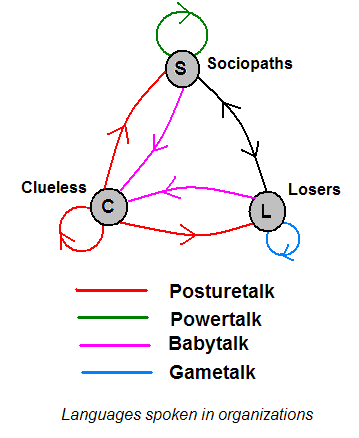
Venkat Rao has followed up his analysis of office dynamics as reflected in The Office, which we discussed last month, with one titled Posturetalk, Powertalk, Babytalk and Gametalk. The Office is running a little thin of meaty examples to make his points in delineating the ways of PowerTalk — the language of the Sociopaths — so Rao reaches out to Goodfellas, Wall Street, The Boiler Room, and Making Jack Falcone. The entire analysis illuminates and is illuminated by a diagram of the disparate languages that Sociopaths, the Clueless, and Losers speak to each other and among themselves. -
"Breathtakingly Stupid" EU Cookie Law Passes
Reader whencanistop writes with some details on an upcoming EU law that slipped under the radar as it was part of the package containing the "three strikes" provision, which attracted all the attention and criticism. "A couple of weeks ago we discussed the EU cookie proposal, which has now been passed into law. While the original story broke on the Out-law blog from a law perspective ('so breathtakingly stupid that the normally law-abiding business may be tempted to bend the rules to breaking point'), there has now been followup from a couple of industry insiders. Aurelie Pols of the Web Analytics Association has blogged on how this will affect websites that want to monitor what people are looking at on their sites, while eConsultancy has blogged on how this will impact the affiliate industry. In all of this the general public is being ignored — the people who, if the law is actually implemented, will have to proceed through ridiculous screens of text every time they access a website. I know most of you guys hate cookies in general, but they are vital for websites to know how people are accessing the sites so they can work out how to improve the experience for the user."