Slashdot Mirror
Domain: sourceforge.net
Stories and comments across the archive that link to sourceforge.net.
Comments · 31,462
-
Easy POP access to Yahoo and Hotmail.If you want POP access to Yahoo! mail, you could always use Yahoo! POPs. It allows you POP access to download your mail directly to whichever client you use (with some exceptions, of course), and to send outbound mail from the same account. I don't use Yahoo! mail, but I do use Hotmail, and Hotmail Popper works wonders for me. I just set up an additional account in Mozilla Mail, set the server address to 127.0.0.1 (obviously, the address is completely user-configurable), and have it, once it downloads the mail from the server, move it into my main account, using the Moz's bayesian filtering along the way. The only downside to these is that you can't run them through your local SpamAssassin, though maybe you can, since I haven't really tried hard enough, and besides, you're still getting your messages straight off the server and opening up space on your account, something you couldn't do before.
I heartily recommend both of these, Hotmail Popper from personal experience, and Yahoo POPs from others'.
-
Is this what you are looking for?
This seems to work fine for me.
-
Camera ?
For the average person that needs to be able to plug in their digital camera without going into the terminal window, we think that the user's experience with any brand of Linux will be sub-par.
I guess he has yet to try SuperMount
Sunny Dubey -
Lowest Common Denominator
First of all, I think mouse gestures are wanky and stupid. Gamers, maybe, find them easy because they're used to gesturing crap with their mice. Mine sits and lights up my table more than anything else.
People constantly forget that in order to reach the largest audience possible for your site, you have to make it compatible with the largest audience out there. Far too many sites, attempting to be universally-accessible, have opted to include features that older browsers don't render correctly, can't disable, or generally make it impossible to navigate.
PEOPLE -- If I can't get to your site or can't read it properly using whatever I'm using, I won't be back.
My patience for tricked-out websites that require 99 different plugins to view is zero. My patience for websites that don't render nicely in Lynx or Links is higher, but still not absolute Side Note: I'd like to wring OSDN's neck for making FM and other sites damned near impossible to navigate in text because of their damned OSDN menus. My personal site is built in POH (Plain Old HTML) because it is most universal...I don't care who you are or what you run, you can see it.
First, JavaScript works on a Russian roulette basis...most of the time you'll get an empty chamber, sometimes it'll blow you up. The consistency in implementation leaves something to be desired, especially with more complicated scripts. Secondly, JS is a limiting technology -- if your browser doesn't do it or doesn't do it the way it was meant to do, it'll limit your audience.
If you're ok with the idea of having people not come to your site, fine. There's a lot of sites out there that wouldn't make sense to dumb them down too much (high media sites, etc. come to mind). But if you want a universal audience -- K.I.S.S. Even the trailers section of Apple's website renders nicely under Links, regardless of the fact that they don't have a text-only Quicktime plugin. -
Re:Stream Rippers und Stern, mit boobies
With tool like audacity...it's getting easier all the time
-
Re:Software Company? Got jobs?
After reading the article I wondered if they had any software job openings posted on their website, take a look at the one Software Engineer job they have open.
Heh. I wish I could plant myself as a mole, but I'd probably not get by the ideology barrier. Hint for people who never released GPL software... and never posted opinions about Free Software except under pseudonym. -
Re:End of an era...?
Well freenet is the obvious answer to this problem.
And, it actually is pretty much working again, at least the web-based part; just use a utility like freeweb to insert your list of songs you uploaded with
It used to be easier, you could use FROST to share files and post messages, but someone went insane at the developer end and decided to make it pretty, and CP free and it hasn't worked for sharing files since v050903.
Before that, there were several thousand files available, download times were comparable with Gnutella / E-Donkey, and it was expanding logarithmically.
-
Re:I've been using fink 0.6.2 for a few days
There is a FAQ about this, I don't know if you tried it, or if it applies to 0.6.2, but it worked for me a couple weeks ago.
-
Re:BSD was in SCO UNIX?
BTW: I haven't touched this in a while, so I looked around. All of this stuff was released opensource, can be seen at the project UDI sourceforge page with a link to download the source from cvs. The usb stuff isn't shipped as part of the environment, but is being used. I guess they closed the drivers, even though essentially they're just BSD code ported to USI.
-
Re:BSD was in SCO UNIX?
BTW: I haven't touched this in a while, so I looked around. All of this stuff was released opensource, can be seen at the project UDI sourceforge page with a link to download the source from cvs. The usb stuff isn't shipped as part of the environment, but is being used. I guess they closed the drivers, even though essentially they're just BSD code ported to USI.
-
Single System Image is Nice
The thing that is special about the NASA computer is that it is a single image system
I did parallel code development on Sun SMP boxes. Starting up jobs, seeing what was going on, killing zombies, debugging was all easier on one system than through different boxes you'd have to ssh over to see.
Even though I was using MPI and getting ready for a distributed memory architecture for the really big runs, the development was easier on the SMP box that showed a single system image.
I haven't used things like OpenMOSIX, and Don Becker, early pioneer of Linux ethernet drivers (not many other folks can claim a complete decade of experience with Linux networking), founded a company called Scyld that sells Linux clusters with single system image.
Sometimes it's convenient to see the whole box as if it were one, even though efficient programming dictates that you become aware of the different costs of data access (network, main memory, cache, disk). Practically speaking, developing and running parallel jobs is a higher user productivity proposition on a single system image.
-
The way forward...
...is sometimes the way back.
X Terminals were a great idea but in a time where machines and network infrastructure were too slow to support them. They have pretty much gone away.
Today your average desktop class machine is really enough to support several dozen regular business users.
Add openMOSIX into the mix, and one virtual machine made up of a small handful of real machines can suddenly support hundreds of users' desktops. New machines can easily be rotated into the cluster (live) while old machines are rotated out when they become obsolete.
On the actual desk itself, something like a VNC terminal appliance is all one needs. Lifespan of one of these units is several times what a PC would last.
A sysadmin with 300 users is now really supporting only one workstation (whose processes are being migrated to maybe a dozen or two other workstations who have direct access to the master node's file system).
This isn't pie in the sky. It's based on very old ideas re-applied using new technologies that weren't available when the ideas were first tried. It actually works very well using the hardware and software available to us today.
I have to laugh when my users think that what I'm doing is bleeding edge. This is old school UNIX administration. -
Re:I don't think so.
Nice way to pick the worst Tenebrae screenshot there, eh? Why not pick something that actually shows off more than just bump mapping, like this one, this one, this one, and so on. I would argue that every one of those shots are graphically superior to Quake 3 Arena (not necessarily later games built with the Q3 engine, but close). Some of them (the first one, for instance) even look close to Doom 3's graphical level.
I'm not affiliated with Tenebrae in any way, but the work that's been done on it is quite breathtaking, IMHO.
-
Re:I don't think so.
Nice way to pick the worst Tenebrae screenshot there, eh? Why not pick something that actually shows off more than just bump mapping, like this one, this one, this one, and so on. I would argue that every one of those shots are graphically superior to Quake 3 Arena (not necessarily later games built with the Q3 engine, but close). Some of them (the first one, for instance) even look close to Doom 3's graphical level.
I'm not affiliated with Tenebrae in any way, but the work that's been done on it is quite breathtaking, IMHO.
-
Re:I don't think so.
Nice way to pick the worst Tenebrae screenshot there, eh? Why not pick something that actually shows off more than just bump mapping, like this one, this one, this one, and so on. I would argue that every one of those shots are graphically superior to Quake 3 Arena (not necessarily later games built with the Q3 engine, but close). Some of them (the first one, for instance) even look close to Doom 3's graphical level.
I'm not affiliated with Tenebrae in any way, but the work that's been done on it is quite breathtaking, IMHO.
-
Re:I don't think so.
Nice way to pick the worst Tenebrae screenshot there, eh? Why not pick something that actually shows off more than just bump mapping, like this one, this one, this one, and so on. I would argue that every one of those shots are graphically superior to Quake 3 Arena (not necessarily later games built with the Q3 engine, but close). Some of them (the first one, for instance) even look close to Doom 3's graphical level.
I'm not affiliated with Tenebrae in any way, but the work that's been done on it is quite breathtaking, IMHO.
-
Re:I don't think so.
There have been many projects based on the GPLed code of Quake 1, like Quake Tenebrae which adds graphical capabilities that surpass Quake 3 and are nearly on par with Doom 3.
Ahahahahah!
Quake Tenebrae
Quake III
Doom 3Yeah, right...
-
Re:Patches ?
Don't know if this is what SGI is using, but the status of NUMA in the kernel and associated patches for it is shown here.
-
TimeI think all open source games need is time. Take for example Quake 3 - this engine didn't just give us Quake 3, but also a whole slew of other fully featured first person shooters like American McGee's Alice and Jedi Knight iirc. And don't forget the enormous number of community made modifications for these commercial engines.
Games are built on top of an engine. What we need is some really good quality open source engines. We only need one or two, and from that we can build a number of excellent games without reinventing the wheel. All it needs is the game development tools to be built up in steps. Crystal space seems to be moving along very well, and may fill this gap for us. Once we see a 1.0 release for that, perhaps open source games will become a lot more common.
At any rate, all I think it needs is time to build up the code assets necessary to make a game. Once those are in place, creating new games on top shouldn't be much more difficult than making new games from the Quake 3 or other engines.
-
Re:I don't think so.
For that matter why would anyone buy XP if Windows NT 4 was still under active development by an open source community that made it just as modern and up to date?
Why would anyone buy Quake 3 if Quake 1 was still under active development by an open source community that made it just as modern and up to date?
There have been many projects based on the GPLed code of Quake 1, like Quake Tenebrae which adds graphical capabilities that surpass Quake 3 and are nearly on par with Doom 3. Yet people still buy new games. Maybe it's an unfair comparison, since the single-player gameplay of Quake 1 is different than that of Quake 3, but then again the multiplayer can be extremely similar.
-
Re:Duh
Lack of skilled artists with spare time isn't really the problem in my mind. They exist, in masses, just look at fan art and person art pages. But these people are ussually just artists and lack the knowlegde of how to transpose a drawing into a game. What is in low supply is graphic artist with modeling skills. Making a good model still requires expencive software and a lot of time. But as making models gets easier and generic ones start comming avaliable there will be people willing to contribute.
To get to this stage though the OS community needs some things. First a usable OS modeling app, this isn't going to exist for quite a while though. Good modeling programs cost thousands and currently would require the developer to working with a different OS to use it. It would also require graphic artist to make in the first place. Things like Crystal Space are starting to appear though.
But there are other things that are needed to build games and the great thing about the OS community is that everything is build in interchangable peices. Things like the physic engine, ai, media handling could all be seperate projects that will evetually spring into existence.
Games like you can buy on the shelf now will be producable by the OS community in a few years. But we will always be behind CS. -
Re:YALD
Sounds like Syllable to me.
It is a fork of AtheOS. Syllable uses it's own kernel and drivers, but most drivers can and have been easily ported from Linux. It has its own GUI, toolkit, filesystem, filesystem layout and applications. It does use the GNU tools and Glibc underneath but there is no reason to use them if you don't need them.
The GUI isn't complete (Close, but not 100% complete) and the desktop is just there until we actually write a proper one, but the hardware support is pretty good (For an "alternative" OS it certainly is). The kernel is almost complete but still has a few bits to complete & tweak.
It also has all sorts of cool stuff, just to satisfy your last requirement. -
Spamassassin and comment spam
I think spam is on its way out-- we recently integrated spamassassin into our email server and spam is a thing of the past. With programs like these being integrated on the ISP level now and in the future combined with individual email packages getting smarter about spam I think we can kill spam dead.
Atleast in email form. Instant message spam, cellphone text spam and of course..
uhm uhm uhm... visit this hot pr0n site!
comment spam -
Non-starter
This keeps coming up... and getting killed. For good reason.
The only people having trouble spam these days are those not smart enough to install SpamBayes
-
Re:For those of us without flash...
What kind of caveman doesn't have Flash? Sorry, but I'm genuinely curious. It's a free download you know.
I think I ran xboard (which, if I remember correctly, can show games in the
All this while Flash has slight problems running on my mother's p166, and some stuff even makes my p3-600 sweat but not fall. =/
-
Re:Postgres/MySQL + OLAP?
Yes, there is. I haven't quite tried it, but I'm about to. It's called
Mondrian OLAP: Mondrian is an OLAP (online analytical processing) database written in Java. It implements the MDX language, and the XML for Analysis and JOLAP specifications. It reads from SQL and other data sources, and aggregates data in a memory cache.
Don't worry if its home page is usually down. The full home page hierarchy is included in the documentation.
To complement Mondrian OLAP functionality there is another very useful project:
JPivot (project page) : JPivot is a JSP custom tag library that renders an OLAP table and let users perform typical OLAP navigations like drill down, slice and dice. It uses Mondrian as its OLAP Server. -
Re:Postgres/MySQL + OLAP?
Yes, there is. I haven't quite tried it, but I'm about to. It's called
Mondrian OLAP: Mondrian is an OLAP (online analytical processing) database written in Java. It implements the MDX language, and the XML for Analysis and JOLAP specifications. It reads from SQL and other data sources, and aggregates data in a memory cache.
Don't worry if its home page is usually down. The full home page hierarchy is included in the documentation.
To complement Mondrian OLAP functionality there is another very useful project:
JPivot (project page) : JPivot is a JSP custom tag library that renders an OLAP table and let users perform typical OLAP navigations like drill down, slice and dice. It uses Mondrian as its OLAP Server. -
Re:Postgres/MySQL + OLAP?
Yes, there is. I haven't quite tried it, but I'm about to. It's called
Mondrian OLAP: Mondrian is an OLAP (online analytical processing) database written in Java. It implements the MDX language, and the XML for Analysis and JOLAP specifications. It reads from SQL and other data sources, and aggregates data in a memory cache.
Don't worry if its home page is usually down. The full home page hierarchy is included in the documentation.
To complement Mondrian OLAP functionality there is another very useful project:
JPivot (project page) : JPivot is a JSP custom tag library that renders an OLAP table and let users perform typical OLAP navigations like drill down, slice and dice. It uses Mondrian as its OLAP Server. -
Re:Why does he hate himself?As far as copyright infringement goes, SCO has now been spouting about this for a year [...]
It is strange to see how fast a company can change its mind.. In 2001 they released the SYS V awk, grep and regex library under GPL. According to the Nov. 2001 issue of Dr. Dobbs Journal, Caldera "expects to release further components of the UNIX intellectual property in coming months." I havent seen those, though.
-
How it works...
(My version numbers on this may be wrong. I just entered the situation with the Windows version.)
In the days of iTunes 4.0.0, there was no attempt at encrypting or otherwise protecting streaming data. The streaming itself is accomplished using a combination of Rendezvous (aka ZeroConf) and a modified HTTP server. This spawned programs like iLeech, iSlurp and various other wittily-named iPrograms.
However, with the next incarnation of iTunes, 4.0.1, Apple got smart. Likely fearing the wrath of the RIAA, a new header was added to all the requests posted to the iTunes serving the music. This value, called Client-DAAP-Validation, looks, smells, and tastes like an MD5 sum. Without the proper DAAP-Validation, iTunes refuses to serve up any content.
Obviously, this broke iSlurp and iLeech. And since there's no easy (read: DMCA-compliant) way to find the source of this value, programs that run separately from iTunes and provide download capabilities are, well, screwed.
Enter myTunes. It's a two-pronged solution to this problem. Behind the scenes, there's a packet scanner watching for requests on the Rendezvous port (3689). When it comes across a request to stream a file, it notes the "URL" and proper DAAP-Validation.
However, all files accessed via the modified iTunes HTTP server are represented via numeric IDs. To get the proper information about the file, myTunes uses a bastardization of the iTunes for Windows Visual Plug-in SDK. For some reason, all visual plug-ins receive notification when the currently playing song in iTunes changes. The myTunes plugin writes this value to the registry, where it is later read by the myTunes GUI and displayed for downloading via libcurl.
This approach raises some interesting DMCA questions. Since the generation of the DAAP-Validation value has not been reverse-engineered, only captured, has anything been circumvented? In effect, myTunes is only a packet replayer.
To counter some of the ill-informed people above, the original file is saved in original format without bitrate modifications. The response to a stream request is the file itself.
General DAAP info -
Re:BitTorrent is too ad-hoc
If you think bittorrent is too adhoc, you've never been to 3dgamers. For every game demo or movie they provide information about, they provide a bittorrent seed. In addition, they do provide direct download mirrors, but I don't even bother anymore.
Another tip: The official bittorrent client isn't that great. You should try Azureus. It's written in Java, which sucks (flame me, I bite back), but even so I love it. In fact it might be the only java program that I like now that I think about it.
-
Atlas :: empirically optimized blas/lapackThere is a variation of this that is very clever that optimizes BLAS and LAPACKroutines "empirically" called ATLAS that has been around a while, originally (and perhaps still) a research project by err Clint Whaley from tennessee (BLAS/LAPACK are numerical routines that do a slew of thing people generally find useful linear algebra and vectors). These routines will often time sit "under" many mathematical packages like matlab/octave/maple/mathematica/scilab as well
as make up the core of much custom scientific computing packages (or even libraries like the "Gnu Scientific Library")
Basically the jist is atlas "empirically" (read: use an optimizer for instance like GA, though empirical may actually mean brute force in this case) to optimize various parameters that will affect things like optimize the routine for the cache size of the processor etc. The cool thing about this, is they can get w/in 10% of hand machine coded BLAS/LAPACK libraries w/out the pain!
-
Re:Rock on! You must be kidding
Is this some kind of a sick joke?
Disclaimer: I use Postgresql and the JDBC driver everyday at work and at home. And I've actually read the source code. And I actually like it nevertheless.
The JDBC drivers are clearly not the main focus of the PostgreSQL community. Here are a few nasties:
-- Very very bad documentation. There is no way to known which features are implemented and which ones aren't.
-- On the same line, the driver claims to be JDBC3 compliant, which is simply not true.
-- When you post a request on the JDBC list, there is always some guy with a 3-month old patch that could solve your problems. It seems that very little development is actually happening.
-- The driver is a pain to compile: You must compile Postgresql at the same time, otherwise it won't work.
-- There is some kind of support for Postgresql distinctive features, but you must read (and fix) the code to make them work.
-- SLOW! DOG SLOW! For example, there is no support for prepared statements (it's my understanding that Postgresql does not support those anyway)
-- Some smaller weirdness, but well I guess that every package as those.
Otherwise, I've never have an actual reliability problem with the driver. Once you have all the workarounds, it simply works.
"Well go fix it then!". First, someone is already working on that, I guess he could use a little exposure (http://sourceforge.net/projects/jxdbcon/).
Second, for my pet project (WKB4J , Boost your Java GIS now!), I just retrieve the raw results using a binary cursor and my queries are about 15 times faster. I agree that this is a particular case.
David -
Compiler optimisations don't win you much ...Todd Proebsting has a "law" like Moore's law
Moore's Law" asserts that advances in hardware double computing power every 18 months. I (immodestly) assert "Proebsting's Law", which says that advances in compiler optimizations double computing power every 18 years.
There is more information on his webpage. It's not strictly true -- compilers have moving targets (different architectures and hardware optimisations over time, greater complexity in languages, etc etc), and for important things like scientific applications compilers can really optimise code; but in general R&D towards compiler development seems to be sorely lacking compared to other areas.
I work on IA64, which is fundamentally designed to take advantage of smarter compilers. While there are some interesting projects (ORC for example) nothing is really close to ready to take over gcc/intel compiler. We really want something that compiles once, can profile code execution and then recompile to optimise based on the execution profile; something along the lines of what this article talks about but built right into the compiler. -
Re:Any recommended software streaming solutions?
gnump3d
Its a nice perl implementation, easy to install, and works flawlessly with my 20GB of MP3s. -
Re:Same day Arnold is sworn in
It's not really a port to Windows itself. They're targetting Cygwin/X.
Actually, that wasn't the port I was thinking of. That port, I believe, was a fairly trivial one, and I know KDE can now run convincingly in this situation, so I think it must be fairly stable already. The one I was thinking of is more experimental.
A quick google and I've found it: Here
They're still targetting cygwin, but they're removing the reliance on an X server. From the screenshots page, it seems as though they have quite a bit of the library working, although whether it is enough or not I don't know... -
something not clear
At first I understood you meant a thing like "Let's answer to their mail, it will make prices fall", but it sounded really too weird for me.
But now I read the article twice, it seems to me you wrote something like "To fight the spammers, let's buy their products" ? Sounds still a bit weird for me.
Really, I think that the best way to fight spammers is to
1- Never answer
2- Whenever possible, block their emails to the root, meaning at SMTP level
3- Let the law break their business
Oh and by the way, install PopFile -
iRate radio.Everytime something like this comes up I'm reminded of iRate radio (I know its slightly off topic but it still comes to mind). From the iRate homepage:
iRATE radio is a collaborative filtering client/server mp3 player/downloader. The iRATE server has a large database of music. You rate the tracks and it uses your ratings and other people's to guess what you'll like. The tracks are downloaded from websites which allow free and legal downloads of their music.
So there you have it. Now you can cut the RIAA out of the loop entirely. -
My experiences
I've also encountered Extegrity's product, which is required at my law school. It does have at least rudimentary protection against the most obvious workarounds - when I tried to run it within VMWare, it "failed security check" and refused to operate. I'm not sure how exactly it checks to see if it's running in a virtualized environment - one project I have on my back-burner is to see how well it deals with bochs.
I'm also the proud owner of a PowerBook. My solution was to trade some other computer gear for a big old PC laptop with a mostly-dead battery that meets the system requirements. I plan to use that laptop only for taking exams. Aside from exams, my school is fairly platform-agnostic: papers are turned in on paper, and the only electronic interaction with professors is via email. The one kink that I have run into is profs and fellow students who insist on sharing their academic insight via Word -
Re:what a sad spectacleReminds me of this one.
Okay, it's not as good as Tux & Linus bending spoons, but it's a start and I have the karma to burn. Any FX guys in the house?
-
MUMPS
If we need database products, we need object oriented databases, heirarchical databases, things that are in relatively short supply, where what is out there is limited in usefulness, so ancient it won't compile, or too hideous to contemplate.
It's hard to create a decent object-oriented database when the word "object" isn't formally defined. "Object-oriented" is merely a programming model. Database management systems require a lot more rigor than that.
And although it might fall into the "too hideous to contemplate" category, you should check out gt.m as a heirarchical DBMS. It's available on sourceforge. It's a MUMPS implementation; for those of you who don't know what that is, it's a heirarchical database system and programming language all rolled into one. It is used in financial institutions and hospitals alike.
In fact, there is a freely-available medical records/hospital management system that is more robust and complete than commercial products costing millions of dollars: VistA, put out by the US Veterans Administration. It is available via the freedom of information act.
There is a project to get VistA running on gt.m: WorldVistA.
But, I think you miss the point of Rekall: it is the RAD tool for existing DBMSs to which you refer. It is quite nice, from all accounts.
Also, for an interesting project that is more industrial in nature, check out Gnu Enterprise, an Oracle-forms like environment that also makes use of existing database management systems.
There's a lot going on, a lot of it both useful and interesting. -
Finally, a desktop DBMS for Linux.This completes the open source office suites. This may also encourage and spread the use of Python. I hope they also include a connector to FireBird.
= 9J =
-
Re:linux kernal != freedom
-
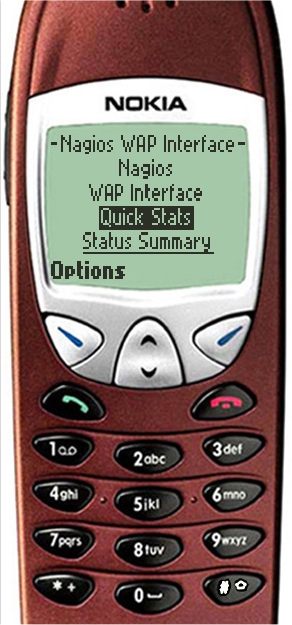
WAP is not dead
just put nagios on top of your usual tools (logcheck, tripwire), set alerts by some SMS gateway and use the WAP interface.
Chances are your current mobile phone can handle WAP and, for the work, a lightweight laptop handy (1-1.5 kg) is much better, IMHO, than any PDA/Phone.
Also, if it's a small problem, the WAP interface will let you discover it in a few clicks. -
Simlair products from Kiss Technology
I have got simlair system made by Danish company Kiss Technlogy few months now. My product is Kiss DVP500 with ethernet adapter. With that I can listen internet radios, play files from my Linux server (officially only Windows server from Kiss) and ofcourse play DVD discs, CD's with audio/mp3/avi/jpg/real/... content.
It's excellent box but only with bad user interface design. But you can upgrade it when ever Kiss publishes new software versions. -
Re:Hey! Shortsighted people!Well, that's where things get really weird. Robert J. Hall, the man whose name is listed on the patent, has written papers on filtering spam, by a method he called "channels" which looks like a variation of the Tagged Message Delivery Agent. And he's not the only AT&T employee that's written about spam filtering, either. There's another article by Lorrie F. Cranor.
It seems odd that someone who wrote a paper on an anti-spam technique in March 1998, would go on to patent an anti-anti-spam technique that wouldn't defeat the technique he discussed months ago. It's entirely possible that AT&T intends to use this to put spam software makers out of business, or at least make spams easier to detect.
-
Yet another perl hacker!
Atheros' CEO is a perl hacker, so I guess that this would mean that whatever they do, it will be good, no?
-
Re:Why?
You can sync all your PIM apps with Evolution thanks to Multisync . It works fairly well, and I was quite happy with my H3600, Familiar and Opie.. until today when I tried to upgrade to 0.7.2. Now my iPaq is dead and will probably need to be reflashed. Joy.
-
Re:Task/Desktop interface?
The only thing I think would still be nice in OSX is multiple desktops, like most Linux wms have.
I've been using Desktop Manager over the last few weeks and despite being at a beta stage it seems rock solid and it has the raw functionality needed. The switcher is very nicely located on the menu bar rather than in the dock.One other thing to bear in mind is that OS X's window management is application driven, not window driven. Bringing all windows belonging to an app to the surface is just a matter of clicking on the app's dock icon. Hold down Option and Command and click on the dock icon and all the other windows disappear leaving you with just that app. (This is in addition to more usual stuff - you can still bring an individual window to the fore by clicking on it for instance.)
Ultimately the enhanced management means multiple desktops isn't as important, but it's still there as an option. Ironically, I think multiple desktops fits in with the original Mac's "spacial" metafore much better than application-centric management, but I guess it's a matter of what's simpler for the LCD user.
-
Atheros Linux driver
here.
For the sake of relevancy.
Also, almost everything is GPL'ed. So: Atheros == good && Broadcom == bad;