Slashdot Mirror
Domain: spaceref.com
Stories and comments across the archive that link to spaceref.com.
Comments · 466
-
Re:X Projects
Oh, and where's the love for VASIMR and aerospike engines?
I believe aerospike engines (and things like Thrust Augmented Nozzles) fall under the new Foundational Propulsion Research program:
http://www.spaceref.com/news/viewsr.html?pid=34019
VASIMR falls under the high-power electric propulsion system project in the Enabling Technology Development and Demonstration (ETDD) program announced last week. I believe the plan is to test and mature VASIMR under that program until its ready to be fully tested on a Flagship Technology Demonstration mission:
-
Re:X Projects
Oh, and where's the love for VASIMR and aerospike engines?
I believe aerospike engines (and things like Thrust Augmented Nozzles) fall under the new Foundational Propulsion Research program:
http://www.spaceref.com/news/viewsr.html?pid=34019
VASIMR falls under the high-power electric propulsion system project in the Enabling Technology Development and Demonstration (ETDD) program announced last week. I believe the plan is to test and mature VASIMR under that program until its ready to be fully tested on a Flagship Technology Demonstration mission:
-
Re:33 years and still going strong - nuclear FTW
In Obama's 2011 budget for NASA there is funding for the DOE to restart P-238 production for RTG's.
http://www.spaceref.com/news/viewnews.html?id=1372 -
Re:Misleading: nuclear is excluded
According to the RFI at http://www.spaceref.com/news/viewsr.html?pid=34056 nuclear propulsion is excluded unless it is used solely for heat generation or as a power source for electric propulsion. Thus, some of the most promising nuclear technologies for rocket propulsion such as micro pellet inertial confinement compression-induced fission are excluded.
There's two questions to ask here. First, is there a role for such propulsion in near future space activities? I'd have to say "no". Most of our transportation overhead is going from Earth to orbit, something which nuclear won't help with, just due to environmental and safety concerns, until it's been proven somewhere else first (namely somewhere in space). You'll need infrastructure there to support such tests IMHO, which makes it a second generation project. Also, you need to do something with the remains of the rocket (another second generation project).
Second, is there an advantage to using these other nuclear technologies? I don't see a big advantage to using nuclear pulse or nuclear thermal rockets over nuclear electric propulsion in space aside from applications where high thrust is desired (like wringing a little more out of the Oberth effect) or when you scale up to huge payloads. Heat radiation is a big issue in space and nuclear reactors would suffer from it as much as anything else (power only scales as the surface area of the vehicle due to this restriction). Nuclear thermal transfers that heat to the exhaust while nuclear pulse dumps that heat (and the rest of the products of the pulse detonation) to space directly. That makes them better technologies for large, relatively high acceleration vehicles. -
Re:Misleading: nuclear is excluded
According to the RFI at http://www.spaceref.com/news/viewsr.html?pid=34056 nuclear propulsion is excluded unless it is used solely for heat generation or as a power source for electric propulsion. Thus, some of the most promising nuclear technologies for rocket propulsion such as micro pellet inertial confinement compression-induced fission are excluded.
Keep in mind that the ETDD program (the one mentioned in the summary) is specifically intended for tech which has already attained a mid-level TRL (Technology Readiness Level) and needs to be developed/tested to a higher-level TRL so it can be used in missions. Things like "micro pellet inertial confinement compression-induced fission," while they have a great potential benefit, are of a relatively low TRL and hence fall under the scope of the newly-announced Space Technology Program, particularly the Early-Stage Innovation and Game Changing Technology sub-programs.
-
Misleading: nuclear is excluded
According to the RFI at http://www.spaceref.com/news/viewsr.html?pid=34056 nuclear propulsion is excluded unless it is used solely for heat generation or as a power source for electric propulsion. Thus, some of the most promising nuclear technologies for rocket propulsion such as micro pellet inertial confinement compression-induced fission are excluded.
-
Re:The west will go to the moon by 2020
I don't remember hearing Musk say anything about the Moon, but its pretty common knowledge he wants to go to Mars. Never heard a time frame mentioned from Musk.
Musk to Mars:
http://www.spaceref.com/news/viewsr.html?pid=3698 -
Re:Human Spaceflight is no longer NASAs job
according to the current budget, its the private sector's job.
There's BILLIONS of dollars in potential earnings from manned space flight in the private sector. First it will be ventures like Space Ship Two that send people up for a couple hundred grand a pop. In a few years there will be the first private orbital manned private spaceflight. There's ideas for hotels, private moon missions and much, much more.
The manned spaceflight program provided the inspirations for thousands if not millions of scientists and engineers.
NASA has successfully pulled this load for 50 years (of course Apollo more than Shuttle). NASAs turn at the forefront is over. Its time for the private sector to start doing the manned flight inspiring.
It's interesting that you chose SpaceShipTwo as an example seeing as how the man behind making that happen, Burt Rutan, completely disagrees with what you just said. http://www.spaceref.com/news/viewpr.html?pid=30293
-
Re:Floor Mats
Well Lockheed is certainly familiar with "unintended acceleration".
-
Depends on the type of code
The answer depends on the type of code, process used, and history of the people involved. I don't doubt that a PM at Microsoft believes that every bug is simple to find if just enough eyes look at it. No doubt at all.
I've worked on real-time space vehicle GN&C code where a slow answer is a wrong answer. We've had a few really complex bugs and a large number of "duh" bugs that the review team studied, but then were convinced it was fine. We've also had bugs where 20 seasoned professionals missed the bug and someone with less than a month on the job caught it because he (actually, it was me) didn't assume something operator order of the compiler that everyone else had assumed. I looked up what the order of operations was and found something very non-standard.
I've seen many array bounds bugs, string handling bugs, pointer miss management bugs, RTTC bugs and library bugs. Most common bugs can be avoided by how you write your code, IME.
1) Always set variables to known values at instantiation and when you are completed with them.
2) Always perform tests with the constant on the left side of the comparison operator.
3) Always set pointers to non-allocated memory to NULL before and after use. It is easy to continue using a pointer that happens to work even when it points to a freed memory block. Better to get a null pointer access error during development than for anyone to find it during runtime.
4) Run all code through an indentation tool to correct any user specific styles.Oh, I've seen rendezvous code fail due to only using a single precision floating point variable in the calculations. The fix was to use double precision floats AND to initialize the variable to ZERO at the end of the calculation, so when another rendezvous 3 body problem calc http://www.scholarpedia.org/article/Three_body_problem was requested, errors didn't add up over time. Actually, this issue was discovered during a flight with many multiple rendezvous guidance calculations. Here's a mention of GN&C issues http://www.spaceref.com/news/viewsr.html?pid=26977 in a NASA release.
Did I mention - I am a rocket scientist.
-
The New Kids Fire Back
Full article: http://www.spaceref.com/news/viewpr.html?pid=30060
Among points I picked up on myself, they point out that since there are no existing standards for them to follow for building human rated craft, they claim that none of them have experience doing so is non sequitor. They politely don't point out that the sole existing man rated spacecraft has had two fatal failures, though they'd also have to admit it's experimental, not commercial, even though built by human rated aircraft corporations.
Even more politely, when ASAP makes the statement that the commercial start ups hoping to carry people are making unsubstantiated claims, they do reply that since they haven't built the hardware yet to test it, and only have stated intentions, it's hardly a valid criticism but don't resort to the sorely needed "DUH!".
ASAP has done a creditable job when it came to criticizing their own work. That is, the BigAero members cooperated fully when investigating problems. But as far as dealing a blow to commercial startups, TFA is so full of FUD that NASA can only take it and leave it or risk being seen being led around by the corporate welfare milk teat.
FAA's Office of Commercial Space Transportation, and more recently Commerce's Office of Space Commercialization, have been plowing full speed ahead to clear the way for the new guys just as much as the big ones. When multibillion dollar corporations get scared enough to "warn" NASA, things are probably going to get interesting. I thought they were interesting enough the year Rutan won the X-prize, because half the licenses for commercial launches issued that year by FAA/AST had his name on them.
-
Re:Priorities are a function of Probabilities
From an open letter to congress, here:
http://www.spaceref.com/news/viewsr.html?pid=9866
"We cannot rely on statistics alone to protect us from catastrophe; such a strategy is like refusing to buy fire insurance because blazes are infrequent. Our country simply cannot afford to wait for the first modern occurrence of a devastating NEO impact before taking steps to adequately address this threat. We may not have the luxury of a second chance, for time is not necessarily on our side. If we do not act now, and we subsequently learn too late of an impending collision against which we cannot defend, it will not matter who should have moved to prevent the catastrophe . . . only that they failed to do so when they had the opportunity to prevent it. "
We do have the technology. We do have the money. We have a moral obligation to our species to protect it.
-
Re:We need an asteroid in the face, folks.
-
Re:I don't understand
Something I don't get, and is unanswered in general. When the ISS was first assembled back in 1998, it was asserted at the time that this was going to be the first permanent outpost of humanity in space.
Perhaps I'm getting senile in my old age and not remembering things very clearly.
YOU are doing just fine, my friend. Those were my first thoughts reading the TFS. Your post really sparked the old gray cells and I thank you for that. That said, google is my friend, and the fossil record indeed supports the idea that we were promised and sold as taxpayers the idea that this would be a permanent station - I simply googled "iss permanent outpost" and got some interesting stuff right off the bat:
http://www.space.com/common/media/show/player.php?show_id=26&ep=4
http://science.howstuffworks.com/space-station.htm
However, note that in 2000, there came the obscure quote from a NASA mgr - "This is the beginning of what we hope is at least 15 years of continuous human presence in space, and personally, I hope its much, much longer than that that once we get this crew on orbit, well have spacecraft flying with people on board for centuries to come." Source -
http://www.space.com/missionlaunches/missions/exp_one_iss_001030.html
Nonetheless, the "permanent outpost" meme was alive and well in 2007 -
http://eu.spaceref.com/news/viewpr.html?pid=24180
And what's NASA's real plan? Get a load of the roadmap on slide 2 - and the clever glyph at the right end of the ISS bar, showing neither certainty nor commitment -
http://www.nasa.gov/pdf/203075main_ECLSS%20Technology%20Exchange%20Conference%20briefing.pdf
-
Re:Sounds Fishy
The Earth has been around for billions of years and in the last several hundred million years, it's been hit by how many bodies large enough to threaten all life?
Well, zero, unless you count a couple of Hollywood movies notable more for their special effects than their accurate science.
But if you want to talk more realistic examples, consider the 1908 Tunguska impact. If that had occurred in a populated area, millions would have died. And nowadays, a disaster of that scale could mean economic disaster across the planet. That kind of impact is said to occur an average of 400 years apart. (And no, that does not mean we have 300 years to prepare. Google "gambler's fallacy.") An impact large enough to end human civilization is much less likely, but still frequent enough to care about.
As Dirty Harry said, do you feel lucky?
-
Re:Lies, Damn Lies and "Science" Articles
Astronauts overwhelmingly have military backgrounds. The US Military has been using drugs well beyond the specifications allowed for "the rest of us" since forever. I guess what we need is a video game titled WWII Pilots: BENZEDRINE VS. METHEDRINE to really bring the point home to the pixels-and-keyboards crowd. The drug cocktail should surprise no one.
Regardless of background, astronauts work for NASA and it calls the shots.
In the military a few individuals in a few situations are given drugs that while increasing performance or some such, are not exotic but rather are common drugs with well know effects and side effects. You don't want the guy in the fox hole with you to decide his helmet is a saucepan, his claymore mine is a steak, and he's going to start a fire in the hole with you both and fix dinner. Of the few who are given such drugs, hardly any get the new, non-formulary stuff. Either way, these are handed out in very restricted matter, not as a part of a collection or "cocktail". That just doesn't happen.
-
Re:Lies, Damn Lies and "Science" Articles
Astronauts overwhelmingly have military backgrounds. The US Military has been using drugs well beyond the specifications allowed for "the rest of us" since forever. I guess what we need is a video game titled WWII Pilots: BENZEDRINE VS. METHEDRINE to really bring the point home to the pixels-and-keyboards crowd. The drug cocktail should surprise no one.
-
New committee heads
The linked article didn't seem to mention it anywhere, but it's worth noting who the heads of the new committees are:
http://www.spaceref.com/news/viewpr.html?pid=29537
http://www.spacenews.com/civil/091030-bolden-revamps-nasa-advisory-council.html* Commercial Space Committee: Bretton Alexander, current head of the Commercial Spaceflight Federation
* Education and Public Outreach: Miles O'Brien, pretty much the best and most clueful space journalist around
* Technology and Innovation Committee: Esther Dyson, well known for her tech entrepreneurship work
* (IT Infrastructure Committee chair seems to be pending)All in all, they seem to be rather good picks. It also seems that Wesley Huntress has been chosen as the chair of the Science Committee. In 2004 he was head of a study, The Next Steps in Exploring Deep Space, a rather fascinating report proposing a space exploration infrastructure which would initially focus on Lagrange points and Near-Earth Objects, quite similar to the Flexible Path option proposed by the Augustine Commission.
-
Re:Epic Fail?
If that is the case then we have already failed. Any number of bacteria could have survived on the rovers could now be contaminating the surface. With no known competition they could be flourishing. I see little that can be done to figure out what is now native bacteria (if any) and what was brought via the rovers.
Wow! Too bad the NASA/ESA scientists weren't as smart as you, because if they were they would have put policies in place to mitigate the risks of contamination.
-
Summary of Augustine Report
For some reason the link for the Augustine Report seems to be going to a download for Windows 7 (Huh?!?), so here's the actual link (mirror).
Here's the main report findings from the PDF:
Summary of Principal Findings
The Committee summarizes its principal findings below. Additional findings are included in the body of the report.
The right mission and the right size: NASA's budget should match its mission and goals. Further, NASA should be given the ability to shape its organization and infrastructure accordingly, while maintaining facilities deemed to be of national importance.
International partnerships: The U.S. can lead a bold new international effort in the human exploration of space. If international partners are actively engaged, including on the "critical path" to success, there could be substantial benefits to foreign relations and more overall resources could become available to the human spaceflight program.
Short-term Space Shuttle planning: The remaining Shuttle manifest should be flown in a safe and prudent manner without undue schedule pressure. This manifest will likely extend operation into the second quarter of FY 2011. It is important to budget for this likelihood.
The human-spaceflight gap: Under current conditions, the gap in U.S. ability to launch astronauts into space will stretch to at least seven years. The Committee did not identify any credible approach employing new capabilities that could shorten the gap to less than six years. The only way to significantly close the gap is to extend the life of the Shuttle Program.
Extending the International Space Station: The return on investment to both the United States and our international partners would be significantly enhanced by an extension of the life of the ISS. A decision not to extend its operation would significantly impair U.S. ability to develop and lead future international spaceflight partnerships.
Heavy lift: A heavy-lift launch capability to low-Earth orbit, combined with the ability to inject heavy payloads away from the Earth, is beneficial to exploration. It will also be useful to the national security space and scientific communities. The Committee reviewed: the Ares family of launchers; Shuttle-derived vehicles; and launchers derived from the Evolved Expendable Launch Vehicle family. Each approach has advantages and disadvantages, trading capability, life-cycle costs, maturity, operational complexity and the "way of doing business" within the program and NASA.
Commercial launch of crew to low-Earth orbit: Commercial services to deliver crew to low-Earth orbit are within reach. While this presents some risk, it could provide an earlier capability at lower initial and life-cycle costs than government could achieve. A new competition with adequate incentives to perform this service should be open to all U.S. aerospace companies. This would allow NASA to focus on more challenging roles, including human exploration beyond low-Earth orbit based on the continued development of the current or modified Orion spacecraft.
Technology development for exploration and commercial space: Investment in a well-designed and adequately funded space technology program is critical to enable progress in exploration. Exploration strategies can proceed more readily and economically if the requisite technology has been developed in advance. This investment will also benefit robotic exploration, the U.S. commercial space industry, the academic community and other U.S. government users.
Pathways to Mars: Mars is the ultimate destination for human exploration of the inner solar system; but it is not the best first destination. Visiting the "Moon First" and following the "Flexible Path" are both viable exploration strategies. The two are not necessarily mutual
-
Re:Darn.
However it seems like theres lots of interest and activity in private space flights currently:
http://en.wikipedia.org/wiki/List_of_private_spaceflight_companies
Interesting article about them
Several other small private aerospace companies not competing for Ansari X Prize are also making news. According to Aviation Week, Bigelow Aerospace, who are developing inflatable space modules, plan to announce shortly the creation of yet another prize competition, this one for $50 million, called Americaâ(TM)s Space Prize that will go to whoever develops a spacecraft that will service their inflatable space modules.
And yet another company, Space Exploration Technologies Corporation (SpaceX), plan to launch their first partly reusable rocket Falcon 1 early next year. In developing their space program, SpaceX has created new technology, which they claim allows them to reduce the cost of launch four times lower than their nearest competitor and increase reliability.
This along with Tickets On Sale In Sweden For Space Tourism, Starting In 2012.
-
Re:THIS ....
Here http://www.spaceref.com/news/viewpr.html?pid=29107 they are testing a lunar port-o-jon. Slightly over sized so the astronauts can maneuver into position with all the space equipment
-
Re:Green is Population Control
http://www.spaceref.com/news/viewnews.html?id=301
Both of these place the average cost per pound of getting something into orbit at about $4,000 USD. Now, if we discount that getting people anywhere they could live without Earth-based support would be far more, and go with the best-case number of $2000 USD
Given that the total yearly GDP of the Earth is 46 Trillion, if we expended 100% of our resources to getting people off the planet, we could send 10^12 / 26*10^4 is a little under 40 million people offworld per year. Thus, it would take 50 years to reduce the global population by one half in a very generous fairytale scenario where everyone works in concert to move people offworld and GDP remains constant despite losing people to colonies (possibly by keeping population constant, thus negating the benefit.)
The numbers are so literally astronomical that I didn't feel a citation was necessary, but there you go, even in fairytale world, it's a very difficult undertaking. In the real world, it's not a reasonable suggestion.
-
Re:Nope
Bob Park and the American Physical Society disagree.
Bob Park's testimony before US Senate re: ISS
"It is the view of the American Physical Society that scientific justification is lacking for a permanently manned space station in Earth orbit."
APS, 20 January 1991The APS recently reaffirmed its statement, but the ISS, though still unfinished, is now in orbit. The question is, what do we do now?
-
Re:possible solutions
Your scenario would be like setting off a bottle rocket from the hood of a racecar. During the time window in question, the SRB is accelerating very quickly. The capsule would launch, and the SRB- pushing even less weight- would accelerate further, destroying the capsule. Arcing the capsule away wouldn't solve the problem because the SRB would be traveling fast enough to put the capsule directly into the path of the nozzle. You are talking about trying to move a heavy capsule's vector from the longitudinal axis of the SRB to a vector around 45 degrees from the l. axis; Nothing we have today could create that kind of delta-v without weighing too much or killing the crew (you would need to travel at least 200 feet from speed=0 in the time it takes the SRB to pass the capsule).
And like I mentioned before, weight is a primary factor here.
-b
ps- here's a good report in case you haven't already read it: http://images.spaceref.com/news/2009/fratricide.report.pdf
-
Re:hmm
It comes down to weight. The capsule is already at its limit. And basically anything you try to use will be damaged by the burning SRB debris which burns at around 4000 degrees F.
http://images.spaceref.com/news/2009/fratricide.report.pdf
-b
-
Re:numbers for the LAS
This is a NASA report that covers your exact question.
http://images.spaceref.com/news/2009/fratricide.report.pdf
Very good visual aid to understand the ideas.
-b
-
This isn't the only technical problem with Ares I
This is only the latest in a long line of technical problems with Ares I, to say nothing of all the delays, cost overruns and other management issues.
First, they discovered an oscillation issue from the SRB that could cause damage to the upper stage and the orion capsule. Last year, they found out that with a slight wind gust, the vehicle might collide with its launch tower.
Incidentally, both of these problems and the current one are all related to the SRB. President Obama needs to do the right thing here and kill Ares I before it has the chance to kill anyone. -
Slide 2 Lower Right
Slide 2 Lower Right "CAPSULE IS HERE"
Feel free to draw your own conclusion. -
Re:Um, why?
"Why send people?" is modded "Troll"? A bit offtopic maybe, but not "Troll". This is the question we must be able to answer if we are to have a successful manned space program, Constellation, DIRECT, COTS, or otherwise.
In the Apollo era, manned space flight provided another means to fund weapons development. The launch vehicles of the early space program, including the Saturn family, are variations of ballistic missiles or started development as heavy launch vehicles for DoD payloads. We are no longer in the same kind of arms race, and finding money to fund civil aerospace ventures is not as easy as military ones.
Many have tried to explain "why" manned space flight in general, let alone the moon and Mars (recently here and here). It is not an easy question to answer. Arguments to the contrary range from "robots are cheaper" to "we should stop spending money on space altogether and address the large number of problems we have here on Earth".
There are those that will say we should do it simply because it is there to explore. That it is human nature. Because it is the unknown, the "final frontier", if you will. A romantic notion (and one that is more than enough to convince some of us), but in the end, this is a political question. We must justify spending tax dollars on manned space flight. What's in it for the taxpayers? While some like to point to technologies that have been spun off of NASA's work over the years, it's not easy to say that the tax-paying public will get X, Y, and Z from future investments.
The true answer here is one that few, if any, politician would ever use even if they knew it was the answer. Why send people? So that we can to guarantee our survival as a species. Humanity has spread beyond the cradle of its birth for many reasons. Initially the exodus was to find more room and resources to support our growing species. Later it was from reasons ranging from natural disasters to religious disputes to dreams of fortune in other lands. If our entire species lived at the foot of a volcano, the volcano could wipe us all out. Our species has spread such that it cannot be wiped out by most natural (or even man-made) disasters. It is only recently that we have started thinking at a scale larger than our local area on this planet. There is plenty of evidence of mass extinctions throughout the Earth's history. Whether by internal (global climate change) or external (comet/asteroid) forces, we are essentially planted at the base of a cosmic volcano. It is time to move beyond the fertile cradle of humanity's birth to ensure its long-term survival. In the past it took picking up and moving to a new field or forest or across a desert or an ocean. These took a variety of effort and planning, but none compare to the journey ahead of us. Our vision as a species, recognizing our strengths and weaknesses and the environment that surrounds us, must guide these decisions for the future. We have taken the first steps to develop habitats for humans to live and work and experiment and learn outside of Earth's atmosphere. We now must take the next steps to develop habitats and technologies that allow us to survive in even harsher environments...those on other planetary bodies. The moon is the closest, and perhaps one of the harshest, places for us to start to take these steps. Without this step, we cannot make the more important steps of leaving our orbit for others around the sun, and someday to other solar systems. We will most definitely not see the results in our lifetimes, but we need to be at a place where our short individual lives don't dictate every decision we make as a species.
Most people alive today can name Armstrong and Aldrin (and some even Collins...though sadly not enough). How many know the names of Cernan, Evans, and Schmitt? Or can name the most recent shuttle o -
Re:How about open-sourcing the transmission instea
"the only way the public would actually accept "public" photograph data as real deal, is if NASA "open-sourced" spacecraft broadcasting interface - frequencies, protocol, encoding, where to set up a dish, size of dish required"
Open source is the wrong term, of course, but none of this information is hidden away: http://www.spaceref.com/news/viewsr.html?pid=16926 The inverse-square law ensures that you need a very large antenna beyond Low Earth Orbit, but the public has been eavesdropping on satellites since Sputnik. In this case, just point the antenna at the Moon
KITZ
ELLIE
Actually it would most definitely be impossible. The parallax of Vega is a bit over a tenth arcsecond. This is straightforward to measure with 19th century technology. More to the point, any spacecraft of Earth origin will be much, much (much, much (much, much)) closer than Vega. Simple trigonometry would reveal the scale of the distance to the origin of the signal with zero chance of being spoofed. This is the antithesis of any Moon Hoax.
-
Re:A comapny with a vision
And each of those 536 congress-critters has their own agenda and suffers from a chronic lack of long term vision or commitment. Their only concern is making their next election cycle, keeping the lobbyist money flowing into their Swiss bank accounts and catering to the very narrow interests of their own constituencies (as they perceive them).
Just from the NASA perspective, look at how the Apollo program was cut off midstream. They canceled the X-38 Crew Return Vehicle in 2002 when congress decided they wanted the money back.
http://en.wikipedia.org/wiki/X-38
With the military now congress has cut off the funding to the F-22, "while-we-are-building-an-operational-fleet". They canceled the RAH-66 Comanche helicopter in 2004 so they could have money to pay for refurbishing the Vietnam era UH-1 helicopters
http://en.wikipedia.org/wiki/RAH-66_Comanche
It would suck to work at NASA where you dedicate 5-10 years of your life to a project to have the rug yanked out from under you at the last moment. It is not surprising that there are not long lines of aerospace scientists and engineers at the doors of SpaceX, hoping for the opportunity to have something you worked on actually make it into space.
http://www.spaceref.com/news/viewnews.html?id=766
If you are a programmer, how would you feel if everything you ever did was for naught and was never deployed?
-
Re:What about the mission?
...NASA...being in full control of what they can and cannot take.
You bet your boots they are.
These aren't robots in a factory we're talking about...
I don't think anyone said that they were.
What I said was that this is the last thing a configuration manager might think of independently - and that's assuming that such a configuration manager and staff exists. Once upon a time, NASA was quite strict in knowing and controlling things to the last iota in space. Let's see if we can find the process definition - here it is: http://www.spaceref.com/shuttle/computer/PGSC.CM.Plan.doc
That's an older copy, but the best that I could do on short notice.
So, let's be clear:
1. NASA isn't a faceless Big Brother
2. NASA has a lot of people trying to coordinate a lot of stuff
3. NASA develops processes to ensure that everything's taken care of, within the reasonable limits of human error (they even have processes to improve processes)
4. The process for what software goes into POC - Portable Onboard Computers - exists and is well-definedSo, if another config board allowed for entertainment DVDs to go up, then someone missed this config board meeting about it.
If, on the other hand, they tell astronauts that they can take up to two pounds of personal items (my made up example) such as books, MP3 players (I don't know) within volume constraints of X cc, etc - then maybe an astronaut missed a config meeting.
I grief on NASA all of the time - but I think your griefing is misplaced, as is that of people ragging the tune, "NASA management sucks," for this particular subject. Astronauts aren't robots - but neither are they helpless victims of a careless NASA that cruelly sends them in harm's way without a lot of foresight and planning.
Either someone -possibly the astronauts themselves - didn't follow a process or screwed up and missed a meeting or someone now has the job of improving a process or creating a new sub-process.
And that's my response to any arguments on this particular subject of a) NASA has bad management, b) NASA is stupid, c) it's so easy, they should have just thought of this, d) they use the wrong PCs, and e) NASA doesn't care.
If anyone's interested in conjecture, here's mine: if NASA were a military organization, either the DVDs would have never made it into space or the POCs would be able to play them - the military has moral and entertainment officers for a reason, and they do tend to think about taking care of people whose jobs place them in life and death situations. Taxpayers don't question those roles and Tony Curtis made generations laugh playing that role in movies. But I can just imagine the outcry if it got out in the popular press that NASA has job openings for "Entertainment and Moral Coordiantor, Shuttle and ISS Directorate." Yeah - that would get funded. (Hell - maybe the job already exists and is staffed. If so - then THEY missed the meetings.)
I agree with the idea that if I were in space, the last thing I'd do with that little precious time off would be to watch an idiot box.
I equally agree with the idea that if I were in space, the first thing I'd do is watch Star Wars (OK, maybe Bab 5, but that's me) if I got the chance.
If I had to choose to which story to tell at parties where people would be buying me drinks, I'd choose the second.
-
More tacos!
So the prediction is for bigger satellites, and more tacos! Who can argue with a forecast that?
-
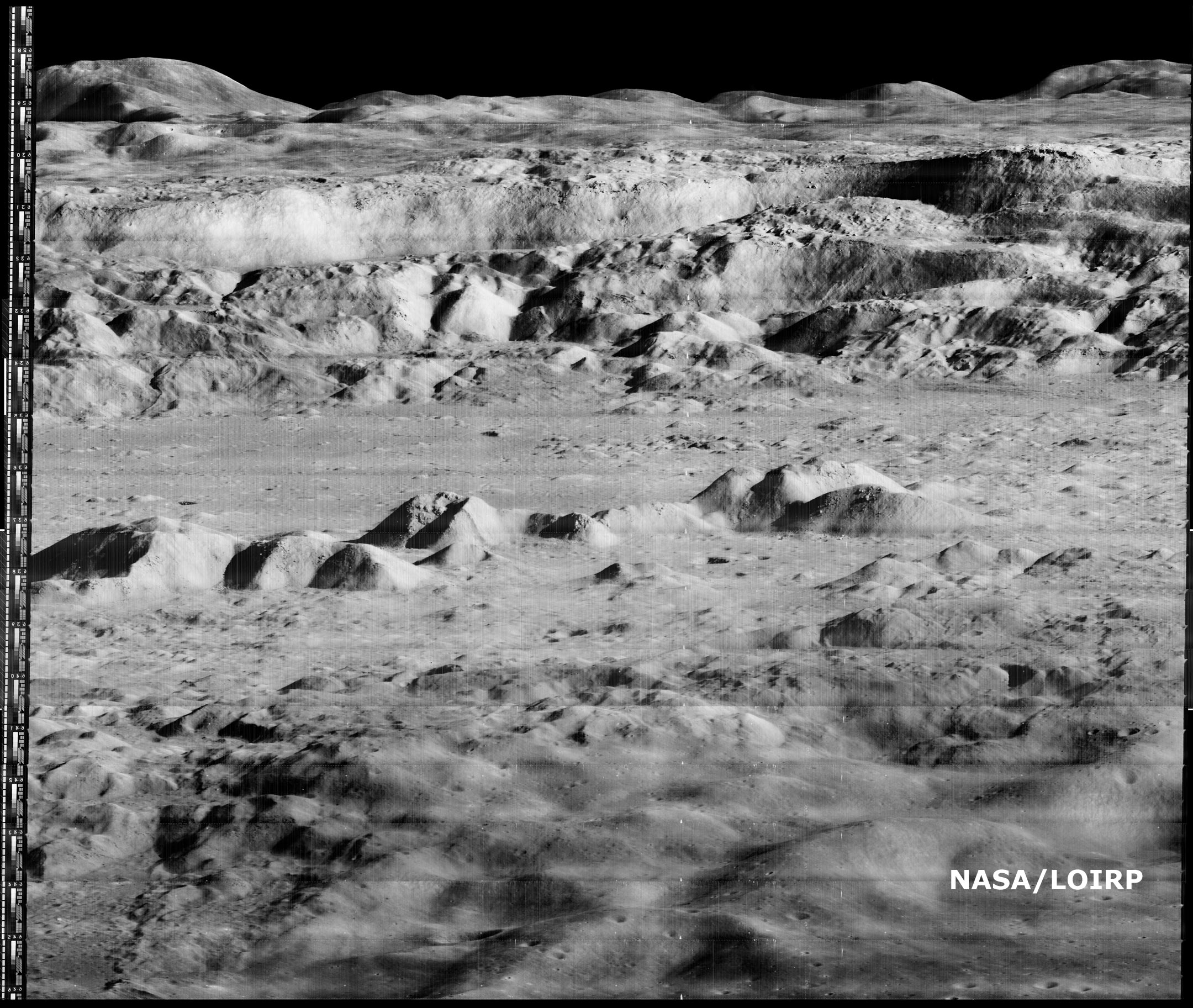
Re:Irony
A larger, raw version (2.2 GB in size) is now online at NASA's Lunar Science Institute.
-
Re:Irony
Here's a nice hi-res image: http://images.spaceref.com/news/2009/lo2.copernicus.med.jpg
Approx 2160px × 1825px and 700 kbAnd if you're really brave, there's a 2gb scan online!!!
http://lunarscience.arc.nasa.gov/files/LOVframe162h3.tifI imagine that might take awhile to load into your browser. I can't imagine pictures being posted online in the gigabyte range... maybe 50 years from now that will be a standard porn format, who knows o_O
-
We can see through it
Heres's how: SOHO
-
Re:A little help
(re: Pizza hut advertising on a NASA rocket http://www.spaceref.com/news/viewpr.html?pid=2202 [spaceref.com])
Off topic to the article, but to your point about sponsors... KFC is actually spending money to fill pot holes and spray-paint their logo on them. Complete with Col. Sanders standing around with a bright green jacket.
-
A little help
To be honest, I've never really understood how the pro gaming leagues really made any money. I understand that sponsors will give money to anything (re: Pizza hut advertising on a NASA rocket http://www.spaceref.com/news/viewpr.html?pid=2202), but this is no excuse. At the very most I'm indifferent about how well other people play the games I play, and I'm pretty sure most of my friends are the same way. The economy is just a useful scapegoat in this situation. Let's take a survey: How many of you enjoy watching other people play video games? How many of you have dismissed players that dominate you as having spent way too much time playing video games? What's your favorite kind of cheese? I'm partial to those Kraft American Singles.
-
Look, we're gonna have to do this...
...so let's do it right the first few times:
1. Send up a net to catch the big stuff. The size of the net and opening determines how many nets we send up. throw the net at Earth. Stuff burns up. The final net will probably more like mesh. On to step 2.
2. Send up a disk of Aerogel. We did this on a smaller scale to capture comet debris. We don't need to get this one back, it can burn up when we throw this at Earth also. But if it doesn't burn, just aim it at the Pacific. Or Russia, some if it is their stuff after all. I live to close to the Iridium home, so that's out of the question, right?
3. Mop up the remainder with variations on the theme.
4. Profit!
We're gonna have to do it. Let's do it right. And we will learn a lot about LEO maneuvering, targeting, robotics in space, etc. We can let the Chinese or the Russians, or the Japanese join in, maybe even Canada or India, some nations that wanna learn space stuff. And we could probably get some commercial outfit to bid on it.
This is a tremendous opportunity, actually. A few $B should cover it. We spend that every week on landfills. Let's just do it.
-
Not a new concept
New Mexico did it first. Pluto has been a planet to anyone entering the state of NM since 2007. http://www.spaceref.com/news/viewsr.html?pid=23558
-
Re:What's the contingency for these missions?
What sort of contingency do they have for sats like this? Do they just fabricate another one and try again in a year or two?
dunno but:
WASHINGTON - NASA's Orbiting Carbon Observatory failed to reach orbit this morning after a 4:51 a.m. EST liftoff from Vandenberg Air Force Base in California. A media briefing on the mishap has been tentatively scheduled for 7:15 a.m. from Vandenberg. The briefing will be carried on NASA TV.
It's now 0614 PST. Did anyone catch the media briefing? The only evidence I can see that the beeb was even aware of it is the line Nasa officials confirmed the launch had failed at a press conference held at 1300 GMT. But there is zero information in this article that you could not have gathered from other sources - the author of the bbc article obviously tapped a couple of sources, read some other articles (the link I place above, the OCO mission page, and others) and spit out a piece of trash we could have done without. Thanks, BBC! Your contribution to mainstream news will be forgotten in the mists of time. I hope.
-
Re:No, it's not the end
Eh, no. Its practically dead. Thats why every delay to this service mission is so critical - if another couple of gyros go, it won't even be able to orient itself well enough to allow the astronauts to get up close. As it is, most of its main instruments are currently out of action.
-
Unlikely that Evergreen will get one
I can't find the original information, but I'm pretty sure the allocation of the shuttles won't be soley based on cash, but also on perceived value to the public for receiving one and consistency with the general mission of the museum. Keep in mind, the $42 million is supposedly for refurbishment for display, not to raise additional money. This first of all will mean cleaning up any potential hazards, like residues of hydrazine manuevering fuel. Of course, they get fairly weathered by each launch and re-entry, so there'll be some polishing to be done, and undoubtably ITAR-sensitive or high value equipment like the main engines will be removed and replaced with detailed replicas where applicable.
There's three orbiters surviving (Discovery, Atlantis, and Endeavor). I suspect Kennedy Space Center will keep one and house it near their Saturn V that's on display. This is consistent with another article that says two orbiters and six engine display kits will be made available according to the RFI. With public accessibility being a likely major consideration, the Smithsonian Air and Space Museum is almost guaranteed one of the actual orbiters, to replace the Enterprise aerodynamic test vehicle which is currently housed there.
That's going to make it a tough grab for the remaining orbiter. Because McMinneville is roughly an hour-long drive from the relatively small and aerospace-vacant city of Portland, I think their chances of getting an orbiter are relatively slim, even though they have a great facility and can probably afford it.
The Intrepid Museum in New York Harbor is certainly prominent enough, but they would need to make a rather substantial addition to protect the shuttle from the elements. It probably wouldn't be possible to deliver it to the waterfront an SCA flight to New York, but if they wanted to put it on a barge like the Concorde they have on site, they may be able to float it straight up from Florida that way. I think they're also at a disadvantage because there will already probably be two shuttles on the East Coast (Florida and DC).
I think Johnson Space Center in Houstan and Marshall Spaceflight Center in Huntsville are the two most likely locations not on one of the major coasts. Both of them already host two of the three remaining Saturn V's (the third is at Kennedy). On the west coast, I think the lead option is Boeing's museum of flight, partially because of their accessibility and ability to host a space shuttle, but also because of their involvement with the shuttle program (although that is due to their acquisition of Rockwell).
I would bet one of these three locations will get the third orbiter. That still leaves Enterprise after it leaves the Smithsonian, which only did glider and procedural tests, but would still be a major attraction. Maybe Evergreen has a chance at getting Enterprise, but I think more likely a second of the above three will get her. There is also a ground-test mockup called Pathfinder currently at MSFC in Huntsville that would likely get a new home if one of the orbiters went there, but it's only externally representative of the flight vehicles.
A commenter on another site had a fantastic idea, in my opinion: before sending the last of the orbiters to a musuem, use the SCA to take it on a tour of the US. This would be a great opportunity for millions to see it and the modified 747 together. -
UCLA had this years ago..
Wow this is old news. Our galaxy with the black hole center was identified at UCLA years ago; http://www.astro.ucla.edu/research/galcenter/ http://www.spaceref.com/news/viewpr.html?pid=18712 tag-redundant
-
Re:I love the space program but ...
I actually agree with you. NASA has a lot of value to the country that people really do not see! There's lots of factors why, and NASA shares a little bit of the blame in that PR could be done a lot better - but overall it's been a constant problem that people don't see the end product of all their government-sponsored research dollars.
There's some good sites online though, that have lists of NASA Spinoff technology:
http://www.thespaceplace.com/nasa/spinoffs.html
http://www.nasa.gov/topics/nasalife/index.html
http://www.spaceref.com/news/viewpr.html?pid=26661
I know I'm starting to sound like a shill at this point, but when you really believe in something, that's a risk you end up taking.
-
Global rethink and reset
Our whole space program needs a general rethink. We have two big programs, flight to the Moon and Mars, that were started by Bush without a lot of thought, we have the ISS which is ready for experiments that we do not have money to fly - such as Samuel Ting's very interesting cosmic anti-matter detector, and we are canceling ready-to-go missions such as the SIM planet finder to pay for new stuff that is frankly never likely to happen.
We do not have a coherent space program, and so we are wasting much of our money. Fixing this will not be easy, but it is very urgent in my opinion.
-
Re:delta-v
Moving around in space is all about changing your velocity. There are a number of ways to effect that change - gravitational slingshot, aerobraking, big sails, thrusters
The most efficient time/location to make orbital adjustments is apogee or perigee. If you enter into a highly eliptical orbit and wish to circularize at a much lower altitude using only a fractional-Newton thruster, yeah, it'll take a while. MESSENGER has a 650N main thruster, but only about 600kg of propellant. That equates to "not a lot" of thruster time. The main engine has a Specific Impulse (Isp) of 318 seconds. On Earth, you'd get about 318 seconds (5+ minutes) of operation. That gravitational element doesn't really apply out in space, so the available thrust-time will be longer. The NASA PDF indicates that the final orbital insertion burn will consume 30% of the propellant, and will last about 14 minutes. Extrapolating, that indicates that MESSENGER has about 42 minutes of propellant on board.
There's also a nice explanation of the orbital maneuvers on the JHUAPL website, and also a nice PDF showing the orbital insertion cost plots. -
Re:NASA getting desperate for PRYou're right, sort of.
If one of the astronauts wants to play chess by mail, that's fine.
They actually did a game over the summer between Mission Control and Chamitoff, which ended with MCC resigning on 8-13: http://www.nasa.gov/mission_pages/station/expeditions/expedition17/chess_chamitoff.html.
Regarding the PR stunt, yes, it is one because it's try to draw lot's of attention, but so is every outreach program run by any kind of organization.
Part of NASA's mission, to quote Michael Griffin, is that "NASA is in the inspiration business." (http://www.spaceref.com/news/viewsr.html?pid=29218) That in itself is PR.
Space exploration needs to be on the forefront of science, along with things like the LHC, etc. Our country is on a decline on the science, technology, and innovation front. Our government has let it go by the wayside (see http://www.spaceref.com/news/viewsr.html?pid=29133 specifically for the space program), and too much of Generation Y is ignoring science, going into "soft" fields (preaching to the choir).
Like I said, NASA needs to inspire more young children to get into science and technology. If what it takes is a "PR stunt" like this, then so be it. Sure, NASA benefits from it, but the real beneficiaries, if it works out right, are the children, and by extension, future society. -
Link to the leaked memo
I didn't see a link to the memo, here it is: