Slashdot Mirror
Domain: spaceweather.com
Stories and comments across the archive that link to spaceweather.com.
Stories · 39
-
The Recent Changes In Earth's Magnetic Field (esa.int)
Europe's Swarm constellation of satellites have documented bigger-than-expected changes that have been occurring in the Earth's magnetic field. Earlier this year SpaceWeather.com reported that the data show clearly that "the field has weakened by about 3.5% at high latitudes over North America, while it has strengthened about 2% over Asia. The region where the field is at its weakest -- the South Atlantic Anomaly -- has moved steadily westward and weakened further by about 2%. These changes have occurred over the relatively brief period between 1999 and mid-2016."
Science writer Robert Zimmerman reports: It was already known that the field has weakened globally by about 10% since the 19th century. These changes appear to be part of that generally weakening. Some scientists have proposed that this is the beginning of an overall flip of the magnetic field's polarity, something that happens on average about every 300,000 years and last occurred 780,000 years ago. At the moment, however, we have no idea if this theory is correct. -
Most Powerful Geomagnetic Storm of Solar Cycle 24 Is Happening
astroengine writes: The most powerful solar storm of the current solar cycle is currently reverberating around the globe. Initially triggered by the impact of a coronal mass ejection (CME) hitting our planet's magnetosphere, a relatively mild geomagnetic storm erupted at around 04:30 UT (12:30 a.m. EDT), but it has since ramped-up to an impressive G4-class geomagnetic storm, priming high latitudes for some bright auroral displays. -
Amateur Astronomers Spot Jovian Blast
RocketAcademy writes "Spaceweather.com reports an explosion on Jupiter, which was detected by two amateur astronomers. According to Spaceweather.com, the event occurred at 11:35 Universal Time on September 10. Dan Peterson of Racine, Wisconsin, observing through a 12-inch Meade telescope, observed a white flash lasting for 1.5-2 seconds. George Hall of Dallas, Texas was capturing a video of Jupiter at the time, which also captured the event. It's believed that the explosion was due to a comet or small asteroid collision. Similar events were observed in the past, in June and August 2010." -
Solar X-Flare Blasts Directly Toward Earth
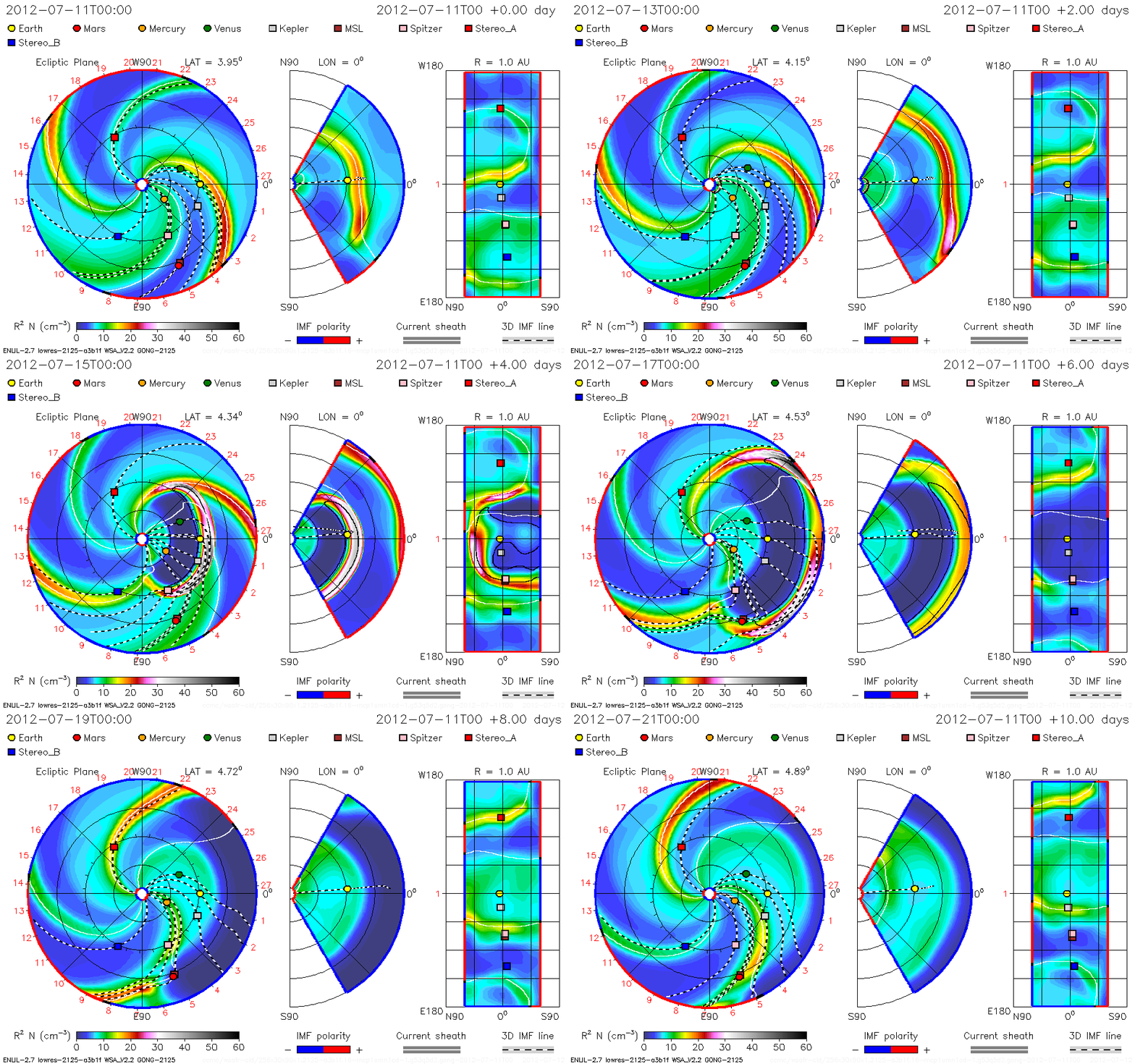
Freshly Exhumed writes with this excerpt from Space Weather: "Big sunspot AR1520 unleashed an X1.4-class solar flare on July 12th at 1653 UT. Because this sunspot is directly facing Earth, everything about the blast was geoeffective. For one thing, it hurled a coronal mass ejection (CME) directly toward our planet. According to a forecast track prepared by analysts at the Goddard Space Weather Lab, the CME will hit Earth on July 14th around 10:20 UT (+/- 7 hours) and could spark strong geomagnetic storms. Sky watchers should be alert for auroras this weekend." -
Asteroid the 'Size of a Minivan' Exploded Over California
astroengine writes, quoting Discovery: "The source of loud 'booms' accompanied by a bright object traveling through the skies of Nevada and California on Sunday morning has been confirmed: it was a meteor. A big one. It is thought to have been a small asteroid that slammed into the atmosphere at a speed of 15 kilometers per second (33,500 mph), turning into a fireball, delivering an energy of 3.8 kilotons of TNT as it broke up over California's Sierra Nevada mountains. Bill Cooke, head of NASA's Meteoroid Environment Office, classified it as a 'big event.' 'I am not saying there was a 3.8 kiloton explosion on the ground in California,' Cooke told Spaceweather.com. 'I am saying that the meteor possessed this amount of energy before it broke apart in the atmosphere. (The map) shows the location of the atmospheric breakup, not impact with the ground.' Interestingly, this event was bigger than asteroid 2008 TC3 that exploded over the skies of Sudan in 2008 after being detected before it hit." -
Large Solar Flare To Glance Off Earth
JoeRobe writes "According to spaceweather.com, a major X5 solar flare is on its way to deliver a glancing blow to the Earth's magnetic field. This is the second x-class flare to be released by the same sunspot in the past few days, the first being an X1. In both cases, the sunspot (spot 1429) was not directly facing Earth, but it is still active, and poses a threat for a large, Earth-directed flare in the next few days." -
Solar Eruption Triggers Strongest Radiation Storm
ForgedArtificer writes "A recent eruption on the sun will be exposing Earth to the strongest radiation storm seen since 2005. [The storm] will potentially disrupt communications and put high-flyers at risk of radiation exposure." Says Spaceweather.com: "On the NOAA scale of radiation storms, this one ranks S3, which means it could, e.g., cause isolated reboots of computers onboard Earth-orbiting satellites and interfere with polar radio communications." According to the Christian Science Monitor, "NOAA's Space Weather Prediction Center has issued a geomagnetic storm watch, and the agency's deputy, Kathy Sullivan, said that polar flights are expected to be re-routed." -
Epic Geomagnetic Storm Erupts
astroengine writes "On Monday, at around 2 p.m. ET, a coronal mass ejection (CME) slammed into the Earth's magnetosphere. For a short time (between 3:06 p.m and 3:11 p.m. ET), energetic solar wind particles penetrated as deep as geosynchronous orbit — home to hundreds of communication satellites. As a consequence, a geomagnetic storm is underway, generating bright aurorae across very low latitudes." Adds reader dtmos, quoting from Spaceweather, which also has a beautiful photo gallery: "'The impact strongly compressed Earth's magnetic field, directly exposing geosynchronous satellites to solar wind plasma, and sparked an intense geomagnetic storm. As night fell over North America, auroras spilled across the Canadian border into the contiguous United States.' Aurora were seen as far south as Baileyton, Alabama." -
Epic Geomagnetic Storm Erupts
astroengine writes "On Monday, at around 2 p.m. ET, a coronal mass ejection (CME) slammed into the Earth's magnetosphere. For a short time (between 3:06 p.m and 3:11 p.m. ET), energetic solar wind particles penetrated as deep as geosynchronous orbit — home to hundreds of communication satellites. As a consequence, a geomagnetic storm is underway, generating bright aurorae across very low latitudes." Adds reader dtmos, quoting from Spaceweather, which also has a beautiful photo gallery: "'The impact strongly compressed Earth's magnetic field, directly exposing geosynchronous satellites to solar wind plasma, and sparked an intense geomagnetic storm. As night fell over North America, auroras spilled across the Canadian border into the contiguous United States.' Aurora were seen as far south as Baileyton, Alabama." -
Epic Geomagnetic Storm Erupts
astroengine writes "On Monday, at around 2 p.m. ET, a coronal mass ejection (CME) slammed into the Earth's magnetosphere. For a short time (between 3:06 p.m and 3:11 p.m. ET), energetic solar wind particles penetrated as deep as geosynchronous orbit — home to hundreds of communication satellites. As a consequence, a geomagnetic storm is underway, generating bright aurorae across very low latitudes." Adds reader dtmos, quoting from Spaceweather, which also has a beautiful photo gallery: "'The impact strongly compressed Earth's magnetic field, directly exposing geosynchronous satellites to solar wind plasma, and sparked an intense geomagnetic storm. As night fell over North America, auroras spilled across the Canadian border into the contiguous United States.' Aurora were seen as far south as Baileyton, Alabama." -
Rare Midnight Solar Eclipse Caught In the Arctic
Tyketto writes "Wired Magazine has an article posted about a solar eclipse occurring overnight in the Arctic and Scandinavian regions over the night of June 1st and 2nd. They explain: 'During the Arctic summer, the sun dips low on the horizon but never sets. That means a solar eclipse is theoretically possible at any time. But this week's eclipse was the first visible from Scandinavia since 2000, and the deepest since 1985. The next one won't be for another 73 years.' NASA has the details, while NPR also has a small blurb on it, with Tromsø, Norway resident Rhys Jones adding some pictures to Flickr, and SpaceWeather putting together a gallery." -
NASA Records Solar Blast of Epic Proportions
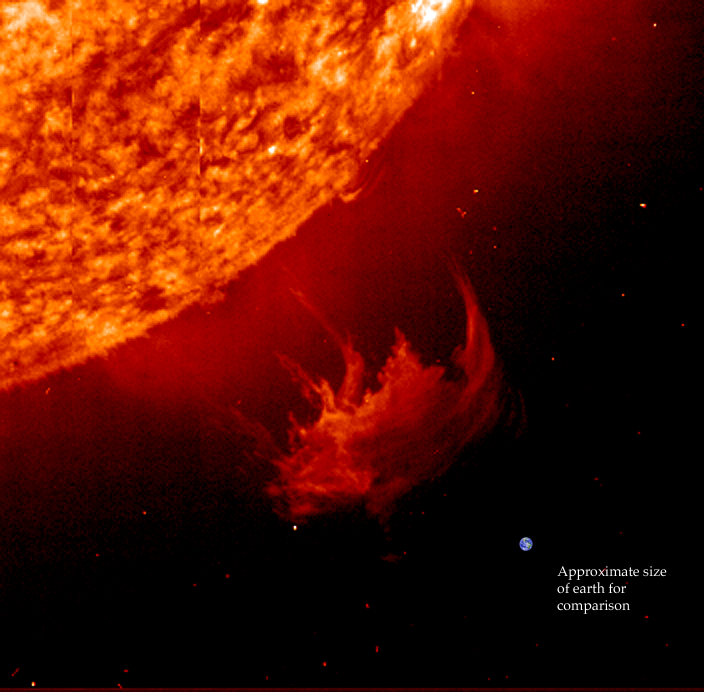
Arvisp writes "As predicted, the a 'mega-filament' of solar magnetism erupted on Dec. 6th, producing a blast of epic proportions. NASA's Solar Dynamics Observatory recorded the action as the 700,000-km long structure lifted off the stellar surface and--snap!!--hurled itself into space. The eruption produced a bright coronal mass ejection (CME) observed by the STEREO-A spacecraft: video. Earth was not in the line of fire; the cloud should sail wide of our planet. Earth-effects might be limited to pretty pictures." -
Impact On Jupiter Observed By Amateur Astronomers
Omomyid and other readers send in the news that the bright flash of an impact on Jupiter has been observed — and caught on film — by amateur astronomers. That WMV is from amateur Christopher Go. Here's Anthony Wesley's video (45 MB AVI; the site is already overloaded). In the larger video you can see the impact lasting for a couple of seconds, and a good deal of structure is visible. The amateurs report that no dark debris field developed around the impact site in the time before it rotated out of sight; this may indicate that the impactor burned up high in Jupiter's atmosphere. Soon professional astronomers, and possibly Hubble, will be on the job. -
Shuttle Reentry Over the Continental US
TheOtherChimeraTwin notes that the shuttle Discovery will land at Kennedy Space Center on Monday morning at 8:48 EDT. The craft will make a rare "descending node" overflight of the continental US en route to landing in Florida. Here are maps of the shuttle's path if is lands on orbit 222 as planned, or on the next orbit. Spaceweather.com says: "...it takes the shuttle about 35 minutes to traverse the path shown... Observers in the northwestern USA will see the shuttle shortly after 5 am PDT blazing like a meteoric fireball through the dawn sky. As Discovery makes its way east, it will enter daylight and fade into the bright blue background. If you can't see the shuttle, however, you might be able to hear it. The shuttle produces a sonic double-boom that reaches the ground about a minute and a half after passing overhead." -
Sunspots May Be Different During This Solar Minimum
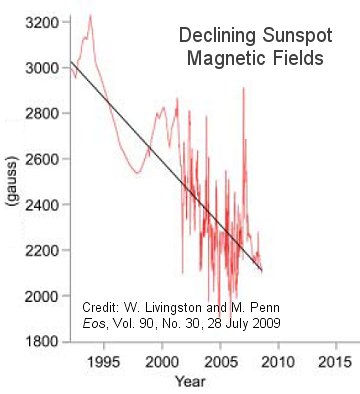
PhreakOfTime writes "According to Bill Livingston and Matt Penn of the National Solar Observatory in Tucson, Arizona, sunspot magnetic fields are waning. The two respected solar astronomers have been measuring solar magnetism since 1992. Their technique is based on Zeeman splitting of infrared spectral lines in radiation emitted by iron atoms in the vicinity of sunspots. Extrapolating their data (PDF) into the future suggests that sunspots could completely disappear within decades." To motivate their interest the researchers mention the Maunder Minimum, which occurred beginning in 1645 and coincided with the coldest part of the so-called "Little Ice Age." Sunspot counts during this period were as low as 1/1,000 of the numbers seen in modern times. -
Dropped Shuttle Toolbag Filmed From Earth
cathector writes "An article at spaceweather.com reports that the toolbag dropped during Heidemarie Stefanyshyn-Piper's spacewalk has been recorded on film from earth: 'When Endeavour astronaut Heidemarie Stefanyshyn-Piper dropped her toolbag during a spacewalk on Nov. 18th and it floated away, mission controllers probably figured they'd seen the last of it. Think again. Last night, Nov. 22nd, veteran satellite observer Kevin Fetter video-recorded the backpack-sized bag gliding over his backyard observatory in Brockville, Ontario. "It was easily 8th magnitude or brighter as it passed by the 4th magnitude star eta Pisces," he says. Spaceweather's satellite tracker is monitoring the toolbag.'" The actual loss of the bag was filmed, too; reader Kagura links in a comment on the original story to this YouTube clip of the bag's escape. -
Dropped Shuttle Toolbag Filmed From Earth
cathector writes "An article at spaceweather.com reports that the toolbag dropped during Heidemarie Stefanyshyn-Piper's spacewalk has been recorded on film from earth: 'When Endeavour astronaut Heidemarie Stefanyshyn-Piper dropped her toolbag during a spacewalk on Nov. 18th and it floated away, mission controllers probably figured they'd seen the last of it. Think again. Last night, Nov. 22nd, veteran satellite observer Kevin Fetter video-recorded the backpack-sized bag gliding over his backyard observatory in Brockville, Ontario. "It was easily 8th magnitude or brighter as it passed by the 4th magnitude star eta Pisces," he says. Spaceweather's satellite tracker is monitoring the toolbag.'" The actual loss of the bag was filmed, too; reader Kagura links in a comment on the original story to this YouTube clip of the bag's escape. -
Water Ice On Mars
cathector sends along a story from SpaceWeather.com on the discovery of water ice on Mars. "Scientists have figured out the mysterious white substance unearthed by NASA's Phoenix lander on Mars. It's frozen water. The breakthrough came last week when Phoenix's stereo camera caught the substance in the act of disappearing. Bathed in martian sunlight for four days, the white substance sublimated — i.e., it transformed from solid to gas without passing through the liquid state. This is how water behaves on Mars.... Some readers have asked, how do we know the white substance is not frozen CO2 (dry ice) instead of frozen water? Answer: Phoenix's landing site is too warm for dry ice. The average daily temperature is about -70 F while dry ice requires temperatures lower than about -109 F." The animated GIF showing the ice sublimating is pretty nice too. -
Water Ice On Mars
cathector sends along a story from SpaceWeather.com on the discovery of water ice on Mars. "Scientists have figured out the mysterious white substance unearthed by NASA's Phoenix lander on Mars. It's frozen water. The breakthrough came last week when Phoenix's stereo camera caught the substance in the act of disappearing. Bathed in martian sunlight for four days, the white substance sublimated — i.e., it transformed from solid to gas without passing through the liquid state. This is how water behaves on Mars.... Some readers have asked, how do we know the white substance is not frozen CO2 (dry ice) instead of frozen water? Answer: Phoenix's landing site is too warm for dry ice. The average daily temperature is about -70 F while dry ice requires temperatures lower than about -109 F." The animated GIF showing the ice sublimating is pretty nice too. -
Comet McNaught Visible in Broad Daylight
AbsoluteXyro writes "As the amateur astronomers among us already know, Comet McNaught has been gracing the early morning and late evening skies... as it approaches the Sun, some estimate it has the potential to become 40 times brighter than Venus, or a magnitude of -8.8! In fact, it has recently been reported at SpaceWeather.com that Comet McNaught is now visible in broad daylight! From the article: "It's fantastic," reports Wayne Winch of Bishop, California. "I put the sun behind a neighbor's house to block the glare and the comet popped right into view. You can even see the tail."" -
NASA Notices New, Nasty Solar Storm Type
saskboy writes "Solar Storms generally aren't this bad, but in January unique conditions led to a "proton superhighway" that bombarded earth with fast moving protons that could have harmed astronauts caught without a radiation shield. "Scant minutes after the January 20th [2005] flare, a swarm of high-speed protons surrounded Earth and the Moon. Thirty minutes later, the most intense proton storm in decades was underway." Listen to the story here. Archives from the January storms are also available from SpaceWeather.com" -
Space Weather Warning
SallyMac writes "The National Oceanic and Atmospheric Administration has issued a Space Weather Warning. On Friday, May 13th, NOAA detected a 'geomagnetic storm of extreme proportions'. From the article: 'This event registered a 9 on the K-Index, which measures the maximum deviation of the Earth's magnetic field in a given three-hour period...The scale ranges from 0 to 9, with 9 being the highest. This was a significant event.' See the article on the NOAA site for more information." Spaceweather.com has details on the resulting auroras. -
X7-class Solar Event Detected
SlySpy007 writes "Spaceweather.com is reporting on an enormous solar event which took place earlier this evening. This event, emanating from the gigantic sunspot 720, registered as an X7-class event, and increased the 24-hour probability of a minor geomagnetic storm to 60% in mid-latitudes (70% in high latitudes). The GOES-12 satellite happened to catch this event with its SXI instrument (Solar X-ray Imager), and there's a pretty gnarly animation of the event from 720 over at the SXI site. I know this is gonna cause havoc for plenty of missions in orbit now; wonder if we'll see any disturbance here on terra firma." Another reader points to ground-based monitoring stations detecting a surge in cosmic rays at the time of the flare. -
The Lyrids Are Coming!
SeaDour writes "The year's first meteor shower, the Lyrids, will peak in the pre-dawn hours of April 22nd when the Earth plows through the debris trail of Comet Thatcher at a relative velocity of 49 km/s (110,000 mph). Lyrids usually aren't as numerous as other showers (such as the famed Leonids), but they're well-known for their spectacular tails; you can expect to see about 5-20 meteors per hour, depending on the severity of your local light pollution. Unfortunately, my current location in the midwest under stormy skies puts me at a bit of a disposition, but hopefully some other Slashdotters can share their observations with us tomorrow." -
A Comet To Watch
Anonymous Coward writes "Ever since comet Hale-Bopp I have been waiting for a new, bright(as in visible to the naked eye), comet. It seems that my wait may have come to an end. Recently discovered comet C/2002 X5 can currently be seen by northern sky watchers through a telescope. It is predicted that it will brighten considerably (magnitude -3) in late January. Let's hope it lives up to expectations. Spaceweather.com has the whole story." -
Today's Solar Flare
An anonymous reader writes "X1-class solar flare today (13:30 Universal Time). Still the SOHO spacecraft offers some of the all-time greatest snapshots anywhere on the web. The flare's residual activity would be shown white and at around 9 o'clock position here. There are 3 major categories, each 10 times stronger than the next: X-class flares are big; they are major events that can trigger planet-wide radio blackouts and long-lasting radiation storms. M-class flares are medium-sized; they generally cause brief radio blackouts that affect Earth's polar regions. C-class flares are small with few noticeable consequences here on Earth. If it were headed towards Earth, arrival is usually 48-72 hrs later (this is not coming this way). Future Mars astronauts should take a lead umbrella because one radiation day on Mars is like living at 70,000 feet on Earth." Nature is pretty. -
Ikeya-Zhang Now Visible
-
Incoming Coronal Mass Ejection == Pretty Aurora
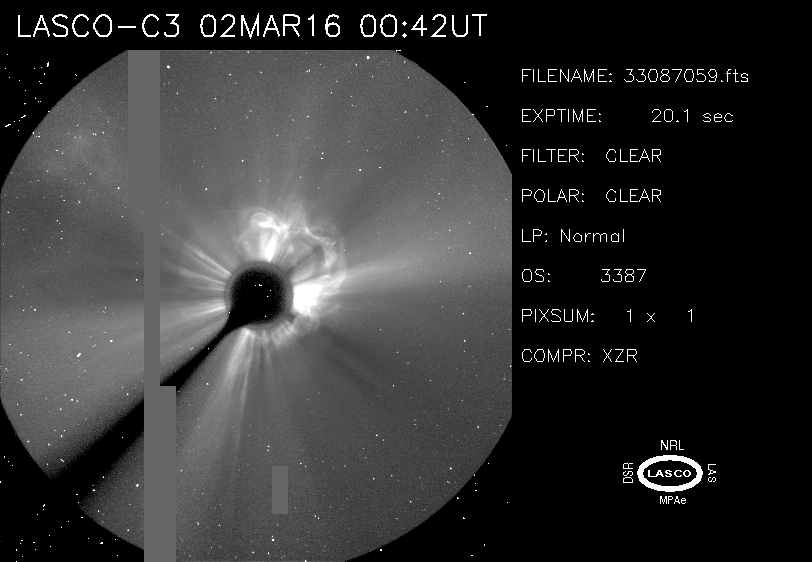
Bill Kendrick writes: "SpaceWeather.com reports that a recent coronal mass ejection on the sun (photo) will be hitting the earth tonight and tomorrow night, causing midnight auroras in northerly points. The moon being a crescent will help, too. Check the skys around midnight, wherever you are." -
Incoming Coronal Mass Ejection == Pretty Aurora
Bill Kendrick writes: "SpaceWeather.com reports that a recent coronal mass ejection on the sun (photo) will be hitting the earth tonight and tomorrow night, causing midnight auroras in northerly points. The moon being a crescent will help, too. Check the skys around midnight, wherever you are." -
Geminid Meteor Shower
Inferno Intelligence writes: "spaceweather.com is reporting that there will be another meteor shower real soon. They are reporting that '[t]he shower [will] peak on Dec. 13th and 14th!' 'What are the Geminid meteors? Scientists aren't sure. Perhaps chips off an exotic asteroid or dust from an extinct comet.' After last months Leonid Shower, I won't miss this one!" Since I slept through the Leonids, I hope I don't miss this one, too. -
First-hand Account Of The Leonid Shower
chongo writes: "The Leonid meteor shower certainly lived up to its hype this year. At Fremont Peak, CA (USA) we saw a peak rate of 2408 meteors/hour. We saw many bright fireballs. During the peak (18 Nov 2001 1015-1130 UTC) there were frequent instances where multiple meteors were visible. Because of this, we suspect the true rate was likely higher than 2500/hr." We've also heard from several folks who were foiled by weather, but it's good that at least some people got the full show. Update: 11/18 17:09 GMT by T : BrianGa writes: "If you missed the show, like I did, you can see some still pictures and animated pictures." He also points to a site with a preliminary graph of the number of meteors visible on November 18th. -
Northern Lights Not So Northern
Several readers have written with news of an unusual display of the Aurora Borealis, among them Georgie Porgie, who writes: "Crawl away from those terminals and step out side for a view of the norther lights... I am in Columbia, Missouri, USA Approx 39.9 N latitude and I am looking at the northern lights... Hope the networks are up tommorow... See what causes the lights at http://www.spaceweather.com/" fjordboy points to this excellent noaa.gov link, too. -
Aurora Alert During The Nights Ahead
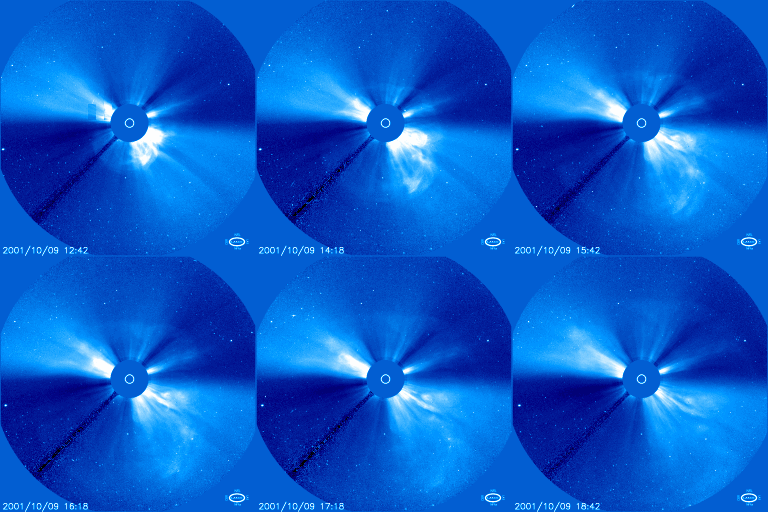
Jens Lönn writes: "Magnetic fields above sunspot 9653 erupted yesterday (Oct. 9th at 1110 UT) and hurled a full-halo coronal mass ejection toward Earth. The expanding cloud, which speed away from the Sun traveling approximately 1000 km/s, could strike our planet's magnetosphere as soon as Thursday, Oct. 11th. Sky watchers, especially those living above geomagnetic latitude 50 degrees, should remain alert for Northern Lights during the nights ahead. The best time to spot auroras is usually around local midnight. Note: This is not an alert for a geomagnetic storm, it's just an alert for those who wants to watch great auroras at night." -
Aurora Alert During The Nights Ahead
Jens Lönn writes: "Magnetic fields above sunspot 9653 erupted yesterday (Oct. 9th at 1110 UT) and hurled a full-halo coronal mass ejection toward Earth. The expanding cloud, which speed away from the Sun traveling approximately 1000 km/s, could strike our planet's magnetosphere as soon as Thursday, Oct. 11th. Sky watchers, especially those living above geomagnetic latitude 50 degrees, should remain alert for Northern Lights during the nights ahead. The best time to spot auroras is usually around local midnight. Note: This is not an alert for a geomagnetic storm, it's just an alert for those who wants to watch great auroras at night." -
Aurora Alert During The Nights Ahead
Jens Lönn writes: "Magnetic fields above sunspot 9653 erupted yesterday (Oct. 9th at 1110 UT) and hurled a full-halo coronal mass ejection toward Earth. The expanding cloud, which speed away from the Sun traveling approximately 1000 km/s, could strike our planet's magnetosphere as soon as Thursday, Oct. 11th. Sky watchers, especially those living above geomagnetic latitude 50 degrees, should remain alert for Northern Lights during the nights ahead. The best time to spot auroras is usually around local midnight. Note: This is not an alert for a geomagnetic storm, it's just an alert for those who wants to watch great auroras at night." -
Radiation Storm Lets You Listen Long-Distance
bubblegoose writes: "There is a large radiation storm in progress caused by a solar flare on the backside of the Sun. Here's a story from Spaceweather. It has a pretty cool effect on radio signals. I was picking up a 6000 Watt North Carolina FM station from near Philly." Bubblegoose also brings you this link to dxing.com, a site all about listening in when freak atmospheric conditions create unusual RF propagation patterns. -
Solar Activity, Northern Lights
GehRehmee writes: "Just a few weeks after the sun's peak in its 11 year cycle, two large CME's (Coronal Mass Ejections) occured on the surface of the sun. Now, as the effects of those eruptions reach earth, we're experiencing an excellent season of aurora, or "Northern Lights". Fantastic red aurora are being reported as far south as central California, and amateur and professional astronomers as far south as 40 degrees latitude are on watch. SpaceWeather.com has all the breaking news, as well as details of the CME's which occurred earlier this week. Take a step outside, get some fresh air, and enjoy the sky. You might just be treated to a rare astronomical opportunity." Maybe people can post links to some of the prettier pictures for those of us (cough, cough) who live in light-polluted cities. -
Another Solar Storm Approaching
RZG writes: "Aurora might be visible again across the mid-latitude portions of the U.S. and Europe, thanks to the CMEs (coronal mass ejections) associated with two powerful X class solar flares, and some smaller flares. The activity may begin in the next few hours, and last up to several days. The NOAA predicts another G3 class storm. Watch Spaceweather.com, the NOAA's space weather forcast, or this solar activity report for more information. The geomagnetic storm could cause power and satellite failures." -
Solar Flare vs. Plasmasphere
The appropriately-named Nova Express informs us, "According to the Space Weather Page, 'A powerful X-class solar flare erupted...today at 1530 UT. The flare could trigger radio blackouts and high radiation levels in low-earth orbit...the leading edge of the disturbance will trigger geomagnetic storms when it passes by Earth in 30 - 45 hours.'" Coincidentally, Tei'ehm Teuw passed along this article showing what it'll collide with when it gets here: our plasmasphere, the shell of ions and electrons lying at the top of our atmosphere and extending far out into space. This press release has some amazing photos and movies taken by an equally amazing satellite.