Slashdot Mirror
Domain: stanford.edu
Stories and comments across the archive that link to stanford.edu.
Comments · 4,853
-
Re:The original Google storage server
GigsVT, I've modded you up enough times to respect your opinion.
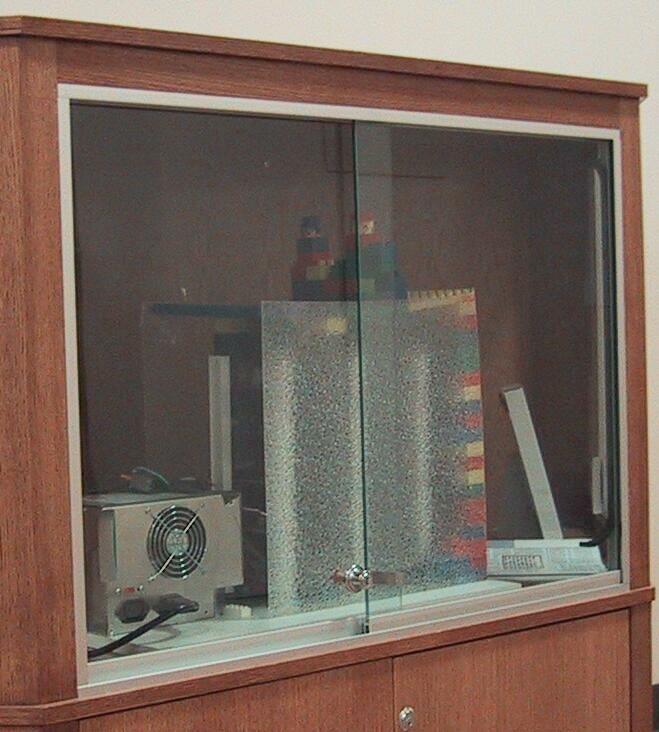
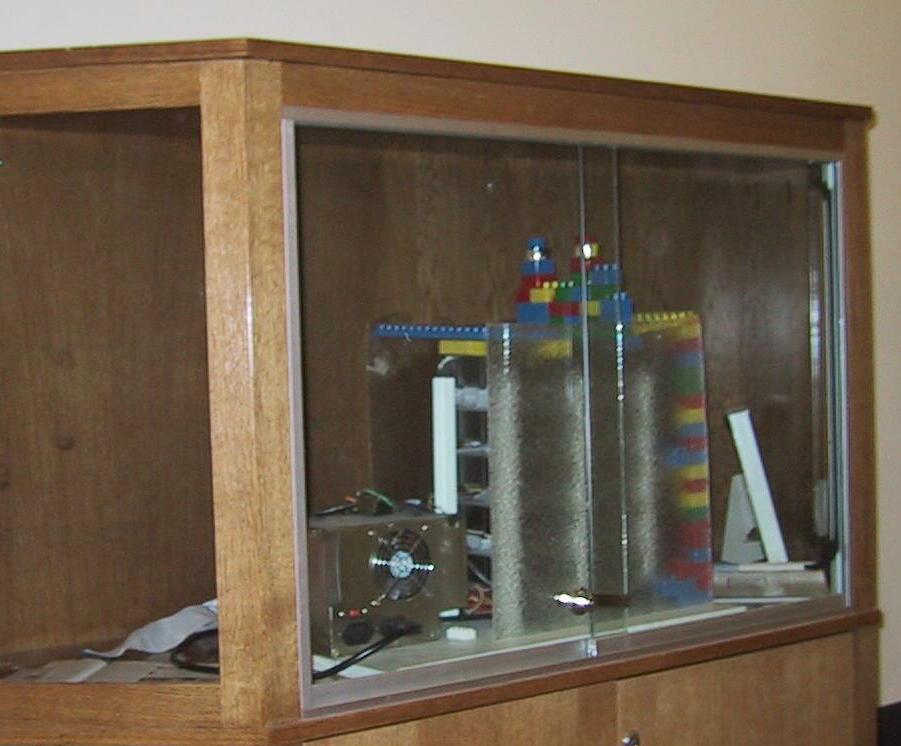
If you can honestly look at this picture and tell me that the blur that stretches all the way into the computer monitor is part of the lego case, I'll believe you.
Admittedly, looking at this picture, it appears that the lock on the display case is not blurred, supporting your theory, and maybe that first picture is because they reduced the size/aspect ratio of the RAID array, but not the plexiglass/glass.
The root of my question, I suppose, is why is the front of the array semi-transparent? Is there a censored joke in there? Some sort of concern about light patterns? Perhaps it was just the material that was available at the time. Whether it's Photoshop or a diffusing sheet isn't really the source of my curiosity.
-
Re:when I was littleBut will the results be public domain?
See here.
Folding@home is run by an academic institution (specifically the Pande Group, at Stanford University's Chemistry Department), which is a non-profit institution dedicated to science research and education. We will not sell the data or make any money off of it.
the raw data of the folding runs will be available for everyone, including other researchers, here on this web site
-
Re:The original Google storage server
Okay, I looked at it. Heck, for the sake of argument, let's say that I'll believe Google started business made out of Legos.
Can you tell me why the heck there are always blurs of one type or another shielding the front of the box from view?
-
Re:The original Google storage server
Okay, I looked at it. Heck, for the sake of argument, let's say that I'll believe Google started business made out of Legos.
Can you tell me why the heck there are always blurs of one type or another shielding the front of the box from view?
-
Re:The original Google storage server
Okay, I looked at it. Heck, for the sake of argument, let's say that I'll believe Google started business made out of Legos.
Can you tell me why the heck there are always blurs of one type or another shielding the front of the box from view?
-
Maybe wearable servers are the answerStanford Wearable Servers.
Name says it all!
-
The original Google storage server
Check it out here.
This is by far to custom case I've ever seen.
Look a bit dangerous though -
Re:when I was little
Why not protien folding or cures for cancer? Some because there is no Linux client.
Click here. -
Re:What are you going to do? Beat cancer!
I'd *love* to switch from SETI to the cancer research program, but I'm definitely not switching to Windows to do it!
There are Linux and MacOSX clients for Folding@Home, other Unices like Solaris, IRIX and AIX are coming as soon as they port them.
-
Re:What are you going to do? Beat cancer!
You could donate to the Protein Folding project. They have a linux client. It goal is to aid research to help understand diseases including Alzheimer's, Mad Cow (BSE), CJD, ALS, and Parkinson's disease
-
Re:Let's try this instead
-
Re:Let's try this instead
-
Re:when I was little
-
Re:What are you going to do? Beat cancer!
I'd *love* to switch from SETI to the cancer research program, but I'm definitely not switching to Windows to do it!
Not sure what OS you are using, but if it's Linux or MacOS, folding is a go for you. See the
client download page. Studying protein folding is maybe not as directly aimed at curing diseases as Cure Cancer@Home, but odds are that if we understand folding better, a good antibody or two (or more efficient means of looking for them) will spring off.
Alex
-
Worthwhile distributed computing
The more I see worthwhile DC projects out there like ECCp-109, Folding at home, and now ClimatePredition.net, the more I think I should participate in these rather than SETI@home (which I've been doing for 3+ year)
Maybe it just comes down to what can aid humanity vs. what is simply a shot in the dark. -
What will you do?
-
Lessig is in front of the Supreme Court over this
Lessig is presenting the Eldred v. Ashcroft case in front of the Supreme Court right now. His intent is to overturn the Sonny Bono Copyright Term Extension Act, which has added 20 years. Lessig is the only publicly visible person I've seen who's actively fighting against copyright abuse.
-
Your post may be the point
I don't mean to be thick-headed about such matters, nor to impugn your programming abilities, but I'm wondering if the impossibility of applying all that theory is perhaps a limitation of the real. I suppose I might explain that a bit more.
I think you're right that much theory cannot be practically applied, but as Jean Baudrillard (postmodernist philosopher who disavows postmodernism altogether [all links about Baudrillard]) writes in The Ecstasy of Communication, "The status of theory could not be anything but to challenge the real."
In other words, theory is meant to challenge what exists, even if what is proposed can't be achieved. So, it makes sense that the challenge of programming theory cannot be taken up by the real of programmnig practice.
Just a thought.
-
Re:Well there we go!
I've been trying to publish a paper about exactly this
I saw the paper named on your website, but couldn't find a copy to read. Any chance you could make it publically available, or does the journal your submitting to have stupid rules? -
Best ways to run clientFor those of you that are interested in participating, but don't like having to deal with the limitations of their client (the console version is cool, but still no where near as nice, imho, as the distributed.net client) you can find some good info on setting them up as services, and running two clients (for all my dual-CPU peeps out there)here. Yeah, it's kind of a pain to set up, but the client is very stable and once you've got this configured, you'll never have to touch it again.
Shameless plug for 2cpu team, ranked 25th & rising!
-
Re:Other uses for Distributed Computing
No, but my google toolbar did popup today and ask if it could use my spare cycles for its Google Compute feature. First beneficiary of my processor and google toolbar? That's right, folding@home.
-
Anonymous is no. 1 kekeke
It would appear that we're not all bad.
Viva la Anonymous Coward! -
Related Link... Folding@Home Download Page
The download page for Folding@Home project can be found here...
-
Folding @ Home page is
-
Links of course
MSNBC Article.
Folding@Home Home
For the real info though check out the Forums
Token link to how my team is doing.
PRIME1 -
Links of course
MSNBC Article.
Folding@Home Home
For the real info though check out the Forums
Token link to how my team is doing.
PRIME1 -
That's it.
I call bullshit on this one.
If the sorting algorithm is so superior, why not post it, so everyone can give critique?
If it's not broken in some manner, i bet Knuth already covered it in his bible on the topic.
Even if it is broken, Knuth probably already covered why.
---
On another note,
if you like "articles" like this one, here's more by Cliff.
Seems Cliff has stood for at least 90% of the "Ask slashdot"s lately, and 100% of the dumb ones. I wonder how many he made up himself.
Still, this is not one of the worst ones.
If you want to block "articles" by Cliff, go here. -
Recommendations for books to take as ones own.
I was going to do a research paper on something similar, but I couldn't find enough scholarly writings on the topic. My paper was going to go through how the music industry and technology interface, and how the technology and contract laws give them large ownership of music, and how if they moved to a digital distribution model (which they could) it would violate their previous business model based on artificial scarcity and monopolistic competition.
I don't know what books you have read but I urge you to read the following two books. I have thoroughly enjoyed reading them and I plan to re-read them as soon as my friends return my copies back to me:
- Lawrence Lessig, The Future of Ideas: The Fate of the Commons in a Connected World (ISBN 0375505784 and 0375726446)
- Siva Vaidhyanathan, Copyrights and Copywrongs: The Rise of Intellectual Property and How It Threatens Creativity (ISBN 0814788068)
Around February 2003 you should be able to find Vaidhyanathan's new book The Anarchist in the Library (ISBN 0465089844) in hardcover. Given how approachable and clearly written Copyrights and Copywrongs is, I fully expect Anarchist in the Library to be worth everyone's while.
Lessig's book is the more scholarly of the two, but that takes away nothing from Vaidhyanathan's excellent book. I would not hesitate to cite, quote, and paraphrase from both of them in any research paper.
In case you're not familiar with Vaidhyanathan and Lessig check out Siva Vaidhyanathan's brief interview on Slashdot a while back. Lawrence Lessig's name might be more familiar as the lawyer who argued Eldred v. Ashcroft before the US Supreme Court on the side of Eric Eldred. Lessig has also done a Slashdot interview.
-
Re:Ok Ok Ok!!!
They probably don't... but these sites do:
http://www.mideastweb.org/palmaps.htm
http://www.un.org/Depts/dpa/qpal/pal_maps.htm
http://www.stanford.edu/~bgiddens/maps.htm
Maybe that will help if you're honest with your question and really wanted to know. -
Re:One word: Knuth. (EOM).
fourth volume info:Knuth
-
Re:So, I found a way...
The answer is clearly explained here. Cheers.
-
Re:Good
AIDS:
FightAids@Home
Cancer:
United Devices
Find-a-Drug
Distributed Folding
Parabon Computation
Bioterrorism Antodotes:
Find-a-Drug
Drug Design Optimization Lab
Other Diseases:
Folding@Home
Genome@Home
Community TSC
Every other distributed computing project that's currently available for you to participate in:
Internet-based Distributed Computing Projects - Active Projects
Kirk
Internet-based Distributed Computing Projects -
Re:Good
AIDS:
FightAids@Home
Cancer:
United Devices
Find-a-Drug
Distributed Folding
Parabon Computation
Bioterrorism Antodotes:
Find-a-Drug
Drug Design Optimization Lab
Other Diseases:
Folding@Home
Genome@Home
Community TSC
Every other distributed computing project that's currently available for you to participate in:
Internet-based Distributed Computing Projects - Active Projects
Kirk
Internet-based Distributed Computing Projects -
YAY
Comedy "give your extra CPU cycles to something that's actually useful" option.
-- Dr. Eldarion -- -
Re:Good
-
Re:Good
-
Re:Question.
Folding and Genome are even more explicit, in that data you process belongs to Stanford and the drug companies bankrolling them.
Really? Please point out where they state this. The FAQ's seem pretty innocuous:
Folding@Home FAQ:
Unlike other distributed computing projects, Folding@home is run by an academic institution (specifically the Pande Group, at Stanford University's Chemistry Department), which is a non-profit institution dedicated to science research and education. We will not sell the data or make any money off of it.
Moreover, we will make the data available for others to use. In particular, the results from Folding@home will be made available on several levels. Most importantly, analysis of the simulations will be submitted to scientific journals for publication, and these journal articles will be posted on the web page after publication. Next, after publication of these scientific articles which analyze the data, the raw data of the folding runs will be available for everyone, including other researchers, here on this web site.
Genome@Home FAQ:
Unlike other distributed computing projects, Genome@home is run by an academic institution (specifically the Pande Group, at Stanford University's Chemistry Department), which is a non-profit institution dedicated to science research and education.
The results from Genome@home will be made available on several levels. First, we put statistics and information about the protein sequences being designed on the web for everyone to see. These are updated daily, and include information about which users contributed which sequences. Second, analysis of the sequences will be submitted to scientific journals for publication, and these journal articles will be posted on the web page after publication. Thirdly, after publication of these scientific articles which analyze the data, the raw data will be available for everyone, including other researchers, here on this web site. -
Re:Question.
Folding and Genome are even more explicit, in that data you process belongs to Stanford and the drug companies bankrolling them.
Really? Please point out where they state this. The FAQ's seem pretty innocuous:
Folding@Home FAQ:
Unlike other distributed computing projects, Folding@home is run by an academic institution (specifically the Pande Group, at Stanford University's Chemistry Department), which is a non-profit institution dedicated to science research and education. We will not sell the data or make any money off of it.
Moreover, we will make the data available for others to use. In particular, the results from Folding@home will be made available on several levels. Most importantly, analysis of the simulations will be submitted to scientific journals for publication, and these journal articles will be posted on the web page after publication. Next, after publication of these scientific articles which analyze the data, the raw data of the folding runs will be available for everyone, including other researchers, here on this web site.
Genome@Home FAQ:
Unlike other distributed computing projects, Genome@home is run by an academic institution (specifically the Pande Group, at Stanford University's Chemistry Department), which is a non-profit institution dedicated to science research and education.
The results from Genome@home will be made available on several levels. First, we put statistics and information about the protein sequences being designed on the web for everyone to see. These are updated daily, and include information about which users contributed which sequences. Second, analysis of the sequences will be submitted to scientific journals for publication, and these journal articles will be posted on the web page after publication. Thirdly, after publication of these scientific articles which analyze the data, the raw data will be available for everyone, including other researchers, here on this web site. -
Re:Question.
The cancer project is being run through United Devices. This is a non-profit project and the data being generated will not be sold to a for-profit firm.
There's also Folding@Home which researches protein folding as well - although instead of only for cancer research it's generally for other medical research such as Alzheimer's, MS, etc. - also non-profit.
There's Genome@Home which analyzes the genome for medical purposes. Non-profit.
And, finally, if you're looking for a generic listing of distributed computing projects, check here. -
Re:Question.
The cancer project is being run through United Devices. This is a non-profit project and the data being generated will not be sold to a for-profit firm.
There's also Folding@Home which researches protein folding as well - although instead of only for cancer research it's generally for other medical research such as Alzheimer's, MS, etc. - also non-profit.
There's Genome@Home which analyzes the genome for medical purposes. Non-profit.
And, finally, if you're looking for a generic listing of distributed computing projects, check here. -
Re:Question.
You can participate in Folding@Home, which uses cycles to study protein folding, misfolding, aggregation, and related diseases. It's run by a Stanford profesor.
-
Re:Open Source Contributions.
Perhaps it's because all the technical people from the East end up in the West?
Look at the listing of graduate students in the CS department of any US university, and you notice a high percentage of them do not appear to be native-born.
examples:
The University of Washington
MIT
Stanford
So, it's not that the East doesn't contribute, it's that Easterners come to the West before they contribute; and who can blame them? Wouldn't you rather be at a well-funded school in an industrialized nation that has the latest equipment than fighting off the roaches while hoping the power doesn't go out to the old VAX in some third-world university? -
Re:P4 1.8GHz?
The original SA Tivo runs on a 55Mghz PPC chip with 16 Meg of RAM.
I would imagine, with quite a bit of certainty, that it additionally has a video compression coprocessor to perform video compression and decompression (see this page which seems to concur, showing separate board chips for video compression and decompression, separate from the CPU), hence leaving the main processor basically as a custodian. I highly suspect this, as 4Mbps MPEG2 compression simply doesn't seem possible on a 55Mhz PowerPC.
Of course Microsoft could just get together with Sigma Designs or such and get some custom hardware to do it much more efficiently, but they probably want programmability (i.e. custom hardware can't adapt when a new codec comes out) -
Re:No, drinking liquid nitrogen is NOT SAFE!
Hm, yeah, I can imagine that if you get this stuff down the throat, you're in deep trouble. Hm, every time I've done it, I have found it completely impossible to get it anywhere near the throat before it evaporates. Douglas Osheroff (nobel laureate in physics) told me that he actually got some nitrogen down the throat when he did this. But I mean, the whole point of the demonstration is to make things look cool, and getting it down the throat makes no impression, because people can't see down your throat. If you only keep it in your mouth, then, it is quite safe. You would have to really work hard to get it down the throat, and that, you obviously shouldn't do. It is not because it is cold, but because liquid nitrogen has, what 700 times? the density of vapor, that's how much it expands.
-
Re:RISC
If you want lots of general purpose registers, take a look at Knuth's MMIX system. Unfortunately, it's not in silicon, but it's there, and it
himi -
Re:Thankyou babel fish
Unless you can follow the frequency hopping scheme, stand close enough, and break the encryption/authentication scheme, it seems quite unlikely.
-
Re:No, computers don't need math
It's actually an odd combination of continuous and discrete mathematcs, hence Concrete Mathematics.
-
Re:No, computers don't need math
programming has little use for math.
Somewhere in Palo Alto, California, God is cringing. Here's why:I am told that the courts are trying to make a distinction between
So maybe most of the math is trivial, but that's not the same as being useless...
mathematical algorithms and nonmathematical algorithms. To a computer
scientist, this makes no sense, because every algorithm is as
mathematical as anything could be. An algorithm is an abstract
concept unrelated to physical laws of the universe.
Nor is it possible to distinguish between "numerical" and
"nonnumerical" algorithms, as if numbers were somehow different from
other kinds of precise information. All data are numbers, and all
numbers are data. -
Wrong! Stanford got a /8 too.
-
Re:Lessig for Supreme Court?
Don't.. feed... the..
Can't do it!
If that's not a jurist's bio , I don't know what is.
Now I could agree that Lessig is not the best candidate for a supreme court appointment, but he is an excellent jurist and lawyer (to the limited extend of his practical experience).