Slashdot Mirror
Domain: teslamotors.com
Stories and comments across the archive that link to teslamotors.com.
Comments · 652
-
Re:Armor
I dunno...
For one thing, a bog standard Tesla already has pretty good protection. The NTSA actually had to make up new tests to find any kind of limits to the thing. For example, when they tried doing standard crashes into poles, it kept breaking their poles. They flat out could not get the thing to roll over. You'd think with that as a standard to start from, they could achieve some pretty great things if given the extra custom design latitude and budget a POTUS limo vendor is typically given.
For another, with the extra space under a stretch limo, as the article points out they ought to be able to pack enough extra battery to make up for the extra weight.
For another, electric cars already have much more power at lower revs than gasoline cars. I'd think that would be a pretty attractive feature for people worried about someone trying to block off their vehicle in an ambush.
-
Re:The only question left?
Well yeah. I said it would be slow. But GP wanted standardized, so until the US switches to 240 outlets as a standard... well. And 240 is hardly impossible in the US. Most homes use 240 for a few appliances already.
According to the
I guess it all depends on the definition of "standard." GP wanted a standardized Tesla charging solution. If you consider 240 standard, then we're already there. A full charge (300 miles) takes a little over 9 hours on a standard 240 plug. Certainly fast enough to let the car operate at maximum on a daily basis. Road trip options are still somewhat limited, but not impossible
-
Re:The only question left?
No, I do not think that is even an unanswered question at this point. The biggest question I have is, will there be a STANDARD connector for quick charging batteries so that after driving 200 miles, can we re-charge the batteries in a few minutes no matter what brand of car we're driving?
If you're willing to pay the money, Tesla's deploying stations that can swap your battery in 90 seconds. If you're willing to sit down and have a bite to eat, Tesla's free superchargers will kick the requisite 200 miles into the battery over the course of ~20 minutes.
As for the 'standard connector', we don't have that yet, I agree. Currently it seems to be a toss-up between Tesla's propriatory connector(that it's willing to license..), J1772, and CHAdeMO. CHAdeMO is currently losing, being the 'nastiest' plug. The 'problem' with J1772 is that most such stations are substantially less powerful than a Supercharging station for Teslas.
Tesla does include a mobile connector that will attach to all the common plugs in the USA, from a 15A@120V standard socket all the way up to 50A@240V ones intended for RVs. No dedicated EV chargers handy? Find an RV park and you can still charge relatively quickly. 'Most' homes have at least 1 dryer socket somewhere, which should be able to charge a Tesla up enough overnight to get to a supercharger.
Right now, the ONLY thing that is preventing me from getting a Tesla is that I have to travel longer than 500 miles a few times a year, and renting a car for a week, three times a year is too expensive an option.
2015 might be your year then, that's when Tesla plans to have all of the USA within range of it's supercharger network. You say 'longer than 500 miles', With a Tesla that's 'start off full, charge maybe twice at supercharging stations, probably arrive at destination with a good bit of range remaining'.
-
Re:The only question left?
No, I do not think that is even an unanswered question at this point. The biggest question I have is, will there be a STANDARD connector for quick charging batteries so that after driving 200 miles, can we re-charge the batteries in a few minutes no matter what brand of car we're driving?
If you're willing to pay the money, Tesla's deploying stations that can swap your battery in 90 seconds. If you're willing to sit down and have a bite to eat, Tesla's free superchargers will kick the requisite 200 miles into the battery over the course of ~20 minutes.
As for the 'standard connector', we don't have that yet, I agree. Currently it seems to be a toss-up between Tesla's propriatory connector(that it's willing to license..), J1772, and CHAdeMO. CHAdeMO is currently losing, being the 'nastiest' plug. The 'problem' with J1772 is that most such stations are substantially less powerful than a Supercharging station for Teslas.
Tesla does include a mobile connector that will attach to all the common plugs in the USA, from a 15A@120V standard socket all the way up to 50A@240V ones intended for RVs. No dedicated EV chargers handy? Find an RV park and you can still charge relatively quickly. 'Most' homes have at least 1 dryer socket somewhere, which should be able to charge a Tesla up enough overnight to get to a supercharger.
Right now, the ONLY thing that is preventing me from getting a Tesla is that I have to travel longer than 500 miles a few times a year, and renting a car for a week, three times a year is too expensive an option.
2015 might be your year then, that's when Tesla plans to have all of the USA within range of it's supercharger network. You say 'longer than 500 miles', With a Tesla that's 'start off full, charge maybe twice at supercharging stations, probably arrive at destination with a good bit of range remaining'.
-
Re:The only question left?
No, I do not think that is even an unanswered question at this point. The biggest question I have is, will there be a STANDARD connector for quick charging batteries so that after driving 200 miles, can we re-charge the batteries in a few minutes no matter what brand of car we're driving?
If you're willing to pay the money, Tesla's deploying stations that can swap your battery in 90 seconds. If you're willing to sit down and have a bite to eat, Tesla's free superchargers will kick the requisite 200 miles into the battery over the course of ~20 minutes.
As for the 'standard connector', we don't have that yet, I agree. Currently it seems to be a toss-up between Tesla's propriatory connector(that it's willing to license..), J1772, and CHAdeMO. CHAdeMO is currently losing, being the 'nastiest' plug. The 'problem' with J1772 is that most such stations are substantially less powerful than a Supercharging station for Teslas.
Tesla does include a mobile connector that will attach to all the common plugs in the USA, from a 15A@120V standard socket all the way up to 50A@240V ones intended for RVs. No dedicated EV chargers handy? Find an RV park and you can still charge relatively quickly. 'Most' homes have at least 1 dryer socket somewhere, which should be able to charge a Tesla up enough overnight to get to a supercharger.
Right now, the ONLY thing that is preventing me from getting a Tesla is that I have to travel longer than 500 miles a few times a year, and renting a car for a week, three times a year is too expensive an option.
2015 might be your year then, that's when Tesla plans to have all of the USA within range of it's supercharger network. You say 'longer than 500 miles', With a Tesla that's 'start off full, charge maybe twice at supercharging stations, probably arrive at destination with a good bit of range remaining'.
-
Re:The only question left?
Tesla can be charged on a standard 3-prong outlet (NEMA 5-15)
Doesn't get much more standardized than that.
Of course, charging with 110 is a slow process. A Tesla requires a bit more juice than your smartphone, but it's still an option for overnight. Especially if you're not maxing out the distance every day. The recommended 240 plug is the same thing you've probably got running to your dryer (NEMA 14-50) so still pretty standardized.
-
Re:Consumer acceptance?
No brake fluid
No grease
No oil
False.
No internal combustion engine repairs/adjustments
But a battery pack that costs more than replacing my engine outright in the car I own today.
So much FUD from the Tesla camp. Just like the company's namesake, much of what you hear is more myth than fact. -
Re:the service station answer is simple
In a nutshell make the batteries themselves removable and generic, but what do I know.
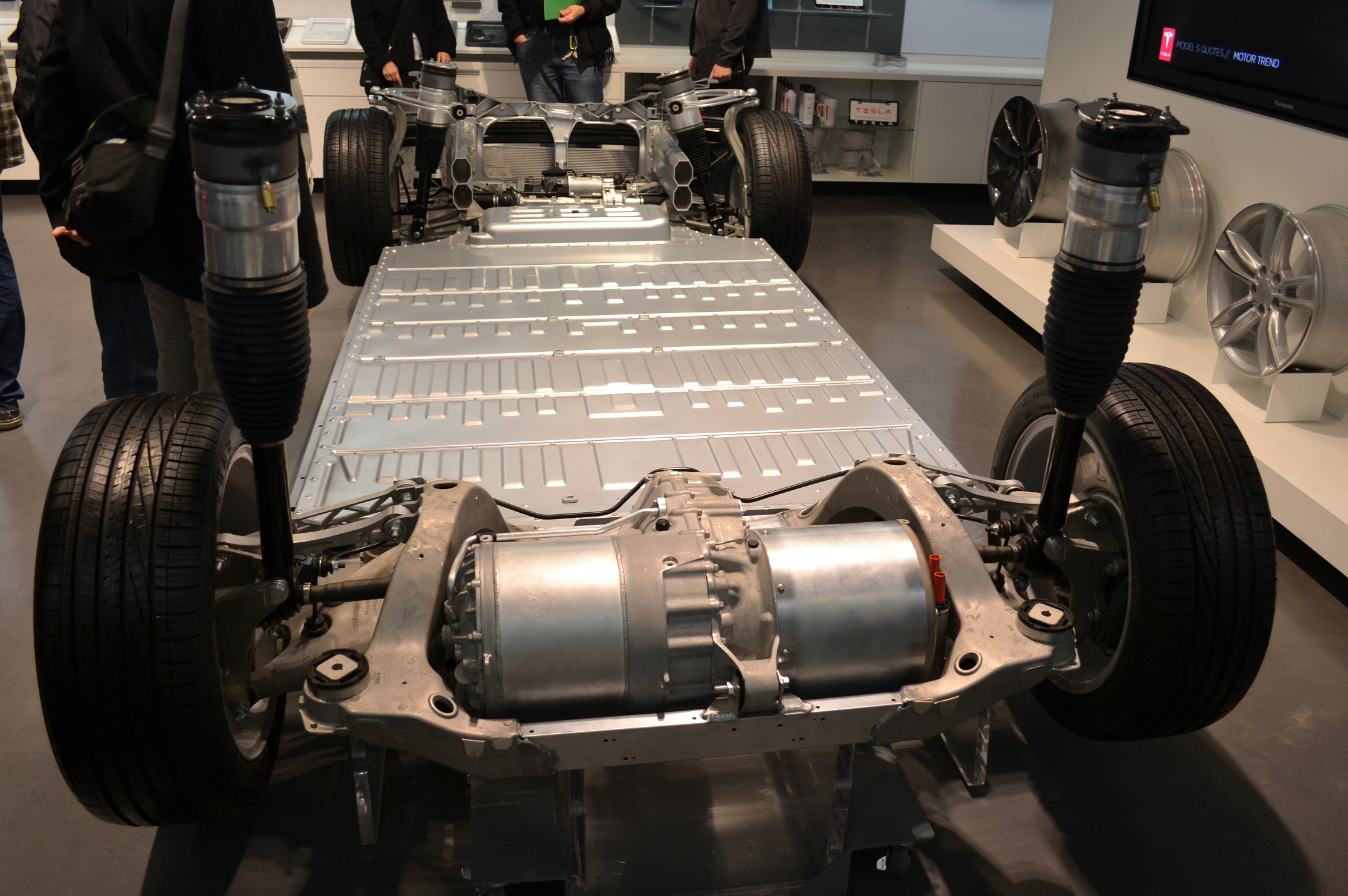
They are removable. The battery pack is roughly like an armored skateboard bolted to the bottom of the car. A mechanical swap takes 90 seconds.
As for generic, Tesla uses more or less standard 18650 cells from panasonic, basically the AA of LiIon rechargable batteries. The pack itself is propriatory at the moment, but what can you do? From what I understand the 'same' pack with generational improvements are going to be used with the Model X.
Thank you and it is good to see some people actually using their brains for a change. A method to save solar power and transport it is the key to the energy problems of this planet. Oil is only a very dirty and slow way of doing the job. No difference except that the sun shines mostly on deserts and methods of transmission must be addressed adequately. By covering a small part of the deserts some reversals of the CO2 caused changes in Ocean PH and the current thaw in your polar regions can also be addressed before the actions of corporate greed and wars cause another mass extinction.
-
Re:the service station answer is simple
In a nutshell make the batteries themselves removable and generic, but what do I know.
They are removable. The battery pack is roughly like an armored skateboard bolted to the bottom of the car. A mechanical swap takes 90 seconds.
As for generic, Tesla uses more or less standard 18650 cells from panasonic, basically the AA of LiIon rechargable batteries. The pack itself is propriatory at the moment, but what can you do? From what I understand the 'same' pack with generational improvements are going to be used with the Model X.
-
Way to Cherrypick
Not to mention the electricity for the Tesla (tada!) isn't free.
24 cents per mile.Nice try. They measured a drag race up to 111 miles per hour.
Actual representative cost per mile is available here and note that the cost per mile column is in CENTS, not dollars. (That chart largely agrees with Tesla's calculator on their official site.
Its a lot closer to 2.14 cents per mile in my state.
Even in California, where your cherry was picked from the real cost is 3.82 cents per mile. -
Re:Their mission is to report on ALL good.
Tax credits vary depending on where you live. Regardless, for US customers there's a federal tax credit of $7,500 for personal use EVs. State incentives can bump that up to $15,000. Base cost is $69,000.
-
Re:"Green"
Not sure which is worse, replying to a troll or replying to yourself... eh.
I highly recommend anyone take a test drive instead of just believing some yahoo on the Interwebs (myself included). See if there is a Tesla dealership in your area, and sign up for a test drive.
I was lucky enough to take a test drive on a random whim. Passed the showroom, and decided to take a peek. It was a slow day so I chatted with a sales rep for a bit and next thing you know, we're on the road.
It was an absolute blast, and if I ever have 80,000 - 100,000 to drop on a vehicle, my decision is already made.
-
Re:Apple Car Troubles
Any issues with the car will probably be blamed on the driver.
Just like tesla.
-
Re:Cat and mouse
The galleries would not make any money since they don't sell cars. It's rather hard to outsource something like that. In Texas the Tesla showrooms are forbidden from telling people to go to http://www.teslamotors.com/ to order their car. The only way to order a Tesla at a showroom is to use a web browser. The showroom employees do not earn any commissions.
-
Re:Best new feature:
and an extra differential, and an extra transmission. You left the last two out of your last paragraph: Teslas have a single motor, plus a transmission (single-speed gearbox), plus a differential, plus CV joints/driveshafts.
No, the SUV Tesla X will have two motors and those angles are pretty flat compared to most cars let alone SUVs. Looking at this shot of the rear of the Model S you can just see the boot for the CV, and the shallow angle it has.
The Model X will be higher, but not that much. The frames look pretty comparable. If you were expecting ground clearance, you will be disappointed. This is definitely an on-street socker-mom's SUV.
-
Re:Best new feature:
On the contrary, it looks like they need less space than convention doors. They are not like the ones on McFly's DeLorean. They are double hinged. If you can drive into a parking space, you can open the doors.
On the image on the Model X page, there is a slider that animates the doors.
It looks like the doors take about 5 to 8 inches beyond the side of the car, but only after sliding straight up. This design takes advantage of the slope if the sides in adjacent cars.The doors are supported all along their top edges, way more practical and less damage prone than Lamborghini fragile solution of single pivot point.
I see nothing about this design that would require sensors, it takes way less room than a swinging door.
Although you might expect that on a high end car, as well as power assist. -
Re:Best new feature:
AWD is not standard. Says so right on their website. http://www.teslamotors.com/mod... Scroll all the way to the bottom.
So, then TFA is wrong when it says
All-wheel drive, using a separate electric drive motor for the front wheels, will be standard on the Model X.
Consequence of the source, I suppose? Why the hell do people keep linking greencarreports articles when they're so poorly researched?
-
Re:Best new feature:
AWD is not standard. Says so right on their website. http://www.teslamotors.com/mod... Scroll all the way to the bottom.
-
Re:Economic problems with hydrogen power
Tesla is also addressing their battery availability issues and is building their giga factory (which will be powered by solar).
The nice thing with my Tesla is every morning I wake up to a full tank. It takes me 5 seconds to plug in at night and 5 seconds to unplug in the morning. If I have to charge at home I can charge at around 55 miles per hour of charging. The only time I need to spend any time charging is during long trips, and in the next three months if I drive down to Los Angeles it will take me only 90 seconds due to battery swapping. It's faster than filling up a gas car. Also, for those long trips the charging is free and always will be. Charging at home at night is also a lot more convenient than having to go out of my way to fill up at a gas station, standing out in the weather. It's also a lot cheaper.
As for drawing huge amounts of power, Tesla is adding batteries to their charging stations so they can maintain a steady load and/or charge the batteries at night to provide the energy during the day. They are also installing solar to offset the energy used and to charge the batteries during the day. The solar won't meet peak demand but that's not necessary. Most of the time the superchargers are not used. They are primarily used on weekends. Most owners just charge at home since it is more convenient. The superchargers tend to be along major routes but not in the middle of big cities. They tend to be at malls or near restaraunts and other things.
There are also a lot more places I can charge than there are gas stations. Electricity is virtually everywhere. I can charge via 110v in the worst case or at any RV hookup or 240v outlet. The supercharger network is also filling out very quickly. By the end of this year most of the country will be covered. Right now I can drive from Vancouver to San Diego, from Southern California to New York and along most of the East coast.
http://www.teslamotors.com/sup...
http://www.teslamotors.com/bat... -
Re:Economic problems with hydrogen power
Tesla is also addressing their battery availability issues and is building their giga factory (which will be powered by solar).
The nice thing with my Tesla is every morning I wake up to a full tank. It takes me 5 seconds to plug in at night and 5 seconds to unplug in the morning. If I have to charge at home I can charge at around 55 miles per hour of charging. The only time I need to spend any time charging is during long trips, and in the next three months if I drive down to Los Angeles it will take me only 90 seconds due to battery swapping. It's faster than filling up a gas car. Also, for those long trips the charging is free and always will be. Charging at home at night is also a lot more convenient than having to go out of my way to fill up at a gas station, standing out in the weather. It's also a lot cheaper.
As for drawing huge amounts of power, Tesla is adding batteries to their charging stations so they can maintain a steady load and/or charge the batteries at night to provide the energy during the day. They are also installing solar to offset the energy used and to charge the batteries during the day. The solar won't meet peak demand but that's not necessary. Most of the time the superchargers are not used. They are primarily used on weekends. Most owners just charge at home since it is more convenient. The superchargers tend to be along major routes but not in the middle of big cities. They tend to be at malls or near restaraunts and other things.
There are also a lot more places I can charge than there are gas stations. Electricity is virtually everywhere. I can charge via 110v in the worst case or at any RV hookup or 240v outlet. The supercharger network is also filling out very quickly. By the end of this year most of the country will be covered. Right now I can drive from Vancouver to San Diego, from Southern California to New York and along most of the East coast.
http://www.teslamotors.com/sup...
http://www.teslamotors.com/bat... -
Re:But Does it Scale?
The Tesla Superchargers are not in heavily populated areas. They are along major routes in areas that aren't served by other charging possibilities. Also, if you look at http://www.teslamotors.com/sup... you will see that by 2015 they will have many, many more superchargers than the current cross country list. Eventually you will be able to do a battery swap. $60 and 90 seconds. Or you can wait for a charge and in an hour get a 'free' charge. Yes, I'm a fan, and no, I cannot afford one currently, but by the time the Model E comes out I will definately in the market. I just hope it doesn't look like a Smart and has performance similar to the current Model S.
-
Re:Range anxiety isn't really rational
They offer the same sort of charging rate as the Supercharger(tm) chargers.
Just fact checking:
Level 3 charger - 240kW max (actual capability depends).
J1722: 240V@80A: 20kW
CHAdeMO: 62.5kW.
Tesla supercharger - 100/120kW
On the other hand, the Leaf maxes out at 44kW with a DC charger. 6.6kW with the onboard charger, vs 11/22 for the Tesla(single/dual charger option).Checking everything, it looks like you would only max out your leaf's charging capacity with a CHAdeMO connection, but while it and J1772 both count as 'level 3' because they're DC and over the capability of level 1 & 2 AC charging, they're not up to Tesla's standards.
Right now Teslas Model S vehicles are the most capable of fast-charging in terms of miles of charge per hour. Given their relatively huge battery packs, this makes sense. -
Re: Range anxiety isn't really rational
They came up with a way to get a 200+ mile pack in your Model S in about 90 seconds... an automated station swaps the battery pack. They have some videos showing it off. The plan is to roll them out at supercharger stations. You'll have the choice of supercharging for free (where 15 minutes gets you something like 85 miles of charge), or doing a battery swap where the swap costs about as much as an equivalent tank of gas at local prices (it's a rental, you're expected to stop and do the swap again on the way back to get your original battery).
-
Re:Range anxiety isn't really rational
A) 2013 Tesla Model S: from 69,900 USD
Yea - "from $69,900 - that's marketing talk for "$69,900 and up." Per Tesla's website, the $70K model has an "EPA-Certified Range" of just over 200 miles, no free access to Superchargers, and no lifetime replacement warranty on the batteries. As the theme of the article we're discussing is "OMG No Fuel Cost Cross Country Drive," it becomes obvious that the $70K base model was not the one being used, but rather it was either the $79,900 85Kw or the $89,900 85Kw Performance version.
On the plus side, though, both 85Kw variants have a range closer to 300 miles.
I don't think that's close to $100,000 or even $80,000.
Well, I said $80K, and if you can't see how $70K is close to $80K... You probably have a different understanding of the value of things than most people I've ever met.
That said, it's still at the pricey side, when you can get a fuel efficient reliable new car for $24,000. But there are a lot of people who can afford this price range, as the large number of vehicles sold in that range indicates. Once the infrastructure is set up and Tesla is ready to release their $30,000 vehicle, the price question will be even less relevant.
Sure, save the fact that most of the people they want to sell $30,000 electric cars to already own $30,000 fossil fuel cars, and can't afford that extra payment. I presume Tesla is banking its hopes on the idea that those people will, someday, trade in their current vehicle and opt for an electric; only time (and availability) can tell on that one.
Personally, I've considered trading my wife's TDI Jetta in on one of the cheaper models when they come out, as it would make a perfect commuter vehicle for her; however, I'm stymied by the fact that I often take trips of over 600 miles in 2 days, and cannot afford to waste time A) searching for a Supercharger (Which won't exist in my state for another 2-3 years), B) waiting for someone else to finish charging so I can start my hour, C) driving around and around until I find a publicly accessible outlet owned by someone cool enough to let me use it, etc.
Plus, the Vee-Dub is fuckin' tight, man - never realized how nice a car 30 grand could get you until I bought the TDI.
B) When you drive 200 miles at a time, do you stop to use a rest room and/or eat?
Hell no!
It's a 3-4 hour trip, hold your shit; I do.
Plug in while you're doing that, and you'll have no problem making the 200 miles.
"Plug in" for how long, and where? Just hope some local resident of Bum-Fuck Egypt has an external outlet, and is kind enough to let me spend an hour or two sucking a few kilowatts the electricity they pay for? Not to mention, I don't know about you but I consider my time, especially on a weekend road trip, far to valuable to waste in such a manner.
So you know, I can spend 10 minutes filling up the TDI, and it will get me there and back (~500 miles total) with enough fuel left to drive to work on Monday. When you consider that 99.99% of the driving population is not only used to, but expects that sort of convenience, you begin to see why electric cars aren't 'taking over' anytime soon.
There's no rule that you have to top up your charge every time you "fill up".
There's no rule that I have to top off my fuel tank, either. The difference is, if I start to run low on diesel, I can pop into the service station that exists on every highway off-ramp and most street corners and re-up. Finding a good-hearted soul that's going to let me park on their property and soak up some of the juice they pay for, not so easy.
While there are a number of reasons to avoid electric vehicles, including the Model S, your reasons are more the popular ones bandied about than actual
-
Re:Give me a petrofuel range extender
2 minutes? I doubt it.
Secondly.
The super chargers are here and being built out NOW. It is no different than gas stations in the 60s when I was growing up, since gas stations were NOT everywhere.
And in 2 years, when gas is 5/gal, please let us know how you feel about the rest of us getting free energy for xing the nation. -
supercharger impact on batteries.
I can't be completely sure how Tesla's batteries work since I don't have the proprietary info on their specific characteristics. However, most batteries are harmfully affected by only 3 things: overcharging, deep discharge, and high temperatures. This means you can charge them at nearly any speed as long as you keep them cool (Tesla's thermal management), don't overcharge them (presumably intelligence in the battery management system), and don't discharge them too low (up to the user). Presumably, if sensors in the battery detect that the pack is getting too warm, the supercharging will slow down to protect the battery pack. While I can't be 100% sure Tesla is doing this, they're pretty smart so it is very likely that supercharging won't have any adverse affect on the battery life - ever.
I agree that I don't think there is a problem with the Tesla batteries. We have nearly 60,000 miles on our Roadster that is over 4 years old and we have minimal noticeable range loss. It has driven and charged in temperatures well over 100F many times. It did, however, limit the charging current below the 40 amps available when it needed to, in order to protect the battery.
A field test engineer told me their test cars were filled over and over with a supercharger during trials, and no measurable change occurred. He was awestruck. -
Where's the number?
Funny how Tesla doesn't tell you how many hours they spent actually charging so you can compare it against the driving time. They only fall back to quoting the marketing talking point of "50% charge in 20 minutes" from a super charging station. 75+ minutes to get to 100%.
Let's just ignore that and assume that charging is linear and 1hr from empty to full charge and that a full charge gets you 300 miles(assuming the 80kWh battery option) at 55mph as the Tesla marketing materials claim.
How does a weekend getaway look for a 650 mile drive?
650mi / 55 mph = 12 hours of driving and need 2 charge stops (2 hours)
A total of 14 hours of travel time and an average speed of 46.5mphIf you drive at a more common 70mph** on such a trip instead of the anemic 55mph and your range is 240 miles
650 / 70mph = 9 hours of driving and need 3 charge stops (3 hours)
A total of 12 hours of driving and and average speed of 54mph**Tesla's web site won't even let you choose 75MPH as a calculation for range despite that being the standard rural speed limit on many Interstate highways.
http://www.teslamotors.com/goe...Remember: those numbers are the most optimistic range and charging estimates from the Tesla web site. More realistic charge times are about 50% longer if you go to 100% each charge) If you don't have access to a 120kW SuperCharger, don't have the 80kWh battery and don't have the dual onboard charger options then charging times increase significantly. A residential 240V 40A charging station takes 9 hours to charge to 300 miles of range!
Use a gasoline fuel engine based car and you'll spend about 10 minutes refueling. Diesel will probably make the round trip without refueling. A 9 hour trip takes... about 9 hours.
The Tesla S is a nice, all-electric short distance commuter car. Why can't they just leave it at that and stop trying to prove that you can take cross-country trips with it even when all the most optimistic numbers say it just doesn't work unless you don't care when you get to your destination?
-
Re:Range anxiety isn't really rational
First off, Model S/X are expensive, but that is about to change in 3 years.
Secondly, Next years Toyota rav ev can make use of the superchargers.
Third, super charging does NOT destroy the batteries. They have already proven that is the case.
Fourth, having a charger every 100 miles does not mean that you must use it, any more than you must use a gas stations that runs block to block.
Fifth, super charging is less than 1 hour to charge the model S from drained. And most sites have 6 slots, not 2. You can use google map to look right down on it and see how many slots, or simply read it straight off the page.
Basically, you BSed your whole way through this. -
For those screaming about chargers, etc.
This is a map of the superchargers that are currently in the USA, as well as those that are under construction. Do a 250 mile range to see where you can drive your model S today. Do a 100 mile range to see where the next super chargers will be built.
In addition, you can see the coverage that Tesla is planning here. Advance the time on the map to see where the build out will be at the end of 2015. -
Re:Exactly how much fossil fuel was burned...
Tesla addresses that issue on their site:
http://www.teslamotors.com/goe...
44% of US power generation comes from coal, with 23% from natural gas and 20% from nuclear. They have a map that shows each state's breakdown. If you're charging in Washington, Idaho, or Oregon, for example, you're not using a lot of fossil fuel. If you're charging in Wyoming, Indiana, or Kentucky, on the other hand, then it's mostly coal. If you're charging in Vermont then you might as well be fellating a tree, but without the splinters.
-
Re:But Does it Scale?
OK, so Tesla builds ONE string of charging stations approx. 150 miles apart that stretches across the US. So tell me how does that work when there are millions of Tesla cars on the road? Charging will take 40 minutes, but the line to get to charge will take 24 hrs.
Will Tesla be able to build enough fast charging stations when selling cars that cost less than $40KSwitch to decaf and chill out. Do you think the gasoline/diesel infrastructure we have today was built in just a year or two? When filling stations first showed up, they too were isolated points that couldn't be linked by the range of the available vehicles, then got strung out on transportation corridors, and only now are ubiquitous. Having a look at the rollout map, the infrastructure will cover a lot of the US's transportation corridors by the end of this year.
As for what happens when $40k electrics start rolling out - I'm not terribly concerned. The number will be small to start, and the number of vehicle trips that would actually require a supercharger station is vanishingly small. I doubt that the utilization of the existing stations now is anything above 5%. You can bet that Tesla has realtime statistics about utilization, and probably even the wait times (i.e., how many cars are queued up), and can adjust their rollout accordingly. Given the stock price, the limiting factor in the rollout certainly isn't capital, which is a good position to be in. -
Re:Range anxiety isn't really rational
Because that's really in their head, more than about any particular drive being possible.
It really isn't, at least from what I can tell, for long road trips. Even under the numbers from Tesla's range calculator you just can't make the same pace you can in a gas car even in reasonably forgiving conditions. In moderately hard but still very realistic conditions, it becomes even less favorable:
If you put in 70 mph and 32 degrees, you get 204 miles. And that's on a full charge. But that's not the most time-efficient way of charging -- better is to spend about 45 minutes charging to, IIRC, about 75-80% capacity. That drops you to 164 miles. So that's "drive for less than 2 1/2 hrs, charge for 45 minutes." That's making pretty poor time IMO.
And what about colder weather and, say, 75 mph (which their range calculator doesn't even go up to)? You could easily be driving less than 2 hrs between charges, even if the superchargers were placed perfectly.
I'm super optimistic about something like the Tesla for around-town driving and shorter trips. But for the longer ones... I think Tesla needs very good coverage with cheaper battery swaps than they are planning.
-
Re:Really?
There should be a station closer to that route by the end of next year. They only finished this east-west corridor very recently, so they have a lot more building to do.
-
Re:Steyn is Slime
The anthropogenic component of global warming is poorly understood, and the appropriate interventions even less so. But diverting taxpayer dollars so wealthy people can get a Tesla as their third or fourth auto is probably suboptimal.
-
Re:Sure
Oh, you mean like this? Though instead of 5 minutes it's more like 90 seconds.
-
Re:Energy density.
That's what the battery swapping will be for. Supercharging is fine if you want to go grab a meal and charge while you eat. Battery swapping will take around 90 seconds, less time than filling up at a gas station.
-
Re:Energy density.
They're building them out pretty quickly. A map is visible at http://www.teslamotors.com/sup...
They already have the west coast, much of the east coast as well as a route across the country set up.
The west coast is already fairly well covered. I can drive from Vancouver to San Diego right now using only the superchargers. By the end of next year they should cover most of the country.
On top of that soon I'll be able to use the ChaDeMo chargers (which are a bit slower). I can also charge at most RV parks or if worse comes to worse a 110V outlet, a dryer outlet or any standard J1772 car charger which are showing up all over the place.
-
Re:Energy density.
One reason someone else might drive 40 miles a day in it would be if they live in a congested supercity / large state where rush hour commutes are greatly sped up by access to HOV lanes. Not an issue for me where I live but it is for some.
You can get a Telsa Model S for about $70K before tax breaks. If you live in the right state/city you can get one below $60K.
Even at $70K it would be insanely nicer and more comfortable than my Toyota Prius, someone elses Nissan Leaf, or the other guys Hyndai/Kia.
It's a friggen luxury car. If you can afford a $70K car it's the BEST $70K car on the market. So if you can afford it why wouldn't you commute 40 miles a day in it?
From http://www.teslamotors.com/mod...
If I won the lottery with a moderate payout (think 6 figures) I'd pick Blue paint, supercharging, the Primacy tire upgrade (saves fuel), and paint armor.
If the payout was really large I might upgrade that to the 85KW battery ($7000 more (tires and supercharging were separate on lower model but included on this one)) and High Power Home Charging ($2700) bringing the car up to roughly $80K.
even if I had millions of dollars either build I just described is nicer than in a dozen ways than any car I have or have had, I wouldn't need every single option maxed out. I'd just geek a bit and then relax in a truly luxurious car properly configured to my desires.
again if you could ride in a car this nice why would you focus on the 40 miles as significant?
-
Re:Energy density.
Lets say i relocate cross country.
I can fill up at any gasoline station.
I am completely shit out of luck with a Tesla.No doubt.
http://www.teslamotors.com/cus...
And believe it or not, people still do relocate. Or go on a road trip, or vacation or visit families.
So unless there are countless charging stations nationwide or a program to swap out batteries when they're almost out of charge, it's not going to replace a gasoline engine anytime soon.From the article:
This was an amazing 15,000 mile Road Trip, we caught up with friends and family, met some intriguing people and saw a bit of America along with some really spectacular roadside kitsch, ticking loads of stuff off our bucket list. All the while, we drove the Model S without compromise, never running out of battery, we always found a place to charge, even in rural America. Now I completely disregard range anxiety as an unnecessary fear.
Or maybe not.
Yeah, this is basically an ad. But clearly, relocating is possible and road trips can be done. If you're worried, use a rental for the trip. Hell, maybe you want something bigger for camping/relocating, anyway. Cars can be shipped.
-
Re:See what happens when leftists are in Charge?
Exactly correct. They're hindered by Texas franchise law.
-
Re:STILL not NEC or NFPA compliant
According to NEC, a standard 15 amp residential wall socket must be derated to 12 amps for any continuous load that lasts longer than 4 hours.
Incorrect in almost every way.
1. NEC doesn't 'derate' anything.
2. an up to code 15A wall socket is good for 15A, period. Probably 20A(they're rated for 20A passthrough; it's fairly common to run a 20A circuit with more 15A sockets). It's the wiring behind the socket that's the real concern...
3. The 12A is for 'dedicated load' use when designing a dedicated circuit(or deciding whether you need one). IE if you KNOW what an outlet is going to be used for before you install it. Maximum design load on a circuit is 80% of the Max. Because 15-20A circuits normally power multiple devices, there are more rules there, like how many outlets are allowed on a circuit. Due to the tendency to use heating appliances in kitchens(toasters, microwaves, etc..), there's fewer outlets allowed per circuit, and 20A is much more likely to be required. So if you're looking at a 14A device, you're required to install a 20A circuit, not a 15. This is partially to avoid having to redo work when the customer replaces said item with a 'heavy duty' one that draws just a touch more...
4. If you're putting an outlet on the circuit, the circuit must be rated for what can plug into said outlet.
5. Besides, Tesla Model S only draws 1.4kw when pluged into a NEMA5-15, 100 watts LESS than a common (US) space heater on 'high'. -
Re:Shouldn't have to run oil by rail
I love it how the goal-posts keep on moving - and how a solution has to solve 100% of the problems or it is a complete fail. Why can't a solution simply be a step in the right direction? Or a solution that works for a very large portion of the population?
On to your arguments:
Tesla will be able to get you from Virginia to Tuscon and Colorado via their Supercharger network in the next month or two. St Louis will be accessible by the end of the year.
Will it be as fast as a gas/diesel vehicle? No, but for cross-country road trips just rent a Prius if you're aiming for maximum speed and efficiency. And as many people will attest, actually slowing down an enjoying the scenery can enhance the road-trip experience. Or simply use a plug-in hybrid - all your local miles will be electric - and you can still have your road trips. The vast majority of your annual miles are within 40 miles of home - low hanging fruit.
As far as 18-wheelers: Most of that cargo should be moved to rail leaving short/medium haul trucking. Short-haul trucks can be electrified, medium-long haul can use natural gas and/or fuel cells. Railways can also be electrified (most trains are simply diesel generators that run electric motors, anyway). Aircraft are a tough nut to crack - bio-fuels are probably our best bet there in the near term.
And as far as power plants go - we need more low-carbon power plants regardless of whether or not we electrify the fleet. But a huge portion of the fleet can easily be powered without substantial changes to the electrical grid.
-
Re:Is Tesla a Continuous Load?
If Tesla overlooked this requirement and put a 15A plug on their charging cable, then they are liable for any damage caused by their improper cable plug selection and lack of warnings.
You think they're that dumb?
Right from Tesla's site:
NEMA 5-15: Standard Outlet 100V/12A 1.4kW 5km/hour
NEMA 14-50: RV'S And Campsites*, 240V/40A 10kW 46km/hour
NEMA 6-50: Welding Equipment 240V/40A 10kW 46km/hour
NEMA 10-30: Older Dryers 240V/24A 5.8kW 27km/hour
NEMA 14-30: Newer Dryers 240V/24A 5.8kW 27km/hourNote that the number after the dash for NEMA designations is the max amps. Generally speaking when somebody says '15A connection' or some such, they're talking about the NEMA 5-15 connector, not the amps the car's pulling.
*Interesting:Hit up a RV park or camp site, set up a tent for the night and have a fully charged Tesla in the morning.
-
Re:Models...
They have actually registered the Model Y trademark.
http://www.teslamotors.com/forum/forums/s-e-x-y-trademarks -
Wow, this guy is a complete nut job. . .
This is how other Tesla owners responded to what we now know was a legitimate complaint. I ask you, who are the real nut jobs?
-
Re:Thin-skinned whiner
Since when is paying off your government loan 9 years early a bad thing?
http://www.teslamotors.com/blog/early-repayment-tesla%E2%80%99s-atvm-loan
-
Re:The only fix for vampire draw
1,000 amps? Since when did residential electrical service supply that much current? No, Tesla's highest-powered residential charger draws less than 100A at 240VAC. And even the Supercharger doesn't use that much power--it's 120kW, whereas 375V 1000A = 375kW. Don't know how much current the Supercharger draw, but Wikipedia says "The SAE DC Level 3 charging has not been determined but the standard as it now exists has the potential 200–600 V DC at a maximum of 400 A (240 kW)."
-
Re:The only fix for vampire draw
1,000 amps? Since when did residential electrical service supply that much current? No, Tesla's highest-powered residential charger draws less than 100A at 240VAC. And even the Supercharger doesn't use that much power--it's 120kW, whereas 375V 1000A = 375kW. Don't know how much current the Supercharger draw, but Wikipedia says "The SAE DC Level 3 charging has not been determined but the standard as it now exists has the potential 200–600 V DC at a maximum of 400 A (240 kW)."
-
Re:2 Words
Here's the closest you'll find so far: http://www.teslamotors.com/modelx
210 mile range for about the same you paid for the Yukon. Seats 7 adults, 0-60 in 4.4 seconds. Deliveries begin in 2014.
Not sure why you need this urban assault vehicle, but I completely understand not wanting anything to do with the typical goofy looking EV micro-cars that are the Leaf, etc. Personally, I see a lot of reasonable stuff in between. If a full size sedan works for you, the Model S (http://www.teslamotors.com/models) seats 5 adults and 2 children very comfortably and sells for about the same as your Yukon.
-
Re:Nowhere to plug one in
Given energy densities and such, it'd need to be at least 220V.
A model S uses 330 wh per mile. Because the compoents tend to get more efficient as they get bigger, leafs are in the same category.
This translates to, with some overhead, and allowances for waste, about 5 miles an hour charging at 120V@15A, or 40 miles over an 8 hour period. Not 'quite' enough for what I'd consider sufficient overhead for the 'averge' round trip commute.
Kick it up to 240V@15A(max you could theoretically do without running heavier wire, which would really cost), and you're looking at 80 miles in the same time.