Slashdot Mirror
Domain: thehaws.org
Stories and comments across the archive that link to thehaws.org.
Stories · 17
-
2006 Nebula Awards
Embedded Geek writes "Locus is reporting on the winners of the 2006 Nebula Awards (as determined by voting by fellow SF authors). Joe Haldeman picked up the Novel award for Camouflage while Kelly Link took home both the Novella ("Magic for Beginners") and Novelette ("The Faery Handbag"). Off the printed page, Joss Whedon beat out Battlestar Galactica with his script for Serenity. You can check out the final ballot here or look at past winners here." -
Gaiman Naming Auction
Embedded Geek writes "Neil Gaiman is auctioning the opportunity to help pick a name in his upcoming novel Anansi Boys. Proceeds will go to the Comic Book Legal Defense Fund. "I've got to name a currently unnamed cruise ship in Anansi Boys. I have no idea what to call it, and, a couple of days ago, realised that my utter lack of inspiration could do good things for the CBLDF. If you wish, you can bid to have the ship named after you, your loved one, your dog, or even your favourite word." As of 10AM PST the bidding is up to US $2,225.00, but surely some slashdotter who cashed out of the bubble at the right time can bid it up. Be warned, though - the auction indicates "Successful bidder agrees to pay actual shipping costs."" -
Locus Interviews Neal Stephenson
Embedded Geek writes "Locus, the trade magazine of Science Fiction, has an interview with Neal Stephenson in their August issue. Excerpts can be found here. A teaser: 'The world of the 'Baroque Cycle' happens to be 99% factual history, or as close as I can come to it, but what readers of this kind of fiction are looking for is the ability to become immersed in a different world. That's why there is a big crossover between historical fiction and SF.' An interesting read for his long time fans or anyone just wondering what all the fuss is about." So this is a teaser for a teaser, but this makes me want to shell out the $8. -
Hugo Nominations Announced
Embedded Geek writes "With the 2004 Nebula Awards being awarded this weekend, the Hugo nominations have been announced. As usual, the field is packed with lots of deserving entries, although I'm sure everyone has a favorite that was missed. I was particularly interested in the Short Form Drama, though, with Joss Wheadon getting three nominations for canceled shows (two Firefly, one Buffy) and Gollum's Acceptance Speech at the 2003 MTV Movie Awards getting a nod. Also of interest are the Retro Hugos, an effort to look back and recognize SF published before anyone thought to hand out awards for it. Retro nominees include such greats as Childhood's End, Fahrenheit 451, and Duck Dodgers in the 24 1/2 th Century (no, really!). You have until 31 July, 2004 to join Noreascon Four and vote for your favorites!" -
Nebula Award Nominees Online
Embedded Geek writes "The SFWA has announced the preliminary ballot for the 2003 Nebula awards. As has become standard over the past few years, the various magazines with short fiction nominees have placed the stories online to order to increase their exposure to voters (here and here for example). This year, the SFWA has helpfully linked all the online versions (as well as Amazon links for the novels and movies) on their ballot page. Those that aren't directly posted are available for free PDA download at fictionwise. Worth checking out, even if you aren't going to the banquet." -
Locus 2003 Recommended Reading List
Embedded Geek writes "Locus magazine has published its 2003 Recommended Reading List of science fiction, fantasy, and related titles. With nearly 300 entries, it's a safe bet that even the most voracious reader will find something new. Personally, I was delighted to see Hitchhiker: A Biography of Douglas Adams under non-fiction and the great listing of short fiction (so I can mine my old magazines for the gems). If you're more of a completist, check out Locus'es exhaustive listings (continued here and here). Definitely worth downloading to your PDA for your next trip to the bookstore." -
Is (Embedded) Linux Worth The Effort?
Embedded Geek writes "Embedded Systems magazine is running an interesting story about building an embedded system (specifically, a diagnostic tool for auto mechanics) using Linux. Despite the foreboding title and tagline ('If your embedded system doesn't need networking and storage, porting Linux to your hardware may not be worth the effort'), it offers a balanced look at how the engineer implemented his solution and observations on each step. Interestingly, his discussion is as much about embedded design philosophy versus Linux's philosophy, pointing out where each meets or diverges. A nice read." -
Ageism in IT?
Embedded Geek writes "It's hardly a new topic, but BBC is running a story about ageism hitting Gen-X, especially in IT. As a 34 year old coder, I was horrified to hear a quote from a *hiring manager*: 'In the IT sector (and coding in particular) younger minds generally work faster -- I would rather employ a keen teenager who code programs computers quickly than an older person.' It didn't help that the person is 32 years old. My kneejerk reaction, the same one anyone else over 30 would have, is that the guy is a buffoon (I'll withhold my preferred, spectacularly vulgar, term). The problem is that I do not believe his idiocy is unique - I have definitely felt the vibe when interviewing. It's frustrating, since Gen-X is finally shedding the media hyped 'slacker' stereotype only to run headlong into this garbage. Have any other Slashdot readers seen this? What is the youngest you can be before some PHB declares you fit for the scrap-heap? Other than stocking up on hair dye and botox, what steps can I take to prepare for the future? Share your war stories here." Ask Slashdot handled this topic over two years ago. Of course, this behavior could be explained away as economic concerns, as the decision to hire younger (and typically cheaper) employees can directly affect the bottom line. However, one has to wonder if the decision to go with less experienced programmers also affects software quality, in the long run. What are your thoughts on this subject? -
Science Fact From Fiction
Embedded Geek writes "The European Space Agency maintains an ongoing project called Innovative Technologies from Science Fiction for Space Applications (ITSF) (Cliquetez ici pour la version française). Its goal is "to review past and present SF literature, artwork and films in order to identify and assess innovative technologies and concepts described which could be possibly developed further for space applications." While I had known about Clarke first envisioning the geostationary satellite, the site also lists some other interesting ideas first pitched in SF: planetary landers, rocket fins, and space stations assembled in orbit. Visitors to the site are encouraged to submit technologies from SF works, although they should look at the master keyword list to avoid duplication first. Also of interest is a spiffy little brochure and a writing contest. Even if it never results in any new technology actually being developed, the site is a nice resource for science educators and science fiction fans." -
How Are You Spending Your Christmas Vacation?
Embedded Geek asks: "Instead of just spending Christmas break (or slowdown if you don't actually get time off) fixing up your house/car/server, are there any neat activities or events in your neck of the woods that you've been putting off? A museum exhibit? A cool new restaurant? An attraction in your hometown you usually only see with out of town relatives? Share your ideas with your fellow Slashdot readers! I, for one, plan to check out Barsoom to Blade Runner: Science Fiction in Southern California in my hometown." -
What's in Your Toolbox?
Embedded Geek asks: "I am a software developer with access to (conservatively) $100K worth of emulators, protocol analyzers, and debugging equipment at work. Nevertheless, as in every lab since Frankenstein's, I can never find a meter or screwdriver when I need one - and God help you if you need electrical tape! Over the years I have accumulated a personal toolkit to fill the gaps between what my employer provides and what I need to get my job done. In addition to the basics (a meter, screwdrivers, cable ties, boxcutter, extra power cables, duct tape) I have a number of oddball items that have come in handy (serial cable gender changers & converters, a dental mirror, dental picks). I'm curious what other items slashdotters doing hardware/software development have found useful that their bosses never provide. What about those in the IT/support world?" -
April 1, 1972: Write Only Memory
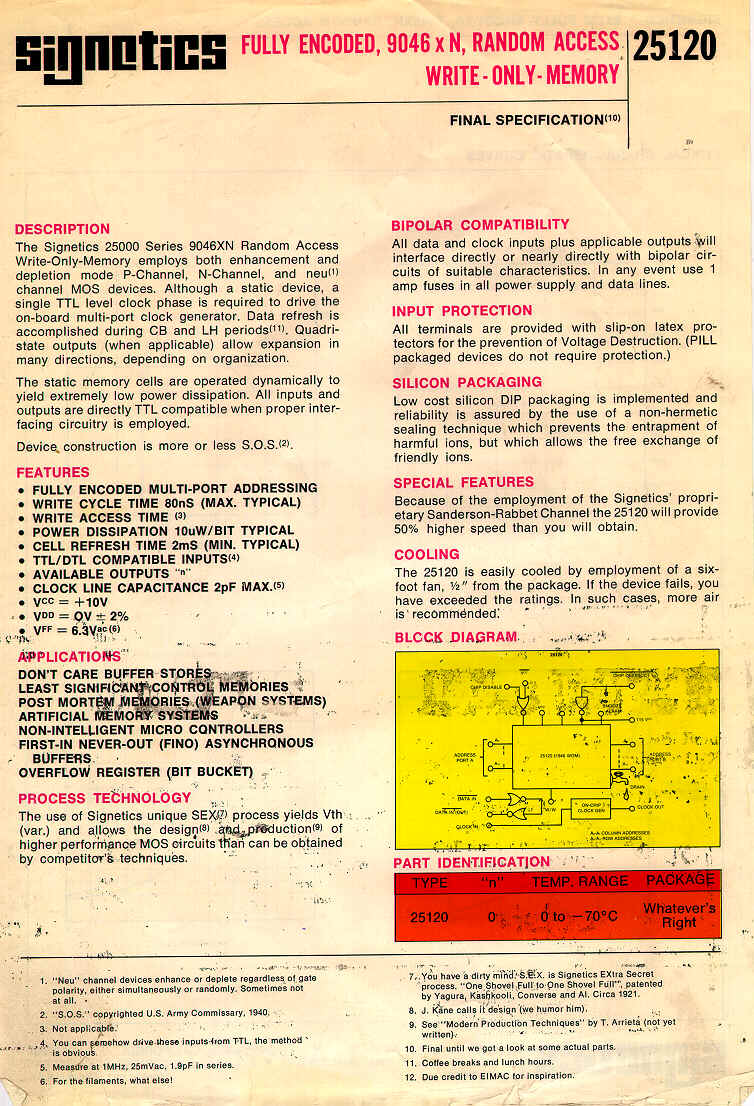
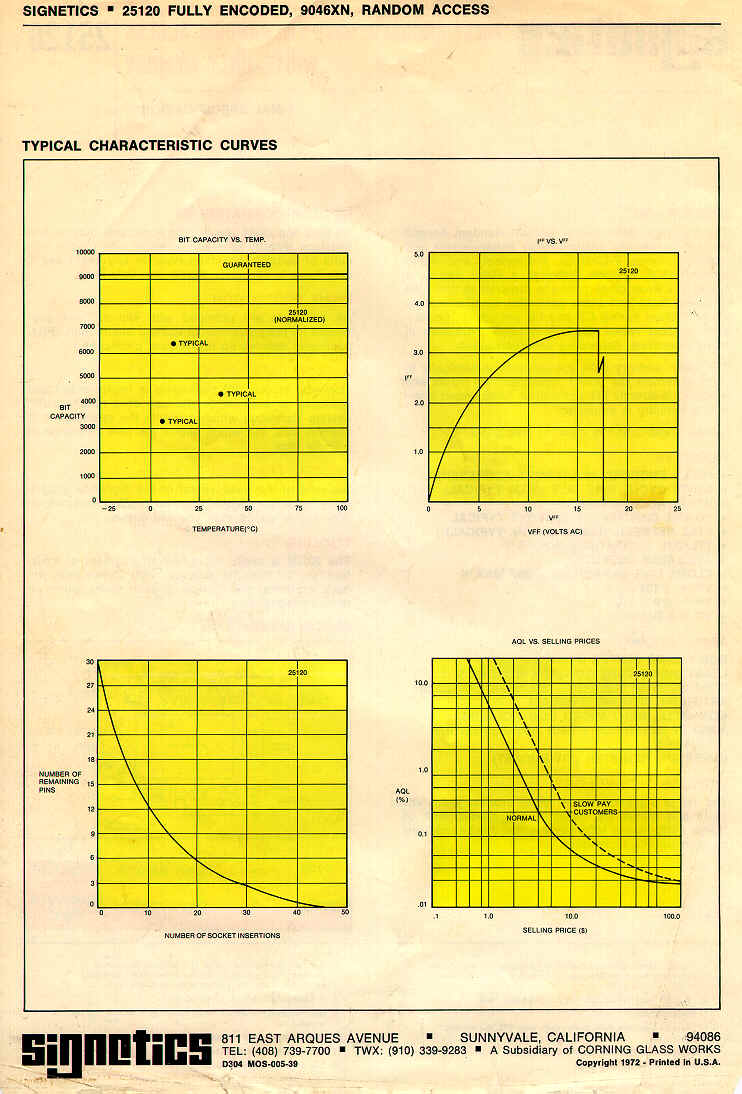
Embedded Geek writes "While digging around Jack Ganssle's site, I came across an amusing prank from days gone by. In 1972 Signetics recognized April Fools day by printing a full color datasheet (scanned sheet 1 and sheet 2 here) for a Write-Only Memory (which accepts data but never reads it back), a considerable effort when documents were made via literal "cut and paste". Packed with jokes both obvious (a graph of "number of pins left versus number of insertions") and subtle ("Vdd = 0V +/- 2%") it's worth a chuckle." -
Open Source & Embedded
Embedded Geek writes "Jack Ganssle has posted a column at embedded.com pondering whether Red Hat and other open source companies serving the embedded community are due a shakeout similar to the dot com collapse. He cites Red Hat's March cuts in their embedded division and their losses of $80M to $140M a year. He admits, though, that because the embedded market is smaller and many companies are privately held it is difficult to get a pulse on what's going on behind closed doors. " -
Is Programming a Dead End Job?
Embedded Geek asks: "There's an interesting opinion piece at Embedded Systems Magazine about [embedded] programming being a dead end job. The author cites burnout ('Pushing ones and zeroes around doesn't sound like a lot of work, but getting each and every one of a hundred million perfect is tremendously difficult.'), prestige, and skill obsolescence as big reasons for programmers to quit or to go 'over to the dark side' and join management or marketing positions. While the piece primarily addresses embedded programmers, the issue is rising for IT workers and other tech workers. When the age issue is combined with the export of jobs offshore, it makes me nervous just to be pushing 35..." Even though the market is going thru a rough patch, and the number of detrimental aspects to programming are increasing (ageism and so forth), I still do not feel that programming is a dead end job. Computers are going nowhere folks, and as long as they are around, programmers will be necessary. People who are in this career for the money or the prestige may not like it after a while, but the people who are in this for something else will tolerate quite a bit before deciding to opt out. The simple measure here: "as long as you love doing it, you'll keep doing it." Isn't this true for any career? -
Geek Outdoor Hobbies?
Embedded Geek asks: "My wife and I, in an effort to get more exercise, have recently begun geocaching, which is basically global scavenger hunt using GPS. We have also been active in the Society for Creative Anachronism and my friends are always trying to draft us into paintball. While we're having a blast with all these, I wanted to see if other slashdotters could suggest more geek style, outdoor hobbies that would appeal to a pair of pasty faced nerds like us." -
Spark Gaps and Ultra Wide Band Data Transmission
Embedded Geek writes: "It sounds like the revenge of Marconi, but Scientific American has a story about the use of spark gap technology for Ultra Wide Band (UWB) data transmission to send data at 100 to 500 Mbps across short distances (five to ten meters). As with every new technology, 'engineers expect these UWB units to be cheaper, smaller and less power-hungry than today's narrowband radio devices,' but there might be some truth to the hype. The secret appears to be the lack of a carrier wave, allowing use of wide swaths of the spectrum for transmission (the few comments I read at the FCC site referenced in the article addressed spectrum allocation)." Read below for a few more links, too."The article pitches the technology as a challenger or succesor to Bluetooth and 802.11a. There are several commercial companies investigating the technology (Aetherwire, Multispectral, and others are cited in the article) and Intel has a paper cited in the article. Spin off applications from the components needed to make this technology work might include a GPS style system accurate to one meter and a radar technology that would allow seeing through walls for construction, rescue, and (ahem) law enforcement."
-
R.I.P for D.I.Y Or Long Live Open Source?
Embedded Geek writes "Scientific American has an article on the decline of science hobbyists. It presents a long litany of woe you'd expect about the "Good Old Days" (the death of classic electronic tinkering magazines, Edmund Scientific's corporate changes, and the cancelation of SciAm's own "Amateur Scientist" column), but also discusses some of the real trends in technology that have caused these changes. Declining manufacturing costs now make it cheaper to buy a telescope, radio, or computer than to build one yourself. The increased complexity of our gadgets doesn't help either (Ever tried to fix surface mount components with a soldering iron at your kitchen table? Don't!!) "Personally, I found the tranformation of science amateurs into "quasi-professionals" intriguing. The Society for Amateur Scientists now holds sessions on how to publish research and how to claim tax deductions for home laboratories. Also, amateur astronmers are making great strides in comet discovery. Being that most of the people in the open source movement are software professionals, it becomes easy to draw an analogy between it and tinkering of yore.