 Slashdot Mirror
April 1, 1972: Write Only Memory
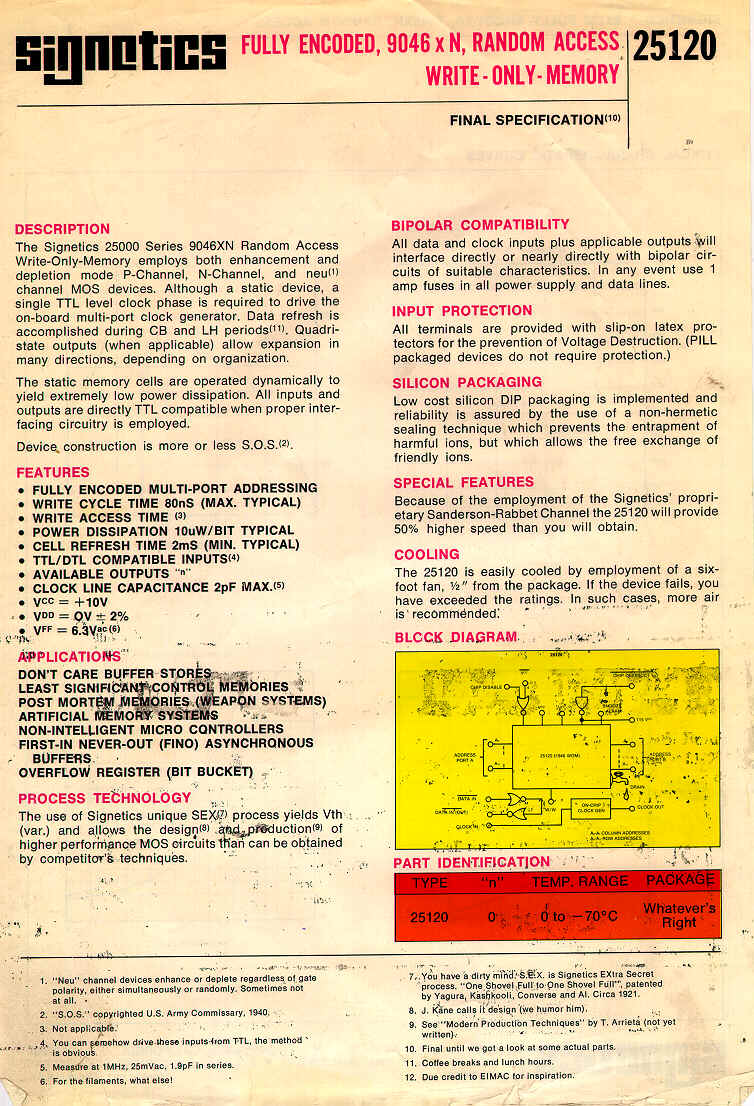
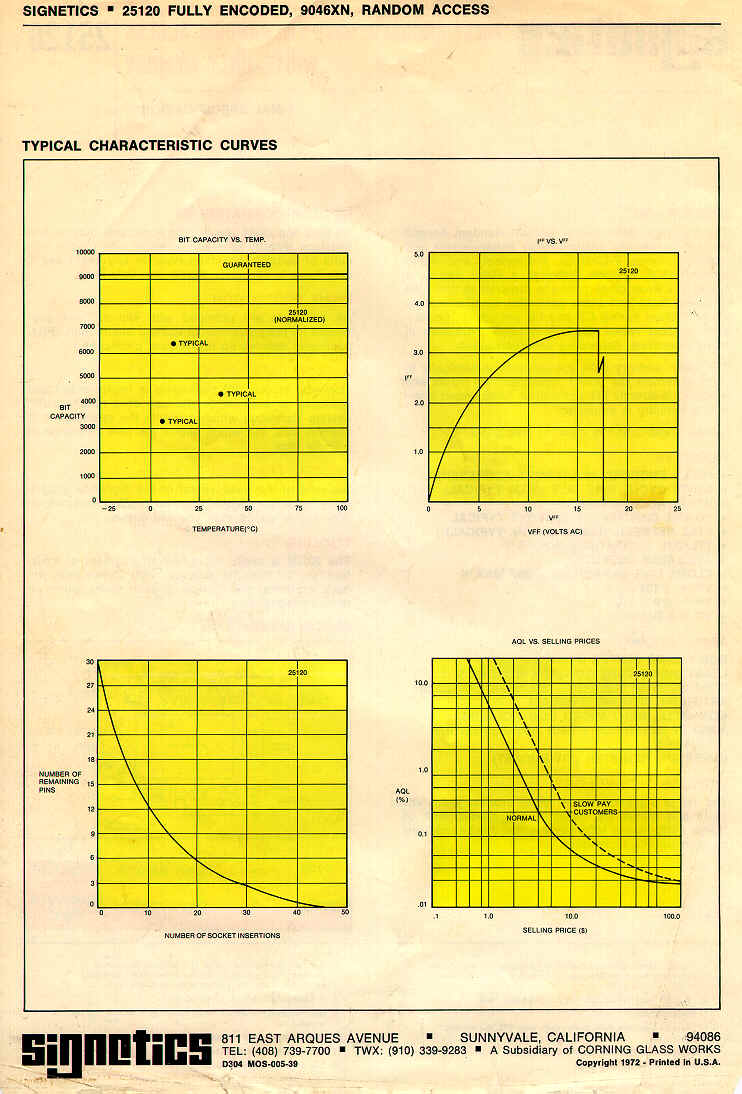
Embedded Geek writes "While digging around Jack Ganssle's site, I came across an amusing prank from days gone by. In 1972 Signetics recognized April Fools day by printing a full color datasheet (scanned sheet 1 and sheet 2 here) for a Write-Only Memory (which accepts data but never reads it back), a considerable effort when documents were made via literal "cut and paste". Packed with jokes both obvious (a graph of "number of pins left versus number of insertions") and subtle ("Vdd = 0V +/- 2%") it's worth a chuckle."
Writing perl code! Write once, read never.
Websurfing done right! StumbleUpon
I thought I just had to avoid reading slashdot one day a year to avoid April Fools crap.
I bet there's some cypto/privacy types out there who think this is still a good idea
In SOVIET RUSSIA the hot grits profit you!
You people ARE nerds! Jebus. I thought everyone was just faking it!
I have been pwned because my
more about their fabrication process. Their "unique SEX process" intriques me...
--Kevin
Where were you on April 1, 1972?
I don't remember.
I get a lot of spam, so I've been working on a hardware accelleration card for /dev/null. This'll save me having to develop my own design in an expensive FPGA.
Something they can sell that has Perfect Copy Protection!
There are circuits in use that are essentially a write-only memory like this (but without the need for a 6 foot fan!), combined with a comparator and possibly a one-way encrypter. You can store an encrypted password in there, which then can never be read back in its encrypted form. Plaintext phrases can be encrypted and compared against the stored password.
One existing application is on debit cards (cards that are charged with a cash amount on the card itself).
If construction was anything like programming, an incorrectly fitted lock would bring down the entire building...
This has been in The Jargon Lexicon for ages. Don't all slashdotters know of it?
Ne mæg werig mod wyrde wiðstondan, ne se hreo hyge helpe gefremman.
I stronly suspect the main site is going to die, so here's a mirror on my website:
Pic 1 Pic 2
#define ROSE any_other_name
You mean like the windows registry?
:)
Crap goes in, but doesn't seem to go out until you have to reinstall a month later
First posts are write only.
The Day Today - Game Warden to the Events Rhino
On the BBC Micro you could add 16Kbyte banks of 'sideways RAM'. I remember that some upgrades had a 'read protect' switch, which sounded very odd. I think it was for compatibility; read protect made the upgrade effectively invisible.
-- Ed Avis ed@membled.com
In case the site is slashdotted, you can get the images from there and there.
*nerd laugh* haha write only, everyone knows that write only memeory is like a bank acount where you know you put in money and they give you a million percent interest but you can never withdraw money. its ironic
If the memory is compared to something, then it is read back.....
So it would NOT be a write-only-memory...
So, they had overclockers back in 1972? Nothing new under the sun, I guess...
"The 25120 will provide 50% higher speed than you will obtain".
If construction was anything like programming, an incorrectly fitted lock would bring down the entire building...
Explain again how you read from this write-only memory then?
therefor, the message content is: void.
... 30 years too late for this?
Don't Panic
I didn't know that DAT backup tapes were invented in 1972... ;-)
As far as the computer and it's memory hierarchy is concerned, there IS write only memory. The printer, for example, in the absence of a scanner, is just this, as could be certain video displays.
The data is compared against the memory inside the IC device. From outside the device the memory can be written to, but the data cannot be read back so it is write-only for all intends and purposes (one could possibly drill into the IC package and get at the memory).
I believe the more common term for this is a black box, but I've heard such device being referred to as having write-only memory.
If construction was anything like programming, an incorrectly fitted lock would bring down the entire building...
Brilliant: slip-on latex protectors for preventage of VD!! (Voltage Destruction) Pill packaged devices do not require protection!
My favorite feature of this device is that typical bit capacity is 35% to 75% of "guaranteed" bit capacity.
I'd rather thought that /dev/null was the most elegant WOM out there...
/dev/null? I personally think it's about time we found out how much you can stash in there.
Heck, they even coded it such that it has infinite capacity, or a very high capacity in any case.
Could someone dedicate a machine for a few years with a shell script running an infinite loop writing data to
Blearf. Blearf, I say.
Lasagna! Pookie
by Losh
"Garfield, dinner!"
Garfield snuggled deeper in his box and mumbled, "Gravity is in effect here. Bring it to me."
"It's lasagna"
*Zooooooommmmmm*
Jon looked down at the table where just a second ago a pan of lasagna had sat. "Well at least I served myself first..." He broke off at the site of his empty plate, then yelled. "Garfield! That was my dinner too!"
Garfield smirked and called out, "Pizza delivery number is by the phone. I'll take a large meat-lovers Jon." He set the pan of lasagna down, then reached over and flipped his blanket out his box, uncovering his best friend. "Pookie, look what I have for dinner. Your pizza's gonna be here soon, I had Jon order you a large meat-lovers. What? You can't eat the entire thing by yourself and you insist on sharing it with me? You're such a good friend."
He grinned at Pookie and reached into the pan of lasagna and scooped up a pawful. "You don't mind if I start without you? Thanks!" He reached over and hugged Pookie in thanks, accidentally getting him covered in lasagna. "Pookie! I told you, your pizza would be here soon. You didn't have to start eating my dinner."
Garfield licked his paw clean while he eyed the cheese, meat and pasta covered bear. "You know, that's a good look for you. It brings out the black in your button eyes and the tomato sauce compliments the thread in your mouth. Pookie..." He paused for a minute and reached out with the paw that still had lasagna on it and brushed it against Pookie's nose. "Gasp. Oh no. Pookie, I got lasagna on your nose. I'm a bad bad cat." Garfield cocked his head to one side, "What? You want me to clean it off? Well if you insist. Besides, lasagna should never be wasted."
He took a step forward until he was nose to nose with Pookie. He flicked his tongue lightly several times over Pookie's nose, until it was free of lasagna bits. When he finished, he sat back on his haunches, "Mmmmm you taste good, Pookie. What? You want me to clean the rest of you off too?" He grinned a Cheshire grin. "I'd love too." He stretched out a paw, pulled Pookie to him and purred, "Have I ever told you how much I love lasagna?" He continued to purr as he began to lick Pookie's neck and then down his chest, his rough tongue causing the bear's fur to stand up in tufts. When he reached Pookie's waist he stopped and stared at the area he just finished cleaning. He reached out and stroked a paw down Pookie's chest, his claws half out, leaving thin, slight trails in the bears fur. "You should bathe in tomato sauce from now on. It's made your fur soooo soft."
Again he brushed his paw down Pookie's chest. He watched as the fur sprang back up after his paw passed. A gleam entered his eyes as he stared at Pookie. His nose twitched and his tail rose straight up in the air. He looked up and gazed into the bear's cute button eyes, "Isn't it amazing the places tomato sauce can get into?" he asked mischievously. Not waiting for a response, Garfield stood again and licked Pookie on his nose then slowly licked a line down the clean furry chest of the bear, this time not stopping at its waist. Purring loudly, he licked between the bear's short, furry legs. The tip of his tail was twitching like crazy as he pressed his nose against Pookie's belly. He continued to lick long strokes between the bears legs.
Garfield's breathing quickened and the tip of his tail flicked this way and that way. Suddenly he pulled back from Pookie and looked into his dark button eyes. He paused, then nodded once, firmly. He pounced on top of the bear and started humping it as he licked and nipped at its neck. Finally with a last twitch of his tail and thrust of his hind end, Garfield stilled then collapsed on top of Pookie.
Still purring, Garfield rolled off Pookie and onto his side. He reached out with a paw and swatted a bit of fur from one of Pookie's button eyes, then laid his head on Pookie's shoulder. "That had to be the best lasagna I've ever had," he said contentedly.
~Fin~
After laughing it up for a bit, their boss walks in. He is visibly angry.
I design user interfaces for a free network management application,
Read and Write in memory terms define what the user/programmer can do with it, not what a program itself can do. Hence write only memory can only be accessed blindly by the system, but you can't directly access the data it contains.
The real question is, why would someone make a first post in the first place?
However, through the use of simple mathematics I've deducted a formula that explains this habit-
sP + aF / P = Need of being the first poster
You see, the persons small penis (sP) factor is added to his annoyance factor (aF) and divided by any real personality this poster may have (P), creates the probability of having a first post, as well as the need to be the first poster.
Therefore, the average first poster believes that by being the first poster, he will enlarge his penis size. Unfortunately, this is most opposite of what *really* occurs.
fP = P / sP - wFOP = First poster's penis size.
As you can see, the first post has the effect of actually *shrinking* his penis, as the personality factor is divided by his existing small penis, minus an additional amount based on the annoyance factor of the first post itself. So, in reality, these people are causing long-lasting damaging effects to their genitals.
And to answer your question, no, I DON'T have anything better to do than post nonsensical, offtopic garbage on a message board.
Robort knows all.
While it was a significantly harder to create documents by hand back then compared to computerized layout today, it really isn't something that deserves commendation. This was done often into the 80s, and many small layout design shops still do this today.
No, a write only memory is a "dead end" device. You have no use for it at all. If there is no feedback (read possibility) and then -> "the more common term" for it is a "terminator" which destroys all inputs, since there is no way of getting that info back, and use it for anything.
Still. You input your password and the black box compares it with
the internal password. Letting you know the results of the comparison
contradicts the assumption that the device is write-only (by reading
at least one bit of information). That's what he was saying.
That you've heard a black-box device referred to as a write-only-memory doesn't make it true....
Reading back the results of the comparison is a 'read', so the argument fails there.
Also, a device containing two major functions, like memory and comparator, is not a memory device (that would be like calling a SDRAM an 'adder' or a CPU a memory device)....
You cannot get the info back, but you can use it for something or get feedback on it. The feedback is not the actual data, but comes in the form of "the data currently on the bus matches / doesn't match what I have stored internally"
If construction was anything like programming, an incorrectly fitted lock would bring down the entire building...
The Amiga 1000 had 'Write Once Memory'. When the kickstart disk (kernel/bios) was loaded in WOM then it got locked. This was done because when the A1000 shipped in september 1985 the firmware was not quite ready...
Because of the employment of the signetics' proprietary Sanderson-Rabbet Channel the 25120 will provide 50% higher speed than you will obtain.
Err .. mmmkay ??!?!?
I remember the C64 had a bank of memory that you could write to, but if you tried reading it back you'd get junk values. I believe it was the sound poking interface.
Imagine if this stuff was placed in Wintel machines - that old buffer over run problem was disappear overnight.
Sounds like a real Linux killer to me.
Now THIS is geek with a capital G. After reading it all, i still dont have a clue what its about. Great!
"640k of Write-Only Memory ought to be enough for anybody".
Baz
I remember a datasheet from Phillips on the DED.(Dark Emitting Diode) and a Texas instruments publication on a spec for the FUDGE gate.
It isnt new, but that one is obviousally old enough to possibly be the first....
Do not look at laser with remaining good eye.
but you are wrong.... cash cards/chips CAN be read. you have to know how much is left on it. and a password storage as you say ALSO can be read as you have to have an indication if the match was positive.
so in fact if you get ANYTHING out of a device it does in fact have a read capability.
Do not look at laser with remaining good eye.
On a similar line, somewhere at home I have a spoof datasheet from Nominal Semidestructors giving information about the new Polish Operational Amplifier.
What I'm missing, however, is my copy of the table of variation of pi with temperature and pressure, which I believe was given to all engineering freshmen at Cambridge at one time. If anyone can help me to locate a new copy I'd be grateful. Please reply here or email me (see homepage).
Every bloody emperor has his hand up history's skirt [Peter Hammill/VdGG]
This would be a usefull tech for anti RIP protests, you could never turn over your PGP key if you can't read it back again
thank God the internet isn't a human right.
... still going today. Billions of writes latter, still hasn't dropped (returned) a single bit. They just don't make them like the ol' days.
Did they get any orders for these? I think that we should be told.
Best wishes,
Bob
For the sceptics, yes there is an output, it's usually just a bit flag; yes or no, there is no way of reading the actual contents of the WOM. The setup I've seen is an IC, that presents to the outside world two write only blocks of memory, one permanantly stores a PIN, the other is used to input the user keyed PIN. The IC compares the two and sets a single bit output high or low depending upon whether the values match or not. The crux is, short of decoding the circuits within the IC, there is no way of retrieving the PIN from a stolen card - there os ready equivalent of /etc/passwd that can be easily read and bruteforced; it's more akin to a shadow password system for PINs.
Physically threatening the owner of the PIN is another issue, or course. ;)
UNIX? They're not even circumcised! Savages!
The article reminded me of a C't article (April edition a couple of years ago) where they reviewed hardware accelerated null devices... :-)
My personal favorite is definitely the Vff rating (6.3V AC).
For those (sane) individuals who don't build their own amplifiers, this is the voltage used in electronic tubes for the heater filaments.
Come to think of it, this would also explain the need for a 6 inch cooling fan.
They even planned far ahead. In 1972, "VFF = 6.3VAC" was obvious in itself, but for you youngsters that don't know about vacuum tubes they added the footnote "6. For the filament heater, of course."
Yes, it's now a very old joke, but it's been fun watching a new "generation" rediscover it every five years or so.
That will probably bugger up my patent. Damn prior art!
You can still bruteforce..
/etc/passwd:
...
Bruteforcing
1) generate possible password
2) oneway encrypt
3) compare
4) rinse and repeat until cracked
The write-only chip:
1) generate possible PIN (looping 0000-9999)
2) write to WOM
3) read flag
4)
Even if you made the memory REALLY slow, like 3 seconds to a write, you'd still run through all 10000 combinations in a matter of 8,3 hours..
- Ranger
This could be a real product!
In a similar vein...
The first random access memory was designed to read and write to random registers.
This does away with the address bus, reducing the pin count and making programming much more exciting.
Ok this is about as geeky as geeky gets, but wheres the news?
The Pseudoacoustic Infector from Rane allows you to add a little bit of "This" and "That" to your audio. It also has BOTH "Power" and "Glory" switches, and a complement of other interesting features, plus a number of in jokes. :)
Another (newer) classic. I'm sure this WOM could be used in creating a digital version of the same.
You could make the chip lock out after three tries (which is what happens on the debit card), or stop accepting new data for a long time (1 day perhaps).
I believe some Israeli guy cracked the Dutch debit card by sticking it in a microwave(!), briefly forcing logic states that normally should never occur, allowing him to get the data out of the memory.
If construction was anything like programming, an incorrectly fitted lock would bring down the entire building...
If this technology could be incorporated into a CD or DVD, all of their "piracy" concerns go away.
Sure, there are some pesky customer satisfaction issues, but let's keep our priorities straight. OK?
I had used this very chip as an example of the problems of searching with Google in a prevous /. post - I was trying to find electronic forms of the datasheet, and was using it as an example of why I felt Google needed boolean searches.
/., I can find that thread with neither /.'s built-in search nor with Google.
/. ;>) follow - go read QST, for example. Why, I even heard Microsoft is getting into the act - they released a fake news release about focusing on security and reviewing their code, but I think they jumped the gun by a couple of months....
The really funny thing is, that while this created a bit of a message thread on
Making fake releases is a tradition many organizations (and
www.eFax.com are spammers
Yeah, my hand-writing is write-only, or so everyone tells me...
// file: mice.h
#include "frickin_lasers.h"
If you got hold of a card (and had the resources) you could still read and brute force the hash of course, or force a valid response at the appropriate point. However, that leaves the physical problem of reassembly of an IC with onboard EEPROM, and even if the card can still be made to fit into the readers it's probably going to be unreadable. All of which needs to be done before the card is cancelled. Quite an elegant solution for those "ultra-paranoid locations" really. ;)
UNIX? They're not even circumcised! Savages!
Didn't the postal office start using these to speed delivery?
>You are assuming a 4 digit numeric PIN and no detection of three repeated failures resulting in a timed lockout of 15 minutes, a la car radios.
The IC on a smart card isn't big enough to hold a charge for 15 minutes, AFAIK.
This is in the Art of Electronics Student Manual.
This manual has lots of little delights. My favorite is Tess o'Bipolariville milking 1 mA of current to find the intrinsic emitter resistance of a transistor.
I protest, this chip is obviously not JEDEC compliant and is therefore prone to silent failure. RMS and EFF ought to kick their asses.
A caveman dreams of being us, the incalculable power and riches. We dream of being Q, then what?
I used to work with some wierd chips back in those days and whilst the "Oldtimer's Disease" is setting in, ISTR the Signetics 82S100 had a write only register.
It wasn't an AFD joke, either. Go look!
Anybody who was just a whippersnapper lab rat in those days care to verify?
... dev/null, in hardware ?
Oh, I can't help quoting you because everything that you said rings true
What a bunch of fricken nerds lol. This isn't even remotely funny lol. Love ya all though. :)
Friends who work at Philips (which bought Signetics years ago) tell me that the 25120 datasheet may be updated and reissued. Keep an eye out for it once Philips gets a usable website.
Lacking <sarcasm> tags,
Its called a memory-mapped register.
I suppose you could say that some VRAM is write-only, but it would have to be read by the hardware, even if its unaccessible to the user.
;-)
The data sheet for the 1Z2Z vacuum tube (circa 1966) contained items like a "urinated tungsten filament" and a monode structure (one less than diode), IIRC.
If humor exists prior to the Google...can anyone laugh?
Man discovers fire.
I know people who have copies of that data sheet.
Another one that was good for a laugh was the ``Damn Fast Op-Amp'' that appeared in a normal device catalog from one of the major electronics device manufacturers (like Signetics, Fairchild, National, or maybe even AMD -- I'm leaning toward the latter but I can't remember any more. Darned cobwebs.) I used to enjoy asking interns to look up some information for me in the catalog and wait to see if they noticed it. You could tell if they did from the laughter.
Another one from the same time frame (1980-ish) was the announcement -- on official IBM product sheets -- of a Galactic Edition' of the VM/CP (or was it VM/CMS?) operating system. This included advanced features like the one that allowed users to create and destroy their own planetary systems and such.
Oh those were the days. Bet you don't see stuff like this appearing in official company literature any more. Hell, there'd probably be someone suing the company after they'd been traumatized upon seeing such offensive material (like `damn') or claiming fraud when their personal solar system didn't appear.
CUR ALLOC 20195.....5804M
This is not a write only memory as it is read when comparing the PINs. It is just integrated in a circuit.
If you really want you can open up the IC and probe the lines to the memory and see what it is.
Back in the days before memory came on SIMMs, a few shady PC hardware manufacturers included "write-only memory" on their motherboards. These devices made the system look like there was an impressive amount of memory on the motherboard, but in actuality they were just molded plastic with unconnected IC pins, filling the spots one would put real RAM chips.
On board battery? Think of a SecureID card on steroids and you'll get the general idea.
UNIX? They're not even circumcised! Savages!
Back when WORM drives were all the rage, some engineers at Atari actually implemented a worn: (Write Once, Read Never) device in Atari BASIC. I don't remember how it was done (it's buried in an old issue of Compute! that I probably threw out years ago) but I actually got to try it out on a computer at the school I was going to (back in the day when everyone had Apple ][s, this school was using Atari 800s).
/dev/null.
It was just an Easter Egg; I suppose some Unix geek at Atari just decided it needed its own equivalent of
/Brian
There was an amusing press release that accompanied the Signetics WOM.
Back in the day of WORM drives, optical nonsense (Write Once Read Multiple). I did own a WORN drive (Write Once Read Never) from IBM.
My UID is prime!
I got a paper from one of my CS professors (many years back) entitled "Chips Found Floating Down Silicon Slough". It doesn't go into a lot of detail like the Write-Only Memory does, but it has several different chips, including the Don't Gate (which made LSI WOM possible), the IN-OP AMP, and the J(UN)K Flip-Flop.
Good to know that we always get current news with Slashdot.
I think I'll submit my story about dinosaur extinction now.
That green slime had it coming.
"INPUT:
All terminals are provided with slip-on latex
protectors for the prevention of Voltage Destruction.
(PILL packaged devices do not require protection.)"
Take his advice seriously people. He would know about this.
I once had an old (circa 1963) Tektronix Scope. In the very detailed service manual among the schematics was a section with the CRT symbolized as it really looked - tapered cone with a schematic of the tube connections. One day I was looking at the print and notice that there was a little stick man with a hat on, a climbing pick and a rope making his way up the side of the CRT.
That's actually my typical experience with sockets.
That's also why I'm not allowed to touch things in the labs anymore.
I thought write-only memory was Microsoft's solution to the problem of memory protection in Windows.
You know, misbehaving applications accidentally used to scribble on other apps' memory spaces. When Microsoft forced the PC industry to install banks of WOM, suddenly every crash became an application error--those applications were not conforming to the Windows API. Instead of scribbling on another application's memory, the app should have been scribbling to the WOM.
It was brilliant because overnight Microsoft foisted millions of dollars in OS support expenses on to application vendors.
He looked at me and said, "Kid, we don't like your kind, and we're gonna send your fingerprints off to Washington."
I always used to joke (half joke) about c++ being a write-only language. ie, you can write code in it, but damned if you'll be able to figure out what you did 6months down the line. hence, write-only.
--
"It is now safe to switch off your computer."
DAT is MORM (mangle-on-read memory). or maybe TORM (tangle-on-read memory).
--
"It is now safe to switch off your computer."
What's the deal with the AOL graph on Sheet 2? AOL wasn't around in 1972, so is this a fake, or does AOL refer to something else besides "It's so lame and slow, no wonder it's #1"?
I've gone out with a few women who's minds use the same principal.
...partcularly in hardware encryption (Debit cards, PVRs, Access control systems, whatever. The point is that a chip has basicly two functions: SetKey(key) and Decode/Encode(data). You set the key, but you can never read the key. Of course the chip will use the key internally to come from plaintext to chipertext or vice versa, but as long as the encryption is strong it doesn't matter. (Def. of strong: Having plain & ciphertext doesn't help to find the key, most algorithms today are strong, the zip encryption is weak though).
Of course this means you need a specialized chip, and not a general CPU, which is overkill in many cases..
Kjella
Live today, because you never know what tomorrow brings
Not truly write-only memory (in the sense that you could get a value, albeit a painfully useless one), but it seems to come close to the spirit.
However, through the use of simple mathematics I've deducted a formula that explains this habit-
sP + aF / P = Need of being the first poster
You see, the persons small penis (sP) factor is added to his annoyance factor (aF) and divided by any real personality this poster may have (P), creates the probability of having a first post, as well as the need to be the first poster.
Be careful applying this formula. For many first posters, you will get a "divide by zero" error.
Have you tried turning it off and on again?
This would obviously have no implications to the DMCA. RIAA and MPAA would wholeheartedly endorse this technology. write-once, read-never technology is something that they have been working on since before Napster.
This was a pants-wetter back in 1972. Though I remember some different tearsheets -- they had marketing material as well, I think. One showed a "modified TO-5 case" that was in fact a photo of a water tower. The WOM campaign became a bit of cult humor for a generation of engineers and hobbyists.
-- We all have enough strength to endure the misfortunes of other people. La Rochefoucauld
Did anyone other than me see the AOL Selling Price diagram on the 2nd sheet?
I seriously doubt that sheet was made as far back as the 1970's!
Meep Meep!
I enjoyed it muchly back in the '80s when I first saw it, and now I will have a computer version...much better than the photcopied version that was many generations old...
ttyl
Farrell
CAN-CON 2019 - Ottawa's only book oriented Science Fiction Convention! October 18-20, Sheraton Hotel, Ottawa, Canada h
The data sheet talks about a clock line capacitance of 2 pF...when measured with a 1.9 pF
capacitor in series. Remember capacitances in series combine by the reciprocal law (1/(1/C1 + 1/C2)) so if you work it out you find the line capacitance is -38 pF.
They'll want to try this as a new copyright-protection scheme, I'm sure!
My old man was an eletrical engineer at Control Data for many years. He brought home doezens of things like this. I remember specifcations for the Write-Only Memory. I remember the FED (Flame-Emitting Diode; a cover photo from EDN magazine), the NED (Noise-Emitting Diode), alternative logic gates like the "DON'T" gate (no matter what two bits are input, the output is zero). I remeber even linear components like the IN-OP AMP. I loved this stuff. My dad was also a radio amateur and he and friend wrote an article proposing solving the spectrum shortage by using the negative freqeuncy spectrum. They included diagrams showing you how to bury your antenna and stick the ground rod up in the air.
Who says engineers aren't funny (at least to each other)?
Well, the next step should be a Don't Read Don't Write memory also called DMem for Dummy Memory. -- Léa Gris
Léa Gris
HAWAT - I want that Press RELEASE!
Please contact me:
abacaxi at hotmail dot com
It would be nice to reissue the press release along with the datasheet.
$5 / month hosted VPS on linux = awesome!
I wonder how may people here
know that refers to tubes.
I have an old CD burner that makes a pretty good WO device. It also uses removable media, so I can use it to make multiple WO backups that can be taken offsite to a secure location. I use it for all of our important HR information.
Be careful applying this formula. For many first posters, you will get a "divide by zero" error.
Are you saying many first posters are women?
Jake
Dating: while( 1 ){ call_girl(); get_rejected(); drink_40(); } return 0;
There was an article about this in (I think) Scientific American a while back. I think I even saved that issue - I'd look it up for you, but I'm in the middle of a move, and it's packed up...somewhere.
... runs on this stuff
The Dark Emitting Diode (DED, aka 'friode'), the Smoke Emitting Diode (SED), and the Light Emitting Resistor.
And the Shakespearean Gate (a picture is funnier, but you get the idea):
__
2B | 2B = ?
Well, I think he might think enlarging his penis is really easy : just consider how many spam mails explain how to do this...
McCartney fans pay bus tickets. [...] Lennon fans too, with discretion.
What happens if P=0? You'd think we'd know by now, seeing as this *IS* /. ...
Ok dating myself! I remember that ad when it pop out. Cant remember if it was in a mag or in a reference book. But I think there was another page. Or was that a funny about the NE555- The greatest washing machine times in history! Using somting about a match and a stick of TNT i think.
Dont you know all of these hyper compressor schemes uses the modern version of this chip.
This is how my memory works most of the time. I do have a patent on it, but can't find it for some reason.
Ah the good old days when real geeks had pocket protectors and a programmer was not afraid of machine code!!!
FYI, This data sheet made it into the Signetics IC handbook, which is where I first saw it back in my PDP 11/35 days. I liked the Drain pin. It was properly placed over the Bit Bucket to prevent spilling data.
The truth shall set you free!
A couple of weeks ago, I destroyed the swap partition on my linux box without any prior preparations, just to see what would happen. The machine had been up and running for weeeks. . .
Sadly, nothing happened. I guess that's what I get for putting 1/2 gig of RAM in a machine that's primarily used for surfing the web . . .
My friend told me about the situation around it's release. It was, in fact, a joke that was included by the engineers and was supposed to be removed before print. He said that when it was discovered by the bosses, they didn't think it was very funny. He was amazed that thirty years later it is still around and being talked about.
"read protect made the upgrade effectively invisible."
I know I love buying new hardware, sticking it in my machine, and never hearing from it again.
--
Internet Explorer (n): Another bug -- that is, a feature that can't be turned off -- in Windows.
Well, that explains the juvenile attitude. Let me guess, you're a college grad as well?
Just testing submitting.
My Canberra ANU Aikido pages
Halt and Catch Fire for the current generation of Linux [on the brain] dweebs.
There's a control register bit called EIEIO (sound it out if you're hard of thinking) - some sort of Extended IO control, I forget exactly what it was for