Slashdot Mirror
Domain: ucsb.edu
Stories and comments across the archive that link to ucsb.edu.
Comments · 436
-
All-Optical Packet Routing: Packet Delay included
So the OCPN research group here has already gotten our All-Optical packet-routing to work. All optical in that the signals is Never converted from Optical. The switching signals are still electronic, but an integral part of the system is the packet delay (so the signal is delayed while the switches are set).
We, at first, literally used strands of fiber to delay the signal (so a non-variable delay), now we're using the same fiber delay, but between the multiple strands of fiber are the typical 2x2 optical switch (like a Mach-Zender interferometer-based switch), allowing you to switch on/off various delay line segments (thus allowing you to choose the delay, so you can synchronize the incoming signal, etc.). For the next step we'll be integrating this system onto an InP chip (similar to what the article says has been done).
More importantly, what good is IndiumPhoside based technology if everything's made on Silicon??? John Bowers here, recently made the breakthrough in bonding InP to Silicon, paving the way for allowing this technology to actually become useful outside of the long-range communications industry! -
they *do* cool stuff: quantum computing anyone?
In case you did not know, MSR also is involved in the field of quantum computing. See http://stationq.ucsb.edu/index.html.
-
I don't compress my Edison
When carrying wax cylinder music, it's important to not compress my music, or it becomes so lossy I lose it.
http://cylinders.library.ucsb.edu/ -
Re:Will they be able to make things better?
You should go read some of the text of the signing statements. Every other sentence refers to the constitution and disputes the given legislature's ability to direct the executive's enforcement activities.
Plus, I have to agree with other folks that signing statements only effect the executive branch. Indirectly they effect everyone, due to their effect on the behavior of the branches of the executive. -
Re:It's not "like a passport" that we already use.
The exact original quote (note a poem) is lost, but here's a page with a very thorough review of the various known versions: Martin Niemöller's famous quotation: "First they came for the Communists".
-
Re:Make Love, Not Warcraft
Sword of 1000 Truths. No doubt when South Park talked to Blizzard to get permission for the episode they worked together to get the content to coincide with upcoming items (or just simply created them because of the episode).
-
Re:scientific articles may need more money
UC actually pays about $8M per year to Elsevier.
The full contract is available online http://www.econ.ucsb.edu/~tedb/Journals/ucelsevier .pdf -
Hmmmm Wrong.
Looks like someone RTFA a bit wrong. Ben Sander works for AMD. He is one of their media presenters. Here are a few of the events he has done: http://www.cpd.iit.edu/cpd/events.htm http://www.ewh.ieee.org/r4/chicago/foxvalley/meet
. thru.mid2005.html http://www.instat.com/FallMPF/06/conf1.htm http://mtv.ece.ucsb.edu/MTV/index_files/program-mt v.txt -
Re:You bring the pitchforks, I'll bring the torche
But it is stipulated that it can only be repealed if Public Safety requires it.
And that is where the debate should be focused - are we in a situation where public safety requires it. I agree we are not at that point.
I don't see any current situation where habeas corpus would be detrimental to the public safety. In fact, it's hard to imagine any scenario outside of fiction where habeas corpus would be dangerous to the people.
Habeas corpus has been suspended several times in our history, most famously by Lincoln (1861), but also by Grant (in 1871, actually he had several proclomations suspending the writ, but only one is enough to prove the point).
You might suggest the suspensions were unjustified in these cases, but that would only serve to show that we can survive such abuses. The best we can do at this point is to vote out ALL the bastards who voted FOR it.
Senators who voted for this bill:
Alexander (R-TN), Allard (R-CO), Allen (R-VA), Bennett (R-UT), Bond (R-MO), Brownback (R-KS), Bunning (R-KY), Burns (R-MT), Burr (R-NC), Carper (D-DE), Chambliss (R-GA), Coburn (R-OK), Cochran (R-MS), Coleman (R-MN), Collins (R-ME), Cornyn (R-TX), Craig (R-ID), Crapo (R-ID), DeMint (R-SC), DeWine (R-OH), Dole (R-NC), Domenici (R-NM), Ensign (R-NV), Enzi (R-WY), Frist (R-TN), Graham (R-SC), Grassley (R-IA), Gregg (R-NH), Hagel (R-NE), Hatch (R-UT), Hutchison (R-TX), Inhofe (R-OK), Isakson (R-GA), Johnson (D-SD), Kyl (R-AZ), Landrieu (D-LA), Lautenberg (D-NJ), Lieberman (D-CT), Lott (R-MS), Lugar (R-IN), Martinez (R-FL), McCain (R-AZ), McConnell (R-KY), Menendez (D-NJ), Murkowski (R-AK), Nelson (D-FL), Nelson (D-NE), Pryor (D-AR), Roberts (R-KS), Rockefeller (D-WV), Salazar (D-CO), Santorum (R-PA), Sessions (R-AL), Shelby (R-AL), Smith (R-OR), Specter (R-PA), Stabenow (D-MI), Stevens (R-AK), Sununu (R-NH), Talent (R-MO), Thomas (R-WY), Thune (R-SD), Vitter (R-LA), Voinovich (R-OH), Warner (R-VA)
Representatives who voted for it:
Aderholt, Akin, Alexander, Andrews, Bachus, Baker, Barrett (SC), Barrow, Barton (TX), Bass, Bean, Beauprez, Biggert, Bilbray, Bilirakis, Bishop (GA), Bishop (UT), Blackburn, Blunt, Boehlert, Boehner, Bonilla, Bonner, Bono, Boozman, Boren, Boswell, Boustany, Boyd, Bradley (NH), Brady (TX), Brown (OH), Brown (SC), Brown-Waite, Ginny, Burton (IN), Buyer, Calvert, Camp (MI), Campbell (CA), Cannon, Cantor, Capito, Carter, Chabot, Chandler, Chocola, Coble, Cole (OK), Conaway, Cramer, Crenshaw, Cubin, Cuellar, Culberson, Davis (AL), Davis (KY), Davis (TN), Davis, Jo Ann, Davis, Tom, Deal (GA), Dent, Diaz-Balart, L., Diaz-Balart, M., Doolittle, Drake, Dreier, Duncan, Edwards, Ehlers, Emerson, English (PA), Etheridge, Everett, Feeney, Ferguson, Fitzpatrick (PA), Flake, Forbes, Ford, Fortenberry, Fossella, Foxx, Franks (AZ), Frelinghuysen, Gallegly, Garrett (NJ), Gerlach, Gibbons, Gillmor, Gingrey, Gohmert, Goode, Goodlatte, Gordon, Granger, Graves, Green (WI), Gutknecht, Hall, Harris, Hart, Hastings (WA), Hayes, Hayworth, Hefley, Hensarling, Herger, Herseth, Higgins, Hobson, Hoekstra, Holden, Hostettler, Hulshof, Hunter, Hyde, Inglis (SC), Issa, Istook, Jenkins, Jindal, Johnson (CT), Johnson (IL), Johnson, Sam, Keller, Kelly, Kennedy (MN), King (IA), King (NY), Kingston, Kirk, Kline, Knollenberg, Kolbe, Kuhl (NY), LaHood, Latham, Lewis (CA), Lewis (KY), Linder, LoBiondo, Lucas, Lungren, Daniel E., Mack, Manzullo, Marchant, Marshall, Matheson, McCaul (TX), McCotter, McCrery, McHenry, McHugh, McIntyre, McKeon, McMorris Rodgers, Mica, Miller (FL), Miller (MI), Miller, Gary, Moore (KS), Murphy, Musgrave, Myrick, Neugebauer, Northup, Norwood, Nunes, Nussle, Osborne, Otter, Oxley, Pearce, Pence, Peterson (MN), Peterson (PA), Petri, Pickering, Pitts, Platts, Poe, Pombo, Pomeroy, Porter, Price (GA -
Re:And?
But, no, as far as I know, there is no martial law provisions that would allow the feds or a fed dept (FEMA) to overrule anything like that on the state level.
Well, consider some of the Executive Orders. (I make no claims as to the reality of the claims made on that page, e.g. regarding "black helicopter traffic" reportings.) Take 12148 as an example:
Section 1. Transfers or Reassignments
1-1. Transfer or Reassignment of Existing Functions.
1-101. All functions vested in the President that have been delegated or assigned to the Defense Civil Preparedness Agency, Department of Defense, are transferred or reassigned to the Director of the Federal Emergency Management Agency.
1-102. All functions vested in the President that have been delegated or assigned to the Federal Disaster Assistance Administration, Department of Housing and Urban Development, are transferred or reassigned to the Director of the Federal Emergency Management Agency, including any of those functions redelegated or reassigned to the Department of Commerce with respect to assistance to communities in the development of readiness plans for severe weather-related emergencies.
1-103. All functions vested in the President that have been delegated or assigned to the Federal Preparedness Agency, General Services Administration, are transferred or reassigned to the Director of the Federal Emergency Management Agency.etc. etc. etc.
Another, arguably scarier example, EO 11000 (text can be found here and here):ASSIGNING EMERGENCY PREPAREDNESS FUNCTIONS TO THE SECRETARY OF LABOR
font face="Times New Roman">
SECTION 1. Scope. The Secretary of Labor (hereinafter referred to as the Secretary) shall prepare national emergency plans and develop preparedness programs covering civilian manpower mobilization, more effective utilization of limited manpower resources including specialized personnel, wage and salary stabilization, worker incentives and protection, manpower resources and requirements, skill development and training, research, labor-management relations, and critical occupations. These plans and programs shall be designed to develop a state of readiness in these areas with respect to all conditions of national emergency, including attack upon the United States.
SEC. 2. Functions. The Secretary shall:
(a) Civilian manpower mobilization. Develop plans and issue guidance designed to utilize to the maximum extent civilian manpower resources, such plans and guidance to be developed with the active participation and assistance of the States and local political subdivisions thereof, and of other organizations and agencies concerned with the mobilization of the people of the United States. Such plans shall include, but not necessarily be limited to:
(1) Manpower management. Recruitment, selection and referral, training, employment stabilization (including appeals procedures), proper utilization, and determination of the skill categories critical to meeting the labor requirements of defense and essential civilian activities.
(2) Priorities. Procedures for translating survival and production urgencies into manpower priorities to be used as guides for allocating available workers.
(3) National guidance. Technical guidance to States for the utilization of the nationwide system of public employment offices and other appropriate agencies for screening, recruiting, and referring workers, and for other appropriate activities to meet mobilization and civil defense -
Re:The Real News
"I hope that you have re-read the Constitution of the United States in these past few weeks. Like the Bible, it ought to be read again and again."
-- President Franklin D. Roosevelt, Radio Address of March 9th, 1937
Imagine any politican nowadays telling the nation that we should read the Bible "again and again". Or the Constitution, for that matter! -
Spot on...
...at least, it precisely parallels my personal usage.
My iTunes library contains 2977 items, of which 215 were purchased from the iTunes Music Store.
Most all the rest were: ripped from CDs and/or transferred from LPs, but:
There is also a considerable smattering of "personal content" including home recordings of my brother's piano recitals, radio shows recorded off the air with a Griffin RadioShark and "time-shifted" (I play them on my iPod in the car, then delete them), some downloaded public domain material (cylinder recordings from the UCSB's absolutely amazing Cylinder Recording and Preservation Project. That probably accounts for about 100-200 items.
But, to a first approximation, 7% iTMS purchases, and the rest "RIPS" in the broad sense of digitized copies of material purchased on other media. -
Re:Soo....
The fun really starts when the requires temperature levels are high enough to trigger the release of methane which is stored near the ocean floor.
- It's 20 times more potent than carbon dioxide
- It also expands when it reaches the surface because of a difference in pressure.
I don't even want to think about something triggering a massive release of methane from the World's oceans and what it could do to the global climate. (including the rate) -
Re: The level of arrogance is astoundingI want to set this straight since it comes up often:
According to the University of California, Santa Barbara:Carbon dioxide is abundant in volcanic gases, but not enough to significantly contribute to the greenhouse effect. Volcanoes contribute about 110 million tons of carbon dioxide per year while man's activities contribute about 10 billion tons per year.
-
Re:"even more catastrophic" ???
9/11 was a local disaster affecting one municipality.
Two municipalities. Let's not forget that a lot of people died at the Pentagon; a former co-worker of mine was on that plane.
-
What A Wonderful Time It Was To Be Alive ...
A couple of years ago an entirely different impact crater was discovered in Australia, with preliminary dating indicating that it happened at about the same time as this one. It, too, is huge -- not as monstrous as this here Antarctica sockdollager, but apparently about as apocalyptic as the one that reputedly KO'd the dinosaurs. Considering the history of our Solar System, I don't think that a multiple-impact armaggedon is at all out of the question. Hell, maybe we'll find even more impact craters, and have to come to the conclusion that it was some kind of supersized rain of fire that reset the planetary ecology switch.
And then, of course, we shouldn't forget about the largest volcanic eruption in the history of the planet that sparked up at just about the same time, too. An area roughly the size of Scandinavia simply melted into a mass of sulfurous, poisonous, volcanic goo for a couple of million years before settling down. I'm not terribly firm on my Permian Era geography, but I'd be willing to bet that the Siberian Traps event was pretty close to the opposite side of the planet at the time of the impacts.
-
Re:Johnstown flood
It didn't cost nearly as many lives, and doesn't even show up in Wikipedia, but the Teton Dam failure in 1976 also deserves a mention.
-
P2P networks are obsolete.
The research i've been doing in P2P networks (due to my involvement in the okopipi project) has shocked me. In file sharing, we're living in the STONE AGE. Yes, even with bittorrent (which depends on centralized servers, and there's practically no privacy. And anonymous bittorrent like mutorrent is closed source, who knows if they got a backdoor in there).
EDonkey uses MD4 for hashing, it depends on central servers, and has no anonymity at all. And without mentioning queue # 4892 for a popular file.
Unfortunately for filesharers, file sharing networks based on modern P2P architectures is very scarse. The supernodes / ultrapeers approach is obsolete, easy to disrupt both denial of service and eavesdropping attacks.
The future of P2P is Overlay Networks.
From an architectural point of view, I would recommend the KAD p2p network, which bases its architecture on the relatively-new kadelmia network (See Technical paper on Kadlemia, 2002).
Even then, Kadelmia could be improved because it's based on a Pastry network topology - compared to other topologies like De Bruijn Graphs, proposed by a recent paper in 2003.
And more research is being done dealing with load balancing, anonymity, trust, reputation, etc.
As I said, current peer to peer networks are in the stone age. Someone needs to design a file sharing network based on the latest research, and publish it. -
Re:Actual Moore's Law
The original article reprinted from Electronics magazine, 1965.
-
Just so we are clear.....
from the TFA.....
Google Earth will not replace high tech programs like AutoCAD or ESRI's ArcGIS
The topic missing from this discussion is a simple question: Where does all this data come from?.
You can't plan bike routes, model road trips, view cityscapes, etc. unless you have good data to start with. Neither Google Earth nor KML function to build geographic data. The tools for doing that are as follows: v
ArcGIS, for vector-based data and some imagery.
ERDAS IMAGINE, for imagery, and
for all you open source kiddies:
GRASS and GRASS for Macs
Without these basic development tools, client-side web apps like Google Earth don't exist. These data have a long history and complex standards for verification and use.
In a community normally so concerned with standards, metadata, etc., I am surprised by the Gee whiz view comparing Google Earth and similar client side apps. -
Potentially groundbreaking
The major innovation you get by using sound is that your detector can be smaller (i.e. faster) and less reliant on precise optics. This is the double whammy Grail of nano-imaging. From TFA: "For a regular AFM to detect the features of the object, the actuator must be large enough to move the cantilever up and down. The inertia of this large actuator limits the scanning speed of the current AFM. But FIRAT solves this problem by combining the actuator and the probe..." But there seems to be some discrepancy in the article. "Georgia Tech researchers have been able to use FIRAT with a commercial AFM system to produce clear scans of nanoscale features at speeds as high as 60 Hertz (or 60 lines per second)." Is this what they mean by a "movie" which they claim has never been done with AFMs? It's true that commercial AFMs do not achieve this speed, but http://hansmalab.physics.ucsb.edu/index.html/ for example custom builds AFMs to that spec since 2002. The second part that seems misinformed is that FIRAT is not unique in it's use of surface properties and a cantilever-type system. Current AFMs "bounce" off the surface in the same way, interacting well before actual contact (insofar as contact has meaning in the quantum mechanical sense).
-
Re:How about making tech attractive to EVERYBODY?
-
physicists rediscovering network analysis. again.Epidemiological studies such as this are not exactly new, although I'm sure that this is (in some ways) a nice data set for investigating this sort of problem. I've skimmed the paper; it appears to be the case that the authors are completely unaware of the body of work that people in the field of social network analysis (SNA) have generated on this problem over the past few decades.
Unfortunately, this is not particularly new, either: for the past several years, physicists have been "discovering" problems, and models, that the SNA folks have known about for quite some time. To give credit where due, physicists' quantitative models for these problems are generally well-constructed, and I appreciate the fact that their entrance into the field has placed more emphasis on quantitative methods. However, their assumptions are not necessarily well-explored, and so their conclusions are not infrequently invalid.
It's true that I haven't checked out this paper in detail, and it's possible that they really did come up with something new. But Nature (the publication, that is
-
Re:No Digg!
Here's the paper.
http://www.kitp.ucsb.edu/community/news/hufnagel_j an06.php -
KITP Press Release - Cool image
Press Release Check it!
-
The real reports
Here is the blurb in Nature, Nature's Editor's Summary
and here is the PDF research paper The scaling laws of human travel. -
The real reports
Here is the blurb in Nature, Nature's Editor's Summary
and here is the PDF research paper The scaling laws of human travel. -
How this probably works ...
You can find corpuses of human faces taken with different emotions displayed.
Once you've either collected them yourself or downloaded them, you need to use a process called eigenanalysis which is basically fancy talk for analyzing a large dataset with multiple classes (emotions) using matrix decomposition.
I've actually worked on many projects involving this and the result is an eigenface (or eigenmask) that allows you to transform the space that the original image is in and classify it using any of a number of algoirthms that use euclidean distance.
I know I left out a lot but there are many papers out there that you can find on citeseer and white papers floating around out there that provide a lot of reading material on this.
There are also strategies which require tagging certain features as points on the face (like corners of eyes, corners of mouth, center of eye, etc) and then using the relative distances between all these points to determine what classification you would give a new face. The problem with this is that it requires a lot of hand work to prepare the training set.
Hope this helps anyone who wants to learn more about the actual process used to accomplish this recognition. -
Re:I wonder if he's really a moron...Why would anyone cover a non-RFID badge with tinfoil?
Maybe just playing around like a guy named Edison with the first cylinder recording in 1877 on tinfoil?
Oh wait, that was Yesterday's news.
-
Re:The raw transfers (lossless) are available
This is correct. We have six files for each cylinder. The original archive file is a 24-bit, 44.1KHz wav file and can be downloaded. We captured at 24 bits not because cylinders need the 144 db of possible dynamic range (if only!) but because noise reduction supposedly works better on files of greater bit depths.
The second file is also a 24 bit file that was run through CEDAR in real time to reduce the amount of noise. It's very mild denoising compared to what is often done for CD reissues, but we just wanted to make it a bit more palatable to the ears of the uninitiated and remove the worst of the pops without clamping down the sound too much. That's why these cylinders sound relatively bright compared to a lot of the CD reissues you'll find of early recordings. There are a lot of cylinders in the archive that are still very noisy and are very difficult to listen to, but this site is not just about entertainment, it's a tool for research.
The third file is a CD standard file that was dithered down to 16 bits and there are three compressed files for online access. The sixth file was for dialup connections, but we didn't put them up. I don't know anybody with dialup anymore that could test them.
Our goal in allowing downloads of the raw file is that if somebody wants to do a CD reissue or reuse the material we should provide for that as they are in the public domain. But if they want a cleaned up version they should do their own restoration, so we don't provide access to the cleaned up wav file (unless somebody asks).
And if anybody cares, these are two pop songs I've been listening to a lot:
Theodore http://www.library.ucsb.edu/OBJID/Cylinder3429
Any Rags http://www.library.ucsb.edu/OBJID/Cylinder4374 -
Re:The raw transfers (lossless) are available
This is correct. We have six files for each cylinder. The original archive file is a 24-bit, 44.1KHz wav file and can be downloaded. We captured at 24 bits not because cylinders need the 144 db of possible dynamic range (if only!) but because noise reduction supposedly works better on files of greater bit depths.
The second file is also a 24 bit file that was run through CEDAR in real time to reduce the amount of noise. It's very mild denoising compared to what is often done for CD reissues, but we just wanted to make it a bit more palatable to the ears of the uninitiated and remove the worst of the pops without clamping down the sound too much. That's why these cylinders sound relatively bright compared to a lot of the CD reissues you'll find of early recordings. There are a lot of cylinders in the archive that are still very noisy and are very difficult to listen to, but this site is not just about entertainment, it's a tool for research.
The third file is a CD standard file that was dithered down to 16 bits and there are three compressed files for online access. The sixth file was for dialup connections, but we didn't put them up. I don't know anybody with dialup anymore that could test them.
Our goal in allowing downloads of the raw file is that if somebody wants to do a CD reissue or reuse the material we should provide for that as they are in the public domain. But if they want a cleaned up version they should do their own restoration, so we don't provide access to the cleaned up wav file (unless somebody asks).
And if anybody cares, these are two pop songs I've been listening to a lot:
Theodore http://www.library.ucsb.edu/OBJID/Cylinder3429
Any Rags http://www.library.ucsb.edu/OBJID/Cylinder4374 -
Re:An unfortunate license choiceOn the other hand, there's this notice on the web site:
The raw transfers created by the University of California are in the public domain. Users of this website are free to use these raw transfers as they see fit, not limited to redistribution to others, including distribution over peer-to-peer file-sharing networks; reissue, mashups, mixes for commercial or non-commercial purposes; or other uses that could be imagined.
So it seems to me that all you need to do is download the original raw recordings yourself (rather than the MP3s, which are, as you mentioned, CC-attrib-noncommercial) and crunch them into MP3s yourself. More work for you, of course, but at least it should be doable.
Restored versions of the audio files, including the downloadable MP3 files are © 2005 by the Regents of the University of California. They are licensed for non-commercial public use under a Creative Commons Attribution-NonCommercial 2.5 License. -
"dialect recordings"
Disclaimer About "Dialect Recordings" "Coon songs," "rube sketches," "Irish character songs," and other dialect recordings that were popular vaudeville routines and genres of songs during the late 19th and early 20th century often contain negative stereotypes and portrayals of blacks and other ethnic groups. These recordings reflect the attitudes, perspectives, and beliefs of different times. Many individuals will find the content offensive...
I'm a bit fixated on the taboo, so I found a some of the "dialect recordings". Anyone who wants to type some racial slurs into the search box can find there own, but here are a few highlights (lowlights?).
http://cylinders.library.ucsb.edu/search.php?query Type=@attr%201=1016&query=bake%20dat&num=1&start=1 &sortBy=&sortOrder=id
http://cylinders.library.ucsb.edu/search.php?query Type=@attr%201=1016&query=darky&num=1&start=3&sort By=&sortOrder=ia
http://cylinders.library.ucsb.edu/search.php?query Type=@attr%201=1016&query=nigger%20possum&num=1&st art=1&sortBy=&sortOrder=id -
"dialect recordings"
Disclaimer About "Dialect Recordings" "Coon songs," "rube sketches," "Irish character songs," and other dialect recordings that were popular vaudeville routines and genres of songs during the late 19th and early 20th century often contain negative stereotypes and portrayals of blacks and other ethnic groups. These recordings reflect the attitudes, perspectives, and beliefs of different times. Many individuals will find the content offensive...
I'm a bit fixated on the taboo, so I found a some of the "dialect recordings". Anyone who wants to type some racial slurs into the search box can find there own, but here are a few highlights (lowlights?).
http://cylinders.library.ucsb.edu/search.php?query Type=@attr%201=1016&query=bake%20dat&num=1&start=1 &sortBy=&sortOrder=id
http://cylinders.library.ucsb.edu/search.php?query Type=@attr%201=1016&query=darky&num=1&start=3&sort By=&sortOrder=ia
http://cylinders.library.ucsb.edu/search.php?query Type=@attr%201=1016&query=nigger%20possum&num=1&st art=1&sortBy=&sortOrder=id -
"dialect recordings"
Disclaimer About "Dialect Recordings" "Coon songs," "rube sketches," "Irish character songs," and other dialect recordings that were popular vaudeville routines and genres of songs during the late 19th and early 20th century often contain negative stereotypes and portrayals of blacks and other ethnic groups. These recordings reflect the attitudes, perspectives, and beliefs of different times. Many individuals will find the content offensive...
I'm a bit fixated on the taboo, so I found a some of the "dialect recordings". Anyone who wants to type some racial slurs into the search box can find there own, but here are a few highlights (lowlights?).
http://cylinders.library.ucsb.edu/search.php?query Type=@attr%201=1016&query=bake%20dat&num=1&start=1 &sortBy=&sortOrder=id
http://cylinders.library.ucsb.edu/search.php?query Type=@attr%201=1016&query=darky&num=1&start=3&sort By=&sortOrder=ia
http://cylinders.library.ucsb.edu/search.php?query Type=@attr%201=1016&query=nigger%20possum&num=1&st art=1&sortBy=&sortOrder=id -
Have a Read of the Copyright Message
It makes an interesting read/rant.
-
Re:A good example of why we need to limit copyrigh
It would be a shame to lose them to the ravages of time because of insane copyright laws, like what can (and is happening) to film from 1923 on.
Right, and I'd like to take a moment to point out what I think is the single most important aspect of this project. To quote their copyright policy page here:
The raw transfers created by the University of California are in the public domain.
In my opinion, one of the greatest things crippling the public domain today is the fact that even when public domain sources exist, they're inaccessible to those who might want to use them. I ran into this problem myself some months back when researching some vintage Broadway material for a recording project. Musicals that were written by people like George M. Cohan circa 1905 are clearly now public domain and, in theory, may be performed, recorded etc. at will. In practice, however, most of the original scripts, musical scores etc. have been bought up by firms like Tams-Witmark (who are happy to license you their own copyrighted reprints, for the right price...) or are stowed away in private collections. The net result is that it is very difficult to actually take advantage of the public domain status of these works because almost no verifiably public domain sources are actually available to the general public.
The solution is not necessarily to use "copyleft"-style licensing to guarantee reprints, restorations, etc. of public domain works remain open. That places restrictions (granted pro-copying ones) on the use of the works, and the original intent of the public domain was that after a certain time no such restrictions should exist. If Tams-Witmark spends the time, effort, and money "polishing up" a century-old Broadway score with new typesetting and the like, then as far as I'm concerned they should be able to offer that for sale and make whatever profit they can with it. What I *do* object to is the fact that the limited availability of original public domain sources effectively makes licensing of a copyrighted derivative the *only* reasonable way to obtain some older works.
In short, I say UCSB has done The Right Thing(tm) here. They've chosen their own terms (in this case a Creative Commons License) for their restored derivatives, but they've explicitly granted the raw transfers to the public domain. The net effect is as though there were thousands more of the original cylinders to work from, available to all those who want one, and the monopoly-of-sorts I described above does not occur. We need more online archives of all manner of public domain material, and it's (in my opinion) particularly vital that the copies offered online be public domain themselves. It's possibly the best way we have of preserving this culture for the future.
-Frank -
Another "jazzy" cylinder recording
Since submitting this SlashDot item, I discovered in the cylinder collection an even jazzier recording (from 1924) that some may enjoy: "Why Did you Do It?" by the Georgia Melodians.
By the 1920's, Edison was mastering onto vertical cut disc masters (and issued as "Diamond Discs"), and then producing cylinder masters by dubbing master disc pressings. So the sound quality of the cylinders issued in the 1920's was lower than the comparable discs, such as the above recording. It should be noted that disc records pretty much took over the market by 1915, so by the end of World War I cylinders became almost like the "8-track" of its day. Edison still issued cylinders until it went under in 1929, but the 1920's cylinders are quite rare compared to the Edison discs (as a side note, in 1928 Edison released lateral cut records to play on regular phonographs, and they sounded quite good. Edison was also late to switch to electrical recording, strangely enough.)
-
Re:Lossless compression?
mp3? Would lossless compression have been a better choice for archiving all these ancient songs?
"Surrogate files for online distribution were created with Sound Forge 6.0's batch converter (mp3 files) and Cleaner XL (mov files)."
The mp3s/webstreams are for the unwashed masses. The assumption is that the original captures have been retained in a more suitable archival format.
-
They have it!Some of you might remember from the movie Titanic them humming the song "Come Josephine in my Flying Machine"... Here it is (I'm not sure that link will work; here's the direct MP3 link. That song was incredibly popular in 1911. If you want to see how far pop music, production and singing have come, that's a good one to check out.
Seriously, though, I've always thought that was an interesting song. Remember that the Wright Brothers flew only in 1903, so the whole concept of "flying machines" was incredibly new and exciting. There's a certain innocent romance to the song that's so... impossible to recapture today.
-
They have it!Some of you might remember from the movie Titanic them humming the song "Come Josephine in my Flying Machine"... Here it is (I'm not sure that link will work; here's the direct MP3 link. That song was incredibly popular in 1911. If you want to see how far pop music, production and singing have come, that's a good one to check out.
Seriously, though, I've always thought that was an interesting song. Remember that the Wright Brothers flew only in 1903, so the whole concept of "flying machines" was incredibly new and exciting. There's a certain innocent romance to the song that's so... impossible to recapture today.
-
Re:Question for biologists...
One thing to consider is that eyes have apparently evolved multiple times. Spiders have several sets of eyes, that serve different purposes, none of them very similar to mammalian eyes. This guy writes about one type of crustacean in which males and females have different numbers of eyes, and different types, which seem to have all evolved independently of one another. I've read some estimates that there are 20 different eye families, with separate evolution backgrounds. What the ID people consistently fail to realize is that 2 billion years is a long, long, long, long, long time. Since they deny that life's been around for 2 billion years, they can't comprehend how many generations, and how much evolutionary change (aka 'progress'), can happen in that much time. Fifteen trillion generations of bacteria, given some (probably lousy) assumptions, can generate a whole lot of complexity, including eyes. Michael Behe has much more of a chance with bacterial flagellae, but even that isn't 'irreducibly complex'.
-
Your poor research has led to pollyannaism.
http://www.ia.ucsb.edu/pa/display.aspx?pkey=1352
"The research described in this week's article demonstrates that over the last 1.3 million years, sea surface temperatures in the heart of the western tropical Pacific were controlled by the waxing and waning of the atmospheric greenhouse effect. The largest climate mode shift over this time interval, occurring ~950,000 years before the present (the mid-Pleistocene transition), has previously been attributed to changes in the pattern and frequency of ice sheets.
The new research suggests instead that this shift is due to a change in the oscillation frequency of atmospheric carbon dioxide abundances, a hypothesis that can be directly tested by deep drilling on the Antarctic Ice Cap. If proved correct, this theory would suggest that relatively small, naturally occurring fluctuations in greenhouse gases are the master variable that has driven global climate change on time scales of ten thousand to one million years."
This study of plankton cores combined with the recent study of bog hardwoods puts all these "sun output" and "natural cycle" arguments to bed. Good night. Usually it's a large catastrophic event releasing trapped methane from ocean depths that cause it. This time we did it all by our lonesome -- or is that loathsome -- selves. -
Re:A sign of things to come?It is really hard to find that particular information again. I did some research and here are the results. First, I had a look at the WP page about the Google platform. In the year 2003 Google released some specifications: "15,000 servers ranging from 533Mhz Intel Celeron to dual 1.4Ghz Intel Pentium III". One year later - the year of the IPO - someone (see the article) estimated the following specs:
- 719 racks
- 63,272 machines
- 126,544 CPUs
- 253 THz of processing power
- 126,544 GB of RAM
- 5,062 TB of hard drive space
Here is a rather interesting interview with Urs Hoelzle. No numbers in here, but still a good read. You can also watch an interview with Urs as he talks about the software and hardware of Google. They use NetScaler as load balancers (link) and I think I read about the 120k machines in an article about the NetScaler load balancers a year ago.
The amount of servers could be something between 100.000 and 200.000 servers. -
The funny thing is
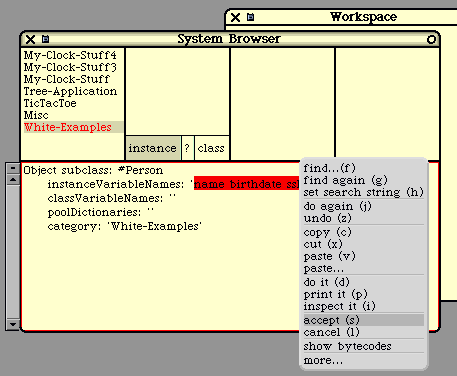
When I try to think of prior examples of people implementing the Creative patent as I understand it, the absolute first thing that comes to mind is... that little file browser thingy from NeXT. Which was later assimilated into OS X when NeXT was bought by... Apple. Can you tell the difference between this and the cascading menus in the iPod? Because I can't.
And of course I'm still trying to figure out whether NeXT themselves ripped off the browser from that class browser widget you see so often in Smalltalk, or if it went the other way around.
Oh, but of course, the NeXT example covers a browser for files and the Smalltalk example covers a browser for objects, and in the mad calculus of patent law this is totally different from a browser for music files... -
Re:Teams?
Nice... you linked to the same article that the
The top team only had 12 people. See: http://www.cs.ucsb.edu/~vigna/defcon/017%20Black%2 0badges,%20black%20jackets,%20and%20the%20competit ion%20banner%20are%200wned.html
The third place team had only 9 people. And, an individual beat this team, and several larger teams. The largest team (the second place team) only had one person who was doing reverse engineering. All in all, it had nothing to do with the size of the team, but more with the skills of the people.
Also, the point system wasn't skewed. Even if someone took all their services down, people and teams still got mega-points for finding bugs. And, while taking services down to keep other people from scoring additional points was certainly an intentional part of the game, people generally didn't take their services down unless they were 100% sure they were getting owned and couldn't do anything about it, because they would then lose points due to the services being down.
I heard that those Kenshoto guys are all wanted by the law, which is why they are using aliases! -
Almost 30 years of prior art?
That both designs display using a Miller column browser (with different content!) and can show an image won't be sufficient.
So that's what it's called. This user interface predates the Macintosh, in fact it predates the Xerox Star office system that inspired the Macintosh. It comes from the Smalltalk class browser. -
Shameless Plug (Google hacks?)
I've been working on a full-earth terrain renderer for the last year, similar in style to Keyhole or Worldwind. The addition of worldwide outlines on google is wonderful, because yesterday afternoon I finally started to add a google maps data source to my application. Until now, it limited to WMS servers such as http://onearth.jpl.nasa.gov./
It's not nearly complete yet, because I still haven't properly handled the projection google uses (so the image is off near the poles), and it breaks at high detail levels, but these should be easily fixed within the next couple days. It should easily scale to the best data Google offers in the future.
There is one screenshot at the bottom of the page. The quality is fairly low, but that's because it's being rendered on a 5 year old laptop (I'm currently away from home).
http://cs.ucsb.edu/~richards/terrain/
I have no idea if I'll ship this with google maps support (since it is against their TOS), but it was fun to do. -
Scott Adams summed this up a decade ago...
-
In other news...There are no solid conclusions among all scientists on the shape of the Earth. You can look here, here, here, and here to see the lack of consensus on this subject among scientists.
The claims of a round earth are nothing more that a main stream media hype of one guys opinion to try to invoke fear in the general population.
Anyone can single out and focus on one area of the planet and come to a conclusion that would sound devastating if it really did apply to the whole planet.



.jpg)