Slashdot Mirror
Domain: uit.no
Stories and comments across the archive that link to uit.no.
Comments · 30
-
Re:stop the pseudo-scientific bullshit
1. This land is geologically YOUNG, it is less than ten thousand years old
2. The earth itself is warming the underside of the permafrost, even if there is contribution from global warming https://cage.uit.no/news/metha...
Thus there is no reason to wail about some imagined harbinger of doom because of these sinkholes.
iggymanz may very well be one of the worlds leading scientists with a better understanding of this than the interviewed researches, but regardless you seem to be attacking a straw man as most of the researchers interviewed in the article seems curious and open, have theories but says more research is needed. The only one with very strongly worded categorical claims here here is you.
-
stop the pseudo-scientific bullshit
1. This land is geologically YOUNG, it is less than ten thousand years old
2. The earth itself is warming the underside of the permafrost, even if there is contribution from global warming https://cage.uit.no/news/metha...
Thus there is no reason to wail about some imagined harbinger of doom because of these sinkholes.
-
Re:Well
Surely they allow DNS? http://dnstunnel.de/
Or maybe even ping. http://www.cs.uit.no/~daniels/PingTunnel/
-
Re:Eeep!
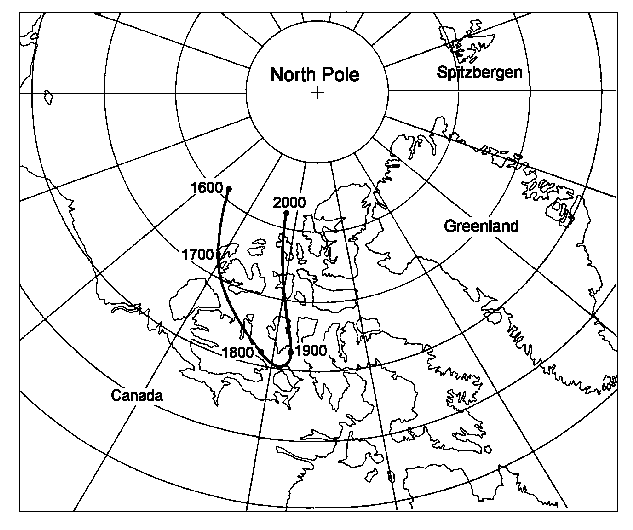
Speed of wandering over pre-historic time can only be measured by localized deposits of volcanic rock that was magnetized as it hardened. This can leave layers after repeated eruptions that are magnetized in different orientations.
After some 400 years of relative stability, (see: http://www.tgo.uit.no/articl/magnorpe.gif ), the North Magnetic Pole, previously wandering in a localized area, has moved nearly 1,100 kilometers out into the Arctic Ocean (in roughly a straight line) during the last century.
There is not that much difference in the total distance moved, the significance is that the direction has changed from a loop to a line.
However, prior to 400 years ago, nobody was paying that much attention, and volcanic deposits over such a time scale are not all that easy to investigate. Lots of digging in rock and stuff. I'm not sure how good the geologic record is prior to 1600s.
-
streaming != download prevention
Part of the point of anyone doing streaming video (or audio) is that the data doesn't touch the hard drive thus preventing (casual) recording, only screen captures of single frames.
Most streaming media can be downloaded to the hard drive easily. Have you never heard of
Streamripper?If the protocol is HTTP, Squid can be configured to always cache large files. As a last resort, the simple BSD licensed PacketProxy program can intercept TCP connections on any port.
-
ProxyBox, Proxies and how you can help.
Not long after the first requests for proxies went out, went out the requests for "So how do I configure this again?".
So I created ProxyBox [mirror] to help people get stuff setup quickly. It has squid (listening on a multitude of ports), tor, & ziproxy. It was quick and dirty (and the file size shows). Not to mention I'm just a Mechanical Engineer, not a security expert. This was meant for the fark crowd and not for the slashdot, I'm sure everyone here is more than capable of setting up some proxies.
Austin Heap has been distributing the Proxies to Iranians on the inside via twitter and such. (Twitter) his biggest problem right now is ssh servers inside of Iran to make sure that proxies work. Supposedly he's also been able to set up VPNs on fast connections. But work is slow because the internet is slow and he's down to 1-2 SSH boxes ATM.
They've already started blocking ports 80,81, 3128 & 8080. And starting to send fake RESETs on TCP connections (Comcast anyone?).
How you can help:
Well I'd like some help making ProxyBox a ton smaller. If DSL can get a full GUI in 50MB, there's no reason ProxyBox should be 400MB. I'd also like to turn it into a LiveCD or LiveUSB so it can be set up by anyone not just with VirtualBox. (jjarvis98 at gmail.com)Tor is being used quite extensively. Some people have setup exit nodes and had their connections filled with people hitting nothing more than twitter, facebook & youtube. Set up an exit node or bridge if nothing else.
Supposedly UDP and ping still work fine. So some people are looking into TCP over UDP or I was also thinking about Ping Tunnel (Tcp over Ping)
#irantech on irc.freenode.net is a bit unorganized but it's working for now.
-
Revenge
Might this mean a return of the good old Moebius Fax? (scroll down a bit)
-
Re:Here's an even better suggestion:
And then the kids tunnel their porn through an ICMP Tunnel and the whole plan falls apart.
-
Re:This only works at night?I just told you what it does - read it again. HAARP is not the only ionospheric heating experiment, not is it the first. The European EISCAT experiment has been around since at least 1979. But do people worry about EISCAT like they do HAARP? Nope!
Here's some EISCAT results:
Leicester Scary, isn't it?
-
Re:Can't stop the signal
There is btw an application that lets do precisely that, to proxy TCP over ICMP : ptunnel
-
Re:Interesting ICMP exploit
Save yourself some trouble, check out PingTunnel.
-
Re:Blocking ports 1-65535 TCP/UDPThat's why we have Ping Tunnel "For those times when everything else is blocked."...
See, there are always some hacker far ahead of ideas like that
-
Work flow
see the work flow diagrams towards the bottom. The basic workflow is more or less the same regardless of whether you modify and existing tool or roll your own.
-
It's been done already
See this or this. RMS and many others are all over it.
-
Re:A plea to all up-and-coming language designers
Does Common Lisp lend itself easily to kernel, systems, or real-time programming on mass-market computer architectures?
(Operating System) Kernels? Sure (there's been more than a few projects over the years). Systems? It's a programming language, after all. Oh, you mean highly complex, interactive models of real-world processes? I don't know too many people who are not using Lisp doing that sucessfuly (no, seriously, there really haven't been too many systems like those described in the link period, and most of those were aborted or had failed miserably). Is music performance real-time enough? If not, maybe you'll find robotics fits the bill. When did the Lisp Machines start making a comeback? All those applications run on regular PCs (with the exception of the robots of course).I know that the developers of a popular PS2 game have disclosed that the game's business logic is written in Lisp
Naughty Dog have developed all of their PS1 and PS2 games (mostly) in Lisp; I didn't know this was a secret. But, a video game's business logic? Man, you need to stop sniffing the Sharpies with the guys from the marketing department.but would one want to write a 3D engine or a cellphone game in Lisp?
There are a few projects doing 3d games in Lisp (but so far I haven't seen anything in terms of purdy screenshots). The CAD and animation packages in Lisp have shown that it's certainly possible to get good 3d performance (Izware's Mirai has the fastest IK/FK solver for skeleton constraints I have ever seen anywhere - the closest competitor in terms of features, Sega's Animanium, is about four to five times slower (in terms of minimum system requirements for interactively solving a ~two-dozen bone human skeleton - Mirai can do this on a 200Mhz PPro with 192M of RAM; Animanium needs at least an 800Mhz PIII with 256M of RAM). I don't know of any Lisp implementations that support cell phones, so I guess you're out of luck until the cell phone companies start offering Lisp (you're pretty much limited to their supported platforms if you want to develop cell phone games).PS - in a recent dick-measuring benchmark (the "Coyote Gulch" floating-point ephemeris calculator), CMU Common Lisp and Steel Bank Common Lisp produced code 5% faster than GCC on a Pentium IV. The participants claim it was "an hour-or-so's work".
-
Re:Logo OS? Try a Lisp OS
you might want to see Movitz a "Common Lisp OS development platform".
-
Re:CitizenCorps=USA's KGBesque informants...
I'm so glad I live in Canada. Until the tanks roll across the border....
Actually, there won't be tanks - "War Plan Crimson" (or whatever the latest intervention plan is called) doesn't envision armoured conflict with Canadian troops. A light urban assault force rolling in to Ottawa, Toronto, Montreal and Kingston is sufficient. From there you can control the major political, media and business centres (except Vancouver, of course) plus military communications, the major highways, railways and the St. Lawrence seaway. Then you just have to manufacture an 'invitation to assist in controlling [whatever destabilizing event]' a la Grenada and there will be nothing to interrupt the flow of natural resources to the US economy. The trick is to move fast, not heavy.
No joke! Declassified US planning documents from the early part of the century lay it all out and US base developments (Fort Drum) continue the trend. Check out Bordering on Aggression by Floyd W. Rudmin [Voyageur, 1993, 192 pages, $14.95 Can. tp, ISBN 0-921842-09-0]. It sounds like crazy talk, but Rudmin does a good job supporting his thesis. This kind of plan is actually just a testament to the abilities of the military to prepare for strange contingencies.
The Baldwins and the Arquettes can rest easy knowing they will be avenged.
A good book review of "Bordering on Aggression" here.
Floyd Rudmin publications listed here.
-
Re:It's amazing that people still can't make it ri
Theres only one True tetris in my eyes, the 1989 IOCCC Best Game winner, A true classic.
of course, it has been cleaned up and improved, and is now included as tetris-bsd in the BSD games collection. -
Re:How to transition?On your gateway, run a 6to4 translator (eg NATPT.) To handle DNS, run the Trick-or-Treat daemon, which takes IPv4-only addresses and puts them into v6 form (NATPT then translates it back at the border.)
Now port all your apps to support IPv6. This involves changing IPv4 specific function calls to their IPv6 equivalent. For folks like me, who only use the web & ssh, this isn't even an issue, since OpenSSH and Mozilla support IPv6.
Viola, you're running IPv6 and nothing else.
-
i'm no expert but...
my google turned up this which seems to suggest it can be done, but doesn't give too many hints other than use Kernel 2.2.13, built-in IrDA driver
-
I hereby invoke the Roman Rule...
FreeCiv, NiL, Pingus, XPilot, NetHack, Crystal Space, GFingerPoken, Koules, Liquid War, XConq, WorldForge, SpellCast. To name the tip of the iceberg; I don't have time to do this all day
Or, in other words: The one who says it cannot be done should never interrupt the one who is doing it.
Cheers,
Daniel -
Some phones are working, but not all
From what I read on the Linux-IRDA howto, some phones are supported...
The list includes: The linux-irda page is here
The phone list is here
The method they use is IrOBEX (Infrared Object exchange), which allows to send/receive data such as contacts from/to the phone... (woah, that's a multiple choice sentence)
I'm just gettin' my Siemens S25 (nifty phone) to work with my laptop.
I don't know about serial cables support, but as the irda port emulates a serial, it should be similar. I haven't tried the PC Cards you can get with some phones, but you may want to stay away from them because they are often doing the modem work themselves (à la winmodem) making linux drivers less likely... -
Some phones are working, but not all
From what I read on the Linux-IRDA howto, some phones are supported...
The list includes: The linux-irda page is here
The phone list is here
The method they use is IrOBEX (Infrared Object exchange), which allows to send/receive data such as contacts from/to the phone... (woah, that's a multiple choice sentence)
I'm just gettin' my Siemens S25 (nifty phone) to work with my laptop.
I don't know about serial cables support, but as the irda port emulates a serial, it should be similar. I haven't tried the PC Cards you can get with some phones, but you may want to stay away from them because they are often doing the modem work themselves (à la winmodem) making linux drivers less likely... -
Re:Palm Security
Try using the IR interface. I've been able to get 115200 Kbps using the SIR interface on my Toshiba Libretto and Linux IRDA. If you have a FIR chip on your desk/laptop you can get up to 4Mbps. That's MORE than enough to kick your cradle's ass speed-wise. Check out the Linux IRDA Project for details!
-
The Linux IrDA-project might be a source....
....if someone wants info on phones which (at some point) may be attached to a Linux-based computer.
Check http://www.cs.uit.no/linux-irda/ for information about this. In particular http://www.cs.uit.no/linux-irda/hardw are.html surveys phones (and other stuff) with emphasis on IrDA-capabilities and cooperation with Linux.
-
The Linux IrDA-project might be a source....
....if someone wants info on phones which (at some point) may be attached to a Linux-based computer.
Check http://www.cs.uit.no/linux-irda/ for information about this. In particular http://www.cs.uit.no/linux-irda/hardw are.html surveys phones (and other stuff) with emphasis on IrDA-capabilities and cooperation with Linux.
-
Toshiba is helping
Toshiba has provided some info about its IR hardware. This was mentioned in several places, and you can find mention of it in the Linux IrDA Diary. (Search for Toshiba)
-
Alternative Album DB Info
One another user-maintained CD database on the net is Mind on Music. That might be a willing site to kick-start a free CDDB alternative database.
-
Here is the article...So you can stop killing this guys server now...
This weeks Spotlight is an interview with the Pioneer behind the Linux IR project, Dag Brattli. His project has greatly improved the lives of those of us blessed with laptops, PDAs, and IR-enabled PCs such as the Netwinder. Dag is 29 years old and is working towards his Ph.D in computer science. His normal home address is in Tromsø, Norway, but he's studying at Lancaster University (UK) until August 1999. Dag Brattli
Mattshouse:
What gave you the idea to start the Linux IR project, and how long has it been around?
Dag:
According to my log-files, I started the project Sun Aug 3 13:49:59 1997. The reason was that I needed more wireless technology to play with for my Ph.D project. HP had donated some HP Netbeam IR (IrDA LAN) boxes to the institute that nobody seemed to use. I thought that it would be cool to have Linux support for these boxes and started coding. If I had known then how much work it would be, I would probably never have started! I'm using much more time on IrDA than I probably should, but then it has been my gateway to the Linux kernel and kernel/network level programming.
Mattshouse:
How much cooperation do you get from the hardware vendors? Who's the best, who's the worst.
Dag:
In the start none of the hardware vendors seemed to care. IrDA didn't even like that we used the word IrDA in the project's title so we had to change the name from "The Linux IrDA Project" to "The Linux/IR Project".
But the interest has been growing, and today most of the large vendors (Fujitsu, Extendsys, Sonycom, Nokia, Corelcomputer, Microsoft, Intel, Actisys, Canon, Hp, Ericsson) subscribe to the the linux-irda mailing-list.
The worst companies I have ever experienced (if I may say so), are Sharp, Toshiba, VLSI. They don't give out any documentation at all about their products. If you are a Linux user, then you should never buy equipment from such companies. I'm the unlucky owner of a Toshiba Tecra 740CDT, and have still not been able to get the documentation I need to write a device driver for the IrDA chip inside the machine.
But there are good companies too! ACTiSYS sent me a 4Mbps IrDA card and a infrared printer adapter, and gave me all the documentation I needed to write device drivers for their products. They even used one of their best developers, Lichen Wang, to help me get the thing working. Finally having 4Mbps support was just fantastic. It was really one of the most interesting moments I have had in the development of Linux/IR. Lichen Wang probably knows all there is to know about IrDA!
Corel Computers also needed help with getting 4 Mbps IrDA support for their NetWinder, and I said it would be much easier to help them if they could send me one unit. A couple of days later, I had the machine at my desk, but unfortunately I haven't been able to make the chip work properly yet. There seems to be some problems with the DMA which I cannot figure out. I haven't given up yet, so I'll give it another try once I have the machine upgraded to Linux-2.2.
Finally I must also mention that Tekram has also been nice and sent us the documentation we needed.
Mattshouse:
Has Irda changed it's position now that we have a working product?
Dag:
No they haven't! Well I haven't contacted them, but I haven't heard from them either. They have this silly rule about the use of the IrDA (R) name. I cannot call it Linux-IrDA, since IrDA is an organization/trademark, and not a product. The right use would probably be "An Implementation of the IrDA (R) Standard Specifications for the Linux Operating System"
Anyway, you have to be a lawyer to understand all the trademark rules. What I know is that if I call it Linux-IrDA, people will know what it's all about, try it out, and maybe buy IrDA equipment. If I call it some other stupid name, nobody would understand what this is all about, and that would be in nobody's interest.
I must mention that I know they have been sending some mail about Linux/IR on their internal mailing-list, but thats all. There was apparently some discussion about the compression protocol used by Linux/IR. Compression is not part of the IrDA protocol specifications, and it was something I came up with since I thought that my 115200 bps connection was way to slow. Linux/IR can negotiate deflate (gzip) compression (bzip2 on the way) and will use it if both parties agree to do so. I haven't done much work with it after I got my 4Mbps card, but I should have written a small paper describing it. I'll try to do it as soon as possible, even if IrDA doesn't like it
I would like Linux/IR to be a member of IrDA, but that would cost me about $1500 and thats way above my budget! I think that Linux could be a very important platform for IrDA (and others) these days, and ignoring it will turn out to be a big mistake!
Mattshouse:
Has the company that recently aquired the rights to the Netwinder contacted you yet?
Dag:
You must be talking about the HCC? Well, I haven't heard anything from them. Chris Herrnberger, Founder and Corp Liason (Corel Computers) posted an annoncement on the NetWinder developer mailing-list trying to ensure that this would not affect the open-source development for the NetWinder. The only problem is that the NetWinder is much more than a machine, it is like a movement or religion. People just liked the Corel NetWinder, and I'm not so sure they will like the HCC NetWinder even if it's the same machine. Lets hope that this goes well!
Mattshouse:
I'm the only one on the mailing list that spoke out against including the IR in the kernel releases. I got my clock cleaned, so to speak. How did that come about? Were you approached by Alan or Linus?
Dag:
Well, it actually started with that mail I sent to the mailing-list. I asked if we should declare a code-freeze and try to make the implementation good enough to be included in the major Linux distributions. In the discussion that followed various people started to discuss if we then should make the source patchable against the Linux kernel, or have its own configuration script like the PCMCIA package from David Hinds. Most people thought that a patch against the kernel would be the best, since having to rebuild both the PCMCIA and IRDA package every time you installed a new kernel on your laptop would just be to painful. The PCMCIA package usually breaks with every new kernel version, making it really frustrating to use.
I then mailed Alan Cox (which I ask for advice when I get really stuck) and asked what he would recommend. He answered that a kernel patch would be the best, and that I should send him a patch of the latest code. After working continuously for 24 hours, the code was converted from the CVS tree to a linux-kernel patch, with new makefiles and configuration stuff that was required. I didn't hear anything from Alan for a couple of days, and I got really happy when I suddenly discovered that the code had been included in Linux-1.1.131ac3 (I think it was). Making it into the ac (Alan Cox) series is not the same as making it into the "real" kernel (people said), and since Linus was on holiday in Finland, I would just have to wait and see. Anyway, Linus included the code in 2.1.132, even after feature-freeze, apparently since the only changes the code required to the rest of the Linux kernel was three lines of code where two of them was #ifdef/#endif.
Mattshouse:
I guess that my thinking was a little selfish. I saw the merger as the end of the fun days, and the start of real work. Did it ever hit you like that?
Dag:
Yes, I know what you mean. Suddenly everything got more serious. It's not that easy to send some patch away these days without testing it with all possible hardware, for all possible configurations. It really takes much more time than before. I feel that I use so much time testing, and not so much time programming anymore. But again, it is probably what's required to get it stable enough to really be used by people, and having developers write applications for it. I really want it to be used by the people!
Mattshouse:
What's next for the IRDA standard? Higher speeds, greater range?
Dag:
Well, its not good to say. RF and microwave seem to be the future, and I think IrDA is struggling a little bit. The market seems to go for technologies like Blue-Tooth, which gives you increased range and no need for line-of-sight.
The reason why IrDA has sort of failed, is that they have not been able to produce the killer application the users wanted. Most people have had laptops with IrDA support for many years now, but using it has been mostly painful. I think that the vendors concentrated too much on protocol-stacks and hardware, and forgot to make the applications that people really needed to be able to use it. The Palm III, however, is a really nice device that has made IrDA get back into the (red) light again. This is because IrDA beaming has been integrated in most of its applications, making it really easy to use.
But you asked about the future for the IrDA standards. The next thing for IrDA is VFIR, AIR, and IrBUS:
o With AIR you will get wider angle and longer distance (10M) but at a lower data-rate. AIR requires hardware and software changes that are costly, so its unlikely that you will see any products shipped with AIR.
o CIR (Control IR, previously IrBUS) is aimed at remote control, IR keyboard, etc., and not for data communication. Remote controls have been the killer app. for infrared communication in the past, so why not in the future
o With VFIR you get a higher data rate (16 Mbps). Unlike AIR and IrBUS, the software changes for VFIR are minimum since all changes are mainly in hardware.
Mattshouse:
I've been a member of the mailing list for a while now, and I've had the pleasure of getting to see the breakthoughs. Were you a little stunned at the rate of progress?
Dag:
Well most of the features in Linux/IR have been developed pretty quickly. One of the worst problems we had (I just have to tell), was that I had forgot to bytestuff the CRC bytes of the IrLAP frames. There are 2 CRC combinations of 256 that need to be bytestuffed which ment that the link would usually go down after a couple of minutes (no help in retransmitting a bad CRC
One more general problem is however that we working mostly by the breadth-first method. We have got most of the features in place, but we really need to make it stable enough to be used by normal deadly people. It's always very hard to get those last 5% in place
Mattshouse:
Now that your code is an 'official' part of the linux kernel, what changes have to be made to the development process?
Dag:
The main difference is that the CVS tree has gone. In the previous development model, all developers had direct access to a CVS repository. CVS worked very nice, but now it would just be a lot of work to keep it synchronized with the kernel.
Now the other Linux/IR developers have to send patches to me. So when I feel that the time is right, I will make a patch which I send to Alan Cox. If he likes it, he will then send it to Linus, and if he likes it, it goes into the kernel. It works much better than I thought it would, since I now see what the other developers are doing. The hardest part is to really get familiar with diff and patch
One problem with using CVS, was that the code was usually not that stable. It could be really painful to try and stay updated and be on the cutting edge. Now, the other developers can work against a normal Linux kernel which is quite stable these days.
Mattshouse:
Let's say that a hungry developer reads this and is inspired to help, what's an example of an application that would be usefull?
Dag:
I really hope that one day I will be able to have a GNOME panel applet where I could just drop the files I wanted to beam to my PDA. An IrOBEX daemon with CORBA/ORBit support would be just smashing! A KDE interface would also be great for those who use it
The Linux IR Project's web page is http://www.cs.uit.no/~dagb/irda/irda.html . Information about joining the development team or writing applications for Linux IR can be found there. How about giving them a hand? That Gnome applet sounded pretty cool, how 'bout it folks? -
There's a "pgplib"
library with source available, but it's not done and there's no app made for it other then a test app.