Slashdot Mirror
Domain: unige.ch
Stories and comments across the archive that link to unige.ch.
Comments · 82
-
Re:Regarding cooling, coal more energy dense
From the NRC's Engineering Analysis of the failure modes of Nuclear Reactors:
Interfacing system loss-of-coolant accidents (ISLOCAs) are a class of accidents that can result in the over-pressurization and rupture of systems that interface with the reactor coolant system outside containment. ISLOCAs have been a concern with regard to public health risk due to the potential for fission product release directly to the environment, bypassing the containment structure. No ISLOCA events have been identified in the total U.S. operating experience (1969–1997). However, during the course of this study, one ISLOCA precursor was identified. The identification of only one ISLOCA precursor in the nearly 2,000 LERs over the nine-year study period is not unexpected, given that only LERs containing documented reactor trips or manual trips from power were included in the study set. The types of activities that would normally lead to the identification of an ISLOCA precursor—maintenance and testing on systems that interface with the reactor coolant system—are usually performed on interfacing systems while the plant is shutdown.
The ISLOCA precursor event identified in this study did not result in a release of reactor coolant to the environment. The Arkansas Nuclear One Unit 1 event occurred as a result of a High Pressure Safety Injection System (HPSI) check valve failing to reseat along with the presence of a differential pressure (d/p) condition between two primary loops due to a tripped reactor coolant pump. This d/p and the failed open check valve allowed reactor coolant system water to backflow outside of containment via the HPSI system. The backflow of the high-temperature reactor coolant heated the HPSI piping enough to cause some combustible material in contact with the piping to start smoldering.
So that is talking about steam hot enough to be a potential ignition source which shows why cooling is *the* critical system of a Nuclear reactor. Additionally there is a short discussion on the impact of drought on Nuclear reactors is discussed on page 4 of this report from the University of Geneve.
As with all basis design issues in nuclear reactors they are only exposed under certain circumstances - that's just how they work. You can mitigate them by designing processes around them to avoid the situation and look for the events that can initiate that form of accident. Considering it is a primary system we are talking about, it is a low probability accident with a very high impact that the NRC's risk analysis describes as neither trending up or down when the study was down in the 90's.
I think the point you are missing is things that change that risk. The NRC's own reporting stated:
Although no ISLOCA has caused core damage, accumulated operational experience, both in the United States and abroad, indicates that ISLOCA-like events have occurred at a rate higher than expected.
-
Re:No generics
Neither do you, apparently. C++ (the language, not the library) is the largest programming language in existence. Nothing is larger.
[citation needed]
A clue: there is no citation because you're making it up.
So let's consider languages where actual formal specifications exist because they have to be written in excricuiating detail because the asusmption there is no reference implementation that people can refer to if in doubt.
[snipped...]
So there you go, there are 4 standardised languages I've given you which have longer specifications than C++.
Well Done. Now, where exactly did I claim that the english-language specification for C++ is larger than the english-language specification for other languages? I claimed that the language "C++" is larger, but only a moron would use number of pages of english text as a measurement.
The C++ language, as defined by its grammar rules in BNF, is larger than any other programming language, as defined by their respective grammar rules in BNF. This is well-known and is taught in almost every introductory compiler class I've reviewed.
Go ahead - look it up. Here's the BNF rules for java, 48 general rules for the programmer to remember, very few depending on context. Here's the one for C++, 80+ rules for the programmer to remember, many of them depending on context.
I'm not going to do your homework and search for the grammar rules for the other languages which you claim are bigger than C++; just refuting the one you listed is enough for you to ask yourself "Whats a BNF and why does it determine the size of a language?" If you do not get the relationship between "this is how much language a programmer needs to keep in their head to program" and "this is how large the BNF for the language is" then I'm afraid you are beyond my (and most professional) help.
(Hint: maybe register for some CS course in programming languages and compiler design? Or write a compiler or two yourself? You would do yourself a favour and learn enough to not use "number of pages in spec" as a measurement of a languages size (and/or complexity, but I didn't even start on that))
Given your propensity to simply make shit up about C++ [citation: see above], your statements lack credibility.
Your nerdrage whenever you perceive an attack on "your" language is laudable, however I suggest you stop being so unreasonably attached to what is only a programming language (albeit a very large one). C++ is what it is. Your insults won't change that.
-
Re:is there an xkcd comic for this?
String theory did produce predictions... like a graviton leaving the brane.
In my experience, most of the anti-physics, anti-string-theory sentiment is based on "look, those really smart guys aren't so smart, so I must be smart too, or at least smart sounding." -
Re:Not the first study of this sort
There's been other similar prior work. For example, there's evidence that gamers can quickly allocate their attention in an efficient fashion. http://www.ncbi.nlm.nih.gov/pmc/articles/PMC2680769/ and that gamers have faster reaction times for a large variety of tasks http://cdp.sagepub.com/content/18/6/321.short.
Indeed, I'd have modded you up if I'd have mod points.
This study is yet another one showing these effects, but is by far not the first. The effects of video-game playing, in particular action video-game playing, on various part of the decision making process have been studied extensively. The whole research was kicked off by the publication of
Green, C.S. & Bavelier, D. (2003). Action video games modify visual selective attention. Nature, 423, 534-537
with more publications related to that topic available on the lab page of Daphne Bavelier.
Disclaimer: I was working in the same department as the above-mentioned lab some years ago -
Re:Not the first study of this sort
There's been other similar prior work. For example, there's evidence that gamers can quickly allocate their attention in an efficient fashion. http://www.ncbi.nlm.nih.gov/pmc/articles/PMC2680769/ and that gamers have faster reaction times for a large variety of tasks http://cdp.sagepub.com/content/18/6/321.short.
Indeed, I'd have modded you up if I'd have mod points.
This study is yet another one showing these effects, but is by far not the first. The effects of video-game playing, in particular action video-game playing, on various part of the decision making process have been studied extensively. The whole research was kicked off by the publication of
Green, C.S. & Bavelier, D. (2003). Action video games modify visual selective attention. Nature, 423, 534-537
with more publications related to that topic available on the lab page of Daphne Bavelier.
Disclaimer: I was working in the same department as the above-mentioned lab some years ago -
Re:People are debating the wrong question
For one, a lot of very wealthy people are going to lose their expensive beach front properties.
A lot of poor people, mostly in third world countries will have to move.
You toss this out as though it's trivial. Where are you going to put 17 million displaced Bangladeshis, when their neighbours are dealing with their own internal refugee crises from the same climate and sea-level changes?
But most people will not starve to death, we will adapt.
Most people in the developed world will not starve to death. The outlook for the rest is not so good, considering that over 30 million people a year already die of starvation. As you say, doing nothing is still an option. But we should at least be up-front about the consequences.
-
Re:Direct democracy
There are lots of nice papers on the subject here: http://edc.unige.ch/
-
So...
the same kind of power they get with Lisp and Ruby, combined with a nice, small, regular syntax
So, it's Lisp then?
Seriously... in terms of small regular syntaxes you don't get smaller and more regular than Lisp:
s_expression = atomic_symbol \
/ "(" s_expression "."s_expression ")" \
/ listlist = "(" s_expression ")"
atomic_symbol = letter atom_part
atom_part = empty / letter atom_part / number atom_part
letter = "a" / "b" / "
number = "1" / "2" / "
empty = " "
(source).
Next smallest and most regular syntax for a useful language is probably smalltalk, but that's too long to post here. It's worth noting that smalltalk (particularly its first-class statement blocks) was a heavy influence on ruby. Smalltalk also gets close to hitting the 'nice' requirement, which IMO Lisp is a long way from.
-
Re:Random Coloration Photos
This has the same problem as my suggestion -- it's to hard to generate more problems without writing something that can solve the problems at the same time.
The spammer can copy your photo, mark areas as cup, flower etc, then the algorithm can look for 'cup' in the sentence and see what colour the pixels are this time.
You might be surprised by this. Click Accept and Connect, click Random, then from the returned images choose a couple as Rel[evant] and click Query. Depending how complicated the image you choose is it could be quite good!
So to solve your CAPTCHA a Google image search for the noun ('cup' etc) returns some results, the most common result is found using the similarity algorithm, and then the most similar part of your photo to the Google image is found and the colour returned.
Having said that, this isn't simple (just, I think, do-able) so it would require a lot of effort from the spammer. -
Products already exists....
The Group of Applied Physics at the university of Geneva, Switzerland is playing with quantum teleportation for some time already, visit
http://www.gap-optique.unige.ch/ for more information.
A spin-off also sells products based on this technology:
http://www.idquantique.com/ -
Bjork ReactTable at Coachella
The ReacTable has been used recently by Bjork at the Coachella festival.
There are lots of good videos linked from the BoingBoing article including one of Robert Moog interacting with a ReactTable.
The software is available so if you want one have a crack at building your own.
As best as I can tell the only innovation that Microsoft has added to their interactive table is the wireless interface support (Bluetooth etc). All the shape and "domino" tags recognition have been done before. It would be interesting to see how many of the developers of other interactive tables have been involved with this project.
Other interactive tables can be found here.
http://mtg.upf.es/reactable/?related
http://www.tangibletable.de/
http://www.ipsi.fraunhofer.de/ambiente/english/pro jekte/projekte/ineractable.html
http://www.jamespatten.com/audiopad/
http://tecfa.unige.ch/perso/staf/nova/blog/2005/01 /10/space-and-place-a-list-fo-interactive-tables/ -
software for exoplanet detection
All exoplanets around the Gliese 581 star were found by HARPS, an instrument installed on European Southern Observatory. HARPS is only one of the two instruments that exist worldwide with high precision capabilities, so imagine what we could find if we had a Beowulf cluster of these. You may like to see the software used to run HARPS.
-
Re:Question...
I admire the skepticism, but here it is:
http://obswww.unige.ch/~udry/udry_preprint.pdf
Dated April 25 so I guess it's not published yet. -
Re:I don't believe this either
I've read an article one year ago or something like that about the same subject in a French magazine. Except it wasn't worded the same way... It was about people hardwired to believe... not to believe specifically in god(s).
Maybe you believe in science or 'nature' or something like that, not really related to the usual meaning of 'religion'.
It's more like a cognitive mechanism acting as rassuring you that there is an 'external' explanation for phenomenons you don't have a rational explanation for.
--
Now I'm thinking about a sketch from a french humorist Fernand Raynaud, that is loosely related to the topic, here is a small excerpt, verbatim, will understand who can...
- Pourquoi que les vaches elles ont des cornes et puis que les chevaux ils en ont pas?
- C'est... C'est étudié pour!
(actually google translation is quite correct, just replace 'studied' by 'designed') -
Re:uh oh, there goes wikipediahttp://tecfa.unige.ch/~nova/img/spam-map.jpg -- Spam map
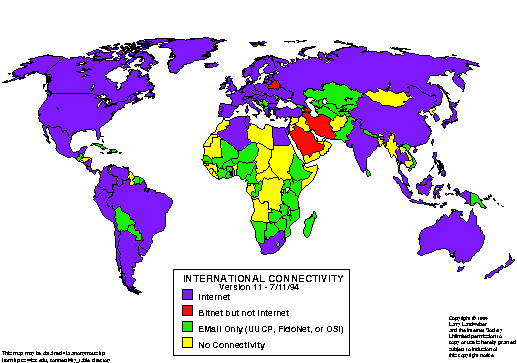
http://www.skills-1st.co.uk/papers/brunel-mirror/w orld-on-your-desktop/internet-map.gif -- Internet map (circa '94)
You'll notice that every nation on the Internet produces spam. Interestingly, in the US the cities that would be most affected by a "block by geography" policy would be LA, Seatle, Dallas, and New York. Spam originates in all nations that have Internet and is most densely located in areas that are most populated. Your policy may work on a case by case basis, but if someone were to block all emails I get from New York I think my boss would be pretty pissed. Korea I can live without, but none of my spam seems to come from there, it comes from client addresses that are scraped by US companies.
-
Re:The big problem
Fine, they won't keep the actual images in their databases, but instead keep a hash/signature of images.
Use a signature generation method like http://vision.unige.ch/publications/postscript/98/ MilaneseCherbuliezPun_icapr98.pdf or even more flexible (kind of like a visual version of musicbrainz) so the signature would be invariant to minor changes in the image. Not really my field, but it seems relatively trivial. -
Re:Old hat
This is not a joke.
Anti-matter weapons are the future. It will not be long until we have what I call a "Planetary Deadman switch".
The mass defect of traditional fission or fusion bombs is infinitesimal, requiring significant quantities of of the materials involved. And no, antimatter is not unobtainable, it is relatively simple to generate, but rather difficult to store.
Matter-Antimatter annilation events result in a complete conversion of matter to energy, unlike the tiny mass defect of nuclear reactions. Not much antimatter is needed for a planet cracking device.
I remember reading about a benchtop device that could generate and store on the order of hundreds of antiprotons for up to ten minutes over 12 years ago. I'm sure this has come a long way since then.
http://cui.unige.ch/isi/sscr/phys/antim-BPP.html
The first nation to build one large enough to destroy the earth in one shot (it will be built - rest assured) will be able to hold the entire earth hostage to its demands.
I just hope it will not be the US, and if not I will welcome the day. -
Kill the pidgeons!They are bound to use the bird-flu scare to kill millions of birds when the real intent is to stop this sort of thing:-
http://www.ietf.org/rfc/rfc1149.txt
http://tecfa.unige.ch/perso/staf/nova/blog/2005/04 /28/pigeon-empowered-wireless-internet/The problem for all 'governments-of-the-day' who enact stupid legislation is that there is always a way around the 'problem'. There is also clandestine high frequency high speed RTTY.
-
Re:Ruby's Quite Nice, Really
And you conclude that from those buggy BNFs you linked to? Or something else?
The "buggy BNF" for Ruby is listed in Ruby's documentation. Matz himself probably wrote it. You want to call the BNF for Java "buggy," fine. First of all, look at the actual BNF instead of the hypertext: here. Second of all, there's another Java BNF here that's even hairier. Third, have you programmed with both languages? It's freaking obvious that Java's more complex if you have. There are many more lines to accomplish the same tasks, and commands like System.out.println() accomplish the same thing as print in Ruby. If you look at code from both languages side by side, Java will have more lines, more commands, and longer commands. The only time this might not be the case is when you're doing something that involves heavy use of libraries, and perhaps Ruby doesn't have a mature library for whatever you're doing.
Ruby:
puts 'Hello World!'
Java (must be in file: "Hello.java"):
public class Hello {
public static void main(String[] args) {
System.out.println("Hello world!");
}
}
Er, hello? I know you were only criticizing the BNF's I cited, but think we can put all this "java is simpler" garbage to rest now.
-
Re:Ruby's Quite Nice, Really
Java's BNF has 64 productions, Ruby's has 44.
And you conclude that from those buggy BNFs you linked to? Or something else?
The import statement BNF you linked to gives the OK to
import foo.bar.*;;
but not
import foo.baz.*;;import foo.bar.*;
import foo.baz.*;Nice.
I'm not disagreeing or agreeing with your assertion about language complexity, but linking to crap like that isn't going to bolster your case.
-
Re:Ruby's Quite Nice, Really
-
Curiosity more interesting
I found more interesting this link, found through the link at the bottom of the article. It says that Sony endowed some AIBOs with an adaptive curiosity system that allowed the robot dogs to learn to do things they weren't specifically programmed to do. This was accomplished by giving the dogs a sort of sense of curiosity and boredom. Cool.
-
Hot date with RealCow tonight!
Technology advances AGAIN! : Bovine rectal palpation simulator. It should be a simple matter to re-design this for goats.
-
How about the iPotty?
No, wait...MS already beat them to it.
-
Re:Programming in english sucks anyway
Achieving unambiguous precision with English is HARD.
To me, this seems hard in any language, programming languages included.
IIRC, even the representation of such simple sructure as ALGOL60 in BNF was ambiguous.
CC. -
Re:Misleading title
Yes, obviously it will be an approximation of the whole universe. It would be impossible to simulate the entire thing...
I had this idea for my science fair in high school, I wanted to simulate the universe but in a slightly different manner (I knew it would be impossible to do a good computational simulation this way on my home PC). Rather than running gravational computations on massive amount of particles, instead I used each star (or stellar object) as a data point, and created a group of equations to simulate how they would age according to known laws of stellar evolution. I also included some basic work on nebulas, white dwarfs, and black holes.
Since it took most of my time writing the equations to age my simulated universe, the graphics and front end were rather weak (320x200x256c). However, my sophomore year at NJIT I rewrote the stellar evolution part of my application in OpenGL with data from real stellar models computed at Geneva University.
Check out the application here if you're interested. -
Re:UNIX was meant as a hoax
Yeah, and they let Bjarne Stroustrup in on the joke back when he was starting out...
-
Dictionary of Programming Languages
Hi,
Besides THE Language list (which is also linked to in the story), I also like the Dictionary of Programming Languages, which includes the Language Type and a Description / History for MANY Programming Languages.
In a more "practical" side, it's also interesting / funny to read 99 Bottles of Beer - one program in 620 variations
-
Java - Not everyone's favorite apparently.
I just did a search for Java on The Language List and here is the result:
Result of search for "Java":
No matching entries found.
-
Re:It has nothing to do with the circles. Anymore.
or the webpage, which has the results of more tests (all the ones out of Checkmark which I could get to work).
When I have time and can find some foreign banknotes, I will try them, but all the tests take about 4 days to run. The Checkmark tests are slow (since they are in Matlab), and for every test I have to try at least ~10 images in a binary search so as to find the changeover point. The strongly detected regions test takes the most time, since I test about 2,000 images. -
Yes, it is encryption
It's not the encryption per se that use quantum mechanics.
But the un-interceptable channel produced by quantum mechanics is used to exchange the encryption keys used in the encryption itself.
So, YES, the quantum mechanics are used in encryption.
Research is currently done on this subject here in switzerland
Principle
- according to quantum mechanics, you cannot split light in smaller element than photons.
- Quantum encryption transmits information (keys) using one single photon at a time (per bit of information).
- If any one attemps to steal the information, they'll "eat" the photon (no way to split photo. Either they go to receiver, or they go to the spy, they cannot go to both place at the same time), and the photon will be lost, just like it happens with other transmission errors.
- Using some error correction-like method both receiver and sender agrees which bits aren't lost and will be used.
- It doesn't matter whether the lost bit where lost due to poor quality of transmission or because of a spy listening : they won't be used any way.
- The "error correction-like" (= agreeing which photon they'll use) can be done on a basic non encrypted channel. Even if the spy get this information, it doesn't help him : because they'll agree on photon that arrived correctly, i.e.: photons the spy hasn't captured. All other photon he did manage to capture will be discarded.
-
Only one line detection?They're basing it on a single emission line detection - that the identified emission line is highly redshifted Lyman alpha. Normally, you'd like at least one or two other emission lines to pin down the redshift uniquely. I can see that they're also arguing that its blackbody color leads to a photometic redshift from z of 9 to 11, but those error bars look mighty big to me, and they're relying on the non-detections short of 1 micron. Any quasar savvy astronomers care to comment? I know you're out there in
Even if it doesn't turn out to be a z~10 quasar, this is an excellent piece of detective work. Big kudos to the authors on this.
Dr Fish
-
Difficult but worth trying
The concept itself is kind of intriguing - for quite some people(like myself) it would be really cool to save the time and hassle of trying on clothes in real shops.
However, it is really difficult to realize. You need inexpensive ways of getting 3D-Data of customers bodies (even data about the "consistency" and "elasticity" of certain parts). And, as many people pointed out, you need far better information about the clothes than just an (often inacurrate) size. The software part for modelling and rendering ist not too difficult.
Miralab at Geneve University has done some cool work in this field:
http://www.miralab.unige.ch
I think they had some cooperation with a larger clothes retailer in Europe on such a project but don't know about the current status. -
Re:Nanotech is XXIst century AI
Most slashdot posters a slightly clueless when it comes to nano tech. Try searching the web for Scanning tunneling microscope . This will give you an idea what a real nano tech product looks like.
-
Re:For image searching GNU has The GIFT
I just tried it online here and was not surprised by how poorly it worked. For my search, I picked a picture of some woman in a white shirt and I got back a picture of a snake, a tiger, an arch, some lions, a kangaroo, a guy with some yacks, two guys with a drum, etc. And that was with limited searches and clean image sets. I can only imagine the random garbage it would generate if it was doing the whole internet.
I think that searching on image content is a terrible idea, especially for finding a particular face. It ranks up there with face recognition at airports. I can't even recognize people in photos on the internet, so I don't see how a computer algorithm can.
Why is this idea so attractive to people? Are people doing Eminem and Beyonce Knowles searches on Google and not finding what they're looking for? -
Better methods needed for CollaborationIt is important to keep an eye on the many groups that are utilizing, facilitating and partaking in "virtual volunteeering." At the same time, however, the methodology being employed - and more importantly that which is being sought - also deserves attention.
ISSHO Kikaku currently uses the JoinProject module for PostNuke as a way to allow people to match their skills with the volunteer tasks that are in demand within the organization. It works well (need to register first), but it is very simple and is not adequate for more sophisticated needs. Why not look for something more sophisticated? We are, but don't forget that to give people all over the globe the potential for equitable access, everything must be translated - at least for some organizations.
So, mechanisms that match tasks and talent certainly need to be improved. But perhaps the bigger issue is tools for facilitating collaboration. These need to be reasonably priced, sophisticated and easy-to-use. And multilingual, of course.
In the specific case of ISSHO, an implementation of Wiki is very exciting so far, but - at the moment - lacks somewhat in the i18n area and in the linkage between the collaboration area and the website proper (this particular problem is related to the multiple flavors of RSS, ability or lack thereof of converting between encodings on the fly, and other issues). Sounds like it would be simple enough to solve, but so far these little nagging problems limit what organizations can do, considerably.
Once these and similar issues are addressed (and systems are in place to ensure that they will continue to be addressed, even as technology progresses) it will become much, much easier for volunteer organizations to get properly organized, and to organize potential volunteers. "Virtual Volunteering" will see a new dimension if and when these groups are able to focus more easily on the results, and don't have to do quite so many handstands to come up with adequate mechanisms for handling the basics.
-
Rockin' music
One of the best things about SC2 was the thumpin' music. My friend had the Gravis Ultrasound card and the music totally ROCKED! In the PC version, the music was done in Amiga MOD format, a four-track music system based on sound samples. It was amazing what could be done with just four tracks. MODs were featured heavily in the demo scene for a while.
You can imagine how pleased I was to find the music in MP3! Grab them here: http://www.classicgaming.com/starcontrol/3do/music -
karma whore strut...
Also seriously flawed in that you need IE on Windoze to use its web access features.
[Leave it to MS to never miss an opportunity to turn a great concept on its head to leverage the rest of their product line:) The folks at MS who actually implemented the web access feature in Project must have had the breath knocked out of them at the "IE specialization".]
Nevertheless, the concept of web based project management is still a really good one. Not only for read-access to view what's going on, but also to help formulate project plans.
I prefer to spend my time programming, but have had brushes with project planning exercises and noted the dearth of good open source alternatives to MS Project (which, practically, seems to require some training in order to learn the quirks of how to use it.)
The most intriguing development I've seen is out of the Horde Project (a PHP framework for web applications).
They mention something called Nag that came out 1.0 on June 11 of this year, but I don't know what it's really like.
But I can see where having an XML database for projects that is accessed via PHP would be a good thing. That, and having some SVG enabled browsers (and server code) to create and view Gantt charts on the fly.
Since I'm throwing buzzwords and wishlists about, I may as well suggest that WebDAV would be a great part of such a tool because it would offer a good means for collaborative authoring of project plans, which is really how the best ones get done. (The worst ones are guesses and dictats that make everyone mad.)
-
Compact Disc Video is not Video Compact Disc...!
laserdisc, quite sure of it...
You're right. I checked this out, and came across something called Compact Disc Video (CD-V; not Video-CD, V-CD or VCD); essentially, this is just Laserdisc and Laserdisc/CD hybrids under a different name.
This page gives a 1987 date for CD-V, and this page dates the official adoption of Video CD (i.e. MPEG-1) to 1993. There's more here and here about CD-V.
The CD-audio 5" disks are actually hybrid CD-DA/Laserdiscs (digital and analog) which is what threw me. (I was wrong earlier- it's the 8" discs that hold 20 minutes of video; the 5" discs hold a whole 6 minutes worth! Wow.)
I don't remember the phrase `Laserdisc' being used to describe any of these discs (5", 8" or 12"); but then, Laserdisc had pretty much bombed in the UK, so it wouldn't surprise me if they marketed all 3 sizes as CD-V.
This still leaves the issue of when VCD (MPEG-1) was launched. The 1987 date given in the URL above seems very early- I think the author of the webpage meant CD-V/Laserdisc (which I saw marketed in '89), or confused it with VCD... I could be wrong though. -
The Language List
It won't be complete if I don't include The Language List. Not only this page contains resources for those esoteric ones, but also other "saner" languages too.
For those of you who want to create programming languages, make sure you read the underlying principles. If you know all these stuffs, your programming language will not be just a toy!
-
Re:clarification - orbital eccentricity
Actually, the newly discovered planet orbiting in the star HD 28185's habitable zone has a fairly low eccentricity of 0.06. For reference, the eccentricity of Earth's and Mars' orbits are 0.0016 and 0.093, respectively. See this diagram and table for more details.
--Chris
http://www.shatters.net/~claurel -
Re:other resources...One of the best fractal generator programs around, even if the interface is somewhat clunky: Fractint
Another good one that even lets you compile your own fractal algorithms into it. For Mac only though. Fractal Designer
-
Good Examples of GUIs + Pipes
Actually the concept of combining Unix-style pipes and a GUI is not new:
- Visual programming languages, of which there are hundreds, are based on the same idea.
- Dataflow architectures are also based on the same idea and have been around for many years.
- A good example is the visual programming environment Khoros Cantata designed in the 1990s for image processing research. Programs are represented by a directed graph whose nodes are data sources, parameterised procedures, or outputs, and whose arcs are data flow paths (aka pipes).
- Visual programming languages, of which there are hundreds, are based on the same idea.
-
Cloth self-collision and responseClothing animation is a very challenging problem. Efficient integration is of course an issue, but all methods should give similar solutions, if given enough time to solve the problem accurately.
A much more severe problem lies in self collisions and response. This has not been addressed at all in the article this story linked to. It has also been largely ignored in the litterature: for instance, in the Baraff & Witkin paper in siggraph 98, they describe their solution for this with a short paragraph which, unfortunately for them, clearly highlights that what they did doesn't work
To sum this up, the problem of cloth self-collisions is a very complex one. Pascal Volino has proposed a solution to this at this year's CGI (article in PDF here), but I have only skimmed through it myself, and others in the field have diverging opinions about it. Ironically though, he proposes a solution to this whole cloth self collision problem using the very same technique that Baraff used for the integration (but failed to use for self collisions).
-
Re:...But it's being done with great successAhhhh, but the cloth simulations are not realtime. As far as that is concerned we have already seen CG cloth done before. As someone mentioned there is Geri's Game, and even The Phantom Menace, though it used part simulation, part hand animating. There have been also commercials like a Coca Cola spot by Digital Domain.
Even before that there have been some amazing demos shown at SIGGRAPH. There is the work of Nadia Thalmann at Miralab and a cloth simulation paper was the cover of the SIGGRAPH 98 Proceedings. It was by David Baraff and Andrew Witkin, both I think are now at Pixar.
It will still take some time to get realtime cloth simulations, especially for simulating different types of cloths, with good collision detection (self and otherwise) and that it doesn't involve a square pice of cloth like a flag, but something more complex like garnments which are made from shaped pieces. Looking forward to it, but not holding my breath.
-
Free databasesHere's a few, taken from the Free Database List:
- DiamondBase
- PQL
- Qddb
- Typhoon
- University INGRES
- MetalBase
- mSQL (Mini SQL)
- Postgres
- REQUIEM
- shql
- Arjuna Distributed Programming System
- EXODUS Project software
- LINCKS (Linkoping Intelligent Communication of Knowledge System)
- OBST
- pfl
- The Texas Persistent Store
- Triton Object-Oriented Database System
- pgperl
- SIOD (Scheme In One Defun/Day)
- Sybperl
- Sybperl
- Sybtcl
- tclgdbm
- tcl+gdbm
- Uniperl
- Willow
- "A Guide to the SQL standard"
- CDF (Common Data Format)
- examples from: "Information Retrieval, Data Structures
- _lex & yacc_ by Levine, Mason & Brown published by O'Reilly
- MultiCal
- persist++
- SQL parser ?
- SQL-86 in HTML
-
Free databasesHere's a few, taken from the Free Database List:
- DiamondBase
- PQL
- Qddb
- Typhoon
- University INGRES
- MetalBase
- mSQL (Mini SQL)
- Postgres
- REQUIEM
- shql
- Arjuna Distributed Programming System
- EXODUS Project software
- LINCKS (Linkoping Intelligent Communication of Knowledge System)
- OBST
- pfl
- The Texas Persistent Store
- Triton Object-Oriented Database System
- pgperl
- SIOD (Scheme In One Defun/Day)
- Sybperl
- Sybperl
- Sybtcl
- tclgdbm
- tcl+gdbm
- Uniperl
- Willow
- "A Guide to the SQL standard"
- CDF (Common Data Format)
- examples from: "Information Retrieval, Data Structures
- _lex & yacc_ by Levine, Mason & Brown published by O'Reilly
- MultiCal
- persist++
- SQL parser ?
- SQL-86 in HTML
-
Free databasesHere's a few, taken from the Free Database List:
- DiamondBase
- PQL
- Qddb
- Typhoon
- University INGRES
- MetalBase
- mSQL (Mini SQL)
- Postgres
- REQUIEM
- shql
- Arjuna Distributed Programming System
- EXODUS Project software
- LINCKS (Linkoping Intelligent Communication of Knowledge System)
- OBST
- pfl
- The Texas Persistent Store
- Triton Object-Oriented Database System
- pgperl
- SIOD (Scheme In One Defun/Day)
- Sybperl
- Sybperl
- Sybtcl
- tclgdbm
- tcl+gdbm
- Uniperl
- Willow
- "A Guide to the SQL standard"
- CDF (Common Data Format)
- examples from: "Information Retrieval, Data Structures
- _lex & yacc_ by Levine, Mason & Brown published by O'Reilly
- MultiCal
- persist++
- SQL parser ?
- SQL-86 in HTML
-
Free databasesHere's a few, taken from the Free Database List:
- DiamondBase
- PQL
- Qddb
- Typhoon
- University INGRES
- MetalBase
- mSQL (Mini SQL)
- Postgres
- REQUIEM
- shql
- Arjuna Distributed Programming System
- EXODUS Project software
- LINCKS (Linkoping Intelligent Communication of Knowledge System)
- OBST
- pfl
- The Texas Persistent Store
- Triton Object-Oriented Database System
- pgperl
- SIOD (Scheme In One Defun/Day)
- Sybperl
- Sybperl
- Sybtcl
- tclgdbm
- tcl+gdbm
- Uniperl
- Willow
- "A Guide to the SQL standard"
- CDF (Common Data Format)
- examples from: "Information Retrieval, Data Structures
- _lex & yacc_ by Levine, Mason & Brown published by O'Reilly
- MultiCal
- persist++
- SQL parser ?
- SQL-86 in HTML
-
Free databasesHere's a few, taken from the Free Database List:
- DiamondBase
- PQL
- Qddb
- Typhoon
- University INGRES
- MetalBase
- mSQL (Mini SQL)
- Postgres
- REQUIEM
- shql
- Arjuna Distributed Programming System
- EXODUS Project software
- LINCKS (Linkoping Intelligent Communication of Knowledge System)
- OBST
- pfl
- The Texas Persistent Store
- Triton Object-Oriented Database System
- pgperl
- SIOD (Scheme In One Defun/Day)
- Sybperl
- Sybperl
- Sybtcl
- tclgdbm
- tcl+gdbm
- Uniperl
- Willow
- "A Guide to the SQL standard"
- CDF (Common Data Format)
- examples from: "Information Retrieval, Data Structures
- _lex & yacc_ by Levine, Mason & Brown published by O'Reilly
- MultiCal
- persist++
- SQL parser ?
- SQL-86 in HTML