Slashdot Mirror
Domain: unix.org
Stories and comments across the archive that link to unix.org.
Comments · 117
-
The UNIX certification program
And the word UNIX at this point is just a trademark
A trademark that represents a certification program. A "UNIX" system conforms to the Single UNIX Specification (that is, POSIX). I don't know if macOS does, but some versions of its predecessor (OS X) were certified as UNIX systems. iOS likely does not conform to POSIX because the system lacks a terminal and shell.
-
Re:The Mac Is Dead
Apple has ALWAYS been barely capable of providing driver support for the tiny stable of hardware they produce themselves. They do not have an open driver model. You point out several application-level software products that Apple did a good job on.
They are in ingrown and conceited team, the software people at Apple.
NextSTEP is 'descended' from BSD 4.4, MacOS is a layer of grease paint on NextSTEP. The really sad part is that NextSTEP is a fork of BSD 4.4, and the BSD OSes have evolved past that. The 'UNIX' in a Mac is old and neglected.
I'd just as soon install SFU (formerly 'Interix') and have a POSIX-compliant subsystem on the NT kernel.
And the word UNIX at this point is just a trademark, if you want to boil it down to essential defintions. Until very recently you could buy a UNIX license plate on the Open Group website if you want a UNIX license. (it appears that I posted the link one time too often about a month ago on
-
Re:Wait, why is this Apple's fault?
Not in the iOS/OS X world (Unix/Linux as well). Long is always 64-bit for a 64 bit processor. Unix uses the LP64 approach. Windows is a different story.
-
Re:Because 64-bit WinOS doesn't support 16-bit app
Continuing to maintain an entire operating system platform to support software that was written before this year's college grads were even born is just plain insane. That's way too much effort for what should be almost zero benefit.
Ever heard of MVS, VM, VMS, or UNIX? All of them (and many others) were developed 40+ years ago and still support software written 4 decades ago today - and are running in many, many commercial environments on current hardware.
-
Re:A UNIX like system?
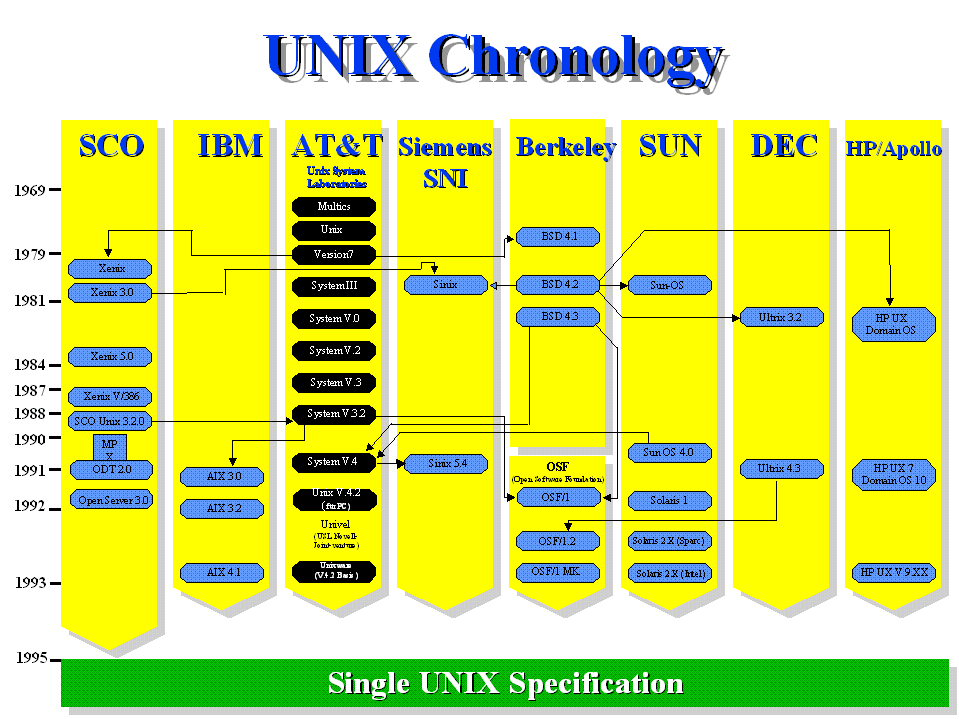
BSD Unix predates the existence of Open Group UNIX certification by 18+ years. Your contention is that Unix didn't exist before 1995?
Here, have a chart from them showing that BSD is Unix, predating their "single specification".
Owning a trademark to say what is certified as a particular specification doesn't override the history of the code in software.
-
Re:C Programmers on Linux, not "Linux Programmers"
> Wow! Really sorry to say that sizeof(int) is 32 bits even on a 64-bit architecture.
Really, it's not. "int" varies depending on compiler and architecture. See below from www.unix.org.
http://www.unix.org/whitepaper...
It's precisely your kind of assumption from limited experience that breaks cross-compilation and multi-platform work.
-
Re: I would suggest the stl
Agreed that CUDA and OpenCL are great secondary and tertiary ways of heterogeneous multi-core programming.
Not sure what your beef again OpenMP is. OpenMP makes it trivial to add multi-threading to your app.
When did C++ get thread control again? Oh yeah, it wasn't until C++11 and you STILL had to wait for compilers to implement it. In the mean-time OpenMP was already here, and working for years. Considering OpenMP has been around for 18 years, calling it a hack when C++ ignored the whole standardization of multi-threading for YEARS is pretty fucking arrogant -- especially when Intel's, Microsoft's and GCC's compilers have natively supported OpenMP for years. What were Windows users supposed to use in the mean-time for portability? A port of pthreads wasn't even available for Win32 until ~2001 if this page is correct.
There are problems with std::future as this committee paper points out:
* N3964 (March 2014)
Even co-routines are still relatively new:
* N4134 (Oct 2014)
C++11 std::thread is great for the future. OpenMP was a perfectly fine solution when C++ didn't even have one back in the day.
-
Re:I thought OS X was Unix
Depends on how you define Unix. OSX/iOS are based on FreeBSD & NetBSD. If you're talking about official, formal Unix OS's, neither Linux, the *BSDs or OSX would count as none of them are entitled to use the Unix trademark; only Solaris, HP-UX and AIX are, that I can think of.
UNIX® is a registered trademark of The Open Group (ditto for Motif, and the X logo is also their trademark), who seem fairly certain that recent versions of Mac OS X are, in fact, certified as being UNIX, and entitled to use the trademark.
-
Re:How cool is it though...
Who ever said it was? UNIX® is a registered trademark of The Open Group. The capitals are important, as that is how the trademark is registered.
If you're not licensed by The Open Group you can't use the trademark UNIX, which is why OS X is UNIX but Linux is only Unix. -
Re:Caldera, Unixware and Unix
Its called the Single UNIX Specification. Informally known as the POSIX spec. You can read/download it here: http://www.unix.org/version4/
-
Re:Caldera, Unixware and Unix
Actually no, if you read here, in the second para, last sentence, it says that the Open Group also owns the trademark UNIXWARE. TSG just owned the product that Novell made, and sold all their Unix assets to UnXis.
-
Re:Caldera, Unixware and Unix
Unixware was a Novell/SCO brandname for their Unix. In terms of the difference there was a greater focus on working well and helping people transition from Netware to more Unix (i.e. what we today call "standard internet" type services). The OpenGroup doesn't own the Unixware trademark, SCO owned that.
In terms of a specification: http://www.unix.org/what_is_unix/single_unix_specification.html
-
Trademark and POSIX
Am I completely off-base or would a ruling in favor of API copyright make the IEEE/Austin Group/Open Group some of the most powerful organizations on the planet?
-
Re:Missing from summary
Blah, I should have looked it up before posting. OSX version 10.5 and higher running on Intel processors are UNIX 03 certified.
http://en.wikipedia.org/wiki/Single_UNIX_Specification#OS_X
Actually, OS X 10.5 and 10.6 running on Intel processors are UNIX 03 certified, but 10.7 isn't.
But you were probably responding to the poster distinguishing between "OS X" and "UNIX". The problem is that "UNIX" can either mean "an operating system from AT&T^WNovell^WSCO with "UNIX" in its name" or "a specification for operating system APIs and commands". The UNIX trademark refers to the latter, and, in that sense, "UNIX" is not an operating system, it's a specification, and it's not clear what it would mean to have malware targeted at it, unless the malware is portable malware that only uses Single UNIX Specification APIs.
-
Re:CLOCK_MONOTONIC
Yes, indeed. The gettimeofday() function should be used only when you need the time of day.
So what do I use if I need the time of day in UTC as specified by ITU-R TF.460-6? I.e., what do I use to get the time of day in a form such that
2 Leap-seconds
2.1 A positive or negative leap-second should be the last second of a UTC month, but first preference should be given to the end of December and June, and second preference to the end of March and September.
2.2 A positive leap-second begins at 23h 59m 60s and ends at 0h 0m 0s of the first day of the following month. In the case of a negative leap-second, 23h 59m 58s will be followed one second later by 0h 0m 0s of the first day of the following month (see Annex 3).
applies, complete with the clock going from 23:59:59 to 23:59:60 to 00:00:00 the next day when a positive leap second occurs and going from 23:59:58 to 00:00:00 the next day when a negative leap second occurs?
Hint: the answer does not involve using any API in the Single UNIX Specification. The answer might involve a combination of an API that returns a count of elapsed seconds of real time since January 1, 1970, 00:00:00 UTC - which is NOT the same as "Seconds Since the Epoch" as defined in the Single UNIX Specification, as the latter doesn't just count seconds over leap seconds - and an API that acts like the gmtime() in the Olson sample code when used with an Olson database file that includes leap seconds.
(Note that the formula in the Single UNIX Specification's definition of "Seconds Since the Epoch" - section 4.15 in "Base Definitions" in the current version of the SUS - can give the same value for "Seconds Since the Epoch" for two different "Coordinated Universal Time names"; the formula
tm_sec + tm_min *60 + tm_hour *3600 + tm_yday *86400 +
( tm_year -70)*31536000 + (( tm_year -69)/4)*86400 -
(( tm_year -1)/100)*86400 + (( tm_year +299)/400)*86400will give the same value for XXXX-XX-XX 23:59:60 and {XXXX-XX-XX + one day} 00:00:00, so that the clock sticks during a positive leap second; that's why you can't turn "Seconds Since the Epoch" into what the SUS calls a "Coordinated Universal Time name" and always get the correct "Coordinated Universal Time name".)
(And, no, CLOCK_MONOTONIC won't do it, as that's time "since some unspecified starting point", so only differences between CLOCK_MONOTONIC values are meaningful. I can has CLOCK_REALTIME_BUT_NOT_FUCKED_UP_BY_LEAP_SECOND_POSIX_CRAP?)
-
Re:ARM Windows
That said, you still have a couple things wrong. First, LLP doesn't really "introduce" long long; that's been usable even in 32-bit software for ages.
Not according to unix.org. What you are talking about is the C99 standard which isn't about data models but a specific programming language specification. I don't have a definite history of LP64 vs LLP64 but the paper from unix.org suggests that it predates C99 by at least a year. Also as you no doubt aware, not every compiler follows the C99 standard fully. GCC supports it mostly. And some compilers use the older C89 standard. And if you are using Windows you are not using the C99 compiler, you are using the MS Visual C++ compiler which is not compliant.
Second, while you do have to do some rewriting to get your code 64-bit clean if you aren't in my magical fantasy world, it's absolutely wrong to say you then need to maintain two source trees.
If you want to develop and maintain your own 64-bit data structures and coding to ensure 32-bit OS handles them correctly, then no you don't need to maintain two source trees. However you would have to maintain those data structures forever instead of relying on MS data types. Or you could the very messy task of putting in #IFDEF everywhere to separate your 64-bit/32-bit parts if you wanted to use the MS data types but keep one version of source code. You could do all of that. Or you could maintain two versions. I would think it's far easier to maintain two versions.
-
Re:This is why OSS is so important
UNIX compliance is decided by the Open Group. Posix compliance is an IEEE standard. Windows can have a POSIX layer without being POSIX compliance and Posix compliance doesn't imply UNIX(tm) compliance.
There is no such thing as "being based on UNIX" and the amount of code that comes from Unix doesn't matter.
Then we have nothing to discuss on this matter, because that's not what the previous comments were saying.
And yes Apple would disagree with you:
I don't see anything there that again, disputes the acronym that Apple gave to the kernel which is the question, which what I keep bringing up and you keep conveniently(?) ignoring.
As far as the fork without exec. Are you sure that's not a POSIX requirement?
Considering things like "The Single UNIX Specification", which includes POSIX, pretty sure.
-
Re:Novel
No, the "brand" is the Unix trademark, which is owned by The Open Group, not by Novel or SCO. What Novel owns are the copyrights to the original Unix code.
-
Trademark
ReactOS is to Windows as XP or Vista is to Windows, not as Linux is to Windows (sort of, it isn't made by Microsoft).
Likewise, "Sam's Cola is to Coca-Cola beverage line as Diet Coke or Coke Zero is to Coca-Cola beverage line, not as Pepsi is to Coca-Cola beverage line"? I don't think so. (Or was that your "sort of"?) What makes it Windows® is that it is made by Microsoft, just like what makes something UNIX is that it is certified by The Open Group. Windows Mobile is Windows; it just isn't Windows NT.
-
Re:Linux vs. FreeBSD
I tended to prefer Linux over BSD because Linux generally acted more like the real UNIX(tm) systems at work
You should have stated your preference for SysV beforehand. UNIX is many things. Even UNIX(tm).
-
Re:File type identification on Unix
I think xattrs are actually part of POSIX
I don't, because I didn't find anything about them in the 2008 Single UNIX Specification, although perhaps I didn't search for them correctly.
I suppose related features like ACLs could help drive more widespread adoption of xattrs
The same underlying mechanism might happen, on some particular file systems, to be used to store extended attributes and ACLS; however, the two are not inherently related.
(though in the kernel the two features are enabled separately, I believe...)
To which particular kernel are you referring?
-
According to UNIX.org
If only there was a Linux that was actually UNIX certified by The Open Group...
http://www.unix.org/what_is_unix/single_unix_specification.html
-
Re:Bull
Yes, you can open() a directory on Mac OS X. That in no way contradicts my statement about the standard.
The "Single Unix Specification" you mentioned says you can open() a directory with O_SEARCH, too. MacOS doesn't have that.
Where did you get that idea? At least in the version I saw (http://www.unix.org/single_unix_specification/), the open documentation does not mention O_SEARCH or directories at all.
Either way, I expect you'll be able to fsync() that fd; that's all you need.
The Subversion code I linked to explicitly said that opening a directory fails on some platforms, so your expectation is incorrect.
-
Re:Mac reliability
Are any of the free BSDs or Linux variants certified Unixes?
(Honest question, I don't know.)
Well, there's the POSIX-compliancy that "sort of" might answer your question. (Your question was a kind of broad, imho) http://en.wikipedia.org/wiki/POSIX and more here http://www.unix.org/version3/
Enjoy!
-
Re:Developers section red now ?C and C++ are the same way. In basically all 64-bit implementations, "int" is a 32-bit data type. In fact, in some of them, "long" is a 32-bit type too. The only thing that must be 64-bit is the pointer type.
-
Re:Macs are UNIX 03
I think that would be like saying a bank is "FDIC insured" means, "well they have some sort of insurance."
The Open Group is not just some certifier. The Single UNIX Specififcation is a Big Deal. It certifies a level of portability and conformance that gives its administrators a level of confidence that cannot be achieved from Unix-like systems (read Linux and BSD... though I personally think these are great platforms) or Windows.
I'm sure the certification is meaningless to game developers, but it carries a lot of weight for enterprise developers.
-
Re:C/C++
I tried looking up "sendmsg" on that site and it gave me no results. Sounds like the man pages have it beat...although the ultimate reference on POSIX is the SUS spec.
-
Re:Incorrect.As are FreeBSD, Darwin, Solaris and Minix. Most of which borrow at least some concepts from System V, but barely a single line of code. (OK, to be a pedant, they are Unix-like OSes, but they are compatible OSes.)
Actually, as per the definition laid down by the creators of Unix, Linux IS Unix, it is simply not UNIX(tm) (as per the Open Group.) If it walks like a duck, and quacks like a duck, then for our purposes it is a duck. If you go try to carry out the stuff you'll find in The Unix Programming Handbook then you'll find that Linux is Unix. Seriously. Because all that stuff still works, and it works in the same way and for the same reason.
However, this distinction would only have been extremely confusing in court and probably not at all germane to the actual issue of who owns what. And so, Darl's statement is not true because he is not talking about Unix, but about UNIX(tm). When you hear Darl (or anyone else in court relating to this whole SCO thing) refer to "unix", they're actually saying "UNIX(tm)". It's just not clear how to pronounce the (tm)... currently the argument is between a click and a cluck.
-
Linux (mostly) follows the open group.
The problem is that its a big difference between being a copy of Unix and being a copy of a specific unix implementation. While linux in many places conforms to the standards making up Unix 93/95/98/2003 its not a verbatim copy of anybody elses implementation of those standards.
This looks very much like an ongoing effort do mislead people about what Unix really is. Somone should sue for slander since its a very rough accusation. That Novell seems to let this slide makes me very worried about their real intentions.
http://www.unix.org/what_is_unix.html -
Re:Finally!
SCO doesn't own Unix. Caldera (now called SCO) bought the old SCO Unix distribution. They also have the right to sell licenses to Unix System V; but they have to give 95% of the Unix license money to Novell (who owns Unix System V).
Neither Novell nor SCO owns the "Unix" name, UNIX® is a registered trademark of The Open Group. http://www.unix.org/trademark.html -
Re:Don't live in the dark ages!Note: I am not the grandparent.
>> And how many UNIX commands do you regularly use that are longer than 8 characters?
> Let's see...
> * ec2-describe-instances
> * ec2-run-instances
> * ec2-* (lots more examples where that came from)
> * wineconfig
> * update-alternatives
> * dpkg-reconfigure
You use these on a regular basis? Funny, the commands I use on a regular basis are all shorter than 8:- ssh
- aptitude (or apt-get when I forget about aptitude)
- svn
- ls
- cd
- cp
- rm
- mv
- less
- grep
- fgrep
- su / sudo
- wc
- tar
- w
- ps
- kill
- vi / nano
- man
- which
- Utility names should be between two and nine characters, inclusive.
- Utility names should include lowercase letters (the lower character classification) and digits only from the portable character set.
I can, in fact, only think of one core utility longer than 9 characters: traceroute. -
"Proprietary UNIX"?
I never thought I'd see these two words together. UNIX is what happens when you meet a set of interfaces defined by a standards body known as The Open Group.
-
"Proprietary UNIX"?
I never thought I'd see these two words together. UNIX is what happens when you meet a set of interfaces defined by a standards body known as The Open Group.
-
Re:From TFA
OSX Leopard (but not earlier versions) is certified as being a UNIX system by The Open Group. LINUX is not and has never claimed to be UNIX.
-
Re:problem is...
It's UNIX compliant now.
Does that mean they've fixed the hierarchy?
If all of what you consider problems in the (presumably file system) hierarchy are forbidden by the Single UNIX® Specification, Version 3, then definitely yes. Otherwise, not necessarily.
-
Re:Market Share is unlikely to drop for a long tim
The OS market "wants" a near monopoly.
Nonsense. It wants a standard (for portability), that doesn't have to be provided by a monopoly. In fact there already is a standard for operating systems, ISO/IEC 9945, and most IT vendors support it (or something very close).
Microsoft (and some uninformed natterers not clear on the point) call their products "standard", but they're confusing that term with "ubiquitous". Heck, given that there are so many not very compatible versions of Microsofts own products, they can hardly be considered standard. (Is "standard Windows" Vista or XP or ???) -
Re:Sometimes it doesn't make any sense to sell/buy
"Everybody assumes that the very name "Unix" has value, but, like autographs collectors specializing in French Existentialist writers, it would have value only to them.
It makes sense to put the ownership up in a trust holding where it can't ever be used in this kind of gambit again and I suspect that a foundation will be set up for that purpose."
It does have value, and its not owned by Novell - its owned by The Open Group. More info at unix org.
Some trademark attributions still say Novell (or even AT&T or Bell Labs), which is correct?
UNIX® is a registered trademark of The Open Group.
- It must not be used as a generic term.
- It must not be used in connection with products, unless the product is licensed to use the mark.
- There are detailed guidelines referring to the visual presentation, form and manner of use.
- In editorial or articles, but not advertising the trade marks may be used without prior permission - provided that the rules in our Trademark Usage Guide are followed.
Here is the defiitive list of UNIXes. As you can see, SCO doesn't have anything past the UNIX 95 spec (Caldera OpenSewer), whereas there have been two major updates - UNIX 98 and UNIX 03.
-
Re:I think its a major achievement
Unix is trademarked by the Open Group, and so to be Unix, you need to pay them to certify your OS. There are several other similar cases in the industry - POSIX is a biggie, as is OpenGL. Often you'll see OpenGL compatible (like Mesa) or POSIX compatible (like Linux and even MacOS X for a while) - basically, they're saying they're API compatible, but not certified.
-
Re:I thought BSD was "blessed"I am sure if the GPL was worded in a couple ways OS X would be Linux Based not Unix Based. "UNIX" is, these days, essentially a spec (specifically, the Single UNIX Specification) and a branding. This may sound like a quibble, but OS X is "officially UNIX" because Apple complies with the spec and pays for the branding. Neither Linux or FreeBSD are "UNIX" from a legal standpoint; they're both UNIX-compatible.
At any rate, I think you're assuming a political/copyright choice on Apple's part that's very more likely a historical engineering choice: OS X is a direct descendant of NextStep -- Apple bought Next for their operating system technology, remember? Even though much of the userland support is ported from FreeBSD, under the hood it's very much still NextStep, as anyone who's beat his head against the NetInfo Manager for a while will tell you (possibly in very colorful language). The choice of BSD userland stuff over Linux userland stuff may have been partially license-driven, but -- like FreeBSD, of course -- Apple uses GNU software when necessary or preferred (bash, zsh, groff, etc.).
At any rate, I think corporate hostility to the GPL is overstated; people tend to assume the BSD license is more "business friendly," but they're looking at it from the point of view of a business wanting to use somebody else's open source software in their proprietary product. If you're the copyright holder and want to release your work as open source, you may well prefer to use the GPL or another license that prevents someone from taking your work and stuffing it into a proprietary product. -
Re:"OSI CERTIFIED open source software"
UNIX® is a registered trademark of The Open Group
Go to the above link to order your cool UNIX license. And yes, the license is REAL, since it's the licensed trademark of the purveyor.
I 'wear' one on the front of my car, to piss off the Redmondslaves at work.
And because it's cool to one a real UNIX license. -
Re:Sad, but predictable
Where are the problems with linux that aren't in BSD? Is it lack of standardization? Or are there specific things that should work that were broken in linux? Why do hard-core admins scoff at linux?
There is a set specification which outlines what a UNIX system is. As far as admins complaining about Linux not being "standard" it often genuinely is the case with a number of binary Linux distributions that a number of the utilities outlined by that specification are not installed by default, but rather are viewed by the distribution makers as being optional extras. They do this in an attempt to increase user-friendliness or save disk space, but there are times when for some people anyway it can simply make life more difficult.
The BSDs are designed to include all of these utilities as part of the core system, so admins and other users who want them can rely on them being there; there is no uncertainty as there can be with Linux distros.
For basic desktop use, Ubuntu is fine, and has been praised for its' user-friendliness. If however there comes a time when you wish to learn more, (which may be of benefit if you wish, as you say, to gain Linux-related employment) I strongly recommend investigating the Linux From Scratch Project. They release an online book which will teach you how to assemble a Linux system yourself that is largely compliant with the abovementioned specification, at least as far as the installed utilities are concerned. If that sounds intimidating right now, I'd also recommend this which is a guide that I wrote for someone else a while back. That will give you the background knowledge you need before attempting to complete the Linux From Scratch book.
After you've done that and used Linux for a while, (months, years, whatever) I'd definitely recommend installing FreeBSD at some point, if only for the sake of contrasting the two and rounding out your knowledge. You will then be in a very good position to determine which system you wish to make your environment of choice, long term. -
Re:stupid users
a) A bootstrap/bootloader.
This is a good example, although I don't really think it's part of the kernel in the context you appear to be using it (based on your mention of GRUB).
The relevant asm file is here. However, you are correct in that as I suspected, direct booting from it is no longer supported. It was historically, though.
What's a "core system service" ?
As far as a (or the) conventional UNIX kernel is concerned, there is a very specific answer as to what does or does not constitute a core system service.
Memory management is another good example, but... where does something like a JVM that also does "memory management" fit into the picture ?
With a kernel written in C, it wouldn't.
d) A means of loading modules for communicating with different forms of hardware.
I'm reading this as hardware drivers. Where do drivers that run in user space fit in ?
Probably as part of the relevant application. Can you give me an example here?
e) A TCP/IP networking stack as part of it.
Consider Trumpet Winsock for Windows 3.x. Part of the kernel or not ?
Application. A userspace hack for an OS which AFAIK was never initially intended to support networking in the first place. AFAIK Trumpet was never used on anything other than fairly early dialup, and it most likely wasn't intended to be. It would have been as slow as hell compared to contemporary stacks, I'm guessing...but would have been written on the assumption that considering how slow the user's physical link was in such a scenario, they wouldn't be likely to notice anywayz. -
Re:For 64bit floats, the PS3 is a powerhouse
Circa 1999 I used to develop under Digital UNIX, with 21164@600MHz CPUs, where longs where 64 bit (Digital C compiler, LP64). Not about elitism, but to broke my many years old 64 bit code snippets (!), which still work flawlessly under most UNIXes/Linux, but are broken for Windows x64. Click here for more info.
-
Re:Commodity hardware
Please review what UNIX is... http://www.unix.org/what_is_unix.html
That defines what UNIX(tm) is, but not what Unix is. Please realize the difference:
Some people are confused over whether this word is appropriately 'UNIX' or 'Unix'; both forms are common, and used interchangeably. Dennis Ritchie says that the 'UNIX' spelling originally happened in CACM's 1974 paper The UNIX Time-Sharing System because "we had a new typesetter and troff had just been invented and we were intoxicated by being able to produce small caps." Later, dmr tried to get the spelling changed to 'Unix' in a couple of Bell Labs papers, on the grounds that the word is not acronymic. He failed, and eventually (his words) "wimped out" on the issue. So, while the trademark today is 'UNIX', both capitalizations are grounded in ancient usage; the Jargon File uses 'Unix' in deference to dmr's wishes.So in other words, UNIX is a trademark, while Unix is a style of operating system. And Linux is Unix. So is UNIX. So is *BSD.
As for databases, I think SQL Server isn't that bad but for very large deployments there are a few other options that make more sense. Most people don't need Oracle, SQL Server or DB2. MySQL or Postgresql are adequate. You can get them to run on almost anything.
If SQL Server is the answer, it must have been a stupid question. Not because there is actually anything wrong with mssql itself, but because it only runs on Windows
Seriously though, MySQL and Postgresql are missing some features and do not scale as well as all of the alternatives. Luckily you can run DB2 or Oracle on Linux as well.
The first person who figures out how to make a SQL server that clusters, automatically replicates, and blah blah blah to make a cluster perform and behave in most cases as well as a monolithic database server is going to be a hero to all. Of course it won't fit all types of data. But right now that's a horribly hard problem and one of the applications really keeping big iron going.
-
Re:Commodity hardware
Please review what UNIX is... http://www.unix.org/what_is_unix.html
Many BSDs have not been tested officially to use the UNIX name. If you simply look at the specification, IBM has done a lot of work with Linux to make it pass. This is a big gray area. The GNU is not UNIX but Linux slowly is becoming an implementation of the standard...
Almost everything runs on ia32 now. People have a choice which is what open source is all about. My personal belief has always been that each OS has an advantage for a specific task or series of tasks. That makes all systems relevant.
As for databases, I think SQL Server isn't that bad but for very large deployments there are a few other options that make more sense. Most people don't need Oracle, SQL Server or DB2. MySQL or Postgresql are adequate. You can get them to run on almost anything. -
Re:Memory Upgrade Too
Good reference for this and different type sizes and ranges: http://www.unix.org/whitepapers/64bit.html.
-
Re:All "in the family."
In licensing the UNIX brand a vendor warrants and represents that every certified product:
That's from The Open Group, who own the trademark. So if you want to call it Unix, your product must meet their standards of what Unix actually is. Presumably you have to pay to get it certified. Only companies like IBM, Sun, HP and Fujitsu are on the certified list, so I'm guessing it's not cheap to obtain or maintain.- Conforms to the specification.
- Meets The Open Group's test and certification requirements.
- Will continue to conform to the specification.
- Will be rectified within an agreed time should it be found to be non-conformant.
Linux flavors are mostly conformant only standards specified by their own vendor. Considering that Windows XP only complies to its vendor's specification, this isn't necessarily a marketing black eye.
The biggest problem with getting certified as a "real" Unix is that every new release must be recertified. This gets expensive and time-consuming, making fast release cycles all but impossible. Red Hat could certify RHEL, which they've given a long release cycle. It might be worth it, though, if they could say "We meet the same Unix standards as IBM, HP and Sun, have over half the total Unix market, and do it at a fraction of their boutique OS prices."
-
Re:All "in the family."
In licensing the UNIX brand a vendor warrants and represents that every certified product:
That's from The Open Group, who own the trademark. So if you want to call it Unix, your product must meet their standards of what Unix actually is. Presumably you have to pay to get it certified. Only companies like IBM, Sun, HP and Fujitsu are on the certified list, so I'm guessing it's not cheap to obtain or maintain.- Conforms to the specification.
- Meets The Open Group's test and certification requirements.
- Will continue to conform to the specification.
- Will be rectified within an agreed time should it be found to be non-conformant.
Linux flavors are mostly conformant only standards specified by their own vendor. Considering that Windows XP only complies to its vendor's specification, this isn't necessarily a marketing black eye.
The biggest problem with getting certified as a "real" Unix is that every new release must be recertified. This gets expensive and time-consuming, making fast release cycles all but impossible. Red Hat could certify RHEL, which they've given a long release cycle. It might be worth it, though, if they could say "We meet the same Unix standards as IBM, HP and Sun, have over half the total Unix market, and do it at a fraction of their boutique OS prices."
-
Re:I don't know about you
Even in a faked screenshot, with all of the filters in Photoshop avaiable, OSX still looks like crap. It's a fucking endless sea of tampons. I guess it's true when they say that you can't polish a turd.
-
They just don't give up.Ok, let's see here. The ELF format is part of the System V ABI specification. The System V specification was owned by USL, and is now custodianed by the OpenGroup. ELF was included because of the original licensing statement made by the TIS Committee:
The TIS Committee grants you a non-exclusive, worldwide, royalty-free license to use the information disclosed in this Specification to make your software TIS-compliant; no other license, express or implied, is granted or intended hereby.
Who was this TIS Committee that dared give away SCO's property?! Why, SCO themselves. Err, actually, it was Absoft, Autodesk, Borland International
Corporation, IBM Corporation, Intel Corporation, Lahey, Lotus Corporation, MetaWare
Corporation, Microtec Research, Microsoft Corporation, Novell Corporation, The Santa Cruz
Operation, and WATCOM International Corporation. Considering the number of companies that ownership was split across, one has to wonder: Did SCO ask permission from their partners before filing suit over technology that they (nee, Taratala) only helped develop?
Darl is getting incredibly desperate, don't you think? Anything to keep from losing the company under his feet, I guess.