Slashdot Mirror
Domain: unmannedspaceflight.com
Stories and comments across the archive that link to unmannedspaceflight.com.
Comments · 40
-
Better picture...
Combining multiple high res adjacent pictures here.
This is magnificent - I count at least ten different types of terrain in just this tiny part of Pluto. What a world.
And IMHO it looks even more like subglacial liquids at play now.
-
Re:Heart Oblique Impact?
It seems more complicated than that (even ignoring that impacts don't generally make heart shapes). For example, have you seen the carbon monoxide data? It's all clustered in that area. Why would an asteroid make carbon monoxide cluster there?
There's some really interesting things going on. Take a look at this picture and think of what it looks like to you:
Link.
Doesn't it look like... well... a shoreline?
Now take a look at those fractures in Sputnik Planum - notice how they have a curious inner ridge:
Where else have we seen that before? Oh right, Europa:
It's the shape of a liquid welling up through a crack and freezing due to a drop in pressure.
To me, this shows all the signs of a cryosea underneath an ice cap. Which leads to the question: can that occur on Pluto? And the answer is, "probably". With N2, CO, and CH4, you can get eutectics with triple points as low as 51K (a naive solar equilibrium-temperature calculation for pluto's surface, without any other sources of heat, reaches up to 55K). Add neon into the mix and it gets down to 24,6K. The key is, these liquids can't exist on the surface - they require pressure to exist. Which means that they can only exist as aquifers and subglacial lakes/seas. Pure nitrogen requires about 18 meters of pure nitrogen ice (more because it'd have pore space and be mixed with lower density ices). Pure neon would require about 3x as much.
The flat areas in Tombaugh Regio have two radically different appearances. One is the aforementioned area that looks like sea ice with frozen cracks (Sputnik Planum). The other is what's being called a "pitted" terrain. The latter touches the "shore" of the regio, while the former is deep in the middle (at least, from the pictures revealed so far). If one wanted to step even further out onto the limb here, they could posit that the "pitted" terrain involves these ices sitting directly on "bedrock" (which in a pluto context here is water ice), while the terrain that looks like sea ice would have liquid dozens of meters or more down.
But this is all just along one line of thinking. There's just so many possibilities right now. One notices, for example, similarities with various pluto features and frost-heaving earth features like pingos and ice wedges. But it could be something completely new entirely. This isn't water we're dealing with.
A real crazy thing is to think about how there might be vertitable explosive processes on Pluto. Solid nitrogen that forms due to decompression undergoes an energetic glass to crystalline transition. And overall does really weird stuff when freezing (start about a minute in).
Also note that there is nitrogen being lost from Pluto. Lots - 500 tonnes an hour. Over geological timeperiods, that's a massive, massive amount. Pluto loses its atmosphere 2 1/2 orders of magnitude faster than Mars. And yet it's still there. So where's it coming from? The team already pointed out that there doesn't seem to be a planetwide layer of deep nitrogen ice. To me that only seems to leave the possibility that it comes from deeper within the planet. But for it to move from deeper within to the top means a fluid (an aquifer), not an ice (either that or serious tectonics dragging up 500 tonnes an hour!). And given that Pluto's crust provides pre
-
Re:Heart Oblique Impact?
It seems more complicated than that (even ignoring that impacts don't generally make heart shapes). For example, have you seen the carbon monoxide data? It's all clustered in that area. Why would an asteroid make carbon monoxide cluster there?
There's some really interesting things going on. Take a look at this picture and think of what it looks like to you:
Link.
Doesn't it look like... well... a shoreline?
Now take a look at those fractures in Sputnik Planum - notice how they have a curious inner ridge:
Where else have we seen that before? Oh right, Europa:
It's the shape of a liquid welling up through a crack and freezing due to a drop in pressure.
To me, this shows all the signs of a cryosea underneath an ice cap. Which leads to the question: can that occur on Pluto? And the answer is, "probably". With N2, CO, and CH4, you can get eutectics with triple points as low as 51K (a naive solar equilibrium-temperature calculation for pluto's surface, without any other sources of heat, reaches up to 55K). Add neon into the mix and it gets down to 24,6K. The key is, these liquids can't exist on the surface - they require pressure to exist. Which means that they can only exist as aquifers and subglacial lakes/seas. Pure nitrogen requires about 18 meters of pure nitrogen ice (more because it'd have pore space and be mixed with lower density ices). Pure neon would require about 3x as much.
The flat areas in Tombaugh Regio have two radically different appearances. One is the aforementioned area that looks like sea ice with frozen cracks (Sputnik Planum). The other is what's being called a "pitted" terrain. The latter touches the "shore" of the regio, while the former is deep in the middle (at least, from the pictures revealed so far). If one wanted to step even further out onto the limb here, they could posit that the "pitted" terrain involves these ices sitting directly on "bedrock" (which in a pluto context here is water ice), while the terrain that looks like sea ice would have liquid dozens of meters or more down.
But this is all just along one line of thinking. There's just so many possibilities right now. One notices, for example, similarities with various pluto features and frost-heaving earth features like pingos and ice wedges. But it could be something completely new entirely. This isn't water we're dealing with.
A real crazy thing is to think about how there might be vertitable explosive processes on Pluto. Solid nitrogen that forms due to decompression undergoes an energetic glass to crystalline transition. And overall does really weird stuff when freezing (start about a minute in).
Also note that there is nitrogen being lost from Pluto. Lots - 500 tonnes an hour. Over geological timeperiods, that's a massive, massive amount. Pluto loses its atmosphere 2 1/2 orders of magnitude faster than Mars. And yet it's still there. So where's it coming from? The team already pointed out that there doesn't seem to be a planetwide layer of deep nitrogen ice. To me that only seems to leave the possibility that it comes from deeper within the planet. But for it to move from deeper within to the top means a fluid (an aquifer), not an ice (either that or serious tectonics dragging up 500 tonnes an hour!). And given that Pluto's crust provides pre
-
Re:From Unmannedspaceflight.com
(As a side note, the closer we get to Pluto and the more we see of it
I'm assuming that's Charon in the lower left. It's funny but it looks like a Susan B. Anthony dollar coin.
-
From Unmannedspaceflight.com
Steve5304: Rumors that Contact with new horizons has been lost again or was never regained. Unconfirmed
Alan Stern: Such rumors are untrue. The bird is communicating nominally.
Alan Stern is the director of the New Horizons mission. So no worries.
This was a really minor glitch and will have no impact on the mission as a whole. There weren't even any significant observations planned for today.
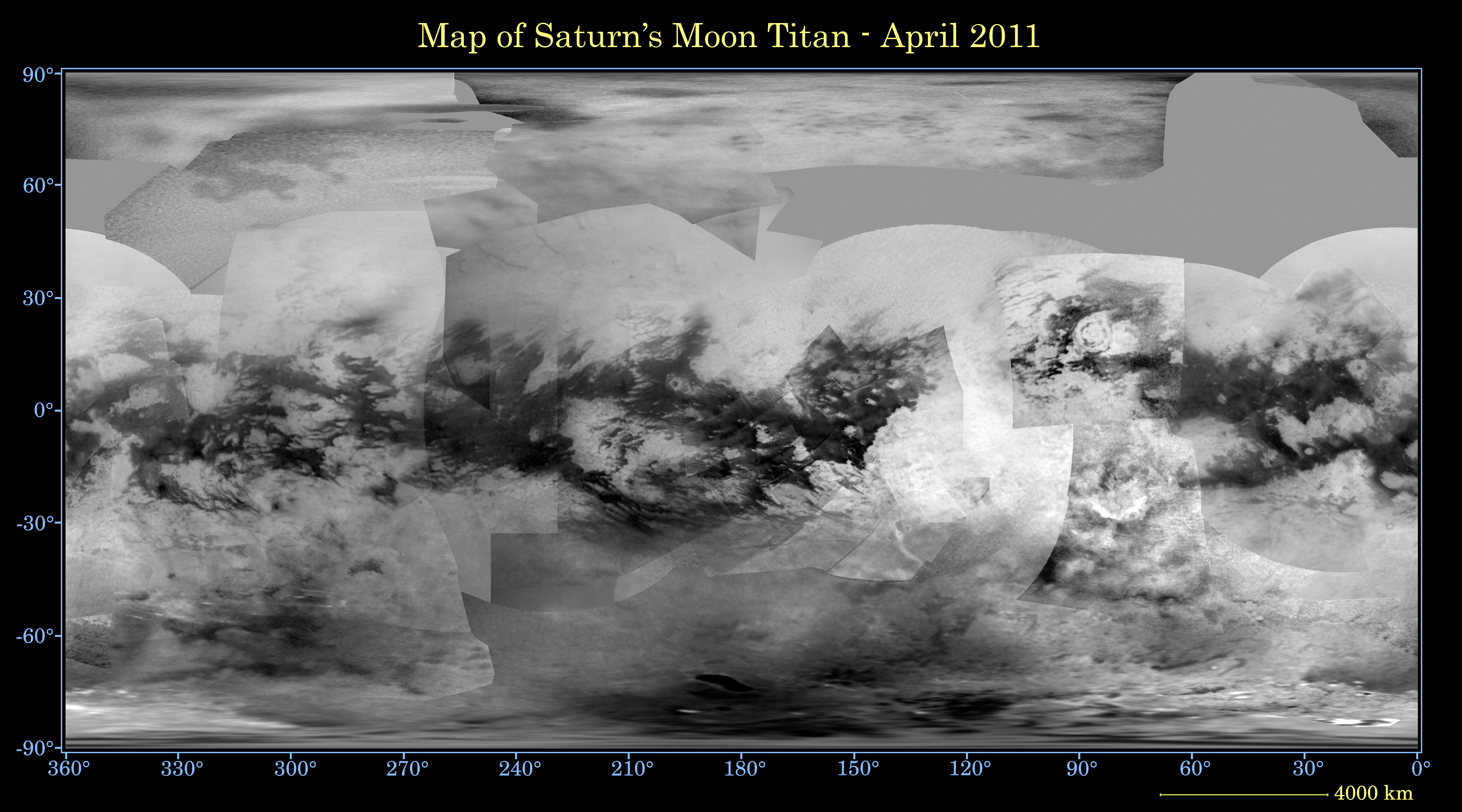
(As a side note, the closer we get to Pluto and the more we see of it (dark band at the bottom is around the equator), the more it's starting to remind me of an airless Titan
-
From Unmannedspaceflight.com
Steve5304: Rumors that Contact with new horizons has been lost again or was never regained. Unconfirmed
Alan Stern: Such rumors are untrue. The bird is communicating nominally.
Alan Stern is the director of the New Horizons mission. So no worries.
This was a really minor glitch and will have no impact on the mission as a whole. There weren't even any significant observations planned for today.
(As a side note, the closer we get to Pluto and the more we see of it (dark band at the bottom is around the equator), the more it's starting to remind me of an airless Titan
-
Re:Movie?
-
Re:Movie?
-
Re:Movie?
-
Re:Occam's
Link directly to the image.
And to the forum thread.
-
Re:Occam's
Link directly to the image.
And to the forum thread.
-
Re:ummm
The Unmanned Space Flight forums has a much better set of photos in this thread. Apparently there are at least two rocks that have appeared, and some dirt. They may have rolled from higher up, this spot is on the uphill side of the rover.
-
Re:Where is the arm?
Top-left here.
(Of note - the raw images got released quite a few hours before the official stitched version did. So a bunch of amateurs including myself and others used various panorama-assembling software to assemble our own, unofficial stitched versions. Seeing Curiosity like this before pretty much everyone else was great...)
-
Re:Why side-lit?
Good question; good answer here http://www.unmannedspaceflight.com/index.php?s=&showtopic=6956&view=findpost&p=179952
Basically, radar doesn't work like a normal camera, the perspective in the image is actually a side-view. -
golden age of astronomy
More and better Earth and Space-based telescopes just keep on coming.
Its appropriate since Galileo took this Dutch novelty exactly four centuries ago and asked "I wonder what I'll see if I look at the night sky?"
I'm looking forward to when various systematic mapping projects put their results into Google Sky and related cloud servers for public access. If you check out the site nmannedspaceflight.com you'll see how amatuers are poring over this kind of data to make important discoveries of near earth objects, internal shadows in Saturns rings, and the like which professionals may have overlooked. -
Re:Problems
I don't understand the problem, here. All data from NASA planetary missions are made public 1 year after they are taken. Here, you can go download them and use them for whatever you like at the Planetary Data System . There's a group of enthusiastic amateurs that use and interpret the raw data at UMSF , among other places. You're welcome to use these data and do science with them and publish them, scooping other scientists. Believe me, there's plenty of science left to be done in there.
-
Re:fp
Frosty patch! (no, really.)
-
Re:Actually huge amount of terrain
See Emily Lakdawalla's pre-encounter blog piece for the Planetary Society, and follow-ups as the data's arriving.
They flew over the south pole at a range of 30km at 50,000 relative speeds. The relative movement was so fast that they had to turn the entire s/c to point backwards before closest approach. There are some superb ("amateur") animations on the UMSF thread. (large, though, 60Mb or so each.) The realtime simulation is really mind-blowing. Just watch Enceladus scudding through the FoV of the ISS camera just after c/a. Superb, superb work by the Cassini team (as always!) This is certainly one of the biggest set-piece events of the entire mission after orbit insertion, others being Huygens, the first Titan flyby (that data took a lot of time to interpret, indeed the radar data is still being puzzled over as each narrow swath appears after another flyby - it's hard to do imaging through that pesky yet oh-so-interesting methane atmosphere) and the Iapetus encounter.
-
Re:Once had life, but no more
For starters, could you explain your solution to the Mach 5 problem? (No, I know you don't know what that is, I'm using it to illustrate my point, vis., that you are talking bollocks about something you know nothing about. Now go away and google and read for a few years.
Here's the explanation (google cached) of the "Mach 5 problem" I found on Google (which really does appear to be unresolved):
Motu Mach 5 problem with Logic 7
Nov 19 2006, 12:06 AM
hi i recently did a re installation of the mach 5 on my G5 computer running the latest version of logic 7. it loaded up fine and asked me to specify a location for the mach 5 sounds folder which i did. however i am getting an error message . . .Hmm... what does that have to do with mars?
Ah... you're probably referring to the problem described in this result, which consists of quotes from this article.
Certainly wouldn't seem to be a well known topic for the general populace. Without quotes in the google search I didn't even get any relevant results in the first page (although adding the word "Mars" might have helped).
-
Re:Problems...
It's not just a question of "it'd be too expensive", it's a case of "it can't be made to work for any value of "work" that is less than the cost of designing an ISS-like structure for the purpose from scratch.
-
Re:Disturbed by the landing?Yes; however (a) these are pulsed thrusters, with a very low (individual) power output, as thrusters go; (b) vertical vector velocity at touchdown is roughly 5mph, and (c) the thrusters cut out instantly at touchdown.
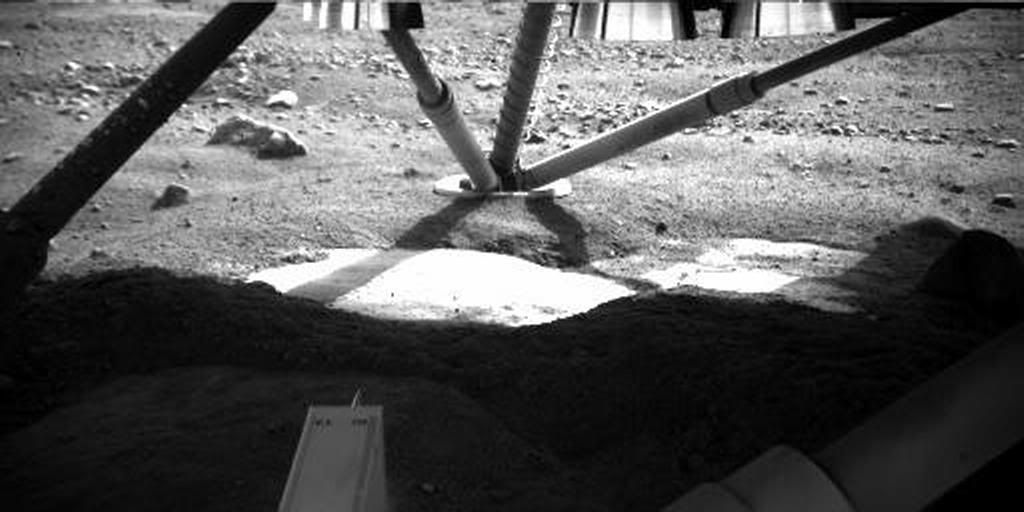
What does seem to have happened, interestingly, is that the upper couple of centimetres of dustry regolith has been blown clear in a big patch directly below the lander. The arm is designed to be able to reach down and image the underside (so that they can be sure all three landing pads are stable enough to risk moving the arm out to the side, potentially tipping the vehicle over if it were perched on a rock or something). That picture was taken with the (small) camera on the end of the arm, which is primarily intended to image the contents of the scoop as it digs. And oh look, that looks exactly like a big patch of ice!
That's a hell of cool image, but it's not going to be on posters on larval geeks bedroom walls for decades to come the way that the big HiRISE shot of the lander and it's parachute in flight, with Heimdal Crater in the background. That is a work of art. I can't understand why it wasn't on all the front pages the next day
-
Re:Of course they've never been seen.
Well, their dramatic wording is very correct - only about 45% of Mercury's surface has been imaged in detail. This was done 33 years ago by Mariner 10. So over half of the map of Mercury is still blank. It's the biggest unimaged planetary area in our solar system! Next week Messenger will image some of these never-before -seen/imaged areas of the planet (about 30% of it IIRC).
Here's a current map of Mercury.
There has been some interesting Earth-based radar observations using Arecibo's radio telescope. These observations give us an idea what to expect to see in the blank areas. Here's a map combined with radar observations. There are also various recent Earth-based optical observations using lucky-imaging techniques, but the images lack detail for accurate mapping.
So to be pedantic the Messenger will take detailed never-before-seen images of never-before-imaged-in-detail and never-before-imaged-at-all -areas of Mercury. In few weeks we'll get a new map of Mercury! -
Re:So how does it recharge its self?
-
Nuclear poweredMars lander trivia:
- Both Viking landers were nuclear powered (RTGs).
- So are both of the rovers, to a certain extent. Both rovers contain slugs of plutonium which keep the electronics boxes warm and reduce the amount of solar power needed for heating.
- Viking 2 lasted 1281 sols and died when its batteries failed. Although the RTGs would have produced usable power for another ten years, the power levels were too low for 70s electronics. So the RTGs would slowly charge the batteries then the batteries would power up the lander for short durations.
- Viking 1 lasted 2245 sols and lost contact with Earth when a bad command was sent which instructed Viking to point its antenna in a different direction (sort of like typing "shutdown -h now" on the command line of a remote server, there's no recovery short of a house-call).
-
Re:Opportunity.
The other rover, Spirit, had one of the wheels lock up about a year ago. Since then it's stayed
in the same general area, but can move slowly. Luckily, the area its stuck in is pretty
interesting, having the stump of an extinct volcano, and silica rich rocks that show signs
of once being soaked in water.
Over on http://www.unmannedspaceflight.com/ , fans have been following both rovers with
an intensity that borders on the obsessive. Highly recommended. -
It's on a slope!!
The article didn't have a larger image because then you'd see that the puddles aren't on the crater floor, but actually on a
huge slope
Read more in this forum -
Re:Why oceans are blue
The blue is digitally added. This comment on the thread linked above to the original image.
According to the thread the image was taken on a slope, meaning relative to the rover the surface in the picture appears flat. Relative to a flat plain this surface is fairly slanted, so if this was a liquid one would think it would appear to be flowing. My guess is that it is just sand. If you have ever seen a desert that can get windy the sand in some areas can look incredibly smooth like a liquid would. I think this may be what happened here. -
Re:Well, admittedly, the image is interesting...
Here's a comprehensive range of responses from a wide selection of informed MER followers at UMSF, ranging from "horsepucky" to "hogwash" via "ludicrous" and "bunk". I'll take UMSF over New Scientist any day.
Sad really, as skipping PE every week when I found that enabled me to skive off to the school library and read the NS (along with the other NS, assorted leftie rags of the 80s, oh and some books) was one of the things that really got me interested in Mars in the first place - that and a big coffee-table atlas with gorgeous repros of Viking Orbiter images of landscapes with obviously terrestrial analogues.
-
Weird
There is so much to know about Mars that we don't.
No light is reflected back, which is kind of spooky. What can be inferred about the depth? How deep would it have to be for the HiRES camera stop sensing the light that is reflected?
It's nice and round, that's unusual. There is no crater ejecta so I'm guessing nothing hit it. I'm not a geologist, but aren't giant round holes in otherwise homogeneous flat terrain a bit uncommon?
Is there any radar in orbit with enough resolution to bounce a signal down one of these? I'm just so full of questions and awe.
I'll be checking unmanned spaceflight for theories to these questions. Awesome site. -
I suggested this and some other "Kodak Moments"
Before the flyby, the New Horizons science team asked a bunch of us amateurs at http://www.unmannedspaceflight.com/ to search for "pretty pictures", pictures that didn't necessarily have scientific value, but were beautiful and worth taking. Europa Rising and the Io and Europa conjunction were the first two returned. The others I suggested were two double shadow transits, a crescent Callisto emerging from behind a crescent Jupiter, and a crescent Ganymede in front of a crescent Jupiter.
Enjoying my 15 minutes of fame. -
No
-
Unmanned Space Flight
For those interested, unmannedspaceflight has active discussions on well.. unmanned space flight, and in particular, this mission. Cassini is another successful unmanned mission. Space is really starting to get exciting again.
-
Re:Sediment?
I'm not a geologist either, althoug I have been following the discussion at Unmanned Spaceflight. There are as many hypotheses as hypothesizers. When you have that many thin layers with significant cross-lamination, then it seems to me to point to deposition by wind or water. It can't just be slabs of lava. Of course, everyone is hoping that water will be the answer.
In some of the images from late last week, there appears to be a spherule, not unlike the ones foundon the other side of the planet by Opportunity. The ones Opportunity found are mostly made of hematite and are thought to be associated with liquid water.
-
Fascinating
Well, this sounds really fascinating. I'm afraid I don't have much to add to that, so - on a slightly-related tangent - (the Magellanic Clouds) - the Opportunity Mars rover recently took pictures of the Martian sky at night that shows the Magellanic clouds. Check out the amateur image processing at Unmanned Spaceflight. There have been some amazing pics from the rovers, but this one stands out for me for emotional impact. (Mind you, I'm a sucker for schmaltz and sentiment... Boing Boing linked to a public domain radio version of "It's a Wonderful Life" the other day, I had to keep pausing it stop from bawling like a 5 year old
-
Amateur Analysis
Since Cassini is so slow in releasing results to the general public, you may be interested in this discussion (including some neat image processing) by amateur astronomers: http://www.unmannedspaceflight.com/index.php?show
t opic=1729 This site usually get a jump on the official Cassini channels of about a week. -
Re:Why?
Robots inspire too. See unmannedspaceflight.com, especially the topics about Mars Exlopation Rovers.
-
Re:Update: Spirit and Opportunity
For those wanting more in depth detail on the whole thing, check out the always fantastic unmannedspaceflight.com. They've already made several animations from the hazcams showing Oppy's progress. There is always something really neat to see there.
-
Re:Update: Spirit and Opportunity
For those wanting more in depth detail on the whole thing, check out the always fantastic unmannedspaceflight.com. They've already made several animations from the hazcams showing Oppy's progress. There is always something really neat to see there.
-
Re:Update: Spirit and Opportunity
For those wanting more in depth detail on the whole thing, check out the always fantastic unmannedspaceflight.com. They've already made several animations from the hazcams showing Oppy's progress. There is always something really neat to see there.
-
Re:Update: Spirit and Opportunity
For those wanting more in depth detail on the whole thing, check out the always fantastic unmannedspaceflight.com. They've already made several animations from the hazcams showing Oppy's progress. There is always something really neat to see there.