Slashdot Mirror
Domain: uoguelph.ca
Stories and comments across the archive that link to uoguelph.ca.
Comments · 145
-
Re:Why does onw degreee makes such a difference?
In my country the temperature varies from -30 C in winter, and +30 C in summer. If the themperatures chang in the future to -29 C in winter, and +31 C in summer. Why should this change the climate so much as it is claimed, when there is already a 60 C change year around?? I call BS on the climatechange.
This lake is almost always covered in ice year round and, from 2007 to 2012 had a mean summer temperatures of -4.9C. The increase in temperature is warming and melting the surrounding permafrost, which drains into the lake, raising both its level and temperature
From: Lake Hazen
Although air temperatures in this area often rise above 10C in July and August, Lake Hazen remains ice covered in most years.
From the actual study in Nature The world’s largest High Arctic lake responds rapidly to climate warming. (linked in the TFA):
A decrease in seasonal ice cover resulted in warming of surface waters and, more importantly, allowed planktonic algae to fill a niche which was previously climatically inaccessible, re-organizing the ecology of the lake at the base of the foodweb.
Collectively, rising air temperatures, increasing glacial melt and runoff, decreasing summer lake ice cover, shifts in primary producer communities and declining fish condition demonstrate the coupling between watershed changes and in-lake conditions and processes.
This vast, deep lake, the High Arctic’s largest freshwater ecosystem, has experienced drastic changes in the last decade, despite its volume, thermal inertia and hypothesized resilience to climate change.
Such changes, and their consequences, are certain to increase further as warming of northern latitudes continues into the future, undoubtedly jeopardizing the security of traditional freshwater foods and other ecosystem services for northern Indigenous peoples throughout the Arctic.
-
Re:Public Work should not be "proprietary"
If you put random data into Mann's formulas you always get the hockey stick? Even "random noise?" Wow, where's the citation for this? And why does he need Mann's personal emails then? It seems like he could show Mann was a liar and phony pretty easily if "random noise" reproduces the results.
The citation for random noise; also note that just because the computer programming implimentation of Mann's formulas is wrong doesn't mean the Mann's formula themselves are wrong.
Backgrounder for McIntyre and Mc Kitrick “Hockey Stick Project”January 27 2005
The GRL article, “Hockey Sticks, Principal Components and Spurious Significance”
<http://www.climate2003.com/pdfs/2004GL012750.pdf> identifies what is almost certainly a computer programming error in the principal components method used in MBH98. The error causes their PC method to nearly always identify hockey
stick shaped series as the “dominant pattern” in a data set (the so-called “first Principal Component” or PC1), even
when the data are just random numbers. We carried out 10,000 simulations in which we fed “red noise”, a form of trendless random numbers, into the MBH98 algorithm . In over 99% of the cases it produced hockey stick shaped PC1
series.Steyn said Mann's "hockey stick" graph was fraudulent, which the above citation appears to support, Mann is suing Steyn for defamation claiming that Steyn called Mann the person a fraud, which is sufficent to allow Steyn pretty wide berth durring the discovery phase to look into Mann's professional conduct and correspondance to deduce past behaviours as part of Steyn's defense. Additionally Steyn is a journalists, and Mann is by most common standards a public figure so the rules governing libel and slander are different then for most of us peons living in anonymity.
-
I am doubtful
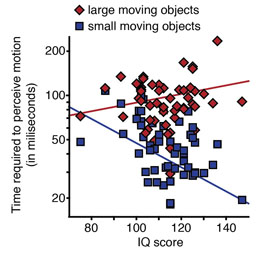
Much of the brain's visual processing can change dynamically with changes in environment.
For example, a common experiment in college psych courses is to give a student glasses that flip the world upside-down. It takes a few days for the student's brain to adapt to the new inputs, and then they see the world normally (and revert after a few days w/o the glasses). Patients with macular degeneration can wear glasses that stretch-map the visual input around areas of missing vision (in the manner of a cylindrical mirror). After some time, they report seeing the world normally - their visual system has adapted and remapped the input.
I wonder if the effect simply measures the amount of reading the subject does; in other terms, perhaps it's just measuring the amount of fine-focus eye training? What does the test show for people who play a lot of arcade games (shooters, especially ones that throw a lot of targets at you)? Or people who use a lot of visual perception in their daily lives?
The article stated that the authors "tested for other possible explanations". Also, the correlation was at most 71%, note that flipping a coin is expected to correlate to around 50%. Their data seems to be awfully well clustered and the slope seems to be due to the outliers. The first study used 12 subjects, and the second only 53.
I'm unconvinced. It could be promising, but I would like to see correlations from more data.
-
Re:Anti-Climate-Change is the Core message
I said it wasn't the topic of conversation, not that I repudiate the results.
Actually, you made it the topic of conversation - "Fine, show me that say 80% of the methods we use to measure temperature are invalid". NASA GISS is one of the primary global temperature datasets, and if you're going to look askance at Watts, it would seem that Hansen could be looked at similarly. But to be specific, I'm not asking you to look askance at Hansen - I'm asking you to understand that *your* feelings towards Watts have a rational and opposite counterpart.
Link to the paper. I'm not reading another blog for you, it isn't my job to fill in your ignorance.
http://www.uoguelph.ca/~rmckitri/research/M&M.EE2005.pdf
http://www.uoguelph.ca/~rmckitri/research/MM03.pdfYou asked me for an experiment. I gave you one. These are the ones I can think of at this stage because all experiments that undermine climate models at this stage are either longitudinal or completely undermine vast swathes of contemporary physics.
You're making an assertion that isn't tenable - the mere existence of contemporary physics does *not* lead to the conclusion "human CO2 emissions are causing global average temperature increases that are bad enough to require restrictions on human CO2 emissions".
Again, the difference between *necessary* and *sufficient* don't seem to be clear to you.
. The only other option I can see is to find some way to show that the empirical parameters of existing models (of which I admit there are a few) cannot take the values the fits currently suggest.
Okay, let's play with models for a second. Take, say any 2 dozen models with the basic, hard coded premise that human CO2 emissions are a primary driver of temperature. They obviously diverge simply between *themselves* in their predictions. Why is it that the assumption is that their basic hard coded premise is correct, and that all variation is due to *other* tweaked variables? It is just as reasonable to assume that their CO2 hard coding is as suspect as any other tweaked variable.
My urine is, statistically speaking, significantly warm than the ocean. Me pissing in the ocean will not warm it in any meaningful way.
Okay, let's run with that. Human CO2, statistically speaking, will have an impact on global average atmospheric temperature, arguably non-zero and arguably positive. At the same time, human CO2 will not warm the atmosphere in any meaningful way. Nothing inconsistent with those two statements.
At first I assumed that you were vaguely familiar with the scientific method, but it is now clear that is not the case.
And after all this time, you *still* haven't started the scientific method by a clear statement of a falsifiable hypothesis
If you were one of my students I'd suggest you take basket weaving
I would've guessed that that was what you actually teach
Step up to the plate, and make your falsifiable hypothesis statement, understanding that we are looking for both those factors that are *necessary* as well as those that are *sufficient*. Relying on physical constants as the sole prop for the validity of tinker toy models is avoiding the question, and you know it
-
Re:Anti-Climate-Change is the Core message
I said it wasn't the topic of conversation, not that I repudiate the results.
Actually, you made it the topic of conversation - "Fine, show me that say 80% of the methods we use to measure temperature are invalid". NASA GISS is one of the primary global temperature datasets, and if you're going to look askance at Watts, it would seem that Hansen could be looked at similarly. But to be specific, I'm not asking you to look askance at Hansen - I'm asking you to understand that *your* feelings towards Watts have a rational and opposite counterpart.
Link to the paper. I'm not reading another blog for you, it isn't my job to fill in your ignorance.
http://www.uoguelph.ca/~rmckitri/research/M&M.EE2005.pdf
http://www.uoguelph.ca/~rmckitri/research/MM03.pdfYou asked me for an experiment. I gave you one. These are the ones I can think of at this stage because all experiments that undermine climate models at this stage are either longitudinal or completely undermine vast swathes of contemporary physics.
You're making an assertion that isn't tenable - the mere existence of contemporary physics does *not* lead to the conclusion "human CO2 emissions are causing global average temperature increases that are bad enough to require restrictions on human CO2 emissions".
Again, the difference between *necessary* and *sufficient* don't seem to be clear to you.
. The only other option I can see is to find some way to show that the empirical parameters of existing models (of which I admit there are a few) cannot take the values the fits currently suggest.
Okay, let's play with models for a second. Take, say any 2 dozen models with the basic, hard coded premise that human CO2 emissions are a primary driver of temperature. They obviously diverge simply between *themselves* in their predictions. Why is it that the assumption is that their basic hard coded premise is correct, and that all variation is due to *other* tweaked variables? It is just as reasonable to assume that their CO2 hard coding is as suspect as any other tweaked variable.
My urine is, statistically speaking, significantly warm than the ocean. Me pissing in the ocean will not warm it in any meaningful way.
Okay, let's run with that. Human CO2, statistically speaking, will have an impact on global average atmospheric temperature, arguably non-zero and arguably positive. At the same time, human CO2 will not warm the atmosphere in any meaningful way. Nothing inconsistent with those two statements.
At first I assumed that you were vaguely familiar with the scientific method, but it is now clear that is not the case.
And after all this time, you *still* haven't started the scientific method by a clear statement of a falsifiable hypothesis
If you were one of my students I'd suggest you take basket weaving
I would've guessed that that was what you actually teach
Step up to the plate, and make your falsifiable hypothesis statement, understanding that we are looking for both those factors that are *necessary* as well as those that are *sufficient*. Relying on physical constants as the sole prop for the validity of tinker toy models is avoiding the question, and you know it
-
Re:Anti-Climate-Change is the Core message
"Hansen and Mann" - Non-sequitor, I didn't cite either of these gentlemen.
So you repudiate NASA GISS temps and dendro reconstructions? I'm cool with that
"the proxy dendro reconstructions have been thoroughly invalidated" - No peer reviewed study there to back up that claim I see.
http://www.uoguelph.ca/~rmckitri/research/trc.html
And yes, they have a peer reviewed study, but far be it for me to appeal to authority
- Yes, and to invalidate the current climate models I expect you to show that these lab experiments have the wrong result.
You're asserting a tautology. Can you admit that it is more than possible for CO2 to have specific wavelength absorption properties, and *still* not be a primary climate driver? Your citation of a physical parameter as a both necessary and sufficient to determine the validity of a tinker toy model is puzzling.
"Put a number on it." - Fine, 4000 years with an error of no more than 1000. You find me say six deglaciations with the properties I suggested which cannot be explained by effects already in the literature I will reconsider.
So 800 years of lag is insufficient, but 4000 years would be? Care to explain *why* those two values imply a qualitative difference?
"UHI is negligible" - The UHI is negligible when talking about global mean surface temperatures.
How can you assert that? Wouldn't the observation of statistically significant UHI falsify that? Again, put a number on it - "negligible" seems to be open to interpretation.
"All industry is carbon heavy" - Let me rephase my suspicion. Who pays your wages? You can just state what industry it is if you like.
Who pays your wages? What industry are you in? Me, I'm in IT. Put more specifically to your suspicions, no, I don't work for an oil company, or coal company, or any other type of dig in the ground for stuff company. However, like *all* companies, inexpensive energy is a benefit, so from that perspective, any rational being will be in support of inexpensive energy. I hold my well considered positions out of principle, not pocketbook though - I could be convinced that human CO2 emissions *must* be reduced, if someone would simply start with a falsifiable hypothesis statement, which, despite very well written comments, has failed to appear
Remember, it's not simply sufficient to say "well, if the speed of light isn't c, my theory is wrong", because simply having the speed of light as c doesn't specifically imply *every* theory you care to cite. You need a list, that I suppose would be much longer than you'd like, that asserts *all* of the ways that your hypothesis could be falsified.
In the simplest case, you could simply make a claim that a specific CO2 level and a specific global average temperature would falsify it. You might want to hedge your bets, so maybe you'll add solar output to that equation, so you don't get falsified during a Maunder minimum, or something like that. Or maybe add in variables for volcanic activity, or any number of other things you think might still matter.
But at this point, you're still just poking around the edges of the real question - I mean, if the CO2 absorption spectrum was say, 1nm off of what you think it is, would *that* falsify your hypothesis? Yes, a certain range of absorption might be *necessary* for your hypothesis to hold water, but it certainly isn't sufficient.
-
Re:How nicely round numbers...
You're way off. http://www.physics.uoguelph.ca/tutorials/sig_fig/SIG_dig.htm
-
Re:A lot of work
Five years ago Kip Thorne recommended Hartle's book "Gravity: An Introduction to Einstein's General Relativity", and it is a wonderful introduction to General Relativity. (I took calculus, linear algebra, advanced linear algebra, differential equations, real analysis, complex analysis, differential geometry, and Fourier analysis before taking the graduate course on General Relativity at UC Davis)
We used Carroll's book on General Relativity, which is more or less his lecture notes which are freely available online at http://preposterousuniverse.com/grnotes/
As far as understanding Einstein's field equations, a wonderful reference by John C. Baez and Emory F. Bunn: The Meaning of Einstein's Equation on Baez's webpage.
Dr Carlip recommended R. A. D'Inverno's Introducing Einstein's Relativity (Oxford University Press, Oxford, 1992) to the graduate physics class.
Dr. Joseph Biello recommended B. F. Schutz's A First Course in General Relativity (Cambridge University Press, Cambridge, 1985) as an introductory text, then follow it up with Robert Wald's General Relativity (University Of Chicago Press, First Edition edition, 1984). I don't know about this, because Wald himself admitted that he didn't give justice to the Lagrangian or Hamiltonian formalism for General Relativity.
When thinking about black holes, or any singularity, the standard reference on this subject is Hawking and Ellis' The Large Scale Structure of Space-Time (Cambridge University Press, 1975).
Everyone says "Misner, Thorne, and Wheeler" and I am inclined to agree. If you are serious about studying General Relativity, you have to read through this at least once. It is the Bible of General Relativity, although there are two opinions people have about it: they love it, or hate it. Those that hate it would object to my opinions...
When you want to start getting into quantum gravity or numerical relativity (i.e., using the computer to solve Einstein's field equations), you need to learn the ADM formalism. There are a few books on this.
Peter Peldan wrote a review article, "Actions for Gravity, with Generalizations" arXiv:gr-qc/9305011v1 which is a great review of all the many different types of variational ways to obtain General Relativity.
Bojowald just wrote a great book, Canonical Gravity and Applications, which is a fabulous introduction.
Poisson wrote a book on a lot of folklore topics in general relativity, which is based on his lecture notes (freely available online at http://www.physics.uoguelph.ca/poisson/research/agr.pdf). In fact, the only difference I can find is that the pdf doesn't have the index or table of contents, but everything else seems identical.
For numerical relativity, Baumgarte and Shapiro's Numerical Relativity: Solving Einstein Equations on the Computer is another fantastic reference. The only disadvantage is their index system is confusing.
As far as the mathematics, there are many books out there on differential geometry. The graduate course sequence on differential geometry at UC Davis used Manfredo P. do Carmo's Riemannian Geometry
However, many of them kind of ignore the intricacies of Lorentzian manifolds. Arthur L Besse's Einstein Manifolds (Springer, 2007) is a wonderful reference for this subject. (Arthur L Besse is a pseudonym for a group of mathematicians inspired by the Bourbaki group, and works primarily on differential geometry.)
-
not a new concept
This kind of idea has been around for ages, for example: the University of Guelph's Living Library.
-
Re:Nothing to do with the scientific consensus
Go ahead - decide which Global Average Temperature methodology we should be using after reading this: http://www.uoguelph.ca/~rmckitri/research/globaltemp/GlobTemp.JNET.pdf
-
Re:And many of the "climate" scientists...
Really? I'd say that IPCC AR4 [realclimate.org] did pretty well predicting the past decade.
I call BS. Your cited graph claims a forecast from 2000, but IPCC AR4 was from 2007. And did you note the huge error bars?
Let's hear your response to this: http://wattsupwiththat.com/2011/06/09/comparing-ipcc-1990-predictions-with-2011-data/
If you can come up with a climate model which has much tighter confidence intervals than current AGW models but with real measurements still fitting in, you might win the Nobel Prize.
I think you hit the nail on the head right there - with such sloppy confidence intervals in the *actual* science, the alarmist claims of accuracy are are highly exaggerated. This might just be a communication problem (dumbing things down until they lose their original meaning), or it could be that it is an intentional misleading. I leave that decision as an exercise for the reader.
And another thing you're forgetting, one of those "toys" helped put man on the Moon and space probes in orbit of various planets in our solar system, hundreds of millions of kilometers away.
Orbital mechanics are orders of magnitude simpler than weather and climate predictions. Newtonian Gravity is only 43 arcseconds off *per century* for predicting the orbit of Mercury, for example. (http://en.wikipedia.org/wiki/Newton's_law_of_universal_gravitation#Problems_with_Newton.27s_theory)
As for the utility of models that predict the statistic "global average temperature", I'll refer you to this: http://www.uoguelph.ca/~rmckitri/research/globaltemp/GlobTemp.JNET.pdf
Perhaps you can suggest what useful information I can get if I knew that next year the global average temperature would be
-
Re:Nothing to do with the scientific consensus
An average increase of 1 degree across the globe will increase that energy heat-difference (between the tropics and poles). It is really very simple.
Wrong. You can have an increase in the energy heat difference between the tropics and the poles without *any* average increase. Simply cool one, and warm the other. You can also have a decrease in the energy heat difference between the tropics and the poles with a significant average increase. Simply warm the poles more than tropics (which, I believe some other AGW proponent has recently claimed is a signature of CO2 based warming rather than solar based warming).
As for *zero* utility for a global average temperature -- you really don't believe that do you?
Actually, I do. Global Average Temperature, is really a useless metric. It can't tell you what temperature it is going to be anywhere in the realm of terrestrial experience. Now, perhaps, if the earth was being used by some alien civilization as a thermometer to decide on when certain holidays were, then you'd have *something* that was affected by Global Average Temperature, but as it stands, it is as useful as calculating the Global Average Phone Number.
Put another way, would a average daily temperature be useful at all (say, temperature on every hour, for 24 hours, then divided by 24)? We generally get told what the high and low will be in a weather report, and intuit that the high will occur sometime after noon, and that the lows happen sometime in the middle of the night, but what would you decide to wear out to work if you were told the average temperature of the day was going to be 65F? It could mean that the low was somewhere at 60, and the high somewhere at 70, evenly distributed. Or it could mean that the high was at 90, and the low was at 40 - definitely a very different scenario, with very different consequences.
Obligatory reference for you:
http://www.uoguelph.ca/~rmckitri/research/globaltemp/GlobTemp.JNET.pdf
For *any* global average temperature, there are a myriad of possible temperature distributions. It is those distributions that have real meaning, and thus far, no climate models have given us *any* hope of predicting those distributions. It may very well be that those distributions simply cannot be predicted by models because of their stochastic nature, but if you wanted to study something that could actually *matter*, that would be it.
-
Re:Follow the data!
http://www.uoguelph.ca/~rmckitri/research/McKitrick-hockeystick.pdf page 8
3.2 The bent principal components
In our analysis of Mann's FTP archive we found some remnant computer code files that turned out to be the Fortran routines he used to compute his principal components. In these we discovered why his PCs could not be replicated. In a conventional PC analysis, if the data are in differing units it is common to "standardize" them by subtracting the mean of each column and dividing by the standard error. This re-centers and re-scales all the data to a mean of zero and a variance of 1. With tree ring data no such re-scaling is needed since the data are pre-scaled before archiving.
In Mann's program, he applied a scaling, but with a difference. Rather than subtract the mean of the entire series length, he subtracted the mean of the 20th century portion, then divided by the standard error of the 20th century portion.11 Most of his proxy series do not look like hockey sticks, they look like flat static, and since they don't change in the 20th century this procedure did not make much difference. The mean of the last section is roughly the same as the mean of the whole series (as is the standard error) so either way of standardizing yields more or less the same result. But some of the series trend upwards in the 20th century. For these, the Mann method has a huge effect. Since the mean of the 20th century portion is higher than the mean of the whole series, subtracting the 20th century mean 'de-centers' the series, shifting it off a zero mean. This, in turn, inflates the variance of these series.
PC algorithms choose weights to maximize the explained variance of a group of data series. If one series in the group has a relatively high variance, its weight in the PC1 gets inflated. The Mann algorithm did just this. It would, in effect, look through a data set and identify series with a 20th century trend, then load all the weight on them. In effect it 'data-mines' for hockey sticks.
Figure 5 gives an example of the effect. It shows 2 of the 90 full-length series in Mann's data base. Both are part of the North America ("NOAMER") proxy roster, whose PC1 is the most influential series on the hockey stick's final shape. The top panel is a tree ring chronology from a stand of bristlecone pines at Sheep Mountain, California. The bottom panel is a tree ring chronology from Mayberry Slough, Arkansas. In the bottom panel, the mean over the last 80 years is roughly equal to the mean for the previous 500 years, but in the top panel the post-1900 mean is above that for the pre-1900 portion. Mann's algorithm gives 390 times as much weight to the top series as to the bottom series in the PC1.Figure 6 shows the contrasting results. The top panel is the MBH98 PC1 for North America, which they call the "dominant pattern" in the data, and which has a distinct hockey stick shape. The second panel shows the simple average of the NOAMER proxies. Note that most proxies look more like Mayberry Sloughâ"only a handful have the 20th century growth spurt. The third panel shows the PC1 computed using a common statistical package, in which the data are standardized in the usual way. It looks like the simple mean, indicating that the dominant pattern in the data does not have a hockey stick shape. I will explain the bottom panel ("Censored") shortly.
To test the power of Mann's data-mining algorithm we ran an experiment in which we developed sequences of random numbers tuned to have the same autocorrelation pattern as the NOAMER tree ring data. In an autocorrelated process a random shock takes a few periods to drift back to the mean. Initially we used a simple first-order autocorrelation model, but later we implemented a more sophisticated ARFIMA12 routine that more accurately represents the entire autocorrelation function associated with tree ring data. In statistics these kinds of models are called "red
-
Re:Wait
You never learned about significant digits, eh?
-
Re:No the way to do it
I'd be happy to listen to an actual argument, backed by facts and research. If it was actually published and peer-reviewed, that'd be great!
Sure.
Here's one specific one:
http://www.uoguelph.ca/~rmckitri/research/trc.html
And here's a whole list:
http://petesplace-peter.blogspot.com/2008/04/peer-reviewed-articles-skeptical-of-man.html
Please feel free to discredit their *arguments*, and restrain yourself from simply attacking their character because they disagree with you
Oh, and regarding my typo of "5 years" instead of "25 years", I must admit, I'm chagrined that I made the same type of mistake that the IPCC made
http://blogs.the-american-interest.com/wrm/2010/01/16/glaciergate-ipcc/
-
Re:How do you know what is real?
I'm quoting the NAS, not Wegman!
Nope, you are quoting The fucking Wegman Report, p.26
-
Re:Didn't even check if evidence existed
-
Re:magical negative feedback
This is what the creationists do--no matter how many fossils you show them, they always insist that the fossil evidence is not strong enough, because there are "missing links."
Let me continue the analogy for you for warmists - no matter how many natural drivers you show them, they always insist that the evidence is not strong enough, because there is "unaccounted for warming."
So Mann made some techincal errors, but they were largely irrelevant to his basic conclusions, which have since been validated by other studies that do not share those technical flaws. This remains the scientific consensus.
Of course science != consensus. But here's a refutation of the whitewash:
http://www.uoguelph.ca/~rmckitri/research/WegmanReport.pdfI challenged you to cite the text of the IPCC report that predicts runaway warming as a consequence of anticipated levels of CO2.
So you didn't look at any of their graphs? Here, try page 792-793. http://www.ipcc.ch/pdf/assessment-report/ar4/wg2/ar4-wg2-chapter19.pdf
In the model, CO2 has exactly the same effect no matter where it comes from. But if something other than CO2, such as an increase in solar radiation, increases the temperature, then CO2 rises afterwards (and amplifies the increase in temperature).
If CO2 has the same effect no matter where it comes from, you can't have lags -> CO2 emitted, whether from oceans in response to solar changes, or from supervolcanoes or model T fords, always acts as a positive feedback effect and raises temperatures. Lags wouldn't exist if CO2 amplified the increase in temperature, since whatever triggered the initial CO2 release, you'd end up with a positive feedback effect.
Dropping a rock in a pond will create ripples. Ripples in a pond do not create dropping rocks.
-
Re:magical negative feedback
A subsequent review by the NRC concluded that McIntyre & Kitrick's techincal objection was correct, but that it did in fact produce an incorrect result in the case of Mann's data.
You meant "correct result", right?
You seem to be trying to argue that "if one measurment is not enough, then however many you have can't be enough either." That makes no sense.
No, I'm really trying to argue that a model cannot be its own justification. A model which takes measurements from 1000 stations cannot be its own justification, just as a model which takes measurements from 1 station cannot be its own justification. This is why Popper's falsifiability criteria is so crucial to determining causality.
This is an independent peer-review panel of the US National Academies of Science, the most respected independent organization of scientists in the nation, if not the world.
I'm sorry, but the appeal to authority argument falls flat here.
http://www.uoguelph.ca/~rmckitri/research/trc.html
"They accepted our argument that Mann's method is biased towards producing hockey stick-shaped PCs, that uncertainties have been underestimated and that the bristlecone data, on which the famous hockey stick shape depends, should not have been used. They also express very little confidence in the IPCC's claim about the 1990s being the warmest decade in the millennium. But you have to read the report closely to pick all these things up--they bury it in a lot of genteel and deferential prose."
Yes, I know what it is called. I asked you to "Kindly quote the section of the IPCC report that predicts runaway warming as a consequence of anticipated levels of CO2."
http://www.ipcc.ch/publications_and_data/ar4/wg2/en/ch4s4-references.html
Check out the page, and text search for "runaway". You'll find it somewhere towards the middle of the page.
Aren't you getting a bit ahead of yourself? You haven't even established that IPCC actually made a prediction of a "runaway greenhouse."
RTFL: http://www.ipcc.ch/publications_and_data/ar4/wg2/en/ch4s4-references.html
And global climate models assume that every molecule of CO2, wherever it came from, has the same physical chemistry and the same impact on climate. No such memory is assumed.
You're contradicting yourself. You asserted that CO2 lags temp changes if the CO2 is not "added", and leads temp changes if it is "added". This is an assertion of different behavior depending upon whether or not the CO2 came from the outgassing of the oceans, volcanoes, or other natural sources, or if they came from the burning of petroleum products by humans. This is an invalid assertion of memory.
If CO2 causes a feedback effect, any addition of CO2 from any source should cause an increase in temperatures. Magical CO2 just does not exist.
-
Re:Let's go ahead and quote from the report:
Well, here's a start:
http://www.uoguelph.ca/~rmckitri/research/trc.html
Of course, a lot of literature refuting the AGW hypothesis has been suppressed, either by implicit or explicit pressure, but I would suppose since ClimateGate we'll be seeing a more fertile field for skeptical publication.
That all being said, let's remember that "peer reviewed" does not mean "peer approved" or "peer consented to" or "peers think this is right" -> it just means that peers have decided it's worthy of publication.
You've also got the whole IPCC relying on non-peer reviewed literature (AmazonGate, GlacierGate, etc). If you want some serious answers on the link between the data they've destroyed or refused to release and claims made, I'd suggest trolling around at http://wattsupwiththat.com/ - they've got pretty savvy comments on a lot of the posts there.
-
Yes, you are a critical thinker!
Everyone has a lot to gain, so I will in fact call anything anyone claims without backing up those claims with any evidence bullshit...
Any normal scientist do will research, write a paper and in the conclusion of the paper claim 'more research needs to be done'... they are no evil money-hungry scientists because of that, it's stating a fact because every field can use more research and coincidentally they will have more work. My problem is with 'scientists' who make extraordinary claims without backing them up with sufficient data, or they have 'proof' but only the pretty graphs not the raw data. These people are fear-mongerers that hold the world hostage with these claims and try to silence opposition. When you can no longer oppose a questionable idea, questionable motives and questionable practices without being attacked you can be damn sure there is something wrong.
You questioned the graph without hesitation, as you should... I have certainly not provided any evidence and you should not believe me on my word on anything... But I have found the source of this graph for you: http://www.uoguelph.ca/~rmckitri/research/nvst.html who also reference http://data.giss.nasa.gov/gistemp/station_data/ -
Re:When...
Obligatory xkcd ref.
Well, if you want to disregard what the Wegman Report says, that's up to you.
The cheaper ones tend to report *cooler* temperatures than the more expensive, standalone sensors. So the "urban" stations actually show *less* global warming if averaged in a naive approach.
This is only true if there are no adjustments made to the temperature reading AND the "cooler" temperature is greater than the heating effect. If these aren't true, then obviously it would depend on the amount of the adjustment and amount of error in the reading.
2) There's a *lot* more than 4 stations in most regions which have correlated temperature anomalies. In the US, generally dozens.
You know very well that the # wasn't significant in the argument. It's fine to eliminate grossly incorrect readings this way. It's another thing entirely to adjust a good reading because the surrounding stations have more error.
3) The heat island effect *is* cancelled algorithmically, and this is verified by, among other things, comparing calm and windy days.
You have a remarkable confidence that this algorithm is very accurate. You can read the conclusion of here and see there are reasons to believe there are deficiencies in the algorithm. Even comparing calm/windy days will be influenced by the location of the unit (walls close by) and topological influences.
For something that is supposedly "validated", we are seeing an awful lot of instances of incorrect usage.
Yes, by people like Watts.
Proof by Innuendo. There's science for you. Are you actually trying to argue that algorithms are better than calibration?
er, ok. These graphs tell me the world is warmer than it was than the Little Ice Age. If you assume all this is due to CO2 (ie there is no solar forcing), one would expect and
2) Since when do you trust Phil Jones?
I don't trust EITHER side in this debate. I note that it is more significant if a proponent of AGW says there's no warming just as if a detractor of AGW says that there is warming.
3) Phil Jones is one climate scientist among several thousand. He is not the god of climate science.
Please. Saying he's just one climate scientist is like saying Joe Biden is just another government employee. It's being disingenuous. It would be much more difficult to make the AGW case if you took his work out of the picture.
4) Wrong. Jones says that there is a +0.12C warming trend for that time, but it's not long enough to be statistically significant. And he's right.
Sorry. I stand corrected. It was for the period Jan 2002-present with the -.12C.
It's idiotic how so many people keep trying to read trends into a couple years of extremely noisy data.
I have NO idea what YOU consider a trend when I wrote the question which is why I asked. Forgive me for not being psychic. Jones uses the word "trend" to talk about Jan 2002- (see question C)
-
Re:Engineering Course Grade = F
When you use floats to do the arithmetic, you lose precision in each operation, and particularly when you multiply two numbers with different scales (exponents).
Why would multiplying numbers cause you to lose precision? I think a more common way to lose precision would be to subtract two numbers that are nearly equal to each other.
-
Re:Great, just great
Interesting you should use noise as a temperature input. In 2005, some researchers did just that. It turns out that feeding "red noise" into these bogus climate models instead of real data yields a "hockey stick" graph 99% of the time. link (pdf).
-
Re:Global Warming
I wish someone would tell me how you compute the mean temperature of a composite substance like the atmosphere. Global atmospheric heat content is meaningful. Global mean temperature is not. Unless someone would care to explain how you actually compute it in a physically meaningful way?
This sounds similar to the arguments presented in a 2007 paper that's widely considered to be some kind of joke.
Perhaps you mean that different substances have different heat capacities. That's only a problem if you want to determine the equilibrium temperature, and even that's just a weighted average. But even an unweighted average improves the signal-to-noise ratio of temperature measurements, which is why climatologists routinely speak of global mean temperatures.
And to be really pedantic, "heat content" isn't physically meaningful either. Heat is a type of energy transfer across a thermodynamic system boundary. Systems don't store heat, they store internal energy, which is also measured in Joules but can be transferred as heat or work. (Yes, this distinction is irrelevant. That's my point.)
Incidentally, whenever I get some free time I plan to copy one of your older comments to the climate change article on my homepage and answer it. That's because compared to most other people arguing against abrupt climate change, you seem significantly more scientifically literate. I'd email you when this happens, but I don't know how to get in touch with you other than comments like this one.
-
Re:anti-solar prejuices, prior neglect
It is asserted that if you use random, trendless data, you also get the same answer. See the graph near mid-page at http://www.uoguelph.ca/~rmckitri/research/trc.archive.html.
I can't get that graph to load (but my net connection has been flaky lately so it could be my fault.) At any rate, it sounds like a claim that MM have made: that sending "red noise" into the MBH98 program results in a hockeystick. The main problem is that the extracted trend explains very little variance relative to the trend extracted from real data. Here's a 4-part primer on PCA to help people understand the basics.
Do you have any comment on the link I gave regarding the Nature correction?
I read some of it, and their complaints sound very similar to what other scientists go through when trying to get their research published. Peer-review is often an unpleasant process because it's based on confrontation, but this is true for everyone. In this particular case, I think Nature was right to reject their article based on the mountain of evidence against their claims.
-
Re:anti-solar prejuices, prior neglect
Thanks for the link (in Point 5, Part II). I also read in point 8 that "If you use the MM05 convention and include all the significant PCs, you get the same answer. If you don't use any PCA at all, you get the same answer. If you use a completely different methodology (i.e. Rutherford et al, 2005), you get basically the same answer."
It is asserted that if you use random, trendless data, you also get the same answer. See the graph near mid-page at http://www.uoguelph.ca/~rmckitri/research/trc.archive.html.
Do you have any comment on the link I gave regarding the Nature correction? -
Re:anti-solar prejuices, prior neglect
But it's ludicrous to suggest that the scientific community as a whole is somehow unaware of these issues or engaged in a massive conspiracy to suppress them.
Then why Nature's soft-pedaling of the correction to Mann? McKitrick and McIntyre detail their experience of trying to deal with Nature to get a correction here. Interesting reading.
And the referees throwing up their hands and saying "this is too complicated for us to evaluate in 2 weeks" shows a weakness in the process. -
Re:No...
poetry aside, there's no doubt the climate is changing. It has changed where I live and apparently in a lot of other places too.
The disagreement is not whether the climate is changing. The disagreement is how much, how fast, and whether it is human-caused.
On the things that ARE human-caused (pollution of rivers/lakes/etc, erosion due to poor farming techniques) we should definitely be working to fix it. On the things that are natural (and Earth's temperature has more to do with irregularities in Earth's orbit and with the cycle of Solar activity than so-called "manmade greenhouse gases"), we can do little.
Yes, in centuries past, there were cold times. The 14-1500s were, according to what little records and the (incomplete) evidence we can gather, colder than we experience today as an average. At the same time, there are periods that were warmer. There is also the problem of having reliable measurements at all (we're talking about maybe 30 years of true recording with properly calibrated instruments, and "measured change" that falls off of most of the measurements if you pay attention to the known accuracy of the instruments and pay attention to your Significant Digits). And then there's the problem of paying attention to what you are measuring rather than cherry-picking your data for your expected result - for instance, if you compare this summer historically to the "average" of the past 10, 15, 20, 25, 30, etc... you will see the "answer" of "hotter" or "colder" fluctuate up and down based on the new data. It gets even worse when you do like the shysters do and compare to an unseasonably cold "reference year" rather than doing a proper analysis of what long-term data we do have.
The "climate change" crazies have one thing in common: they all know how to lie with statistics. My clearest evidence against them is the fact that their "argument" relies more on the star/celebrity power of their spokespeople than on actual scientific evidence, just like the anti-vaccination crowd.
-
Re:This sort of thing would make anyone suspicious
You are right to be suspicious, especially when you learn more about the shenanigans of some of the alarmist climate researchers. One professor who has co-authored papers with Phil Jones of CRU is up on academic misconduct and fraud charges brought by Doug Keenan. See http://www.informath.org/apprise/a5620.htm See also the English Translation of the article titled "Kyoto Protocol Based on Flawed Statistics" found at http://www.uoguelph.ca/~rmckitri/research/Climate_L.pdf
-
Crystal radio
I'd start with a crystal radio, although there are designs far more compact than the one on Wikipedia. Next, perhaps a simple transistor amplifier (for which you can use the crystal radio as an audio source), then it might be time to move on to the thousand and one projects you can build around a 555 timer chip and some LEDs.
All of these are low power, low cost, and produce a visible or audible result for immediate gratification.
Mal-2
-
Re:Whew, no problem then
Look at the data again. There is most assuredly a dramatic warming trend, despite the slight decrease in global mean temperature over the past few years. Run a regression on the data, it's quite clear.
You mean this data?
http://data.giss.nasa.gov/gistemp/graphs/Fig.D.lrg.gif
Or this one?
http://data.giss.nasa.gov/gistemp/graphs/Fig.C.lrg.gif
In my opinion, any evidence based on "global temperature" that includes data from more than just recent years should be viewed with scepticism, because our worldwide measurement and calculation techniques have changed dramatically, which likely skews the results in one direction or another. NASA presents data on mean global temperature extending from today back to 1880 as a single line graph with no error bars, which is ridiculous.
Instead, look at the temperature trends I linked to above, based only on direct measurements made in the United States since 1880, or "mean global temperature" using modern measurement techniques (since 1996). These datasets are, IMO, the only ones we can believe with any confidence. Is there a dramatic warming trend? The answer is as likely no as yes, or a resounding "we don't know".
Here's another interesting way to look at the data:
http://www.uoguelph.ca/~rmckitri/research/nvst.html
Mean global temperature versus number of measuring stations. In the 1990s the dramatic temperature increase coincides with the loss of thousands of Russian measuring stations when the Soviet Union collapsed. My point is that arriving at a "mean global temperature" is a very difficult calculation to make.
-
Re:Ask and you shall receive...
1. There were two congressional panels, not one. The one done by the statistics experts that upheld MM's findings was headed by Edward Wegman - its report can be found here: http://www.uoguelph.ca/~rmckitri/research/WegmanReport.pdf
Sorry, that report is *highly* politicized. Hell, it wasn't even peer reviewed. And despite the issues that report identified, they don't substantively change Mann, et al's results.
From what I understand, you have to read this one carefully - apparently the report and the media spin are in opposition. An op-ed discussing this can be found here: http://www.uoguelph.ca/~rmckitri/research/NAS.op-ed.pdf
On the contrary. The BBC's article on the topic does an excellent job of outlining both aspects of the report: a) that the fundamental conclusions of Mann, et al, are sound, and b) statistical rigor needs to be improved in climate science. Go read the summary yourself, it's pretty clear:
"Based on the analyses presented in the original papers by Mann et al. and this newer supporting evidence, the committee finds it plausible that the Northern Hemisphere was warmer during the last few decades of the 20th century than during any comparable period over the preceding millennium."
Sounds to me like you're the one who's spinning.
The more I looked at both sides, the more I saw the deniers using critical thinking and attacking the results and methodologies,
On the contrary, I see a bunch of people who have a series of preconceived notions about the scientific process, and/or earth's climate and our ability to alter it, and are thus coming to conclusions and then searching for evidence to prove them. Like I've said elsewhere, it's disturbingly familiar to the arguments between creationists and biologists.
and people like Mann and Al Gore launching character assassinations in response
Yup, I have to agree with you, there. The attacks have clearly gotten personal. Again, the ID/Evolution debate rings rather true, here.
But Mann did commit what amounts to an academic fraud that changed his field, and in the process undermined a lot of the research in it and relating to it.
Again, you repeat this, despite plenty of evidence that indicates this isn't at all true. Who's cherrypicking now?
-
Re:Ask and you shall receive...
1. There were two congressional panels, not one. The one done by the statistics experts that upheld MM's findings was headed by Edward Wegman - its report can be found here: http://www.uoguelph.ca/~rmckitri/research/WegmanReport.pdf
Sorry, that report is *highly* politicized. Hell, it wasn't even peer reviewed. And despite the issues that report identified, they don't substantively change Mann, et al's results.
From what I understand, you have to read this one carefully - apparently the report and the media spin are in opposition. An op-ed discussing this can be found here: http://www.uoguelph.ca/~rmckitri/research/NAS.op-ed.pdf
On the contrary. The BBC's article on the topic does an excellent job of outlining both aspects of the report: a) that the fundamental conclusions of Mann, et al, are sound, and b) statistical rigor needs to be improved in climate science. Go read the summary yourself, it's pretty clear:
"Based on the analyses presented in the original papers by Mann et al. and this newer supporting evidence, the committee finds it plausible that the Northern Hemisphere was warmer during the last few decades of the 20th century than during any comparable period over the preceding millennium."
Sounds to me like you're the one who's spinning.
The more I looked at both sides, the more I saw the deniers using critical thinking and attacking the results and methodologies,
On the contrary, I see a bunch of people who have a series of preconceived notions about the scientific process, and/or earth's climate and our ability to alter it, and are thus coming to conclusions and then searching for evidence to prove them. Like I've said elsewhere, it's disturbingly familiar to the arguments between creationists and biologists.
and people like Mann and Al Gore launching character assassinations in response
Yup, I have to agree with you, there. The attacks have clearly gotten personal. Again, the ID/Evolution debate rings rather true, here.
But Mann did commit what amounts to an academic fraud that changed his field, and in the process undermined a lot of the research in it and relating to it.
Again, you repeat this, despite plenty of evidence that indicates this isn't at all true. Who's cherrypicking now?
-
Re:And what about proven scientific fraud?
"Run? He's one of twelve different contributors. Here's what they had to say about Wegman's analysis [realclimate.org], by the way. I'll just post the most important parts here:"
Why don't you try actually reading some material on Wegman and his analysis, rather than just parroting Mann and his cronies.
The Wegman report: http://www.uoguelph.ca/~rmckitri/research/WegmanReport.pdf
If you read nothing else, I would suggest you read the Findings section on page 3.
Commentary on Wegman: http://www.uoguelph.ca/~rmckitri/research/WegmanOp-Ed.pdf
-
Re:And what about proven scientific fraud?
"Run? He's one of twelve different contributors. Here's what they had to say about Wegman's analysis [realclimate.org], by the way. I'll just post the most important parts here:"
Why don't you try actually reading some material on Wegman and his analysis, rather than just parroting Mann and his cronies.
The Wegman report: http://www.uoguelph.ca/~rmckitri/research/WegmanReport.pdf
If you read nothing else, I would suggest you read the Findings section on page 3.
Commentary on Wegman: http://www.uoguelph.ca/~rmckitri/research/WegmanOp-Ed.pdf
-
Ask and you shall receive...
Ask and you shall receive:
1. There were two congressional panels, not one. The one done by the statistics experts that upheld MM's findings was headed by Edward Wegman - its report can be found here: http://www.uoguelph.ca/~rmckitri/research/WegmanReport.pdf
A commentary by McKitrick explaining the report can be found here: http://www.uoguelph.ca/~rmckitri/research/WegmanOp-Ed.pdf
2. The National Research Council report can be found here: http://www.uoguelph.ca/~rmckitri/research/NRCreport.pdf
From what I understand, you have to read this one carefully - apparently the report and the media spin are in opposition. An op-ed discussing this can be found here: http://www.uoguelph.ca/~rmckitri/research/NAS.op-ed.pdf
Documentation of the dishonest approach used to get the "hockey stick" into the IPCC report can be found here: http://bishophill.squarespace.com/blog/2008/8/11/caspar-and-the-jesus-paper.html
Additionally, you will also find these links of interest:
http://www.climateaudit.org/?page_id=354
http://www.uoguelph.ca/~rmckitri/research/McKitrick-hockeystick.pdfNow, you talk about the "denialists" (which isn't a real word - trust me on this, I write and edit for a living - the word you want is "deniers"...a "denialist" would be somebody who studies or specializes in denial) as though they are either a conspiracy nut or part of a conspiracy themselves. It's not the case with scientists in the field - why would it be the case with commentators inside and outside of it?
For example, I'm a writer, editor, publisher, and grad student. I got into this as an interested party with a critical mind, and the more I looked at the field, the less it made sense. The more I looked at both sides, the more I saw the deniers using critical thinking and attacking the results and methodologies, and people like Mann and Al Gore launching character assassinations in response. One of these "refuted arguments" is the Medieval Warm Period being warmer than today, but the evidence is so overwhelming in favour of it that Mann put that data into a folder with the word "CENSORED" in it for his own analysis. You can't disprove the existence of the Roman Empire in Europe by stating that the Mayans of the time didn't encounter Romans, but Mann attempted to do something similar with his own work.
Are all climatologists fraudsters? I very much doubt it. But Mann did commit what amounts to an academic fraud that changed his field, and in the process undermined a lot of the research in it and relating to it. CO2 is a greenhouse gas, and in order to understand its relation to the greenhouse effect, accurate temperature over time measurements are necessary. But Mann skewed his data and created inaccurate temperature over time results - so any analysis based on that "hockey stick" is using inaccurate information, and is in error. This goes outside of the field - a lot of work is being done to determine the role of solar activity in climatology, but if a researcher is using Mann's results, he's not going to be able to make an accurate analysis.
The analysis from the entire field of climatology since Mann's "hockey stick" is now on very shaky ground, and a lot of work has to be redone before the data is trustworthy again. Mann has become a scientific superstar, but the damage that has been done to our understanding of climate is incredibly high.
-
Ask and you shall receive...
Ask and you shall receive:
1. There were two congressional panels, not one. The one done by the statistics experts that upheld MM's findings was headed by Edward Wegman - its report can be found here: http://www.uoguelph.ca/~rmckitri/research/WegmanReport.pdf
A commentary by McKitrick explaining the report can be found here: http://www.uoguelph.ca/~rmckitri/research/WegmanOp-Ed.pdf
2. The National Research Council report can be found here: http://www.uoguelph.ca/~rmckitri/research/NRCreport.pdf
From what I understand, you have to read this one carefully - apparently the report and the media spin are in opposition. An op-ed discussing this can be found here: http://www.uoguelph.ca/~rmckitri/research/NAS.op-ed.pdf
Documentation of the dishonest approach used to get the "hockey stick" into the IPCC report can be found here: http://bishophill.squarespace.com/blog/2008/8/11/caspar-and-the-jesus-paper.html
Additionally, you will also find these links of interest:
http://www.climateaudit.org/?page_id=354
http://www.uoguelph.ca/~rmckitri/research/McKitrick-hockeystick.pdfNow, you talk about the "denialists" (which isn't a real word - trust me on this, I write and edit for a living - the word you want is "deniers"...a "denialist" would be somebody who studies or specializes in denial) as though they are either a conspiracy nut or part of a conspiracy themselves. It's not the case with scientists in the field - why would it be the case with commentators inside and outside of it?
For example, I'm a writer, editor, publisher, and grad student. I got into this as an interested party with a critical mind, and the more I looked at the field, the less it made sense. The more I looked at both sides, the more I saw the deniers using critical thinking and attacking the results and methodologies, and people like Mann and Al Gore launching character assassinations in response. One of these "refuted arguments" is the Medieval Warm Period being warmer than today, but the evidence is so overwhelming in favour of it that Mann put that data into a folder with the word "CENSORED" in it for his own analysis. You can't disprove the existence of the Roman Empire in Europe by stating that the Mayans of the time didn't encounter Romans, but Mann attempted to do something similar with his own work.
Are all climatologists fraudsters? I very much doubt it. But Mann did commit what amounts to an academic fraud that changed his field, and in the process undermined a lot of the research in it and relating to it. CO2 is a greenhouse gas, and in order to understand its relation to the greenhouse effect, accurate temperature over time measurements are necessary. But Mann skewed his data and created inaccurate temperature over time results - so any analysis based on that "hockey stick" is using inaccurate information, and is in error. This goes outside of the field - a lot of work is being done to determine the role of solar activity in climatology, but if a researcher is using Mann's results, he's not going to be able to make an accurate analysis.
The analysis from the entire field of climatology since Mann's "hockey stick" is now on very shaky ground, and a lot of work has to be redone before the data is trustworthy again. Mann has become a scientific superstar, but the damage that has been done to our understanding of climate is incredibly high.
-
Ask and you shall receive...
Ask and you shall receive:
1. There were two congressional panels, not one. The one done by the statistics experts that upheld MM's findings was headed by Edward Wegman - its report can be found here: http://www.uoguelph.ca/~rmckitri/research/WegmanReport.pdf
A commentary by McKitrick explaining the report can be found here: http://www.uoguelph.ca/~rmckitri/research/WegmanOp-Ed.pdf
2. The National Research Council report can be found here: http://www.uoguelph.ca/~rmckitri/research/NRCreport.pdf
From what I understand, you have to read this one carefully - apparently the report and the media spin are in opposition. An op-ed discussing this can be found here: http://www.uoguelph.ca/~rmckitri/research/NAS.op-ed.pdf
Documentation of the dishonest approach used to get the "hockey stick" into the IPCC report can be found here: http://bishophill.squarespace.com/blog/2008/8/11/caspar-and-the-jesus-paper.html
Additionally, you will also find these links of interest:
http://www.climateaudit.org/?page_id=354
http://www.uoguelph.ca/~rmckitri/research/McKitrick-hockeystick.pdfNow, you talk about the "denialists" (which isn't a real word - trust me on this, I write and edit for a living - the word you want is "deniers"...a "denialist" would be somebody who studies or specializes in denial) as though they are either a conspiracy nut or part of a conspiracy themselves. It's not the case with scientists in the field - why would it be the case with commentators inside and outside of it?
For example, I'm a writer, editor, publisher, and grad student. I got into this as an interested party with a critical mind, and the more I looked at the field, the less it made sense. The more I looked at both sides, the more I saw the deniers using critical thinking and attacking the results and methodologies, and people like Mann and Al Gore launching character assassinations in response. One of these "refuted arguments" is the Medieval Warm Period being warmer than today, but the evidence is so overwhelming in favour of it that Mann put that data into a folder with the word "CENSORED" in it for his own analysis. You can't disprove the existence of the Roman Empire in Europe by stating that the Mayans of the time didn't encounter Romans, but Mann attempted to do something similar with his own work.
Are all climatologists fraudsters? I very much doubt it. But Mann did commit what amounts to an academic fraud that changed his field, and in the process undermined a lot of the research in it and relating to it. CO2 is a greenhouse gas, and in order to understand its relation to the greenhouse effect, accurate temperature over time measurements are necessary. But Mann skewed his data and created inaccurate temperature over time results - so any analysis based on that "hockey stick" is using inaccurate information, and is in error. This goes outside of the field - a lot of work is being done to determine the role of solar activity in climatology, but if a researcher is using Mann's results, he's not going to be able to make an accurate analysis.
The analysis from the entire field of climatology since Mann's "hockey stick" is now on very shaky ground, and a lot of work has to be redone before the data is trustworthy again. Mann has become a scientific superstar, but the damage that has been done to our understanding of climate is incredibly high.
-
Ask and you shall receive...
Ask and you shall receive:
1. There were two congressional panels, not one. The one done by the statistics experts that upheld MM's findings was headed by Edward Wegman - its report can be found here: http://www.uoguelph.ca/~rmckitri/research/WegmanReport.pdf
A commentary by McKitrick explaining the report can be found here: http://www.uoguelph.ca/~rmckitri/research/WegmanOp-Ed.pdf
2. The National Research Council report can be found here: http://www.uoguelph.ca/~rmckitri/research/NRCreport.pdf
From what I understand, you have to read this one carefully - apparently the report and the media spin are in opposition. An op-ed discussing this can be found here: http://www.uoguelph.ca/~rmckitri/research/NAS.op-ed.pdf
Documentation of the dishonest approach used to get the "hockey stick" into the IPCC report can be found here: http://bishophill.squarespace.com/blog/2008/8/11/caspar-and-the-jesus-paper.html
Additionally, you will also find these links of interest:
http://www.climateaudit.org/?page_id=354
http://www.uoguelph.ca/~rmckitri/research/McKitrick-hockeystick.pdfNow, you talk about the "denialists" (which isn't a real word - trust me on this, I write and edit for a living - the word you want is "deniers"...a "denialist" would be somebody who studies or specializes in denial) as though they are either a conspiracy nut or part of a conspiracy themselves. It's not the case with scientists in the field - why would it be the case with commentators inside and outside of it?
For example, I'm a writer, editor, publisher, and grad student. I got into this as an interested party with a critical mind, and the more I looked at the field, the less it made sense. The more I looked at both sides, the more I saw the deniers using critical thinking and attacking the results and methodologies, and people like Mann and Al Gore launching character assassinations in response. One of these "refuted arguments" is the Medieval Warm Period being warmer than today, but the evidence is so overwhelming in favour of it that Mann put that data into a folder with the word "CENSORED" in it for his own analysis. You can't disprove the existence of the Roman Empire in Europe by stating that the Mayans of the time didn't encounter Romans, but Mann attempted to do something similar with his own work.
Are all climatologists fraudsters? I very much doubt it. But Mann did commit what amounts to an academic fraud that changed his field, and in the process undermined a lot of the research in it and relating to it. CO2 is a greenhouse gas, and in order to understand its relation to the greenhouse effect, accurate temperature over time measurements are necessary. But Mann skewed his data and created inaccurate temperature over time results - so any analysis based on that "hockey stick" is using inaccurate information, and is in error. This goes outside of the field - a lot of work is being done to determine the role of solar activity in climatology, but if a researcher is using Mann's results, he's not going to be able to make an accurate analysis.
The analysis from the entire field of climatology since Mann's "hockey stick" is now on very shaky ground, and a lot of work has to be redone before the data is trustworthy again. Mann has become a scientific superstar, but the damage that has been done to our understanding of climate is incredibly high.
-
Ask and you shall receive...
Ask and you shall receive:
1. There were two congressional panels, not one. The one done by the statistics experts that upheld MM's findings was headed by Edward Wegman - its report can be found here: http://www.uoguelph.ca/~rmckitri/research/WegmanReport.pdf
A commentary by McKitrick explaining the report can be found here: http://www.uoguelph.ca/~rmckitri/research/WegmanOp-Ed.pdf
2. The National Research Council report can be found here: http://www.uoguelph.ca/~rmckitri/research/NRCreport.pdf
From what I understand, you have to read this one carefully - apparently the report and the media spin are in opposition. An op-ed discussing this can be found here: http://www.uoguelph.ca/~rmckitri/research/NAS.op-ed.pdf
Documentation of the dishonest approach used to get the "hockey stick" into the IPCC report can be found here: http://bishophill.squarespace.com/blog/2008/8/11/caspar-and-the-jesus-paper.html
Additionally, you will also find these links of interest:
http://www.climateaudit.org/?page_id=354
http://www.uoguelph.ca/~rmckitri/research/McKitrick-hockeystick.pdfNow, you talk about the "denialists" (which isn't a real word - trust me on this, I write and edit for a living - the word you want is "deniers"...a "denialist" would be somebody who studies or specializes in denial) as though they are either a conspiracy nut or part of a conspiracy themselves. It's not the case with scientists in the field - why would it be the case with commentators inside and outside of it?
For example, I'm a writer, editor, publisher, and grad student. I got into this as an interested party with a critical mind, and the more I looked at the field, the less it made sense. The more I looked at both sides, the more I saw the deniers using critical thinking and attacking the results and methodologies, and people like Mann and Al Gore launching character assassinations in response. One of these "refuted arguments" is the Medieval Warm Period being warmer than today, but the evidence is so overwhelming in favour of it that Mann put that data into a folder with the word "CENSORED" in it for his own analysis. You can't disprove the existence of the Roman Empire in Europe by stating that the Mayans of the time didn't encounter Romans, but Mann attempted to do something similar with his own work.
Are all climatologists fraudsters? I very much doubt it. But Mann did commit what amounts to an academic fraud that changed his field, and in the process undermined a lot of the research in it and relating to it. CO2 is a greenhouse gas, and in order to understand its relation to the greenhouse effect, accurate temperature over time measurements are necessary. But Mann skewed his data and created inaccurate temperature over time results - so any analysis based on that "hockey stick" is using inaccurate information, and is in error. This goes outside of the field - a lot of work is being done to determine the role of solar activity in climatology, but if a researcher is using Mann's results, he's not going to be able to make an accurate analysis.
The analysis from the entire field of climatology since Mann's "hockey stick" is now on very shaky ground, and a lot of work has to be redone before the data is trustworthy again. Mann has become a scientific superstar, but the damage that has been done to our understanding of climate is incredibly high.
-
Re:And what about proven scientific fraud?
You might want to look at the source there. Realclimate is a website operated by Michael Mann, who created the "hockey stick" graph in the first place - and who also shocked the Wegman panel by citing his own papers as "independent verification."
If you want some more detailed information on this, you should read this: http://www.uoguelph.ca/~rmckitri/research/McKitrick-hockeystick.pdf - it discusses the way MM found climatology circles to work, as well as discussing the censored data and why it's important.
-
And what about proven scientific fraud?
"They get called deniers because that is exactly what they are: in the face of overwhelming evidence, they continue to deny, using logic that is identical to 9/11 wonks, moon hoax nutters and, yes, even Holocaust deniers."
And what about proven scientific fraud?
A couple of years ago, two Canadians named Steve McIntyre and Ross McKitrick (aka MM) decided to try to recreate the famous "Hockey Stick." As I recall, one was an economist, the other a mathematician - their work was just to reproduce the results Mann had published using Mann's own model and technique.
They couldn't do it.
In fact, they found two things:
First, Mann and his team had cherry picked their data. They took only the lowest samples from the Medieval Warm Period, and only the highest samples for the modern period. In the case of the former, quite a lot of data was collected and then withheld, data which placed the Medieval Warm Period as considerably hotter than today. This is the equivalent of a historian trying to erase the Roman Empire from history.
Second, Mann's model itself would generate a "hockey stick" out of any data that was fed into it. MM fed a number of samples that were actually random noise into the model, and every single one came out a hockey stick.
Once MM corrected the graph and collected more representative data, what they found was a Medieval Warm Period quite higher than temperatures today, followed by a dip in temperature, and a rise in temperature in the last few years, but NOT one that was out of the ordinary in terms of size or scale.
The paper in which this was published ( http://www.climateaudit.org/pdf/mcintyre.mckitrick.2003.pdf ) raised enough questions that in 2006 it was put before a committee led by a statistics professor named Edward Wegman, which performed an independent review of both Mann and his team's "hockey stick," as well as MM's work on debunking it. Not only did they find and report to Congress that the "hockey stick" could not be reproduced, but also that the entire paleoclimate field had become isolated and often unwilling to share important data, or clarify their methodologies - in some cases claiming that a bad methodology was fine because the answer was correct anyway. MM's work was upheld, and the "hockey stick" was debunked.
Sources so far:
http://www.uoguelph.ca/~rmckitri/research/WegmanOp-Ed.pdf
http://www.uoguelph.ca/~rmckitri/research/trc.html
http://www.climateaudit.org/?page_id=354When it comes to the IPCC report, the committee broke its own rules to use Mann's "hockey stick." This is documented here: http://bishophill.squarespace.com/blog/2008/8/11/caspar-and-the-jesus-paper.html
This is very far from "logic that is identical to 9/11 wonks, moon hoax nutters and, yes, even Holocaust deniers" - it is, however, a damning observation that the emperor is wearing no clothes.
-
And what about proven scientific fraud?
"They get called deniers because that is exactly what they are: in the face of overwhelming evidence, they continue to deny, using logic that is identical to 9/11 wonks, moon hoax nutters and, yes, even Holocaust deniers."
And what about proven scientific fraud?
A couple of years ago, two Canadians named Steve McIntyre and Ross McKitrick (aka MM) decided to try to recreate the famous "Hockey Stick." As I recall, one was an economist, the other a mathematician - their work was just to reproduce the results Mann had published using Mann's own model and technique.
They couldn't do it.
In fact, they found two things:
First, Mann and his team had cherry picked their data. They took only the lowest samples from the Medieval Warm Period, and only the highest samples for the modern period. In the case of the former, quite a lot of data was collected and then withheld, data which placed the Medieval Warm Period as considerably hotter than today. This is the equivalent of a historian trying to erase the Roman Empire from history.
Second, Mann's model itself would generate a "hockey stick" out of any data that was fed into it. MM fed a number of samples that were actually random noise into the model, and every single one came out a hockey stick.
Once MM corrected the graph and collected more representative data, what they found was a Medieval Warm Period quite higher than temperatures today, followed by a dip in temperature, and a rise in temperature in the last few years, but NOT one that was out of the ordinary in terms of size or scale.
The paper in which this was published ( http://www.climateaudit.org/pdf/mcintyre.mckitrick.2003.pdf ) raised enough questions that in 2006 it was put before a committee led by a statistics professor named Edward Wegman, which performed an independent review of both Mann and his team's "hockey stick," as well as MM's work on debunking it. Not only did they find and report to Congress that the "hockey stick" could not be reproduced, but also that the entire paleoclimate field had become isolated and often unwilling to share important data, or clarify their methodologies - in some cases claiming that a bad methodology was fine because the answer was correct anyway. MM's work was upheld, and the "hockey stick" was debunked.
Sources so far:
http://www.uoguelph.ca/~rmckitri/research/WegmanOp-Ed.pdf
http://www.uoguelph.ca/~rmckitri/research/trc.html
http://www.climateaudit.org/?page_id=354When it comes to the IPCC report, the committee broke its own rules to use Mann's "hockey stick." This is documented here: http://bishophill.squarespace.com/blog/2008/8/11/caspar-and-the-jesus-paper.html
This is very far from "logic that is identical to 9/11 wonks, moon hoax nutters and, yes, even Holocaust deniers" - it is, however, a damning observation that the emperor is wearing no clothes.
-
Re:I don't think it would help...
Actually, you are wrong in your math. When using significant digits, as the parent was doing -- because the $80 difference has absolutely no effect on the argument -- parent is correct: $0.99 * 8000 = $8000.
That's like 9th grade math, bud.
-
Re:Carbon Dating
I get your joke, but it presents an opening to state the following little known fact:
Diamonds are not, in fact, forever
Under normal temperature and pressure conditions, diamond is not the most stable form of carbon - graphite is. Using thermodynamic arguments and building a free energy curve, one can show that some fraction of a diamond must decay to graphite in order to achieve a minimum energy state. It does take a very long time for this to happen - geologic time - but even a "long time" is not forever. If you aren't that patient, heat the diamond up to, say, 1500 C to speed things up. Oh, but be sure to do that in the absence of oxygen, because diamond burns just like other forms of carbon.
Some references: [1], [2], [3] -
Re:Sig digs
Uh, no. 151.20 has four (not even 5) significant digits, whereas 222,000 has six.
A refresher:
http://www.physics.uoguelph.ca/tutorials/sig_fig/SIG_dig.htm
-Bill -
Re:"Yeah, those suspicious e-lectronics".
Yes, it does look innocuous enough to someone who knows something about electronics. It looks like a solderable protoboard with some LEDs and a battery. She was probably using an NE555 or something similar to flash the LEDs. Harmless enough
A circuit with an oscillator (i.e. NE555), mini step-up transformer (about the size of a pea), rectifying diodes (i.e. LEDs), and capacitors that looked nearly exactly like hers can make a voltage ladder that can accumulate a sizeable high voltage spark to set off an explosive material -- for example the putty she was carrying around.
For an example of the circuit, look at Fig 1 on this page. Now imaging the bottom part of the circuit (oscillator) replaced with the simple integrated 555 oscillator and using the blinking LED's inlined with the rectifying LEDs in the high-voltage ladder. Now tell me you couldn't make the device look very much like what she was wearing.
If you Google "555 voltage ladder" you will see a huge array of high-voltage circuits you can make with the simple 555 IC. -
Re:US vs World
Hey, since you're into trends, you would probably be interested in the trend of how average global surface temperature has risen as Russian meteorological measurement stations close down. It's on page six.
Seems like a trend that as the temperature measuring stations that measure the coldest areas on the planet close down, the average global temperature seems to increase.
(Or is that not the kind of trend you were looking for?) -
Re:Well waddaya know....
And why don't you take a look at what the Wegman panel and the National Research council had to say about Mann's work?
http://www.uoguelph.ca/~rmckitri/research/WegmanRe port.pdf
http://www.uoguelph.ca/~rmckitri/research/NRCrepor t.pdf