Slashdot Mirror
Domain: usgovernmentspending.com
Stories and comments across the archive that link to usgovernmentspending.com.
Comments · 219
-
Re:All government salaries combined
say we make it permanent and fire all furloughed workers. We might actually be able to balance the budge,
All government salaries combined account for around $200 billion. We could literally fire every single federal employee and we still wouldn't have even covered half the federal deficit ($779 billion last year).
Who's with me on this....
Nobody with a brain in their skull.
The retard is demanding that all of the people now working without pay be dismissed? Or is the the new Republican plan to re-institute slavery?
-
All government salaries combined
say we make it permanent and fire all furloughed workers. We might actually be able to balance the budge,
All government salaries combined account for around $200 billion. We could literally fire every single federal employee and we still wouldn't have even covered half the federal deficit ($779 billion last year).
Who's with me on this....
Nobody with a brain in their skull.
-
Re:Here's Trump
The tax cuts reduced revenue. Deficits have doubled.
Tax revenue is up, not down.
https://www.nytimes.com/2018/1...Deficit is up, but nowhere near "doubled".
https://www.usgovernmentspendi...They need to cut spending to cut the deficit.
-
Re:Moderation is the key
60 years ago taxes may have been too high
You should account in your theory somewhere for the fact that in constant dollars per capita, federal total revenue has gone up 3x over the last 60 years. So maybe we're actually on average being required to pay 3x as much as we used to for a not significantly improved "product" from the federal government.
But don't worry, spending measured the same way over the same time period has gone up almost 4x
The federal deficits aren't a revenue problem, they're a spending problem. Congress spends more and in the process the government manages to waste more.
-
Re:Not sure what country you're in
Federal spending. Social spending is about 68% of the entire budget - yeah, not 70% but quite close.
Medicare is bankrupt in 2026 and Social Security in 2032, the average being about 12 years from now.
-
Re:779 billion dollars deficit
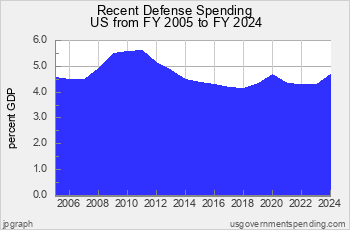
FY2017 spending was approved by President Obama; defense spending for the first year of the Trump administration was set by the Obama budget. It is back to around the level of 2010-2011 in dollars, and well under the first term of President Obama as a percent of GDP.
-
Re:$320 billion wasted
$18 billion per year divided by 3.8 million births per year = about $4,700 per new family. Give it to them as a tax credit, let them use it to defray medical costs, take unpaid time off to recover from birth, etc, etc, etc.
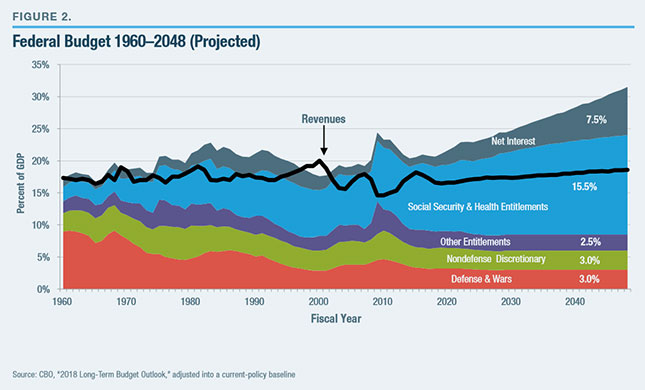
Defense spending has dropped significantly as percent of the budget since the 1960s. The bulk of the budget is now Social Security, Medicare, and other entitlements. We already spend $2.6 trillion dollars per year on the types of programs you're advocating. Adding $18 billion would hardly make a difference. At this point you're advocating removing sand from a molehill to try to make a mountain bigger.
Point being, there are ways to spend the money that don't involve building murder weapons.
Point out one country which doesn't spend money on a military. There isn't, because everyone country which tried it was invaded and conquered by another country. Like it or not, the world is not unicorns and rainbows. The bottom line is that it's nearly always cheaper to forcibly take resources away from a neighbor than it is to cultivate/harvest/mine/develop them yourself. So there will always be an incentive for countries to invade and conquer other countries.
Having a military to defend yourself with is the most economically sound way to dissuade a potential invader. You have $200 billion in assets, but no defense. An invader figures they can spend $5 billion to invade you and take away your $200 billion, for a net profit (to them) of $195 billion.
But if you spend $5 billion of your assets on a military which can inflict $200 billion in damage, that changes the math. Now the invader estimates it will lose $205 billion from invading you, for a net loss of $5 billion. So they leave you alone. Yes you had to spend $5 billion, but it resulted in you not losing $200 billion.
This is an unfortunate oversight in a lot of people's thinking. They assume the status quo would continue to exist even if they eliminated one factor, ignoring how that factor contributes to the status quo. Like people who think because the air is clean, we don't need clean air regulations. The country being free from invasion is not its natural state. If you eliminate military spending and the "murder weapons" as you put it, someone else would simply waltz in and take away everything you own, probably murdering several or most of your family in the process. I know because it's what happened to my country (Korea). -
Re:Eisenhower's Farewell Address
That "visual guide" is very misleading because it's only showing the discretionary budget, making it look like defense spending is by far the largest part of the total budget. Here's a more accurate, if less visually pleasing, set of charts.
2018:
https://www.usgovernmentspendi...2007:
https://www.usgovernmentspendi...TL;DR version: the budget for defense spending in 2018 was 21%, and in 2007 was 24%.
-
Re:Eisenhower's Farewell Address
That "visual guide" is very misleading because it's only showing the discretionary budget, making it look like defense spending is by far the largest part of the total budget. Here's a more accurate, if less visually pleasing, set of charts.
2018:
https://www.usgovernmentspendi...2007:
https://www.usgovernmentspendi...TL;DR version: the budget for defense spending in 2018 was 21%, and in 2007 was 24%.
-
Re:That's mean!
I would start by eliminating add Federal Departments created after 1950. Then I would prune back all Federal agencies created after 1950 as well.
Then, recognizing that the largest share of Federal spending is on Healthcare (2nd place is pensions - 99% of which is SSI), I would cut Federal healthcare spending back to 1% of GDP maximum as it was in the 1950s. This one change alone would cut Federal spending by approximately $1 trillion - our entire deficit. The Federal Government dominates all healthcare spending the US (approximately 40% of all healthcare spending is directly done by the Federal Government).
With these changes, we'd back to fiscally responsible Federal Government spending, and could start addressing our massive debt.
For what it's worth, I would love to see you live in the kind of world you wish to create.
-
Re:That's mean!
I would start by eliminating add Federal Departments created after 1950. Then I would prune back all Federal agencies created after 1950 as well.
Then, recognizing that the largest share of Federal spending is on Healthcare (2nd place is pensions - 99% of which is SSI), I would cut Federal healthcare spending back to 1% of GDP maximum as it was in the 1950s. This one change alone would cut Federal spending by approximately $1 trillion - our entire deficit. The Federal Government dominates all healthcare spending the US (approximately 40% of all healthcare spending is directly done by the Federal Government).
With these changes, we'd back to fiscally responsible Federal Government spending, and could start addressing our massive debt.
-
Re:So...
What money? The money we aren't spending?
The money from this pie chart shows where the governments spends the money:
https://www.usgovernmentspendi...
When you cut the government spending in half, which of the sections of the pie chart will be reduced/removed ?
-
Re:Thanks Obama
Depending on who runs the numbers under Obama the national deficit rose by 7 to 10 trillion dollars.
No, you are wrong! At least get the terms "deficit" and "debt" right. The federal deficit will be $985 billion in 2019 (estimate). Deficit is completely different than debt, and using those terms wrong make you look ignorant. Here are several charts that show the historical and current deficit numbers.
For people who are too lazy to look it up:
National debt: total amount of money we owe.
National deficit: amount we are adding to the debt (this year). -
Re: How about a living wage instead?
So many misconceptions... So little time..
The majority of welfare takers live in big cities and blue states... https://www.usgovernmentspendi...
This means that Trump voters are less likely to collect WIC than democratic voters, just on it's face.
The rest of your assumptions are just as bad.
-
Re:What did you expect?
Here's federal government spending per capita in constant dollars. You'll notice it only levels out or decreases when there is a Republican Congress and a Democratic President.
Congress controls the budget. When there is a Republican President and a Democratic Congress, Congress spends more, but they work with the President to fund some of his priorities.
When there is a match between Congress and the President's party, they spend more.
So a more accurate statement would be that Democrats always spend more. Republicans also spend more, except when there is a Democratic Party President.
Oh, and it's completely a spending problem. Revenue (i.e. taxes) per capita in constant dollars has also increased 3x over the last 60 years and is at record highs, despite the occasional dip based primarily on how the economy is doing and tax law changes. It's just that as much as the federal government has increased tax revenue over the years, Congress has managed to spend even more. So let's work on cutting the spending, or at least slowing down the growth!
-
Re:$135000
hmm...some real numbers - https://www.usgovernmentspendi...
Not sure where you get the $1.11 Trillion for discretionary spending...but military was only $798 Billion for 2015. Military has yet to break the $1 Trillion mark; yet Healthcare did in 2015 ($1028.4) and Pensions was just shy ($953.6 Billion); "Pensions" seem to include Social Security.
Oh - I figured out the $1.11 Trillion - a misleading chart that pulls from various budget items and compares against select items. How'd I figure that out? The numbers don't match up against actual data...so be careful with your "nationalpriorities.org" usage. -
Re:$135000
Here's some real numbers for you - https://www.usgovernmentspendi...
Solving the Healthcare problem would do so much better than cutting defense - since Obama took office Healthcare went from $641.8 Billion (2007) to $1,130 Billion (2017). Defense however has only gone from $652.6 Billion (2007) to $832.1 Billion (2017). Yeah - ObamaCare (PPACA) did nothing but exasperate it as it had no real spending controls in it.
Or take federal government pensions - $636.1 Billion (2007) to $1006.1 Billion (2017). -
Re: $135000
The US defense budget is 3.3% of US GDP
And 3.3% more than we can afford, given the tax cuts and infrastructure crumbling thanks to Reagan tax cuts.
Funny... https://www.usgovernmentspendi... - there's many other areas where spending can be more easily cut...from discretionary/healthcare/pensions/education, and more...
-
Re:Dragging us back to the 1940's -- or earlier :-
Military spending is twice what it should be as a percentage of GDP - look at 1940 just before the war. Then shit got real and we spent 40% of GDP for WW2. Imagine what would happen if the US spent $7.89 trillion on war. That'd be a freakin' space opera.
A true "Bring Back the Good-Old Days" policy would cut DoD spending to $291.35B instead of increasing it to $639.1B - a $347B difference or 53% of the deficit. $650B in cost cutting or revenue increases needs to happen to stop the debt from growing. If each tax bracket was increased by 5%, the gap would be closed and the budget would be balanced. To actually pay the debt off, you'd need to raise 6.1 times current annual revenue in excess of spending. It can be done, but needs to be done as a 50 year plan to not wreck the economy. Politicians are incapable of long-term planning.
-
Re:Because Americans won't spend
The Federal government also just (yet again!) took in record levels of revenue. Of course, it also still spends more than ever. You may notice from those charts the tremendous increase in government revenue per person over time... and the even larger increase in government spending per person over the same time period.
"If we want these things, we have to be willing to spend less on other stuff we don't need."
-
Re:False "facts"
California spends ~21% of all State and Local welfare spending but has about 12% of the population.
-
Re:Trickle down economics doesn't work
In terms of borrowing money, Federal government spending per capita in constant dollars has increased by 4x over the last 60 years. During the same time, federal government income per capita in constant dollars has increased by 3.5x.
The deficit is a result of government spending growing much faster than the increase in revenue has increased. It can't be attributed to less revenue because there is way more tax revenue over time. Saying revenue levels is why the debt is being added to is ridiculous. The government is borrowing money to pay for excessive government spending.
So yeah, let's reduce the debt by cutting spending back to say, per capita inflation adjusted levels of just 12 years ago and we can reduce the debt by a couple of Trillion dollars every year, but whining about a mouse of tax cuts when the elephant in the room is spending just discredits your position.
-
Re:You're deliberately twisting my words
The expiration of some of the tax cuts is a budget rules gimmick to be able to use reconciliation in 2017. No one expects them to actually expire because there is bipartisan support for renewing them. That already played out once with the Bush tax cuts and Obama. The people reporting otherwise are those trying to come up with partisan talking points. It makes it pretty obvious where you get your opinions from.
The top 1% already pay more federal income taxes than the bottom 90% pay. If you're going to cut Federal income taxes, without a lot of contortions (some of which they did include in this bill for that very purpose), the people who actually pay the majority of taxes are likely to pay less taxes.
In terms of borrowing money, Federal government spending per capita in constant dollars has increased by 4x over the last 60 years. During the same time, federal government income per capita in constant dollars has increased by 3.5x.
The deficit is a result of government spending growing much faster than the increase in revenue has increased. It can't be attributed to less revenue because there is way more tax revenue over time. Saying "we are borrowing money to give it away to the ultra rich" is ridiculous. We're borrowing money to pay for excessive government spending.
P.S. Your personal attacks are completely off the mark and appear to be mostly projection on your part....
-
Re:too many taxes already
$0.87 trillion for defense is peanuts compared to $1.16 on welfare?! https://www.usgovernmentspending.com/
Hey bub, can I have a peanut?
Of course, those are only the official figures. A recent study found $21 trillion in unauthorized spending in the last 18 years.
https://scienceblog.com/498204/scholars-find-21-trillion-unauthorized-government-spending-defense-department-conduct-first-ever-audit/ -
Re: Military applications
Healthcare spending tops military spending - 27% to 22% of Federal spending. And that does not include State spending on healthcare. We spend a massive amount of dollars every year on healthcare, which is curious given that the Constitution is explicit in its statement about Federal support of the military but curiously quiet about healthcare (other than the massively over-twisted-and-stretched "public welfare" clause used to justify any spending that anyone in Congress wishes to dole out to their benefactors or constituents).
-
Re:Corporatism
All that safety net addition in the last Administration did nothing, apparently. Likewise during the Clinton years - it wasn't until welfare reform was pushed through that the poverty rate started to drop. You sound all nice and intellectual and high-minded, but the reality is that if you make it easy to stay in the safety net - a good percentage of people will choose to do so. When you make staying in the safety net harder - you'll find a lot leave it, and the only ones that stay there probably truly need it.
Our Federal Government spends about $1000 per MONTH per man, woman and child in these United States. Of that $1000, about $700 of it is on social welfare (medicare/medicaid, social security, welfare, unemployment, SNAP, etc.). How much more needs to be spent - per person - to solve your issues? Do you have a number you can give us? Apparently $8,400 per man, woman, and child per year doesn't do it - how much more?
Assuming your statistics above are correct, if the spending was just on those who live in poverty, are homeless, and go bankrupt, that would be about $56,000 per year per person - those who need the safety net. That is well above the the median income in the US, and one would think it would empty the safety net entirely - yet it doesn't solve the issue. Why? Because of rampant waste and misuse of those social funds. Note that I am only talking about spending RIGHT NOW on social welfare - not redirecting EPA, transportation, debt interest, defense, etc. We are supposedly spending tens of thousands of dollars a year per person in the safety net - and we see their numbers increase, not decrease. Why is that? Why aren't we able to help people out?
I propose it's not because of the amount of spending being too little - but that we make it too easy to stay in the net. And there are strong political and financial benefits to many in Government by keeping that safety net full of dependents.
So I ask you: how much spending should we do to help those in the safety net - a nice solid number or reference (such as we should spend up to XX% of the median personal income), and should we help people out - or just leave them in it?
-
Re:Unrealistic for you, maybe
Ho hum, that old line of reasoning.
Nobody is suggesting that the military go away. GP said "scaled
You're all hot to point out that the Constitution requires the government to provide for the common defense. But you seem to want to gloss right over the promote the general welfare part. Why is that, do you suppose?
And if we the people want it, it seems to me that the government can solve the affordable health care problem. No Constitutional Amendment required/ We already do lots of other things under the banner of promoting the general welfare, e.g. seatbelt and airbags in cars, safe food, clean air and water, etc., etc. (and Science, bitches.)
OTOH you know what isn't in the Constitution? There's nothing in it that guarantees that every business will succeed. While Conservitards everywhere are obsessing over the possibility that some theoretical welfare queens somewhere (that typically don't actually exist) are bilking the government for millions, Corporate Welfare Queens are getting tax breaks and using bookkeeping tricks to avoid paying taxes they owe on billions in income. Talk about not seeing the forest for the trees. Oh, and those Corporate Welfare Queens are people too, thanks to Citizens United, so they can donate huge sums of money to the very same Congress Critters who give them those tax cuts, bookkeeping dodges, and "people" status. Something's fishy in Denmark if you ask me. (And hey, I'm a person too, I want that same 15% tax rate that Twitler wants to give them.)
But yeah, keep whining about health care not being in the Constitution. The ACA didn't give health care to anyone. It required the freeloaders who weren't buying insurance and driving the rest of our rates up to be adults and finally buy insurance. Maybe you didn't like the subsidies that the poor got, is that what your gripe was? Let me ask you, do you call yourself a Christian? Ask yourself, would Jesus have helped the poor? Should he have helped the poor? Would he have wanted you to help the poor? Is there a reason you don't think the poor should get help with buying the insurance they need? And want to buy?
-
Let me just leave this here for you
Okay so for you it's pretty much about you want to send more of our money to Washington, it sounds like. Okay. Just curious, looking at this:
http://www.usgovernmentspendin...
At what point is it enough? Right now the government takes 37% of your pay, and clearly that's not enough for you. How much is enough? 50%? 80%?
FYI if you wren't aware Washington gets 37% and you get 63%, it looks something like this:
You earn $100.
Washington takes $7.65 and calls it FICA. (Actually they take 15.3%, but let's pretend it's only 7.65%)
You have $92.35 left.
Washington takes $20-$25 and calls it income taxes. You have about $70 left.
You use the $70 to put gas in your cars. Washington takes $5.36, calling it gas tax. You earned $100 and get $65 worth of gas - Washington took the other $35. -
Re:There are only four programs that matter
You're forgetting the other other big one: interest payments on national debt.
But even all of the "small beans" items are larger than they look... for example, the federal spending on education contributes only about 7% of the actual operating costs for a K-12 school, the majority of which is typically paid by State, County, City, and local taxes. But the feds make schools really work and jump through lots of hoops and administer tests to tick off the boxes that allows them to tap into that 7% of funding.
Anyway, http://www.usgovernmentspendin... does a better job including some of these other tax revenue streams into the total picture.
If anyone is interested in one-upping Steve Ballmer, have at it. Lots of source data from the White House Office of Management and Budget:
https://www.gpo.gov/fdsys/brow...
All the raw data is there in lots and lots of Excel spreadsheets. Not very well organized or visualized, but it's there.I got interested in doing something like this after an engineering accounting class I took a decade ago:
http://hairball.mine.nu/~rwa2/... -
Re:Easy way to fix this
"The law was written with the assumption that we properly fund education in a country where we've been cutting that funding for 40 years."
That claim is so totally absurd that I'm not even going to ask you to cite whatever bullshit source you used as a basis for that statement.
In constant dollar terms, total spending on education in the USA (fed + state + local) has increased from $356 billion in 1976 to over $938 billion in 2016.
http://www.usgovernmentspendin...
Another source with line charts in nominal $$$ shows the same trend:
-
Re:Defense and spending ceilings
You must have searched long and hard for such a dishonest breakdown.
Try this: http://www.usgovernmentspending.com/breakdown -
Re: Change the law
Debt ratios of US States: http://www.usgovernmentspendin... California isn't the worst, that would be New York. But California certainly isn't the best either...
-
Largest defense spending cuts
> And they don't even talk about cutting defense spending which is the biggest issue.
As far as "the biggest issue", it's about 1% of GDP. That's significant. Obamacare probably has larger economic effects, but 1% is significant.
Here's a chart of defense spending over 30 years. You can see the largest cuts, which are significant, were the cuts passed in 1989, starting with the 1990 budget and phased in over ten years. You probably remember who was president.
-
Re: Extrapolation?
Libertarian philosophy is *explicitly* to "keep government out of the way", limiting government's role basically to defense and police work. Over the last 40 years, while demand for quality education has become strongly inelastic (it's necessary for individual economic survival, we'll pay through the nose to get it), the libertarians in our society have successfully reduced education funding at all levels, with college and grad school seeing the largest shift from public funding to students and families.
I think it would be educational for you to look at how much we actually spend on education in the US. Sure, there was a modest drop after the 2008 recession, but one would have to go back to the late 70s to find an era where less public funds were spent on college than now.
College funding hasn't significantly changed at all over the last 40 years. The problem is that costs have grown immensely. And they grew so because students could borrow arbitrary amounts of money and have the loan guaranteed by Uncle Sam.
Sorry, libertarians aren't to blame for this mess. -
Re: Can we see this evidence?
Overall the answer is "yes" assuming the Generalization is an allegedly "Free" Western form Government. The US pays the 2nd highest (not 3rd) Corporate taxes in the World. This is in addition to income tax, property tax, social security tax, unemployment tax, State tax, Estate Tax, Death Tax, Capital Gains tax, interest taxes, City Tax (does not universally apply but must be considered), sales tax, taxes on services (health and human services fees and various fees for insurance), and Regulatory fees for virtually everything.
A recent report shows that over 20% of our GDP is Government, which requires revenue from Taxes. That is not just the Broken Window fallacy on steroids, it's a full blown rampaging radioactive Hulk.
If you wish to compare some taxes you are being dishonest, but I agree that you can find some types of tax where we are not the highest.
-
Re:The assholes do spend over $1billion / year eac
that's enough to pay the administrative costs alone for social security for two years.
Probably not enough now that Obama has done everything he could to expand it. Today about three quarters of social security payments go to people under the age of 65.
-
Military spending: 18% of the federal tax burden
You use the military, whether you want it or not. In the US that represents somewhere around 30-50% of your federal tax burden.
The U.S. spends 3.3% of GDP on the military (see https://en.wikipedia.org/wiki/... )
Federal spending represents about 18% of GDP (see http://www.usgovernmentspendin... )
So from these figures, military spending represents 3.3 / 18 = 18% of our federal tax burden.
-
Re:Taxes = theft
Since you don't use the police
Domestic law-enforcement is a tiny fraction of tax expenditures. So tiny, bringing it up is a misnomer. Even public schools cost more ($620 billion ) than police in the US (under $200 billion) — and parents still need to add hundreds of dollars on top of it. Which about matches the 640 billion spent collectively on Medicare.
But schools aren't the highest expenditure either — welfare spending exceeds $1 trillion every year (that's just the Federal government spending, BTW), for example, which is 10 times the spending on police by both Federal and local governments.
Military, the usual lighting rod of Leftists, is expensive too, but those expenditures (along with law enforcement) are explicitly in the government's care according to the Constitution. Nothing else is...
To even bring up "police" in any tax-discussion is dishonest. One can always tell a Statist by it.
-
Re:Taxes = theft
Since you don't use the police
Domestic law-enforcement is a tiny fraction of tax expenditures. So tiny, bringing it up is a misnomer. Even public schools cost more ($620 billion ) than police in the US (under $200 billion) — and parents still need to add hundreds of dollars on top of it. Which about matches the 640 billion spent collectively on Medicare.
But schools aren't the highest expenditure either — welfare spending exceeds $1 trillion every year (that's just the Federal government spending, BTW), for example, which is 10 times the spending on police by both Federal and local governments.
Military, the usual lighting rod of Leftists, is expensive too, but those expenditures (along with law enforcement) are explicitly in the government's care according to the Constitution. Nothing else is...
To even bring up "police" in any tax-discussion is dishonest. One can always tell a Statist by it.
-
Re:Only possible with unreasonable tax rates
Federal spending on social services (pensions (driven by social security), health care, and welfare) and interest on the national debt already consume 69% of all Federal spending. Federal spending is about $4 trillion this year, so that spending is about $2.8 trillion. All the spending is also adding $1.4 trillion of that to the national debt, meaning we didn't have revenues to cover it - only the first $2.6 trillion.
So we're spending $2.8 trillion on pensions, healthcare, welfare and interest on the national debt, and that is more revenue than the Federal Government takes in. Completely eliminate - 100% - all military spending and you're still running a deficit. It's not military spending that is the problem - it's out-of-control social spending (which has far outstripped revenues and population on an inflation adjusted scale). And that's just the kind of spending that's easiest to buy votes and retain power...
-
Re:Good
Check out where we spend. Social insurance (Medicare/Medicaid, welfare, Social Security) costs and interest on the debt are 69% of all spending - which consumes 100% of Federal revenues. Everything else - defense, transportation, education, etc. - is paid for with borrowed money, and is just 31% of all spending. It's not defense spending - it's ALL spending, and you cannot solve it without cutting social insurance costs.
By the way, we've already passed $1.33 trillion in deficit spending this year, we'll probably hit $1.4 trillion. That's more than that 31% in total - meaning we're at the point where we can't even cover our social insurance and interest costs with tax revenues.
-
Re:Hater's Gonna Hate...
Wow, why all the hate? This dude has a sweet home theatre room complete with a pile of Tribbles in the corner. Be happy for the guy!
Mod this up! Why the hate? Just because I probably wouldn't take his theater for free (not my design ethic at all), I don't begrudge him his fun.
And another poster nails it with recognizing that the money spent on it benefits other people directly.
"Why couldn't he just give that money to poor people?" The 2016 US budget just for Pensions, Health Care, Education and Welfare comes to around 2 1/2 trillion. His theater money ain't gonna help.
-
Re:Soros?
Well - no, they are not. According to wikipedia, total expenditure on social programs in the US is $1.3 trillion per year
That's the total expenditure on Social Security. The total spending on various entitlements in the US is $2.6 trillion.
Is $10,000/year even enough to live on in the US?
It's not supposed to be a sole source of income, it's supposed to supplement incomes. Of course if you choose not to work you're going to be poor, as you should. UBI does not aim to change that. But when you start out with $10,000 a year in income, suddenly a low-paying job is tenable.
-
Socialism sucks
Except none of that has anything to do with socialism
By definition, Socialism is a range of economic and social systems characterised by social ownership and democratic control of the means of production. The higher the proportion of the nation's spending, that is decided by the nation's government rather than directly by the citizenry, the higher the degree of Socialism there is in the country.
This share for the US has been gradually rising (except for the spike during WW2), inhibiting our standards of living. It is still not as high at some other countries, so we are still richer than they are. I'd rather see the trend towards increased government control reversed, however.
Next time you meet Bernie Sanders, ask him, what would he, given a similar position, do differently from Hugo Chavez...
-
Re:Not just laptops
Amazing. Absolutely amazing. You've outdone yourself this time. Let me guess, labor force participation is down because, well, "damn lazy kids!" amirite? Incomes are stagnant because "damn lazy kids!" or else "damn hippies!" amirite?
Then you're going to link us to some chart that as far as I can tell is also throwing in god knows what to arrive at a grand total of 50% some odd of the GDP. Here, let me help. I noticed there's a drop box you've selected "Total Spending" from. Let me switch that to "Welfare". Fucking 2.5% of the GDP. Throw in Pensions and we can get the stacked graph all the way up to fucking just under 10%.
So, I don't know what the hell the word socialism means to your senile/shill brain, but I assume it means something similar to what "welfare" means on that graph, and you're going to conclude that because we spend 2.5 FUCKING % of the GDP on keeping people from starving to death (and the supporting bureaucracy to make sure that the wrong fucking person doesn't get one of those unearned, undeserved free lunches).
Now, tell me if you're going to completely slash "welfare," that you're also willing to completely slash^H^H^H^H free up the 7.5 fucking % of the GDP that's spent on "pensions."
Really, I hope you do live in a country like that some day where there are people, especially older people, dying in the streets from starvation. Please get the hell out of my beloved country. Your grasp of everything I've seen you comment on lately is just beyond fucked up.
Not logging in for this one because you must be a fucking shill or something. Are you being paid by Lyin' Ted? Do you suck dicks? I'll bet you're the kind of guy who doesn't even have the common courtesy to give a reach around!
-
Re:Not just laptops
Socialism — measured as the part of the GDP spent by government — sucks.
There's actually extremely little correlation between labor force participation rate and gov't share of GDP. Germany's only slightly below US levels on labor force participation, the UK is roughly in line, and the Scandinavian countries are actually above US levels on both labor force participation and gov't spending as a share of GDP.
-
Not just laptops
Some official statistics may look decent, but the labor-force participation (a figure not prone to fudging like politically redefined unemployment) is the lowest it has been since 1978.
With over 94 million not even looking for work — and thus not included in the unemployment statistics — we can afford less and less non-necessities.
With the constantly rising food-prices and the incomes of those still working stalling, expect further declines.
Socialism — measured as the part of the GDP spent by government — sucks.
-
Re:It's to keep upstarts down and themselves in po
According to the IRS historical tax data for 2013, there were 41,520 returns filed in the State of New York with an Adjusted Gross Income greater than $1,000,000.
The total amount of income reported by that group was $161,908,290,000, or a round $162 billion. Taking a quick calculation of 1% of that gives $1.62 billion.
The total State of New York Education Budget for 2013 was $72.3 billion, of which that $1.62 billion is an extra 2.25%. It may not seem like much from a percentage, but the goal isn't to replace existing funding but supplement it to improve services -- and that amount can do some serious good.
http://www.usgovernmentspending.com/year_spending_2013NYbs_17bs2n_20#usgs302
https://www.irs.gov/uac/SOI-Tax-Stats-Historic-Table-2
And no, for anyone in that income bracket this isn't a speed-bump to moving up the ladder. You're already in the nose bleed section and can handle this without losing a step. There is a much greater benefit for those in the bottom 50% getting up a rung than someone of my ilk going from Top 5% to Top 4%.
-
Re:More Money Is Not the Answer
If you eliminated 100% of the defense budget, we'd still run a deficit (our national debt would still increase). The ONLY place you can realistically cut would be the "safety nets". Pension, healthcare, welfare, and interest on the debt combine to 69% of our national spending.
-
Re:What is it per person?
Top five spending categories: Pensions (Social Security) - $1221B, healthcare $990B, defense $829B, welfare $383B, and interest on the national debt $240B.
Better, now you're getting more specific, but you're missing the point, aren't you?
Social Security, separately funded still, isn't it? Its revenues are not drawn from the general tax base. Healthcare, aka, Medicare, still separately funded as well. And those expenses are not going away. That money was collected under a promise, it would be wrong to keep taking it and not delivering. It's not discretionary. It's mandatory.
But then you look further at the Welfare, and see it includes...Workers Comp? That's an insurance program too. I can't count it as welfare. Money taken with a promise itself. I'd have to look more and see what else is similar, but looks like it'd knock off a percent or two just from a quick look.
So that's a bit over 2000 billion out of the pool, leaving the defense spending looking much larger if you don't conflate it with the mandatory programs.
Which is why they do. It serves to mislead very well. Do you not see it?
And right now, Social Security runs in the red adding to the Federal deficit, and has done so since 2010.
So? Did you think I was making a claim about it being revenue-neutral right now? I wasn't. I was pointing out that it's not discretionary spending, and that you conflated numbers. Social Security still isn't being funded from the general tax pool, so what are you trying to make an argument for revising its policies to make it year-to-year or something?
Whatever. Do it if you like, but you'll still have those obligations. It's not a discretionary program at all.
You end it? It was collected with a promise. That money is going to go back to the people who have a right to it. You won't change the deficit at all or the debt.