Slashdot Mirror
Domain: uspto.gov
Stories and comments across the archive that link to uspto.gov.
Comments · 5,413
-
Re:Yuck
Hold your disgust - the patent system isn't "allowing" anything, as the patent hasn't even been examined yet. You can check the status of the application and the back and forth between the USPTO and the lawyers handling this hereby typing in the number given in the article under "Publication Number": http://portal.uspto.gov/external/portal/pair
-
Actual patent information
If you want to read the actual 64 claims, check out the Patent.
I'm all for patent outrage, but this one isn't a good example, unless you're against all IP protection, everywhere. -
Apple Out of New Ideas? Scary!
This is only one of possibly dozens of pre-existing patents. How about the Shell Gas Station rfid? That's been around for a least three to five million years! Just One Patent.
-
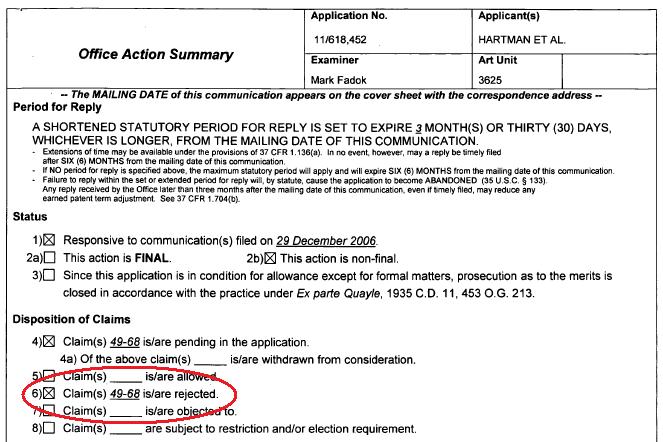
All UNCANCELED Claims Were Rejected
Claims 1-48 were dropped in the continuation application and claims 49-68 were just rejected.
-
Re:That thing can really take a poundingCan't patent sex toys - not patentable subject matter. If you are a patent attorney, I hope you don't give this advice to your clients. I suggest you read the recent Juicy Whip case. This will get you started.
The PTO is not authorized to determine whether an invention is "immoral."
Also see this patent and this patent. -
Re:That thing can really take a poundingCan't patent sex toys - not patentable subject matter. If you are a patent attorney, I hope you don't give this advice to your clients. I suggest you read the recent Juicy Whip case. This will get you started.
The PTO is not authorized to determine whether an invention is "immoral."
Also see this patent and this patent. -
Chastity Bono ActIP generally includes patents, trademarks, and copyright protection. It's not confusing, rather, it just refers to these three bodies of law aimed to allow private agents to internalize the positive externality of knowledge by way of a government-granted monopoly So if someone says "intellectual property rights should be expanded", to which of the three bodies of law is he referring? The arguments for expanding the scope of copyrights, the scope of patents, and the scope of trademarks will necessarily differ completely. and promote its dissemination into the public domain after a set period of time. You already confused something: of the three property forms you mention, only patents expire. Trademarks and copyrights under United States law do not enter the public domain; they can be renewed indefinitely. Each trademark is renewed along with a declaration of continued use, under sections 8 and 9 of the Trademark Act. A copyright, on the other hand is renewed under a periodic legislative extension of all subsisting copyrights. The U.S. Congress added 19 years with the Copyright Act of 1978 and 20 years with the Sonny Bono Copyright Term Extension Act of 1998, and is expected to add 20 to 30 years with the Chastity Bono Copyright Term Extension Act of 2018.
-
Did they include...
I wonder if they included Microsoft patents such as their Virtual Desktop Pager patent? (http://patft.uspto.gov/netacgi/nph-Parser?Sect1=PTO2&Sect2=HITOFF&u=%2Fnetahtml%2FPTO%2Fsearch-adv.htm&r=1&f=G&l=50&d=PTXT&p=1&p=1&S1=(Microsoft.ASNM.+AND+%22Virtual+desktop+manager%22)&OS=AN/Microsoft+and+) Honestly, a vast portion of Microsoft's patents are complete bullshit that should NEVER have been awarded. Remove cases of OBVIOUS prior art (Linux has had virtual desktop pagers as described in that patent forever, and when they received this patent Microsoft had never used such a thing), and Microsoft's patent portfolio is shit. ~nog_lorp
-
Re:In future use the trade mark rules
It's too late for the person in the article, but if your domain name is important and doesn't infringe any existing trade marks, trade mark it immediately.
Doesn't quite work this way, as the article submitter indicated that the domain name is meaningful only to the submitter. Might I suggest a more authoritative source, such as this link, instead of depending upon Slashdot for legal advice? -
Re:Submitter here. That's too true...
The cost to file a trademark is like $25.
Oops. Look like you mistyped that. The cost to file for a federal trademark is $275 (or more, depending on the details).
You can see the PTO's current fee schedule here: http://www.uspto.gov/web/offices/ac/qs/ope/fee2007september30.htm -
Re:Even if it is a joke...
From: http://uspto.gov/
Application Number: 77342191
Word Mark: NSFW
Goods and Services: IC 041. US 100 101 107. G & S: Entertainment services, namely, providing on-line reviews of news articles, web articles, web postings and/or photographs; Entertainment Services namely providing a website featuring photographic, audio, video and prose presentations featuring comments and comedic captions about current events and/or web postings; Entertainment services, namely, providing a web site featuring musical performances, musical videos, related film clips, photographs, and other multimedia materials. FIRST USE: 20010502. FIRST USE IN COMMERCE: 20010502
There are so many reasons this won't get approved by the USPTO besides the fact that NSFW falls in public domain and that it was in use prior to what the application states (they claim first use of May 2, 2001). For a better understanding of trademarks I refer you to.... http://en.wikipedia.org/wiki/Trademark -
Re:OCP is real
OCP is a real company and I'm a 23-foot-tall ostrich*. that sitehas absolutely no content other than the home page which talks about Brawndo. Someone else said it: there's something fishy about all this...
Well, if you don't believe the website, you could always believe the US trademark office. -
Re:Is that for real ?
And don't forget the brawndo trademark registration:
Omni Consumer Products LLC LTD LIAB CO DELAWARE -
Re:Well shit.
Check the trademark registration for Brawndo. There's more to this than you're thinking.
-
Re:Still Obvious
Looking at the patent US 5572576, it seems to have priority to May or March of 1992. It could be March 31st if the claims are completely supported by the continuation-in-part, but it definitely is supported to 5/12/92 (i.e. it's a continuation of a case that was filed on that date).
-
Re:!Patent TrollPeople patent, processes, machines, designs, and plants. According to the US patent office, anyway. One doesn't necessarily have to have a physical representation of what is being patented, that would make a lot of legitemate inventions a lot harder to get protected, just an effective example or description with enough information to determine what is being patented and if it is patentable. What was patented here was the process of visual voicemail, not the idea. Ideas are copyrighted.
I agree that something like this shouldn't be patentable, but, unfortunately, that's up to the patent inspectors to decide, and since there are about twelve of them at the moment it's unlikely they have enough time to do more than skim the abstract before stamping approval.
-
USPTOWhat braindead Slashdotter tagged this story with "patents"? It's a trademark issue, not a patent one. Slashdot and Hormel are based in the United States. In the United States, the same government agency handles patents and trademarks. Or it could be the general confusion caused by the term "intellectual property".
-
This is wierd
Wierd. First, it's not a "nuclear battery". Those have been around since the 1950s, and they typically have quite modest power output, from a few watts to a few hundred watts. They're just some radioactive material decaying at its normal rate; they don't use a chain reaction. If this thing is supposed to produce 27MW, it has to be a real nuclear reactor.
And it is. Here's the patent application, out of Los Alamos National Laboratory. The basic idea is this: "This present invention achieves control by utilizing the properties of a fissile metal hydride as a self-contained nuclear fuel and neutron energy moderator. If the physical size, fissile metal content and enrichment are appropriately selected, the metal will absorb ambient hydrogen, which moderates the neutron energies so that nuclear fission criticality is achieved. The temperature will then be increased by the fission reactions until the dissociation pressure of the hydrogen for that temperature is greater than the ambient pressure of the hydrogen, at which point the hydrogen dissociates from the hydride and the source becomes sub-critical." So that's the way it self-regulates. It's supposed to operate at a constant temperature; if you remove heat with a working fluid, it produces more heat; if you don't, it stabilizes at its normal operating temperature. It's a uranium reactor, using 5% enriched uranium. Runs at 350C to 800C. Uses heat pipes to get the heat out to a working fluid, probably water, used to make steam and drive a turbine.
It's not clear if this is a workable design. There's no prototype. But it's at least plausible. It's not a totally new idea; the TRIGA reactors are self-regulating in a somewhat similar fashion.
The "Los Alamos Study Group" that made critical comments has nothing to do with Los Alamos National Laboratories. Their director "worked as a transportation planner, natural foods manufacturing entrepreneur, high school teacher, hazardous waste investigator, and contaminant hydrologist."
-
Re:Yeah. But no.
-
Re:Yeah. But no.
-
Re:Yeah. But no.
-
Re:Yeah. But no.
-
Re:Abuse of the system
Where is the abuse of the system here? Amazon is playing by all the rules set forth by Congress and the Patent Office. If prior art is found that reads on their claim, they amend the claim by adding more limitations (making it more specific) so that the claim overcomes the art rejection. The new limitations generally come from the dependent claims and must have adequate written description in the original patent application.
The
And finally, I want everyone to look at the claim, not the title of the patent, and then, without impermissible hindsight, get to work finding prior art to read on the claim. Just saying that a single click of the mouse is obvious makes you look dumb. That's your homework for this week, now get to work!
-
The actual patent
Patent found here
Abstract:
"A non-catalytic process for the production of carbon nanotubes includes supplying an electric current to a carbon anode and a carbon cathode which have been securely positioned in the open atmosphere with a gap between them. The electric current creates an electric arc between the carbon anode and the carbon cathode, which causes carbon to be vaporized from the carbon anode and a carbonaceous residue to be deposited on the carbon cathode. Inert gas [*] is pumped into the gap to flush out oxygen, thereby preventing interference with the vaporization of carbon from the anode and preventing oxidation of the carbonaceous residue being deposited on the cathode. The anode and cathode are cooled while electric current is being supplied thereto. When the supply of electric current is terminated, the carbonaceous residue is removed from the cathode and is purified to yield carbon nanotubes."
I assume this means she's identified the electric properties of the metal catalyst as the significant factor in the success of those techniques, and simply, with genius, replaces those properties with an electric current. You could probably do the same thing using a metamaterial or an EM radiation cavity, if you wanted to bypass the patent.
* "Intert gas" is usually helium, or the much, much cheaper alternative of nitrogen. -
Re:Tesla won but...
And?
That's pretty typical. Example: who do you think of as the inventor of the telephone? Most people would say Alexander Graham Bell. But one could equally credit Antonio Meucci, Johann Philipp Reis, and Elisha Gray. Meucci especially. He beat Bell to it by over 20 years. But he was an Italian immigrant, spoke only poor English, and was effectively broke.
Example: A couple years ago, I independently came up with this:
http://appft1.uspto.gov/netacgi/nph-Parser?Sect1=PTO2&Sect2=HITOFF&p=1&u=%2Fnetahtml%2FPTO%2Fsearch-bool.html&r=4&f=G&l=50&co1=AND&d=PG01&s1=blur&s2=camera&OS=blur+AND+camera&RS=blur+AND+camera
Did I patent it? Nope. Why? Because I have about as much ability to manufacture modern cameras as I have to get to the moon. I have no knowledge about how to market such things to other companies, to raise venture capital, or anything of the sort. My variant was actually a bit better than theirs (combining superresolution imaging with blur correction), but, well, too late.
And that's the way things go. It happens all the time, and you'd expect it to. If one person can come up with the idea, why not several people? As tech advancing opens up new possibilities, it's only a matter of time before novel applications of it are invented, independent of who reaches the patent office first. -
Why allude?I think it would be fair to assume that I am using the term "IP" in the context of the discussion at hand (i.e. copyrights). Several publishers of copyrighted works, knowing that they face an uphill battle at best in a lawsuit on copyright grounds, turn to trademark claims on the names of the characters, especially the trademark on "Harry Potter" for books. Or would nominative use be a valid defense here? To be even more specific, copyrights as they pertain to artistic works such as novels and music (that I alluded to in my post). If you want to discuss copyrights, and you don't want to bring comparisons to patents into the mix, then why allude and not just say "copyright"?
-
Re:Uhm
Thermodynamics applies to *everything*, not just heat engines. Are you confusing thermodynamics as a whole with the Carnot limit?
All processes are lossy. Batteries, however, are very minimally lossy. Charging and discharging a lithium-ion battery loses virtually no power. Not so with hydrogen. The best you'll do with a fuel cell is something like 70% efficiency. Likewise, excepting these special cases of direct hydrogen generation, creating the hydrogen itself is also a lossy process. And there's loss in putting it into the tank -- especially when there's a storage medium used (which sometimes also gives losses in getting it out of the tank).
EV's on the other hand, need to sit at a charger for a minimum of a couple hours
The Tesla and the EV series do, but this isn't an inherent limitation of EVs. For example, check out this patent from the company EEStor, a company with a market capitalization of ~$60m which is making ultracapacitors on contract for ZENN. To translate, that's 342 Wh/kg (compared to 150-200 Wh/kg for Li-ion. And it has a lower discharge rate and doesn't lose capacity like Li-ion. Which is what I was getting at with my allusion to not counting vehicles that don't yet exist for hydrogen, because if you do that, you ought to count advancing battery tech to. Ultracapacitors charge incredibly rapidly -- in the case of the aforementioned EESU, a reported 4-6 minutes. The bottlebeck is no longer your vehicle, but the wires to your house
It's a mass produced, production fuel cell vehicle with the full interior room of a normal Equinox, that'll be driven by 1000 "owners" in the 3 major cities next year
It sounds an awful lot like the EV1 program. Which I don't think should be very encouraging to anyone. By the way, AFAIK, it's 100, not 1000. -
Re:All software patents are worthless.
At least one company seems to show an interest in using the patent system to build a niche for itself. And that company seem to produce a lot of innovations that arguably advance the arts and sciences.
Innovating and seeking patent rights may be completely independent. Sure, there are potential strategies that might leverage the patent system. But, like any business strategy, how can anyone be sure success comes from the strategy or from other factors. You never know for sure that success was in spite of, not a result of, engaging a particular strategy.
Because there are so many other factors, it is hard to prove that a strategic tool, such as software patents, have real benefits. But, it is also hard to prove that they do not have real benefits. To accept either position based on little more than appeal to authority and assertion that the issue has been fully-decided is foolhardy, which is why such arguments are not particularly persuasive.
-
Patent In Question & University Patent PortfolA a link to the patent, according to the article with the description: A distributed computer database system including a front end computer and a plurality of computer nodes interconnected by a network into a search engine. A query from a user is transmitted to the front end computer which forwards the query to one of the computer nodes, termed the home node, of the search engine. The home node fragments the query and hashes the fragments of query to create an index by which the hashed query fragments are transmitted to one or more nodes on the network. Each node on the network which receives a hashed fragment uses the fragment of the query to perform a search on its respective database. The results of the searches of the local databases are then gathered by the home node. However, I submitted this story yesterday and found a list of patents by that professor with that company and suspected a more interesting patent. From that description: A distributed computer database system connected to a network, e.g., the Internet or on an intranet, indexes interests of agents that have registered with the system, examines information objects, for example, that reside on the network, and, responsive to a match with the registered agents' interests, specifies to the agents the relevant information objects. It's your decision whether or not he's a patent troll but that professor seems to have many patents. I fear that the future only holds more and more patents being acquired by professors. I do not think this was the norm 10 years ago but my professor at George Mason University gave me a very frank lecture one day that essentially spelled out that the university rewards them for these things and the university is building a portfolio. What the states pay a professor is not much compared to what they could be earning in the field so he really has no choice.
I congratulated him on the several patents he just acquired. Although I can't say I was very happy about his recent moves. -
Patent In Question & University Patent PortfolA a link to the patent, according to the article with the description: A distributed computer database system including a front end computer and a plurality of computer nodes interconnected by a network into a search engine. A query from a user is transmitted to the front end computer which forwards the query to one of the computer nodes, termed the home node, of the search engine. The home node fragments the query and hashes the fragments of query to create an index by which the hashed query fragments are transmitted to one or more nodes on the network. Each node on the network which receives a hashed fragment uses the fragment of the query to perform a search on its respective database. The results of the searches of the local databases are then gathered by the home node. However, I submitted this story yesterday and found a list of patents by that professor with that company and suspected a more interesting patent. From that description: A distributed computer database system connected to a network, e.g., the Internet or on an intranet, indexes interests of agents that have registered with the system, examines information objects, for example, that reside on the network, and, responsive to a match with the registered agents' interests, specifies to the agents the relevant information objects. It's your decision whether or not he's a patent troll but that professor seems to have many patents. I fear that the future only holds more and more patents being acquired by professors. I do not think this was the norm 10 years ago but my professor at George Mason University gave me a very frank lecture one day that essentially spelled out that the university rewards them for these things and the university is building a portfolio. What the states pay a professor is not much compared to what they could be earning in the field so he really has no choice.
I congratulated him on the several patents he just acquired. Although I can't say I was very happy about his recent moves. -
Patent In Question & University Patent PortfolA a link to the patent, according to the article with the description: A distributed computer database system including a front end computer and a plurality of computer nodes interconnected by a network into a search engine. A query from a user is transmitted to the front end computer which forwards the query to one of the computer nodes, termed the home node, of the search engine. The home node fragments the query and hashes the fragments of query to create an index by which the hashed query fragments are transmitted to one or more nodes on the network. Each node on the network which receives a hashed fragment uses the fragment of the query to perform a search on its respective database. The results of the searches of the local databases are then gathered by the home node. However, I submitted this story yesterday and found a list of patents by that professor with that company and suspected a more interesting patent. From that description: A distributed computer database system connected to a network, e.g., the Internet or on an intranet, indexes interests of agents that have registered with the system, examines information objects, for example, that reside on the network, and, responsive to a match with the registered agents' interests, specifies to the agents the relevant information objects. It's your decision whether or not he's a patent troll but that professor seems to have many patents. I fear that the future only holds more and more patents being acquired by professors. I do not think this was the norm 10 years ago but my professor at George Mason University gave me a very frank lecture one day that essentially spelled out that the university rewards them for these things and the university is building a portfolio. What the states pay a professor is not much compared to what they could be earning in the field so he really has no choice.
I congratulated him on the several patents he just acquired. Although I can't say I was very happy about his recent moves. -
Look at this guy's patent
He seems to want to patent multicast video?
http://appft1.uspto.gov/netacgi/nph-Parser?Sect1=PTO1&Sect2=HITOFF&d=PG01&p=1&u=%2Fnetahtml%2FPTO%2Fsrchnum.html&r=1&f=G&l=50&s1=%2220070005804%22.PGNR.&OS=DN/20070005804&RS=DN/20070005804
or go to
http://appft1.uspto.gov/netahtml/PTO/srchnum.html and query 20070005804. -
Look at this guy's patent
He seems to want to patent multicast video?
http://appft1.uspto.gov/netacgi/nph-Parser?Sect1=PTO1&Sect2=HITOFF&d=PG01&p=1&u=%2Fnetahtml%2FPTO%2Fsrchnum.html&r=1&f=G&l=50&s1=%2220070005804%22.PGNR.&OS=DN/20070005804&RS=DN/20070005804
or go to
http://appft1.uspto.gov/netahtml/PTO/srchnum.html and query 20070005804. -
Re:Interesting Questions
Believe it or not, there is actually a 1990 statute regarding the patent question: 35 USC section 105 (Inventions in outer space).
Basically, if the invention is made, used, or sold on an outer space object under the jurisdiction or control of the U.S., it's considered to have been done within the U.S.
I don't know of any specific statue regarding invention, but there's an analogous one on inventions made abroad (35 USC 104), and it says that if you call the U.S. home and you are in another country on behalf of the U.S., then you are considered to have invented it in the U.S. as well. All very rationale stuff.
-
Re:Interesting Questions
Believe it or not, there is actually a 1990 statute regarding the patent question: 35 USC section 105 (Inventions in outer space).
Basically, if the invention is made, used, or sold on an outer space object under the jurisdiction or control of the U.S., it's considered to have been done within the U.S.
I don't know of any specific statue regarding invention, but there's an analogous one on inventions made abroad (35 USC 104), and it says that if you call the U.S. home and you are in another country on behalf of the U.S., then you are considered to have invented it in the U.S. as well. All very rationale stuff.
-
Re:This is why we need to KEEP software patents
Maybe patent applications should be examined by qualified people to see if they can be implimented using only the information supplied in the application together with that already in the public domain.
There's no maybe about this. As part of a patent application, "the specification must include a written description of the invention and of the manner and process of making and using it, and is required to be in such full, clear, concise, and exact terms as to enable any person skilled in the technological area to which the invention pertains, or with which it is most nearly connected, to make and use the same"; and patent examiners are responsible for determining if a patent application meets this requirement.
Most of the problems with the patent system right now can be traced to the fact that patent examiners neither have enough time nor the qualifications necessary to make such determinations -- the days when the likes of Einstein worked for the Patent Office are long past. However, this is a reason to recruit more and better patent examiners (and in particular more in the area of computing), not to throw out the entire system. -
Re:Well
Incorrect, at least in the US. Trademarks work more or less like copyright; they are automatic upon use of the mark to trade goods or services (service marks).
No. In fact (with a nod to Strongbad), answer equals very no.
Copyright protection is automatic upon creation under U.S. federal law (although *enforcement* of that protection in court requires registration); trademarks do not work this way. While one may claim a common law trademark and notify others (through the use of a TM or SM) that the user considers the mark a trademark, the enforceability is extremely limited. For federal trademark protection, one must not only apply for registration, but have it granted by the U.S. Patent and Trademark Office, after a long process and a fair amount of back and forth with the examiner. Registrations will also only be issued to marks that are currently in use in commerce--one may start the registration process before the mark is in use (an "intent to use" application), but it won't be issued unless one gives the examiner proof of use (e.g. labels, packaging). (States may have analogous processes.) Even once a mark is registered, it only gives the holder a right within the particular class of goods or services for which it was issued.
Getting back to the OP question, registering a domain name does not give trademark rights. The converse is *somewhat* true; owning a trademark can give some priority over the owner of a domain name incorporating that mark, under certain circumstances generally involving bad faith (under the Anticybersquatting Consumer Protection Act, 15 USC Section 1125(d), which doesn't actually require a *registered* trademark, or the ICANN UDRP). The alleged trademark holder would have to demonstrate either use of the domain name as a trademark, or some kind of registration. {ProfJonathan} -
Re:Well
Incorrect, at least in the US. Trademarks work more or less like copyright; they are automatic upon use of the mark to trade goods or services (service marks).
No. In fact (with a nod to Strongbad), answer equals very no.
Copyright protection is automatic upon creation under U.S. federal law (although *enforcement* of that protection in court requires registration); trademarks do not work this way. While one may claim a common law trademark and notify others (through the use of a TM or SM) that the user considers the mark a trademark, the enforceability is extremely limited. For federal trademark protection, one must not only apply for registration, but have it granted by the U.S. Patent and Trademark Office, after a long process and a fair amount of back and forth with the examiner. Registrations will also only be issued to marks that are currently in use in commerce--one may start the registration process before the mark is in use (an "intent to use" application), but it won't be issued unless one gives the examiner proof of use (e.g. labels, packaging). (States may have analogous processes.) Even once a mark is registered, it only gives the holder a right within the particular class of goods or services for which it was issued.
Getting back to the OP question, registering a domain name does not give trademark rights. The converse is *somewhat* true; owning a trademark can give some priority over the owner of a domain name incorporating that mark, under certain circumstances generally involving bad faith (under the Anticybersquatting Consumer Protection Act, 15 USC Section 1125(d), which doesn't actually require a *registered* trademark, or the ICANN UDRP). The alleged trademark holder would have to demonstrate either use of the domain name as a trademark, or some kind of registration. {ProfJonathan} -
Trademarks must be registered
I doubt that farmer has trademarked simpledog. But you might as well check the US Patent and Trademark office first. Go here to search for existing registered trademarks: http://www.uspto.gov/main/profiles/acadres.htm Trademarks aren't the same as copyright. You must register your trademark with the US Gov.
-
It's a web spammer
OK, let's do some lookups.
First, the USPTO trademark database. "Simpledog" - no hits. "Simple AND dog" - three dead applications for long phrases containing those two words. Definitely not a registered trademark. File your own trademark application if you like. It's easy, the entire process is online, and the fee is a few hundred dollars.
Next, let's try DomainTools.. "GNO, Inc. owns about 22,379 other domains." "1,219,449 other sites hosted on this server." That's a web spammer.
Now let's check domain dispute decisions. Here's Panthers BRHC L.L.C. v. Gregg Ostrick/GNO, Inc. (re "bocaresorts.com" dispute). The owners of a resort hotel in Boca Raton challenged GNO for using "bocaresorts.com" against their trademark "Boca Raton Resort & Club" and domain "bocaresort.com". GNO lost.
Finally, couldn't resist running "simpledog.com" through our SiteTruth system. No street address on the site. No SSL cert. Not in any of the business databases. "Site ownership unknown or questionable."
Yes, that's a web spammer all right. No sign of anything that looks like a trademark or a legitimate business.
-
Answer is: maybe
Step 1: Did the link farmer claim to have a trademark on his site? That is, was his logo followed by a "TM" or an "R" in a circle? The mere use of a name does not confer a trademark, nor does asserting it in private email. You have to publicly claim a trademark on it and notify those who see it that you're claiming trademark status.
For fun, check out http://www.uspto.gov/main/trademarks.htm and click "search" over in the right-hand box.
Step 2: How strong is the trademark? A mark like Exxon is extremely strong. It has no existance except for the oil company. If you use "exxon" in any context you're probably violating the mark.
"Simpledog" is the concatenation of two english words. Its already weak. Next its use seems to be for a link farm with generic search links about dogs. Weak weak weak. If he had a trademark it would probably only extend to the use of "simpledog" for a link farming page. Everything else (including a blog) would probably fall outside the trademark. If he had one to begin with.
Personally, I'd search the PTO for a trademark registration and then register it myself if I didn't find one. Ignroe the fellow (don't reply) until the registration is granted. Then send him a registered letter advising him that if he doesn't give up the name on which you have a registered mark, you'll sue.
Of course, that's not the end of the story and just 'cause he can't win doesn't mean he can't sue you in some geographically inconvenient location. So if you worried, you need to visit a local lawyer. -
Re:TrademarksYou don't need to register to get trademark protection. You get protection by simply using the name in commerce. That's the TM mark. You may register with either the state or with the USPTO once you register you fet the circle R mark. Simpledog.com is probably not using the name in commerce. Also the OP probably cannot register because he currently does not have a product. You must use the product first and then register. insert standard this is not legal advice here.
I'll insert my knowledge from when I claimed "FreeDOS" as a trademark in 2001. (Although I now believe there is no difference between "typed drawing" of "FreeDOS" and "FREEDOS" in this context.)
I had once considered applying for a registered trademark, which is ® not TM, but the issue is tricky. I think I have come to a reasonable understanding of trademarks in the US. First of all, to apply for a registered trademark (®) in the US, you need to pay a fee to the US Patent and Trademark Office (USPTO). Even the small entity fee for basic filing is pretty expensive.
Also, there is the issue of diligence
There are several ways to dispute use of a trademark by a third party. Depending on the situation, the Trademark Office may not be the proper forum. For a real trademark fight, you would need an attorney, preferably one specializing in trademark law. And since inaction would imply that you are giving up the right on the trademark, time to get that lawyer can be of the essence.
However, it is not necessary to register a mark with the USPTO order to claim it as a trademark. From the USPTO: "Any time you claim rights in a mark, you may use the "TM" (trademark) or "SM" (service mark) designation to alert the public to your claim, regardless of whether you have filed an application with the USPTO."
Federal registration is not required to establish rights in a trademark. Common law rights arise from actual use of a mark. Generally, the first to either use a mark in commerce or file an intent to use application with the Patent and Trademark Office has the ultimate right to use an registration.
The other guy is probably doing this because he believes it is what he has to do to protect his trademark. But I don't know that there's a trademark to be protected, since there's nothing really behind it. IANAL, but if he's just using the domain name to run a link farm, and isn't actually doing anything with the name "simpledog" (he has no content on his site
Asking him for his USPTO registration number (as other posters have advised) isn't a good way to ensure if he has the right of trademark, since you don't need to register to use "TM". However, you can respond by asking for demonstrable proof for how he has used "simpledog" in a commerce-related activity related to an actual product. You can back yourself by stating in your written response that you do not consider a link farm with no original content to be an actual product (this will make it harder for him to get a lawyer involved, I think.)
Don't roll over on this. If you do, then you'll demonstrate by inaction that he holds the trademark on "simpledog" and he may further pester you by demanding you turn over your domain to him. If he gets a lawyer involved and that lawyer sends a Cease and Desist letter, then you'll have to make a decision if you want to fight by hiring your own lawyer. Or maybe you'll make an announcement on your web site at that time, that you're shutting down the site for an unrelated reason (no time to admin it, etc.)
But honestly, I suspect that this guy won't bother you after you send back your "no thanks" response.
-
Re:Well
Incorrect, at least in the US. Trademarks work more or less like copyright; they are automatic upon use of the mark to trade goods or services (service marks).
Registering does have several advantages (again, in the same vein as copyright) over not registering: Nationwide presumption, ability to bring suits in federal courts, etc.
When you register a trademark, it is no longer a simple trademark, but a "registered trademark", denoted by a (r) rather than a (tm).
If I recall, it's also pretty difficult to win registration for a mark.
More info: http://www.uspto.gov/web/trademarks/workflow/start.htm -
Re:WellOr, just visit the USPTO documentation relating to this. Essentially, it boils down to this:
A mark composed of a domain name is registrable as a trademark or service mark only if it functions as a source identifier. The mark as depicted on the specimens must be presented in a manner that will be perceived by potential purchasers as indicating source and not as merely an informational indication of the domain name address used to access a web site.
Looks pretty clear to me. -
Why do
these retarded questions get through the lameness filter? You get a trademark if you file one with http://www.uspto.gov/ or whatever your countries trademark bureau is.
-
Re:Meaning of "first" in "first to file"
If you do not wish that I use Wikipedia article URLs to identify topics, please pretend I linked to interference proceeding and defensive publication instead. Now do you have a citation that a switch to a first to file rule in app vs. app interference proceedings will result in the elimintation of the novelty requirement for app vs. publication?
-
Re:Playing devil's advocate
I'm guessing that you have never actually written a claim for a patent application, because "for example, X" is an almost guaranteed rejection under 35 USC 112 second paragraph as set forth in MPEP 2173.05(d).
-
Re:Prior Art.
Oddly enough the patent doesn't mention Chinese characters, though it does mention Chinese restaurants. It does say "Also, the dictionaries are not limited to the English language, but may cover other languages having other characters, and even other types of objects. ", but I can't see how this "would allow an English speaker, for example, to use the keypad of any mobile phone to enter Chinese characters" - what would be the point, unless the English speaker also reads / writes Chinese?
Anyway, the parent poster would be right about prior art, if there was such a mechanism described in the patent - I have here in my possession a Japanese mobile phone with the normal set of numeric keys, which I can use to enter Japanese / Sino-Japanese characters, and I presume there are Chinese mobile phones with similar capability.
-
Re:Prior Art.
Maybe you should read the claims and find out?
US2006/0230350
You never know you might learn something before spouting off about something you clearly know nothing about. -
Re:Almost content-less article
I'm guessing it's number 5,602,987 which was struck down in 2003 when they sued others and reversed on appeal more recently.