 Slashdot Mirror
Amazon Sneaks One-Click Past the Patent System
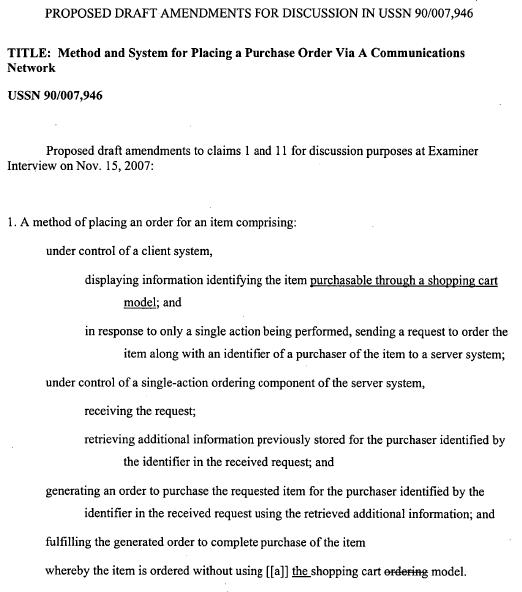
theodp writes "By changing the word 'a' to 'the' and adding the phrase 'purchasable through a shopping cart model,' lawyers for Amazon.com have apparently managed to reinstate two of CEO Jeff Bezos' 1-Click Patent claims that were rejected a month earlier. 'Patent Owner's Rep was informed that the proposed addition to the claims appear to place the claims in condition of patentability,' writes the USPTO in its Ex Parte Reexamination Interview Summary of the 11-15 conference call that was held with five representatives of the USPTO and patent reformer Amazon."

What about obvious to the expert part ?
I'd hate to present this as an option but is it able to be reviewed again after they snuck more bogus crap back in?
Couldn't anyone who gets sued because of this claim that the previously rejected patent is prior art?
+1 Agree -1 Disagree
I better hurry patenting the wheel before it's too late... the one purchasable through a shopping cart model that is.
The real news is that this revision was just a means to an end, and apparently the patent office fell for it...
The world's only surviving livewriter.
Do you want to get a good car? Use some Open Source alternative.
Will the last sane person in government please switch it to runlevel 6? But run rm -rf /home/uspto first please.
Which is to push a lobbist of some sort to get this thru... This is so obvious that I suspect someone got a promise for something to allow it thru... I mean, It is the American way after all!!
If this isn't illegal, it should be.
And the masses cried out, "09 F9 11 02 9D 74 E3 5B D8 41 56 C5 63 56 88 C0!"
The present system of patents is totally broken. It appears to exist for the promotion of lawsuits and legal fees rather than achieving true innovation.
Nobody ever thought of cheating the patent office in this way!
__
A Lost Frenchman
A previous president apparently set a precedent...
Thank you very much!
Excuse me, but please get off my Pennisetum Clandestinum, eh!
If you have an account, cancel it "due to my disagreement with your 1-click patent that stiffles innovation".
Who dares to put his money where his mouth is?
Ah hah... I supposed.
This comment is probably just a waste of virtual breath, but I'll give it a try anyway:
Here on Slashdot, it looks like everybody enjoys conflating the issues of 1) whether we should have software patents at all and 2) whether the subject matter of this patent is obvious or not. It may be way too late for any meaningful discussion of this patent here on Slashdot, but keeping those two things separate would help out there.
So I'd like to make an argument here, and see if I actually get any constructive responses: I really don't think that it was obvious or anticipated by any prior or *at the time that it was filed.* It was filed on September 12, 1997. How many people on here remember the state of internet commerce back in 1997? This idea was pretty innovative at that time. (Now that it's been used for 10 years, it's pretty obvious.)
I'd also like to point out (and see if I get any constructive responses) that this patent isn't that broad, and not worth of the fear-mongering it has induced over the years. Here's the first claim of the patent (I added the numbers):
1. A method of placing an order for an item comprising:
1)under control of a client system,
2) displaying information identifying the item; and
3) in response to only a single action being performed, sending a request to order the item along with an identifier of a purchaser of the item to a server system;
4) under control of a single-action ordering component of the server system,
5) receiving the request;
6) retrieving additional information previously stored for the purchaser identified by the identifier in the received request; and
7) generating an order to purchase the requested item for the purchaser identified by the identifier in the received request using the retrieved additional information; and
8) fulfilling the generated order to complete purchase of the item
9) whereby the item is ordered without using a shopping cart ordering model.
If your e-commerce site leaves out any one of those 9 clauses, you're not infringing. For example, if you're using a shopping cart ordering model, you're not infringing (look at part 9 there, you have to have a shopping cart ordering model to be within its bounds).
Anyway, Happy Thanksgiving!
Let's see:
There. Fixed that for ya.
HAND.
I'd also like to point out (and see if I get any constructive responses) that this patent isn't that broad, and not worth of the fear-mongering it has induced over the years. Here's the first claim of the patent (I added the numbers):
You can't determine how broad a patent is by counting how many elements a claim has. Most of the elements of the claims of the Amazon patent don't limit the claims. Despite your verbal acrobatics and distortions, the patent is broad.
(And those are not "claims" those are "elements".)
There are two kinds of fool One says 'This is old therefore good' Another says 'This is new therefore better'- Dean Ing
That's all the bother that patents on intangible non-inventions deserve.
It could be worse, look at some of these patents.
A thistle is a fat salad for an ass's mouth...
Given the prior art on the old patent, I tend to doubt there was an inventive step (i.e. it wasn't non-obvious) in the 'invention'. Of course this is much harder to prove, so Amazon can unfortunately count on getting awaay with it.
Is this really news? The ex-parte re-exam with the prior art uncovered by the New Zealand man invalidated all claims except those that mentioned a shopping cart; this was reported weeks ago.
Back then, the PTO said that were Amazon to amend the rejected claims to include a shopping-cart limitation, which was not found in the newly uncovered prior art, those claims would probably be admissible.
The "news" appears to be that Amazon did what the PTO suggested it to do...
Most would consider this question answered, as the founders of computer science, renowned lawyers and Nobel-laureate economists agree that software patents are not defensible on any grounds.
"One Click" shopping is an e-commerce technique, which allows a customer to purchase products via the Internet without repeatedly entering personal information such as name and address. At the time it was introduced it eased the frustration of on-line shopping.
The problem is, the whole reason cookies were created was precisely to enable on-line shopping:
http://www.ietf.org/rfc/rfc2109.txt
So soon after the RFC was *announced* Amazon requested a patent for doing what the RFC was specifically designed for. If you ignore the sleeziness of the action, it would be virtually impossible to find prior art since no implementation was possible before the standard was approved. And even if an early implementations of cookies existed, since Amazon was one of the few e-commerce site out there at the time, there would be virtually no chance of finding another prior art implementation.
Now you could go to the real-world analogy of going to a friendly store and pointing at a bunch of things and saying "Charge it", but since it's done by "a computer" it magically turns into a completely different thing.
Not because I think the patent isn't obvious or is right. But, I HATE the whole amazon one-click thing. It's way too easy to accidently order something while just trying to get a total price including shipping. So I'm glad they've patented it so no one else implements that annoying system.
All they did was patent taking the safety checks out of online transactions.
As more than one person has pointed out, this was exactly what the RFC pointed to. The RFC is as much prior art as an software pantent can be a patent. (If you think a verbal, non-compilable description of an algorithm, even (especially) if it is couched in legal language, can be patented, then you have to accept the standard (or the standard proposal, which RFCs have been used as for a long time, contrary to the original intent of RFCs) as art.
We aren't talking about people putting source code in patents. That's what everybody is missing. Without an actual implementation there is no actual art. Unless you are willing to call something like an RFC art. (Which is insane!)
Software patents should have to require source code to be submitted, (Which points out a number of issues as to why copyright is precisely the right thing to use and patent is not, unless the patent applicant is intending to open source the object of the patent.)
Again, as more than one person has pointed out, reducing the number of clicks has always been a goal for an interface designer. Admittedly, there is some question to the sanity of reducing things to a single click, but Amazon hasn't really done that anyway. Certificates, cookies, buring state information in a stateless interface, all of this points to reducing the interface burden on the user, and that is all that one-click is about.
And, yes, I was there and I remember.
And the point isn't that the patent isn't broad, it is that it has been used by lawyers to force settlements (which ought to be seen as the real question begged by allowing software patents without source code in the submission).
<deep-breath/>
Well, now that I'm done ranting, the whole craziness of trying to use patents and copyrights as a backdoor to bringing back patronage is likely driven, in large part, by the fact that, with all the essential services mechanized, there isn't enough work to go around. Unless we (citizens of the US and other "developed" countries) take it on ourselves to find some way to account value in going to "undeveloped" countries to "help" them conquer their "problems". And somehow do that without committing serious breaches of ethics, without ending up destroying their cultural heritage.
Which is why religion is not evil after all, if we can only acknowledge that everyone is going to believe what they choose and quit trying to force it.
<hard-reset/><eor/>
The patent is obvious because plenty of offline services, like bars and restaurants, keep a user's credit card details to save the user entering them every time he or she wishes to make a purchase. This is the usual procedure when someone wishes to buy the all drinks in bar for a group of people for a certain amount of time. My boss's travel agent has his credit card details so his employees can book him a flight without the need for my boss to go through the "checkout process" every time. Amazon have managed to patent this very old process simply because the process has now appears on the internet.
Could someone please beat Jeff Bezos over his fat head with a festivus pole already ? It's a dumb patent, for a dumb "invention" that doesn't confer any business advantage. People don't care about one-click anything, they care about finding what they want at a price they can stomach, which Amazon tends to do fairly well. Most people don't even read what they click anyway.
-Billco, Fnarg.com
DIGITAL MILLENNIUM COPYRIGHT ACT
1. Detailed identity of the copyrighted work that I believe has been infringed upon. This includes identification of the web page or specific posts, as opposed to entire sites. Posts must be referenced by either the dates in which they appear or the permalink of the post
http://slashdot.org/comments.pl?sid=368407&cid=21450629
2. Identity of the material that I claim is infringing upon the copyrighted work listed in item #1 above.
'shopping list model'
3. Location of the author copyright notice (for information).
http://slashdot.org/comments.pl?sid=368407&cid=21448235
4. Information to permit our company, the provider, to contact you.
http://slashdot.org/~cyphercell/journal/188515
5. Statements
http://en.wikipedia.org/wiki/DMCA#Example_of_DMCA_Takedown_ProvisionReproduce the next statements:
I have a good faith belief that use of the copyrighted materials (didn't you see the © - that's real shit man) described above on the infringing web pages is not authorized by my registered copyright and by the law (gimme money, money, money, bwahhahah). I swear, under penalty of perjury, that the information in the notification is accurate and that I am the copyright owner of an exclusive right that is infringed.
cyphercell (843398)
Under the influence of Post-Cyberpunk Gonzo Journalism
How can Amazon be a "patent reformer"? Should there be this much doublespeak on Slashdot?
My blog: http://www.seebs.net/log/ --- My iPhone/iPad app: http://www.seebs.net/seebsfrac/
Amazon.com?
... were up to something.
Hmmm I knew that those sneaky sons of a
Has RMS weighed in on this yet?
AMAZON Sucks for two reasons: ( 2++ reasons actually )
1. The whole "We're patenting prior art" on "One click shopping"(tm),
2. It hurts the local book stores. ( I *LOVE* my local book stores. )
and
3. Amazon does not get me out of the house to meet cute chicks at said local book stores.
( no one on the internet knows: A) Your a Dog, and WORSE B) you shop at Amazon )
I canceled my account there years ago, after RMS boycotted them.
I got an account there about 2 years ago, but NEVER PAID THOSE ***** A DIME.
==Rant over==
RMS? RMS? Calling RMS?
They have good service and good products, but this kind of patent trash has got to stop. I am taking my business elsewhere.
And I urge everyone else to do the same.
Goodbye, Mr. Bezos.
I'll come back when you get rid of the patents. Same goes for O'Reilly the publisher who does not seem to have any beef being so close to Bezos all the while arguing against patents.
I don't implement a one click system for items purchasable through a shopping cart model. I've got a shopping cart which can add items purchasable through a one-click model.
I'm surprised TFA didn't link to his blog.
SLM
main() {1;}