Slashdot Mirror
Domain: vice.com
Stories and comments across the archive that link to vice.com.
Stories · 1,377
-
Kaspersky Suits Tossed, Fed Bans Will Continue (axios.com)
A Washington D.C. court has dismissed Kaspersky Lab's lawsuits against the U.S. government over two different rules banning Kaspersky products from federal systems. From a report: Both a federal law passed as part of last years National Defense Authorization Act (NDAA,) and a binding operational directive (BOD) issued by the Department of Homeland Security, prohibit federal agencies from using Kaspersky products. Both portrayed Kaspersky, a Moscow based company, as a national security risk. Kaspersky sued to prevent the two rules from coming into place, claiming the NDAA was a form of unlawful punishment against a specific company known as a bill of attainder. The judge reasoned that "The NDAA does not inflict 'punishment' on Kaspersky Lab. It eliminates a perceived risk to the Nation's cybersecurity and, in so doing, has the secondary effect of foreclosing one small source of revenue for a large multinational corporation." Because the NDAA ruling remains in effect, the judge ruled the BOD case was more or less a moot point. Further reading: Who's Afraid of Kaspersky?, and US Government Can't Get Controversial Kaspersky Lab Software Off Its Networks. -
Internal Documents Show Apple Knew the iPhone 6 Would Bend (vice.com)
In 2014, multiple users reported that their iPhone 6 and 6 Plus handsets were bending under pressure, such as when they were kept in a pocket. As a byproduct of this issue, the touchscreen's internal hardware was also susceptible to losing its connection to the phone's logic board. It turns out, Apple was aware that this could happen. Motherboard: Apple's internal tests found that the iPhone 6 and iPhone 6 Plus are significantly more likely to bend than the iPhone 5S, according to information made public in a recent court filing obtained by Motherboard. Publicly, Apple has never said that the phones have a bending problem, and maintains that position, despite these models commonly being plagued with "touch disease," a flaw that causes the touchscreen to work intermittently that the repair community say is a result of bending associated with normal use. The information is contained in internal Apple documents filed under seal in a class-action lawsuit that alleges Apple misled customers about touch disease. The documents remain under seal, but US District Court judge Lucy Koh made some of the information from them public in a recent opinion in the case. The company found that the iPhone 6 is 3.3 times more likely to bend than the iPhone 5s, and the iPhone 6 Plus is 7.2 times more likely to bend than the iPhone 5s, according to the documents. Koh wrote that "one of the major concerns Apple identified prior to launching the iPhones was that they were 'likely to bend more easily when compared to previous generations.'" -
The Wayback Machine is Deleting Evidence of Malware Sold To Stalkers (vice.com)
The Internet Archive's Wayback Machine is a service that preserves web pages. But the site has been deleting evidence of companies selling malware to illegally spy on spouses, Motherboard reported Tuesday. From the report: The company in question is FlexiSpy, a Thailand-based firm which offers desktop and mobile malware. The spyware can intercept phone calls, remotely turn on a device's microphone and camera, steal emails and social media messages, as well as track a target's GPS location. Previously, pages from FlexiSpy's website saved to the Wayback Machine showed a customer survey, with over 50 percent of respondents saying they were interested in a spy phone product because they believe their partner may be cheating. That particular graphic was mentioned in a recent New York Times piece on the consumer spyware market.
In another example, a Wayback Machine archive of FlexiSpy's homepage showed one of the company's catchphrases: "Many spouses cheat. They all use cell phones. Their cell phone will tell you what they won't." Now, those pages are no longer on the Wayback Machine. Instead, when trying to view seemingly any page from FlexiSpy's domain on the archiving service, the page reads "This URL has been excluded from the Wayback Machine." -
The Wayback Machine is Deleting Evidence of Malware Sold To Stalkers (vice.com)
The Internet Archive's Wayback Machine is a service that preserves web pages. But the site has been deleting evidence of companies selling malware to illegally spy on spouses, Motherboard reported Tuesday. From the report: The company in question is FlexiSpy, a Thailand-based firm which offers desktop and mobile malware. The spyware can intercept phone calls, remotely turn on a device's microphone and camera, steal emails and social media messages, as well as track a target's GPS location. Previously, pages from FlexiSpy's website saved to the Wayback Machine showed a customer survey, with over 50 percent of respondents saying they were interested in a spy phone product because they believe their partner may be cheating. That particular graphic was mentioned in a recent New York Times piece on the consumer spyware market.
In another example, a Wayback Machine archive of FlexiSpy's homepage showed one of the company's catchphrases: "Many spouses cheat. They all use cell phones. Their cell phone will tell you what they won't." Now, those pages are no longer on the Wayback Machine. Instead, when trying to view seemingly any page from FlexiSpy's domain on the archiving service, the page reads "This URL has been excluded from the Wayback Machine." -
NASA's Atomic Fridge Will Make the ISS the Coldest Known Place in the Universe (vice.com)
An anonymous reader shares a report: Later this year, a small part of the International Space Station will become 10 billion times colder than the average temperature of the vacuum of space thanks to the Cold Atom Lab (CAL). Once it's on the space station, this atomic fridge will be the coldest known place in the universe and will allow physicists to 'see' into the quantum realm in a way that would never be possible on Earth.
In a normal room, "atoms are bouncing off one another in all directions at a few hundred meters per second," Rob Thompson, a NASA scientist working on CAL explained in a statement. CAL, however, can reach temperatures that are just one ten billionth of a degree above absolute zero -- the point at which matter loses all its thermal energy -- which means that this chaotic atomic motion comes to a near standstill.
CAL uses magnetic fields and lasers traps to capture the gaseous atoms and cool them to nearly absolute zero. Since all the atoms have the same energy levels at that point, these effectively motionless atoms condense into a state of quantum matter called a Bose-Einstein condensate. This state of matter means that the atoms have the properties of one continuous wave rather discrete particles. -
Hacker Breaches Securus, the Company That Helps Cops Track Phones Across the US (vice.com)
Securus, the company which tracks nearly any phone across the US for cops with minimal oversight, has been hacked, Motherboard reported Wednesday. From the report: The hacker has provided some of the stolen data to Motherboard, including usernames and poorly secured passwords for thousands of Securus' law enforcement customers. Although it's not clear how many of these customers are using Securus's phone geolocation service, the news still signals the incredibly lax security of a company that is granting law enforcement exceptional power to surveill individuals. "Location aggregators are -- from the point of view of adversarial intelligence agencies -- one of the juiciest hacking targets imaginable," Thomas Rid, a professor of strategic studies at Johns Hopkins University, told Motherboard in an online chat. -
Nobody Knows How Much Energy Bitcoin Is Using (vice.com)
dmoberhaus writes: A new report published in 'Joule' today claims Bitcoin may use up to 0.5% of the world's energy by the end of this year. We often hear about how bad Bitcoin is for the environment -- it already uses the same amount of energy as the country of Ireland -- but these numbers are usually just the /minimum/ amount of energy the network must be using. The actual amount of energy used by the Bitcoin network is likely substantially higher, but getting an accurate reading on that energy level is hard. The only researcher trying to quantify Bitcoin's energy use spoke to Motherboard about opening Bitcoin's 'black box.' -
Attention PGP Users: New Vulnerabilities Require You To Take Action Now (eff.org)
A group of European security researchers have released a warning about a set of vulnerabilities affecting users of PGP and S/MIME. From a report: EFF has been in communication with the research team, and can confirm that these vulnerabilities pose an immediate risk to those using these tools for email communication, including the potential exposure of the contents of past messages. The full details will be published in a paper on Tuesday at 07:00 AM UTC (3:00 AM Eastern, midnight Pacific).
In order to reduce the short-term risk, we and the researchers have agreed to warn the wider PGP user community in advance of its full publication. Our advice, which mirrors that of the researchers, is to immediately disable and/or uninstall tools that automatically decrypt PGP-encrypted email. Until the flaws described in the paper are more widely understood and fixed, users should arrange for the use of alternative end-to-end secure channels, such as Signal, and temporarily stop sending and especially reading PGP-encrypted email. Further reading: People Are Freaking Out That PGP Is 'Broken' -- But You Shouldn't Be Using It Anyway (Motherboard). -
Reporter Shares Experience of Visiting a Flat Earth Convention (vice.com)
Tom Usher, reporting for Vice: I arrived at the venue -- a Jurys Inn hotel -- on a wet Saturday morning, to discover that the event was essentially a small carpeted convention room boasting a few cameras, some stalls selling merchandise, and 70 or so attendees watching PowerPoint presentations beamed onto a wall. As I entered, I was offered a gift of "fluoride-free" toothpaste. This made perfect sense, given the location. A popular conspiracy theory states that governments across the world have been putting fluoride in our water supply to tranquilize the masses, despite the fact the only piece of "evidence" for this theory -- which involves both the Nazis and the Communists -- has been widely discredited. With the tone set for the day, I sat down to watch some speeches.
The speakers all seemed well aware of how "globe-earthers" view the idea of a flat Earth, i.e. ludicrous, and their talk of the current scientific establishment felt very "us versus them" -- a nice bit of truther tribalism. One speaker talked at length about the moon, and how its orbit proved the Earth couldn't be spherical, which seemed a little counterintuitive. Another talked about how the Egyptian pyramid structure points toward clues that the Earth is a flat diamond shape, supported by pillars. Between sounding off about the Vatican and the fact that the establishment has indoctrinated us to believe all sorts of things, including that the Earth is a sphere, a third speaker suggested that cancer is caused by negative emotions and argued that dinosaurs didn't exist. The story also explores why some people still believe these long-debunked theories. Further reading: The bizarre tale of the flat-Earth convention that fell apart (CNET). -
Reporter Shares Experience of Visiting a Flat Earth Convention (vice.com)
Tom Usher, reporting for Vice: I arrived at the venue -- a Jurys Inn hotel -- on a wet Saturday morning, to discover that the event was essentially a small carpeted convention room boasting a few cameras, some stalls selling merchandise, and 70 or so attendees watching PowerPoint presentations beamed onto a wall. As I entered, I was offered a gift of "fluoride-free" toothpaste. This made perfect sense, given the location. A popular conspiracy theory states that governments across the world have been putting fluoride in our water supply to tranquilize the masses, despite the fact the only piece of "evidence" for this theory -- which involves both the Nazis and the Communists -- has been widely discredited. With the tone set for the day, I sat down to watch some speeches.
The speakers all seemed well aware of how "globe-earthers" view the idea of a flat Earth, i.e. ludicrous, and their talk of the current scientific establishment felt very "us versus them" -- a nice bit of truther tribalism. One speaker talked at length about the moon, and how its orbit proved the Earth couldn't be spherical, which seemed a little counterintuitive. Another talked about how the Egyptian pyramid structure points toward clues that the Earth is a flat diamond shape, supported by pillars. Between sounding off about the Vatican and the fact that the establishment has indoctrinated us to believe all sorts of things, including that the Earth is a sphere, a third speaker suggested that cancer is caused by negative emotions and argued that dinosaurs didn't exist. The story also explores why some people still believe these long-debunked theories. Further reading: The bizarre tale of the flat-Earth convention that fell apart (CNET). -
A Smart Doorbell Company Is Working With Cops To Report 'Suspicious' People, Activities (vice.com)
An anonymous reader quotes a report from Motherboard: Smart doorbell company Ring is making it easier for customers to call the cops on "suspicious" people and activities. The startup, which Amazon acquired for reportedly "more than" $1 billion this year, uses security cameras to let people monitor their entryways. Now, it's launching its Neighbors app -- a platform for reporting crime that, so far, police in Fort Lauderdale and Orlando, and the Ventura Sheriff's Department, have access to. "Over the next days and weeks, law enforcement across the U.S. will be joining Neighbors," a Ring spokesperson told me over email.
The app, while presented as a crime-fighting aid, could also be a new place for paranoid people to profile fellow citizens, as similar platforms in the past have turned out to be. According to the company's statement in a press release for Neighbors today: "In addition to receiving push notifications about potential security issues, app users can see recent crime and safety posts uploaded by their neighbors, the Ring team and local law enforcement via an interactive map. If a neighbor notices suspicious activity in their area, they can post their own text, photo or video and alert the community to proactively prevent crime." -
MIT Invented a Tool That Allows Driverless Cars To Navigate Rural Roads Without a Map (vice.com)
An anonymous reader quotes a report from Motherboard: A student at MIT's Computer Science and Artificial Intelligence Lab (CSAIL) is developing new technology, called MapLite, that eliminates the need for maps in self-driving car technology altogether. This could more easily enable a fleet-sharing model that connects carless rural residents and would facilitate intercity trips that run through rural areas. In a paper posted online on May 7 by CSAIL and project partner Toyota, 30-year-old PhD candidate Teddy Ort -- along with co-authors Liam Paull and Daniela Rus -- detail how using LIDAR (a radar-like sensor that uses lasers instead of radio waves to measure distances) and GPS together can enable self-driving cars to navigate on rural roads without having a detailed map to guide them. The team was able to drive down a number of unpaved roads in rural Massachusetts and reliably scan the road for curves and obstacles up to 100 feet ahead, according to the paper. -
'Biohacker' Who Injected Himself With DIY Herpes Treatment Found Dead (livescience.com)
Long-time Slashdot reader Okian Warrior quotes Live Science: The CEO of a biomedical startup who sparked controversy when he injected himself with an untested herpes treatment in front of a live audience in February has died, according to an email sent to Live Science. Aaron Traywick, the CEO of Ascendance Biomedical, was found dead at 11:30 a.m. ET on Sunday (April 29) in a spa room in Washington, D.C., according to a statement provided to Live Science by the Metropolitan Police Department (MPD) of the District of Columbia. Traywick was 28 years old. According to the website News2Share.com, Traywick was found in a flotation tank. Flotation tanks are soundproof pods filled with body-temperature saltwater that are used to promote "sensory deprivation."
Vice News reports that Traywick had "lost touch" with co-workers at his company more than four weeks ago, adding that "Disagreements over the company's direction and philosophical differences over how to best distribute its creations split the small startup."
MIT Technology Review reports that Traywick, "who had no formal medical training, was also planning to test an experimental lung cancer treatment that supposedly involved the gene-editing tool CRISPR. The therapy was to be offered at a clinic in Tijuana, Mexico, just a few miles over the U.S. border... An employee at the Tijuana clinic, International BioCare Hospital & Wellness Center, confirmed in a phone interview that doctors there were working with Traywick to set up the trial but won't be moving forward with it after his death...
"In December, the American Society for Gene and Cell Therapy issued a statement warning patients about unregulated gene therapies, saying such procedures are potentially dangerous and unlikely to provide any benefit." -
Gmail's 'Self-Destruct' Feature Will Probably Be Used To Illegally Destroy Government Records (vice.com)
An anonymous reader quotes a report from Motherboard: A new update rolling out for Gmail offers a "self destruct" feature that allows users to send messages that expire after a set amount of time. While this may sound great for personal use, activists fear that government organizations will use the feature to delete public records to hide them from reporters and others interested in government transparency. Normally, government emails are available to journalists, researchers, and citizens using Freedom of Information Act requests (and its state-level analogues.) The self destruct feature was announced on April 25 as part of Google's new confidential mode for G Suite. In addition to self destruct, confidential mode allows users to delete messages after they have been sent and places restrictions on how recipients can interact with received emails. "As more local and state governments and their various agencies seek to use Gmail, there is the potential that state public records laws will be circumvented by emails that 'disappear' after a period of time," the National Freedom of Information Coalition wrote in a letter to Google CEO Sundar Pichai. "The public's fundamental right to transparency and openness by their governments will be compromised. We urge you take steps to assure the 'self-destruct' feature be disabled on government Gmail accounts and on emails directed to a government entity." -
Facebook Has Fired Multiple Employees for Snooping on Users: Motherboard (vice.com)
Joseph Cox and Max Hoppenstedt, reporting for Motherboard: On Tuesday, Facebook fired an employee who had allegedly used their privileged data access to stalk women online. Now, multiple former Facebook employees and people familiar with the company describe to Motherboard parts of the social media giant's data access policies. This includes how those in the security team, which the fired employee was allegedly a part of, have less oversight on their access than others. The news emphasizes something that typical users may forget when scrolling through a Silicon Valley company's service or site: although safeguards against abuse may be in place, there are people who have the power to see information you believe to be private, and sometimes they may look at that data.
Motherboard granted the sources in this story anonymity to speak more candidly about Facebook's policies and procedures. One source specifically mentioned Facebook's strict non-disclosure agreement. One former Facebook worker said when they joined the company multiple people had been terminated for abusing access to user data, including for stalking exes. Another former Facebook employee said that they know of three cases where people were fired because they mishandled data, one of which included stalking. Typically, these incidents are not publicly reported. -
Facebook Fires Employee Who Allegedly Used Data Access To Stalk Women (vice.com)
After a member of the information security community provided evidence to Facebook's chief information security officer, the company has terminated a security engineer who allegedly used their work position to stalk women online. From a report: On Monday, Motherboard reported that Facebook was investigating a claim that one of its employees used access to data granted by their job to stalk women online. Facebook has since terminated the employee, Facebook confirmed to Motherboard on Tuesday, coincidentally shortly after the social media giant announced its upcoming dating service. "We are investigating this as a matter of urgency. It's important that people's information is kept secure and private when they use Facebook," Alex Stamos, Facebook's chief information security officer, told Motherboard in a statement. -
FTC Gives Sony, Microsoft, and Nintendo 30 Days To Get Rid of Illegal Warranty-Void-if-Removed Stickers (vice.com)
Matthew Gault, reporting for Motherboard: The Federal Trade Commission put six companies on notice in early April for illegally telling customers that getting third-party repairs voids the warranty on their electronics. You've seen the stickers before and read the messages buried in end user license agreements. Plastered on the back of my PlayStation 4 is a little sticker that says "warranty void if removed." That's illegal. Motherboard has obtained copies of the letters via a Freedom of Information Act request and has learned the names of the six companies that were warned. They are Sony, Microsoft, Nintendo, Hyundai, HTC, and computer hardware manufacturer ASUS. The letters were sent by Lois Greisman, the FTC's associate director of marketing practices, on April 9; the FTC has given each company 30 days to change its official warranty policies and says that it may take legal action against the companies. -
YouTube Is Removing Some Nootropics Channels (vice.com)
According to Wikipedia, nootropics are drugs, supplements, and other substances that improve cognitive function, particularly executive functions, memory, creativity, or motivation, in healthy individuals. Many of them are not regulated by the Food and Drug Administration, and some have reported addiction and harm, as well as uncomfortable side effects. These concerns may be behind YouTube's recent decision to delete at least three nootropics channels over the past three days. Motherboard reports: The nootropics YouTubers don't know why YouTube penalized them. YouTube's community guidelines prohibit harmful or dangerous content, including "hard drug use," which seems like the most likely reason. [Ryan Michael Ballow, a YouTuber whose channel "Cortex Labs Nootropics" was deleted] believes it's either "pharmaceutical industry influence" or some other elements within YouTube's leadership decided to target nootropics specifically. "It's all extremely fishy, and demonstrates a continued censorship trend with YouTube," he said in an email. [Jonathan Roseland, another YouTube that recently had their channel "Limitless Mindset" deleted] guessed his channel got flagged because he made videos about kratom, an opioid-like substance that has been linked to deaths and is coming under increased government regulation. Other kratom videos have apparently been removed. But Ballow said he's never posted a video about kratom, and a search for "kratom" on YouTube pulls up countless results, including reviews. Similarly, searching for nootropics, magnesium, aniracetam, oxiracetam, and Modafinil showed no shortage of videos, including reviews.
It's hard to know why the channels were removed since YouTube declined to clarify specifics with the creators and did not respond to a request for comment. YouTube allows creators to appeal enforcement decisions, but Ballow's appeal was rejected. The rejection notice did not clearly state which guidelines were violated, but it pointed to another potential violation. YouTube "included a paragraph that states that if the sole purpose of your YouTube videos is to drive people off of the platform, said videos break the rules," Ballow said. He interpreted this to mean the fact that his videos directed viewers to other websites to buy products. -
Facebook Is Investigating a Claim That an Employee Used His Position To Stalk Women (vice.com)
Facebook is investigating a claim that an employee potentially used access granted by their job to stalk women online, the social media giant confirmed in a statement to Motherboard on Monday. From the report: "Although we can't comment on any individual personnel matters, we are aware of the situation and investigating," a Facebook spokesperson wrote in an email. The claim came from Jackie Stokes, founder of Spyglass Security, in a tweet posted Monday. "I've been made aware that a security engineer currently employed at Facebook is likely using privileged access to stalk women online. I have Tinder logs. What should I do with this information?" Stokes' tweet read. In a follow-up tweet, Stokes wrote multiple senior Facebook employees had reached out over the claim. Stokes told Motherboard in a Twitter direct message that she provided the relevant details to Alex Stamos, Facebook's chief security officer. -
Facebook Has Hosted Stolen Identities and Social Security Numbers for Years (vice.com)
Cybercriminals have posted sensitive personal information, such as credit card and social security numbers, of dozens of people on Facebook and have advertised entire databases of private information on the social platform, Motherboard reports. Some of these posts have been left up on Facebook for years, and the internet giant only acted on these posts after the publication told it about them. From the report: As of Monday, there were several public posts on Facebook that advertised dozens of people's Social Security Numbers and other personal data. These weren't very hard to find. It was as easy as a simple Google search. Most of the posts appeared to be ads made by criminals who were trying to sell personal information. Some of the ads are several years old, and were posted as "public" on Facebook, meaning anyone can see them, not just the author's friends. Independent security researcher Justin Shafer alerted Motherboard to these posts Monday. -
MIT Researchers Developed a 'System For Dream Control' (vice.com)
dmoberhaus writes: Researchers at MIT Media Lab have adapted a centuries' old technique for inducing hypnagogia for the 21st century. Known as Dormio, this system is able to extend and manipulate the period users spend in a transitional state of consciousness between wakefulness and sleep known as hypnagogia. This state is characterized by vivid hallucinations and microdreams, and as the MIT researchers demonstrated, the contents of these microdreams can be manipulated with the system and subsequently result in heightened creativity when the user awakes. Motherboard got the exclusive details on the system. -
Dutch Study Finds Some Video Game Loot Boxes Broke the Law (vice.com)
The Netherlands Gaming Authority has published a study it conducted of 10 video games that reward players with loot boxes, packages players can sometimes buy with real money that contain random-in game rewards, and found that 4 of the 10 games it studied violated the Dutch Gaming Act. "It determined that loot boxes are, in general, addictive and that four of the games allowed players to trade items they'd won outside of the game, which means they've got a market value," reports Motherboard. From the report: According to the study, the authorities picked games "based on their popularity on a leading Internet platform that streams videos of games and players." Motherboard has reached out to the Gaming Authority for clarification on both the games it picked (the study doesn't name them) and the method by which it picked them, but did not receive an immediate reply. However, Twitch is the most popular way gamers watch others play and it's a good bet that Twitch is how the Gaming Authority focused its attention. Six of the ten games the Gaming Authority studied aren't in violation of Dutch law. "With these games, there is no opportunity to sell the prizes won outside of the game," the press release said. "This means that the goods have no market value and these loot boxes do not satisfy the definition of a prize in Section 1 of the Betting and Gaming Act."
The four others though offer the opportunity for players to trade items outside of the game and therefore meet the the Netherlands definition of gambling. To come into compliance, those games need to make their loot boxes less interesting to open. The Gaming Authority wants the companies to "remove the addiction-sensitive elements ('almost winning' effects, visual effects, ability to keep opening loot boxes quickly one after the other and suchlike)...and to implement measures to exclude vulnerable groups or to demonstrate that the loot boxes on offer are harmless." -
Cloudflare: FOSTA Was a 'Very Bad Bill' That's Left the Internet's Infrastructure Hanging (vice.com)
Last week, President Donald Trump signed the Fight Online Sex Trafficking Act (FOSTA) into law. It's a bill that penalizes any platform found "facilitating prostitution," and has caused many advocacy groups to come out against the bill, saying that it undermines essential internet freedoms. The most recent entity to decry FOSTA is Cloudflare, which recently decided to terminate its content delivery network services for an alternative, decentralized social media platform called Switter. Motherboard talked to Cloudflare's general counsel, Doug Kramer, about the bill and he said that FOSTA was an ill-consider bill that's now become a dangerous law: "[Terminating service to Switter] is related to our attempts to understand FOSTA, which is a very bad law and a very dangerous precedent," he told me in a phone conversation. "We have been traditionally very open about what we do and our roles as an internet infrastructure company, and the steps we take to both comply with the law and our legal obligations -- but also provide security and protection, let the internet flourish and support our goals of building a better internet." Cloudflare lobbied against FOSTA, Kramer said, urging lawmakers to be more specific about how infrastructure companies like internet service providers, registrars and hosting and security companies like Cloudflare would be impacted. Now, he said, they're trying to figure out how customers like Switter will be affected, and how Cloudflare will be held accountable for them.
"We don't deny at all that we have an obligation to comply with the law," he said. "We tried in this circumstance to get a law that would make sense for infrastructure companies... Congress didn't do the hard work of understanding how the internet works and how this law should be crafted to pursue its goals without unintended consequences. We talked to them about this. A lot of groups did. And it was hard work that they decided not do." He said the company hopes, going forward, that there will be more clarity from lawmakers on how FOSTA is applied to internet infrastructure. But until then, he and others there are having to figure it out along with law enforcement and customers. "Listen, we've been saying this all along and I think people are saying now, this is a very bad law," Kramer said. "We think, for now, it makes the internet a different place and a little less free today as a result. And there's a real-world implication of this that people are just starting to grapple with." -
Millions of Chrome Users Have Installed Malware Posing as Ad Blockers (vice.com)
Kaleigh Rogers, writing for Motherboard: Andrey Meshkov, the cofounder of ad-blocker AdGuard, recently got curious about the number of knock-off ad blocking extensions available for Google's popular browser Chrome. These extensions were deliberately styled to look like legitimate, well-known ad blockers, but Meshkov wondered why they existed at all, so he downloaded one and took a look at the code. "Basically I downloaded it and checked what requests the extension was making," Meshkov told me over the phone. "Some strange requests caught my attention."
Meshkov discovered that the AdRemover extension for Chrome -- which had over 10 million users -- had code hidden inside an image that was loaded from the remote command server, giving the extension creator the ability to change its functions without updating. This alone is against Google's policy, and after Meshkov wrote about a few examples on AdGuard's blog, many of which had millions of downloads, Chrome removed the extensions from the store. I reached out to Google, and a spokesperson confirmed that these extensions had been removed. -
Autonomous Boats Will Be On the Market Sooner Than Self-Driving Cars (vice.com)
An anonymous reader quotes a report from Motherboard: In the autonomous revolution that is underway, nearly every transportation machine will eventually be self-driving. For cars, it's likely going to take decades before we see them operating freely, outside of test conditions. Some unmanned watercraft, on the other hand, may be at sea commercially before 2020. That's partly because automating all ships could generate a ridiculous amount of revenue. According to the United Nations, 90 percent of the world's trade is carried by sea and 10.3 billion tons of products were shipped in 2016. According to NOAA's National Ocean Service, ships transported $1.5 trillion worth of cargo through U.S. ports in 2016. The world's 325 or so deep-sea shipping companies have a combined revenue of $10 billion.
Startups and major firms like Rolls Royce are now looking to automate the seas and help maritime companies ease navigation, save fuel, improve safety, increase tonnage, and make more money. As it turns out, autonomous systems for boats aren't supremely different than those of cars, beyond a few key factors -- for instance, water is always moving while roads are not, and ships need at least a couple miles to redirect. Buffalo Automation, a startup in upstate New York that began at the University at Buffalo, just raised $900,000 to help commercialize its AutoMate system -- essentially a collection of sensors and cameras to help boats operate semi-autonomously. CEO Thiru Vikram said the company is working with three pilot partners, and intends to target cargo ships and recreational vessels first. Autonomous ships are an area of particular interest for the International Maritime Organization (IMO), which sets the standards for international waters. It launched a regulatory scoping exercise last year to analyze the impact of autonomous boats. By the time it wraps in 2020, market demand may make it so that we already have semi-autonomous and unmanned vessels at sea. -
What It's Like To Live in America Without Broadband Internet (vice.com)
Motherboard has an interesting piece which serves as a reminder that even today in every single state, a portion of the population doesn't have access to broadband, and some have no access to the internet at all. From the piece: Wilfong (an anecdote used in the story) is one of the more than 24 million Americans, or about 8 percent of the country, who don't have access to high-speed internet, according to the Federal Communications Commission (FCC) -- and that's a conservative estimate. Most of them live in rural and tribal areas, though the problem affects urban communities, too. In every single state, a portion of the population doesn't have access to broadband.
The reasons these communities have been left behind are as diverse as the areas themselves. Rural regions like Wilfong's hometown of Marlinton are not densely populated enough to get telecom companies to invest in building the infrastructure to serve them. Some areas can be labeled as "served" by telecoms even if many homes don't actually have internet access, as in Sharon Township, Michigan, just a short drive from the technology hub of Ann Arbor. Others are just really far away. These places are so geographically remote that laying cable is physically and financially prohibitive, so towns like Orleans, California, have started their own nonprofit internet services instead. -
Lawmakers Call FBI's 'Going Dark' Narrative 'Highly Questionable' After Motherboard Shows Cops Can Easily Hack iPhones (vice.com)
Joseph Cox, reporting for Motherboard: This week, Motherboard showed that law enforcement agencies across the country, including a part of the State Department, have bought GrayKey, a relatively cheap technology that can unlock fully up-to-date iPhones. That revelation, cryptographers and technologists said, undermined the FBI's renewed push for backdoors in consumer encryption products. Citing Motherboard's work, on Friday US lawmakers sent a letter to FBI Director Christopher Wray, doubting the FBI's narrative around 'going dark', where law enforcement officials say they are increasingly unable to obtain evidence related to crimes due to encryption. Politico was first to report the letter. "According to your testimony and public statements, the FBI encountered 7,800 devices last year that it could not access due to encryption," the letter, signed by 5 Democrat and 5 Republican n House lawmakers, reads. "However, in light of the availability of unlocking tools developed by third-parties and the OIG report's findings that the Bureau was uninterested in seeking available third-party options, these statistics appear highly questionable," it adds, referring to a recent report from the Justice Department's Office of the Inspector General. That report found the FBI barely explored its technical options for accessing the San Bernardino iPhone before trying to compel Apple to unlock the device. The lawmaker's letter points to Motherboard's report that the State Department spent around $15,000 on a GrayKey. -
Apple Sued an Independent iPhone Repair Shop Owner and Lost (vice.com)
Jason Koebler, reporting for Motherboard: Last year, Apple's lawyers sent Henrik Huseby, the owner of a small electronics repair shop in Norway, a letter demanding that he immediately stop using aftermarket iPhone screens at his repair business and that he pay the company a settlement. Norway's customs officials had seized a shipment of 63 iPhone 6 and 6S replacement screens on their way to Henrik's shop from Asia and alerted Apple; the company said they were counterfeit. Apple threatened to take action, unless Huseby provided the companies with copies of invoices, product lists, and a plethora of other things. The letter, sent by Frank Jorgensen, an attorney at the Njord law firm on behalf of Apple, included a settlement agreement that also notified him the screens would be destroyed. [...] Huseby decided to fight the case. Apple sued him. Local news outlets reported that Apple had five lawyers in the courtroom working on the case, but Huseby won. Apple has appealed the decision to a higher court; the court has not yet decided whether to accept the appeal. -
Apple Sued an Independent iPhone Repair Shop Owner and Lost (vice.com)
Jason Koebler, reporting for Motherboard: Last year, Apple's lawyers sent Henrik Huseby, the owner of a small electronics repair shop in Norway, a letter demanding that he immediately stop using aftermarket iPhone screens at his repair business and that he pay the company a settlement. Norway's customs officials had seized a shipment of 63 iPhone 6 and 6S replacement screens on their way to Henrik's shop from Asia and alerted Apple; the company said they were counterfeit. Apple threatened to take action, unless Huseby provided the companies with copies of invoices, product lists, and a plethora of other things. The letter, sent by Frank Jorgensen, an attorney at the Njord law firm on behalf of Apple, included a settlement agreement that also notified him the screens would be destroyed. [...] Huseby decided to fight the case. Apple sued him. Local news outlets reported that Apple had five lawyers in the courtroom working on the case, but Huseby won. Apple has appealed the decision to a higher court; the court has not yet decided whether to accept the appeal. -
Cops Around the Country Can Now Unlock iPhones, Records Show (vice.com)
Law enforcement agencies across the country have purchased GrayKey, a relatively cheap tool for bypassing the encryption on iPhones, while the FBI pushes again for encryption backdoors, Motherboard reported on Thursday. From the report: FBI Director Christopher Wray recently said that law enforcement agencies are "increasingly unable to access" evidence stored on encrypted devices. Wray is not telling the whole truth. Police forces and federal agencies around the country have bought relatively cheap tools to unlock up-to-date iPhones and bypass their encryption, according to a Motherboard investigation based on several caches of internal agency documents, online records, and conversations with law enforcement officials. Many of the documents were obtained by Motherboard using public records requests.
The news highlights the going dark debate, in which law enforcement officials say they cannot access evidence against criminals. But easy access to iPhone hacking tools also hamstrings the FBI's argument for introducing backdoors into consumer devices so authorities can more readily access their contents. -
Cops Around the Country Can Now Unlock iPhones, Records Show (vice.com)
Law enforcement agencies across the country have purchased GrayKey, a relatively cheap tool for bypassing the encryption on iPhones, while the FBI pushes again for encryption backdoors, Motherboard reported on Thursday. From the report: FBI Director Christopher Wray recently said that law enforcement agencies are "increasingly unable to access" evidence stored on encrypted devices. Wray is not telling the whole truth. Police forces and federal agencies around the country have bought relatively cheap tools to unlock up-to-date iPhones and bypass their encryption, according to a Motherboard investigation based on several caches of internal agency documents, online records, and conversations with law enforcement officials. Many of the documents were obtained by Motherboard using public records requests.
The news highlights the going dark debate, in which law enforcement officials say they cannot access evidence against criminals. But easy access to iPhone hacking tools also hamstrings the FBI's argument for introducing backdoors into consumer devices so authorities can more readily access their contents. -
Trump Signs Law Weakening Shield For Online Services (vice.com)
President Donald Trump has signed a new law aimed at curbing sex trafficking. From a report: The bill -- a mashup of the Fight Online Sex Trafficking Act (FOSTA) and the Stop Enabling Sex Traffickers Act (SESTA), which is commonly referred to as the latter -- passed Congress in March. It makes websites liable for what users say and do on their platforms, and many advocacy groups have come out against the bill, saying that it undermines essential internet freedoms.
It could be months -- or as late as January 2019 -- before FOSTA is enacted and anyone could be charged under the law. But even in the days immediately after the bill passed in Congress, platforms started scrambling to proactively shut down forums or whole sites where sex trafficking could feasibly happen. Fringe dating websites, sex trade and advertising forums, and even portions of Craigslist were taken down in the weeks following, while companies like Google started strictly enforcing terms of service around sexual speech. Commenting on the development, EFF said, "As we've already seen, this bill silences online speech by forcing Internet platforms to censor their users." -
FTC Warns Manufacturers That 'Warranty Void If Removed' Stickers Break the Law (vice.com)
schwit1 writes: The Federal Trade Commission put six companies on notice today, telling them in a warning letter that their warranty practices violate federal law. If you buy a car with a warranty, take it a repair shop to fix it, then have to return the car to the manufacturer, the car company isn't legally allowed to deny the return because you took your car to another shop. The same is true of any consumer device that costs more than $15, though many manufacturers want you to think otherwise.
Companies such as Sony and Microsoft pepper the edges of their game consoles with warning labels telling customers that breaking the seal voids the warranty. That's illegal. Thanks to the 1975 Magnuson-Moss Warranty Act, no manufacturer is allowed to put repair restrictions on a device it offers a warranty on. Dozens of companies do it anyway, and the FTC has put them on notice. Apple, meanwhile, routinely tells customers not to use third party repair companies, and aftermarket parts regularly break iPhones due to software updates. -
FTC Warns Manufacturers That 'Warranty Void If Removed' Stickers Break the Law (vice.com)
schwit1 writes: The Federal Trade Commission put six companies on notice today, telling them in a warning letter that their warranty practices violate federal law. If you buy a car with a warranty, take it a repair shop to fix it, then have to return the car to the manufacturer, the car company isn't legally allowed to deny the return because you took your car to another shop. The same is true of any consumer device that costs more than $15, though many manufacturers want you to think otherwise.
Companies such as Sony and Microsoft pepper the edges of their game consoles with warning labels telling customers that breaking the seal voids the warranty. That's illegal. Thanks to the 1975 Magnuson-Moss Warranty Act, no manufacturer is allowed to put repair restrictions on a device it offers a warranty on. Dozens of companies do it anyway, and the FTC has put them on notice. Apple, meanwhile, routinely tells customers not to use third party repair companies, and aftermarket parts regularly break iPhones due to software updates. -
Biometric and App Logins Will Soon Be Pushed Across the Web (vice.com)
Soon, it will be much easier to log into more websites using a hardware key plugged into your laptop, a dedicated app, or even the fingerprint scanner on your phone. Motherboard: On Tuesday, a spread of organizations and businesses, including top browser vendors such as Microsoft and Google, announced a new standards milestone that will streamline the process for web developers to add extra login methods to their sites, potentially keeping consumers' accounts and data more secure. "For users, this will be a natural transition. People everywhere are already using their fingers and faces to 'unlock' their mobile phones and PCs, so this will be natural to them -- and more convenient," Brett McDowell, executive director at the FIDO Alliance, one of the organizations involved in setting up the standard, told Motherboard in an email.
"What they use today to 'unlock' will soon allow them to 'login' to all their favorite websites and a growing number of native apps that already includes Bank of America, PayPal, eBay and Aetna," he added. Passwords continue to be one of the weaker points in online security. A hacker may phish a target's password and log into their account, or take passwords from one data breach and use them to break into accounts on another site. The login standard, called Web Authentication (WebAuthn), will let potentially any website or online service use apps, security keys, or biometrics as a login method instead of a password, or use those alternative approaches as a second method of verification. The key here is making it easy and open for developers to use, and for it to work across all different brands of browsers. The functionality is already available in Mozilla's Firefox, and will be rolled out to Microsoft's Edge and Google Chrome in the new few months. Opera has committed to supporting WebAuthn as well. -
Recent iOS Update Kills Functionality On iPhone 8s Repaired With Aftermarket Screens (vice.com)
An anonymous reader quotes a report from Motherboard: Apple released iOS 11.3 at the end of March, and the update is killing touch functionality in iPhone 8s repaired with some aftermarket screens that worked prior to the update. That means people who broke their phone and had the audacity to get it repaired by anyone other than Apple is having a hard time using their phone. "This has caused my company over 2,000 reshipments," Aakshay Kripalani, CEO of Injured Gadgets, a Georgia-based retailer and repair shop, told me in a Facebook message. "Customers are annoyed and it seems like Apple is doing this to prevent customers from doing 3rd party repair." According to Michael Oberdick -- owner and operator of iOutlet, an Ohio-based pre-owned iPhone store and repair shop, every iPhone screen is powered by a small microchip, and that chip is what the repair community believes to be causing the issue. For the past six months, shops have been able to replace busted iPhone 8 screens with no problem, but something in the update killed touch functionality. According to several people I spoke to, third-party screen suppliers have already worked out the issue, but fixing the busted phones means re-opening up the phone and upgrading the chip. It remains to be seen whether Apple will issue a new software update that will suddenly fix these screens, but that is part of the problem: Many phones repaired by third parties are ticking timebombs; it's impossible for anyone to know if or when Apple will do something that breaks devices fixed with aftermarket parts. And every time a software update breaks repaired phones, Apple can say that third-party repair isn't safe, and the third-party repair world has to scramble for workarounds and fixes. -
'Vigilante Hackers' Strike Routers In Russia and Iran, Reports Motherboard (vice.com)
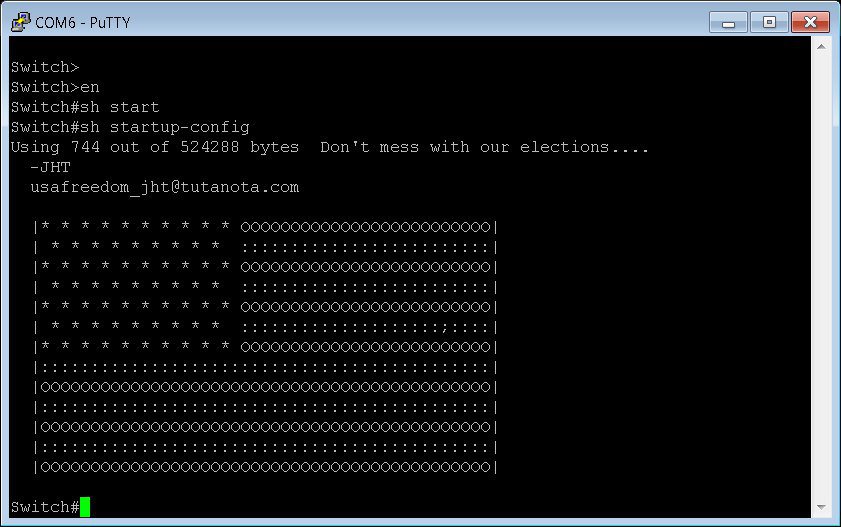
An anonymous reader quotes Motherboard: On Friday, a group of hackers targeted computer infrastructure in Russia and Iran, impacting internet service providers, data centres, and in turn some websites. "We were tired of attacks from government-backed hackers on the United States and other countries," someone in control of an email address left in the note told Motherboard Saturday... "We simply wanted to send a message...." In addition to disabling the equipment, the hackers left a note on affected machines, according to screenshots and photographs shared on social media: "Don't mess with our elections," along with an image of an American flag...
In a blog post Friday, cybersecurity firm Kaspersky said the attack was exploiting a vulnerability in a piece of software called Cisco Smart Install Client. Using computer search engine Shodan, Talos (which is part of Cisco) said in its own blog post on Thursday it found 168,000 systems potentially exposed by the software. Talos also wrote it observed hackers exploiting the vulnerability to target critical infrastructure, and that some of the attacks are believed to be from nation-state actors...
Reuters reported that Iran's IT Minister Mohammad Javad Azari-Jahromi said the attack mainly impacted Europe, India, and the U.S.... The hackers said they did scan many countries for the vulnerable systems, including the U.K., U.S., and Canada, but only "attacked" Russia and Iran, perhaps referring to the post of an American flag and their message. They claimed to have fixed the Cisco issue on exposed devices in the US and UK "to prevent further attacks... As a result of our efforts, there are almost no vulnerable devices left in many major countries," they claimed in an email.
Their image of the American flag was a black-and-white drawing done with ASCII art. -
'Vigilante Hackers' Strike Routers In Russia and Iran, Reports Motherboard (vice.com)
An anonymous reader quotes Motherboard: On Friday, a group of hackers targeted computer infrastructure in Russia and Iran, impacting internet service providers, data centres, and in turn some websites. "We were tired of attacks from government-backed hackers on the United States and other countries," someone in control of an email address left in the note told Motherboard Saturday... "We simply wanted to send a message...." In addition to disabling the equipment, the hackers left a note on affected machines, according to screenshots and photographs shared on social media: "Don't mess with our elections," along with an image of an American flag...
In a blog post Friday, cybersecurity firm Kaspersky said the attack was exploiting a vulnerability in a piece of software called Cisco Smart Install Client. Using computer search engine Shodan, Talos (which is part of Cisco) said in its own blog post on Thursday it found 168,000 systems potentially exposed by the software. Talos also wrote it observed hackers exploiting the vulnerability to target critical infrastructure, and that some of the attacks are believed to be from nation-state actors...
Reuters reported that Iran's IT Minister Mohammad Javad Azari-Jahromi said the attack mainly impacted Europe, India, and the U.S.... The hackers said they did scan many countries for the vulnerable systems, including the U.K., U.S., and Canada, but only "attacked" Russia and Iran, perhaps referring to the post of an American flag and their message. They claimed to have fixed the Cisco issue on exposed devices in the US and UK "to prevent further attacks... As a result of our efforts, there are almost no vulnerable devices left in many major countries," they claimed in an email.
Their image of the American flag was a black-and-white drawing done with ASCII art. -
T-Mobile Stores Part of Customers' Passwords In Plaintext, Says It Has 'Amazingly Good' Security (vice.com)
T-Mobile Austria admitted on Twitter that it stores at least part of their customer's passwords in plaintext. What this means is that "if anyone breaches T-Mobile (it's only a matter of time), they could likely guess or brute-force every user's password," reports Motherboard. "If the passwords were fully encrypted or hashed, it wouldn't be that easy. But having a portion of the credential in plaintext reduces the difficulty of decoding the hashed part and obtaining the whole password." From the report: "Based on what we know about how people choose their passwords," Per Thorsheim, the founder of the first-ever conference dedicated to passwords, told me via Twitter direct message, "knowing the first 4 characters of your password can make it DEAD EASY for an attacker to figure out the rest." T-Mobile doesn't see that as a problem because it has "amazingly good security." On Thursday, a T-Mobile Austria customer support employee made that stunning revelation in an incredibly nonchalant tweet. Twitter user Claudia Pellegrino was quick to point out that storing passwords in plaintext is wrong, but another T-Mobile customer rep didn't see it that way. "I really do not get why this is a problem. You have so many passwords for every app, for every mail-account and so on. We secure all data very carefully, so there is not a thing to fear," the rep wrote back. -
The FCC Is Refusing To Release Emails About Ajit Pai's 'Harlem Shake' Video (vice.com)
bumblebaetuna writes from a report via Motherboard: On the eve of the net neutrality repeal, just as tensions and public debate over the issue were reaching a fever pitch, someone in the FCC decided it would be a good idea to have chair Ajit Pai ridicule legitimate concerns of internet users with a video featuring an outdated meme and a pizzagate conspiracy theorist. Now, citing the infamous b5 FOIA exemption, the Federal Communications Commission is refusing to release emails related to the planning of the video. The b5 exemption is supposed to protect "inter-agency or intra-agency memorandum or letters which would be privileged in civil litigation," but each agency interprets that meaning differently. -
Chrome Is Scanning Files on Your Computer, and People Are Freaking Out (vice.com)
Some cybersecurity experts and regular users were surprised to learn about a Chrome tool that scans Windows computers for malware. But there's no reason to freak out about it. From a report: Last year, Google announced some upgrades to Chrome, by far the world's most used browser -- and the one security pros often recommend. The company promised to make internet surfing on Windows computers even "cleaner" and "safer" adding what The Verge called "basic antivirus features." What Google did was improve something called Chrome Cleanup Tool for Windows users, using software from cybersecurity and antivirus company ESET.
[...] Last week, Kelly Shortridge, who works at cybersecurity startup SecurityScorecard, noticed that Chrome was scanning files in the Documents folder of her Windows computer. "In the current climate, it really shocked me that Google would so quietly roll out this feature without publicizing more detailed supporting documentation -- even just to preemptively ease speculation," Shortridge told me in an online chat. "Their intentions are clearly security-minded, but the lack of explicit consent and transparency seems to violate their own criteria of 'user-friendly software' that informs the policy for Chrome Cleanup [Tool]." Her tweet got a lot of attention and caused other people in the infosec community -- as well as average users such as me -- to scratch their heads. -
A Struggling Town Is Reviving Itself With... Geocaching (vice.com)
An anonymous reader shares a report: In the town of Wilberforce, Ontario, a quick detour from the main street will take you to a seven-foot-tall wooden fork that sits at the point where the road splits into two -- a literal fork in the road. Unfamiliar passers-by may think it's a joke. But to locals, this landmark goes by the name "Fork and Beans." It has a logbook hidden inside its frame and it's one of the more than 500 geocaches scattered around Wilberforce -- the "Geocaching Capital of Canada," as the town calls itself, and home of one of the most popular geocaching tours in the world.
The rise of Pokemon Go in 2016 brought with it a surge of location-based outdoor games on mobile. Geocaching, which is akin to an outdoor scavenger hunt, uses GPS to locate hidden caches with logbooks inside and predates the latest crop of augmented reality games; it was a fixture of internet culture at the turn of the millenium. Geocachers use either an app or a GPS-enabled device to search for hidden containers (usually filled with something like a notebook) that are nearby or that they've sought out online. According to Geocaching HQ, a company that created one of the largest websites for the geocaching community in 2000, there are currently more than three million of these caches hidden in more than 190 countries around the world.
For Wilberforce, geocaching is more than a game from back when a low-res dancing baby was the height of online entertainment. It's a growing industry, with new caches being hidden and special events organized every year, that is helping keep the town afloat amidst economic struggles. -
A Struggling Town Is Reviving Itself With... Geocaching (vice.com)
An anonymous reader shares a report: In the town of Wilberforce, Ontario, a quick detour from the main street will take you to a seven-foot-tall wooden fork that sits at the point where the road splits into two -- a literal fork in the road. Unfamiliar passers-by may think it's a joke. But to locals, this landmark goes by the name "Fork and Beans." It has a logbook hidden inside its frame and it's one of the more than 500 geocaches scattered around Wilberforce -- the "Geocaching Capital of Canada," as the town calls itself, and home of one of the most popular geocaching tours in the world.
The rise of Pokemon Go in 2016 brought with it a surge of location-based outdoor games on mobile. Geocaching, which is akin to an outdoor scavenger hunt, uses GPS to locate hidden caches with logbooks inside and predates the latest crop of augmented reality games; it was a fixture of internet culture at the turn of the millenium. Geocachers use either an app or a GPS-enabled device to search for hidden containers (usually filled with something like a notebook) that are nearby or that they've sought out online. According to Geocaching HQ, a company that created one of the largest websites for the geocaching community in 2000, there are currently more than three million of these caches hidden in more than 190 countries around the world.
For Wilberforce, geocaching is more than a game from back when a low-res dancing baby was the height of online entertainment. It's a growing industry, with new caches being hidden and special events organized every year, that is helping keep the town afloat amidst economic struggles. -
Amazon is Burying Sexy Books, Sending Erotic Novel Authors to the 'No-Rank Dungeon' (vice.com)
Samantha Cole, reporting for Motherboard: In the last few days, word has spread among independent erotica authors on social media that Amazon was quietly changing its policies for erotic novels. Five authors I spoke to, and several more on social media, have reported that their books were stripped of their best seller rankings -- essentially hiding them from casual browsing on the site, and separating them from more mainstream, safe-for-work titles.
[...] Most people browsing Amazon books might not notice or care about the best seller rank -- a number that's based on how well the title is selling on Amazon.com -- but it's part of an algorithm that influences how the book appears in search, and whether it shows up in advertisements, including suggestions from one product to the next ("If you like this book, you might like this book"). For independent authors and booksellers, this ranking is hugely important for visibility. -
More Than 75 Percent of Earth's Land Areas Are 'Broken,' Major Report Finds (vice.com)
Like a broken cell phone that can only text or take pictures, but not make a single call, more than 75 percent of the Earth's land areas have lost some or most of their functions, undermining the well-being of the 3.2 billion people that rely on them to produce food crops, provide clean water, control flooding and more. From a report: These once-productive lands have either become deserts, are polluted, or have been deforested and converted for unsustainable agricultural production. This is a major contributor to increased conflict and mass human migration, and left unchecked, could force as many as 700 million to migrate by 2050, according to the world's first comprehensive evidence-based assessment of land degradation, released today in MedellÃn, Colombia.
Land degradation -- including deforestation, soil erosion, and salinity and pollution of fresh water systems -- is also driving species to extinction and aggravating the effects of climate change, the report concludes. It was written by more than 100 leading experts from 45 countries for the Intergovernmental Science-Policy Platform on Biodiversity and Ecosystem Services (IPBES). IPBES is the 'IPCC for biodiversity,' a scientific assessment of the status of non-human life that makes up the Earth's life support system. -
State Department Seemingly Buys $15,000 iPhone Cracking Tech GrayKey (vice.com)
An anonymous reader quotes a report from Motherboard: Grayshift, a company that offers to unlock modern iPhones for as little as $50 each, has caused a buzz across law enforcement agencies, with local police already putting down cash for the much sought-after tech. Now, it appears a section of the U.S. State Department has also purchased the iPhone cracking tool, judging by procurement records reviewed by Motherboard. Grayshift's iPhone product, dubbed GrayKey, can unlock devices running versions of Apple's latest mobile operating system iOS 11, according to marketing material obtained by Forbes. An online version of GrayKey which allows 300 unlocks costs $15,000 (which boils down to $50 per device), and an offline capability with unlimited uses is $30,000. According to a recent post from cybersecurity firm Malwarebytes, which obtained leaked details on GrayKey, the product itself is a small, four inch by four inch box, and two iPhones can be connected at once via lightning cables. Malwarebytes adds that the time it takes to unlock a device varies depending on the strength of the user's passcode: it may be hours or days. Notably, Grayshift includes an ex-Apple engineer on its staff, Forbes reported.
On March 6, the State Department ordered an item from Grayshift for just over $15,000, according to a purchase order listing available on the U.S. government's public federal procurement data system. The listing is sparse on details, putting the order under the generic label of "computer and computer peripheral equipment." But Motherboard confirmed that the Grayshift in the State Department listing is the same as the one selling iPhone cracking tech: the phone number of the vendor in both the purchase order and documents Motherboard previously obtained detailing a GrayKey purchase by Indiana State Police is the same. The "funding office" for the Grayshift purchase was the Bureau of Diplomatic Security, according to the procurement records. The Bureau acts as the law enforcement and security arm of the State Department, bearing "the core responsibility for providing a safe environment for the conduct of U.S. foreign policy," the State Department website reads. -
Sex Workers Say Porn On Google Drive Is Suddenly Disappearing (vice.com)
An anonymous reader quotes a report from Motherboard: Porn performer Avey Moon was trying to send the lucky winner of her Chaturbate contest his prize -- one of her videos, titled "POV Blowjob" -- through her Google Drive account. But it wouldn't send, and Google wasn't telling her why. "I thought there was something wrong with my file and I got rather worried," Moon told me in a Twitter message. "I had promised this guy his content and he was so good to me. I was panicked because I thought if I couldn't give him his prize, he would feel like he got ripped off and never come back again or worse, he could actually file a complaint with Chaturbate about me and they can take money from me." She's not alone. Six porn performers I talked to and more on social media said that they suddenly can't download adult content they keep on Google Drive. They also said they can't a share that content with other accounts or send to clients. In some cases, the adult content is disappearing from Drive without warning or explanation. The porn performers I talked to started sounding the alarm on Twitter last week. They said that Google Drive no longer seemed sex-trade friendly, detailing error messages and sharing cloud storage alternatives with each other.
When I asked about sexual content being blocked on Drive, a spokesperson for Google directed me to the Drive policy page -- specifically the section on sexually explicit material, which says, "Do not publish sexually explicit or pornographic images or videos.... Additionally, we do not allow content that drives traffic to commercial pornography." Writing about porn and sex is permitted, the policy states, as long as it's not accompanied by sexually explicit images or videos. According to Google, Drive uses a combination of automated systems and manual review to decide what's in violation. One worker said they've been using Google Drive for most of the last five and a half years but just recently received an error message when sending a video, saying that the item may violate Google's Terms of Service, with a link to request a review. In this case, the video title was explicit, but other adult performers report similar messages when sending content with non-explicit titles. "Some sex workers are wondering if this has something to do with the impending vote on the SESTA-FOSTA bill," reports Motherboard. We now have learned that the Senate has passed the bill. -
New York Councilman Proposes Bill That Would Grant NYC Workers 'Right To Disconnect' (vice.com)
An anonymous reader quotes a report from Motherboard: New York City councilman Rafael Espinal released a "Right to Disconnect" bill on Thursday, advocating for the rights of employees to stop answering work-related emails and other digital messages, like texts, after official work hours. "Our work lives have spilled into our personal lives because of technology," he told me. "It's time we unblur and strike a clear line." Brooklyn-based Espinal said he got the idea from France, where a bill passed early last year by the Ministry of Labor requires companies of over 50 employees to define out-of-office email rules. He wanted to create a similar guideline so that workers would not be penalized for disconnecting after work hours. But that's France -- known for joie de vivre -- and this is New York, known for not sleeping.
Answering work emails after work hours, or during weekends, or on vacation, has become par for the course here, and across the US. Statistics rarely account for the extra hours spent managing post-office work -- by most official counts, Americans work the same number of hours -- around 39 to 47 per week -- just as we did in the 1950s. But those of us living it know this isn't true: technology has completely changed the way we work, and burnout is rampant among American workers. If Espinal were able to implement the bill, it would face similar challenges to its European counterparts. Critics say the legislation in France has no teeth, and companies are still allowed to define their own guidelines, leaving room for exploitation. And the New York version of the "Right to Disconnect" bill includes exemptions for jobs that require 24-hour on-call periods. -
Pablo Escobar's Brother Says He Met an FBI Agent Posing As Satoshi Nakamoto (vice.com)
Jordan Pearson, writing for Motherboard: Colombian drug lord Pablo Escobar's brother, Roberto Escobar, is launching a new cryptocurrency called "Dietbitcoin." It's a clone of Bitcoin of the kind that can take mere minutes to create, with no changes or improvements whatsoever. But Escobar is nonetheless hawking virtual coins for $2 USD each now, and $1,000 in later rounds of the crowd sale. Now here's the good shit. Along with Dietbitcoin's launch came a 280-page book, part memoir and part manifesto, titled "Pablo Escobar's Dietbitcoin: The True Story by Roberto Escobar." Roberto allegedly authored the book -- when I reached Escobar for an interview the company said he was not available, but CEO Olof Gustafsson told me over the phone that Roberto wrote it. In it, Roberto claims that he had a close encounter with a US government agent posing as the pseudonymous creator of Bitcoin, Satoshi Nakamoto. This encounter led Roberto to conclude that the US government created Bitcoin and will one day crash the market by selling all of Nakamoto's stashed bitcoins. The veracity of this tale is highly suspect; Roberto Escobar is a well-known eccentric who once claimed to have cured HIV with his knowledge of horses. -
Did Stephen Hawking Owe a Nobel Physicist a Subscription To a Softcore Porn Magazine? (vice.com)
dmoberhaus writes: In 1974, Stephen Hawking made a bet with Nobel Prize-winning cosmologist Kip Thorne about a black hole. The wager was a subscription to the softcore porn magazine Penthouse for Thorne or a subscription to "Private Eye" (basically the British equivalent of The Onion) for Hawking. Hawking ultimately lost the bet, but did he ever pay up? Motherboard dug around to find out if Hawking settled this infamous bet.
Motherboard's Daniel Oberhaus wasn't able to get ahold of Thorne, but did manage to track down a copy of the obscure 1997 straight-to-VHS documentary called Black Holes, which is the only evidence that the wager even happened. "In 1990, Stephen Hawking happened to be visiting Los Angeles and he broke into my office and thumb printed off on this bet," Thorne recalls in the video. Oberhaus writes: "Although the status of Cygnus X-1 was an open question in the 70s, by the 90s mounting evidence had forced Hawking to concede the wager. The bet was recorded in a handwritten note scrawled on a piece of card which is shown in the film. It read: 'Whereas Stephen Hawking has a large investment in general relativity and black holes and desires an insurance policy, and whereas Kip Thorne likes to live dangerously without an insurance policy, therefore be it resolved that Stephen Hawking bets 1 year's subscription to 'Penthouse' as against Kip Thorne's wager of a 4-year subscription to 'Private Eye,' that Cygnus X-1 does not contain a black hole of mass above the Chandrasekhar limit.' 'I had given Thorne a subscription to Penthouse, much to his wife's disgust,' a smiling Hawking says in the film."