Slashdot Mirror
Domain: w3.org
Stories and comments across the archive that link to w3.org.
Comments · 6,785
-
New site validates properlyGood work -- the new site validates properly against the W3c checks for valid XHTML Strict and CSS.
Helevius
-
New site validates properlyGood work -- the new site validates properly against the W3c checks for valid XHTML Strict and CSS.
Helevius
-
Re:ALA is ok but CSS is broken
I don't know if this si a browser issue, or a problem with the CSS spec, but text overflow is a serious issue, one which breaks nearly every CSS page with complex layout in existance.
Yeah, you'd think somebody would come up with an " overflow " property and put it in the CSS spec to fix that, wouldn't you?
Snarky comments aside, most problems with layouts being broken by text magnification can be fixed with careful design. Yeah, it takes some work, but generally no more than what you'd put in nesting 800 tables...
-
Re:Blech...
It overrides my default font with something they presumably thought was better. Why? Was there any good reason for this? Or was it just another example of CSS overdesign?
In the modern world, we do such things with user stylesheets. If you wanted, say, Verdana, you could get that with the following rule in your user CSS:
font-family: Verdana!important
The !important declaration, contrary to the meaning of "!" in other languages, makes this rule take precedence over anything a web designer specifies.
Perhaps in the future you should know what you're talking about before you bash it for "overdesign."
-
Re:Blech...
The designer hardcoded a fontface because CSS doesn't automatically resize columns like tables do.
Er, 'fontface'? WTF is a 'fontface'?
As for CSS resizing automagically, resize in relation to what, pray tell? A box with width: 30%; resizes in relation to the viewport, a box with width: 15em; resizes in relation to font size, as of CSS 2.1 a box with float: left or float: right and no width resizes in relation to content (most browsers--including IE/Win--do this anyway) and table-layout will get you table-style layout with whatever tags you like. MS just didn't feel the need to support it in IE 5/Win or IE/Mac so people don't use it much. That's Microsoft's fault, not the W3C's
Because CSS was designed by doofus eggheads and not experts in solving real world web design problems.
Ian Hickson edited the CSS2.1 spec, and he's been 'solving real world web design problems' since at least 1998 when I worked with him at the Web Stanards Project. Hakon Wium Lie edited CSS 1, 2 and 2.1 and has been working on Opera since 1999, earned an MS in Visual Studies from MIT and wrote his thesis on electronic display of newspapers. TantekCelik is responsible for the widely-lauded Tasman rendering engine used in IE 5.x/Mac. These people do use this stuff in the real world, and if you don't like the directions they're taking your'e free to join the www-style discussion list and let them know.
Which then forces me to do a bunch of work
One line of CSS is 'a bunch of work'? I suppose you find tying your own shoes a pretty onerous task as well?
or accept undesirable browser settings
Let me get this straight: you're hacked because the site doesn't use your settings for font size and face, but setting your browser to override the site's settings with your choices is 'undesirable'? Huh?
-
Re:Blech...
The designer hardcoded a fontface because CSS doesn't automatically resize columns like tables do.
Er, 'fontface'? WTF is a 'fontface'?
As for CSS resizing automagically, resize in relation to what, pray tell? A box with width: 30%; resizes in relation to the viewport, a box with width: 15em; resizes in relation to font size, as of CSS 2.1 a box with float: left or float: right and no width resizes in relation to content (most browsers--including IE/Win--do this anyway) and table-layout will get you table-style layout with whatever tags you like. MS just didn't feel the need to support it in IE 5/Win or IE/Mac so people don't use it much. That's Microsoft's fault, not the W3C's
Because CSS was designed by doofus eggheads and not experts in solving real world web design problems.
Ian Hickson edited the CSS2.1 spec, and he's been 'solving real world web design problems' since at least 1998 when I worked with him at the Web Stanards Project. Hakon Wium Lie edited CSS 1, 2 and 2.1 and has been working on Opera since 1999, earned an MS in Visual Studies from MIT and wrote his thesis on electronic display of newspapers. TantekCelik is responsible for the widely-lauded Tasman rendering engine used in IE 5.x/Mac. These people do use this stuff in the real world, and if you don't like the directions they're taking your'e free to join the www-style discussion list and let them know.
Which then forces me to do a bunch of work
One line of CSS is 'a bunch of work'? I suppose you find tying your own shoes a pretty onerous task as well?
or accept undesirable browser settings
Let me get this straight: you're hacked because the site doesn't use your settings for font size and face, but setting your browser to override the site's settings with your choices is 'undesirable'? Huh?
-
Re:Teeny Bug
I'm not really up on my css, but I would guess a solution would be to have the centre column floating next to the left column, or to define the distance from the left hand side in em units instead of pixels.
Or the CSS property overflow , which could be used in a variety of ways to make the text visible when it gets too large for the column.
-
Re:Agent sensing
Selecting based on user-agent is a Bad Thing. The preferred method to provide "light" style to a PDA is the @media rule in CSS, which would allow PDAs to get their style via an "@media handheld" rule in the stylesheet, or from a simple link like this:
<link rel="stylesheet" href="pda.css" media="handheld">
The author of the ALA article used the same technique to provide "printer-friendly" layout via CSS, and it can work for a variety of other media as well.
-
XHTML or HTML 4.,01 Strict?
If XHTML, there are some things to consider:
It's important to note that using XHTML 1.1 requires you to send your documents as XML. This means the document should have an XML declaration above the doctype, and needs to be sent with an XML mime-type, ideally application/xhtml+xml. This has a significant drawback; IE can't see it.
A fairly well established workaround is to use mod_rewrite and munge the mime-type of a document based on what a user agent sends in its Accept header (To date, Mozilla is the only browser to include application/xhtml+xml in its Accept header). However, some would argue that this too has drawbacks. Since only Mozilla understands application/xhtml+xml, your documents will be sent as text/html, and XHTML does not validate as HTML.
The arguments around this issue have been summarized in the widely linked "Sending XHTML as text/html Considered Harmful"
-
XHTML or HTML 4.,01 Strict?
If XHTML, there are some things to consider:
It's important to note that using XHTML 1.1 requires you to send your documents as XML. This means the document should have an XML declaration above the doctype, and needs to be sent with an XML mime-type, ideally application/xhtml+xml. This has a significant drawback; IE can't see it.
A fairly well established workaround is to use mod_rewrite and munge the mime-type of a document based on what a user agent sends in its Accept header (To date, Mozilla is the only browser to include application/xhtml+xml in its Accept header). However, some would argue that this too has drawbacks. Since only Mozilla understands application/xhtml+xml, your documents will be sent as text/html, and XHTML does not validate as HTML.
The arguments around this issue have been summarized in the widely linked "Sending XHTML as text/html Considered Harmful"
-
XHTML or HTML 4.,01 Strict?
If XHTML, there are some things to consider:
It's important to note that using XHTML 1.1 requires you to send your documents as XML. This means the document should have an XML declaration above the doctype, and needs to be sent with an XML mime-type, ideally application/xhtml+xml. This has a significant drawback; IE can't see it.
A fairly well established workaround is to use mod_rewrite and munge the mime-type of a document based on what a user agent sends in its Accept header (To date, Mozilla is the only browser to include application/xhtml+xml in its Accept header). However, some would argue that this too has drawbacks. Since only Mozilla understands application/xhtml+xml, your documents will be sent as text/html, and XHTML does not validate as HTML.
The arguments around this issue have been summarized in the widely linked "Sending XHTML as text/html Considered Harmful"
-
XHTML or HTML 4.,01 Strict?
If XHTML, there are some things to consider:
It's important to note that using XHTML 1.1 requires you to send your documents as XML. This means the document should have an XML declaration above the doctype, and needs to be sent with an XML mime-type, ideally application/xhtml+xml. This has a significant drawback; IE can't see it.
A fairly well established workaround is to use mod_rewrite and munge the mime-type of a document based on what a user agent sends in its Accept header (To date, Mozilla is the only browser to include application/xhtml+xml in its Accept header). However, some would argue that this too has drawbacks. Since only Mozilla understands application/xhtml+xml, your documents will be sent as text/html, and XHTML does not validate as HTML.
The arguments around this issue have been summarized in the widely linked "Sending XHTML as text/html Considered Harmful"
-
Horray!
I think Its a great idea that slashdot is complying with the w3c standards. Howerver; not all browsers comply with the w3c standards. I'm currently designing a website for an individual. I tried to use the CSS1 tag, background-attachment: fixed; and I quickly foundout that IE does not fully support CSS1. I have validated my html code, and yes, It does make it more compatible with browsers. I worked out a lot of cross browser issues by simply validating the code.
-
Not ANOTHER non-standard page...
PLEASE, whatever you do, just don't optimize it for any specific browser.
Slashdot readers use perhaps the most varied array of operating systems of any news site, and I can bet you that if our Linux, Mac, Solaris, BSD, UNIX, BeOS, etc. users could not access the web site because they had no access to the latest version of IE, that it would be quite a mess.
Please, please, support web standards that can make web sites available to everyone. -
Re:"next page" tag in HTML?
There's a "link" tag in HTML 4.0
By the way, Mozilla also has a "Site Navigation Bar" to handle the "link" tag.
-
Re:Accessability
Not necessarily true. Genuinely accessible site development consideres features such as this to be add-ons to the core message. The site must be fully accessible without stylesheets or scripting to pass the accessibility test anyway. If you can take advantage of the added feature that's great. Otherwise, you should still be able to get to the information just like everybody else.
Ideally, someone using Links (as opposed to Lynx) gets the same information as anyone else. That's the beauty of having a text only, no frames, no scripts browser around. Test your site in it and you find a lot of the access problems very quickly.
Unfortunately, neither Section 508 or WCAG guidelines really do anything about useability. You can have a completely accessible site that even a deaf, blind, quadriplegic can use but, if it's unuseable due to layout and/or design it won't matter anyway.
-
Re:HTML Documentation
People creating HTML in line with WAI should skirt this problem neatly. A good piece of documentation should make no assumptions about the capabilities of the device displaying it, but the writer should feel free to take advantage of things (like images) if it aids in the understanding of the material.
-
All that, AND a bag of chips...!
The key here is that they are attempting to put something together that our naive end users will be able to dig and thus buy - pushing the precentage of desktops more on an even keel with you know who. This can't be bad for the Linux world domination conspiracy -er- Linux users...
One of the major complaints I hear is about differing interpretations of the file system hierarchy. While I think standardization is good, I also believe developers should have a certain amount of flexibility - which the standard allows. The key here, I think, is for the distributions to honor the locations that the developers established for their files - so compatability crosses all boundaries and documentation can be maintained by the developer on the particulars of his application - instead of the distributor. In cases where the application creates problems due to inappropriate placement - the issue needs to be raised to the developer to correct his implementation; distributors would have the option not to include the application/system if it was too disruptive - but that is all (more than this and the distributor can cause more problems than he intends to fix). Developers need to understand the standard; distribution creators need to cede the responsibility for application locations to the developers - with the right to veto bad locations from entering their distro until corrections are made by the developer. This way, no matter which distribution you are using, foo.ini is located in the same place every time.
Related to this, and probably more frustrating for end users, is when application developers make assumptions about libraries and other applications that exist on the system during the build. For hard core *nix system administrators this is no big issue - something they have been dealing with for years; however, for a general purpose workstation this has to be idiot proof. Coupled with standard locations includes being able to check those locations for particular files, and if not found, have the confidence to load them for the user, rather than simply complaining and dropping back to the command line. Again, the onus is on the developer to include all parts necessary to work with his tool (perhaps even going so far as loading a different library in an alternate location [sub directory in standardized path location] - then changing an environmental variable used exclusively by the application to locate it without disturbing an existing library or any applications that depend upon it - lets definitely do it smarter than Microsoft DLL hell)
These two items coupled together would make installation and maintenance across all distributions easy - and dependent on the documentation and careful work of the developer community - instead of left at the whim of the distribution agents - who are not on the same sheet of music. If developer X creates app Y and puts it in location Z - then Z should be where everyone finds Y when they look on their system.
Finally, I think easy to use tools for administering very clearly standardized core items (the rc.d run level scripts, crontab management, X configurations etc...) should leverage existing text based configuration files. Lets not get into the trap of reimplementing the Microsoft registry - as a single point of failure. Up to this point these types of tools have been adhoc; someone needs to take the ball and run with it to create something that is clearly superior and usable for all distributions that intend to target the niave user (hmmm - sounds like a good open source project to me - maybe a python Tk gui with a builtin command language parser for power users...
These are the core items I think are critical to a successful linux desktop to compete with Microsoft's dynasty.
One additional frill I would suggest:
Implementation of a better 'Annotea' W3C -
Validation
I heard the whole site will validate as XHTML 1.1 and not use any nonstandard technologies!
-
Re:Oh man...
How about this: if you're going to "do something" about this problem, only do it to web sites that don't validate.
-
All caps
Putting the "This provided As Is" section in all caps is SOP for licensing. Check any of your software boxes, or Google "software license". Point-and-click examples include the W3C license, or Apache license.
-
Here are some that come to mind...
Since nobody who seems to have actually read any computer science papers has posted, here are two that immediately come to my mind.
Vannevar Bush. As We May Think. Atlantic Monthly, July, 1945.
This paper put forth the very first ideas about how people can mechanically search for information. While we don't have desks with levers on them, we do have Google.
Tim Berners Lee. Information Management: A Proposal. 1989.
This paper is where Tim Berners Lee proposes what we now know as the world wide web. It's an interesting read if you'd like to see what the original intent of the web was so that you can compare it to what we have today.
A place to look for good old computer science papers is in older issues of Communications of the ACM. There are lots of articles in plain English that you may find of interest. If you are a university student, your school may have a subscription to the ACM Digital Library. If they do, you can read all the issues back to 1958.
Also, you can find a lot of interesting CS publications at Citeseer. They have a page with the top 200 most accessed papers of all times. When I skimmed through it, I saw quite a few titles that may be of interest. -
Let me help
-
Re:The problem with personal websitesJust to make a simple but reasonblly respectable* site would need two years of university education if you never done it before.
Not really. My brother has his own blog, and he's not a CS student (of course, he is an engineer with a degree from the US Naval Academy, so he's obviously quite bright). I have my own personal site and blog as well, although in my case I was a CS student.
It's not all that difficult. A few hours at W3C, a few tutorials and one's up and running. HTML is dead-simple; CSS is slightly more complicated--and that's all one needs to know.
He who cannot write HTML by hand can not, in all likelihood, write anything.
-
Re:The problem with personal websites
Unwise of him. HTML 3.0 was only ever a draft and never became a recommendation.
A decent designer today should be sticking with code that validates as HTML 4.01 Strict, and be aware of which features can cause problems in certain browsers. I suspect that's probably what you meant, but it's not what you said.
But I fully agree that a clean site in pure HTML or XHTML 1.0 (with Appendix C) totally outperforms the WYSIWYMGIYL rubbish out there.
-
Re:Great site
Actually, with a proper web browser you get a nice page of text that resembles HTML. The server is improperly configured and is serving the index page as text/plain. Since MIME headers sent by a server are authoritative, a standards-conforming browser must treat the document as plain text, not HTML.
-
Re:Hmmmm, other motivations....
Yeah, it's not like you need to like at the W3C member list either.
-
Re:Hmmmm, other motivations....
Isn't Microsoft a member of W3C as listed here
-
Re:If people want things to look and work like Mac
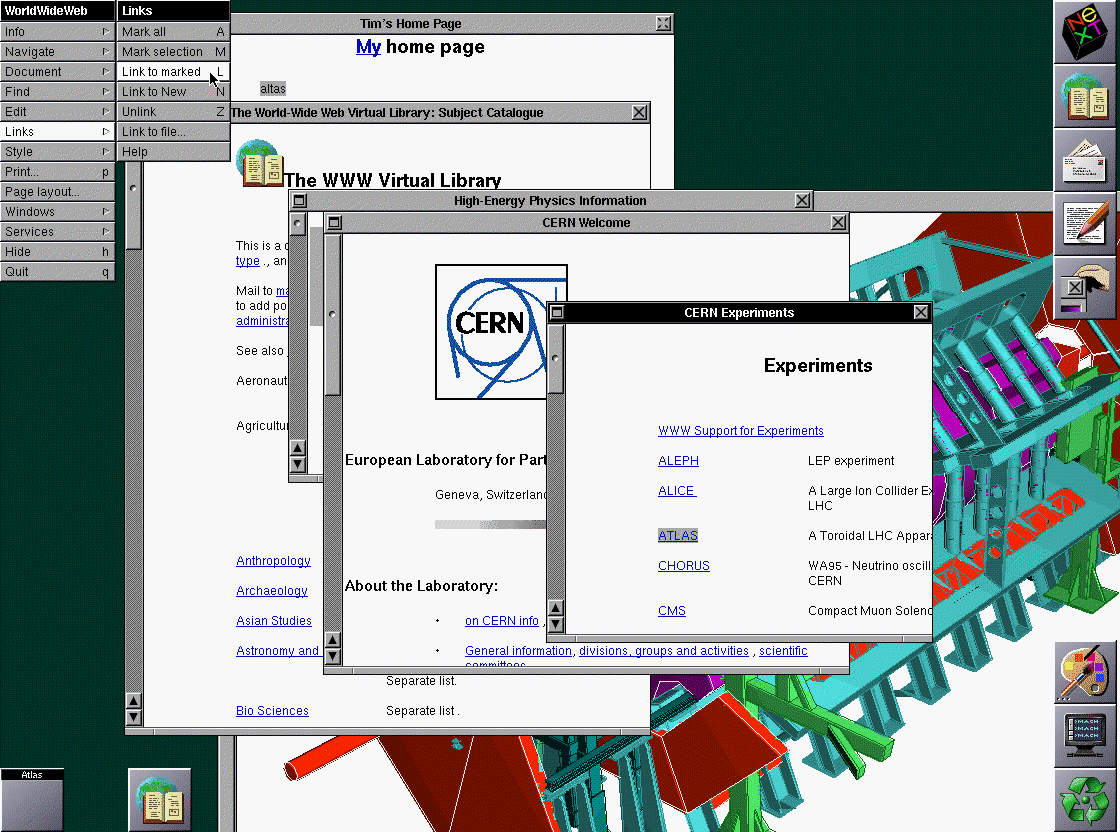
Mosaic was not the first browser. World Wide Web by Time Berners-Lee was. Completely done in Objective-C in a NeXT ( screenshot).
And just by that screenshot it's clear to me that the NeXT interface is a much more tasteful and usable choice to emulate than, well, all other GUI's, and thus GNUstep is becoming every day more and more a real option with real advantages. Alas, blinking bars and Matrix-like desktops seem to be the "hip" thing, but lest hope that good taste prevails.
fsmunoz -
Re:If people want things to look and work like Mac
Mosaic was not the first browser. World Wide Web by Time Berners-Lee was. Completely done in Objective-C in a NeXT ( screenshot).
And just by that screenshot it's clear to me that the NeXT interface is a much more tasteful and usable choice to emulate than, well, all other GUI's, and thus GNUstep is becoming every day more and more a real option with real advantages. Alas, blinking bars and Matrix-like desktops seem to be the "hip" thing, but lest hope that good taste prevails.
fsmunoz -
A potentially better solution...and another...
Here is a better solution that will work with multiple different types of machines:
1. Set up CFengine on all of your boxes (microsloth windows too).
2. Configure a master system with all of your working files.
3. Configure your slave systems to query the master and copy over new/changed files.
Once you have this set up properly, it takes care of itself. As an added benefit it makes managing multiple machines a snap.
You can even have it kick off an application/script (like CVS) when something changes - to capture it in your archive if you like (so you can roll back as needed).
I love revision control, but managing it by hand is a pain in the behind.
Ultimately, I want to not have to worry about locations of files at all - depending instead on meta-data to provide searchable, annotatable links into the actual files with overlays of my own notes, similar to the 'Annotea' project module in the W3C AMAYA web browser (this is pretty cool - you can 'annotate' documents without altering their content - even documents on other servers; the system keeps 'RDF' xpointers and xlinks on your home system, and amaya renders your notation links in the web page as you view it). -
Re:Wow!!!
You are so naive.
-
fix it!
Maybe they can finally support PNG images properly... they've only been an Internet standard for seven years.
Throw in built-in SVG support, too, so we can actually start using them (Internet standard for two years now). Maybe then Mozilla/Firebird, etc. will sort our their library licensing issues and support SVG out of the box, too. -
fix it!
Maybe they can finally support PNG images properly... they've only been an Internet standard for seven years.
Throw in built-in SVG support, too, so we can actually start using them (Internet standard for two years now). Maybe then Mozilla/Firebird, etc. will sort our their library licensing issues and support SVG out of the box, too. -
Actually...
The way it works is probably the best. Let's not mess it up!
-
Let me help you out
-
Let me help you out
-
Re:The real flash killer
Incorporate {Scalable Vector Graphics} into {w3c standards compliant open source web rendering engine} and add {Synchronized Multimedia Integration Language} with support for mp3 and/or {Audio compression and streaming that isn't patent encumbered}.
-
Re:The real flash killer
Incorporate {Scalable Vector Graphics} into {w3c standards compliant open source web rendering engine} and add {Synchronized Multimedia Integration Language} with support for mp3 and/or {Audio compression and streaming that isn't patent encumbered}.
-
Re:Can someone explain?
Because CSS is already taken.
-
Re:Please, oh god, please
They have something to refer to. You haven't read the link I posted, have you?
-
Re:been there, done that.... SVG in KDE
Remember that SVG is a W3C standard.
For that reason, it is imperative that Microsoft to make its own superceding one (embrace, etc.). A lot of other organizations suffer from the NIH malady, but it's extra painful when it is a company with this much influence.)
The community really needs free, powerful, robust SVG renderers and authoring tools using public standards to become popular, or else Microsoft will own yet another "standard".
-
wow what wit
Can we ask W3C to rename SVG Animation to "Brilliance" or "Twinkle" or "Somesuch"?
-
Re:Certification == Money
Or at least do them right. Also, 'Preview' only takes a sec.
-
Sorry, I was under the impression...
That the first browser was developed on a NEXT station by Tim Berners-Lee. NEXT was the evolution of ideas born of Apple(and Xerox/PARC) and today we have the same high-quality tools and language(ProjecctBuilder/XCode & Objective C) available to us with OS X.
My point is that not recognizing the contributions of many platforms is really disingenuous. Whatever your feelings about Apple today, to not acknowledge the contribution they have had on computing as a whole is intelectually dishonest.
Most computer users cut their teeth on Apple systems back in the day -- as well as Commodore PETs -- and today we have come full circle to a point where Apple is making great Hardware and software...but I don't care to shill for the company, my point was simply that the whole fanboy thing is overdone -- the fact is the Linux sheep -- and that might not include you, but who knows -- are vastly more likely to be wanabee weenies -- with less of a clue but more of an attitude -- than many other Platform users. My linux wiz-to-poseur ratio is 1 to 10,000 -- for every 1 smart and thoughtful Linux user I meet, I have to suffer the mindless-drone-think of 10,000 l337 h4xx0r5 intent on defending a platform that is not under attack.
I knew Linux...I fought next to Linux...you sir are no Linux... -
Re:Parent correct -- read the abstract!
Is there a formal defintion of the www?
Yes. Note that HTTP is listed as an example protocol, not the only one. Hypertext is vital, but needn't be HTML nor delivered over HTTP.
-
Re:It Gets Worse
Actually, the pattent specifically and repeatedly says "World Wide Web". Contrary to popular belief, the WWW is NOT the Internet. The WWW is a subset of the Internet. DHCP would not apply, since it's not part of the WWW. FTP would not apply. NNTP, SCP, UUCP, RCP, SMTP, or any protocol other than HTTP would be outside the scope of this patent.
The Web is NOT just HTTP; a much better yardstick of whether something's on the Web is whether it has a URI. There are three major components to the Web; Identifiers (URIs), Formats (HTML) and Protocols (HTTP). Of the three, Protocols and Formats can be switched in and out, but the general consensus is that if it doesn't have a URI, it's not "on the Web."
The TAG is noodling on these issues as we speak. The Web has also been described as an "information space," which is nice and vague (nice for the purposes of fighting patents, that is). -
Re:Parent correct -- read the abstract!
Sigh... it's called a definition.
-
Anyone have movie rights yet?
I can't wait to see someone make a movie out of this fiasco, just like "Pirates of Silicon Valley" . Only it should be called "The Lone Cockblocker Who Almost Destroyed The Web" . No one else could make such outrageous claims like they invented the letter "e" and sold it to IBM.
All I can say is Tim Berners-F'n-Lee is on this now?
Booyah, Grandma, Booyah!
-
Re:Anyone tried AnnotateIt?
What about taking the basics of the W3C Amaya project and turbocharging it?
This tool looks at it from the other side - you keep your own local annotations - or you can save public annotations that others can see.
The neat thing about this tool is it keeps all the meta data seperate from the document itself - which remains pristine - so you could annotate any web page or file on any system you can touch.
The tool as it stands now is very crude. I could see somthing like this becoming the basis for personal information management in the short future.