Slashdot Mirror
Domain: washington.edu
Stories and comments across the archive that link to washington.edu.
Stories · 221
-
Researchers Develop 3D Printed Objects That Can Track and Store How They Are Used (washington.edu)
Researchers at the University of Washington have developed 3D printed assistive technology that can track and store their use -- without using batteries or electronics. From a blog post on University of Washington: Cheap and easily customizable, 3D printed devices are perfect for assistive technology, like prosthetics or "smart" pill bottles that can help patients remember to take their daily medications. But these plastic parts don't have electronics, which means they can't monitor how patients are using them. Now engineers at the University of Washington have developed 3D printed devices that can track and store their own use -- without using batteries or electronics. Instead, this system uses a method called backscatter, through which a device can share information by reflecting signals that have been transmitted to it with an antenna.
"We're interested in making accessible assistive technology with 3D printing, but we have no easy way to know how people are using it," said co-author Jennifer Mankoff, a professor in the UW's Paul G. Allen School of Computer Science & Engineering. "Could we come up with a circuitless solution that could be printed on consumer-grade, off-the-shelf printers and allow the device itself to collect information? That's what we showed was possible in this paper." The UW team will present its findings next week at the ACM Symposium on User Interface Software and Technology in Berlin. -
Researchers Develop 3D Printed Objects That Can Track and Store How They Are Used (washington.edu)
Researchers at the University of Washington have developed 3D printed assistive technology that can track and store their use -- without using batteries or electronics. From a blog post on University of Washington: Cheap and easily customizable, 3D printed devices are perfect for assistive technology, like prosthetics or "smart" pill bottles that can help patients remember to take their daily medications. But these plastic parts don't have electronics, which means they can't monitor how patients are using them. Now engineers at the University of Washington have developed 3D printed devices that can track and store their own use -- without using batteries or electronics. Instead, this system uses a method called backscatter, through which a device can share information by reflecting signals that have been transmitted to it with an antenna.
"We're interested in making accessible assistive technology with 3D printing, but we have no easy way to know how people are using it," said co-author Jennifer Mankoff, a professor in the UW's Paul G. Allen School of Computer Science & Engineering. "Could we come up with a circuitless solution that could be printed on consumer-grade, off-the-shelf printers and allow the device itself to collect information? That's what we showed was possible in this paper." The UW team will present its findings next week at the ACM Symposium on User Interface Software and Technology in Berlin. -
Researchers Create First Flying Wireless Robotic Insect (newatlas.com)
An anonymous reader quotes a report from New Atlas: You might remember RoboBee, an insect-sized robot that flies by flapping its wings. Unfortunately, though, it has to be hard-wired to a power source. Well, one of RoboBee's creators has now helped develop RoboFly, which flies without a tether. Slightly heavier than a toothpick, RoboFly was designed by a team at the University of Washington -- one member of that team, assistant professor Sawyer Fuller, was also part of the Harvard University team that first created RoboBee. That flying robot receives its power via a wire attached to an external power source, as an onboard battery would simply be too heavy to allow the tiny craft to fly. Instead of a wire or a battery, RoboFly is powered by a laser. That laser shines on a photovoltaic cell, which is mounted on top of the robot. On its own, that cell converts the laser light to just seven volts of electricity, so a built-in circuit boosts that to the 240 volts needed to flap the wings. That circuit also contains a microcontroller, which tells the robot when and how to flap its wings -- on RoboBee, that sort of "thinking" is handled via a tether-linked external controller. The robot can be seen in action here. -
Russian Fake News Ecosystem Targets Syrian Human Rights Workers (securityledger.com)
chicksdaddy shares a report from The Security Ledger: Kremlin linked news sites like RT and Sputnik figure prominently in an online disinformation campaign portraying Syrian humanitarian workers ("White Helmets") as terrorists and crisis actors, according to an analysis (PDF) by researchers at University of Washington and Harvard. An online "echosystem" of propaganda websites including Russia backed news outlets Sputnik and RT is attacking the credibility of humanitarian workers on the ground in rebel occupied Syria, according to a new analysis by researchers at The University of Washington and Harvard University. Online rumors circulated through so called "alternative" media sites have attacked the Syrian Civil Defense (aka "White Helmets") as "crisis actors" and Western agents working on behalf of the U.S. and NATO. Statistical analysis of the online rumors reveal a tight network of websites sharing nearly identical content via Twitter and other social media platforms, wrote Kate Starbird. Starbird is an Assistant Professor of Human Centered Design & Engineering at University of Washington and a leading expert on so-called "crisis informatics."
In activity reminiscent of the disinformation campaigns that roiled the U.S. Presidential election in 2016, articles by what Starbird describes as "a few prominent journalists and bloggers" writing for self described "alternative" news sites like 21stCenturyWire, GlobalResearch, MintPressNews, and ActivistPost are picked up by other, smaller and more niche websites including both left- and right-leaning partisan news sites, "clickbait sites," and conspiracy theory websites. Government funded media outlets from Syria, Iran, Hezbollah and Russia figure prominently in the Syrian disinformation campaign, Starbird's team found. In particular, "Russian government-funded media outlets (i.e. SputnikNews and RT) play a prominent and multi-faceted role within this ecosystem," she wrote. -
For Under $1,000, Mobile Ads Can Track Your Location (mashable.com)
"Researchers were able to use GPS data from an ad network to track a user to their actual location, and trace movements through town," writes phantomfive. Mashable reports: The idea is straightforward: Associate a series of ads with a specific individual as well as predetermined GPS coordinates. When those ads are served to a smartphone app, you know where that individual has been... It's a surprisingly simple technique, and the researchers say you can pull it off for "$1,000 or less." The relatively low cost means that digitally tracking a target in this manner isn't just for corporations, governments, or criminal enterprises. Rather, the stalker next door can have a go at it as well... Refusing to click on the popups isn't enough, as the person being surveilled doesn't need to do so for this to work -- simply being served the advertisements is all it takes.
It's "an industry-wide issue," according to the researchers, while Mashable labels it "digital surveillance, made available to any and all with money on hand, brought to the masses by your friendly neighborhood Silicon Valley disrupters." -
How Hackers Can Use Pop Songs To 'Watch' You (fastcompany.com)
An anonymous reader quotes a report from Fast Company: Forget your classic listening device: Researchers at the University of Washington have demonstrated that phones, smart TVs, Amazon Echo-like assistants, and other devices equipped with speakers and microphones could be used by hackers as clandestine sonar "bugs" capable of tracking your location in a room. Their system, called CovertBand, emits high-pitched sonar signals hidden within popular songs -- their examples include songs by Michael Jackson and Justin Timberlake -- then records them with the machine's microphone to detect people's activities. Jumping, walking, and "supine pelvic tilts" all produce distinguishable patterns, they say in a paper. (Of course, someone who hacked the microphone on a smart TV or computer could likely listen to its users, as well.) -
How Hackers Can Use Pop Songs To 'Watch' You (fastcompany.com)
An anonymous reader quotes a report from Fast Company: Forget your classic listening device: Researchers at the University of Washington have demonstrated that phones, smart TVs, Amazon Echo-like assistants, and other devices equipped with speakers and microphones could be used by hackers as clandestine sonar "bugs" capable of tracking your location in a room. Their system, called CovertBand, emits high-pitched sonar signals hidden within popular songs -- their examples include songs by Michael Jackson and Justin Timberlake -- then records them with the machine's microphone to detect people's activities. Jumping, walking, and "supine pelvic tilts" all produce distinguishable patterns, they say in a paper. (Of course, someone who hacked the microphone on a smart TV or computer could likely listen to its users, as well.) -
Scientists Create DNA-Based Exploit of a Computer System (technologyreview.com)
Archeron writes: It seems that scientists at University of Washington in Seattle have managed to encode malware into genomic data, allowing them to gain full access to a computer being used to analyze the data. While this may be a highly contrived attack scenario, it does ask the question whether we pay sufficient attention to data-driven exploits, especially where the data is instrument-derived. What other systems could be vulnerable to a tampered raw data source? Perhaps audio and RF analysis systems? MIT Technology Review reports: "To carry out the hack, researchers led by Tadayoshi Kohno and Luis Ceze encoded malicious software in a short stretch of DNA they purchased online. They then used it to gain 'full control' over a computer that tried to process the genetic data after it was read by a DNA sequencing machine. The researchers warn that hackers could one day use faked blood or spit samples to gain access to university computers, steal information from police forensics labs, or infect genome files shared by scientists. To make the malware, the team translated a simple computer command into a short stretch of 176 DNA letters, denoted as A, G, C, and T. After ordering copies of the DNA from a vendor for $89, they fed the strands to a sequencing machine, which read off the gene letters, storing them as binary digits, 0s and 1s. Yaniv Erlich, a geneticist and programmer who is chief scientific officer of MyHertige.com, a genealogy website, says the attack took advantage of a spill-over effect, when data that exceeds a storage buffer can be interpreted as a computer command. In this case, the command contacted a server controlled by Kohno's team, from which they took control of a computer in their lab they were using to analyze the DNA file." You can read their paper here. -
Researchers Have Figured Out How To Fake News Video With AI (qz.com)
An anonymous reader quotes a report from Quartz: A team of computer scientists at the University of Washington have used artificial intelligence to render visually convincing videos of Barack Obama saying things he's said before, but in a totally new context. In a paper published this month, the researchers explained their methodology: Using a neural network trained on 17 hours of footage of the former U.S. president's weekly addresses, they were able to generate mouth shapes from arbitrary audio clips of Obama's voice. The shapes were then textured to photorealistic quality and overlaid onto Obama's face in a different "target" video. Finally, the researchers retimed the target video to move Obama's body naturally to the rhythm of the new audio track. In their paper, the researchers pointed to several practical applications of being able to generate high quality video from audio, including helping hearing-impaired people lip-read audio during a phone call or creating realistic digital characters in the film and gaming industries. But the more disturbing consequence of such a technology is its potential to proliferate video-based fake news. Though the researchers used only real audio for the study, they were able to skip and reorder Obama's sentences seamlessly and even use audio from an Obama impersonator to achieve near-perfect results. The rapid advancement of voice-synthesis software also provides easy, off-the-shelf solutions for compelling, falsified audio. You can view the demo here: "Synthesizing Obama: Learning Lib Sync from Audio" -
UW Professor: The Information War Is Real, and We're Losing It (seattletimes.com)
An anonymous reader writes: It started with the Boston marathon bombing, four years ago. University of Washington professor Kate Starbird was sifting through thousands of tweets sent in the aftermath and noticed something strange. Too strange for a university professor to take seriously. "There was a significant volume of social-media traffic that blamed the Navy SEALs for the bombing," Starbird told me the other day in her office. "It was real tinfoil-hat stuff. So we ignored it." Same thing after the mass shooting that killed nine at Umpqua Community College in Oregon: a burst of social-media activity calling the massacre a fake, a stage play by "crisis actors" for political purposes. "After every mass shooting, dozens of them, there would be these strange clusters of activity," Starbird says. "It was so fringe we kind of laughed at it. "That was a terrible mistake. We should have been studying it." Starbird argues in a new paper, set to be presented at a computational social-science conference in May, that these "strange clusters" of wild conspiracy talk, when mapped, point to an emerging alternative media ecosystem on the web of surprising power and reach. There are dozens of conspiracy-propagating websites such as beforeitsnews.com, nodisinfo.com and veteranstoday.com. Starbird cataloged 81 of them, linked through a huge community of interest connected by shared followers on Twitter, with many of the tweets replicated by automated bots. Starbird is in the UW's Department of Human Centered Design & Engineering -- the study of the ways people and technology interact. Her team analyzed 58 million tweets sent after mass shootings during a 10-month period. They searched for terms such as "false flag" and "crisis actor," web slang meaning a shooting is not what the government or the traditional media is reporting it to be. Then she analyzed the content of each site to try to answer the question: Just what is this alternative media ecosystem saying? Starbird is publishing her paper as a sort of warning. The information networks we've built are almost perfectly designed to exploit psychological vulnerabilities to rumor. "Your brain tells you 'Hey, I got this from three different sources,'" Starbird says. "But you don't realize it all traces back to the same place, and might have even reached you via bots posing as real people. If we think of this as a virus, I wouldn't know how to vaccinate for it." The report goes on to say that "Starbird says she's concluded, provocatively, that we may be headed toward 'the menace of unreality -- which is that nobody believes anything anymore.'" -
New Technique Turns Random Objects Into FM Radio Stations (thestack.com)
"A new technology is enabling everyday objects, such as posters and clothing, to be transformed into FM radio stations," reports The Stack, citing research from the University of Washington. An anonymous reader quotes their report. The team has introduced a technique called "backscattering" which uses ambient low-power radio signals to broadcast messages from random objects to smartphones in the local vicinity.The researchers hope that the development could help support various smart city applications, and picture a future where anything from a poster at a bus stop to a road sign can transmit audio updates and information to passers-by.
During testing, the researchers were able to use the backscattering technique to create a "singing poster" which could send out the music of an advertised band to smartphone users at a distance of up to 4 meters and to cars in an 18-meter [59-foot] radius. "What we want to do is enable smart cities and fabrics where everyday objects in outdoor environments -- whether it's posters or street signs or even the shirt you're wearing -- can 'talk' to you by sending information to your phone or car," explained lead faculty and UW assistant professor of computer science and engineering Shyam Gollakota. -
New Technique Turns Random Objects Into FM Radio Stations (thestack.com)
"A new technology is enabling everyday objects, such as posters and clothing, to be transformed into FM radio stations," reports The Stack, citing research from the University of Washington. An anonymous reader quotes their report. The team has introduced a technique called "backscattering" which uses ambient low-power radio signals to broadcast messages from random objects to smartphones in the local vicinity.The researchers hope that the development could help support various smart city applications, and picture a future where anything from a poster at a bus stop to a road sign can transmit audio updates and information to passers-by.
During testing, the researchers were able to use the backscattering technique to create a "singing poster" which could send out the music of an advertised band to smartphone users at a distance of up to 4 meters and to cars in an 18-meter [59-foot] radius. "What we want to do is enable smart cities and fabrics where everyday objects in outdoor environments -- whether it's posters or street signs or even the shirt you're wearing -- can 'talk' to you by sending information to your phone or car," explained lead faculty and UW assistant professor of computer science and engineering Shyam Gollakota. -
Researchers Develop System To Send Passwords, Keys Through Users' Bodies (onthewire.io)
Trailrunner7 quotes a report from On the Wire: Credential theft is one of the more persistent and troubling threats in security, and researchers have been trying to come up with answers to it for decades. A team at the University of Washington has developed a system that can prevent attackers from intercepting passwords and keys sent over the air by sending them through users' bodies instead. The human body is a good transmission mechanism for certain kinds of waves, and the UW researchers were looking for a way to take advantage of that fact to communicate authentication information from a user's phone directly to a target device, such as a door knob or medical device. In order to make that idea a reality, they needed to develop a system that could be in direct contact with the user's body, and could produce electromagnetic signals below 10 MHz. And to make the system usable for a mass audience, the team needed widely available hardware that could generate and transmit the signals. So the researchers settled on the fingerprint sensor on iPhones and the touchpad on Lenovo laptops, as well as a fingerprint scanner and a touchpad from Adafruit. The concept is deceptively simple: generate an electromagnetic signal from the fingerprint sensor or touchpad and transmit that through the user's body to the target device. The signal can carry a typical password or even an encryption key, the researchers said. "We show for the first time that commodity devices can be used to generate wireless data transmissions that are confined to the human body. Specifically, we show that commodity input devices such as fingerprint sensors and touchpads can be used to transmit information to only wireless receivers that are in contact with the body," the researchers, Mehrdad Hessar, Vikram Iyer, and Shyamnath Gollakota, of UW said in their paper, "Enabling On-Body Transmissions With Commodity Devices." -
This Battery-Free Computer Sucks Power Out Of Thin Air (fastcodesign.com)
An anonymous reader shares an article on Fast Co Design (edited and condensed for clarity): Researchers at University of Washington's Sensor Lab have created the WISP, or Wireless Identification and Sensing Platform: a combination sensor and computing chip that doesn't need a battery or a wired power source to operate. Instead, it sucks in radio waves emitted from a standard, off-the-shelf RFID reader -- the same technology that retail shops use to deter shoplifters -- and converts them into electricity. The WISP isn't designed to compete with the chips in your smartphone or your laptop. It has about the same clock speed as the processor in a Fitbit and similar functionality, including embedded accelerometers and temperature sensors. [...] It has about the same bandwidth as Bluetooth Low Energy mode, the wireless power-sipping technology which drives most Bluetooth speakers and wireless headphones. -
Children To Parents: 'Don't Post About Me On Facebook Without Asking Me' (nytimes.com)
HughPickens.com writes: Sites like Facebook and Instagram are now baked into the world of today's families. Many, if not most, new parents post images of their newborn online within an hour of birth, and some parents create social media accounts for the children themselves -- often to share photos and news with family, although occasionally in the pursuit of "Instafame" for their fashionably clad, beautifully photographed sons and daughters. Now, KJ Dell'Antonia writes in the NYT about the growing disconnect between parents and their children and the one surprising rule children want their parents to know: Don't post anything about me on social media without asking me. "As these children come of age, they're going to be seeing the digital footprint left in their childhood's wake," says Stacey Steinberg. "While most of them will be fine, some might take issue with it." Alexis Hiniker studied 249 parent-child pairs distributed across 40 states and found about three times more children than parents thought there should be rules about what parents shared on social media. "Twice as many children as parents expressed concerns about family members oversharing personal information about them on Facebook and other social media without permission," says co-author Sarita Schoenebeck. "Many children said they found that content embarrassing and felt frustrated when their parents continued to do it."
When researchers asked kids what technology rules they wished their parents would follow -- a less common line of inquiry -- the answers fell into seven general categories: 1) Be present -- Children felt there should be no technology at all in certain situations, such as when a child is trying to talk to a parent. 2) Child autonomy -- Parents should allow children to make their own decisions about technology use without interference. 3) Moderate use -- Parents should use technology in moderation and in balance with other activities. 4) Supervise children -- Parents should establish and enforce technology-related rules for children's own protection. 5) Not while driving -- Parents should not text while driving or sitting at a traffic light. 6) No hypocrisy -- Parents should practice what they preach, such as staying off the Internet at mealtimes. 7) No oversharing -- Parents shouldn't share information online about their children without explicit permission. -
Researchers Make Low-Power Wi-Fi Breakthrough (networkworld.com)
alphadogg writes: The biggest downside of Wi-Fi for most users might be that it can really drain your smartphone or tablet battery, but a research team at the University of Washington has come up with a way to make using the nearly ubiquitous wireless technology in a less taxing way. They have demonstrated a technique for using 10,000 times less power than typical Wi-Fi (well, at up to 11Mbps anyway) and next month will present a paper titled "Passive Wi-Fi: Bringing Low Power to Wi-Fi Transmissions" at the USENIX Symposium on Networked Systems Design in Santa Clara. The main trick involves decoupling digital and analog components of a typical Wi-Fi router. -
UW Astronomers Find A Rare Supernova 'Imposter' In A Nearby Galaxy (washington.edu)
After a star explodes as a supernova, it usually leaves behind either a black hole or what's called a neutron star -- the collapsed, high-density core of the former star. Neither should be visible to Earth after a few weeks. But this supernova -- SN 2010da -- still was.
"SN 2010da is what we call a 'supernova imposter' -- something initially thought to be a supernova based on a bright emission of light, but later to be shown as a massive star that for some reason is showing this enormous flare of activity," said Breanna Binder, a University of Washington postdoctoral researcher in the Department of Astronomy and lecturer in the School of STEM at UW Bothell. Many supernova imposters appear to be massive stars in a binary system -- two stars in orbit of one another. Stellar astrophysicists think that the impostor's occasional flare-ups might be due to perturbations from its neighbor. -
Create Your Favorite Actor From Nothing But Photos (i-programmer.info)
mikejuk writes: If you always wanted to see John Wayne play the lead in The Good, the Bad and the Ugly, you might not have to wait much longer. A University of Washington team has essentially reversed engineered what makes an actor recognizable as that actor, or as the title of the paper puts it, "What Makes Tom Hanks Look Like Tom Hanks." It explains how using nothing but photos and videos from the web it is possible to create an actor puppet that follows the expressions of a driver (i.e. a puppeteer). Now you really can see actors perform things they never got around to performing. The model of the "puppet" is first created using photos from the web. The next stage is to analyze a video of the "driver", i.e. to work out the deformations in the puppet needed to make it follow the driver. ... What they discovered: "After a great deal of experimentation, we obtained surprisingly convincing results using the following simple recipe: use actor B's shape, B's texture, and A's motion (adjusted for the geometry of B's face)." -
First Liquid-Cooling Laser Could Advance Biological Research (washington.edu)
Zothecula writes: In a world where lasers are sci-fi's weapon of choice for melting away an enemy spaceship, researchers at the University of Washington have swum against the current and produced the first laser capable of cooling liquids. " They demonstrated that the laser could refrigerate saline solution and cell culture media that are commonly used in genetic and molecular research. To achieve the breakthrough, the UW team used a material commonly found in commercial lasers but essentially ran the laser phenomenon in reverse. They illuminated a single microscopic crystal suspended in water with infrared laser light to excite a unique kind of glow that has slightly more energy than that amount of light absorbed. This higher-energy glow carries heat away from both the crystal and the water surrounding it." The technology could be especially useful for slowing down single cells and allowing scientists to study biological processes as they happen. -
Researchers Create 'Habitability Index' For Exoplanets
hypnosec writes: The Kepler Space Telescope has allowed astronomers to detect and catalog thousands of exoplanets and exoplanet candidates. With more powerful telescopes like the James Webb Space Telescope scheduled for launch, scientists will be able to check if any of these exoplanets are habitable. But these space telescopes are expensive to create, and access time is coveted. This means simply pointing telescopes to random exoplanets isn't a practical proposition. That's why researchers have created what they call a "habitability index for transiting planets," with which astronomers will be able to prioritize the use of space telescopes for finding habitable planets. Their paper is available at the arXiv. -
Microsoft Funds First US-Based Chinese Research University Degree Program
theodp writes: Microsoft will give $40 million to help fund a graduate-school program with the Univ. of Washington and China's Tsinghua University. The Global Innovation Exchange, which will be located in the Seattle area, marks the first time a Chinese research university has established a physical presence in the U.S. The center will open in 2016 with the goal of attracting 3,000 students within a decade, according to Microsoft general counsel Brad Smith. UW Interim President Ana Mari Cauce and Tsinghua President Qiu Yong made the announcement Thursday afternoon in downtown Bellevue, accompanied by Gov. Jay Inslee and Microsoft CEO Satya Nadella. Both Cauce and Smith waved off concerns about the possibility that a partnership with a Chinese university could lead to corporate espionage or hacking. "The solution to mistrust is more contact, not less," said Cauce, whose UW currently hosts 3,500+ students from China. -
UW Researchers Prototype Sonar-Based Contactless Sleep Monitoring
n01 writes: Researchers of the University of Washington are testing the prototype of their ApneaApp to diagnose sleep apnea, a health problem that can become life-threatening. To monitor a person's sleep, the app transforms the user's smartphone into an active sonar system that tracks tiny changes in a person's movements. The phone's speaker sends out inaudible sound waves, which bounce off a sleeping person's body and are picked back up by the phone's microphone. "It's similar to the way bats navigate," said Rajalakshmi Nandakumar, lead author and a doctoral candidate in the UW's department of computer science and engineering. "They send out sound signals that hit a target, and when those signals bounce back they know something is there." In technical terms, the app continuously analyzes changes in the acoustic room-transfer-function (sampled at ultrasonic frequencies) to detect motion. This is very similar to what the iPhone app Sleep Cycle Sonalarm Clock does, except that the UW researchers have improved the sensitivity of the method so it can precisely track the person's breathing movements which allows it to not only detect different sleep phases but also sleep apnea events. The advantage in both use cases is that the sleep monitoring is contact-less (there's nothing in the user's bed that could disturb their sleep) and doesn't require any additional hardware besides the user's smart phone. -
Seafloor Sensors Record Possible Eruption of Underwater Volcano
vinces99 writes: Thanks to high-tech instruments installed last summer by the University of Washington to bring the deep sea online, what appears to be an eruption of Axial Volcano on April 23 was observed in real time by scientists on shore. "It was an astonishing experience to see the changes taking place 300 miles away with no one anywhere nearby, and the data flowed back to land at the speed of light through the fiber-optic cable ... in milliseconds," said John Delaney, a UW professor of oceanography who led the installation of the instruments as part of a larger effort sponsored by the National Science Foundation. Delaney organized a workshop on campus in mid-April at which marine scientists discussed how this high-tech observatory would support their science. Then, just before midnight on April 23 until about noon the next day, the seismic activity went off the charts. The gradually increasing rumblings of the mountain were documented over recent weeks by William Wilcock, a UW marine geophysicist who studies such systems. During last week's event, the earthquakes increased from hundreds per day to thousands, and the center of the volcanic crater dropped by about 6 feet in 12 hours. "The only way that could have happened was to have the magma move from beneath the caldera to some other location," Delaney said. -
Microsoft, Amazon, Google, Facebook Press WA For $40M For New UW CS Building
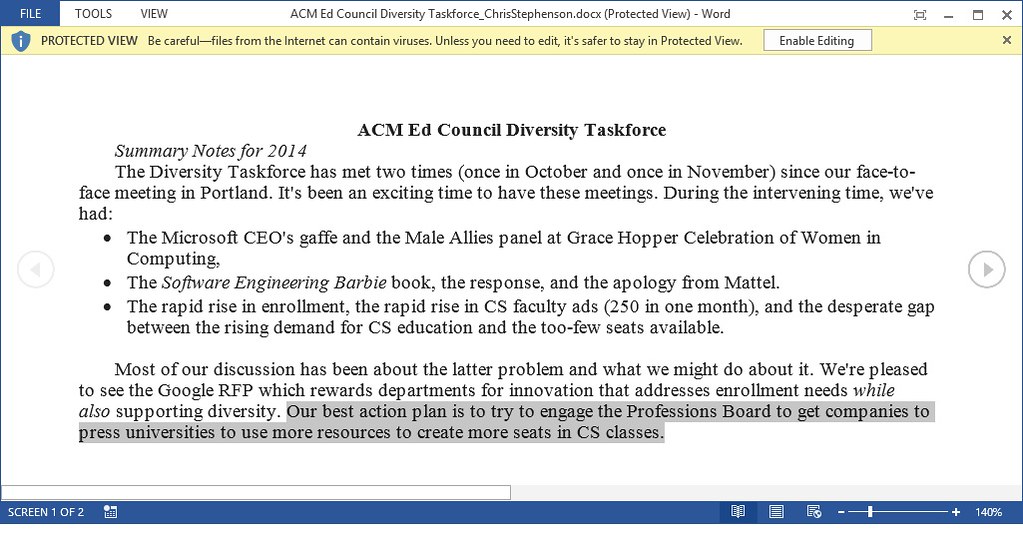
theodp (442580) writes "Nice computer industry you got there. Hate to see something bad happen to it." That's the gist of a letter sent by Microsoft, Amazon, Facebook, Google, Code.org, and other tech giants earlier this week asking the WA State Legislature to approve $40M in capital spending to help fund a new $110M University of Washington computer science building ($70M will be raised privately). "As representatives of companies and businesses that rely on a ready supply of high quality computer science graduates," wrote the letter's 23 signatories, "we believe it is critical for the State to invest in this sector in a way that ensures its vibrancy and growth. Our vision is for Washington to continue to lead the way in technology and computer science, but we must keep pace with the vast demand." The UW Dept. of Computer Science & Engineering profusely thanked tech leaders for pressing for a new building, which UW explained "will accommodate a doubling of our enrollment." Coincidentally, the corporate full-press came not long after the ACM Education Council Diversity Taskforce laid out plans "to get companies to press universities to use more resources to create more seats in CS classes" to address what it called "the desperate gap between the rising demand for CS education and the too-few seats available. -
Microsoft, Amazon, Google, Facebook Press WA For $40M For New UW CS Building
theodp (442580) writes "Nice computer industry you got there. Hate to see something bad happen to it." That's the gist of a letter sent by Microsoft, Amazon, Facebook, Google, Code.org, and other tech giants earlier this week asking the WA State Legislature to approve $40M in capital spending to help fund a new $110M University of Washington computer science building ($70M will be raised privately). "As representatives of companies and businesses that rely on a ready supply of high quality computer science graduates," wrote the letter's 23 signatories, "we believe it is critical for the State to invest in this sector in a way that ensures its vibrancy and growth. Our vision is for Washington to continue to lead the way in technology and computer science, but we must keep pace with the vast demand." The UW Dept. of Computer Science & Engineering profusely thanked tech leaders for pressing for a new building, which UW explained "will accommodate a doubling of our enrollment." Coincidentally, the corporate full-press came not long after the ACM Education Council Diversity Taskforce laid out plans "to get companies to press universities to use more resources to create more seats in CS classes" to address what it called "the desperate gap between the rising demand for CS education and the too-few seats available. -
How Gaseous, Neptune-Like Planets Can Become Habitable
An anonymous reader writes: Life as we know it requires small, rocky planets. The gas giants of our solar system aren't habitable (to our knowledge), but a research team has discovered that smaller, Neptune-like planets can be transformed into gas-free, potentially habitable worlds with a little help from red dwarf stars. Such planets are usually formed far out in a planetary system, but tidal forces can cause them to migrate inward. When they reach the habitable zone of their host star, they absorb far larger amounts of x-ray and ultraviolet radiation. This can eventually boil off most of the the gas atmosphere, leaving behind the core: a small, rocky world capable of supporting life. -
How Gaseous, Neptune-Like Planets Can Become Habitable
An anonymous reader writes: Life as we know it requires small, rocky planets. The gas giants of our solar system aren't habitable (to our knowledge), but a research team has discovered that smaller, Neptune-like planets can be transformed into gas-free, potentially habitable worlds with a little help from red dwarf stars. Such planets are usually formed far out in a planetary system, but tidal forces can cause them to migrate inward. When they reach the habitable zone of their host star, they absorb far larger amounts of x-ray and ultraviolet radiation. This can eventually boil off most of the the gas atmosphere, leaving behind the core: a small, rocky world capable of supporting life. -
How a Shaking Stadium Is Helping Scientists Track Earthquakes
vinces99 writes Researchers are installing three seismometers in Seattle's CenturyLink stadium to monitor shaking from Seahawks fans during Saturday's NFL playoff game. The new, faster data transmission will show crowd motion on the website before a touchdown shows up on the 10-second delayed TV broadcast. Researchers dub these "Early Earthquake Rowdiness Warnings." A guaranteed shaking and intense public interest gives the seismologists a unique opportunity to test new technology that gives seconds to minutes warning of a real earthquake. -
Warmer Pacific Ocean Could Release Millions of Tons of Methane
vinces99 writes: Off the U.S. West Coast, methane gas is trapped in frozen layers below the seafloor. New research from the University of Washington shows that water at intermediate depths is warming enough to cause these carbon deposits to melt, releasing methane into the sediments and surrounding water. Researchers found that water off the coast of Washington is gradually warming at a depth of 500 meters (about a third of a mile down), the same depth where methane transforms from a solid to a gas. The research suggests that ocean warming could be triggering the release of a powerful greenhouse gas (abstract).
Scientists believe global warming will release methane from gas hydrates worldwide, but most of the focus has been on the Arctic. The new paper estimates that, from 1970 to 2013, some 4 million metric tons of methane has been released from hydrate decomposition off Washington's coast. That's an amount each year equal to the methane from natural gas released in the 2010 Deepwater Horizon blowout off the coast of Louisiana, and 500 times the rate at which methane is naturally released from the seafloor. -
'Mirage Earth' Exoplanets May Have Burned Away Chances For Life
vinces99 writes: Planets orbiting close to low-mass stars — easily the most common stars in the universe — are prime targets in the search for extraterrestrial life. But new research led by an astronomy graduate student at the University of Washington indicates some such planets may have long since lost their chance at hosting life because of intense heat during their formative years. Low-mass stars, also called M dwarfs, are smaller than the sun, and also much less luminous, so their habitable zone tends to be fairly close in. The habitable zone is that swath of space that is just right to allow liquid water on an orbiting planet's surface, thus giving life a chance. [Researchers found] through computer simulations that some planets close to low-mass stars likely had their water and atmospheres burned away when they were still forming because they were exposed to high temperatures from their parent stars. -
LinkedIn Study: US Attracting Fewer Educated, Highly Skilled Migrants
vinces99 writes The U.S. economy has long been powered in part by the nation's ability to attract the world's most educated and skilled people to its shores. But a new study of the worldwide migration of professionals to the U.S. shows a sharp drop-off in its proportional share of those workers – raising the question of whether the nation will remain competitive in attracting top talent in an increasingly globalized economy. The study, which used a novel method of tracking people through data from the social media site LinkedIn, is believed to be the first to monitor global migrations of professionals to the U.S., said co-author Emilio Zagheni, a University of Washington assistant professor of sociology and fellow of the UW eScience Institute. Among other things, the study, presented recently in Barcelona, Spain, found that just 13 percent of migrating professionals in the sample group chose the U.S. as a destination in 2012, down from 27 percent in 2000. -
Major Brain Pathway Rediscovered After Century-old Confusion, Controversy
vinces99 writes A couple of years ago a scientist looking at dozens of MRI scans of human brains noticed something surprising: A large fiber pathway that seemed to be part of the network of connections that process visual information that wasn't mentioned in any modern-day anatomy textbooks. "It was this massive bundle of fibers, visible in every brain I examined," said Jason Yeatman, a research scientist at the University of Washington's Institute for Learning & Brain Sciences. "... As far as I could tell, it was absent from the literature and from all major neuroanatomy textbooks.'"With colleagues at Stanford University, Yeatman started some detective work to figure out the identity of that mysterious fiber bundle. The researchers found an early 20th century atlas that depicted the structure, now known as the vertical occipital fasciculus. But the last time that atlas had been checked out was 1912, meaning the researchers were the first to view the images in the last century. They describes the history and controversy of the elusive pathway in a paper published Nov. 17 in the Proceedings of the National Academy of Sciences. You'd think that we'd have found all the parts of the human body by now, but not necessarily. -
Study Shows Direct Brain Interface Between Humans
vinces99 writes University of Washington researchers have successfully replicated a direct brain-to-brain connection between pairs of people as part of a scientific study following the team's initial demonstration a year ago. In the newly published study, which involved six people, researchers were able to transmit the signals from one person's brain over the Internet and use these signals to control the hand motions of another person within a split second of sending that signal. -
New Study Shows Three Abrupt Pulses of CO2 During Last Deglaciation
vinces99 writes A new study shows that the increase of atmospheric carbon dioxide that contributed to the end of the last ice age more than 10,000 years ago did not occur gradually but rather was characterized by three abrupt pulses. Scientists are not sure what caused these abrupt increases, during which carbon dioxide levels rose about 10 to 15 parts per million – or about 5 percent per episode – during a span of one to two centuries. It likely was a combination of factors, they say, including ocean circulation, changing wind patterns and terrestrial processes. The finding, published Oct. 30 in the journal Nature, casts new light on the mechanisms that take the Earth in and out of ice ages.
"We used to think that naturally occurring changes in carbon dioxide took place relatively slowly over the 10,000 years it took to move out of the last ice age," said lead author Shaun Marcott, who did the work as a postdoctoral researcher at Oregon State University and is now at the University of Wisconsin-Madison. "This abrupt, centennial-scale variability of CO2 appears to be a fundamental part of the global carbon cycle."
Previous research has hinted at the possibility that spikes in atmospheric carbon dioxide may have accelerated the last deglaciation, but that hypothesis had not been resolved, the researchers say. The key to the new finding is the analysis of an ice core from the West Antarctic that provided the scientists with an unprecedented glimpse into the past." -
Be True To Your CS School: LinkedIn Ranks US Schools For Job-Seeking Programmers
theodp writes "The Motley Fool reports that the Data Scientists at LinkedIn have been playing with their Big Data, ranking schools based on how successful recent grads have been at landing desirable software development jobs. Here's their Top 25: CMU, Caltech, Cornell, MIT, Princeton, Berkeley, Univ. of Washington, Duke, Michigan, Stanford, UCLA, Illinois, UT Austin, Brown, UCSD, Harvard, Rice, Penn, Univ. of Arizona, Harvey Mudd, UT Dallas, San Jose State, USC, Washington University, RIT. There's also a shorter list for the best schools for software developers at startups, which draws a dozen schools from the previously mentioned schools, and adds Columbia, Univ. of Virginia, and Univ. of Maryland College Park. If you're in a position to actually hire new graduates, how much do you care about applicants' alma maters? -
Early Childhood Neglect Associated With Altered Brain Structure, ADHD
vinces99 writes "Under the rule of dictator Nicolae Ceausescu, thousands of Romanian children were placed in overcrowded orphanages with bleak conditions and minimal human contact, a legacy that continued even after the 1989 revolution. Only recently have research and public concern caused policy changes.
University of Washington research on children who began life in these institutions shows that early childhood neglect is associated with changes in brain structure. A paper published this month in Biological Psychiatry shows that children who spent their early years in these institutions have thinner brain tissue in cortical areas that correspond to impulse control and attention. "These differences suggest a way that the early care environment has dramatic and lasting effects for children's functioning," said lead author Katie McLaughlin, a UW assistant professor of psychology.
Since 2000, the Bucharest Early Intervention Project has worked to document and treat the children's health. McLaughlin joined the team about six years ago to focus on brain development. This study is among the first in any setting to document how social deprivation in early life affects the thickness of the cortex, the thin folded layer of gray matter that forms the outer layer of the brain. The study provides "very strong support" for a link between the early environment and ADHD, McLaughlin said. -
Fusion Reactor Concept Could Be Cheaper Than Coal
vinces99 writes Fusion energy almost sounds too good to be true – zero greenhouse gas emissions, no long-lived radioactive waste, a nearly unlimited fuel supply. Perhaps the biggest roadblock to adopting fusion energy is that the economics haven't penciled out. Fusion power designs aren't cheap enough to outperform systems that use fossil fuels such as coal and natural gas. University of Washington engineers hope to change that. They have designed a concept for a fusion reactor that, when scaled up to the size of a large electrical power plant, would rival costs for a new coal-fired plant with similar electrical output. The team published its reactor design and cost-analysis findings last spring and will present results Oct. 17 at the International Atomic Energy Agency's Fusion Energy Conference in St. Petersburg, Russia. -
New Study Projects World Population of 11B by 2100
vinces99 (2792707) writes Using modern statistical tools, a new study led by the University of Washington and the United Nations finds that world population is likely to keep growing throughout the 21st century. The number of people on Earth is likely to reach 11 billion by 2100, the study concludes, about 2 billion higher than widely cited previous estimates. The paper published online Sept. 18 in the journal Science includes the most up-to-date numbers for future world population, and describes a new method for creating such estimates. "The consensus over the past 20 years or so was that world population, which is currently around 7 billion, would go up to 9 billion and level off or probably decline," said corresponding author Adrian Raftery, a UW professor of statistics and of sociology. ... The paper explains the most recent United Nations population data released in July. This is the first U.N. population report to use modern statistics, known as Bayesian statistics, that combines all available information to generate better predictions.
Most of the anticipated growth is in Africa, where population is projected to quadruple from around 1 billion today to 4 billion by the end of the century. The main reason is that birth rates in sub-Saharan Africa have not been going down as fast as had been expected. There is an 80 percent chance that the population in Africa at the end of the century will be between 3.5 billion and 5.1 billion people. -
California Blue Whales Rebound From Whaling
vinces99 writes: The number of California blue whales has rebounded to near historical levels, according to new research (abstract) by the University of Washington, and while the number of blue whales struck by ships is likely above allowable U.S. limits, such strikes do not immediately threaten that recovery. This is the only population of blue whales known to have recovered from whaling – blue whales as a species having been hunted nearly to extinction. Blue whales – nearly 100 feet in length and weighing 190 tons as adults – are the largest animals on Earth and the heaviest ever, weighing more than twice as much as the largest known dinosaur, the Argentinosaurus. They are an icon of the conservation movement and many people want to minimize harm to them, according to Trevor Branch, UW assistant professor of aquatic and fishery sciences. California blue whales, most visible while feeding 20 to 30 miles off the California coast, range from the equator to the Gulf of Alaska. Today they number about 2,200, according to monitoring by other research groups, which is likely about 97 percent of the historical levels. -
Scientists Craft Seamless 2D Semiconductor Junctions
vinces99 (2792707) writes Scientists have developed what they believe is the thinnest-possible semiconductor, a new class of nanoscale materials made in sheets only three atoms thick. The University of Washington researchers have demonstrated that two of these single-layer semiconductor materials can be connected in an atomically seamless fashion known as a heterojunction. This result could be the basis for next-generation flexible and transparent computing, better light-emitting diodes, or LEDs, and solar technologies.
"Heterojunctions are fundamental elements of electronic and photonic devices," said senior author Xiaodong Xu, a UW assistant professor of materials science and engineering and of physics. "Our experimental demonstration of such junctions between two-dimensional materials should enable new kinds of transistors, LEDs, nanolasers, and solar cells to be developed for highly integrated electronic and optical circuits within a single atomic plane." -
Cause of Global Warming 'Hiatus' Found Deep In the Atlantic
vinces99 writes with news about a study that may account for a slowdown in air temperature rises. Following rapid warming in the late 20th century, this century has so far seen surprisingly little increase in the average temperature at the Earth's surface. More than a dozen theories have now been proposed for the so-called global warming hiatus, ranging from air pollution to volcanoes to sunspots. New research from the University of Washington shows the heat absent from the surface is plunging deep in the north and south Atlantic Ocean, and is part of a naturally occurring cycle. The study is published in Science. Subsurface ocean warming explains why global average air temperatures have flatlined since 1999, despite greenhouse gases trapping more solar heat at the Earth's surface. "Every week there's a new explanation of the hiatus," said corresponding author Ka-Kit Tung, a UW professor of applied mathematics and adjunct faculty member in atmospheric sciences. "Many of the earlier papers had necessarily focused on symptoms at the surface of the Earth, where we see many different and related phenomena. We looked at observations in the ocean to try to find the underlying cause." What they found is that a slow-moving current in the Atlantic, which carries heat between the two poles, sped up earlier this century to draw heat down almost a mile (1,500 meters). Most previous studies focused on shorter-term variability or particles that could block incoming sunlight, but they could not explain the massive amount of heat missing for more than a decade. -
Harvesting Wi-Fi Backscatter To Power Internet of Things Sensors
vinces99 (2792707) writes "Imagine a world in which your wristwatch or other wearable device communicates directly with your online profiles, storing information about your daily activities where you can best access it – all without requiring batteries. Or, battery-free sensors embedded around your home that could track minute-by-minute temperature changes and send that information to your thermostat to help conserve energy. This not-so-distant 'Internet of Things' reality would extend connectivity to perhaps billions of devices. Sensors could be embedded in everyday objects to help monitor and track everything from the structural safety of bridges to the health of your heart. But having a way to cheaply power and connect these devices to the Internet has kept this from taking off. Now, University of Washington engineers have designed a new communication system that uses radio frequency signals as a power source and reuses existing Wi-Fi infrastructure to provide Internet connectivity to these devices. Called Wi-Fi backscatter, this technology is the first that can connect battery-free devices to Wi-Fi infrastructure. The researchers will publish their results at the Association for Computing Machinery's Special Interest Group on Data Communication's annual conference this month in Chicago. The team also plans to start a company based on the technology. The Pre-print research paper. -
Harvesting Wi-Fi Backscatter To Power Internet of Things Sensors
vinces99 (2792707) writes "Imagine a world in which your wristwatch or other wearable device communicates directly with your online profiles, storing information about your daily activities where you can best access it – all without requiring batteries. Or, battery-free sensors embedded around your home that could track minute-by-minute temperature changes and send that information to your thermostat to help conserve energy. This not-so-distant 'Internet of Things' reality would extend connectivity to perhaps billions of devices. Sensors could be embedded in everyday objects to help monitor and track everything from the structural safety of bridges to the health of your heart. But having a way to cheaply power and connect these devices to the Internet has kept this from taking off. Now, University of Washington engineers have designed a new communication system that uses radio frequency signals as a power source and reuses existing Wi-Fi infrastructure to provide Internet connectivity to these devices. Called Wi-Fi backscatter, this technology is the first that can connect battery-free devices to Wi-Fi infrastructure. The researchers will publish their results at the Association for Computing Machinery's Special Interest Group on Data Communication's annual conference this month in Chicago. The team also plans to start a company based on the technology. The Pre-print research paper. -
Oso Disaster Had Its Roots In Earlier Landslides
vinces99 writes: The disastrous March 22 landslide that killed 43 people in the rural Washington state community of Oso involved the "remobilization" of a 2006 landslide on the same hillside, a new federally sponsored geological study concludes. The research indicates the landslide, the deadliest in U.S. history, happened in two major stages. The first stage remobilized the 2006 slide, including part of an adjacent forested slope from an ancient slide, and was made up largely or entirely of deposits from previous landslides. The first stage ultimately moved more than six-tenths of a mile across the north fork of the Stillaguamish River and caused nearly all the destruction in the Steelhead Haven neighborhood. The second stage started several minutes later and consisted of ancient landslide and glacial deposits. That material moved into the space vacated by the first stage and moved rapidly until it reached the trailing edge of the first stage, the study found. "Perhaps the most striking finding is that, while the Oso landslide was a rare geologic occurrence, it was not extraordinary," said Joseph Wartman, a University of Washington associate professor of civil and environmental engineering and a team leader for the study. -
Air Pollution Can Disrupt Pollinating Insects By Concealing the Scent of Flowers
vinces99 writes Car and truck exhaust fumes that foul the air for humans also cause problems for pollinators. In new research on how pollinators find flowers when background odors are strong, University of Washington and University of Arizona researchers found that both natural plant odors and human sources of pollution can conceal the scent of sought-after flowers. When the calories from one feeding of a flower gets you only 15 minutes of flight, as is the case with the tobacco hornworn moth studied, being misled costs a pollinator energy and time. "Local vegetation can mask the scent of flowers because the background scents activate the same moth olfactory channels as floral scents," according to Jeffrey Riffell, UW assistant professor of biology. "Plus the chemicals in these scents are similar to those emitted from exhaust engines and we found that pollutant concentrations equivalent to urban environments can decrease the ability of pollinators to find flowers." -
Discrete Logarithm Problem Partly Solved -- Time To Drop Some Crypto Methods?
An anonymous reader points out this Science Daily report: "Researchers ... have solved one aspect of the discrete logarithm problem. This is considered to be one of the 'holy grails' of algorithmic number theory, on which the security of many cryptographic systems used today is based. They have devised a new algorithm that calls into question the security of one variant of this problem, which has been closely studied since 1976. The result ... discredits several cryptographic systems that until now were assumed to provide sufficient security safeguards. Although this work is still theoretical, it is likely to have repercussions especially on the cryptographic applications of smart cards, RFID chips , etc." -
Gary Kildall, Father of the PC OS, Finally Gets His Due
theodp writes: "GeekWire reports that Gary Kildall, the creator of the landmark personal computer operating system CP/M, will be recognized posthumously by the IEEE for that contribution, in addition to his invention of BIOS, with a rare IEEE Milestone plaque. Kildall, who passed away in 1994 at the age of 52, has been called the man who could have been Bill Gates. But according to Kildall's son, his dad wasn't actually interested in being what Bill Gates became: 'He was a real inventor,' said Scott Kildall. 'He was much more interested in creating new ideas and bringing them to the world, rather than being the one that was bringing them to market and leveraging a huge amount of profits. He was such a kind human being. He was always sharing his ideas, and would sit down with people and show flowcharts of what he was thinking. I think if he were around for the open-source movement, he would be such a huge proponent of it.' Techies of a certain age will also remember Gary's work as a co-host of Computer Chronicles." -
Bug Bounties Don't Help If Bugs Never Run Out
Bennett Haselton writes: "I was an early advocate of companies offering cash prizes to researchers who found security holes in their products, so that the vulnerabilities can be fixed before the bad guys exploited them. I still believe that prize programs can make a product safer under certain conditions. But I had naively overlooked that under an alternate set of assumptions, you might find that not only do cash prizes not make the product any safer, but that nothing makes the product any safer — you might as well not bother fixing certain security holes at all, whether they were found through a prize program or not." Read on for the rest of Bennett's thoughts.In 2007 I wrote:
It's virtually certain that if a company like Microsoft offered $1,000 for a new IE exploit, someone would find at least one and report it to them. So the question facing Microsoft when they choose whether to make that offer, is: Would they rather have the $1,000, or the exploit? What responsible company could possibly choose "the $1,000"? Especially considering that if they don't offer the prize, and as a result that particular exploit doesn't get found by a white-hat researcher, someone else will probably find it and sell it on the black market instead?
Well, I still believe that part's true. You can visualize it even more starkly this way: A stranger approaches a company like Microsoft holding two envelopes, one containing $1,000 cash, and the other containing an IE security vulnerability which hasn't yet been discovered in the wild, and asks Microsoft to pick one envelope. It would sound short-sighted and irresponsible for Microsoft to pick the envelope containing the cash — but when Microsoft declines to offer a $1,000 cash prize for vulnerabilities, it's exactly like choosing the envelope with the $1,000. You might argue that it's "not exactly the same" because Microsoft's hypothetical $1,000 prize program would be on offer for bugs which haven't been found yet, but I'd argue that's a distinction without a difference. If Microsoft did offer a $1,000 prize program, it's virtually certain that someone would come forward with a qualifying exploit (and if nobody did, then the program would be moot anyway) — so both scenarios simply describe a choice between $1,000 and finding a new security vulnerability.
But I would argue that there are certain assumptions under which it would make sense not to offer a cash prize program — and, in keeping with my claim that this is equivalent to the envelope-choice problem, under those assumptions it actually would make sense for Microsoft to turn down the envelope containing the vulnerability, and take the cash instead. (When I say it would "make sense", I mean both from a profit-motive standpoint, and for the purposes of protecting the security of their users' computers.)
On Monday night I saw a presentation put on by Seattle's Pacific Science Center "Science Cafe" program, in which Professor Tadayoshi Kohno described how he and his team were able to defeat the security protocols of a car's embedded computer system by finding and exploiting a buffer overflow. That's scary enough, but it was more interesting how his description of the task made it sound like a foregone conclusion that they would find one — you simply sink this many person-hours into the task of looking for a buffer overflow, and eventually you'll find one that can enable a complete takeover of the car. (He confirmed to me afterwards that in his estimation, once the manufacturer had fixed that vulnerability, he figured his same team could have found another one with the same amount of effort.)
More generally, I think it's reasonable to assume that for a given product, there is a certain threshold amount of money/effort/person-hours such that if you throw that much effort at finding a new security vulnerability, you will always find a new one. Suppose you call this the "infinite bug threshold." Obviously the amount of vulnerabilities is not really infinite — you can only do finitely many things to a product in a finite amount of time, after all — but suppose it's so close to infinite as to make no difference, because the manufacturer would never be able to fix all the vulnerabilities that could be found for that amount of effort. I'm sure that $10 million worth of effort, paid to the right people, will always find you a new security vulnerability in the Apache web server; the same is probably true for some dollar number much lower than that, and you could call that the "infinite bug threshold". On the other hand, by definition of that threshold, that means that the amount of vulnerabilities that can be found for any amount of money below that, will be finite and manageable.
(I'm hand-waving over some details here, such as the disputes over whether two different bugs are really considered "distinct," or the fact that once you've found one vulnerability, the cost of finding other closely related vulnerabilities in the same area of the product, often goes way down. But I don't think these complications negate the argument.)
Meanwhile, you have the black-market value of a given type of vulnerability in a given product. This may be the value that you could actually sell it for on the black market, or it may be the maximum amount of effort that a cyber-criminal would invest in finding a new vulnerability. If a cyber-criminal will only start looking for a particular type of vulnerability if they estimate they can find one for less than $50,000 worth of effort, then $50,000 is how much that type of vulnerability is worth to them.
Now consider the case where
infinite bug threshold > black-market value
This is the good case. It means that if the manufacturer offered a prize equal to the black-market value of an exploit, any rational security researcher who found a vulnerability, could sell it to the manufacturer rather than offering it on the black market (assuming they would find the manufacturer more reliable and pleasant to deal with than the Russian cyber-mafia). And we're below the infinite bug threshold, so by definition the manufacturer only has to pay out a finite and manageable number of those prizes, before all such vulnerabilities have been found and fixed. I've made a couple of optimistic assumptions here, such as that the manufacturer would be willing to pay prizes in the first place, and that they could correctly estimate what the black-market value of a bug would be. But at least there's hope.
On other hand, if
infinite bug threshold < black market value
everything gets much worse. This means that no matter how many vulnerabilities you find and fix, by the definition of the infinite bug threshold there will always be another vulnerability that a black-hat will find it worthwhile to discover and exploit.
And that's the pessimistic scenario where it doesn't really matter whether Microsoft chooses the envelope with the vulnerability or the envelope with the $1,000, if the infinite-bug-threshold happens to be below $1,000. (Let's hope it's not that low in practice! But the same analysis would apply to any higher number.) If the black-market-value of a bug is at least $1,000, so that's what the attacker is willing to spend to find one, and if that's above the infinite-bug-threshold, then you might as well not bother fixing any particular bug at that level, because the attacker can always just find another one. It doesn't even matter whether you have a prize program or not; the product is in a permanent state of unfixable vulnerability.
At that point, the only ways to flip the direction of the inequality, to reach the state where "infinite bug threshold > black-market value", would be to decrease the black market value of the vulnerability, or increase the infinite bug threshold for your product. To decrease the black market value, you could implement more severe punishments for cyber-criminals, which makes them less willing to commit risky crimes using a security exploit. Or you could implement greater checks and balances to prevent financial fraud, which decreases the incentives for exploits. But these are society-wide changes that would not be under the control of the software manufacturer. (I'm not sure if there's anything a software company could do by themselves to lower the black-market value of a vulnerability in their product, other than voluntarily decreasing their own market share so that there are fewer computers that can be compromised using their software! Can you think of any other way?)
Raising the infinite bug threshold for the product, on the other hand, may require re-writing the software from scratch, or at least the most vulnerable components, paying stricter attention to security-conscious programming standards. Professor Kohno said after his talk that he believed that if the programmers of the car's embedded systems had followed better security coding practices, such as the principle of least privilege, then his team would not have found vulnerabilities so easily.
I still believe that cash prizes have the potential to achieve security utopia, at least with regard to the particular programs the prizes are offered for — but only where the "infinite bug threshold > black-market value" inequality holds, and only if the company is willing to offer the prizes. If the software is written in a security-conscious manner such that the infinite bug threshold is likely to be higher than the black-market value, and the manufacturer offers a vulnerability prize at least equal to the black-market value, then virtually all vulnerabilities which can be found for less than that much effort, will be reported to the manufacturer and fixed. Once that nirvana has been achieved, for an attacker to find a new exploit, the attacker would have to be (1) irrational (spending an estimated $70,000 to find a vulnerability that is only worth $50,000), and (2) evil beyond merely profit motive (using the bug for $50,000 of ill-gotten gain, instead of simply turning it in to the manufacturer for the same amount of money!). That's not logically impossible, but we would expect it to be rare.
On the other hand, for programs and classes of vulnerabilities where "infinite bug threshold < black-market value", there is literally nothing that can be done to make them secure against an attacker who has time to find the next exploit. You can have multiple lines of defense, like installing anti-virus software on your PC in case a website uses a vulnerability in Internet Explorer to try and infect your computer with a virus. But Kaspersky doesn't make anything for cars.
-
Fruit Flies, Fighter Jets Use Similar Evasive Tactics When Attacked
vinces99 writes: "When startled by predators, tiny fruit flies respond like fighter jets – employing screaming-fast banked turns to evade attacks. Researchers at the University of Washington used an array of high-speed video cameras operating at 7,500 frames a second to capture the wing and body motion of flies after they encountered a looming image of an approaching predator (abstract). 'We discovered that fruit flies alter course in less than one one-hundredth of a second, 50 times faster than we blink our eyes, and which is faster than we ever imagined.' In the midst of a banked turn, the flies can roll on their sides 90 degrees or more, almost flying upside down at times, said Florian Muijres, a UW postdoctoral researcher and lead author of the paper. 'These flies normally flap their wings 200 times a second and, in almost a single wing beat, the animal can reorient its body to generate a force away from the threatening stimulus and then continues to accelerate,' he said." -
Firefox 29 Beta Arrives With UI Overhaul And CSS3 Variables
An anonymous reader writes "Following the release of Firefox 28 just two days ago, Mozilla today updated its Firefox Beta channel to version 29 for Windows, Mac, Linux, and Android. This is a massive release: Firefox Sync has been revamped and is now powered by Firefox Accounts, there's a new customization mode, and the major user interface overhaul Australis has finally arrived. Release notes are here: Desktop and Android." Of interest to developers: Firefox 29 will feature the first implementation of CSS3 variables. Yes, variables for CSS (15 years later).