 Slashdot Mirror
Domain: wikimedia.org
Stories and comments across the archive that link to wikimedia.org.
Comments · 6,832
-
Re:Huh
> A more radical break would almost certainly have had an even tougher road ahead.
This is why we are still waiting for Perl 6, if it ever gets released.
It's just too radical a break from what the Perl community expects. Even if you've never used Perl, you can tell from the drastic difference between Perl 5's dependable Camel to Perl 6's Camelia.
-
Re:Huh
> A more radical break would almost certainly have had an even tougher road ahead.
This is why we are still waiting for Perl 6, if it ever gets released.
It's just too radical a break from what the Perl community expects. Even if you've never used Perl, you can tell from the drastic difference between Perl 5's dependable Camel to Perl 6's Camelia.
-
Re:What 20 years of research on pot has taught us
> Adverse effects of acute cannabis use
- Cannabis does not produce fatal overdoses.Indeed! There is no LD50 for Cannabis that I'm aware of
It is hypocritical that some far worse drugs have social acceptance such as caffeine, nicotine, and alcohol, while safer drugs are socially ostracized.
-
Re:The best keyboard is the IIGS ADB original.
One of my favorite keyboards is the one from ABC 802. It doesn't have enough keys for use today, but for its intended uses it was perfect. The grey plate that surrounds the keys is 5mm solid aluminum plate. The included wrist rest is some sort of a wood-based composite, nicely insulating the carpal tunnel from the aluminum heatsink.
I still keep the little bugger in a closet and fire it up every now and then. And to think I've had email running on it, written in BASIC, running over serial TCP/IP at 19,200 bps. Yep, everything was in BASIC, the TCP/IP stack included. Obviousl, being busy with all that, my high school performance was otherwise "poor".
Their BASIC was to die for, the fastest BASIC I've ever used on a Z80 machine.
-
Re:Trading Freedom for Security?
-
Re:Pigs are dependent on humanity?
Pretty sure that the same argument can be applied to justify eating human babies.
...And that would prevent them from becoming a burden to their parents or country while making them beneficial to the publick.
-
Re:General Moters
There where plenty of electric vehicles prior to General Moters buying all the street-car companies and replacing the cars with diesel buses.
The truth is that the street car and interurban rail (suburban commuter lines) were dead on their feet before World War I.
The street car ticket cost five cents.
It was an expensive business, maintaining tracks, cars and overheads.
The Ford car cost about a penny a mile, portal-to-portal, for a family of four plus dog and cargo.
You could shop the big downtown department stores, the new self-service supermarkets, and not pay a dime extra for merchant home delivery.
This photograph suggests the big-city reality of 1920, fifteen years earlier, you would be dodging horses and wagons, bicycles, and push carts to reach the cars. It could be quite a challenge, particularly for a woman.
-
Re:unsubstantiated hope and guessing
One hundred years ago the progress of passenger steamship development was proceeding at a very fast pace. There were some Titanic failures along the way, but we were learning.
Perhaps that progress slowed down towards the end as the hull speed barrier was hard to overcome. Bow bulbs only get you so much extra.
But then someone came along and invented the trans-atlantic airliner.
Crystalline Si photocells may indeed max out at 65% efficiency, but we aren't anywhere near to that yet and still progressing quickly
http://upload.wikimedia.org/wi...
There is no other way to read these charts than to admit that we live in exciting times for solar research.
And when we do get there with Si photocells, what makes you think that we'll stop at that chemistry and not change over to another solar technology?
-
Re:MDMA Demand
How do you powder molly?
-
Re:net metering != solar and 10% needs new physics
Aquion batteries are saltwater based and use no lead or rare earths. They were specifically designed with the impact of resource limitations on grid-scale battery deployment in mind, because that is their target market.
And no, lead is a rare earth, and isn't actually all that common compared to the truly common elements in the earth's crust.
http://upload.wikimedia.org/wi...
That's by atoms compared to silicon rather than mass, but consider that the vertical axis is logaithmic that's mostly not going to make a huge difference in relative abundance. Compared to lead there's 160,000 times as much oxygen, 10,000x as much hydrogen, 2,500x as much manganese, 180 times as much carbon, and 63x as much sulfur. All of which are rock-forming elements much more accessible and less toxic than lead. And guess what - I just listed the primary elemental components of an Aquion battery. -
Re:Start menu usage dropped in lieu of what?
It's a shame that the same ugly style is now being incorporated to the Start Menu too. I think it's a big step backwards from the nice looking Windows 7 Start Menu.
-
Re:Should we?
The only safe ship is the one that never leaves harbor...
Ouch!
-
Re:Really?
See, just as I suspected. That's not taxpayer money. The "EEG Umlage" is not a tax (taxes are not bound to a particular usage). The fixed compensation is paid by the consumers as part of the electricity price and only used to pay for electricity, that which is fed into the grid by renewable energy sources. It's almost completely compensated for by the reduced wholesale price that resulted from the availability of renewable power at the electricity exchanges. Here is a nice graph to illustrate that fact. The subsidies for the nuclear power industry on the other hand are paid from taxes, which is why nobody makes a fuss about them.
-
Re: Really?
Roof top solar power generation comes in at a price firmly below current retail price in Germany, including financing costs, etc. That is despite Germany's unfavorable climate. If you use all your solar generated electricity, it will lower your electricity bill, with not a cent in subsidies exchanging hands. The guaranteed price for excess electricity is already significantly below retail price (about half) and scheduled to decline further. The crossover was ca. two years ago.
The widely hated "EEG Umlage", the part of the price per kWh which (completely) pays for the price guarantee on renewable energy fed into the grid, is expected to remain the same or decrease next year. Take a look at this graph showing the components of the kWh price. Over 10 years from 2002 to 2012, the electricity price increased from 16ct/kWh to 26ct/kWh (ca. 60% increase). In the same timeframe, heating oil (diesel without the taxes) more than doubled in price: 35ct/l to 85ct/l for a 140% increase. Also note that the disproportional increase in the "EEG Umlage" since 2009 is accompanied by a decrease of the wholesale price: The effect of the renewables on the wholesale electricity price compensates the "EEG Umlage" almost completely.
-
Re:Not so....
Actually, the cost of subsidizing solar and wind has doubled the cost of power in Germany.
It has done no such thing, neither wholesale nor retail.
Germany's power industry is increasing the amount of energy generated with coal. That's because coal power is the cheapest and they need some way to keep down those skyrocketing prices.
No. The long term trend for coal is down. The recent small increases are no bigger than previous fluctuations and mostly compensate for a small part of the reduction of nuclear power generation (the majority of which is compensated for by increased renewables.
The good thing here is that renewables are almost at a point where they're viable even without subsidies, so you can "disagree" and spread the lies all you want: It won't matter. Wind and solar are taking off, whether you're on board or not.
-
Re:Not MAD.
MIRV = Multiple independently targetable reentry vehicle. So each of those 1500 MIRVs carries multiple nuclear warheads. Need five mid-sized nukes to wipe out NYC? No problem. Ten for LA? Still no problem. One missile each, just program in your preferred detonation pattern for the warheads:
http://en.wikipedia.org/wiki/M...
Here's a long-exposure photo of a single "Peacekeeper" missile dropping eight independent warheads (unarmed in this case):
-
Re:Works particularly well in SA/Victoria
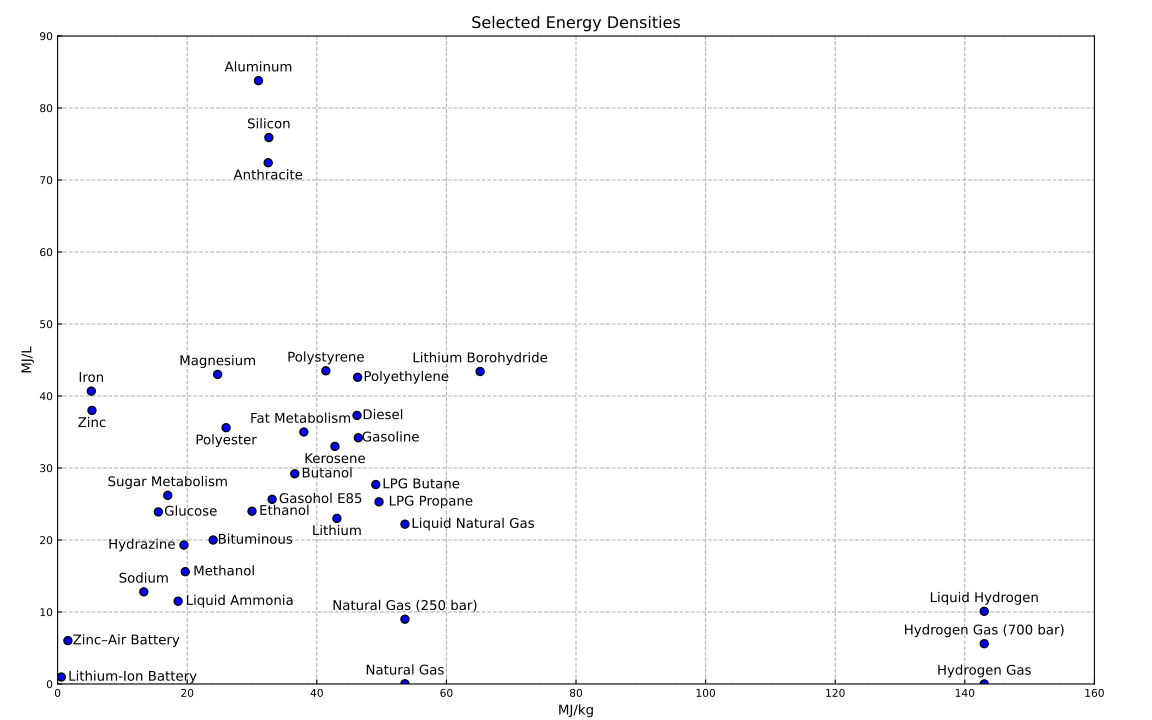
All you gotta do is store the electric temporarily in Edison nickel-iron tote batteries of 300 gals (1200L) each, then use that to run an electrolysis making iron(abundant) dust, or zinc blocks(not so abundant), things you can later recombust either for heat in the wintertime, or in a metal-air battery. Zinc stores nicely in stacks outside in the weather, but iron needs protection, such as the dust mixed up with an oil, that can be later washed off with pentane(or similar low boiler cyclic hydrocarbons for instance), or even hot water soap, but with pentane you can drop the clean iron out after like 3 washes, then distill the pentane out at low temperature to recover both it and the oil, and also dry the metal in a pot to recover the pentane. It gets a little complex compared to zinc, but iron is abundant everywhere in the world, plus it may be easier to electrowin, with less gassing. On the Wikipedia energy density page http://upload.wikimedia.org/wi... you can see that both solid iron dust and zinc slabs have good volumetric energy storage capacities, though they are very heavy. Magnesium, aluminum and silicon are better, but no low temperature straightforward process is available for their extraction as metal, unlike zinc(with plating bath additives/pickling gas suppressors) and iron have easy aqueous electrolyte processing. In particular, unlike sodium in the Castner-Kellner process, or even calcium in the Humphry Davy amalgam process, magnesium does not form a good, strongly binding amalgam with a high hydrogen overpotential, but gasses out immediately, and it's not possible to low temperature electrowin into mercury, (or safer gallium/ldead/antimony/indium/tin/etc-like molten alloys), from which then it could be stripped in a lithium ion battery solvent aprotic electrolyte, electrolyzed directly into metal form, at room temperature. However calcium is possible, sodium and potassium too, which then can be thermite reacted with magnesium things, of course losing some energy in the process, but magnesium is both light to stack, and it has good atmospheric corrosion properties, better than iron. (Sodium, calcium or potassium are not possible to store well in a stack in open weather, unless complicated coated, like in a tote, but now it becomes expensive on the totes. And they are very dangerous for children to play with by accident.) Of course aluminum forms an amalgam with mercury too, but once it's bound to oxygen in any form, including any aqueous solution, it's near impossible to reduce, maybe unless you can form a conductive hydroxide precipitate layer on the surface of mercury, chromium electrolysis style, but I don't know if that also does not gas out with hydrogen fast, like magnesium does. And thermiting calcium with aluminum oxide gives an even greater energy loss than with magnesium. In any case, long term stacked outside in a pile ways of chemical energy storage methods should be happy with 50% efficiency of input energy recoverable, unlike with pumped hydro, which has limited capacity worldwide, but can do 90+% storage efficiency.
-
Re:What where they copying?
> How often does a new genre of gaming get created?
Pretty often in the 80's since the established genres were still being created! Today, not so much. Everything is cross genre these days.
id invented the First Person Shooter with Wolfenstein 3D (though purists might argue it was earlier
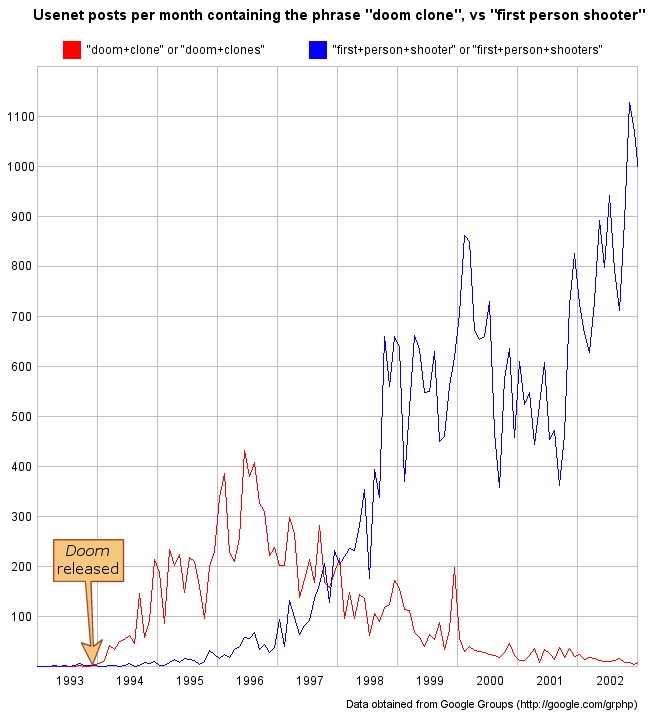
Doom settled the deal though: Doom Clone vs FPSColossal Cave Adventure was the first text adventure, but Infocom (with Zork) refined it.
> I often hear Blizzard criticized for not being original enough
That is definitely one criticism -- they just copy other people's gameplay and polish the art. They _used_ to have fun execution. Diablo 3 was a complete clusterfuck of bland and boring itemization
The other is the disrespect for player's time, and the constantly dumbing down and half-baked game play mechanics in all their latest games.
-
Re:Freeman Dyson
Oh, by the way, a correction is needed. I been thinking about this, hydrogen being the most excellent rocket fuel. Hydrogen has a high energy density on it's own, when atmospheric oxygen is plenty, but in a rocket you don't always have time to collect atmospheric oxygen, and outside the atmosphere it's no longer available, also it's almost not available as you go higher and higher in altitudes, where the air gets thinner and thinner. But for the lower portions of traveling through the atmosphere part, a Blackbird-spy-plane like drive based on light liquid hydrogen fuel + atmospheric oxygen might be justifiable, considering the cost of added complexity and weight compared to just a plain and simple less things to go wrong when it's time to switch propulsion methods to internal oxidizer+fuel mixtures.
With an internal oxidizer, such as liquid oxygen carried on the space shuttle, at an 8:1 liqO2/liqH2 ratio, (so hydrogen itself a mere 1/9 or 11.1% of the fuel mixture weight) hydrogen ranks fairly low amongst other rocket fuel combinations. The list I posted here long time ago on Wikipedia, http://en.wikipedia.org/wiki/T... also http://upload.wikimedia.org/wi..., and as you can see, as a mixture of reducer/oxidizer beryllium oxide tops the chart, followed by lithium fluoride, beryllium fluoride, etc. However these top lowest weight oxides per energy gained are all solid, so cannot be used directly as a rocket fuel, all you get during the reaction is just a white hot glowing mass of incandescent lava, that does not explode or generate pressure or want to create mechanical propulsion to fly anywhere. If you notice water is way down the page, and I put it down as a liquid to get a higher number for it, when it's usually combusted to vapor instead, getting a slightly lower number. Which explains the reason for solid rocket boosters for the space shuttle based on ammonal (aluminum/ammonium nitrate or similar perchlorate mixtures) where the aluminum actually generates the energy, and the mechanical carrier gases of that energy, like the evolved nitrogen and water vapor, do the propulsion. Beryllium is very toxic, as are most fluorides, and boron should not be used too much either, unless you deal with space propulsion, where under battle circumstances, you need top performance for military spaceships, and then beryllium and lithium fluoride emitted into the emptiness of space is of no concern. But I don't know. Maybe emitting magnesium fluoride or especially lithium fluoride might be tolerable, so a mix of liquid fluorine + oxygen at the right proportions with cryogenic nanoparticle lithium or lithium hydride (which loses some energy compared to bare metallic lithium) plus liquid hydrogen mixtures might be most efficient, where the lithium selectively seeks out the fluoride, and the hydrogen the oxide, the lithium being the major energy generator, and the hydrogen the major mechanical pressure propulsion generator. The maximum pressure is limited to the boiling point of lithium fluoride, which I'm lazy to look up now, but if it's over 2000C, thats a place where water naturally decomposes into hydrogen and oxygen, and no free energy gain from the reaction with oxygen can be obtained, which is why ammonal, where the nitrogen gas evolved can be heated to any desired temperature almost because of the strength of the nitrogen bond, might be better. But in fact, given enough energy by the aluminum, you don't really care if you're above 2000C, and the water is decomposed to even higher pressure gases of hydrogen and oxygen, getting you even more propulsion. So in effect, hydrogen itself as the propulsion gas may be most efficient, by weight, running off of the heat of beryllium oxide, or lithium fluoride, if you could design such a rocket engine able to combust it. Or even magnesium + liquid fluorine + liquid hydrogen, in a t -
Re:Not a problem...
Midwestern states had higher combined populations than the Northwestern states.
You truly are a blithering nincompoop, aren't you? Can't tell the difference between population and population density
Irony: calling the American Midwest "unpopulated", yet calling someone else (who points out that the Midwest is not, in fact, unpopulated) a "blithering nincompoop."
The word you may have meant to use is underpopulated. I know language is complicated, but despite sharing several letters, "un" and "under" do not, in fact, mean the same thing.
Sincerely - One of the tens of millions of people who live in the Midwest.
-
Re:Not a problem...
Midwestern states had higher combined populations than the Northwestern states.
You truly are a blithering nincompoop, aren't you? Can't tell the difference between population and population density
-
Re:On site transmutation
You are very rude.
Because you're being so disingenuous. Any time I show you how wrong you are using very basic mathematics, you just change the subject, or make a new equally outrageously wrong claim.
Anyhow, now that you're finally making claims which are at least vaguely quantitative and testable, we're at least getting somewhere.Scale the bean luminosity up by a factor of fifty and set one up at each power station and you are done in a year.
First off, I hope you meant beam current, not luminosity (since that's a property of accelerators with detectors), since that's the property that actually tells you the number of particles in the beam and therefore how many nuclei you can affect. Second, the rate at which you do it doesn't change the total energy investment needed, it'll still cost about $20bn/ton. Oh and how much such a large number of facilities would cost to build and operate is a whole other matter. Oh and the transmutation products might still very well produce a significant amount of decay heat, so you'll have averted exactly zero risks of meltdown (though this depends on the details of your proposal).
But go ahead, present your detailed numerical analysis. Perhaps you have some amazing physical insight that makes this all wonderfully efficient, safe and sensible. -
Thanks,
now I can't get this image out of my head http://upload.wikimedia.org/wi...
-
Re:Well, we really should be at that stage by now.
I agree. Ideally the whole country and the world should run on fully wind, solar and hydro, and then we can ban things like nuclear, and even coal and natural gas burnt for simply electric power in major power plants, not used as a chemical feedstock. And there is enough solar input to the world to cover the world's energy needs, true it does require a huge huge huge area and infrastructure. See the image by Matthias Loster, for what kind of area would be needed to supply all of the world's energy needs(including transportation, industrial, household, etc,) if it were based on silicon based solar cells, at: http://commons.wikimedia.org/w... also at http://www.ez2c.de/ml/solar_la...
Note that the black dots on that picture represent a huge huge huge area of land fully covered with solar cells, possibly beyond our economic means to accomplish, so we may need, at least for the present time, a secure fallback on high energy density and guaranteed availability, no bullshit nuclear power. But we should make all effort and strive for the ability to leave behind nuclear completely, and fully rely on renewables only.
-
Re:Well, we really should be at that stage by now.
Yeah well anyway, for nonmilitary uses, or especially for buses, they should keep all nuclear materials out of public life. Buses should be nuclear powered by electricity or ammonia coming from a well guarded, high security and military operated nuclear power plant, or even if private, the military participates and is fully involved, and has authority to dictate terms of operation above and beyond any private property owners and investors. Nuclear is important but not a joke. It has a potential for vast quantities of energy, but you have to transpose that into lower energy density chemical storage carriers.
For chemical energy storage, see http://en.wikipedia.org/wiki/E... and also http://upload.wikimedia.org/wi... . Btw, I'm the original creator of that MJ/L vs MJ/kg chart, back in like 2006, and some of the values on it I'm still not sure I did not make a mistake on, people should double check Wikipedia numbers. But the overall, large picture still stands, as far as trends go. I did it in Excel at first, then took a png screenshot of it, and some guy rewrote it in python. My posting of the original picture, is removed even from my wikipedia postings history, hmm, but I found it reposted here, http://commons.wikimedia.org/w... by http://commons.wikimedia.org/w... but she kept it under my public domain notice though so it's all good. (I guess they might worry about steganography which is why svg's are better than pngs, but it's not like you cannot do steganography with svg's, only your bandwidth or payload is less. I'm ok if you repost it, but it would be nice if that meant you also double checked the numbers to make sure I did not make mistakes). Anyway, the guy who rewrote it in python left boron off the chart which really flies off the top in volumetric energy density as raw fuel, in absence of the oxygen containing oxide, which btw, would have to be recycled, so heavy, and it's an unfairly large number on the chart then. Also boron is deadly to all chitin based life such as bugs and fungi, and polluting the environment full of it, other than trace quantities here and there (which is actually needed), would devastate the ecosystem of this planet, for any plant based life that depends on flowers (which is pretty much all plant life, except evergreen flowerless conifer forests way up the cold mountainside). Also lithium borohydride might look an amazing material compared to gasoline and diesel, but the fact is that hydrocarbons like fat, gasoline and diesel are king, because LiBH4 is a solid, and needs some kind of solvent, plus the end result of combustion is lithium borate, a heavy solid or ash, as opposed to gases of CO2, H2O, and N2, (minor NOx) with liquid hydrocarbons or just H2O (and minor NOx) with ammonia. Also hydrogen is off the chart as far as density by weight goes - it makes a great rocket fuel, where weight is absolutely everything, for super heavy freight payload space rockets where containment pressure surface weight is small compared to the huge bulk volume, but it is really poor on storage by volume - but for things where weight is not everything - including automotive applications - plus the quantities are small and the relative containment cylinder weight is very heavy, hydrogen is neither good by weight, and especially it sucks by density by volume, not even beating zinc air batteries at 700 bar (or 700x14.503= 10,000 psi compression, and all batteries are notoriously poor in energy density. and in the liquid state it requires constant venting and boil off to keep the temperatures low, including filling the atmosphere with hydrogen gas that ends up in the troposphere and at the prevailing Earth temperatures, it has enough escape velocity to leave the planet (which is why Earth is not a gas covered giant like Ju
-
Re:Well, we really should be at that stage by now.
Yeah well anyway, for nonmilitary uses, or especially for buses, they should keep all nuclear materials out of public life. Buses should be nuclear powered by electricity or ammonia coming from a well guarded, high security and military operated nuclear power plant, or even if private, the military participates and is fully involved, and has authority to dictate terms of operation above and beyond any private property owners and investors. Nuclear is important but not a joke. It has a potential for vast quantities of energy, but you have to transpose that into lower energy density chemical storage carriers.
For chemical energy storage, see http://en.wikipedia.org/wiki/E... and also http://upload.wikimedia.org/wi... . Btw, I'm the original creator of that MJ/L vs MJ/kg chart, back in like 2006, and some of the values on it I'm still not sure I did not make a mistake on, people should double check Wikipedia numbers. But the overall, large picture still stands, as far as trends go. I did it in Excel at first, then took a png screenshot of it, and some guy rewrote it in python. My posting of the original picture, is removed even from my wikipedia postings history, hmm, but I found it reposted here, http://commons.wikimedia.org/w... by http://commons.wikimedia.org/w... but she kept it under my public domain notice though so it's all good. (I guess they might worry about steganography which is why svg's are better than pngs, but it's not like you cannot do steganography with svg's, only your bandwidth or payload is less. I'm ok if you repost it, but it would be nice if that meant you also double checked the numbers to make sure I did not make mistakes). Anyway, the guy who rewrote it in python left boron off the chart which really flies off the top in volumetric energy density as raw fuel, in absence of the oxygen containing oxide, which btw, would have to be recycled, so heavy, and it's an unfairly large number on the chart then. Also boron is deadly to all chitin based life such as bugs and fungi, and polluting the environment full of it, other than trace quantities here and there (which is actually needed), would devastate the ecosystem of this planet, for any plant based life that depends on flowers (which is pretty much all plant life, except evergreen flowerless conifer forests way up the cold mountainside). Also lithium borohydride might look an amazing material compared to gasoline and diesel, but the fact is that hydrocarbons like fat, gasoline and diesel are king, because LiBH4 is a solid, and needs some kind of solvent, plus the end result of combustion is lithium borate, a heavy solid or ash, as opposed to gases of CO2, H2O, and N2, (minor NOx) with liquid hydrocarbons or just H2O (and minor NOx) with ammonia. Also hydrogen is off the chart as far as density by weight goes - it makes a great rocket fuel, where weight is absolutely everything, for super heavy freight payload space rockets where containment pressure surface weight is small compared to the huge bulk volume, but it is really poor on storage by volume - but for things where weight is not everything - including automotive applications - plus the quantities are small and the relative containment cylinder weight is very heavy, hydrogen is neither good by weight, and especially it sucks by density by volume, not even beating zinc air batteries at 700 bar (or 700x14.503= 10,000 psi compression, and all batteries are notoriously poor in energy density. and in the liquid state it requires constant venting and boil off to keep the temperatures low, including filling the atmosphere with hydrogen gas that ends up in the troposphere and at the prevailing Earth temperatures, it has enough escape velocity to leave the planet (which is why Earth is not a gas covered giant like Ju
-
Re:Well, we really should be at that stage by now.
Yeah well anyway, for nonmilitary uses, or especially for buses, they should keep all nuclear materials out of public life. Buses should be nuclear powered by electricity or ammonia coming from a well guarded, high security and military operated nuclear power plant, or even if private, the military participates and is fully involved, and has authority to dictate terms of operation above and beyond any private property owners and investors. Nuclear is important but not a joke. It has a potential for vast quantities of energy, but you have to transpose that into lower energy density chemical storage carriers.
For chemical energy storage, see http://en.wikipedia.org/wiki/E... and also http://upload.wikimedia.org/wi... . Btw, I'm the original creator of that MJ/L vs MJ/kg chart, back in like 2006, and some of the values on it I'm still not sure I did not make a mistake on, people should double check Wikipedia numbers. But the overall, large picture still stands, as far as trends go. I did it in Excel at first, then took a png screenshot of it, and some guy rewrote it in python. My posting of the original picture, is removed even from my wikipedia postings history, hmm, but I found it reposted here, http://commons.wikimedia.org/w... by http://commons.wikimedia.org/w... but she kept it under my public domain notice though so it's all good. (I guess they might worry about steganography which is why svg's are better than pngs, but it's not like you cannot do steganography with svg's, only your bandwidth or payload is less. I'm ok if you repost it, but it would be nice if that meant you also double checked the numbers to make sure I did not make mistakes). Anyway, the guy who rewrote it in python left boron off the chart which really flies off the top in volumetric energy density as raw fuel, in absence of the oxygen containing oxide, which btw, would have to be recycled, so heavy, and it's an unfairly large number on the chart then. Also boron is deadly to all chitin based life such as bugs and fungi, and polluting the environment full of it, other than trace quantities here and there (which is actually needed), would devastate the ecosystem of this planet, for any plant based life that depends on flowers (which is pretty much all plant life, except evergreen flowerless conifer forests way up the cold mountainside). Also lithium borohydride might look an amazing material compared to gasoline and diesel, but the fact is that hydrocarbons like fat, gasoline and diesel are king, because LiBH4 is a solid, and needs some kind of solvent, plus the end result of combustion is lithium borate, a heavy solid or ash, as opposed to gases of CO2, H2O, and N2, (minor NOx) with liquid hydrocarbons or just H2O (and minor NOx) with ammonia. Also hydrogen is off the chart as far as density by weight goes - it makes a great rocket fuel, where weight is absolutely everything, for super heavy freight payload space rockets where containment pressure surface weight is small compared to the huge bulk volume, but it is really poor on storage by volume - but for things where weight is not everything - including automotive applications - plus the quantities are small and the relative containment cylinder weight is very heavy, hydrogen is neither good by weight, and especially it sucks by density by volume, not even beating zinc air batteries at 700 bar (or 700x14.503= 10,000 psi compression, and all batteries are notoriously poor in energy density. and in the liquid state it requires constant venting and boil off to keep the temperatures low, including filling the atmosphere with hydrogen gas that ends up in the troposphere and at the prevailing Earth temperatures, it has enough escape velocity to leave the planet (which is why Earth is not a gas covered giant like Ju
-
Re:Science creates understanding of a real world.
Climate Change Denier!? You are a Climate Fact Molester then sir. You obviously do not even understand the debate. Everyone on WUWT, JoNova, ClimateAudit, and ClimateETC, DO NOT arbitrarily embrace an opposite. They merely object to so called "scientists" voting amongst themselves that the debate is over than their particular view of their "models" constitutes irrefutable fact. That in the last 10k year over the Holocene, with it's multitude of temperature excursions up and down, whatever made it do it then is simply POSSIBLE that it is doing it now. But we are clubbed over the head with 97% horse shit by people looking only to use this for political purposes, read "get into my wallet". Reprint from one of those dumb ass blog guys: rgbatduke says: February 7, 2014 at 10:34 am A) The increase in temperature we have experienced during the 20th century is nothing unusual and is quite normal, and, B) the rain and storms suffered by the people of the UK are also nothing unusual. A) Which half? The increase in the first half of the 20th century is almost identical to the increase in the second half. The two halves are so nearly identical in form that unless you have studied them enough to be able to pick out specific features, you won’t be able to tell which one occurred with the hypothetical help of CO_2 and which one occurred without the hypothetical help of CO_2 when they are plotted on the same vertical relative scale and the same horizontal relative scale but with the actual dates obscured. In the first half of the 20th century, not even the most ardent warmists claim that there was enough anthropogenic CO_2 in the atmosphere to have any measurable effect. The global industrial revolution that started the CO_2 crank was 1950s on, and there was supposedly a lag of 30 years before that had any effect (to explain the fact that through the 50s, 60s, and early 70s the temperature was pretty close to flat, which didn’t fit in well with the instantly well-mixed, instantly more strongly forcing picture of CO_2 emissions. So as a matter of pure fact, the increase in temperature experienced during the 20th century was not unusual or abnormal in any way that can be definitively linked to anthropogenic activity as far as we can tell from the data! We had little to no impact on the first half, the warming in the second half matched that of the first half (with our hypothetical help), both halves were part of a perfectly reasonable continuing century-scale rebound from the lowest temperatures experienced on Earth since the Holocene Optimum during the Little Ice Age. It’s amazing how ignorant people who participate in this debate with total certainty that our climate is unusual are of the “patient’s” history. I like to keep the patient’s chart for the last 12,000 years handy to help them learn: http://commons.wikimedia.org/w... Note well, this is smoothed. Note also that the error bars (never, ever shown in climate science) are probably as wide as the total variability envelope of all contributing reconstructions — an easy 1 to 2 C. As Lief pointed out above, reconstructing things like solar activity or temperature in the pre-instrumental era is neither easy nor precise, and the tiniest hint of bias or prior belief in the part of the researcher can effortlessly further cloud the proxy-based extrapolations by causing them to make countless small, almost harmless decisions that ultimately are cherrypicking of the data, comparing low temporal resolution data to high temporal resolution data to make erroneous statements about extremes, or ignoring the possibility of confounding causes or degradation of the data sources in those sources that match their “preferred” narrative at the expense of those that do not. If you count the assumptions — most of which cannot possibly be verified in the present — that go into reconstructions, there are many and each one contributes to incre
-
Re:So....
You call that a splitter? That's a bloody filter! This is a splitter...
-
Re:So....
splitters
You call that a splitter? This is a splitter.
-
Re:cram lots of people in a confined space
-
Re:Mod up 1000+
Yes, you really did get that backwards.
Here's a picture of the Shah having a chat with Kennedy in the White House.
http://upload.wikimedia.org/wi...And Nixon was so incensed by that "non-dollar oil sales" that Nixon went to visit the Shah after he was deposed.
During his second exile, Mohammad Reza Pahlavi traveled from country to country seeking what he hoped would be temporary residence. First he flew to Assuan, Egypt, where he received a warm and gracious welcome from President Anwar El-Sadat. He later lived in Morocco as a guest of King Hassan II, as well as in the Bahamas, and in Cuernavaca, Mexico, near Mexico City, as a guest of José López Portillo. Richard Nixon, the former president, visited the Shah in summer 1979 in Mexico.
And then when the Shah got sick, the USAF flew him to the US for medical treatment.
The Shah suffered from gallstones that would require prompt surgery. He was offered treatment in Switzerland, but insisted on treatment in the United States.
On 22 October 1979, President Jimmy Carter reluctantly allowed the Shah into the United States to undergo surgical treatment at the New York–Weill Cornell Medical Hospital. While in Cornell Medical Center, Mohammad Reza Shah Pahlavi used the name "David D. Newsom" as his temporary code name, without Newsom's knowledge.
The Shah was taken later by U.S. Air Force jet to Kelly Air Force Base in Texas and from there to Wilford Hall Medical Center at Lackland Air Force Base.[75] It was anticipated that his stay in the United States would be short; however, surgical complications ensued, which required six weeks of confinement in the hospital before he recovered. His prolonged stay in the United States was extremely unpopular with the revolutionary movement in Iran, which still resented the United States' overthrow of Prime Minister Mosaddegh and the years of support for the Shah's rule. The Iranian government demanded his return to Iran, but he stayed in the hospital
So...we disappointed our good friends who deposed the hated Shah by treating him and then protecting him in the US, or you got it backwards.
Btw, written on the US/english Wikipedia page about "that Shah" is
The Shah's diplomatic foundation was the United States' guarantee that they would protect him, which was what enabled him to stand up to larger enemies.
There are three instances of the word "dollar" on that page, and none of them have to do with oil sales.
Also, Nixon wasn't president in 1963. Kennedy was until November, then LBJ was. So how, exactly, did the Shah "bluntly refuse toward Nixon" in 1963 when Nixon was not at all part of the government? All Nixon was in 1963 was ex-Vice President who lost to Kennedy.
-
Re:Seriously?
If my eyes were on their way out, such a small screen would be truly brutal; but if smallish print isn't an issue small screens really aren't bad(for texts that reflow well, PDFs, technical documentation, images/diagrams, etc. are a total clusterfuck). Back in the day, I burned through a lot of Project Gutenberg stuff with my Visor Edge(mine was silver; but same 160x160 pixel screen) and Weasel Reader. Slim, light, good battery life, backlight was alien-abduction-green but perfectly functional, and zTXT format stored a small library even in the teeny sliver of storage that classic PalmOS devices offered.
Barring the (legitimate and serious; but only if you are one) case of the visually impaired and dealing with documents that reflow poorly, you can do surprisingly well with seriously lousy specs. -
Re:The Future!
I respectfully disagree. Fragmentation impacts both developers and the end users.
Developers:
There are a finite pool of people that have the knowledge to improve/write software. That group is further divided down into those that have the time and motivation to contribute to the open-source software. From there they are further divided among the competing projects that are doing the same thing. Example: GNOME 3 vs Cinnamon vs MATE vs KDE vs Trinity. Debian vs Red Hat vs Arch vs Suse vs Slackware. Therefore this fragmentation needlessly reduces the pool of available contributors.Also, any software package needs to be maintained for so many different configurations. A very good example is the package management: Debian, Red Hat, Gentoo, Slackware each have their own package format. This fragmentation adds more boring workload on the maintainers. Now that we will have distributions with or without systemd, it means that if the software deals with the area affected, TWO versions need to be developed! Doing something twice is again wasted effort.
End User:
Fragmentation adversely affects the user because the software he/she needs may not be available for the configuration that it being used. It is hard to come up with example for systemd since it is such a system-level system. Much easier to use an example of window-manager fragmentation: A certain package may look terrible on the one that the user chose.Even if the software is available, documentation may be only written for another distribution.
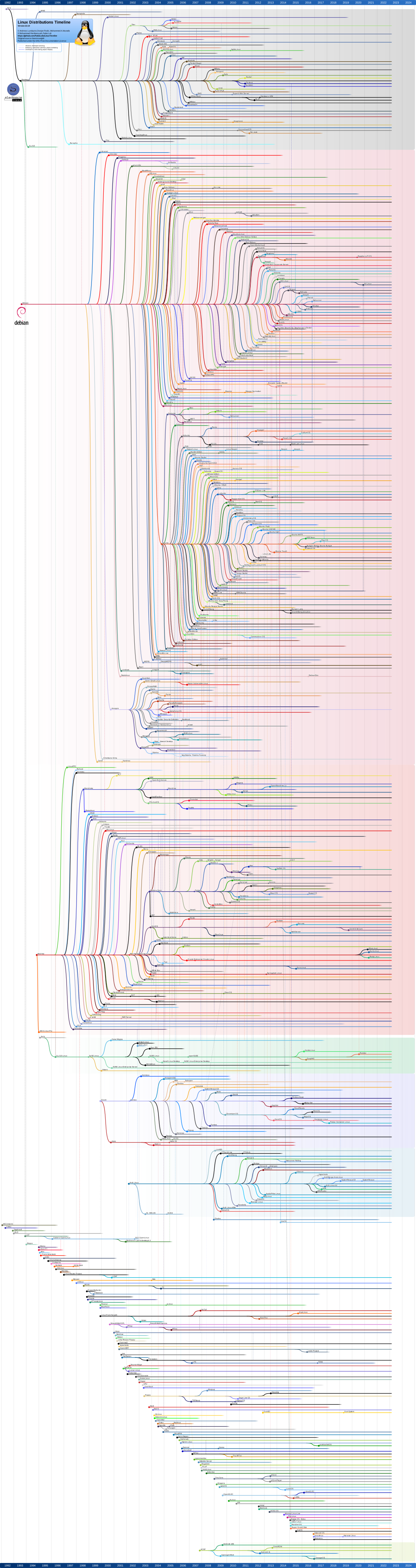
Finally, the user needs to choose a distribution to start with. The choice is literally overwhelming. Have a look at this timeline: Distribution Timeline. Now imagine it exploding even further into systemd using/rejecting versions. That much amount of choice is paralyzing.
In the end, fragmentation just wastes resources on doing the same things more than once. It is necessary if the constrain is quite severe, but right now in the community forks happen over something as trivial as library versions or the visual look!
-
Re: Browser wars are back
Jesus Fucking Christ, did you even look at your stats? Did you look at when they're from?
Data from September 2012
Yes, that's right, you just tried to use 2 year old data to back up your point. Nice try, but you're wrong, and your data is outdated and irrelevant.
Let's look at some more recent data, okay? How about Wikimedia's stats for July 2014?
Oh, my! Well, it looks like the GP is correct. Chrome has 26.49% of the desktop market, and 15.01% of the smartphone market. That's over 40%, which I consider reasonably close to the GP's estimate of 50%.
And the GP is right when it comes to Firefox. It has 9.78% of the desktop market, and a trifling 0.17% of the mobile market. That does put it right around 10%.
The GP is wrong when it comes to Safari. It's more popular than Firefox, at 4.32% of the desktop market, 5.51% of the tablet market, and 14.61% of the smartphone market. So that's over 20%.
But the GP is right about Opera being totally irrelevant. It's only at about 2% overall.
If we look at stats from today, we can clearly see that Chrome has absolutely crushed Firefox and the other browsers. Firefox is just BARELY holding on these days, and given how angry its users are with Australis and other changes, I could see it being at 5% by the end of the year. Face it, Firefox is a dead product at this point.
-
Re: Browser wars are back
This browser war is already over, and Chrome has won, both on the desktop and on mobile devices. It probably has over 50% of the market at this point. IE is the next biggest player at around 20%. Firefox is a footnote, at around 10% or less. Safari and Opera are less relevant than Firefox. And the remaining browsers are even less relevant than they are.
Sorry to bring you back from your fantasy land to reality, but what I just linked above is a graph of the ratios of distinct user agents connecting to one of the highest traffic sites on the web. (Wikimedia sites, including Wikipedia, just to be clear.)
It clearly shows Chrome in the lead, but not by much of a margin. IE and Firefox are both within 10% of that. Safari is a close 4th with around half of Chrome's user base. Beyond that, then you can call it a lost cause.
Next time you make some dumb-ass assertion to back up your world view, try at least justifying it with some actual numbers from somewhere.
Also, I will never use Chrome because Chrome is a "soviet russia" type of browser. It watches you. And that will be its downfall, eventually.
-
Re:why the focus on gender balance?
Yup. And of course, you are looking at the English Wikipedia, which is the most-developed language version of Wikipedia. Yet Wikipedia claims to be available in over 280 languages, when in many of them, coverage is really, really rudimentary. See e.g. the "Mind the zombies" slide from a recent Wikimania presentation – basically, only 125 language versions of Wikipedia have more than 5 editors. The others are, to all intents and purposes, dead.
Note also that even English Wikipedia contributor numbers (as opposed to reader numbers, which are immense) are really quite small. (Someone else has pointed this out above.) If you look at this table, you'll see that there are only about 3,000 regular editors in the English Wikipedia, i.e. people who make more than 100 edits a month (i.e. about three a day). That number has shrunk considerably over the past few years, from a March 2007 high of 4785. At the same time, of course, the number of articles continues to increase constantly (now at 4.6 million). There are fewer contributors, and more articles to be watched over.
So Wikipedia has many articles that it does not have the (wo)manpower to curate adequately. In the early days, of course, everyone thought that "eventually" all these articles that someone started would become little masterpieces, but it's becoming clear that this will not happen. Little-watched biographies in particular are a problem, as the only people interested in them are usually the subjects and/or people who hate them for some reason, so they turn either into puff-pieces or hatchet jobs, with no one really noticing (there are well over half a million articles that no one has on their watchlist). Yet they are the top search hit when someone Googles the name online. -
The solution is simple...
They should use the OMG Ponies theme!
-
Re:Inevitable
Lend-lease was important, but in the critical 1942-43 period its impact was relatively small from what I've read. Certainly the vast majority of arms used on the eastern front were manufactured by the USSR.The USSR consistently out-produced Germany in all categories.
Your statement that "[The USA] took over the bulk of the military responsibilities of European allies" is WAY off the mark, that was always the USSR. While lend-lease may even have tipped the balance, it didn't add up to making the US contribution the majority effort in Europe. While I know this isn't strictly speaking your point in your response, check out the deaths per front in this http://commons.wikimedia.org/w... - it makes clear the overwhelming importance of the eastern front,
One bloodthirsty dictator beating another (slightly more) bloodthirsty dictator isn't quite as good a story as "America, World Police", but it's closer to the mark.
Overall in WW2 the USA did shoulder a huge responsibility of course, but a good portion of that went to the pacific.
-
Re:On site transmutationGosh, mdsolar, you know just enough to confuse yourself into thinking you know it all. The page you cited talks about exactly what I talked about, an accelerator-driven power reactor that still produces fission product waste and notably doesn't destroy fission product nuclei by splitting them. You don't even have an idea of the energy required to do so. Below Fe56, fission is a net energy loss, even assuming you could somehow get the nucleus to fission (FP cross sections are tiny compared to TRUs). Essentially, you're proposing doing fusion power in reverse, which is crazy! Here's the money quote from your article (emphasis mine):
Essentially, current ATW proposals sacrifice effective transmutation for energy, and require several unproven technologies combined with concepts used in Generation IV breeder reactors like advanced processing and molten coolants. The idea of using accelerator neutrons to manipulate the reactor's neutron economy is a nice one, and indeed energy might plausibly be produced through burning the TRUs, but it is not a complete waste solution (especially in the case of long lived fission products) and requires significant engineering advances in accelerator, spallation, cooling, and reprocessing technology. Even if energy can be produced, there is little evidence that a combined system would be more effective than simply burning the TRUs in an ADS and then using the energy for a separate, dedicated ATW system. Even this scenario would require detailed processing of the wastes to high purities that hasn't been demonstrated.
The problem is, you don't understand what you're reading.
-
Spinning Statistics
I don't like the posting of netmarketshare as gospel especially when they adjust their data, but quoting wikipedia as a measure is simply spinning figures in a "I don't even give a fuck about reality way" A quick look at statcounter shows firefox usage slightly down http://gs.statcounter.com/#bro... and at 18%. Netshare shows firefox slightly down at http://marketshare.hitslink.co... as 15%. Not a million miles from each other, but the trends basically show firefox usage is pretty flat. Even these figures are less of a reflection of how badly firefox is doing, but how well chrome is.
-
Meanwhile, Firefox is dying off.
While Mozilla squanders resources on this shitty mobile OS that nobody actually wants, Firefox, the only product of theirs that sees any sort of use these days, is dying off. They've done nothing but fuck up one release after another, introducing awful changes that existing Firefox users hate. Good God, the whole Chrome imitation UI they released a few releases ago was a huge slap to the face of every Firefox user out there.
Firefox's users are getting tired of being shit upon time and time again by Mozilla. Instead of innovating and creating a better browsing experience, the Firefox devs have just chosen to copy Chrome. Meanwhile, they haven't bothered to fix the persistent memory leaks and unjustifiable CPU usage that Firefox suffers from.
As should be expected, Firefox's users are getting sick and tired of being mistreated by Mozilla, and they're sick and tired of the shitty browsing experience that Firefox has been delivering. They're doing the only sensible thing they can do: moving to a different browser.
Wikimedia's stats are a good measure of how Firefox is dying off. Just look at the decrease in market share:
January 2013: 15.06%
January 2014: 11.53%
July 2014: 9.78%Firefox's usage is likely under 10% now! I think that this is a total disaster. Firefox is the only viable alternative to Chrome for many people. Yet by wasting effort on stupid shit like Firefox OS, and making one stupid decision after another with Firefox, Mozilla is absolutely killing Firefox.
Please, Mozilla, I beg of you, stop this stupidity. Stop wasting resources on stupid software like Firefox OS that will never be able to compete. Please, Mozilla, salvage Firefox before it's too late. Please don't destroy Firefox in this pathetic quest to weakly take on Android and iOS!
-
Meanwhile, Firefox is dying off.
While Mozilla squanders resources on this shitty mobile OS that nobody actually wants, Firefox, the only product of theirs that sees any sort of use these days, is dying off. They've done nothing but fuck up one release after another, introducing awful changes that existing Firefox users hate. Good God, the whole Chrome imitation UI they released a few releases ago was a huge slap to the face of every Firefox user out there.
Firefox's users are getting tired of being shit upon time and time again by Mozilla. Instead of innovating and creating a better browsing experience, the Firefox devs have just chosen to copy Chrome. Meanwhile, they haven't bothered to fix the persistent memory leaks and unjustifiable CPU usage that Firefox suffers from.
As should be expected, Firefox's users are getting sick and tired of being mistreated by Mozilla, and they're sick and tired of the shitty browsing experience that Firefox has been delivering. They're doing the only sensible thing they can do: moving to a different browser.
Wikimedia's stats are a good measure of how Firefox is dying off. Just look at the decrease in market share:
January 2013: 15.06%
January 2014: 11.53%
July 2014: 9.78%Firefox's usage is likely under 10% now! I think that this is a total disaster. Firefox is the only viable alternative to Chrome for many people. Yet by wasting effort on stupid shit like Firefox OS, and making one stupid decision after another with Firefox, Mozilla is absolutely killing Firefox.
Please, Mozilla, I beg of you, stop this stupidity. Stop wasting resources on stupid software like Firefox OS that will never be able to compete. Please, Mozilla, salvage Firefox before it's too late. Please don't destroy Firefox in this pathetic quest to weakly take on Android and iOS!
-
Meanwhile, Firefox is dying off.
While Mozilla squanders resources on this shitty mobile OS that nobody actually wants, Firefox, the only product of theirs that sees any sort of use these days, is dying off. They've done nothing but fuck up one release after another, introducing awful changes that existing Firefox users hate. Good God, the whole Chrome imitation UI they released a few releases ago was a huge slap to the face of every Firefox user out there.
Firefox's users are getting tired of being shit upon time and time again by Mozilla. Instead of innovating and creating a better browsing experience, the Firefox devs have just chosen to copy Chrome. Meanwhile, they haven't bothered to fix the persistent memory leaks and unjustifiable CPU usage that Firefox suffers from.
As should be expected, Firefox's users are getting sick and tired of being mistreated by Mozilla, and they're sick and tired of the shitty browsing experience that Firefox has been delivering. They're doing the only sensible thing they can do: moving to a different browser.
Wikimedia's stats are a good measure of how Firefox is dying off. Just look at the decrease in market share:
January 2013: 15.06%
January 2014: 11.53%
July 2014: 9.78%Firefox's usage is likely under 10% now! I think that this is a total disaster. Firefox is the only viable alternative to Chrome for many people. Yet by wasting effort on stupid shit like Firefox OS, and making one stupid decision after another with Firefox, Mozilla is absolutely killing Firefox.
Please, Mozilla, I beg of you, stop this stupidity. Stop wasting resources on stupid software like Firefox OS that will never be able to compete. Please, Mozilla, salvage Firefox before it's too late. Please don't destroy Firefox in this pathetic quest to weakly take on Android and iOS!
-
Re:if 1 drive full, raid. Dual read write armature
Like this one?
In a nutshell, the smaller production runs make this type of drive more than twice as expensive as two regular drives, with similar performance for independent workloads. (But if you have a particular workload, you may benefit.)
-
Re:Can it scram in 10 seconds?
During the 11th March earthquake in Japan a couple of plants experienced problems with their SCRAM mechanisms.
Yes, that's possible, however the control rod budget is quite oversubscribed, so that even if some of them fail, there should be enough of them to stop the reactor. Should the gravitational system itself fail, it's always possible for the drive mechanism to push them inside after the fact. Lastly, should this fail, modern reactors (such as the AP1000) have on gravitational injection of borated coolant water, which kills the reaction, though takes a little longer and relies on the reactor vessel being intact.
As for the leaks of reactor pipes, it's always a possibility due to their unfortunate high-pressure vessel design. To my knowledge no reactor vessel or piping has ever catastrophically failed (double-ended pipe break), though Fukushima obviously did leak in places. However, I don't think that the inability of operators to monitor was the direct cause of the issues, as right after the earthquake monitoring equipment was still operational. Instead the problem was the fact that the site was 100% dependent on on-site diesel, which was flooded half an hour later when the tsunami arrived - I can't imagine which idiot thought placing the diesels in the basement and air intake louvers so low was a good idea. The hydrogen explosion problem could have been averted had they used proper passive autocatalytic recombiners, but they cheaped out and instead decided to just duct the hydrogen away, which is a boneheaded idea.
In any case, I'm much less a fan of these old plant designs. They're much better than the sitting bomb RBMK designs, but they're certainly very far from perfect (early Gen II - basically designed when these were the most powerful computers available). Don't you think we might have made significant advancements since then in safety? I'm especially interested in the denatured molten salt reactor, which avoids the complexities of salt reprocessing and brings full passive safety with it. -
Re:And how long does it take...
No you weren't,
You don't get to speak for me.
Not a chance. They're all large
Riiiight. The beauty about underground storage tanks is - they don't take up any excess space. As for fire zoning laws - depends on the country (Japan in the pic above, famous for its high-density urban areas). The beauty about a gas station is that you don't need to park there to fill up, so few are needed and their urban impact is pretty negligible. In any case, we're getting completely off topic, as my point wasn't that urban areas would be impacted by charging station size. It was the out-of-urban long-distance stations that would need to be of considerable size. Of course, outside of the city space is usually plentiful, but it's not free to purchase and free to develop. The associated costs of construction (e.g. pulling high-power lines, landscaping, paving, etc.) could be significantly higher - and that was my whole point.
You only need to install a few. Those who need a charge will park there.
And how do you imagine you'll enforce that? Or rapid turn-around, when the person leaves that spot as soon as possible after finishing charging. There's necessarily going to be some part encroachment by non-users.
It's BS to jump from the today to 100% EVs. The future gets built-out slowly
How slow is slow? 30 years? Urban infrastructure, especially roads and parking spaces, easily persists for half a century or more. Growth of cities at this point is pretty much only performed by people outside moving to them, not new births - in fact, in the west, overall population growth has been slowing down considerably in the last decade. So I'd wager that conversion, if it occurs, will not be due to construction of new infrastructure, it will be due to retrofitting old infrastructure. Now I'm not saying it can't be done - of course it can - my point is that we might get better bang for our buck if we reuse what existing infrastructure we have and change only the source of its input, rather than rebuilding the whole thing.
And for this future of yours, that's decades from now, for some reason you're using the high, early-adopter prices of these charging stations, today. Even you can't pretend that's fair.
The learning curve of charging systems is mostly non-existent. The components aren't high-tech and are already factory built. Once you're down to materials, bulk manufacturing and shipping & labor, costs are essentially flat. You perhaps didn't even notice that I already underestimated the cost of the Supercharger units (I assumed them at ~3x cheaper than Musk quoted).
-
Re:This will be a thoughtful, productive discussio
I apologize, I was answering the hypothetical answer to the GPs question... You know, the one you didn't actually answer.
You didn't answer the question. You simply made an erroneous assertion.
Ya me too, I much prefer a climate that we're not evolved to survive in.
Well, I do prefer a climate that we're evolved in to survive. Which is why it would actually not be such a bad thing if the current ice age came to an end. We are currently in an ice age with rapid temperature fluctuations. That is not what mammals or primates evolved in. It's probably one of the most challenging climates in the history of the planet, short of snowball earth. I refer you to the cold temperatures and rapid temperature fluctuations that started about 7 million years ago and have been getting more and more extreme:
http://upload.wikimedia.org/wi...
Conveniently, there are temperature predictions from the worst case IPCC predictions (RPC8.5) in that graph, which show you that those would merely take us back to the climate of 7 million years ago, just about pre-ice-age.
We should be so lucky. In reality, RPC8.5 is not a reasonable prediction, and humans will stop burning fossil fuels due to market forces long before that. Unfortunately, we will probably not be able to end the current ice age.
Humanity sure flourished through the Dryas events, didn't they?
Well, no, it probably was not so pleasant for humanity. Since the Dryas events were periods when a period of rapid global warming was interrupted and a previous cold climate was restored, I'm not sure in what way you think that that's an argument for keeping the climate cold. Colder temperatures are generally not a good thing.
Humanity clearly did flourish during the period of rapid global warming and sea level rise that started 20000 years ago and ended about 2000 years ago.
-
Re:bureaucracy in action
The title of the petition is: Petitioning Lila Tretikov. Remove new "superprotect" status; and permit Wikipedia communities to enact (current) software decisions uninhibited.
Alternatively, people who have a Wikipedia or Wikimedia account can sign here on Meta. (Only sign in one of these places.) -
WikiWand
What's become clear here (see also following section) is that the Wikimedia Foundation is afraid it will lose readers to sites like WikiWand that offer Wikipedia content as a pure consumable with a much more aesthetically pleasing interface. The moment Wikipedia page views go down, the Alexa rank will go down and donations will go down, as fewer people will see the fundraising banners. The problem is that the Foundation's own efforts to create a more pleasing interface have been unsuccessful; they have the money, but simply seem to lack the talent and experience. Partly they are also hampered by the underlying coding chaos of Wikipedia – underneath the Wikipedia text, there are thousands of ad-hoc templates created in a very inconsistent manner by volunteers over the years. This is the main reason the VisualEditor failed.
This story was also covered by The Register.





.jpg)



.jpg)













.jpg)


